




Abstract
BACKGROUND:
Traditional warm-up exercises generally consist of submaximal aerobic running. Thereafter static or dynamic stretching exercises appropriate to the field are advised to keep the strength, which is the main component of physical fitness, stabilized.
OBJECTIVE:
To examine and compare the acute effects of static stretching (SS) and dynamic stretching (DS) on the knee and ankle flexor and extensor concentric (CON) isokinetic strength in well-trained male taekwondo athletes.
METHODS:
A total of 14 male taekwondo athletes who train at least 4 days a week, 90 min. a day, were tested for knee and ankle flexor and extensor isokinetic peak moment (PM) at 60 and 180
RESULTS:
None of the exercises: NS, SS and/or DS had any effect on the concentric strength of the knee and ankle flexor and extensor muscles.
CONCLUSIONS:
These findings suggest that in well-trained taekwondo athletes who are accustomed to static or dynamic movement actions may be less suscePMible to stretching-induced strength deficit. Whether this conclusion may be extended to other sporting events requires further research.
Keywords
Introduction
The main component in a traditional warm-up is submaximal aerobic running, which is used to increase the body temperature approximately 1–2
However, recent studies reported that pre-exercise SS decreased the maximal isometric force production, jump height, sprint performance, balance, agility, and movement time compared to dynamic stretching (DS) [2, 3, 4]. Negative effects of SS are attributed to mechanical factors (e.g., alterations in muscle tendon unit stiffness) and neural alterations such as changes in reflex sensitivity and decreased motor unit activation as evidenced by reductions in EMG output [2, 5].
Because of the negative performance effects of SS prior to muscular strength and power tasks, several researchers have suggested the use of DS exercise [2, 6, 8]. Yamaguchi et al. [8] reported that the improvement in muscle performance following DS might be associated with two factors: an increase in muscle temperature and the occurrence of post-activation potentiation (PAP). PAP involves the phosphorylation of myosin regulatory light chains, which improve actin–myosin interaction. This interaction is caused by the voluntary contraction of the muscle antagonist to target the stretched muscle [9].
The explosive strength at the beginning and during the motion is extremely important in Taekwondo. Strength may decrease the decision-making duration of the opponent as the speed increases, and it may also increase the possibility of making mistakes [10]. For this reason, some researchers pointed out to a stretching protocol that will not cause decreases in the strength performance. Strength and condition trainers have adopted dynamic and active stretching protocols to prepare the athletes for competitions [11, 12]. Kim et al. [13] argued that the measurement of extensor and flexor strength in taekwondo athletes is an important indicator in monitoring training effects.
Contradictory results regarding the effects of SS and DS on isokinetic strength were also reported. Some researchers argued that SS has detrimental effects on isokinetic strength [14, 15, 16, 17], whereas others reported no strength isokinetic deficits after SS [18, 19, 20].
Therefore, the current study primarily aimed to examine and compare the acute effects of SS and DS on the knee and ankle flexor and extensor concentric (CON) isokinetic PM at 60 and 180
Methods
Participants
A total of 14 male licensed taekwondo athletes (mean age, 21.28
Experimental protocol
Participants began with a 5-min standardized warm-up (cycling at 90 W at 60–70 rpm) before NS, SS and DS sessions.
Non-stretching (NS) session
Participants had no stretching exercises.
SS session
This session consisted of forward fold (1), standing quadriceps stretch (2), seated calf stretch with band (3), and tibialis anterior stretch (4) for 3
DS exercises
This session consisted of high knee skips (1), butt kick (2), ankle circles (3), and ankle bouncing (4) exercises. The participants were instructed to execute the exercises in a repetitive manner and as fast as they could. In this session, exercises were executed at each joint for 3
Isokinetic tests
These were performed concentrically before and after each stretching session, using a Cybex-Humac Norm-brand dynamometer. The tests were conducted according to [21] that included a total of 6 days between 13:30 and 16:00 PM with at least 48-h resting intervals. The first 3 days were planned for the knee joint flexion–extension and the last 3 days for ankle plantar-dorsi flexion.
Flowchart of the study.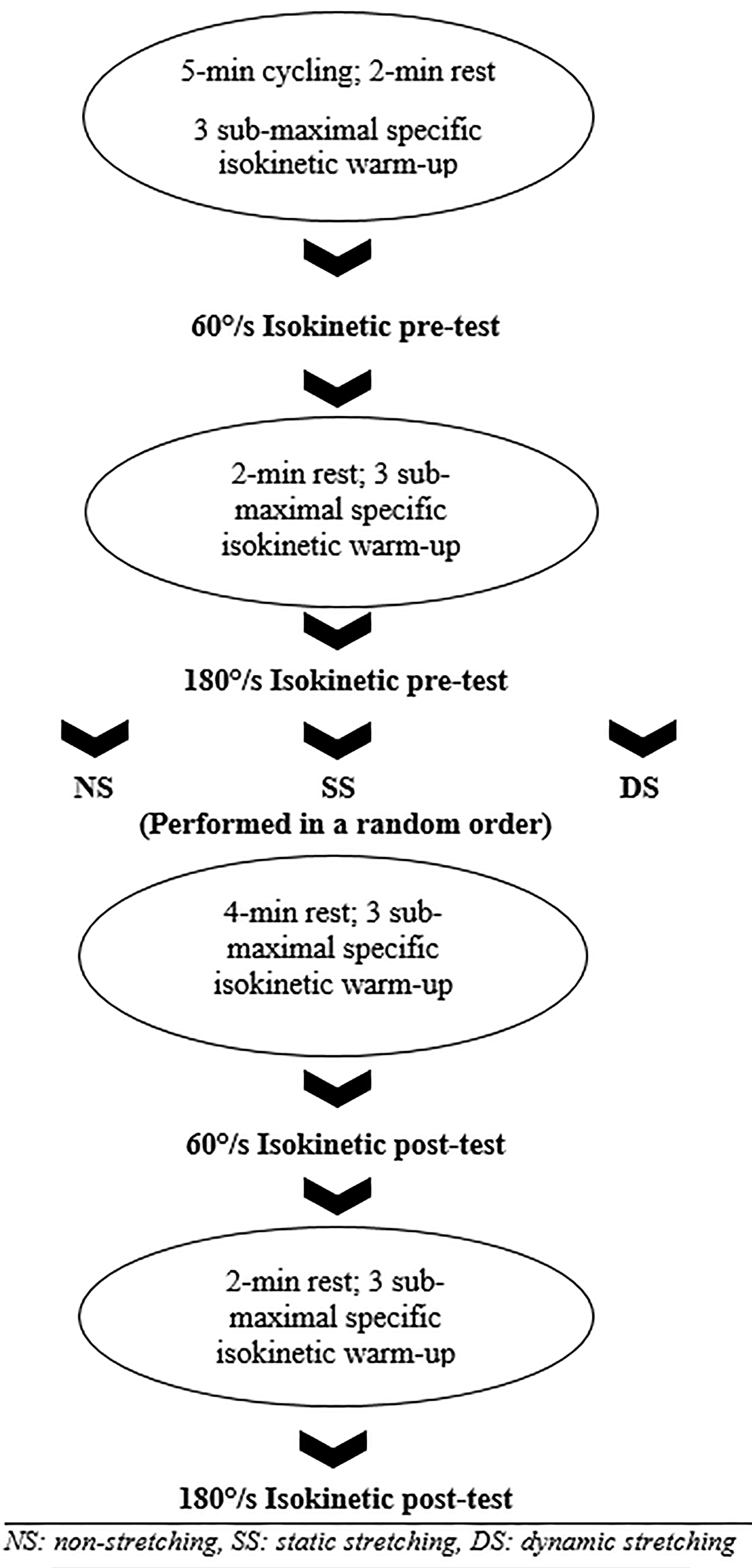
The order of NS, SS, and DS sessions was randomized for each participant in a crossover study design. The tests were applied in dominant leg at 60 and 180
The statistical analysis was initially performed using the “Shapiro-Wilk” normality test, and all variables presented with normal distribution. Therefore, statistical differences between the pre- and post-test at each session were evaluated using the “Paired t-test.” Statistical differences among post-tests after three stretching exercises were evaluated using “Repeated Measures ANOVA” according to the 95% reliability. So findings are presented as descriptive analyses, ANOVA results and an alpha level of
Results
No significant differences (
Strength (in Nm) pre and post the stretching exercises: at 60
/s
Strength (in Nm) pre and post the stretching exercises: at 60
NS: non-stretching, SS: static stretching, DS: dynamic stretching, MPoC: Mean Percentage of Change.
The main findings point out no stretching-induced strength deficit by SS exercises while the DS exercises do not cause a higher strength increase compared to their SS counterparts on the knee and ankle flexors and extensors of well-trained taekwondo athletes. In this respect the results of this study should be examined in the light of Kapo et al.’s findings [22] who have reported superior strength effect of DS compared with proprioceptive neuromuscular facilitation in 50 male athletes from different sports disciplines, such as karate, taekwondo, box, football, and athletic sprint.
In contrast with our study, Sekir et al. [23] reported that SS significantly decreased quadriceps and hamstring muscle strength in eccentric (ECC) and CON modes at same velocities in well-trained track and field athletes. On the other hand, similar to the results of our study, Egan et al. [20] found that SS did not adversely affect the CON strength over a velocity spectrum during any of the post-stretching intervals in National Collegiate Athletic Association Division I women’s basketball players.
Strength (in Nm) pre and post the stretching exercises: at 180
/s
Strength (in Nm) pre and post the stretching exercises: at 180
NS: non-stretching, SS: static stretching, DS: dynamic stretching, MPoC: Mean Percentage of Change.
Regarding recreational athletes, researchers reported that SS exercises have generally no stretching-induced PM deficits in the knee muscles [5, 15, 18, 19]. Ayala et al. [18] reported that short pre-exercise SS and DS of the lower limb stretching routine did not elicit stretching-induced deficit or improvements on the knee flexor and knee extensor isokinetic CON and ECC strength and power at different velocities (60
As mentioned, two factors have been proposed to explain the stretching-induced strength deficit [20]: (a) mechanical factors associated with decreased musculotendinous stiffness that may alter the length-tension relationship and (b) neural factors caused by decreased muscle activation.
We found that the majority of the studies involved the effects of different stretching exercises on the isokinetic strength of knee muscles. In this regard, the results of the current study also suggest that differences in isokinetic ankle flexion and extension PM after NS, SS, and DS are not significant. According to Kim et al. [24] competitive taekwondo athletes use kicking more often than punching during the competition. Additionally, the World Taekwondo Federation competition rules indicates that to score a point, the kick must be powerful [24]. Thus kick flexion and extension strength are very important for achieving successful results in taekwondo [24, 25].
In conjunction with previous studies, disparate findings on the effects of SS and DS on isokinetic strength exist. Their causes remain unknown [26]; however, they could be related to the duration and intensity of SS exercise, subjects’ training or competition experience level [20, 27], and isokinetic test speeds [28]. According to Ayala et al. [18] the overall SS duration per isolate muscle group of
Based on previous studies [20, 23, 29] well-trained athletes who are accustomed to static or dynamic movement actions as in taekwondo may be less susceptible to the stretching-induced strength deficit. These results should only be considered in male taekwondo athletes who can perform SS and DS prior to training and competition without subsequent strength deficits.
The limitations of this study are as follows: (a) we did not evaluate the effects of SS and DS via EMG. Therefore, obtained results were interpreted based on the findings from previous studies. (b) In performing isokinetic tests, we observed low warm-ups and familiarizations of tests and a long time of rest between stretching sessions and post-test (c) a small sample size. Thus, larger studies are needed.
Conclusion
In sports events in which slight positive increases and differences in force and performance affect the result of the competition, it is recommended that the stretching protocols applied in warm-up are performed in accordance with the requirements of relevant sports event. All considered we recommend that future studies are conducted by considering the mechanical and neuromuscular factors that include proper set numbers and stretching durations to achieve positive increases in strength in Taekwondo athletes. However, whether this conclusion may be extended to other sporting events requires further research.
Footnotes
Acknowledgments
We would like to thank Prof. Dr. Cem Çeti̇n and Dr. Yurdagül Baygül (Süleyman Demirel University, Department of Sports Medicine) for their contribution during the isokinetic tests.
Conflict of interest
The authors declare no conflicts of interest.