Basketball is an intermittent sport were both neuromuscular and aerobic fitness are essential for the players. Thereby, repeated sprint training seems to be a feasible training strategy to improve these physical attributes.
OBJECTIVE:
The aim of the present study is to verify the effect of repeated sprint training on the anaerobic and aerobic performance in basketball players.
METHODS:
Seventeen college players were randomized into two groups, repeated sprint training ( 9) and control group ( 8). The repeated sprint training group performed 2–3 sets of 6 30 m all-out sprints, twice per week, in addition to the regular training routine. The control group performed only regular training routine during six weeks on the pre-season. The dependent variables were aerobic fitness, vertical countermovement jump, repeated vertical jump ability, and repeated sprints ability.
RESULTS:
Repeated sprint training improve the best sprint time ( 0.033), worst sprint time ( 0.035), sprint decrement ( 0.04), CMJ ( 0.037), and peak speed in the incremental test ( 0.008).
CONCLUSION:
Repeated sprint training is effective in conditioning neuromuscular quality-related abilities of short sprint speed, jump, and aerobic fitness in college basketball players during the last phase of the pre-season.
Basketball is a team sport with intermittent characteristics that elite players perform several high-intensity actions (i.e., sprints and jumps), alternating with low-intensity movements (i.e., walking and jogging) [1]. It might be defined as a sport with a great anaerobic and aerobic component [2]. Moreover, during intense periods of the games, time-motion studies have found that 28.5–46.1% of the actions are sprints, and players often repeated these high-intensity actions every 21–39 s [3, 4]. Thereby, maintaining the maximum performance after several sprints is fundamental. Accordingly, the ability to preserve the best performance over a sequence of sprints, defined as Repeated Sprint Ability (RSA) is characterized by short high-intensity sprints ( 10-s) with short recovery periods ( 60-s) [5]. The RSA is commonly used as a specific test of athletic performance in sports that involve running as the main form of movement [6].
Traditionally, in the pre-season, the main physical components required in sports are emphasized during training, including their physiological determinants [7, 8]. The energy system contribution to RSA is altered according to the number of bouts and recovery periods, that is, a gradual increase in aerobic fitness occurs as more sprints are added in the training [9, 10]. Thus, high aerobic fitness is described as a recovery optimization during high-intensity intermittent exercise, a common trait in high-performance basketball players [2]. Furthermore, the relevance of aerobic fitness in basketball players is observed in studies that show the relationship between aerobic power and RSA [11], game time spent at high-intensity performance during the matches [3], and in high-performance athletes [12]. Thus, strategies that aim to improve the RSA physiological determinants are needed.
Interestingly, previous studies have demonstrated that Repeated Sprint Training (RST), was effective for improving aerobic fitness in young basketball players without negative effects on lower limbs explosive strength [13, 14]. RST is a high-intensity aerobic interval training method that aims at the improvement of neuromuscular (i.e. sprints and jumps) and metabolic function in the short-term period (2–6 weeks) [15, 16]. In fact, it is well established that both movements require a greater neuromuscular demand (i.e. motor unit synchronization, recruitment of high-order motor units, stretch-shortening cycle efficiency, and musculotendinous stiffness) to develop maximal power [17]. Accordingly, previous studies have reported a relationship between vertical jump height and the maximum speed achieved at a 30-m distance, indicating that the relationship is attributed to the similar demands of stretch-shortening cycle required in both movements [18, 19]. Thus, RST might be an interesting strategy to include in training during the pre-season to improve muscle power performance in basketball players.
A meta-analysis conducted by Taylor et al. [16] demonstrated that RST enhanced RSA, high-intensity running, and countermovement jump (CMJ) performances. Although this meta-analysis [6] provided interesting data regarding the improvement of several fitness components related to sports performance following RST, some limitation could be pointed out in this study, which in turn, reinforce the need of futures investigations on this topic. First, only 13 studies were included in the final analysis while the authors found a low to moderate heterogeneity of the studies mostly because of the small sample size, which may have affected both the magnitude and the uncertainty of these effects [20]. Second, both controlled and non-controlled trials were included in the analysis. For instance, only two controlled trials investigated the effect of repeated-sprint training on vertical jump performance and only three on sprint performance. Considering that during the pre-season several fitness components are targeted to be improved, studies that add non-controlled trials design make it difficult to isolate the effects of RST. Thereby, any improvement in fitness components should be considered with caution because it is still unknown if those changes occur as a result of technical-tactical training routine. Some studies have demonstrated improvements in skills and physical performance following game-based training (i.e. technical-tactical training routine) [21, 22, 23]. Thus, to fully quantify and understand the effects of repeated-sprint training on the athletic group, a controlled randomized trial design is necessary. Additionally, due to the high frequency of jumps during games and training sessions in basketball [3, 4], improvements in a single effort jump performance may not reflect the real game demand in sports with intermittent nature. For instance, during a basketball game, an athlete might perform 44 jump actions [3].
Thus, it is important to identify strategies to improve the ability to maintain jump power throughout matches, which is crucial for high performance. However, data regarding the short-term effect of RST on repeated vertical jump ability (RVJA) in basketball players are still unavailable. Thus, the aim of this study was to analyze the effect of 4 weeks of RST on the anaerobic and aerobic fitness of basketball players during pre-season. Our hypothesis was that RST strategy might improve the RSA, vertical jump, and aerobic fitness in comparison to the traditional basketball technique training.
Methods
Participants
The sample size was estimated using a priori power analysis that was conducted using the program G*Power version 3.0.10 (Heinrich-Heine-University at Dusseldorf, Germany). The repeated measures ANOVA with an 0.05, 0.80, and partial for best RSA from a previous study [24] gave a statistical power of 97.07% and an estimated sample size of 18 subjects. Twenty male college basketball players (age: 21.2 2.3 years, range 18–24; weight: 81.1 12.6 kg; height: 180 5.8; %body fat: 23.1 5.9; fat-free mass: 62.1 7.1), who compete at the regional and national college level were recruited to participate in the study. No differences were observed in baseline between groups. The inclusion criteria considered in the study were: a) being active in competitive basketball for 3 years, b) not presenting any injury that could make the experimental protocol unfeasible, c) not using ergogenic substances that could influence data collection, and d) attending 85% of training sessions. At the end of the experimental protocol, three players were excluded (attendance 85% in the training sessions), resulting in 17 players analyzed. The study was approved by the Ethics and Research Committee local (CAAE: 58886816.2.0000.5537) following the ethical principles contained in the Declaration of Helsinki (2008). All participants who voluntarily participated in the research signed in a Free and Informed Consent Term.
Measures
Body composition
Body mass and height were measured at baseline using an electronic scale (Welmy, São Paulo, Brazil), with an accuracy of 50 g, and a coupled stadiometer, with an accuracy of 0.1 cm. Body composition, %body fat, and fat-free mass were determined using dual-energy radiological absorptiometry (DEXA) (Lunar/G.E PRODIGY – LNR41.990, USA), following the standards adopted by Naimo et al. [25].
Incremental treadmill protocol
Participants performed a maximal incremental test on a treadmill (Centurion 200, Micromed, Brasilia, Brazil) to assess maximal velocity (V) and VO. The protocol consisted of maintaining a speed of 8 km.h during the first 3-min, increasing 1 km.h every 1-min until voluntary exhaustion in agreement with the protocol described by Alvarez et al. [26]. All players received strong verbal encouragement during the test. Heart rate (RS800cx, Polar Electro, Oy, Kempele, Finland) and respiratory gas exchange (Metalyzer 3B, Cortex Biophysik GmbH, Leipzig, Germany) were continuously measured during the test. The ventilatory analyses were averaged in 20-s epochs. To be considered maximum the test had to achieve at least two of the following criteria: (a) respiratory exchange ratio 1.1; (b) peak heart rate 90% predicted by age (HR 220 age), and (c) RPE 19 reported by the Borg scale [27]. Before each test, the flow, volume, and gases of the metabolic chart were calibrated according to the manufacturer’s recommendations. The temperature in the laboratory was 23 during the incremental test. Before the test, participants were instructed not to engage in vigorous physical activity on the last day before the test, not to eat heavy meals, and not to drink caffeinated beverages in the three hours preceding the test.
The RSA test consisted of six repetitions of 30-m all-out sprints with 20-s recovery between each sprint [28]. Each sprint was registered through a photocell system (Speed Test 6.0 CEFISE, São Paulo, Brazil) positioned at every 10-m of the total 30-m on a basketball court. Immediately after a warm-up ( 5-min) consisted of running at RPE 12–14 (somewhat hard), short burst sprints, and lower-body stretching, the players performed a 30-m maximum speed test. This test was used as an approval criterion for the RSA protocol. For avoiding pacing strategy, players were requested to perform in the maximum effort during each sprint and the first sprint score achieve at least 90% of the maximal 30-m speed. Regarding performance, the following indices were identified: RSA the best performance among all sprints; RSA the worst performance among all sprints; RSA total time of all sprints; RSA mean sprint time; and RSA sprint decrement performance. The last one was identified by the following equation:
The RVJA test was analyzed through a jump platform connected to the Jump System 1.0 software (CEFISE, São Paulo, Brazil). The players performed the countermovement jump test (CMJ) before the repeated vertical jump protocol; also, two CMJs were performed with a passive recovery of 1-min between each jump, and the best performance was recorded. All players were requested to perform the maximum effort during RVJA and at least 90% of their individual CMJ for the first jump score. The RVJA consisted of four sets of continuous 15-s jumps with 20-s recovery between each set, the recovery period was adapted from 10-s [29] to 20-s in our study. In both jump tests, players started from an upright standing position with hands on the hips. The participants were instructed to quickly bend the knees (knee angle of 90) and then immediately jump as high as possible. During the jump, the legs were kept extended, to avoid knee flexion during the flight phase and the participants were asked to land at the initial point [30]. The following indexes were identified: RVJA the best 15-s average jump; RVJA 60-s average jump; and RVJA jump decrement performance. High levels of reliability have been reported for those indicators [31].
Effect of six weeks training on physical performance (mean SD)
Variables
RSTG
Control group
Qualitative change
Pre
Post
Pre
Post
ES (90% CI)
ES magnitude
% chance to be
beneficial/trivial
/harmful
RSA (s)
4.56 0.24
4.36 0.14*#
4.64 0.24
4.61 0.24
0.74 (1.28 to 0.20)
Moderate
95/05/0
RSA (s)
5.08 0.47
4.77 0.26*#
5.09 0.29
5.10 0.24
0.85 (1.44 to 0.26)
Moderate
96/03/0
RSA (s)
4.83 0.38
4.67 0.21
4.84 0.26
4.87 0.22
0.57 (1.10 to 0.04)
Small
88/11/01
RSA (s)
29.00 2.30
28.07 1.28
29.08 1.56
29.27 1.34
0.58 (1.11 to 0.05)
Small
88/10/01
RSA (%)
6.40 3.47
2.99 1.70*#
4.13 1.84
4.35 1.51
1.22 (1.84 to 0.59)
Large
99/01/0
CMJ (cm)
34.47 4.75
37.94 3.32*#
34.96 6.38
35.29 4.96
0.71 (0.26 to 1.16)
Moderate
97/03/0
RVJA (cm)
32.13 5.28
34.02 2.95
31.83 4.73
32.17 5.04
0.55 (0.02 to 1.11)
Small
86/13/02
RVJA (cm)
29.91 5.52
32.47 3.30
30.49 4.91
30.07 3.54
0.89 (0.39 to 1.39)
Moderate
99/01/0
RVJA (%)
7.01 6.34
5.80 4.65
5.64 2.38
6.03 4.57
0.42 (1.17 to 0.34)
Unclear
66/22/12
VO (ml/min/kg)
49.24 5.50
50.25 4.62
48.38 4.34
46.43 2.62
0.61 (0.08 to 1.14)
Moderate
90/09/01
V (km/h)
15.55 2.18
17.44 2.12*#
15.87 1.12
16.5 1.60
0.73 (0.31 to 1.16)
Moderate
98/02/0
ES Cohen’ standardized differences; RSA best sprint time; RSA worst sprint time; RSA average sprint time; RSA total sprint time; RSA decrease repeated sprint ability; CMJ countermovement jump; RVJA repeated vertical jump first 15”; RVJA repeated vertical jump 60”; RVJA decrease repeated vertical jump; VO peak oxygen uptake; V final speed achieved in incremental treadmill test. *time effect ( 0.05); # interaction effect ( 0.05).
Design and procedures
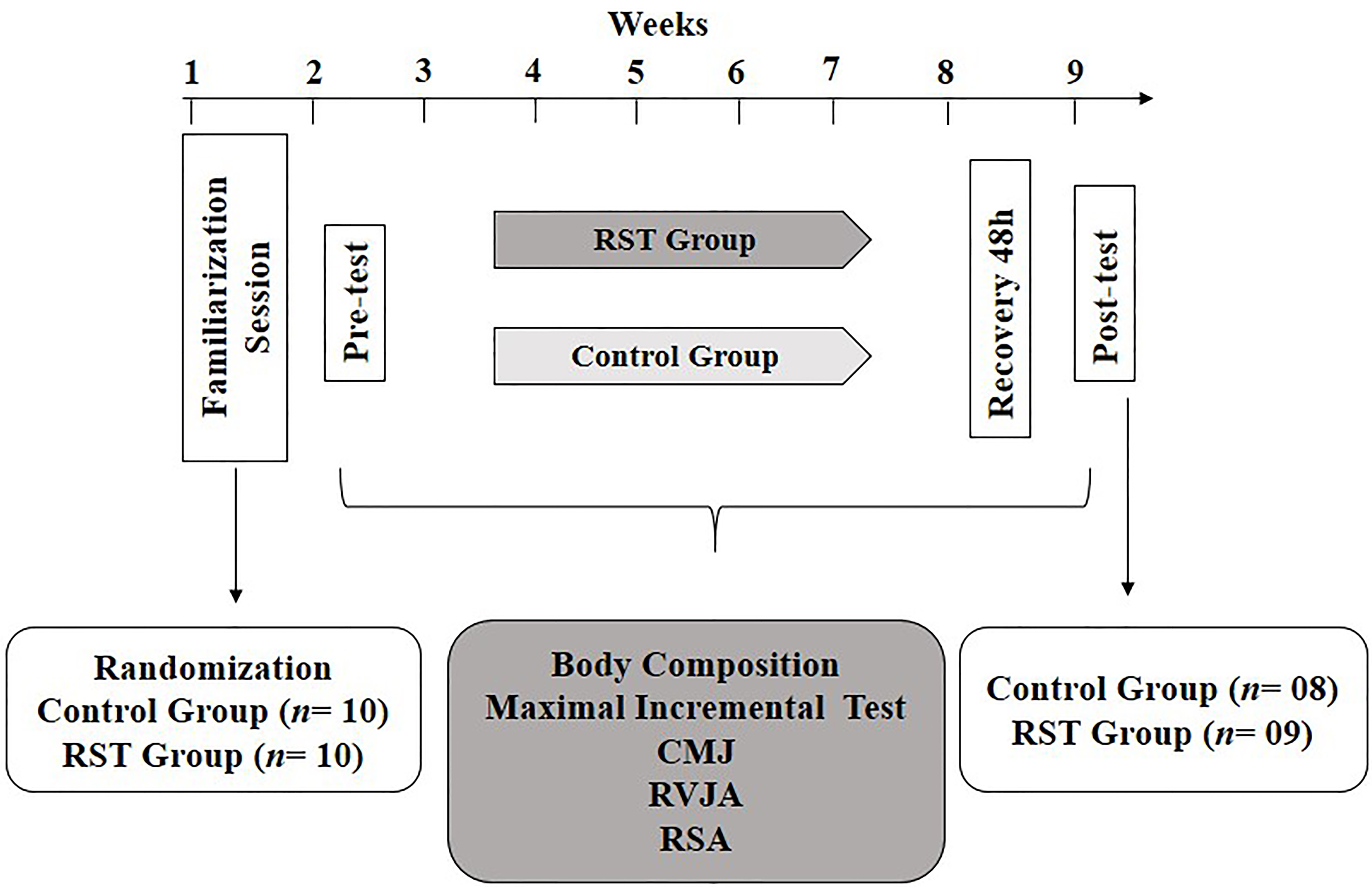
This is an experimental study with randomized block design (1 1) for interventions and assessments. Randomization was made using a calculator (available at: http://www.graphpad.com/quickcalcs/randomize1. cfm) by an independent researcher who abstained from direct contact with participants and assessments. College male basketball players were allocated either in the RST group (RSTG; 9) or in the control group (CG; 8) that performed traditional basketball technique training sessions (mainly technical-tactical basketball exercises). Both groups performed equal training volume (i.e., 2 hours per day, 3 days per week). In order to equalize the total volume of training for each session, in the first part of training, the RSTG performed the repeated sprint training while CG performed physical and technical exercises. Following, both groups performed the same training routine (physical and technical exercises). This study was conducted during the last phase of the basketball pre-season period and lasted nine weeks (see Fig. 1). In the first week, all the participants were familiarized with the tests (i.e., RSA, CMJ, and RVJA). In the second week, three evaluation sessions with intervals of 48–72 h were performed: pre-test evaluations including body composition, maximal incremental test, countermovement jump (CMJ), RVJA, and RSA. The CMJ, RVJA, and RSA were performed on the same day with a 20-min recovery between jump and sprint tests. For isolating training session effects, RSTG avoided specific neuromuscular training (i.e., strength training and plyometric training).
Training sessions
The training sessions started one week after pre-testing and consisted of 3–4 sessions per week, over a period of six consecutive weeks, in which two non-consecutive days were designated to the RST (on Mondays and Wednesdays). The sessions started with a 10-min warm-up that involved specific basketball actions (i.e., dribbling and shooting exercises) followed by RST or physical-technical exercises (i.e., running, field-goal shooting, offensive/defensive, and opposition exercises) depending on the group the participant is allocated (RST for the RSTG and physical-technical exercises for CG). The remaining time was dedicated to specific and generic exercises according to player positions (i.e., guard, forward and center). The routine of training sessions (18 sessions) was composed of technical, tactical, and simulated games. The technical training included field-goal shooting, passing, dribbling, and rebound exercises. The tactical training included zone, individual, and pressure marking, counterattack movements, half-court, and offensive actions exercises. Specifically, both groups were matched by the total training time ( 6 hours per week), including similar warm-up, technical, tactical, and basic skill drills. RSTG in the first week consisted of two sets of 6 30-m sprints all-out in a straight line, from the second to the fifth week, three sets of 6 30-m; and in the sixth week, two sets of 6 30-m. According to rest intervals, it consisted of 20-s passive recovery between sprints and 3-min of active recovery (defined as rating of perceived exertion equal to 9–10 “easy” on the 6–20 Borg scale) [27].
Statistical analyses
A priori power analysis was conducted using the program G*Power. The normality of the data distribution was verified by the Shapiro-Wilk test. Data were reported as mean and standard deviation. A mixed ANOVA for repeated measures was used to determine differences in time between groups. The independent variables included an inter-subject factor (control experimental) and an intra-subject factor (pre and post-intervention). The assumption data sphericity was verified by the Mauchly’s test, and the Greenhouse-Geisser correction was adopted when this assumption was violated. The standardized difference or the effect size (ES) of changes in each fitness parameter between the RSTG and the control group was calculated using the pooled pre-training standard deviation [32]. Threshold values for Cohen ES statistics were 0.2 (small), 0.5 (moderate), and 0.8 (large). In addition to the null hypothesis testing, the magnitude-based inference was used to examine the meaning of differences in the training response between pre-to post-intervention for each training condition. The smallest meaningful effect was used to determine whether the observed changes were considered harmful, trivial, or beneficial. The smallest worthwhile change was calculated as 0.2 of the pooled between-group SD before training [33]. A 90% confidence interval was applied to the between-group difference using an online spreadsheet [34] to calculate the probabilistic inference of each observed difference being greater than the smallest meaningful effect, applying the thresholds of 1%, almost certainly not; 1%–5%, very unlikely; 5%–25%, unlikely; 25%–75%, possibly; 75%–95%, likely; 95%–99%, very likely; and 99%, almost certain [34]. If the chance of having beneficial/better or detrimental/poorer performances were both 5%, the true difference was assessed as unclear. The level of significance was 0.05 and the analyses were performed using the Statistical Package for Social Sciences software version 20.0 (Chicago, IL, USA).
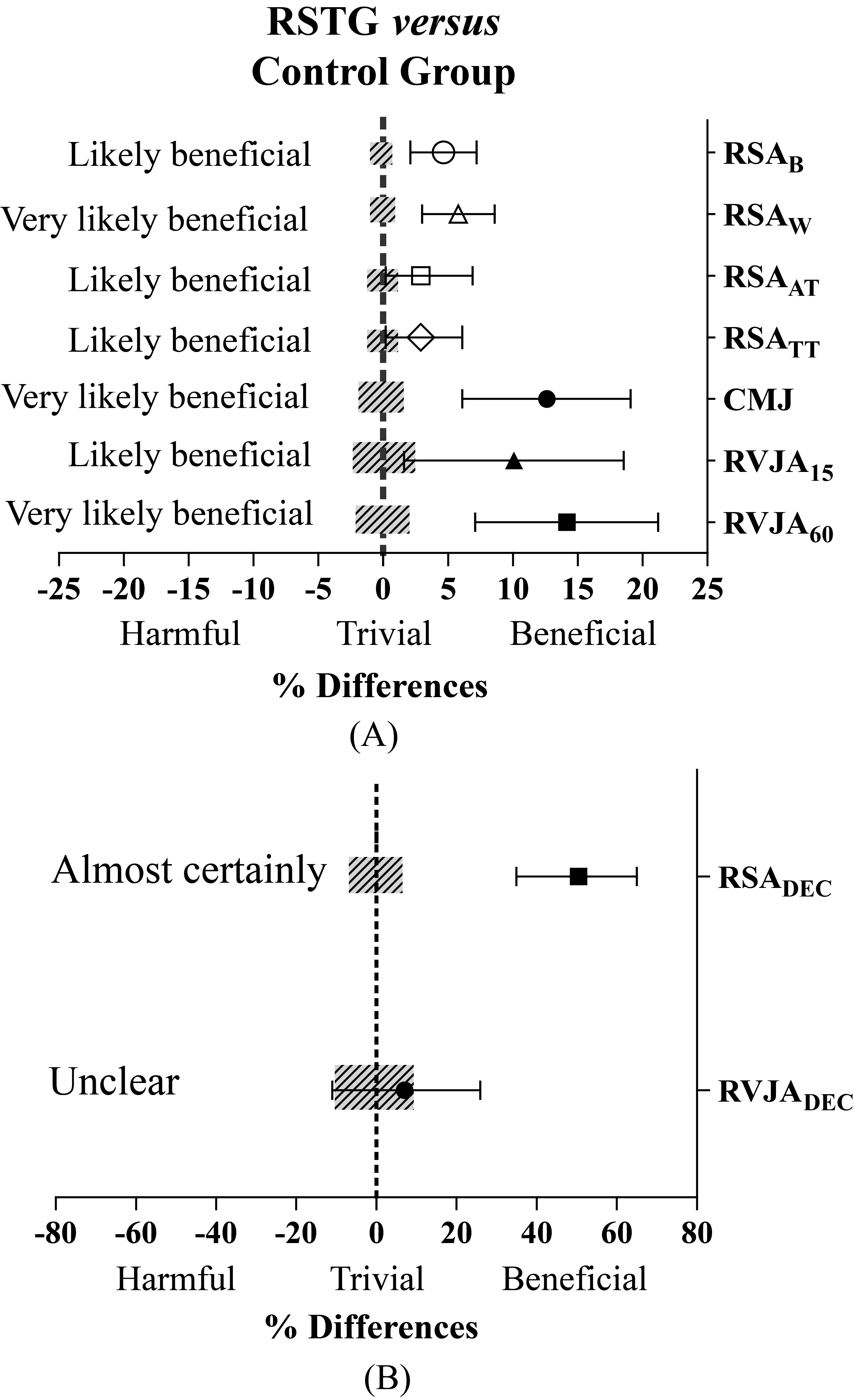
Efficiency of the RSTG compared with control group to improve RSA and RVJA index. (A) RSA best sprint time; RSA worst sprint time; RSA average sprint time; RSA total sprint time; CMJ countermovement jump; RVJA repeated vertical jump first 15”; RVJA repeated vertical jump 60”;(B) RSA decrease repeated sprint ability (%); RVJA decrease repeated vertical jump (%) (bars indicate uncertainty on the true mean changes with 90% confidence intervals). Trivial areas (shaded) were calculated from the smallest worthwhile change (see methods). Note that for clarity, all differences are presented as improvements for each training, so that negative and positive changes are presented in the same direction.
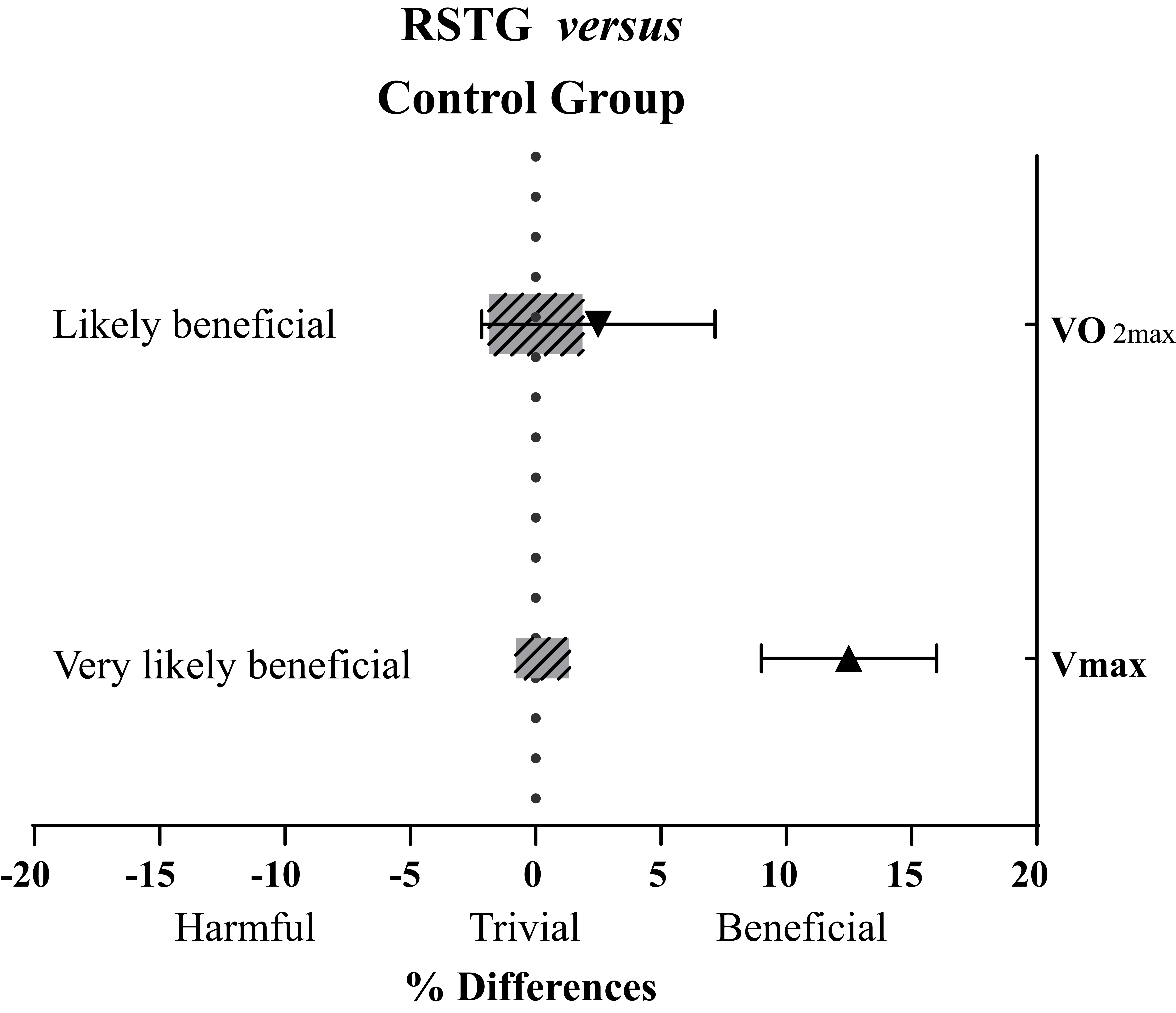
Efficiency of the RSTG compared with control group to improve aerobic fitness. VO peak oxygen uptake; vPeak final speed achieved in an incremental treadmill test (bars indicate uncertainty in the true mean changes with 90% confidence intervals). Trivial areas (shaded) were calculated from the smallest worthwhile change (see methods).
Results
Table 1 reports the relative changes resulting from the intragroup analysis, after the RST sessions, for the RSA and RVJA indices and aerobic fitness.
Repeated sprint ability (RSA)
Interaction (group versus. time) was observed in RSA ( 0.033; partial 0.268), RSA ( 0.035; partial 0.263), and RSA ( 0.04; partial 0.428). For the RSTG, the following time effects were found: RSA (F 11.63; 0.001; partial 0.521; 0.72), RSA (F 15.04; 0.03; partial 0.458; 0.61), and RSA (F 15.76; 0.004; partial 0.663; 0.88). However, interaction was not observed for RSA and RSA.
Countermovement jump (CMJ) and repeated vertical jump ability (RVJA)
Interaction was observed for CMJ performance ( 0.037; partial 0.260), related to the RSTG (F 11.0; 0.02; partial 0.475; 0.60). No interaction effects were observed for RVJA, RVJA and RVJA.
Aerobic fitness
The results did not present interaction for the VO ( 0.064; partial 0.211). On the other hand, there was a significant interaction (group versus time) for the V ( 0.008; partial 0.386), related to the RSTG (F 5.25; 0.001; partial 0.749; 0.62).
Between-group changes
Absolute changes and qualitative outcomes between training conditions (RSTG vs control group) for RSA, RVJA indices, and aerobic fitness are shown in Table 1, Figs 2 and 3, respectively.
Discussion
The present study demonstrated that the RST improved athletic performance compared to the common technique of pre-season training in basketball players. RST was “likely” and “almost certainly” more effective in improving the RSA, RSA, RSA, CMJ, and V. In addition, practical significance analyses suggested that RSA, RSA, VO, RVJA, and RVJA were “likely” to “very likely” beneficial for the RST. These data add to the current body of knowledge and confirm the hypothesis that RST provides stimuli for improving the CMJ height, sprint speed, and the ability of active muscles to preserve speed decrement and maintain short-duration supra-maximal exercise.
The effectiveness of RST is an interesting finding within the team-sport context, specifically because it confirms the improvements in actions frequently required to players during the games (sprints and jumps) [2, 3]. Those improvements are supported by a recent meta-analysis that demonstrated RST is effective on power, speed, RSA, and endurance in diverse athletic groups [16]. RSA and vertical jump are important components of high-intensity performance in team sports, including variables as acceleration/deceleration, player ability to repeatedly produce maximal sprint efforts and explosive strength capacity that are fundamental parameters in competitive basketball games [2]. The results of the present study are in agreement with those previous investigations reporting similar training type designed for young basketball [13], soccer [35], and adult handball [36] players, which had reported improvement on RSA and jumping performance.
Noteworthy, this is the first study to investigate the effect of RST on repeated vertical jump performance. Despite non-significance on RVJA indices, practical analyses suggested that RST provides stimuli from “likely” to “very likely” for improving RVJA and RVJA, respectively. The mechanisms underlying the improvement in RSA, RSA, and CMJ height during RST may be a consequence of increased leg muscle explosive power, improvements in motor unit synchronization, and stretch-shortening cycle efficiency [37]. As previously reported, a strong correlation is reported between CMJ and 30-m sprint time performance in basketball players [18, 19]. This is not a surprise, since both CMJ and sprints movements, especially when the player reaches the maximum speed, present characteristics of the stretch-shortening cycle [38] as well as greater leg muscle explosive power. Another possible explanation for the improved performance on RSA indices after RST may be related to the usual learning effect of training exercise specificity between this exercise and RSA [39].
Basketball players perform 55–105 sprints movements during a game, which can be repeated every 21–39 s [3, 4]. Those time-motion studies reinforce the practical relevance of “almost certainly” beneficial change ( 53%) observed in the sprint performance decrement after RST, which is supported by a similar response in young sub-elite male soccer players after five weeks of RST [35]. In the present study, physiological measurements were not obtained, but previous studies demonstrated effects of RST on sarcoplasmic reticulum Ca release [40], autonomic function [41], and muscle oxygen uptake kinetics [42], which affect repeated sprint performance. Moreover, it should be noted that studies involving elite adult players [23, 24] frequently failed to find positive responses to RST. Therefore, the improvement in sprint performance found in our study may be related to the competitive level of players (college vs elite adult players).
Aerobic fitness parameters are also considered a key component of physical fitness in basketball players [2]. Changes in VO and V were “likely” to “very likely” beneficial following RST, respectively. Both components are considered crucial for basketball players due to the fact that aerobic fitness is related to the player’s capacity to cope with external training load during daily training sessions [43]; also, it was positively related with time spent at high intensity during games in Under-19 basketball players [3]. Thereby, previous studies have found a higher percentage of change (%) in aerobic power following RST with change of direction (180) when compared to the results of the present study [24, 44]. In addition, Buchheit et al. [8] found greater cardiorespiratory demand in repeated sprints with direction change (180) when comparing to sprints without it, which may explain those differences. It should be noted that RST is a time-efficient training strategy for enhancing aerobic power, given to the lower volume session required by RST when compared to other high-intensity aerobic interval training. For example, Bravo et al. [44] demonstrated similar aerobic adaptations between RST ( 10-min) and high-intensity aerobic interval training consisted of 4 sets of 4 min running at 90–95% of HR( 18-min), and greater improvement in RSA, despite the lower volume of RST ( two-fold). In our study, a volume of 2.5-min per session (without active recovery) induced greater improvements in aerobic fitness and neuromuscular components than the control group.
Therefore, the prescription of RST seems to be an interesting strategy for team sports. Our results clearly show improvements in RSA, vertical jump, and aerobic fitness. However, limited scientific research investigated if the training-induced improvements on those physical components might be applied in basketball-specific movements and competitive game performance. Future research should aim to provide data on those aspects, as well as, investigate the effect of other training methods on repeated jump capacity (i.e. repeated sprint with direction change and plyometric training). From a practical perspective, the RST lasting only a few weeks (i.e. six weeks) might be applied as a specific training method for conditioning in basketball performance-related physical fitness attributes before seasons. Physical conditioning coaches are strongly encouraged to include this strategy into the preparation of regular basketball training during pre-season, given that sprints and jump movements are the most high-intensity actions performed by players in games. Moreover, both are involved in discrimination function related to basketball success (i.e. blocks, rebounds, and field-goal shooting). Furthermore, those short-term training-specific adaptations offer to coaches and practitioners the possibility to emphasize on technical-tactical exercises during pre-season. Even with consistent and relevant results, these data are specifically for college basketball players, thus, a generalization of the results should be performed with caution. In regard to elite basketball players, the effects of RST on sprint, jump, and aerobic performance should be explored.
Conclusion
The RST additional to a common technique basketball training is effective for conditioning the neuromuscular quality-related abilities of short sprint speed, jump, and aerobic fitness in college basketball players during the last phase of the pre-season.
Footnotes
Conflict of interest
None to report.
References
1.
PaduloJBragazziNLNikolaidisPTDello IaconoAAtteneGPizzolatoF, et al. Repeated sprint ability in young basketball players: Multi-direction vs. one-change of direction (Part 1). Front Physiol2016; 7: 1-12.
2.
NarazakiKBergKStergiouNChenB. Physiological demands of competitive basketball. Scand J Med Sci Sports2009; 19: 425-432.
3.
AbdelkrimNBFazaaSEAtiJ. Time-motion analysis and physiological data of elite under-19-year-old basketball players during competition. Br J Sports Med2007; 41: 69-75.
4.
McInnesSCarlsonJJonesCMcKennaM. The physiological load imposed on basketball players during competition. J Sports Sci1995; 13: 387-97.
5.
GirardOMendez-VillanuevaABishopD. Repeated-sprint ability part I: Factors contributing to fatigue. Sports Med2011; 41: 673-694.
6.
ZagattoABeckWGobattoC. Validity of the running anaerobic sprint test for assessing anaerobic power and predicting short-distance performances. J Strength Cond Res2009; 23: 1820-7.
7.
BuchheitMLaursenPB. High-intensity interval training, solutions to the programming puzzle: Part II: Anaerobic energy, neuromuscular load and practical applications. Sports Med2013; 43: 927-954.
8.
BuchheitMBishopDHaydarBNakamuraFYAhmaidiS. Physiological responses to shuttle repeated-sprint running. Int J Sports Med2010; 31: 402-409.
9.
McGawleyKBishopDJ. Oxygen uptake during repeated-sprint exercise. J Sci Med Sport2015; 18: 214-218.
10.
MilioniFZagattoAMBarbieriRAAndradeVLDos SantosJWGobattoCA, et al. Energy systems contribution in the running-based anaerobic sprint test. Int J Sports Med2017; 38: 226-232.
11.
BishopDEdgeJGoodmanC. Muscle buffer capacity and aerobic fitness are associated with repeated-sprint ability in women. Eur J Appl Physiol2004; 92: 540-547.
12.
MetaxasTIKoutlianosNSendelidesTMandroukasA. Preseason physiological profile of soccer and basketball players in different divisions. J Strength Cond Res2009; 23: 1704-1713.
13.
AtteneGLaffayeGChaouachiAPizzolatoFMigliaccioGMPaduloJ. Repeated sprint ability in young basketball players: One vs. two changes of direction (Part 2). J Sports Sci2015; 33: 1553-63.
14.
AtteneGNikolaidisPTBragazziNLDello IaconoAPizzolatoFZagattoAM. Repeated sprint ability in young basketball players (Part 2): The chronic effects of multidirection and of one change of direction are comparable in terms of physiological and performance responses. Front Physiol2016; 7: 262.
15.
BuchheitMLaursenPB. High-intensity interval training, solutions to the programming puzzle: Part I: Cardiopulmonary emphasis. Sports Med2013; 43: 313-338.
16.
TaylorJMacphersonTSpearsIWestonM. The effects of repeated-sprint training on field-based fitness measures: A meta-analysis of controlled and non-Controlled trials. Sports Med2015; 45: 881-891.
17.
CormiePMcGuiganMRNewtonRU. Developing maximal neuromuscular power. Sport Med2011; 41: 17-38.
18.
AlemdaroğluU. The relationship between muscle strength, anaerobic performance, agility, sprint ability and vertical jump performance in professional basketball players. J Hum Kinet2012; 31: 149-158.
19.
LópezMMarquesMVan den TillaarRGonzálezJ. Relationships between vertical jump and full squat power outputs with sprint times in U21 soccer players. J Hum Kinet2011; 30: 135-144.
20.
HigginsJPT. Measuring inconsistency in meta-analyses. BMJ2013; 327: 557-560.
21.
GabbettTJenkinsDAbernethyB. Game-based training for improving skill and physical fitness in team sport athletes. Int J Sports Sci Coach2009; 4: 273-283.
22.
BuchheitMLaursenPBKuhnleJRuchDRenaudCAhmaidiS. Game-based training in young elite handball players. Int J Sports Med2009; 30: 251-258.
23.
Soares-CaldeiraLFde SouzaEAde FreitasVHde MoraesSMFLeichtASNakamuraFY. Effects of additional repeated sprint training during preseason on performance, heart rate variability, and stress symptoms in futsal players. J Strength Cond Res2014; 28: 2815-2826.
24.
Fernandez-FernandezJZimekRWiewelhoveTFerrautiA. High-intensity interval training vs. repeated-sprint training in tennis. J Strength Cond Res2012; 26: 53-62.
25.
NaimoMde SouzaEWilsonJCarpenterAGilchristPLoweryR. High-intensity interval training has positive effects on performance in ice hockey players. Int J Sports Med2014; 36: 61-66.
26.
AlvarezJCD’OttavioSVeraJGCastagnaC. Aerobic fitness in futsal players of different competitive level. J Strength Cond Res2009; 23: 2163-2166.
27.
BorgG. Borg’s Perceived Exertion and Pain Scales. Champaign, IL: Human Kinetics; 1998.
28.
RossignolPLGabbettTJComerfordDStanton,WR. Repeated sprint ability and team selection in australian football league players. Int J Sports Physiol Perform2014; 9: 161-165.
29.
HespanholJSilva NetoLArrudaMDiniC. Assessment of explosive strength-endurance in volleyball players through vertical jumping test. Braz J Sports Med2007; 13: 181-184.
30.
KomiPV. Strength and Power in Sport (Artmed, Ed). (Artmed.), 2009.
31.
HespanholJESilva NetoLGArrudaM. Reliability of the four series 15-second vertical jumpingtest. Braz J Sports Med2006; 12: 95-98.
32.
CohenJ. Statistical Power Analysis for the Behavioral Sciences. (Hillsdale, Ed.) 2nd edition. New Jersey, 1988.
33.
BatterhamAMHopkinsWG. Making meaningful inferences about magnitudes. Int J Sports Physiol Perform2006; 1: 50-57.
34.
HopkinsWGMarshallSWBatterhamAMHaninJ. Progressive statistics for studies in sports medicine and exercise science. Med Sci Sport Exerc2009; 41: 3-12.
35.
LaiaFMFiorenzaMLarghiLAlbertiGMilletGPGirardO. Short-or long-rest intervals during repeatedsprint training in soccer? PLoS ONE2017; 12: 1-15.
36.
Dello IaconoAArdigòLPMeckelYPaduloJ. Effect of small-sided games and repeated shuffle sprint training on physical performance in elite handball players. J Strength Cond Res2016; 30: 830-40.
37.
BishopDGirardOMendez-VillanuevaA. Repeated-sprint ability – part II: Recommendations for training. Sports Med2011; 41: 741-756.
38.
HarrisonAJKeaneSPCoglanJ. Force-velocity relationship and stretch-shortening cycle function in sprint and endurance athletes. J Strength Cond Res2004; 18: 473.
39.
BuchheitM. Should we be recommending repeated sprints to improve repeated-sprint performance? Sports Med2012; 42: 169-173.
40.
OrtenbladNLundePKLevinKAndersenJLPedersenPK. Enhanced sarcoplasmic reticulum Ca(2+) release following intermittent sprint training. Am J Physiol Regul Integr Comp Physiol2000; 279: 152-160.
41.
VernilloGAgnelloLBarbutiADi MecoSLombardiGMeratiGLa TorreA. Postexercise autonomic function after repeated-sprints training. Eur J Appl Physiol2015; 115: 2445-2455.
42.
BaileySJWilkersonDPDimennaFJJonesAM. Influence of repeated sprint training on pulmonary O2 uptake and muscle deoxygenation kinetics in humans. J Appl Physiol2009; 106: 1875-1887.
43.
MarcelinoPRDe ArrudaAFSDe OliveiraRAokiSMFreitasCGMoreiraA. Does the level of fitness affect the magnitude of internal training load response in young basketball players? Rev Andal Med Deporte2013; 6: 115-119.
44.
BravoDImpellizzeriFMRampininiECastagnaCBishopDWisloffU. Sprint vs. interval training in football. Int J Sports Med2008; 29: 668-674.