Despite the importance of knowledge regarding the effects of different warm-up strategies not much is known about these effects and specific strategies with respect to basketball players.
OBJECTIVE:
To analyze the effect of different warm-up strategies on two specific functional actions of basketball, countermovement jump and speed.
METHODS:
Nineteen male basketball players aged between 19 and 27 (23.7 1.1 years) were recruited. Experimental sessions were conducted with a 24 h interval in-between. The athletes performed randomly the five warm-up conditions (aerobic resistance training, aerobic jumps, resistance training jumps, jumps only, and control condition) followed by the physical tests (countermovement jump and a 20-m sprint).
RESULTS:
All warm-up conditions increased significantly the countermovement jump and sprint performance mainly for the jumps only condition for countermovement jump performance ( 0.01) and resistance training jumps for sprint performance ( 0.01).
CONCLUSION:
Warm-up with jumps was the most effective method for increasing countermovement jump while resistance training jumps was the best strategy to enhance 20 m speed performance.
Basketball is an intermittent sport which is characterized by interaction among players due to cooperation and opposition process. In fact, Basketball players are required to perform within a wide range of physical requirements such as: repeated sprints, changes in running direction, jumps, and high-intensity running [1, 2]. Some attributes as maximum aerobic power (VOmax), anaerobic capacity, anaerobic power, speed, and agility seem to discriminate basketball players in different levels [3]; indeed, it has been reported that elite players are able to maintain high performance capacity for repeated sprints even after particular activities, for example, small-sided games [4].
In the professional scenario, considering the characteristics of the basketball game and high performance professionals, coaches are often concerned about planning effective training loads to increase physical and technical attributes in basketball. In addition, warm-up activities and their possible effects on performance have been demanding attention of coaches in practical settings. Thereby, warm-up activities could positively influence subsequent training and competition performance. Amongst the possible warm-up activities and tasks, those related to the post-activaction potentiation phenomena have been proposed [5, 6, 7]. The literature on post-activaction potentiation suggests that the choice for the best warm-up strategy ought to consider the specific characteristics of a given sport, which might improve physical attributes of athletes.
Furthermore, according to McGowan et al. [8], warm-up should lead to an increase in intramuscular temperature, speed of neural recruitment, kinetics of muscular oxygen consumption as well as the availability of energetic substrates for muscles. Therefore, the most common warm-up strategies adopted by athletes are running, cycling, flexibility, technical movements, and calisthenics exercises [8]. However, Barnes et al. [9] emphasizes that traditional warm-ups, which aim to raise body temperature, might not be the finest strategy for enhancing physical performance. In addition, according to Rezende et al. [6], it seems that combined exercise (aerobic resistance training or resistance training jumps) might result in improved physical performance in athletes compared to warm-ups performed with a single exercise. On the other hand, Ribeiro et al. [10] were unable to find an increase in repetition number until fatigue when combined warm-ups (aerobic following specific) were performed. Futhermore, Abad et al. [11] demonstrated that a combined warm-up improved leg-press 1-repetition maximum (1RM) test when compared to isolated warm-up.
Zourdos et al. [12] showed that warm-up with specific aerobic exercise in moderate intensity performed intermittently was effective to improve 30 min time trial performance in high performance marathon runners, whereas Barnes et al. [9] demonstrated that specific warm-up performed with high intensity exercise was the best strategy to optimize muscular power in moderate trained men. Hence, although the literature is unconvincing, it seems that specific warm-up for each sport is a good strategy to maximize the physical performance in athletes.
However, considering warm-up with combined exercises, findings of Ayala et al. [5] indicated that warm-up along with speed exercises, changing direction, and countermovement jump (CMJ) were a poor strategy to improve anaerobic power of lower limbs and speed in young soccer athletes, opposing Rezende et al. [6] results. Noteworthy, none of the investigations demonstrated immunity from the effect of duration in different experimental warm-up conditions. This indicates that statistical differences in the respective studies may be related to warm-up duration.
Despite the importance of knowledge production about the effects of different warm-up strategies on performance in basketball players, a lack of empirical evidence is clear. Additionally, from a practical point of view, it seems relevant that coaches are aware about the effects of different warm-up strategies, considering the duration of warm-up and possible changes in jump performance and speed. Thus, the aim of this study was to analyze the effect of different warm-up strategies on two variables associated to main physical attributes in basketball: CMJ performance and running speed. Considering previous observations [5, 9, 12] it was hypothesized that: a) specific warm-up with CMJ would lead to a greater improvement in CMJ performance; b) aerobic jumps would generate greater improvement on running speed performance in basketball players.
Experimental conditions
Condition
Aer
RT
Jumps
Control
Aer RT
4 min in treadmill with 70% VOmax intensity
3 sets of 5 repetitions at 80% of 1RM in Squat (Smith Machine) with 2 min interval
–
–
Aer Jumps
4 min in treadmill with 70% VOmax intensity
–
3 sets of 6 CMJs in effort maximal with 10 s interval between jumps and 2 min interval between sets
–
RT Jumps
–
3 sets of 5 repetitions at 80% of 1RM in Squat (Smith Machine) with 2 min interval
3 sets of 5 repetitions at 80% of 1RM in Squat (Smith Machine) with 2 min interval
–
Jumps only
–
–
6 sets of 6 CMJs in maximal effort with 10 s interval between jumps and 2 min interval between the sets
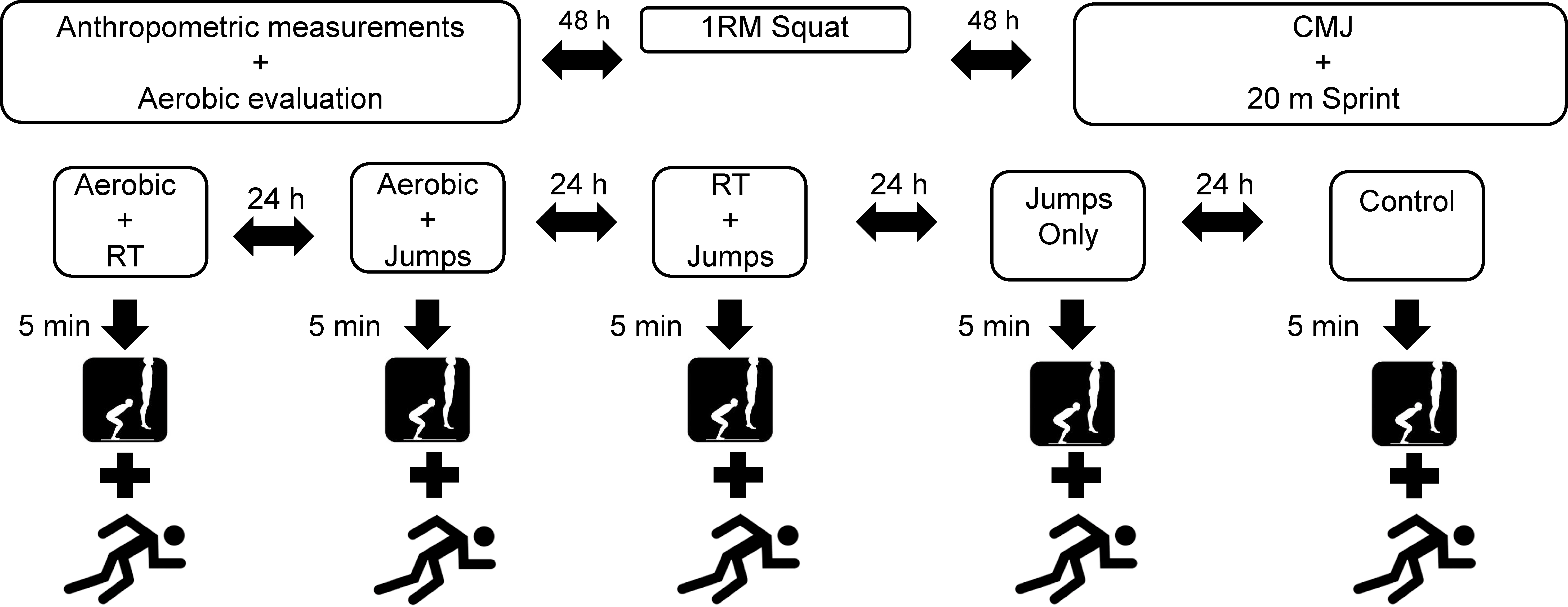
Experimental design of the investigation. Note. RT resistance training; 1RM repetition maximum; CMJ countermovement jump.
Materials and methods
Participants
A convenience sample of 19 male basketball players, aged between 19 and 27 years (23.7 1.1 years) were recruited from a team competing in the main State Basketball Championship. Players trained on average of 3 hours per day, 5 times per week. Habitually, in a weekly basis, the assessed players participated in one training session per day ( 180 minutes per session), 5 days per week, and one official match per week. Training sessions usually consisted of basketball drills, tactics, sprints, intermittent running exercises, and specific conditioning works as well as weight and plyometric trainings. The only additional criteria to take part in the present investigation, besides being part of the assessed basketball team, was to parctipate in all experimental sessions. After receiving information about the procedures particpants would be submitted, they signed an informed consent form, agreeing with the methodological procedures of the investigation. The procedures adopted in this study complied with the norms of the Helsinki Declaration for research on humans. The project was approved by the Local University Institutional Research Ethics Committee.
Experimental design
The study comprised two weeks. The experimental design is presented in Fig. 1. In the first visit, anthropometric evaluation (body mass, height, and skinfolds) was performed, which was followed by maximal incremental exercise test with gas analyzer on a treadmill to determine aerobic capacity. After two days, the players performed a 1-RM test in the squat position using the Smith Machine. Finally, at the end of the first week, the players performed the CMJ test and the 20-m sprint test. In the second week, the experimental sessions were conducted with a 24 h interval in-between. The order of the experimental sessions was randomized. The players randomly performed the five warm-up conditions followed by the physical tests (CMJ test and 20-m sprint test). The five warm-up conditions were: aerobic resistance training, aerobic jumps, resistance training jumps, jumps only, and control condition. Noteworthy, under all conditions, the total warm-up time was 10 min (Table 1). Following 5 min of warm-up, the players performed the CMJ test and 20-m sprint test.
Measures
CMJ
An eletronic contact jump mat (CEFISE, Jump System Pro, Nova Odessa, Brazil) was used to analyze the height of the jump from the flight time. The height of the jump was calculated using the following formula: h (m) 1.32627*flight time(s) [13]. Each player performed 3 attempts with 30-s interval among trials. The best result was retained for analysis. The players performed the CMJ with arm swing and no restrictions were placed on the knee angle during the eccentric phase of the jump; also, players were instructed to maintain the legs in a straight position during the flight. All players were familiar with the test prior the beginning of the investigation. A previous study indicated good reproducibility for the CMJ test (ICC 0.94) [13]. In the present study, the intraclass correlation coefficient was 0.99 for CMJ.
20 m sprint
For the 20-m sprint test, time was recorded to the nearest one-hundredth of second using photocells (Smart Speed, Fusion Equipment, Australia) placed 0.5 m above the ground, and positioned along the course of the race, with distances of 0 and 20 m. Players performed two trials at maximum effort with recovery time of 3-min. Verbal encouragement was given during the test. The best result was retained for analyses. Players were positioned 0.5 m behind the starting line (first pair of photocells) with the premise of reducing the inertia effect. The 20-m sprint test was performed in an indoor gym. All participants were familiar with the test. Previous research demonstrated good reproducibility for the 20-m sprint test (ICC 0.97) [14]. In the present study, the intraclass correlation coefficient was 0.97 for 20-m sprint test.
Descriptive values (mean and standard deviation) of the research variables
Variables
Mean SD
CMJ (m)
0.42
0.08
20 m Sprint (s)
2.43
0.21
1RM Squat (kg)
187.90
22.93
VOmax (ml/kg/min)
52.59
6.06
Body mass (kg)
92.47
9.18
Height (m)
1.97
0.09
%BF
19.65
7.51
Note. CMJ countermovement jump; %BF body fat percentage; 1RM 1 repetition maximum; VOmax maximum aerobic power; SD standard deviation.
Mean, standard deviation, and effect size of CMJ performance (m) according to warm-up conditions
Mean (SD)
Baseline
Aer RT
Aer Jumps
RT Jumps
Jumps only
Control
Baseline
0.42 (0.08)
–
0.5
0.7
0.8
1.2
0.1
Aer RT
0.44 (0.07)
–
0.2
0.1
0.6
0.5
Aer Jumps
0.45 (0.10)
–
0.2
0.7
0.7
RT Jumps
0.46 (0.08)
–
0.4
0.8
Jumps
0.48 (0.09)
–
1.1
Control
0.43 (0.09)
–
Note. SD standard deviation; Aer Aerobic; RT resistance training. 0.05 in relation to “Baseline” and “Control”; 0.05 in relation to “Jumps”; Effect size: 0.35 trivial, 0.35 0.80 low, 0.80 1.5 moderate and, 1.5 large.
Mean, standard deviation, and effect size of 20 m sprint test (s) according to warm-up condition
Mean (SD)
Baseline
Aer RT
Aer Jumps
RT Jumps
Jumps only
Control
Baseline
2.43 (0.21)
–
0.6
0.6
1.3
0.5
0.1
Aer RT
2.34 (0.18)
–
0.2
0.7
0.3
0.6
Aer Jumps
2.32 (0.23)
–
0.6
0.1
0.7
RT Jumps
2.28 (0.18)
–
0.8
1.2
Jumps
2.35 (0.22)
–
0.5
Control
2.41 (0.20)
–
Note. SD standard deviation; Aer Aerobic; RT resistance training. 0.05 in relation to “Baseline” and “Control”; 0.05 in relation to “RT Jumps”; Effect size: 0.35 trivial, 0.35 0.80 low, 0.80 1.5 moderate and, 1.5 large.
1-RM test
Maximum muscle strength was determined by the 1-RM test. The exercise was squat in the Smith Machine of the Matrix brand. The 1-RM test was preceded by warm-up (8 to 12 repetitions), with approximately 60% of the load estimated arbitrarily for the first trial. After 2-min rest the 1-RM started off. The players were encouraged to perform two repetitions with the intensity imposed in 5 trials. If the two repetitions were completed on the first trial, or if a single repetition was not completed, a second trial was performed after a 5-min recovery interval. If necessary, the procedure would be repeated until the 5 trial. So, the 1-RM recorded was the one which the athlete performed a single repetition. All athletes were familiar with the 1-RM squat test. The 1RM test present good reproducibility (ICC 0.93) [15]. In the present investigation, the intraclass correlation coefficient and standard error of measurement for 1RM test was 0.99 and 3.5 kg, respectively.
VOmax
VOmax was measured by a computerized metabolic analyzer (CPX/D Cortex Metalizer 3B, Germany) during an incremental treadmill test. The test was preceded by warm-up developed on the same treadmill for 3 min, adopting a speed of 10 km/h. The athlete rested for 2 minutes prior incremental test start. Volunteers were instructed to perform the test under as much effort as possible. Verbal encouragement was provided throughout the entire test. The initial speed of the test was 8 km/h, with increments of 1 km/h every minute until voluntary exhaustion or impossibility to maintain current speed. Heart rate (HR) was continuously monitored by a HR monitor (S810i, Polar). Respiratory variables were measured uninterruptedly every 20-s. The test was interrupted when one of the following situations occurred: 1) plateau or reduction of VO with increasing speed; 2) respiratory coefficient greater than or equal to 1.1; and 3) 95% of the maximum HR predicted by age (220-age) was achieved, as recommended by Howley, Basset and Welch [16]. The highest VO value before interruption of the test was adopted as VOmax, following a methodology adopted in another study [17].
Anthropometric
For the determination of body mass and height, a portable scale with accuracy of 0.1 kg (Tanita and a stadiometer with accuracy of 0.1 cm (Welmy) were used. The body density was determined according to skinfold thickness using a compass of the brand Lange (USA) and based on the triceps, pectoral and subscapular skinfolds [18]. The International Society for Advancement for Kineanthropometry standardizations [19] were used for the measurements of skinfolds. The percentage of body fat (%BF) was determined using the Siri equation [20].
Data analysis
The Shapiro Wilk test was conducted to evaluate data distribution. The Levene’s test was used to verify data homocedasticity, while the sphericity was verified by the Mauchly’s test. Considering the non-violation of the presumptions, it was decided to use parametric techniques. The repeated measures ANOVA two-way [interaction of time (pré vs. post) and conditions] was conducted to compare the CMJ and the 20-m sprint test performance between the experimental conditions. The Bonferroni post hoc test was used to identify statistical differences. All data were analyzed by SPSS 21.0 software, adopting a significance level of 5%. In addition, the Cohen effect size (“”) was used to analyze the magnitude of the differences. The effect size was classified according to Rhea [21]: 0.35 trivial, 0.35 0.80 low, 0.80 1.5 moderate and, 1.5 large.
Results
The descriptive data (mean and SD) (CMJ, 20-m sprint, 1-RM, VOmax, body mass, height and %BF) are presented in the Table 2.
Regarding CMJ performance (Table 3), a condition effect was observed ( 48.14, 0.001). The data revealed that all the warm-up conditions increased the CMJ performance from pre to post warm-up (aerobic resistance training: % 3%; aerobic jumps: % 4%; resistance training jumps: % 4%; jumps only: % 7%), except for the control condition ( 2.64, 0.23). It is noteworthy that the warm-up jumps only condition has observed better performance in the CMJ compared to the other conditions ( 37.87, 0.01).
As for the 20-m sprint test performance (Table 4), the results indicated condition effects ( 41.37, 0.001). All the warm-up conditions enhanced the performance of the 20-m sprint test in comparison to the baseline (aerobic resistance training: % 2%; aerobic jumps: % 3%; resistance training jumps: % 5%, jumps only: % 2%), except for the control condition ( 1.83, 0.27). It is noteworthy that warm-up resistance training jumps condition presented better performance in the 20-m sprint test when compared to other conditions ( 28.08, 0.01).
Discussion
The aim of this study was to analyze the effect of different warm-up strategies on CMJ performance and 20-m speed in male basketball players. The findings revealed positive (increased performance) effects for all warm-up conditions on CMJ and 20-m sprint performance, although the conditions “jumps only” and “resistance training jumps” were significantly more effective for the tests of the CMJ and 20-m sprint, respectively. The hypothesis of a greater improvement in CMJ performance due to a specific warm-up with CMJ was then corroborated. However, the aerobic jumps condiction did not generate greater improvement in running speed performance as expected.
The results for the CMJ indicated that all the warm-up conditions increased jump height, although the magnitudes of improvement were different. The aerobic resistance training, aerobic jumps, and resistance training jumps conditions showed enhacements of 4% in the CMJ performance carried out 5 min following warm-up. It should be noted, however, that the jumps only condition revealed a superior improvement (7%) in the CMJ performance. The present result is in agreement with data reported by Rezende et al. [6] who investigated the effect of different warm-up strategies on the CMJ performance in volleyball athletes; they showed that jumps warm-up improved the CMJ performance (12%) and this strategy presented the best results compared to bicycling (7%) and resistance exercise (6%).
In fact, studies have shown that warm-up activities with muscular movements like those that will be conducted later, have higher post-activation potential [5, 6, 7]. The main mechanisms that explain post-activation potential are increased neural recruitment in fast contracting fibers and increased muscle temperature [22]. However, Ayala et al. [5] have argued that these mechanisms are activated with greater accuracy only after performing exercises with high intensity. According to Barnes et al. [9], the more specific the warm-up from the point of view of neural recruitment and the intensity imposed, the greater the improvement in neuromuscular performance in subsequent exercise. In this sense, although the present investigation did not measure the electromyographic activation of the knee extensor muscles in the CMJ performance, it is suggested the greatest improvement from the jumps only condition is likely to be related to the post-activation potential.
Concerning the 20-m sprint performance, the findings showed that all the warm-up conditions could increase the performance, except for the control condition. The aerobic resistance training, aerobic jumps, and jumps only conditions revealed 2% improvement in of 20-m sprint performance, while the resistance training jumps condition presented higher magnitude of improvement (5%) compared to other warm-ups conditions.
Considering warm-up specificity, it was expected that aerobic jumps warm-up condition might induce greater increase in 20-m sprint performance. The results of the present study for the aerobic jumps condition support findings from Zourdos et al. [12] who claimed that if the intensity is different from the specific demands in the physical test, it might be poorly improved, even if the movements performed during warm-up are similar to the subsequent test. In the present study, the aerobic jumps condition was conducted with 4-min of running in intensity corresponding to 70% of the VOmax, while in the 20-m sprint test the speed employed by players was higher.
Regarding the resistance training jumps condition, the findings might be explained by neural adaptations caused by these two types of exercises. Ayala et al. [5] studied the effect of some types of warm-up on physical performance variables in soccer athletes and demonstrated that resistance training and jump warm-ups (FIFA 11+) could maximize performance in sprint test. According to Ayala et al. [5], warm-up with physical exercise in which there is a neural recruitment, predominantly from fast-twitch muscle fibers, may be a good strategy on improving subsequent neuromuscular performance; this might be a possible explanation for the present results. Indeed, the results of the present investigation corroborate with results from Loturco et al. [14] who revealed that young soccer players improved performance in the 20-m sprint test after a horizontal jumping protocol, although the plyometry method was adopted.
The present study, although revealing interesting results, is endowed with limitations that must be mentioned. Feeding and sleeping quality of the athletes were not controlled, which might have affected the study results. However, it should be noted that athletes were instructed to maintain their regular diet. Moreover, generalization of the results might be hampered due to athletes belong to a single team.
Conclusion
From the practical point of view, the present study indicates that all experimental warm-up strategies might improve performance in CMJ and 20-m speed in male basketball players that participate in state championships. Coaches, therefore, might adopt both the specific warm-up with jumps to improve the performance of the jump or that related to this type of action, and the resistance training jumps warm-up which could influence speed positively. Finally, considering the findings emerging from the control condition, we recommend not to keep athletes sitting on the bench before and during the match.
Footnotes
Conflict of interest
None to report.
References
1.
MoreiraANosakaKNunesJAViveirosLJamurtasAZAokiMS. Changes in muscle damage markers in female basketball players. Biol Sport. 2014; 31(1): 3-7. doi: 10.5604/
2.
DelextratABadiellaASaavedraVMatthewDSchellingXTorres-RondaL. Match activity demands of elite Spanish female basketball players by playing position. Int J Perform Anal Sport. 2015; 15(4): 687-703.
3.
ZivGLidorR. Physical attributes, physiological characteristics, on-court performances and nutritional strategies of female and male basketball players. Sports Med. 2009; 39(7): 547-568. doi: 10.2165/00007256-200939070-00003
4.
MarcelinoPRAokiMSArrudaAFSFreitasCGMendez-VillanuevaAMoreiraA. Does small-sided-games’ court area influence metabolic, perceptual, and physical performance parameters of young elite basketball players? Biol Sport. 2016; 33(1): 37-42. doi: 10.5604/20831862.1180174
5.
AyalaFCalderón-LopezADelgado-GosalbezJCParra-SanchezSPomares-NogueraCHernandez-SanchezSLopez-ValencianoACroixMS. Acute effects of three neuromuscular warm-up strategies on several physical performance measures in football players. Plos One. 2016; 12(1): 1-17. doi: 10.1371/journal.pone.0169660
6.
RezendeFNMotaGRLopesCRSilvaBVSimimMAMMarocoloM. Specific warm-up exercise is the best for vertical countermovement jump in young volleyball players. Motriz. 2016; 22(4): 299-303.
7.
NeivaHPMarquesMCBarbosaTMIzquierdoMVianaJLMarinhoDA. Effects of 10 min vs. 20 min passive rest after warm-up on 100 m freestyle time-trial performance: A randomized crossover study. J Sci Med Sport. 2017; 20(1): 81-86. doi: 10.1016/j.jsams.2016.04.012
8.
McGowanCJPyneDBThompsonKGRattravB. Warm-Up strategies for sport and exercise: mechanisms and applications. Sports Med. 2015; 45(11): 1523-1546. doi: 10.1007/s40279-015-0376-x
9.
BarnesMJPettersonSCochraneDJ. Effects of different warm-up modalities on power output during the high pull. J Sports Sci. 2016; 35(1): 976-981. doi: 10.1080/02640414.2016.1206665
10.
RibeiroASRomanziniMSchoenfeldBJSouzaMFAvelarACyrinoES. Effect of different warm-up procedures on the performance of resistance training exercises. Perceptual Motor Skills. 2014; 119(1): 133-145.
11.
AbadCCPradoMLUgrinowitschCTricoliVBarrosoR. Combination of general and specific warm-ups improves leg-press one repetition maximum compared with specific warm-up in trained individuals. J Strength Cond Research. 2011; 25(8): 2242-2245. doi: 10.1519/JSC.0b013e3181e8611b
12.
ZourdosMCBazylerCDJoEKhamouiEVParkBLeeSPantonLBKimJ. Impact of a submaximal warm-up on endurance performance in highly trained and competitive male runners. Res Quart Exercise Sport. 2016; 81(1): 114-119. doi: 10.1080/02701367.2016.1224294
13.
Balsanobre-FernandézCTejero-GonzálezCMCampo-VecinoJDBavarescoN. The concurrent validity and reliability of a low-cost, high-speed câmera-based method for measuring the flight time of vertical jumps. J Strength Cond Res. 2014; 28(2): 528-533. doi: 10.1519/JSC.0b013e318299a52e
14.
LoturcoIPereiraLAKobalRZanettiVKitamuraKAbadCCCNakamuraFY. Transference effect of vertical and horizontal plyometrics on sprint performance of high-level U-20 soccer players. J Sports Sci. 2015; 33(20): 2182-2191. doi: 10.1080/02640414.2015.1081394
15.
RibeiroASNascimentoMASalvadorEPGurjãoALAvelarARitti-DiasRMMayhewJLCyrinoES. Reliability of one-repetition maximum test in untrained young adult men and women. Isokinetics Exercise Sci. 2014; 22(1): 175-182. doi: 10.3233/IES-140534
16.
HowleyETBassetDRWelchHG. Criteria for maximal oxygen uptake: review and comentary. Med Sci Sports Exercise. 1995; 27(9): 1292-1301.
17.
FortesLSMendonçaLCVPaesPPViannaJMDiefenthaelerF. Can power and anaerobic capacity reduce according to disordered eating behaviors in cyclists? Motriz. 2017; 23(1): 60-64. doi: 10.1590/s1980-6574201700010009
18.
JacksonASPollockML. Generalized equations for predicting body density of men. Br J Nutr. 1978; 40(4): 497-504.
19.
The Internacional Society for Advancement for Kineanthropometry [homepage on the Internet]. Australia: National Library of Australia [cited 2013 Jul 2013]. Available from: http://www.isakonline.com.
20.
SiriWE. The gross composition of the body. In: TobiasCALawrenceJH, eds. Advances in Biological and Medical Physics. New York: Academic Press, 1956: pp. 239-80.
21.
RheaMR. Determining the magnitude of treatment effects in strength training research through the use of the effect size. J Strength Cond Res. 2004; 18(6): 918-20.
22.
SeitzLBHaffGG. Factors modulating post-activation potentiation of jump, sprint, throw, and upper-body ballistic performances: A systematic review with meta-analysis. Sports Med. 2016; 46(2): 231-240. doi: 10.1007/s40279-015-0415-7