




Abstract
BACKGROUND:
Push-up plus exercise is applied to scapular winging to selectively activate serratus anterior (SA).
OBJECTIVES:
To compare muscle activity, muscle activity ratios, and the degrees of rotation of the thoracic and lumbar spine during a modified push-up plus exercise.
METHODS:
In total, 20 subjects with scapular winging participated. Subjects performed the knee push-up plus with ipsilateral leg extension (KPP-ILE) and the standard push-up plus with ipsilateral leg extension (SPP-ILE) exercises. During the SPP-ILE and KPP-ILE, SA, pectoralis major (PM), ipsilateral external oblique (ipsiEO), and contralateral external oblique (contEO) muscle activities, the SA/PM and ipsiEO/contEO ratios were assessed and the degree of rotation of the thoracic and lumbar spine were assessed.
RESULTS:
Muscle activities of SA, PM, ipsiEO, contEO, and SA/PM ratio were significantly higher during SPP-ILE than KPP-ILE. The ipsiEO/contEO ratio decreased more significantly during SPP-ILE versus KPP-ILE. Thoracic and lumbar rotation values were significantly lower in SPP-ILE.
CONCLUSIONS:
The SPP-ILE may be a useful exercise for subjects with scapular winging because of the increased SA/PM ratio, the diminished compensatory rotation through increased scapular stabilization muscle activity and co-contraction of the abdominal trunk-stabilizing muscles.
Introduction
The serratus anterior (SA) plays an important role in stabilizing the scapular to the thorax [1]. Thus, SA weakness is a factor known to be associated with pain in the shoulder, shoulder impingement, and scapular winging [2]. Additionally, compensatory recruitment of the pectoralis major (PM) occurs in individuals with scapular winging during scapular protraction, due to the weakened SA [3]. This compensatory activation of the PM can result in scapulothoracic and glenohumeral joint pathology [4], such as decreased volume of the subacromial space [5], increased compressive force to the glenoid [6], and subacromial impingement [7]. Thus, quite a number of studies have investigated increasing SA activity while reducing recruitment of the PM; the results are frequently presented as the SA/PM ratio to show the relative activities [3, 8, 9, 10]. Additionally, many techniques and exercises have been created and modified to selectively activate the SA, such as using visual electromyography (EMG) biofeedback, tubing bandages, and open and closed kinetic chain exercises [9, 11].
In the early stages of SA strengthening, closed kinetic chain exercises have been suggested [12]. Because closed kinetic chain exercises stimulate mechanoreceptors, scapular stabilization muscles are activated more effectively [13, 14]. Knee push-up plus (KPP) and standard push-up plus (SPP) are general closed kinetic SA-strengthening exercises; of the two, SPP is more effective for activating SA than KPP because there is more weight bearing in SPP [3]. Additionally, for more selective activation of SA, these exercises have been modified in many ways.
Among the modified protocols, ipsilateral leg extension (ILE) has been suggested to effectively activate the SA during KPP in healthy subjects [15], and produced greater activity in the abdominal trunk stabilization muscles [16]. Co contraction patterns of the trunk stabilization muscles are known to affect spine stability during dynamic activities [17], especially when the subject should maintain a neutral trunk position against external and internal forces [18]. Co contraction of trunk stabilization muscles transfers and controls the force and motion delivered to the terminal segment during integrated kinetic chain activities [19] and provides a base for generating greater force in the upper limbs [20]. In the abdominal trunk stabilization muscles, the external oblique (EO) maintains trunk stability by controlling the spinal neutral position and transferring external load from the upper trunk to the pelvis [19]. Thus, for selective activation of the SA, co-contraction of the EO, as a trunk stabilizer, should be considered when making modifications to push-up plus exercises.
To date, there have been many reports about exercises performed on stable or unstable surfaces [21, 22, 23]. However, there have been only a few studies on modified exercises that applied a dynamic challenge according to the subject’s motion. There is also a lack of studies investigating compensatory motions, such as trunk rotation, while measuring muscle activities during push-up plus exercises.
Thus, the purpose of this study was to compare muscle activities (SA, PM, and bilateral EO) and activity ratios (SA/PM, ipsilateral EO; ipsiEO/contralateral EO; contEO) with compensatory trunk rotation during SPP and KPP while performing ILEs (KPP-ILE, SPP-ILE) in subjects with scapular winging. We hypothesized that SA, PM, and bilateral EO activities would be increased, and there would be no significant difference in the SA/PM ratio in SPP-ILE. Also, because of increased muscle activities, we expected a decrease in compensatory rotation.
Method
Subjects
The sample size was calculated using G*power software (ver. 3.1.9; Franz Faul, University of Kiel, Kiel, Germany) according to a pilot study with a power of 0.8, an effect size of 0.81, and an
Twenty subjects (11 males, 9 females) with scapular winging volunteered to participate in this study. The inclusion criterion was the presence of scapular winging. Measurements were conducted in the scapular winging side of subjects according to the screening test. A screening test using a scapulometer was conducted to investigate scapular winging [10]. Scapular winging was identified by measuring the distance between the inferior angle of the scapula and the thoracic wall in the standing position, with the elbow flexed at 90
General characteristics of the subjects (
20)
General characteristics of the subjects (
BMI: body mass index.
Subjects provided written informed consent before the experiment. This study was approved by the Yonsei University Wonju Institutional Review Board (approval number: 1041849-201701-BM-001-02).
Surface electromyography
Surface electromyography (EMG) (Noraxon TeleMyo DTS; Noraxon Inc., Scottsdale, AZ, USA) was used to measure muscle activity on the scapular winging side in the SA, PM and bilateral EO muscles. Ag/AgCl surface electrodes were used. For the SA, electrodes were placed at the level of the inferior tip of the scapula and medial of the latissimus dorsi [24] on the side of scapular winging. For the PM, electrodes were placed on the chest wall, horizontal from the arising muscle mass (
Three-dimensional motion-tracking system
A three-dimensional (3D) motion-tracking system (Noraxon Research MyoMotion; Noraxon Inc., St. AZ, USA) was used to measure the thoracic and lumbar rotation angles during the KPP-ILE and SPP-ILE exercises. The sampling rate was set at 100 Hz and MR3 software (ver. 3.6.3.2; Noraxon Inc., St. AZ, USA) was used to collect kinematic data. Three wireless sensors (3.5
Procedures
Before data collection, subjects were instructed on how to perform the KPP-ILE and SPP-ILE exercises. Measurements started after the subjects were familiarized with the exercises. The order of performing the two exercises was randomized using the random number generator in Microsoft Excel software (Microsoft Corp., Redmond, WA, USA).
KPP-ILE exercise
The subject assumed a quadruped position with the shoulder, knee, and hip at 90
Knee push-up plus with ipsilateral leg extension exercise (KPP-ILE).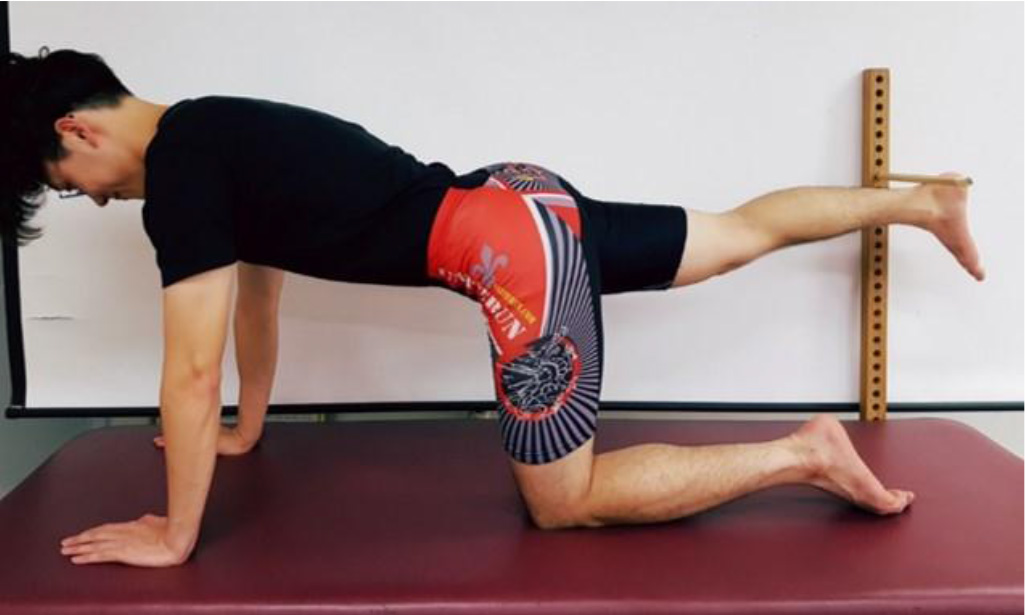
The subject took a push-up position with straightened trunk, legs, and elbows. The width of the hands and legs was same as that of the shoulder. In the push-up position, the subject performed full scapular protraction (push-up plus) according to the instructions. During the push-up exercise, the 3D motion-tracking system was calibrated. After the calibration, the subject extended the leg on the side of the scapular winging (Fig. 2).
Standard push-up plus with ipsilateral leg extension exercise (SPP-ILE).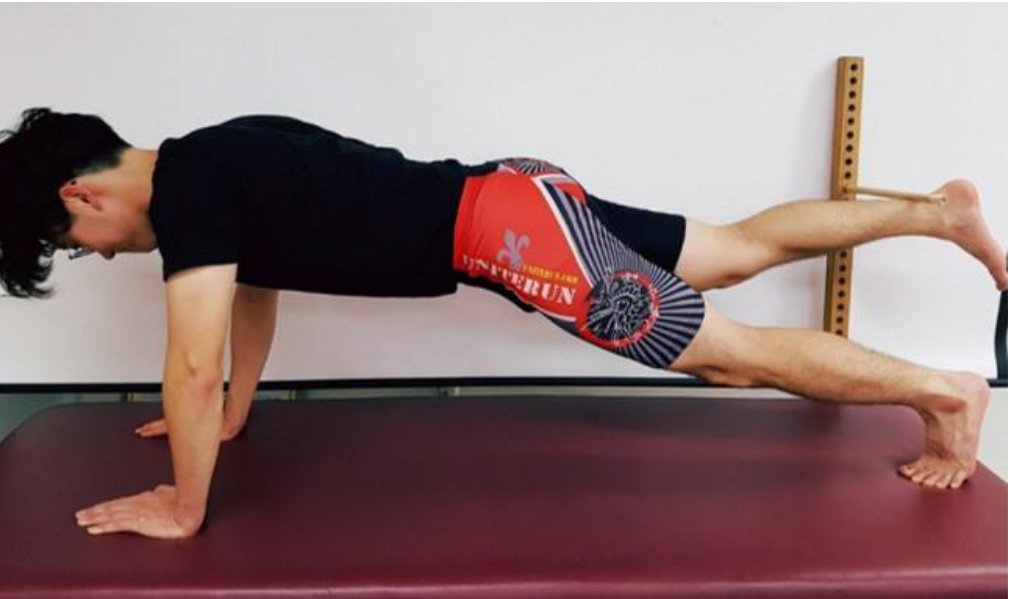
During both exercises, a target bar was installed to prevent the height of the legs from exceeding that of the pelvis. For effective SA activation, we instructed the subject to maintain slight cranio-cervical flexion [26]. All subjects performed each exercise three times, for 6 s each.
Data were collected while subjects performed the KPP-ILE and SPP-ILE exercises for 6 s and data from 2 to 5 s were used. To normalize muscle activity data, maximal voluntary isometric contraction (MVIC) was performed for 6 s and the data between 2 and 5 s were used to determine the mean MVIC amplitude. The MVIC test position was performed according to Kendall et al. [27]. For the SA, the subject was seated on a treatment table with no back support, and shoulder internal rotation and 125
Normalized data are expressed as a percentage of MVIC (%MVIC). The SA/PM and ipsiEO/contEO activity ratios were calculated using normalized muscle activity data. In the 3D motion-tracking system, positive values indicate ipsilateral side rotation of the spine and negative values denote contralateral side rotation of the spine. EMG data were synchronized using the 3D motion-tracking system and were analyzed using MR3 software (ver. 3.6.3.2; Noraxon Inc., St. AZ, USA).
Statistical analysis
The Shapiro-Wilk test was used to assess the normality of data distributions and all variables appeared to be normally distributed. Thus, paired t-tests was used to compare the muscle activities, muscle activity ratios, and rotation angles during two different push up plus with ipsilateral leg extension conditions (within factor: KPP-ILE and SPP-ILE). The SPSS software package (ver. 23.0; SPSS Inc., Chicago, IL, USA) was used for statistical analyses and the significance level was set at
Results
Muscle activity
There was a significant difference between the two exercises (KPP-ILE and SPP-ILE) in the SA (
Muscle activity ratio
There was a significant difference in the SA/PM and ipsiEO/contEO muscle activity ratios. The SA/PM ratio increased significantly in SPP-ILE versus KPP-ILE (
Comparison of SA/PM and ipsiEO/contEO ratios during KPP-ILE and SPP-ILE
Comparison of SA/PM and ipsiEO/contEO ratios during KPP-ILE and SPP-ILE
SA: serratus anterior; PM: pectoralis major; ipsiEO: ipsilateral external oblique; contEO: contralateral external oblique;
Comparison of the degree of lumbar and thoracic rotation during KPP-ILE and SPP-ILE
A positive value means the ipsilateral side to scapular winging and a negative value means the contralateral side.
Activities of the four muscles were significantly higher in standard push-up plus with ipsilateral leg extension (SPP-ILE) than knee push-up plus with ipsilateral leg extension (KPP-ILE) (SA: serratus anterior, PM: pectoralis major, ipsiEO: ipsilateral external oblique, contEO: contralateral external oblique; 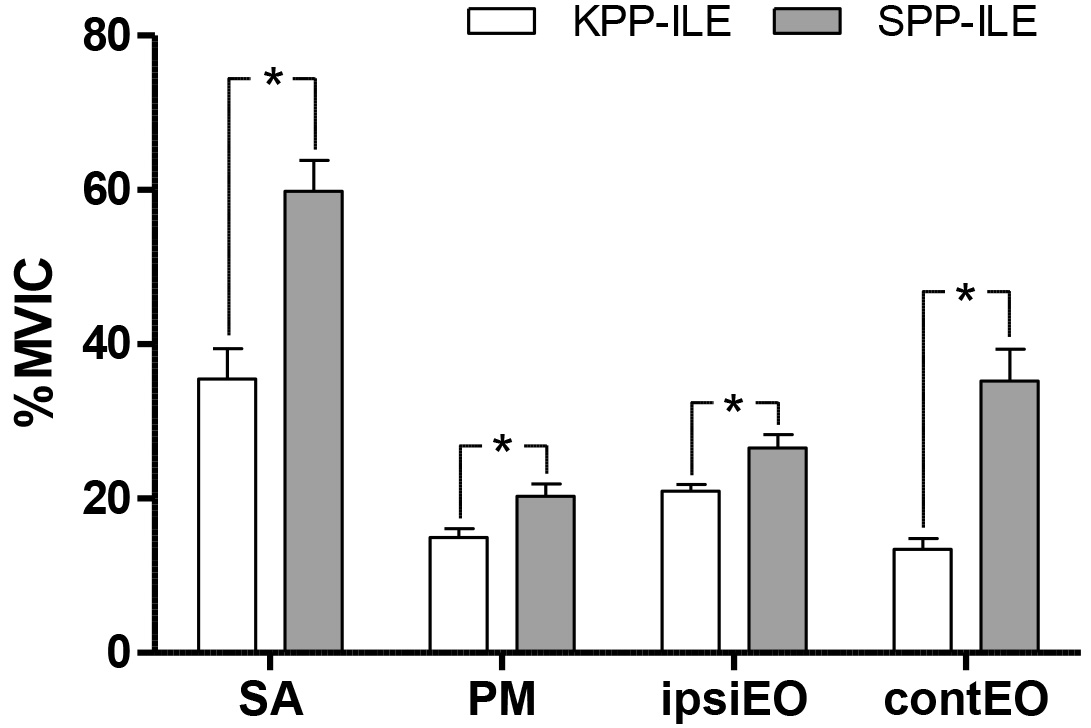
There were significant differences in lumbar and thoracic rotation between the KPP-ILE and SPP-ILE exercises. The lumbar spine rotated significantly (
Discussion
In this study, we compared the SA, PM, ipsiEO, and contEO muscle activities, the SA/PM and ipsiEO/contEO ratios, and compensatory trunk rotation during KPP-ILE and SPP-ILE exercises. The results indicated that the SPP-ILE exercise was more effective for activating the SA (
According to the results of this study, we found that activation of the four studied muscles was increased significantly during SPP-ILE versus KPP-ILE. In KPP-ILE, as the subject’s knee and ankle were maintained on the floor, there was a larger supporting surface on which to maintain the exercise than in SPP-ILE. In contrast, during SPP-ILE, subjects maintained their posture on a narrow supporting surface using the end of the feet; thus, during the SPP-ILE, subjects carry their weight more on the upper limb than during the KPP-ILE. This increased weight bearing caused increased SA and PM activities, thus stabilizing the scapula [3, 28]. Additionally, these tasks produced more activation of the bilateral EO to maintain trunk stability during SPP-ILE [17, 19].
Contrary to our hypothesis, the SA/PM ratio was higher in SPP-ILE than KPP-ILE. Although PM activity was also increased, due to increased weight bearing, SPP-ILE produced more SA activity, sufficient to increase the SA/PM ratio. The upper limb can exert greater force after the trunk stabilization muscles are activated [29]. Additionally, many previous studies suggested that trunk stabilization contributes to the generation of greater activation and force during shoulder and scapular movements, through the sequential activation of muscles [30, 31]. In particular, Jang et al. [30] reported an effect on decreasing compensatory activation during shoulder and scapular movement through augmented trunk stabilization. In this study, there was significantly increased activation of the bilateral EO as a trunk stabilizer. Accordingly, as trunk stability was increased, the SA was activated more during SPP-ILE than KPP-ILE; this explains why the SA was more selectively activated, with decreased compensatory activation of the PM, during the SPP-ILE versus KPP-ILE.
In this study, the ipsiEO/contEO ratio decreased significantly. During the KPP-ILE, the ipsiEO/contEO ratio was 1.99
Co-contraction of the bilateral EO maintains the spine in a neutral position during dynamic activities [19]; thus, lumbar rotation would be expected to be affected by bilateral EO activation and the ipsiEO/ contEO ratio. During KPP-ILE, the ipsiEO/contEO ratio was higher than that in SPP-ILE, and the lumbar spine was rotated to the ipsilateral side of the scapular winging. In contrast, during SPP-ILE, the lumbar spine was rotated slightly to the contralateral side of the scapular winging, due to increased activation of contEO. Additionally, the absolute value of lumbar rotation showed a decreased value during SPP-ILE (1.42) versus KPP-ILE (2.53). These effects would be expected, in that the EO showed relatively balanced and increased activation during SPP-ILE.
According to the results, the degree of thoracic rotation was decreased during SPP-ILE (2.13) versus KPP-ILE (0.20). This decreased thoracic rotation in SPP-ILE is expected given the results showing increased SA and PM activity. SA and PM are the main muscles that stabilize the scapula; in particular, the SA is the major muscle that stabilizes the scapulo-thoracic joint [33]. Thus, decreased thoracic rotation during SPP-ILE could be the result of increased stabilization in the thoracic region.
This study had several limitations. First, the subjects were young and currently asymptomatic. Although we assume that performing the ILE could be difficult for individuals with scapular winging, this needs to be investigated in older and symptomatic populations before generalizing the findings. Second, we did not compare the SPP-ILE or KPP-ILE with the ‘original’ SPP or KPP. We expect that excessive tasks could induce fatigue in a weakened SA. Additionally, when we observed muscle activities before and after extending the leg, muscle activities increased clearly after extending the leg. However, to prevent confusion, it would be better to determine the effects during the original SPP and KPP exercises. Finally, this study used a cross-sectional design and we did not measure activity for other compensatory muscles or trunk stabilizer muscles, such as the upper trapezius and IO. In further studies, we suggest making comparisons with other compensatory muscles and longitudinally investigating the effects of these exercises.
Conclusion
The aim of this study was to compare SA, PM, ipsiEO, and contEO activity, the SA/PM and ipsiEO /contEO ratios, and the degrees of thoracic and lumbar rotation during KPP-ILE and SPP-ILE. In terms of the increased SA/PM ratio, SPP-ILE may be a suitable exercise for subjects with scapular winging. Additionally, the SPP-ILE exercise is better than KPP-ILE in terms of the diminished compensatory rotation due to increased scapular stabilization muscle activity and co contraction of abdominal trunk-stabilizing muscles. In conclusion, the SPP-ILE exercise may be useful in subjects with scapular winging.
Conflict of interest
There are no conflicts of interest associated with this publication and there had been no significant financial support for this work that could have influenced its outcome.
Footnotes
Acknowledgments
This research was supported by Basic Science Research Program through the National Research Foundation of Korea (NRF) funded by the Ministry of Education (2015R1D1A1A01057620) and results of a study on the “Leaders Industry-university Cooperation” project.