




Abstract
Flying ad-hoc network (FANET) has been growing rapidly and can utilized in sectors such as disaster response, healthcare, military, agriculture, and more. These networks utilize Unmanned aerial vehicles (UAVs), required advanced routing algorithms for effective communication. Due to the lack of suitable routing algorithms, FANETs often encounter communication issues. This article explores the integration of Nature-inspired based routing algorithms into the FANET framework. Specifically, it examines the two distinct algorithms namely, swarm intelligence and genetic algorithms. Simulated results demonstrate the superiority of the proposed algorithm over standard benchmark schemes. Validation of the proposed algorithm using performance parameters, such as throughput, reveals significant improvements over benchmark schemes. Moreover, the packet delivery ratio for providing resources to FANET users is 98% while achieving minimum end-to-end delay for the proposed scheme. These findings underscore the potential of Nature-inspired algorithms (NIAs) across various scenarios within the FANET framework.
Introduction
Technological breakthroughs have made Unmanned aerial vehicles (UAVs) more versatile and capable of performing more aerial tasks. In recent times, the burgeoning demands for UAVs in real-time scenarios has led to higher network complexity. An effective solution to handle the increasing complexities of multi-UAV systems is the establishment of an Ad hoc network for small UAVs, known as Flying Ad hoc Networks (FANETs) [1]. FANETs offer cost effectiveness and straightforward implementation, making them deployable in challenging real-time scenarios. FANET’s main advantage lies in enhancing efficiency across disaster response, agriculture, military operations, and healthcare. Facilitating updated communication among UAVs and drones stands as a critical feature of FANET [2]. Due to the high mobility of these devices, transmitting data packets through a sensor network can be challenging. Optimizing the operational conditions of each node involves assessing their energy levels, frequency resources, and radio signal characteristics. This assessment is conducted through routing protocol in FANETs enabling efficient data packet movement. While Ad-hoc On-demand Distance Vector (AODV) routing configurations are adaptable for various routing protocols, they remain clear and articulate. however, the conventional method of flooding neighboring nodes during the discovery phase, though efficient, can strain the limited resources of FANET, potentially negative impact on operation of the nodes.
A new generation of metaheuristics has emerged, aiming to enhance the route discovery capabilities of AODV by using the principles of living organisms. Diverse modifications to Bee and Ant algorithms have been implemented across different networks. For improved performance, algorithms named BeeAdHoc and AntHocNet were developed through multiple iterations in FANET [3]. This study introduces a hybrid approach that combines FANET methods and Ant Colony Optimization (ACO)-Levy flight techniques to improve the routing optimization capabilities of AODV. The aim was to create a new set of performance parameters [4]. The authors formulated an optimization problem centered on discovering the most effective solution for a given problem, capable of adapting to the state of the problem. Various techniques to solve by defining the objectives: either a single objective or a multi-objective approach.
Applications areas of UAVs.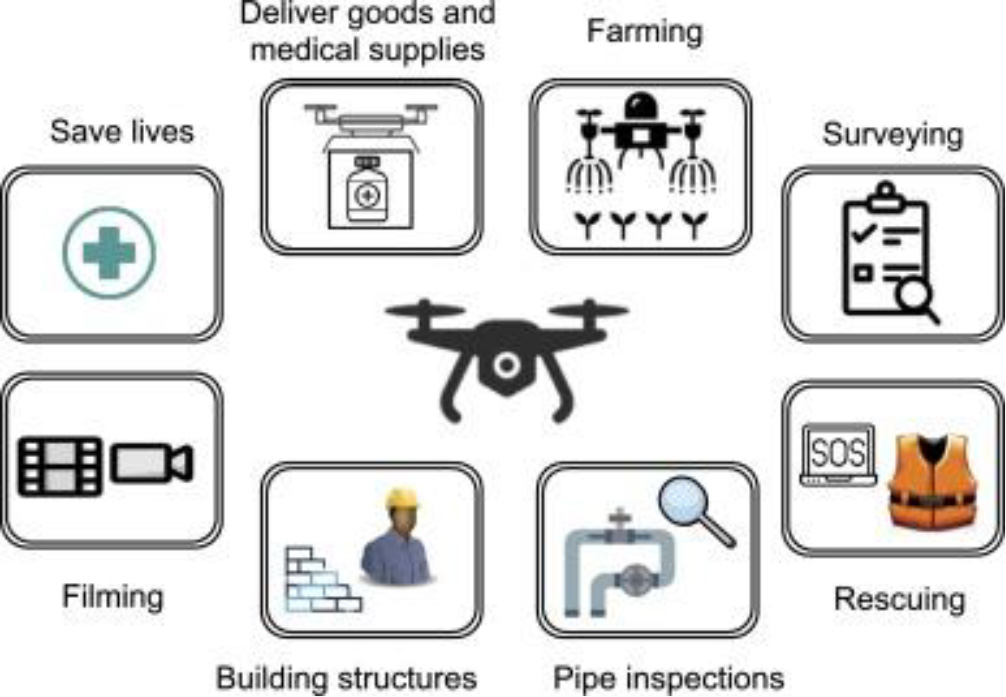
This paper introduces a novel algorithm by leveraging the concept of firefly algorithm. This algorithm has been modified by considering and removing some of the underutilized constraints present in its previous version and variants. For the verification of the proposed MFA, the simulated results are analyzed using various performance parameters and compared with the standard benchmark schemes. FANETs offer adaptability to cater to the network advancements. As the demands for higher throughput increase, FANETs provide efficient routing techniques to manage loads and minimize system vulnerabilities. Energy conservation is one of the key feature of FANET. Simulation results of the proposed algorithm reveal its capability to reduce packet drop rates, and delays while improving network throughput. The study employs the Network simulator NS-3.26 to conduct experimental tests utilizing NIAs. The study aims to present an overview of both limitations and strengths inherent in FANETs employing NIA-based routing schemes. This exploration may encourage researchers to further investigate the proposed algorithms applicability across diverse scenarios and applications. The key contributions of this work are as follows.
We have proposed a modified firefly algorithm (MFA) that significantly enhances throughput, packet delivery ratio (PDR), and End-to-End delay. We introduced the optimal clustering using MFA involves defining an objection function that considers various factors to enhance the performance within FANET. Validation of the proposed approach has been conducted through diverse performance parameters and comparisons with standard benchmark schemes.
The paper is organized into 5 main sections: Section 2 provides motivation and a review of related works in FANETs. Section 3 presents the network model. In Section 4, the experimental setup and proposed method have been discussed to achieve the objectives. Section 5 presents extensive simulation results and performance evaluations of routing protocols in FANETs. Finally, Section 6 concludes the paper, highlighting the improvements from the proposed approach and discussing the potential use of the proposed work.
Motivations
FANETs represents a groundbreaking technology that enables diverse applications across sectors like healthcare, agriculture, disaster management, and military operations. Their effective utilization necessitates robust routing protocols capable of managing their inherent complexities. While some algorithms like Optimized Link State Routing (OLSR) and Ad-hoc On-demand Distance Vector (AODV) are commonly used in FANETs, their suitability for this technology remains uncertain. The rise of Nature-Inspired Algorithms has triggered a significant shift in routing techniques, aiming to explore various aspects of the FANET routing protocols. This article conducts extensive simulations to analyze NIAs features, including packet delivery ratio, end-to-end delay, and throughput within FANETs. The primary objective of this literature survey is to optimize the selection of algorithms for routing in FANETs. This study aims to contribute towards the development of more efficient and seamless FANETs for real-time applications.
Related works
Flowchart of classification of FANET routing algorithms.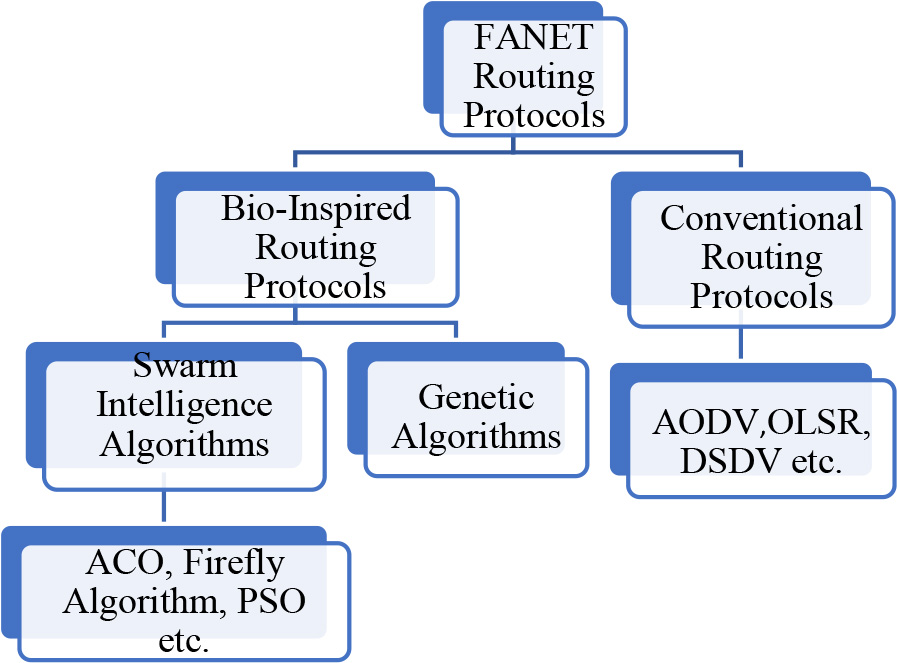
Nature-inspired algorithms have played a pivotal role in enhancing routing performance within FANETs. The aim is to thoroughly examine recent works on various routing protocols used in FANETs. The significance and distinctiveness of each contribution have been acknowledged in this subsection. Studies of routing algorithms in FANETs highlight Nature-inspired algorithms (NIAs) as a more prominent and efficient technique in advancing this technology. Within this subsection, we explore various NIAs-based routing protocols, such as Ant Colony Optimization (ACO) and Particle Swarm Optimization (PSO) depicted in Fig. 2. This subsection highlighted the efforts made to optimize the performance through routing techniques in FANETs. This article offers an extensive overview of the performance of FANETs using key performance parameters like packet delivery ratio (PDR), end-to-end delay, and throughput, which assess their effectiveness within the network.
The two most prominent Conventional Routing Algorithms used in FANETs are Ad-hoc On-demand Distance Vector (AODV) and Optimized Link State Routing (OLSR). When a new transmission is required, AODV introduces a delay in the creation of the route until it is established. As the network topology changes, the route breaks more frequently, which may potentially increasing overhead and latency. Nonetheless, the AODV remains one of the most widely used routing techniques. Optimized link state routing is a table-driven method aimed at enhancing the performance of FANETs. It employs a link-state algorithm to maintain the network’s routing information and updates its route information periodically. One of the drawbacks of this method is that it has an overhead from these periodic updates. However, the dynamic nature of FANETs limits the effectiveness of this algorithm. The network topology can change rapidly due to the unpredictable nature of the environment [3]. Conventional algorithms rely on network stability, which cannot adapt to these unpredictable scenarios. This may lead to poor routing decision and increased packet loss. Next, we will discuss and examine the features of NIAs in the following section to overcome the limitations of conventional routing algorithms. However, NIAs offer a new perspective to address the challenges encountered by FANETs and aim to solve such challenges more clearly and efficiently.
Swarm intelligence algorithms: Emulating nature’s collective wisdom
Due to the emergence of novel swarm intelligence (SI) algorithms that are inspired by the natural behaviors of swarms, they have gained widespread attention in the realm of FANET routing [4, 5]. An example of an algorithm that draws inspiration from ant foraging behavior is the ACO. It takes into account the various factors that influence a decision-making process [6]. For the last two decades, numerous researchers have been developing algorithms inspired by nature [7, 8, 9]. Studies demonstrate the advantages of ACO in improving the throughput and packet delivery ratio of FANETs [10]. Besides ACO, other Swarm Intelligence (SI) algorithms such as PSO and Firefly are also considered components of the same category. While they hold promise, further exploration and optimization are essential to unlock their full potential for FANET routing applications. In [11], authors proposed an improved algorithm based on particle swarm optimization (PSO) aimed at enhancing the lifetime of the cluster, delay, and energy consumption. As per the simulation outcomes, the suggested routing protocol is efficient on all the parameters as compared to the existing algorithm. However, in [12], authors proposed an algorithm that improves ACO via multipath data transfer. The algorithm aims to improve throughput, delay, and packet delivery in FANETs. Further advancements are presented by the authors in [13] and [14] , introducing Salp and the improved firefly algorithm to solve the problem of routing and enhance the performance of FANETs in terms of packet delivery ratio and throughput parameters.
Genetic algorithms: Evolutionary routing solutions
The use of genetic algorithms in FANETs involves optimizing routing through their emulation of natural selection processes. An enhanced genetic algorithm was proposed by the author of [15] and compared the performances with AODV and dynamic source routing (DSR) protocol. Outcomes of the proposed approach through rigorous simulated results, the proposed algorithm performs well in terms of its performance in various categories, such as throughput, delay, and overhead [16]. The authors of [17] and [18] noted through the study that increasing the radius of constraint is needed to improve the throughput of the proposed algorithm.
Recent advancements: Navigating the future of FANET routing
Recent research endeavors in FANET routing have extended beyond individual NIAs to explore hybrid algorithms and novel adaptations. Hybrid algorithms, which amalgamate the strengths of NIAs with conventional methods, hold significant promise in addressing the intricate routing needs of FANETs. A paper shows a study on nature-inspired algorithms the bee colony algorithm and the Moth and Ant algorithm by the authors of [19]. This paper shows how both algorithms are feasible for route planning in FANETs. Authors in [20]proposed an ACO based on Fuzzy logic to optimize routing in FANETs. One of the paramount concerns in FANETs is energy efficiency. Many new effective energy-saving algorithms have been proposed which include the Moth Flame algorithm, Grey Wolf Algorithm, and modified AntHocNet and Secure Waterfall protocol [21, 22, 23, 24].
Some of the major research gaps are identified from the extensive literature works:
Lack of consideration of the analysis of different parameters to enhance the network: The performance analysis of various performance parameters in different routing protocols is very important to make FANET more robust and optimized. This analysis helps us to identify the best network configurations and their constraints. Lack of finding the optimal routing based on various network parameters: Routing optimization in FANETs is an important aspect that involves the path selection strategy for information that is traveled from a source to a destination. The task has been complex to maintain network topology, delay, and reliability.
To overcome these gaps which are identified through extensive literature work, NIA-based routing algorithms have been used by the consideration of important performance metrics such as throughput, end-to-end delay, and packet delivery ratio. To solve such challenges faced in FANETs, we need to understand the constraints and demands that can help to make an efficient solution in FANETs.
Scenario illustration of FANETs framework.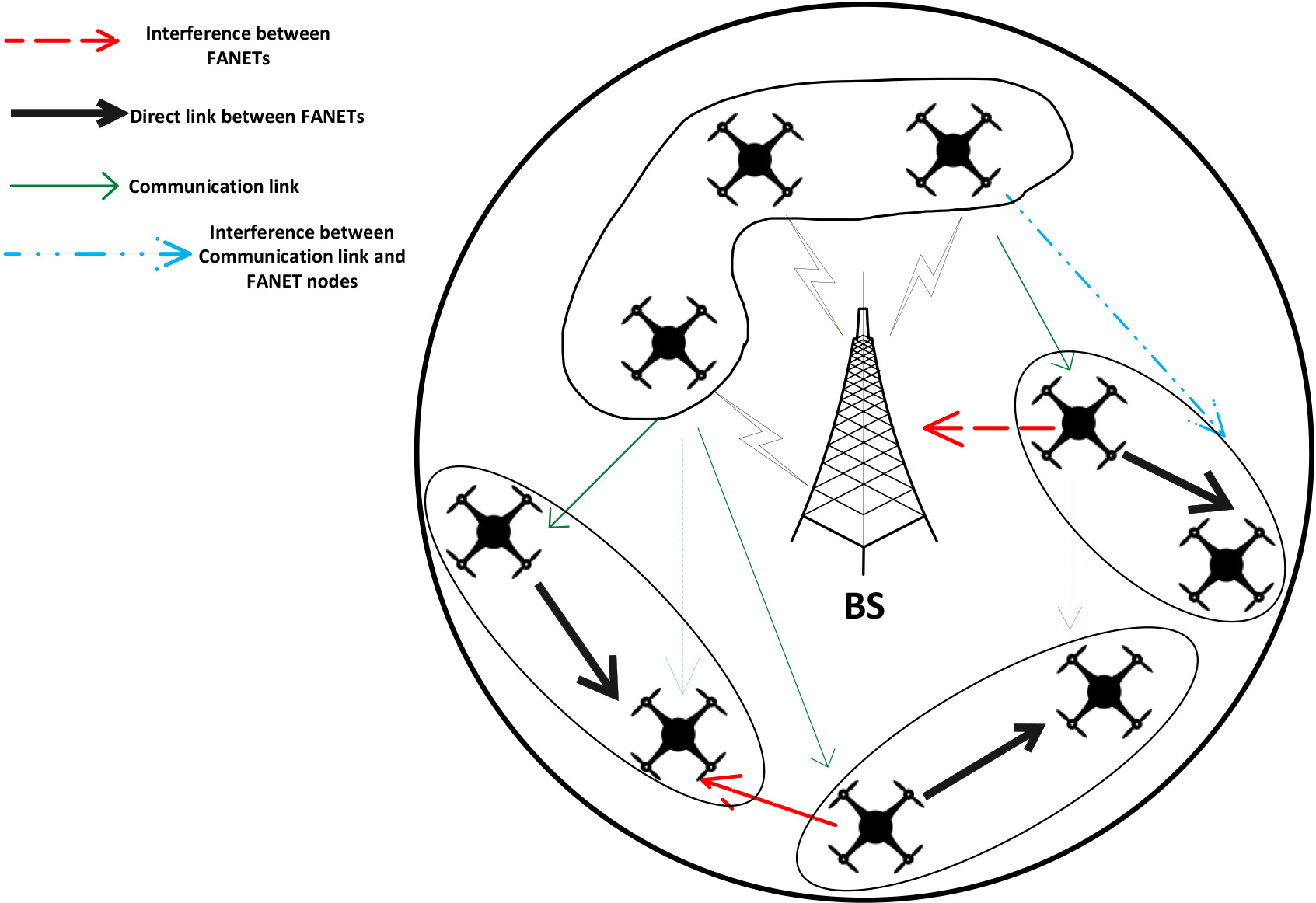
In this section, we discuss the network model description and the evaluation of key parameters to validate the effectiveness and performance of proposed algorithm in FANETs. Figure 3 illustrates a framework for conceptualizing FANET networks. The ad hoc UAVs are grouped within a cell to enhance FANET efficiency, of with the base station centrally located at the origin of the cell. A qualitative evaluation of primary features within the ad hoc UAV network was conducted, analysing the network’s weaknesses, distinctive attributes, and strengths. Grouping UAVs offers numerous advantages, including enhanced coverage, data aggregation, and reliability. Implementing and utilizing cluster-based routing networks (CBRNs) can pose challenges with larger networks. Routing protocols are currently under development with the help of jointly consideration of probabilistic and deterministic clustering techniques. A fusion of these techniques allows for efficiently designed networks meeting diverse service needs. Routing Protocols are divided into three categories: bio-inspired, dynamic, and hybrid types. Prioritized metrics for deterministic cluster-based routing protocols (CBRPs) can be used to determine the cluster head (CH). Figure 2 shows the classification of the various routing algorithms that are used in the FANET with further detailed discussions on their characteristics. Probabilistic algorithm aims to discover optimal routes for interconnected networks while extending their lifespan. This section delves into the CBRPs’ features based on the concept of probabilistic clustering, necessitating active selection and formation within this clustering approach.
The methods used were dynamics and evaluated effectively for making reliable communication with each other in FANETs. The following performance parameters have been considered in the FANETs framework to enhance the performance of the network using the proposed modified firefly algorithm which is discussed next.
Network End-to-End delay: End-to-end delays refer to the time taken for data transmission from the sender to the receiver. These delays can arise due to queue route complexity or the discovery process. The duration of the delay in message transmission from the source to the intended recipient is determined by the time taken for packets to reach the receiving end. Various factors can impact end-to-end delays, including the time taken to establish a route and the promptness of evaluating intermediate nodes.
Where end-to-end delay is denoted as
Throughput: If a significant amount of data is delivered successfully through the FANET system, our aim is to achieve high throughput. The count of successful packets denotes those reaching the destination node within a specific period. Greater throughput signifies the superior protocol performance.
Where
Packet Delivery Ratio (PDR): The ratio of the number of packets that the receiver will receive from the sender node is known as the packet delivery ratio. This parameter is calculated by comparing the number of packets that the source node received to the total number of available data packets. Mathematically, defined as:
where
Routing overhead: The routing overhead occurs when additional control packets are sent to ensure successful packet delivery. The number of control packets sent by each node is then compared with the arrival of packets at the receiver side of FANETs.
In this section, we will analyze and discuss the performance of NIAs within FANETs. Efficiently identify and control the FANET nodes through the extensive use of NIAs in FANETs. It helps in maintaining communication and stability between the nodes. Performance assessments are usually carried out by using network simulation tools or testing FANETs in real life. In the next subsection, the experimental setup of the proposed MFA algorithm for the performance analysis has been discussed in more detail. A network simulator (NS3.26) is used for the validation of proposed algorithm performances.
Experimental setup
In this section, the experimental setup of the proposed FANET framework using Network Simulator (NS-3.26) has been discussed. An experiment has been performed for the outdoor propagation.
Network Topology: Establishing a realistic FANET network topology was critical to ensure the validity of experiments. Scenarios were crafted wherein Unmanned Aerial Vehicles (UAVs) acted as network nodes, mimicking real-world implementations. Factors such as node mobility patterns, communication ranges, and terrain variations were considered, rendering our experiments highly representative of practical FANET deployments. Through comparative studies, we aimed discern the strengths and weakness of different NIAs. It helps to understand the deeper understanding of their potential applications. This study aims to enhance the performance of FANETs and optimize the efficiency of NIAs, enabling effective communicate among nodes and readiness to face the challenging environments.
Nature-Inspired Algorithms Selection: The selection of NIAs was based on a comprehensive literature review focused on identifying the most promising routing algorithms capable of diverse scenario adaptations. The three NIAs that were selected: Ant Colony Optimization, the Genetic Algorithms, and the Firefly Algorithm. These algorithms underwent thorough study and implementation within the NS-3.26 simulator, demonstrating high accuracy and adherence to their fundamental principles.
Following is a brief description of the algorithms considered majorly in NIAs for routing.
Ant colony optimization (ACO)
ACO is a swarm intelligence system that was modeled after the foraging abilities of ants. In ACO, a population of virtual ants iteratively constructs solutions to a problem, such as finding optimal routes in a network. Each ant probabilistically selects paths based on pheromone levels and heuristics. Over time, pheromone levels are updated based on the quality of the solutions found. The mathematical representation of pheromone update in ACO can be expressed as follows:
Where:
The mathematical model of the Ant Colony Optimization technique used in FANETs has been discussed in more detail in [23, 25].
The Firefly Algorithm draws inspiration from the flashing behavior of fireflies, used to attract mates. In this algorithm, each firefly represents a potential solution, and they adapt their brightness (fitness) and positions over iterations. Fireflies are attracted to brighter fireflies and move towards them in the search space. The mathematical representation of the Firefly Algorithm includes the following equations:
Brightness Update:
Movement of Firefly
Where
This paper introduces a modified firefly algorithm aimed at enhancing the performance of FANET routing through a clustering mechanism. The cluster structure comprises multiple nodes, each cluster having a cluster head that is determined by the residual energy of the nodes, with the cluster head possessing the highest energy being selected.
The modified firefly algorithm operates by initiating cluster formation and initialization of the node population. It establishes cluster within the network, appointing cluster head is confirmed, data transmission occurs solely using the proposed modified firefly algorithm. The algorithm should continuously monitor the residual energy during the transmissions’ aids in identifying potential new cluster heads. Additionally, the algorithm continuously evaluate the condition of the node population is essential.
Where the first term used in Eq. (7) is denoted by
The location of the base station must maintain its position through a system check. The available area of the wireless network has been evaluated as
where
The available network area is determined by the Eq. (9). The time frames and energy spent is defined as 0
The simulations have been carried out through NS3.26 by taking into account which we will discuss in the upcoming section in more detail. In Eq. (10), the calculation of the area is carried out according to the sites
This section presents the analysis of experiments exploring the utilization of nature-inspired algorithms in flying ad-hoc networks (FANETs). The calculation and comparison of various performance metrics, such as the packet delivery ratio (PDR), end-to-end (E2E) delay, and throughput, are discussed concerning different benchmark schemes. The NIA-based modified firefly algorithm was simulated using the NS-3.26 simulator with the aim of enhancing the performance of FANET through improved routing techniques. We have seen through the graphs presented in this section demonstrate that superior performance parameters for the proposed scheme compared to the benchmark schemes in this section. Benchmark schemes utilized in this study, include Ant Colony Optimization (ACO), Improved Artificial Bee Colony (IABC), and Existing Firefly Algorithm (EFA). Performance evaluation of MFA, ACO, IABC, and EFA algorithms was conducted based on various features. Table 1 exhibits the network simulation parameter values used in NS 3.26 for calculating performance parameters of FANETs. Simulation were performed to assess the impact of parameters on FANETs.
Network simulation parameters
Network simulation parameters
In this subsection, the performance of the proposed algorithm through various plots has been discussed and compared with benchmark schemes. Also, the performance has been verified for the proposed MFA for the FANET framework through experimental tests.
End-to-end delay vs number of nodes.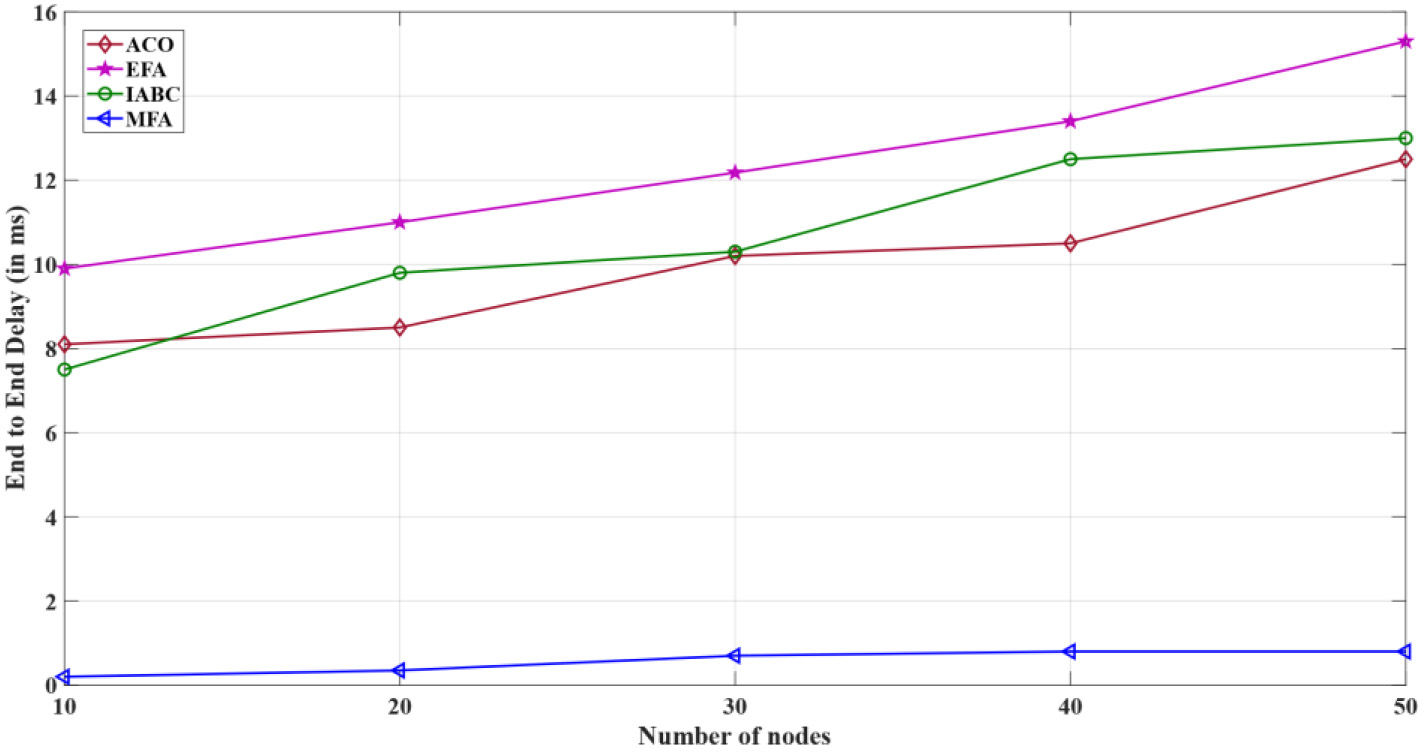
Figure 4 illustrates the graph of end-to-end delays versus when the number of node densities increases. The performances have been compared with benchmark schemes, such as ACO, IABC, and EFA. From Fig. 4, we have observed that the proposed MFA has a lower delay than those of EFA, ACO, and IABC schemes. The proposed modified firefly algorithm (MFA) performed well in the analysis of end-to-end delay. Figure 5 illustrates the current and proposed delivery ratios of protocols. Figure 5 depicts that the proposed MFAs deliver better than the benchmark schemes. The comparative analysis of the proposed MFA with other benchmark schemes provides a valuable impact on the algorithm’s performance when it comes to FANET routing. The proposed MFA is deployed with 50 nodes to achieve a PDR of 98%. This indicates its ability to maintain packet delivery in FANET scenarios.
Packet delivery ratio vs number of nodes.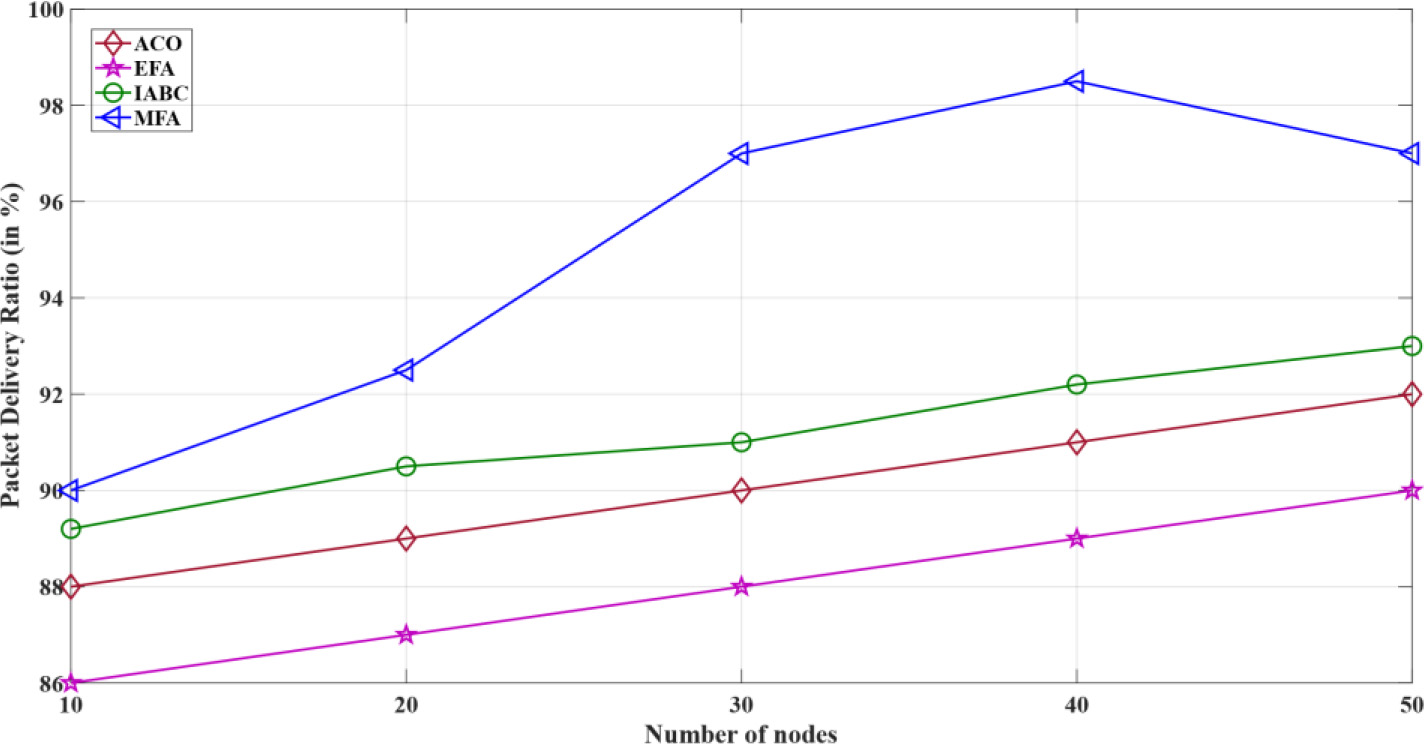
Throughput of FANETs vs number of nodes.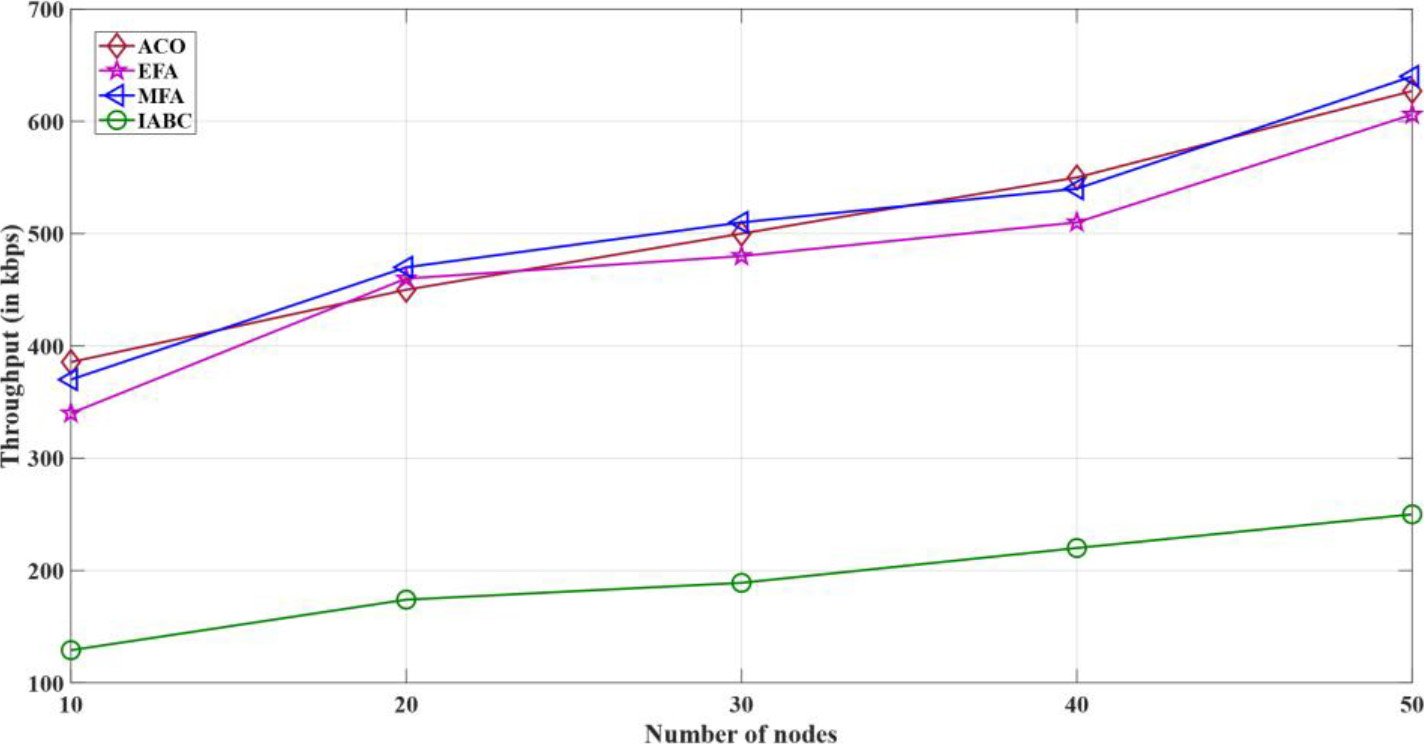
Figure 6 demonstrates the analysis of the throughput parameter while varying the number of FANET nodes. To assess the effectiveness of the proposed algorithm, a comparison was made with the benchmark schemes. The performance of the proposed algorithm achieves notably higher throughput compared to the other benchmark schemes. As depicted in Fig. 6, the proposed MFA algorithm demonstrates enhanced throughput. However, its performances significantly degrades when the number of nodes in a network exceeds 20 nodes. The proposed algorithm exhibits high throughput in scenarios where data transfer capacity is critical, such as disruption in the communication pathway and the unpredictable terrains. The overheads of the proposed scheme was evaluated across several variations in the speed of FANETs as depicted in Fig. 7. The number of bytes sent and received by the network is the parameter that determines the algorithm’s throughput. The proposed algorithm demonstrates overhead is minimum when the FANETs speed is 50 m/s.
The outcomes of our performance analysis have been summarized in Table 2, and present a detailed comparison of NIAs in various FANET scenarios.
The above table provides a comprehensive comparison between the algorithms based on key parameters including PDR, delay, and throughput. ACO exhibits a noteworthy 92% packet delivery rate alongside high throughput. MFA, with 645 kbps throughput, 98% PDR, and 0.9 ms E2E delay when the number of nodes varies from 10 to 50, emerges as a strong candidate for routing. IABC showcases a robust 97% PDR with a mere 13 ms delay, making it a compelling choice for routing. Notably, the EFA Algorithm experiences increased delay as the simulation area expands for a given number of nodes. The results of the study have revealed the effectiveness of different NIAs. MFA emerged as a notable performer.
The open challenges for the researchers to explore FANETs routing algorithm in different scenarios where the demand of higher throughput, minimum delay, low power consumption, and energy harvesting techniques are crucial parameters. Investigation and in-depth studies are essentials for the advancement in this field. The main considerations from this work and for the future perspective have been identified as
Performance Comparison of NIAs
Performance Comparison of NIAs
Overhead vs number of nodes in FANET.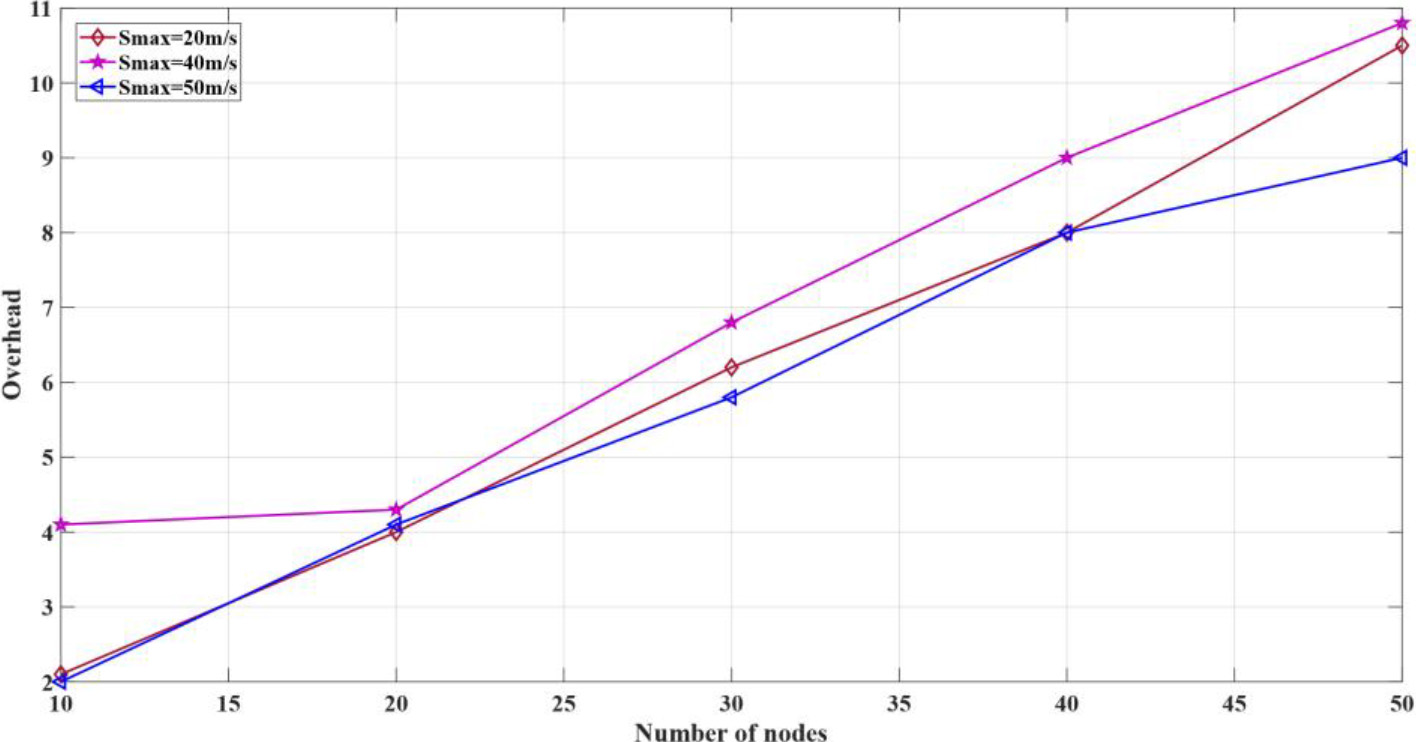
Transformation of Nature-Inspired Algorithms (NIAs) Various routing algorithms based on NIAs, such as ACO, IABC, and AntHocNET, have been studied to highlight the importance and scope of NIA in routing. Future research programs should explore the utilization of NIAs inspired by natural phenomena, like bird swarms and fish swarms, in FANETs. Introducing the new routing algorithms could address existing issues and offer enhanced solutions. Expedition of Energy-Efficient Routing Algorithms: Prioritization of Energy-harvested routing algorithms is crucial for FANETs. This study aims to achieve the optimal energy consumption, enabling adaptation to challenging environments. Revolutionary Hybridized Routing Algorithms: Integrating state-of-the-art techniques with conventional approaches has showcased the potential of the algorithms for addressing the routing complexities in FANETs. Hybrid routing techniques combine features of NIA-based routing techniques in FANETs, providing greater flexibility and more robust solutions in complex environments. The alteration from software to Hardware Implementations: Implementing NIA-based routing protocols in hardware marks a crucial step in advancing real-time applications. While simulations remain vital for evaluating scenarios, transitioning algorithms to hardware for real time implementation streamlines complex scenarios into manageable real-time applications. Hybridization of algorithms into hardware creates test beds for real-world scenario implementations.
In this work, we have studied various Nature-inspired algorithm (NIA) based routing techniques in FANETs. This study has helped us to understand the traits of the Genetic Algorithm and Swarm Intelligence with crystal clear concepts. The performance of various techniques was thoroughly studied through several simulations using the NS-3.26 Simulator. These methods underwent various measures, such as throughput, end-to-end delay, and packet delivery ratio. The findings of this study indicate that NIAs have the potential to enhance the efficiency of the FANET routing system. While the study identifies the modified firefly algorithm (MFA) as a promising candidate for FANET routing, it should not overshadow other NIAs capable of providing more niche applications, such as GAR and ACO. The characteristics of Swarm Intelligence algorithms make them an ideal choice for FANETs, being adaptable and self-sufficient, which are suitable for seamlessly integrating the aerial network’s dynamic demands. Many promising directions for further research will help push the field of this technology. The concept of hybrid algorithms involves merging the elements of NIAs and conventional routing techniques, unlocking new dimensions of adaptability and efficiency. Due to the energy-constrained nature of FANET networks, optimizing the algorithms for efficiency is a critical concern. Researchers have entered a new frontier which creates new opportunities to fulfil the gap in theoretical and practical deployment after shifting from simulation to hardware-based setups. The results demonstrate that the performance is more prominent for the proposed techniques over standard benchmark schemes. Performance parameters in terms of throughput show significant improvements compared to benchmark algorithms. The parameter packet delivery ratio for delivering resources to FANET users is 98%, the highest among other benchmark techniques, and achieved minimum end-to-end delay for the proposed scheme. In summary, as Flying Ad-Hoc Networks continue to evolve and find applications across an array of industries, the adoption of Nature-Inspired Algorithms for routing stands as a pivotal and transformative stride toward achieving the twin goals of efficiency and reliability in airborne communication.
Footnotes
Acknowledgments
There is no acknowledgment.
Conflict of interest
The authors declare that there is no conflict of interest.
Declaration of competing interest
The authors declare that they have no known competing financial interests or personal relationships that could have appeared to influence the work reported in this paper.