




Abstract
In today’s society, the application of multimedia data is increasing, and the accompanying data security is also an important issue. This paper will analyze the data security of multimedia network based on routing algorithm. The advantages of wireless local area networks (WLAN) and ad hoc networks are combined in wireless mesh networks (WMNs), which have steadily grown to be a reliable method of wireless broadband access. The application of multi RF and multi-channel technology improves the performance of WMN. However, the limitation that includes the number of wireless network interface cards and channels in the network, results in the great challenges ofrouting and channel allocation in multi RF and multi-channel WMN. Based on AODV algorithm, this paper proposes a new cross layer routing algorithm which is JRCA-AODV algorithm. The simulation results demonstrate that the JRCA-AODValgorithm can successfully increase multiRF multi-channel WMN throughput while lowering packet loss rate and network delay. Take the packet rate of 8 Mbps as an example, the network throughput based on JRCA-AODV algorithm is 1.14 times that of MRMC-AODV algorithm, the packet loss rate based on JRCA-AODV algorithm is 14.06% lower than that of MRMC-AODV algorithm, and the network time delay based on JRCA-AODV algorithm is 14.27% lower than that of MRMC-AODV algorithm. At the same time, JRCA-AODV algorithm can effectively reduce the probability of data loss caused by the competitive and shared access mechanism of the channel, improve the success rate of data transmission, thus reduce the probability of data eavesdropping and tampering in the process of repeated transmission, and improve the security of multimedia network data.This will provide a new direction for promoting the idea of multimedia data security.
Introduction
With the continuous evolution of wireless communication technology and the explosive growth of global mobile terminal equipment and communication services, intelligent terminals and high broadband services put forward higher technical requirements for wireless communication technology, which include high traffic density, millisecond end-to-end delay and high-speed mobility. At the same time, the emergence of various new wireless networks, such as short-range WLAN, wireless sensor network, Ad hoc network and WMN, makes people more convenient in communication, entertainment, shopping, learning and work [1, 2, 3]. There are a lot of wireless users due to the convergence and quick growth of computer technology and wireless communication technology [4]. Compared with wired network, the network structure of wireless network is more flexible and more convenient for users to install. However, wireless networks are also facing serious security problems. The specific manifestations of security threats include authorization violation, counterfeiting, eavesdropping, network flooding, tampering with information, denial, routing attack and replay [5]. Accordingly, the security risks of wireless network mainly include stealing information, unauthorized use of resources, stealing services and denial of service. In the current network era, people rely heavily on the network in their life, work and study. A large number of sensitive data related to transportation, finance, medical treatment and so on need to be transmitted through wireless network. Therefore, wireless network needs to provide users with high-quality communication services on the one hand, and ensure the security of the network on the other hand [6, 7]. The Aerial Relay Nodes (ARNs) in the proposed architecture are Unmanned Aerial Vehicles (UAVs) and Ground Roadside Units (RSUs). These ARNs provide extra communication resources and let ground vehicular nodes communicate with one another. Both ARNs and RSUs use LTE Vehicle-to-Everything (LTE-V2X) technology. Using a fuzzy multi-attribute decision-making (fuzzy MADM) technique, each ARN is placed as optimally as possible. Each RSU is responsible for managing a Local Virtual Resource Pool (LVRP) that comprises Shared Radio Blocks (SRBs) and Local Radio Blocks (LRBs) in terms of network architecture. Concurrently, a Virtual Resource Pool (VRP) that houses the SRBs of the RSUs is managed by an SDN controller [26]. This research proposes a 5G-VCC network slicing technique that prioritizes energy economy and quality of service for automotive applications. Based on QoS and energy considerations, it assesses user service satisfaction. Resource Blocks (RBs) are assigned to user services by the current Point of Access (PoA) if the satisfaction level is higher than a certain threshold. If not, more RBs are committed to meeting service needs from the SDN controller’s Virtual Resource Pool (VRP). Through the use of an SDN controller and a Management and Orchestration (MANO) entity, the plan coordinates the process while preventing disruption from nearby PoAs [27]. The system presented in this article uses the current Point of Access (PoA) to distribute telecommunication resources to support user services in the event that the available connection throughput above a predefined service threshold. In contrast, the PoA commits more resources from a Virtual Resource Pool (VRP) located at the Software-Defined Networking (SDN) controller to satisfy the necessary services if the connection throughput drops below the designated threshold. The recommended method performs better when benchmarked against cutting-edge algorithms in terms of throughput, packet loss ratio, jitter, and end-to-end latency [28].
WMN has the advantages of high reliability, low interference, self-organization, self-healing, multi-hop and so on. Taking WMN as an example, this paper first introduces the characteristics of WMN, and the characteristics of routing and the classification of routing protocols. Then, the channel allocation and routing of multi RF and multi-channel WMN are analyzed, and a cross layer routing algorithm is built. Finally, through simulation, the network performance and data security based on cross layer routing algorithm are studied.
Multi RF and multi-channel WMN
WMN
WMN is a new wireless network technology based on WLAN and mobile Ad hoc network. It not only has broadband wireless network structure, but also has the characteristics of self-organization, self-healing and multi hop [8, 9, 10]. WMN includes two types of nodes, which are wireless mesh router node and wireless mesh terminal node respectively. Wireless mesh router has the functions of gateway and repeater on the one hand, and it has the special function of supporting WMN on the other hand. The two roles of a wireless mesh terminal node are router and host. As a router, nodes must execute pertinent routing protocols and take part in routing tasks including route management and discovery. On the one hand, the node runs necessary applications as the host [11, 12, 13]. The topology of WMN is grid, and the typical implementation modes include infrastructure grid mode, end-user grid mode and hybrid mode. Among them, the infrastructure network model has the advantages of low construction cost, wide coverage and high reliability, but it can’t directly realize the communication between nodes. When the number of nodes is limited and there is no need to connect to the core network, the end user network mode is implemented [14].
WMN is quite different from WLAN. Taking the topology as an example, the differences between them are shown in Table 1.
The differences of topologybetweenWMN and WLAN
The differences of topologybetweenWMN and WLAN
Despite being built on the principles of mobile ad hoc networks, WMN and these networks differ in a few ways, as Table 2 illustrates.
WMN has the characteristics of rapid deployment, easy installation and flexible structure, which makes its scale expand continuously. However, for the WMN with single radio frequency (RF) and single channel, there are a large number of concurrent transmissions between adjacent nodes, resulting in serious interference and sharp decline of network performance [15]. In order to improve the performance of access to large-scale mesh networks, some scholars have proposed the application of multi RF and multi-channel technology to WMN. Multi RF and multi-channel WMN can configure multiple radio frequencies for nodes, and then make each radio frequency work in different channels through channel allocation algorithm [16, 17].
The differences between Ad hoc network and WMN
The schematic diagram of single RF single channel and multi-RF multi-channel wireless mesh network.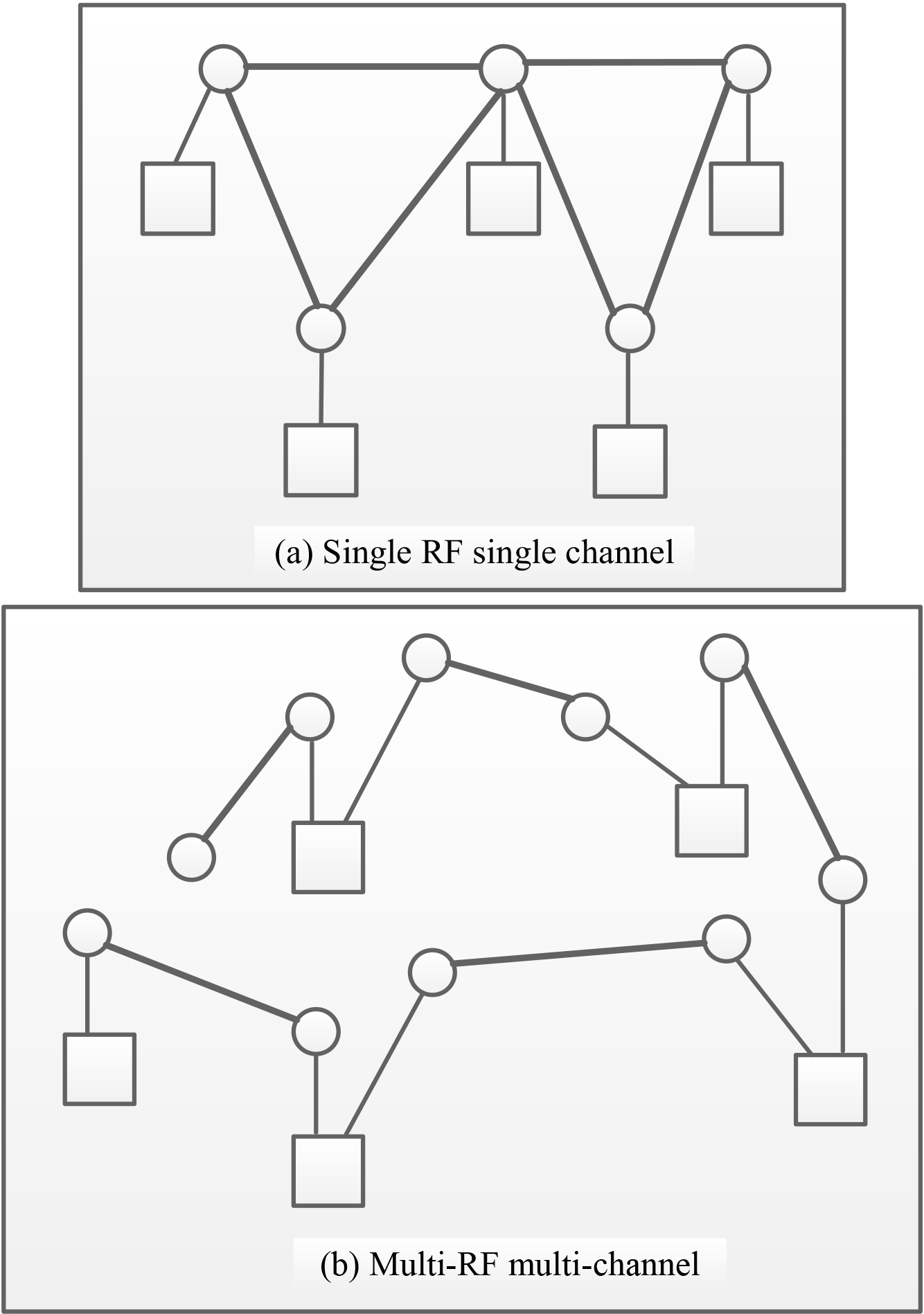
For the Multi RF and multi-channel WMN, multi RF means that there are multiple wireless network interface cards available for nodes in the network, and the communication between RF is completely independent. Multi-channel means that there are multiple available channels in the network. IEEE802.11b/g and 802.11a standards specify three and twelve orthogonal channels and non-orthogonal channels for adjacent nodes to use at the same time. The schematic diagram of single RF single channel wireless mesh network and Fig. 1 depicts a multi-RF, multi-channel wireless mesh network [18, 19, 20].
In wireless networks, the use of several channels guarantees that neighboring connections use different channels. This method greatly reduces the effects of interference-induced channel capacity attenuation, increasing the network’s available bandwidth. In the multi-channel wireless network environment, if each node has only a single RF, each RF needs to constantly switch channels when communicating with different nodes [21, 22, 23]. This will cause the network topology and interference to change from time to time, thus makes the load balancing and guarantee complicated. In the multi-channel wireless network using multi RF, each RF has independent and physical layer characteristics, which can facilitate routing and coordinate the communication between different nodes.
Multi RF and multi-channel WMN has the following advantages [24]:
Multi RF nodes can receive and transmit data at the same time. More RF spectrum can be used by wireless networks. Using RF with different broadband range and attenuation characteristics can improve the self-healing ability, connectivity and network performance of the network. Cheap hardware equipment provides a prerequisite for the large-scale network.
For multi RF WMN, the shortest path algorithm can’t meet the needs of network routing. If only the path length is considered and the adjacent links can’t be guaranteed to use different channels, the shortest path algorithm is not suitable for multiRF and multi-channel network environment. The algorithm can select the path in different nodes, on the other hand, it needs to select the channel and RF on the path [21, 22, 23]. In this way, it can’t only balance the network load, but also ensure that adjacent links use different channels to avoid the interference between links. In addition, in the process of RF and channel changes, in order to maintain good network performance, cross layer design needs to be considered. That is, MAC, routing protocol, transmission protocol and even application layer need to interact with the physical layer effectively to adapt to characteristics. The network needs to adapt to the changing service types and their quality of service requirements, and support the changes of network topology [22].
The flow chart of JRCA-AODV algorithm.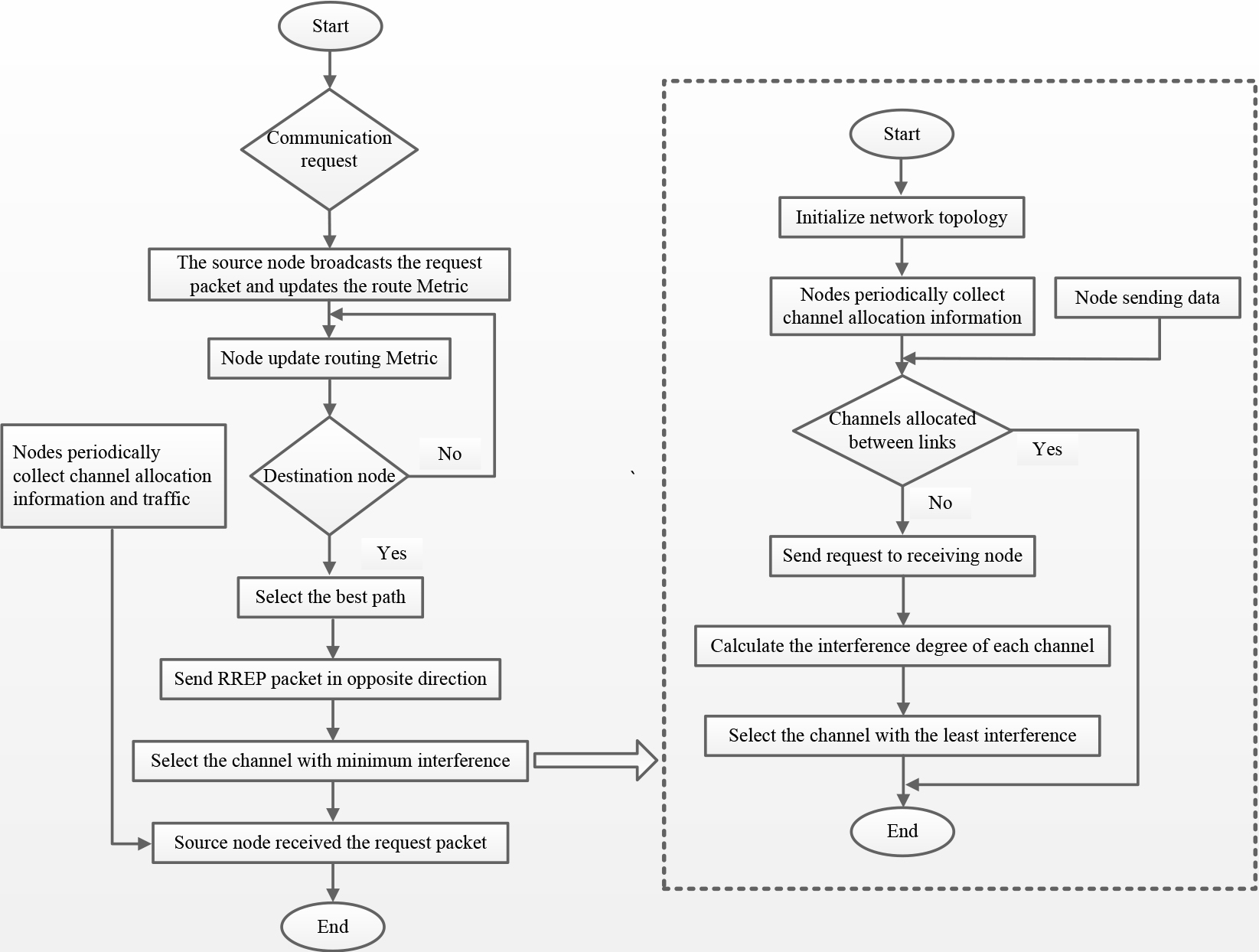
Generally speaking, cross layer design is mainly realized by two methods: (1) When optimizing MAC layer or network layer, not only the optimization parameters of this layer, but also the relevant parameters of another layer are considered to realize information interaction and sharing; (2) In cross layer channel allocation, MAC layer and routing layer are integrated for overall optimization [20].
Due to the similarity between Ad hoc network and WMN, AODV algorithm, which is widely used in Ad hoc networks, is generally applied to WMN in previous studies. AODV algorithm is a classical reactive routing protocol, which can directly reflect the number of hops experienced by the data flow before reaching the physical layer transmission rate, bit error rate and other parameters between different links, nor does it consider the interference in the network [23, 24]. Therefore, when applied to WMN, AODV algorithm can’t give full play to the advantages of multi-channel. Based on AODV algorithm, some scholars proposed MRMC-AODV algorithm. This algorithm is an on-demand routing algorithm, which uses static channel allocation algorithm to allocate channels for each node, and then uses AODV algorithm. The operation of MRMC-AODV algorithm is simple, but the network connectivity is not high because the allocation of interface channels is fixed. MRMC-AODV algorithm allocates the channel first and then selects the route, which may lead to a waste of RF resources. In addition, AODV algorithm adopts the minimum hop routing and ignores the link quality, which may lead to serious link congestion and reduced communication quality. According to the above analysis, for multi RF and multi-channel WMN, the dynamic channel allocation algorithm and MAC layer parameters need to be considered at the same time. Therefore, this paper proposes a new cross layer routing algorithm that is JRCA-AODV algorithm. This algorithm is based on distributed dynamic channel allocation algorithm and the principle of minimum interference, and considers load balancing routing parameters. The flow chart of JRCA-AODV algorithm is shown in Fig. 2 [25].
Where, Metric is shown in Eq. (3) [23].
Where, ETT is the expected transmission time.
The calculation method of channel interference degree
Where,
For multi RF and multi-channel WMN, in order to study the network communication servicequality and network data security based on the cross layer routing algorithm proposed in this paper, multi RF and multi-channel expansion is carried out based on the wireless nodes of NS. The outcomes are shown in Table 3 after the simulation settings have been adjusted.
The schematic diagram of single RF single channel and multiRF multi-channel wireless mesh network
The schematic diagram of single RF single channel and multiRF multi-channel wireless mesh network
In order to study the network communication service quality and network data security based on JRCA-AODV algorithm, taking MRMC-AODV algorithm as the comparison object, the changes of network throughput, end-to-end delay and packet loss rate of the two algorithms are studied by changing the transmission rate.
The Variation of throughput with packet rate.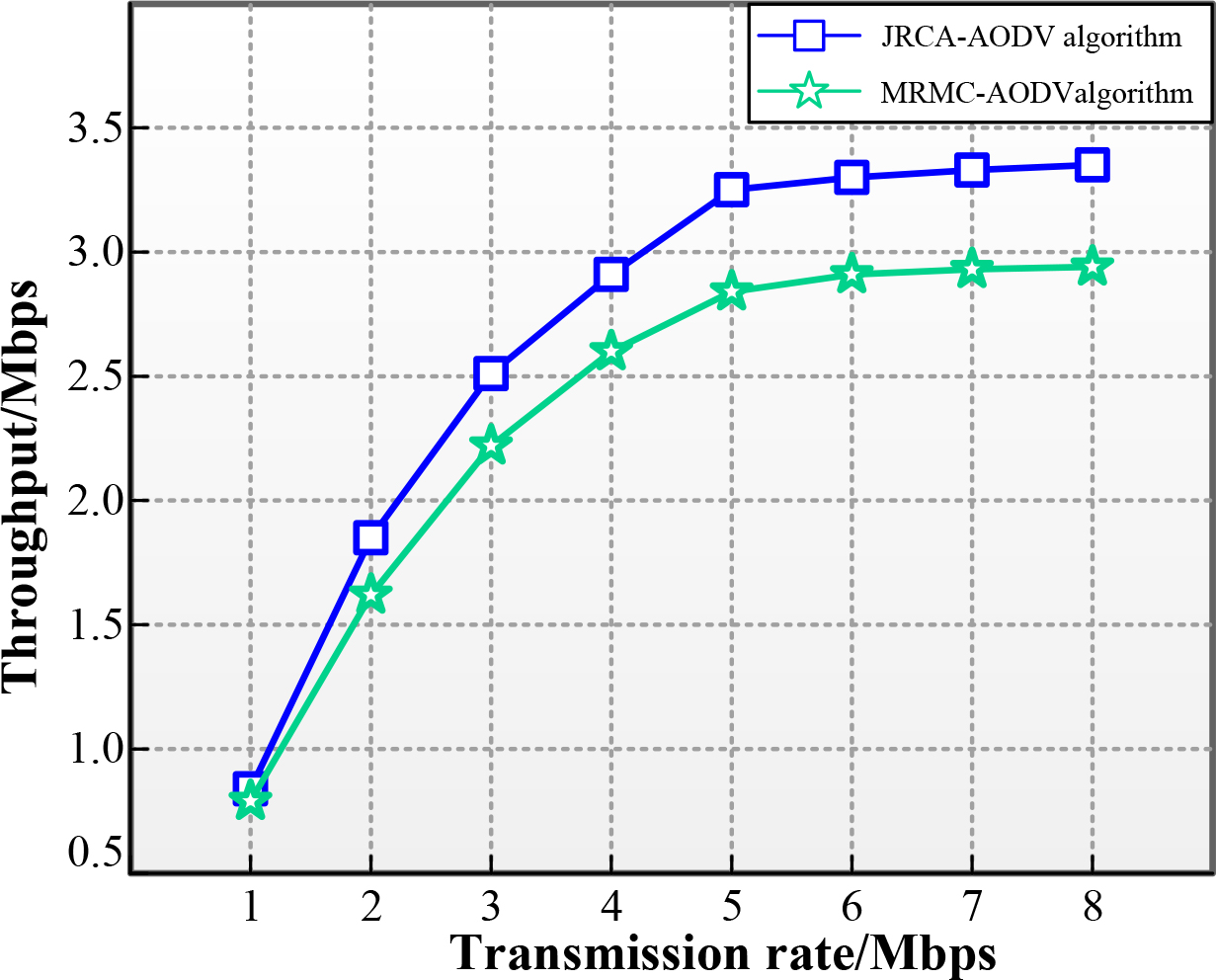
When the packet rate increases from 1 to 8 Mbps, the network throughput comparison results of RCA-AODV algorithm and MRMC-AODV algorithm are shown in Fig. 3.
It can be found that:
When the packet rate increases from 1 to 8 Mbps, with the increase of packet rate, the network throughput based on JRCA-AODV algorithm increases from 0.84 to 3.35 Mbps, and the network throughput based on MRMC-AODV algorithm increases from 0.79 to 2.94 Mbps. With the increase of the packet rate, the network throughput of two algorithms increases gradually, but the growth rate decreases gradually. In addition, the growth rate of network throughput based on JRCA-AODV algorithm is higher than that of MRMC-AODV algorithm. When the packet rate is 2 Mbps, the network throughput based on JRCA-AODV algorithm is 1.14 times that of MRMC-AODV algorithm. When the packet rate is 4 Mbps, the network throughput based on JRCA-AODV algorithm is 1.12 times that of MRMC-AODV algorithm. When the packet rate is 6 Mbps, the network throughput based on JRCA-AODV algorithm is 1.14 times that of MRMC-AODV algorithm. When the packet rate is 8 Mbps, the network throughput based on JRCA-AODV algorithm is 1.14 times that of MRMC-AODV algorithm. It shows that JRCA-AODV algorithm can effectively improve the network throughput.
The Variation of packet loss rate with packet rate.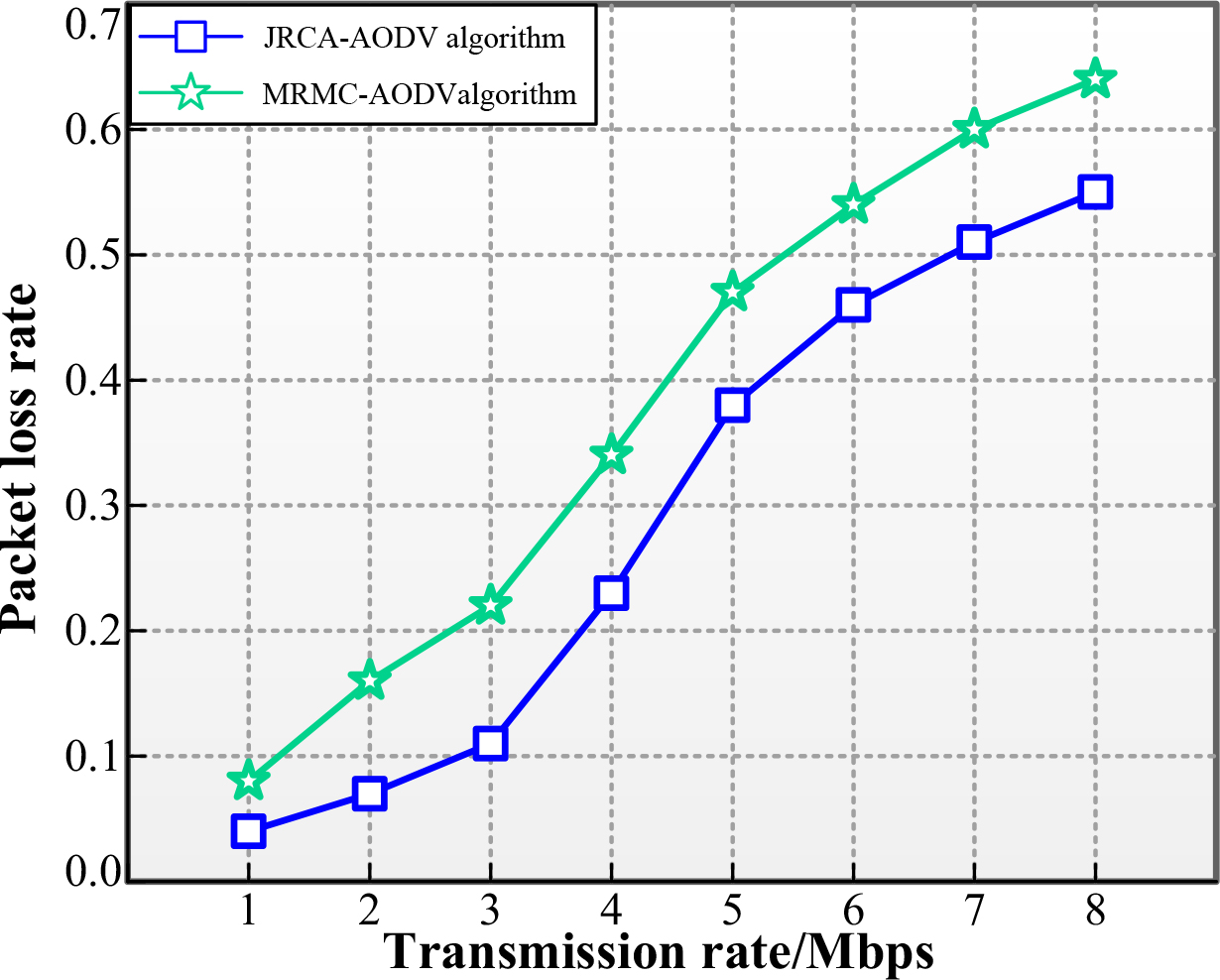
When the packet rate increases from 1 to 8 Mbps, the comparison results of packet loss rate between JRCA-AODV algorithm and MRMC-AODV algorithm are shown in Fig. 4.
It can be found that:
When the packet rate increases from 1 to 8 Mbps, the network packet loss rate based on JRCA-AODV algorithm and MRMC-AODV algorithm increases with the increase of packet rate. When the packet rate is 2 Mbps, the network packet loss rate based on JRCA-AODV algorithm is 56.25% lower than that of MRMC-AODV algorithm. When the packet rate is 4 Mbps, the network packet loss rate based on JRCA-AODV algorithm is 32.35% lower than that of MRMC-AODV algorithm. When the packet rate is 6 Mbps, the packet loss rate based on JRCA-AODV algorithm is 14.81% lower than that of MRMC-AODV algorithm. When the packet rate is 8 Mbps, the network packet loss rate based on JRCA-AODV algorithm is 14.06% lower than that of MRMC-AODV algorithm. It shows that compared with MRMC-AODV algorithm, JRCA-AODV algorithm can effectively reduce the network packet loss rate.
The Variation of delay with packet rate.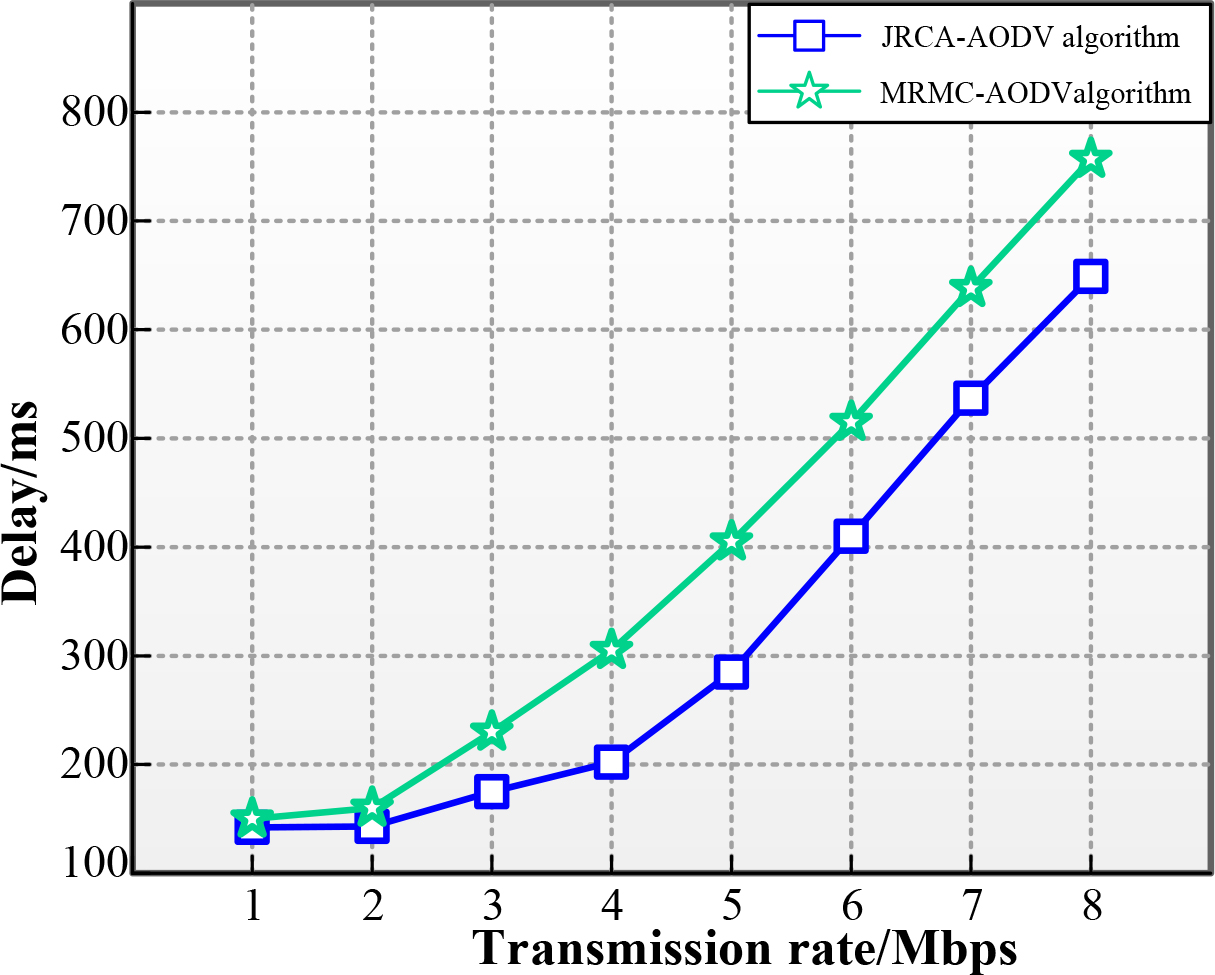
When the packet rate increases from 1 to 8 Mbps, the networkdelay comparison results of JRCA-AODV algorithm and MRMC-AODV algorithm are shown in Fig. 5.
It can be found that:
When the packet rate increases from 1 to 8 Mbps, the network delay based on JRCA-AODV algorithm and MRMC-AODV algorithm increases with the increase of packet rate. When the packet rate is 2 Mbps, the network time delay based on JRCA-AODV algorithm is 10.63% lower than that of MRMC-AODV algorithm. When the packet rate is 4 Mbps, the network time delay based on JRCA-AODV algorithm is 33.77% lower than that of MRMC-AODV algorithm. When the packet rate is 6 Mbps, the network time delay based on JRCA-AODV algorithm is 20.39% lower than that of MRMC-AODV algorithm. When the packet rate is 8 Mbps, the network time delay based on JRCA-AODV algorithm is 14.27% lower than that of MRMC-AODV algorithm. It shows that compared with MRMC-AODV algorithm, JRCA-AODV algorithm can effectively reduce network delay.
According to the above analysis, it is found that JRCA-AODV algorithm can effectively improve the throughput of multi RF and multi-channel WMN, reduce the packet loss rate and delay of the network, effectively reduce the data loss probability caused by the channel competitive shared access mechanism, and improve the security of multimedia network data.
In order to solve the problems of routing and channel allocation in multi RF and multi-channel WMN, a new cross layer routing algorithm which is JRCA-AODV algorithm is proposed in this paper. The simulation results show that when the network parameters are consistent, if the packet rate is 8 Mbps, the network throughput based on JRCA-AODV algorithm is 1.14 times that of MRMC-AODV algorithm, the packet loss rate based on JRCA-AODV algorithm is 14.06% lower than that of MRMC-AODV algorithm, and the network time delay based on JRCA-AODV algorithm is 14.27% lower than that of MRMC-AODV algorithm. It shows that JRCA-AODV algorithm can improve the network performance of WMN, reduce the data loss probability caused by the competitive shared access mechanism of channel, and improve the security of multimedia network data.
Data availability
The data used to support the findings of this study area vailable from the corresponding author upon request.
Funding statement
This study did not receive any funding in any form.
Footnotes
Conflict of interest
The authors declare no conflicts of interest.