




Abstract
This article presents a selective literature review of Analytics Intelligent Decision Technologies Systems (Analytics IDTS) developed to support decision-making in business and public organizations, with a particular focus on the global COVID-19 pandemic. We select Analytics IDTS published in 2019–2020 and evaluate them with an Analytics IDTS Design and Evaluation Framework. We include the types of Analytics IDTS, their decisional services, architectural capabilities, and support for phases in the decision-making process. Results are shown for 33 articles in the general Analytics domain and 71 articles in the focused Public Health domain applied to COVID-19, including how these Analytics IDTS were architected and utilized for decision making. Research in descriptive and predictive models is evident in Public Health COVID-19 research reflecting the lak of knowledge about the disease, while predictive and prescriptive models are the primary focus of the general Analytics domain. IDTS in all disciplines rely on Algorithmic decision services and Heuristic Analysis services. Higher-level decisional Synthesis and Hybrid services such as design, explanations, discovery, and learning associated with human decision-making are missing in most types of decision support, indicating that research in Machine Learning and AI has many growth opportunities for future research.
Keywords
Introduction
The COVID-19 pandemic is a public health crisis that has had a concomitant effect on economic and social dimensions worldwide [1, 2]. Globally, as of April 7, 2021, there are over 132 million confirmed cases of COVID-19 reported to the World Health Organization [3]. In response to the ongoing pandemic, governments closed their borders, declared sudden or phased lockdowns in their countries, and implemented quarantine policies for social distancing and isolation, all of which have led to dramatic changes in how organizations across industries act and make decisions [4, 5, 6].
Organizations of different sizes in different industries and countries are confronted with many short-term and potentially long-term challenges, such as safety and health, rules and regulations, value chain and supply chain, the workforce, consumer demand, sales, and marketing [5]. Decision-makers and policymakers around the globe face an urgent need to reframe and leverage their decision-making strategies under the threat of pandemics like COVID-19. Multiple efforts on how computational technologies can help cope with the damage are currently underway in the research arena of intelligent decision support systems. In this paper, we investigate ways that Analytics Intelligent Decision Technologies Systems (Analytics IDTS) can help address critical issues in the context of a global crisis such as COVID-19 [7, 8, 9].
IDTS are defined as information systems utilizing intelligent technologies to enhance the capabilities of decision-makers in understanding a decision problem and selecting a sound alternative [10]. Traditional decision support systems are usually implemented with digital storage and information retrieval systems. Analytics IDTS are enhanced for optimal decision support with intelligent and analytics technologies, such as ontologies, fuzzy cognitive maps, case-based reasoning, agent-based systems, heuristic ruled-based systems, natural language interfaces, classic and modern data mining, and machine learning to offer additional support [11]. These capabilities have frequently been applied to healthcare and crisis management [10, 12, 13, 14]. Accordingly, the ongoing COVID-19 outbreak has revealed countless new themes, concepts, risks, heuristics, rules, and big data that demand updated and enhanced Analytics IDTS to support decision-makers effectively, efficiently, and ethically [9, 15, 16, 17, 18, 19, 20].
Motivated by the emerging challenges as well as the lack of practical transference of applying Analytics IDTS in the global pandemic, we conduct a selective literature review [21] of the applications and emerging trends of Analytics IDTS for the 2019–2020 time period to provide an updated Analytics IDTS Design and Evaluation Framework including the types of systems, their decisional services, architectural capabilities. We analyze the systems with a generic 5-phased decision-making process to report descriptive and quantitative findings for identified papers in the general Analytics domain and focused Public Health domain for COVID-19. We provide an analysis of how these Analytics IDTS were architected and used and then develop recommendations for applying Analytics IDTS to facilitate decision-making in the global COVID-19 pandemic. The results of this study provide frameworks that can assist Analytics IDTS researchers. Practitioners and designers are provided recommendations on using IDTS to cope with global pandemic challenges and crises.
The remainder of this paper is structured as follows: Section 2 provides a summary of the theoretical background of intelligent decision technologies and depicts an adapted Design and Evaluation Framework for applying relevant Analytics IDTS tools and capabilities. Section 3 reports a selective review to identify relevant studies during the 2019–2020 period addressing the themes of COVID-19 and Analytics IDTS. Section 4 reports the results of the review and a discussion of Analytics IDTS applications and implications and for supporting organizations in the global pandemic. Finally, Section 5 concludes with research limitations, recommendations, and conclusions.
Theoretical background
Review of intelligent decision technologies systems (IDTS)
Decision Technologies Systems (DTS) are defined as any computer-based system designed to support several or all phases of a decision-making process [22, 23, 24, 25, 26, 27, 28]. DTS have their origin in Decision Support Systems (DSS), which emerged in the early 1970 s and evolved during the past half-century [23, 27, 28, 29, 30]. More recently, the rise of the Internet of Things (IoT) or the Industrial Internet together with accelerated access to large amounts of data enabled the data-intensive DTS trend. Intensively data-driven systems and methods, such as Analytics, have been proposed to improve new and real-time business decisional-making processes. According to Delen and Demirkan [30], Analytics refers to a set of traditional and advanced decision-making tools for transforming data to information and knowledge usable for decision-makers.
Such innovative development has led to the concept of Analytics DTS, described as “the scientific process of transforming data into insight for making better decisions” according to the INFORMS Society [31]. Similarly, Power et al. [32, p. 51] defined Analytics DST as “a systematic thinking process that applies qualitative, quantitative, and statistical computational tools and methods to analyze data, gain insights, inform, and support decision-making.” Specifically, when the core capabilities of the Analytics DTS integrate AI-based mechanisms, such systems can be referred to as Analytics Intelligent DTS or Analytics IDTS. These Analytics IDTS are designed to enhance generic DTS by incorporating more complete data representations, information, and knowledge models, and more intelligent processing algorithms than traditional systems [27, 33].
Analytics IDTS framework [45]
Analytics IDTS framework [45]
Analytics IDTS can be categorized into three groups based on the analysis methods they utilize: Descriptive, Predictive, and Prescriptive [30]. Descriptive systems primarily answer the question ‘what happened?’ by providing statistical and visual descriptions of historical data. Examples of these systems are Data Warehouse-based Business Intelligence tools (DW/BI) and Executive Information Systems (EIS) that provide standard, ad-hoc, on-demand, and/or interactive querying, reporting, and data visualization. In contrast, predictive Analytics IDTS attempt to answer the question ‘what will happen?’ by analyzing historical data to make predictions about the likelihood of future outcomes. Mathematical/statistical models such as linear and logistic regression, and machine learning models such as neural networks, help discover patterns and trends that suggest future states. Examples of predictive systems are Data Mining (DM) and Business Statistical Analytics DSS (BSA). Finally, prescriptive Analytics IDTS utilize mathematical/statistical models to answer the question ‘what should happen?’. For example, methods such as optimization can be applied to prescribe the best course of action when making tradeoffs between a goal and the constraints of a problem. In practice, some systems embed these types of support, which involve Analytics and Heuristic Optimization methods. For example, Knowledge Management Systems (KMS), Expert Systems or Knowledge-based Systems (ES/KBS), Decision Support Systems (DSS), Group Decision Support Systems (GDSS), and Intelligent DSS (i-DMSS).
Table 1, based on [45], summarizes the leading decision support characteristics provided by various types of classical and modern Analytics IDTS types and their explicit (using the symbol •) and implicit (using the character
Taxonomy of IDTS decisional services [28]
Analytics IDTS design and evaluation framework.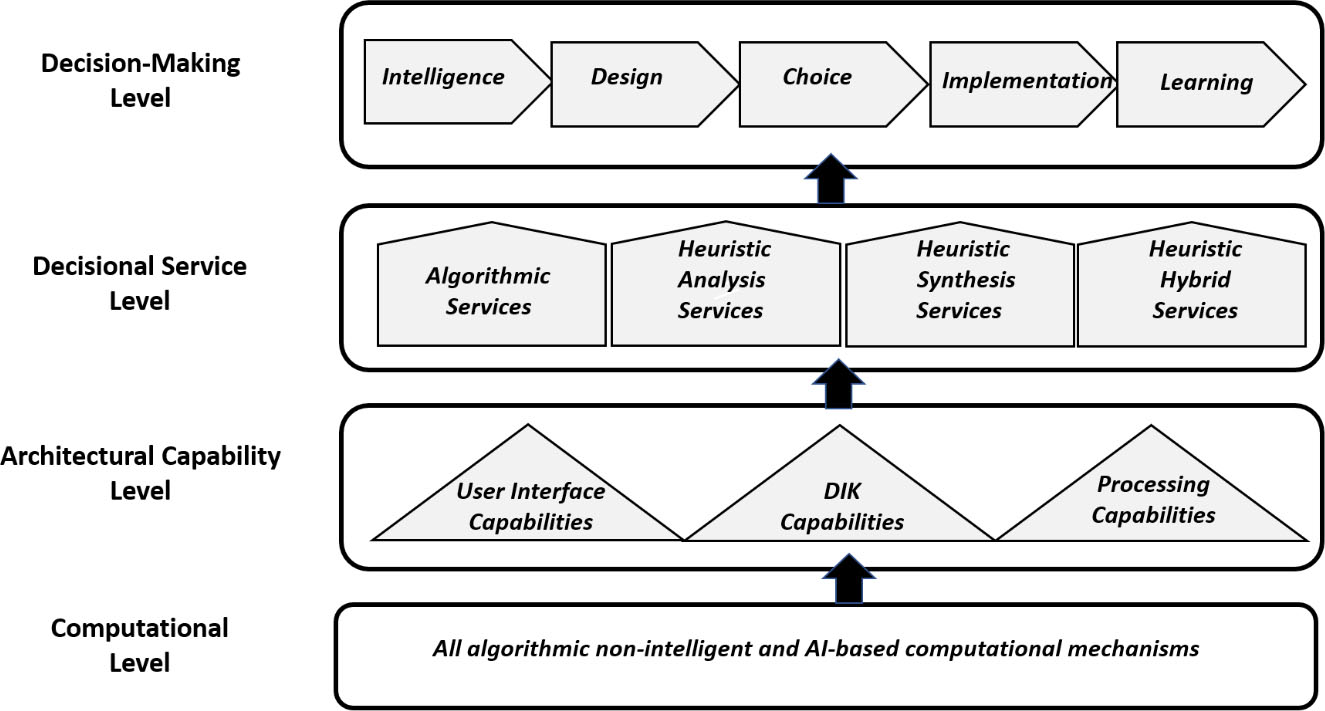
The Analytics IDTS Design and Evaluation Framework has been derived from the intelligent DMSS Design and Evaluation Framework (IDEF-i-DMSS) reported in [27]. IDEF-i-DMSS was elaborated to integrate the DMSS literature with the Artificial Intelligence (AI) literature to improve designs of i-DMSS, as well as providing an architectural evaluation framework. The underlying theoretical premise of the IDEF-i-DMSS framework, adapted in this study as the Analytics IDTS Design and Evaluation Framework, proposes that decision-making phases and steps can be enhanced with decisional services supported by architectural capabilities implemented computational mechanisms. Figure 1 illustrates the framework.
IDTS Architectural Capability Levels [46]
IDTS Architectural Capability Levels [46]
The Decision-Making Level shows the decision-making phases based generically on Simon [24]. The stages are Intelligence, Design, Choice, Implementation, and Learning. The literature [22, 23, 24, 25, 26] details the steps in the phases such as detecting the problem, gathering data, formulating the problem, classifying and building the model, validating and evaluating the model, performing sensitivity analysis, presenting results, task planning and monitoring, analyzing and synthesizing the outcome and process. Decisional services support DMP phases and steps by the second level, the Decisional Services Level. Four categories of decisional services are proposed: Algorithmic, Heuristic Analysis, Heuristic Synthesis, and Hybrid Services. Table 2 shows a suggested taxonomy of the decisional services at a high level of abstraction. Decisional services are the building blocks for designing an IDTS by selecting the types of services needed for support, and only the services required may be available. The third level, the Architectural Capability Level, includes the User Interface (UI), Data-Information-Knowledge (DIK), and Processing (P) capabilities provided by implementing computational components. The UI and DIK capabilities are based on the general and standard structure for a DMSS [34, 35]. The P capability is based on the levels of intelligence embedded in the computational mechanisms [36, 37].
Table 3 presents a description of UI, DIK, and P capabilities. Table 3 also reports the ordinal conceptual scales to measure the degree of UI capability, structure in the DIK capability, and the degree of intelligence embedded in the computational mechanisms in the IDTS. It must be noted that any support level usually includes or can include capabilities from the previous level. Finally, the fourth and lowest level, the Computational Level, refers to the algorithmic non-intelligent and the AI-based computational mechanisms to be used in a particular IDTS.
We propose that this IDEF-i-DMSS framework provides a conceptual tool to evaluate how Analytics IDTS have been architected and used conjointly with the Analytics IDTS Framework (see Table 1) to support decision-making phases in the context of issues from the COVID-19 pandemic.
We conducted a selective literature review to identify relevant research studies reported during the 2019–2020 period addressing the themes of COVID-19 and Analytics Intelligent Decision Technologies Systems. A selective literature review method can be defined as a descriptive research approach and literature analysis research method [21]. This method pursues identifying the most relevant studies on a specific topic or a group of related issues to elaborate a descriptive landscape on the selected topics and highlight insights valuable to state these studies’ current achievements and limitations.
A selective literature review differs from a systematic literature review [38] and a mapping study [39]. A selective literature review relies on a reduced study sample rather than analyzing an exhaustive set of papers under the criteria. Also, it differs in purpose by focusing on specific research questions and extracting core findings rather than elaborating a broad classification of topics of interest to researchers.
We applied the following seven steps in this selective review method. (1) We defined the knowledge inquiry as researching the use and architectural design of Analytics Intelligent Decision Technologies Systems to support a decision-making process. (2) The selection criteria identified leading journals, defined as the top 10%, in the Analytics and Public Health domains. The final set of journals and number of articles is shown in the Appendix. (3) We used the search statement as ‘COVID-19’ plus any one of the terms ‘analytics’, ‘decision making’, ‘knowledge management’, ‘business intelligence, ‘simulation’, ‘modelling’, ‘optimization’, ‘intelligent’ for the timeframe 2019–2020. (4) We used Google Scholar to identify articles. A total of 325 and 299 articles were located, respectively, for the Analytics and Health domains. (5) Articles that did not address decision-making were excluded after applying the first inclusion-exclusion criteria that the article address COVID-19, 95 and 161 articles remained in the two domains. After applying the second criteria that the article explicitly addresses decision support, a final tally of 33 and 71 articles in the Analytics and Health domains, respectfully, were analyzed. (6) We downloaded the identified articles for detailed analysis. (7) The framework in Tables 4 and 5 was populated.
Results and discussion
Descriptive results
Tables 4 and 5 show the evaluations for the 33 and 71 IDTS cases found in the general Analytics and focused Public Health domains, respectively. Tables 4 and 5 show the descriptive results on how these 33 and 71 IDT cases are classified as one of the three types of analytics (i.e., descriptive, predictive, and prescriptive) and the eight types of IDTS (EIS, DW/BI, SBA, DSS, ES/KBS/KMS, GDSS and Optimization i-DSS). Further, we show how they support one or several phases of the Generic Decision-Making Process, as well as how these they are architected and structured with User Interface (UI), Data, Information and Knowledge (DIK), and Processing capabilities levels. The description of each IDTS architectural capability level is reported in Table 3.
Tables 6 and 7 report the complimentary evaluations for the 33 and 71 IDTS cases. Tables 6 and 7 show the descriptive results on how these 33 and 71 IDTS cases, also classified by the three types of Analytics and the eight types of IDTS, provide one or several intelligent decisional services. The description of each IDTS intelligent decisional service is presented in Table 2.
Discussion
The type of Analytics IDTS from the two domains, Analytics and Public Health, is shown for comparison in Table 8. As can be seen, Predictive Analytics is provided by more systems than Descriptive or Predictive, with approximately 40–60% of the total cases. Interestingly, Descriptive and Prescriptive Analytics support is different in the two domains, with Descriptive Analytics more critical in Public Health and Prescriptive Analytics necessary in the more general Analytics domain. The result is not surprising since Public Health publications have focused on a data-driven approach to aggregating Big Data from multiple sources over the past two years. The Analytics community focused on reporting, describing and visualizing data since COVID-19 was a new disease with many unknowns regarding how infection spread and potential mitigation. As more became known about the disease, predictive models were developed based on modeling of similar types of coronaviruses. More broadly, the Analytics domain is maturing and has focused more recently on AI methods that support human decision-making in the Prescriptive Analytics area. In addition, Descriptive Analytics is more domain-dependent since the statistical methods are well understood, and visualization methods have already been developed for Big Data.
In the Analytics domain, Table 4 shows that 61% of the models are predictive. Predictive models are generally focused on specific application areas such as finance, marketing, or operations management. Prescriptive models make up the next largest share of models at 36%. These models often explore machine learning and Big Data technologies. Descriptive models have the lowest percentage at 3% over the past two years.
Table 5 shows that 46% of Analytics IDTS are in Predictive analytics, focusing on SBA forecasting and regression models in the public health domain. This situation is consistent with the early utilization of a hybrid approach of statistical and disease transmission models such as those from the Health Metrics and Evaluation (IHME) global health research center at the University of Washington [40] to estimate the impact COVID-19. These models are grounded in real-time data and include human behavior and interven-
Evaluation of analytics IDTS architectural capabilities from the analytics domain
Evaluation of analytics IDTS architectural capabilities from the analytics domain
Evaluation of analytics IDTS architectural capabilities from the public health domain
Evaluation of analytics IDTS decisional services from the analytics domain
Evaluation of analytics IDTS decisional services from the public health domain
tions such as government controls (e.g., masks, social distancing, closures) instituted to contain COVID-19 (
Table 5 also shows descriptive analytics for COVID-19 analysis, with 32.5% of the studies using these models. Descriptive analytics uses Big Data to characterize the current and past state of factors related to the pandemic. For example, the Johns Hopkins University Coronavirus Research Center [43] provides data curated from many sources to show elements such as global and local deaths, hospitalizations, confirmed cases, and positivity ratio. These data provide a measure of ‘what has happened’.
The third type of modeling approach shows 21.5% for Prescriptive Analytics in Table 5. In general, these types of models utilize AI techniques such as intelligent agents. For example, a geo-social simulation, called location-based social networks, with intelligent agents that employ behaviors based on psychology and social science principles can explore different mitigation strategies to control disease spread [44]. This model allows the exploration of policies that minimize new infections while also minimizing the socio-economic costs of interventions. Optimization models have also been used to allocate resources in anticipation of demand. These models provide answers to ‘what should happen’.
In terms of Analytics IDTS architectural capabilities shown in Tables 4 and 5, support focuses on specific components such as text, basic and advanced graphics, and databases. Table 9 presents a summary of the results.
As seen in Tables 6 and 7, IDTS in all domains rely on decisional Algorithmic services and Heuristic Analysis services. Higher-level decisional Synthesis and Hybrid services such as design, explanations, discovery, and learning associated with human decision making are missing in current Analytics IDTS, indicating that research in Machine Learning and AI still has many growth opportunities. Table 10 reports a summary of the results.
This paper has investigated the current state of Analytics IDTS over the timeframe 2019–2020. To categorize associated COVID-19 research, we separated the field into two subsections: the general Analytics domain and the focused Public Health domain. Based on a review of the literature, we conclude that:
Predictive models are the most widely researched models in both Analytics and Public Health domains; Predictive models are helpful in COVID-19 decision making even with the uncertainties inherent in a new problem domain; Descriptive models are beneficial in COVID-19 research due to the quantity and variety of Big Data reported from multiple global sources; Analytics IDTS currently provide support for lower- and middle-level decision-making capabilities using Algorithmic and Heuristic Analysis; Research opportunities for Analytics IDTS are evident in Machine Learning and AI to support higher-level thought processes.
Continued development of Analytics IDTS offers decision-making support in rapidly evolving pandemics and any data-rich environment. This research has shown that such systems can be envisioned as an architecture amenable to the types of decision support needed in the problem domain. Newer, adaptable decision technology systems with advanced machine learning and artificial intelligence capabilities offer the promise of improved decision-making delivered in near real-time that can positively impact human response to challenges such as global pandemics.
Footnotes
Acknowledgments
The authors thank their respective institutions for the academic support provided for this research.
Appendix
Selected Journals and articles for the analytics and public health domains
Journal in the analytics domain
ISSN journal
Total of articles located
Total of valid articles – screening 1
Total of valid articles – Screening 2
International Journal of Information Management
02684012
45
20
0
Knowledge-Based Systems
09507051
44
3
3
Information & Management
03787206
8
0
0
MIS Quarterly
02767783
0
0
0
Omega
03050483
14
1
0
Journal of Strategic Information Systems
09638687
5
1
0
Decision Support Systems
01679236
18
2
0
Information Processing & Management
18735371
24
8
5
European Journal of Operational Research
03772217
75
6
4
European Journal of Information Systems
0960085X
17
15
3
Journal of Management Information Systems
1557928X
0
0
0
Management Science
15265501
0
0
0
Information Systems Research
15265536
1
1
0
IEEE Transactions on Computational Social Systems
2329924X
8
3
1
Journal of Decision Systems
21167052
7
1
0
Journal of Intelligent & Fuzzy Systems
18758967
59
34
17
Totals
325
95
33
Journal in the public health domain
ISSN Journal
Total of articles located
Total of valid articles – screening 1
Total of valid articles – screening 2
The Lancet Public Health
24682667
45
29
12
Annual Review of Public Health
15452093
2
1
0
Epidemiologic Reviews
14786729
2
1
1
European Journal of Epidemiology
15737284
15
13
5
Eurosurveillance
15607917
71
47
33
American Journal of Public Health
15410048
41
31
2
Journal of Epidemiology and Community Health
14702738
3
0
0
Journal of Health Economics
18791646
1
1
1
Population Health Metrics
14787954
1
1
0
Health Policy and Planning
14602237
28
2
0
Public Health Reviews
21076952
1
1
0
Medical Decision Making
1552681X
5
3
2
Health Care Management Review
15505030
0
0
0
European Journal of Health Economics
16187598
1
1
1
Int. Journal of Health Policy and Management
23225939
66
21
6
BMC Medical Informatics and Decision Making
14726947
13
7
6
Totals
299
161
71