




Abstract
Energy consumption reduction has been an increasing trend in machine learning over the past few years due to its socio-ecological importance. In new challenging areas such as edge computing, energy consumption and predictive accuracy are key variables during algorithm design and implementation. State-of-the-art ensemble stream mining algorithms are able to create highly accurate predictions at a substantial energy cost. This paper introduces the nmin adaptation method to ensembles of Hoeffding tree algorithms, to further reduce their energy consumption without sacrificing accuracy. We also present extensive theoretical energy models of such algorithms, detailing their energy patterns and how nmin adaptation affects their energy consumption. We have evaluated the energy efficiency and accuracy of the nmin adaptation method on five different ensembles of Hoeffding trees under 11 publicly available datasets. The results show that we are able to reduce the energy consumption significantly, by 21% on average, affecting accuracy by less than one percent on average.
Introduction
Energy consumption in machine learning is starting to gain importance in state-of-the-art research. This is clearly visible in areas where researchers are incorporating the inference or training of the model inside the device (i.e. edge computing or edge AI). An area whose main focus is on real-time prediction on the edge is data stream mining.
One of the most well-known and used classifier is the decision tree, due to its explainability advantage. In the data stream setting, where we can only do one pass over the data, and we can not store all of it, the main problem of building a decision tree is the need to reuse the examples to compute the best splitting attributes. Hulten and Domingos [16] proposed the Hoeffding Tree or VFDT, a very fast decision tree for streaming data, where instead of reusing instances, we wait for new instances to arrive. The most interesting feature of the Hoeffding tree is that it builds an identical tree with a traditional one, with high probability if the number of instances is large enough, and that it has theoretical guarantees about that.
Decision trees are usually not used alone, but within ensembles methods. Ensemble methods are combinations of several models whose individual predictions are combined in some manner (e.g., averaging or voting) to form a final prediction. They have several advantages over single classifier methods: they are easy to scale and parallelize, they can adapt to change quickly by pruning under-performing parts of the ensemble, and they therefore usually also generate more accurate concept descriptions.
Advancements in data stream mining have been primarily focused on creating algorithms that output higher predictive performance. For that, they used ensembles of existing algorithms. However, these solutions output high predictive performance at the cost of higher energy consumption. We recently conducted an experiment comparing Online Boosting [34, 35] to standard Hoeffding trees for the Forest dataset (Section 5.1). Online Boosting was able to achieve 14% more accuracy but consuming 5 times more energy. To address this challenge, we present the nmin adaptation method for ensembles of Hoeffding Tree algorithms [16], to make them more feasible to run in the edge.
The nmin adaptation method is a method presented in [18], which reduces the energy consumption of standard Hoeffding tree algorithms by adapting the number of instances needed to create a split. We extend that study by incorporating the nmin adaptation method to ensembles of Hoeffding trees. The goal of this paper is two-fold:
Present an energy efficient approach to real-time prediction with high levels of accuracy. Present detailed theoretical energy models for ensemble of Hoeffding trees, together with a generic approach to create energy models, applicable to any class of algorithms.
We have conducted experiments on five different ensembles of Hoeffding trees (Leveraging Bagging [6], Online Coordinate Boosting [37], Online Accuracy Updated Ensemble [11], Online Bagging [36],and Online Boosting [36]), with and without nmin adaptation, on 11 publicly available datasets. The results show that we are able to reduce the energy consumption by 21%, affecting accuracy by less than 1%, on average.
This approach achieves similar levels of accuracy as state-of-the-art ensemble online algorithms, while significantly reducing its energy consumption. We believe this is a significant step towards a greener data stream mining, by proposing not only more energy efficient algorithms, but also creating a better understanding of how ensemble online algorithms consume energy.
The rest of the paper is organized as follows: The work related to this study is presented in Section 2. Background on Hoeffding trees and the nmin adaptation method is presented in Section 3. The main contribution of this paper is presented in Section 4. There we first describe how to build energy models for any kind of algorithm (Fig. 2), we then present extensive theoretical energy models for the Online Bagging, Leveraging Bagging, Online Boosting, Online Coordinate Boosting, and Online Accuracy Updated Ensemble algorithms. This helps at understanding the energy bottlenecks of the algorithm, and why nmin adaptation is efficient at handling those bottlenecks. The design of the experiments together with the results are presented in Sections 5 and 6 respectively. The paper ends with conclusions in Section 7.
Energy efficiency has been widely studied in the field of computer architecture for decades [23]. Moore’s law stated that the performance of CPUs was going to double every 18 months, by doubling the number of transistors. This prediction was made considering one fundamental constraint, that the energy consumed by each unit of computing would decrease as the number of transistors increased.1
Machine learning research, and in particular deep learning, is aware of the need to focus not only on creating more accurate models, but also on creating energy efficient models [21, 20, 38]. The researchers in this area have realized that the amount of energy and resources (e.g. GPUs) needed to perform training and inference on such models is impractical, especially for mobile platforms. Currently most of the machine learning models used in the phone are accessed through the cloud, since doing inference in the phone is challenging. Some research is going in that direction, such as The Low Power Image Recognition Challenge (LPIRC) [19], and the work by [13, 39].
Approaches to mine streams of data have been evolving during the past years. We consider the Hoeffding tree algorithm [16] to be the first algorithm that was able to classify data from an infinite stream of data in constant time per example. That approach was later improved to be able to handle concept drift [26], that is, non-stationary streams of data that evolve through time. The ability to handle concept drift introduces many computational demands, since the algorithm needs to keep track of the error to detect when a change occurs. ADWIN (adaptive windowing) [3] is the most efficient change detector that can be incorporated to any algorithm. The Hoeffding Adaptive Tree (HAT) [4] was introduced as an extension to the standard Hoeffding tree algorithm that is able to handle concept drift using the ADWIN detector.
In relation to energy efficiency and data stream mining, several studies have recently focused on creating more energy efficient versions of existing models. The Vertical Hoeffding Tree (VHT) [29] was introduced to parallelize the induction of Hoeffding trees. Another approach for distributed systems is the Streaming Parallel Decision Tree algorithm (SPDT) [2]. Marrón et al. [33] propose a hardware approach to improve Hoeffding trees, by parallelizing the execution of random forests of Hoeffding trees and creating specific hardware configurations. Another streaming algorithm that was improved in terms of energy efficiency was the KNN version with self-adjusting memory [30].
A recent publication at the International Conference on Data Mining [31] presented an approach similar to ours, which estimates the value of nmin to avoid unnecessary split attempts. Although their approach seems to better estimate the value of nmin, our approach is still more energy efficient (based on their results), which is the ultimate goal of our study. We believe that trading off a few percentages of accuracy is necessary in some scenarios (e.g. embedded devices) where energy and battery consumption is the main concern. This work is an extension of an already published study where we introduced nmin adaptation [18]. While in that work the nmin adaptation method was only applied to the standard version of the Hoeffding tree algorithm, this study proposes more energy efficient approaches to create ensembles of Hoeffding trees, validated by the experiments on five different algorithms and 11 different datasets. On top of that, this study presents, to the best of our knowledge, the first approach to create generic energy model for any class of machine learning algorithm.
This section explains in detail Hoeffding trees, together with the ensembles of Hoeffding trees used in this study.
Hoeffding tree algorithm
The Hoeffding tree algorithm (Algorithm 3.1), also known as Very Fast Decision Tree (VFDT) [16], was first introduced in the year 2000, presenting the first approach that was able to mine from a stream of data in constant time per example, with low computational constraints, and being able to read the data only once without storing it. The algorithm builds and updates the model as the data arrive, storing only the necessary statistics at each node to be able to grow the tree.
The algorithm reads an instance, traverses the tree until it reaches the corresponding leaf, and updates the statistics at that leaf based on the information from that instance. For attributes with discrete values, the statistics are counts of class values for each attribute value. On the other hand, for attributes with numerical values there are several approaches to safe the information in the most efficient way. The most common approach used nowadays is to maintain a Gaussian function with the mean, standard deviation, maximum, and minimum, at each node, for each class label and attribute.
Once nmin instances are read in a particular leaf, the algorithm calculates the information gain(entropy) for each attribute, using the aforementioned statistics. If
and it states that the split on the best attribute having observed
[bht] AttemptSplit
The nmin adaptation method was previously introduced in [18]. While that study only focused on the energy reduction of standard Hoeffding tree algorithms, this study proposes to use the nmin adaptation method on ensembles of Hoeffding trees, to align with the current approaches in data stream mining.
The goal of the nmin adaptation method is to estimate the number of instances (nmin) that are needed to make a split with confidence
Our method estimates, for each node, the nmin instances that ensure a split, to calculate the splitting attributes only when there is going to be a split. Since each node will have their own nmin, we allow the tree to grow faster (lower nmin) in those branches where there is a clear attribute to split on, and to delay the growth (higher nmin) in those branches where there is no clear attribute to split on.
Example of the nmin adaptation method. The value of nmin is going to be adapted based on two scenarios: scenario 1 (left plot), and scenario 2 (right plot).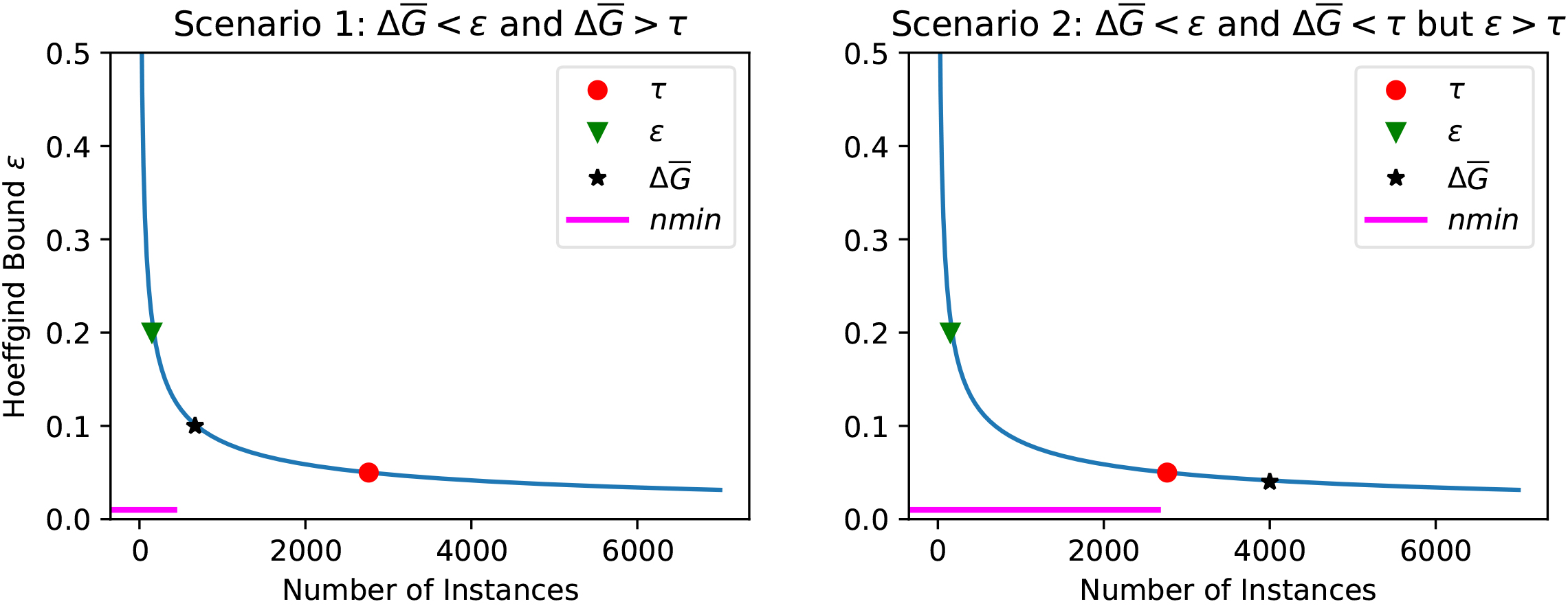
The value of nmin is going to be adapted only when a non-split occurs, otherwise we assume that the current value is the optimal one. The method follows two approaches, illustrated in Fig. 1.
The first approach (scenario 1) approximates the value of nmin when the non-split occurred because no attribute was the clear winner (Fig. 1 left plot). In this case, nmin is estimated as the number of instances needed for the best attribute to be higher than the second best attribute with a difference of
The second approach (scenario 2) approximates the value of nmin when the non-split occurred because
The nmin adaptation implemented for the Hoeffding tree algorithm is portrayed in Algorithm 1.
[tbh] Hoeffding Tree with nmin adaptation.
This section presents the main contribution of this paper, guidelines on how to construct energy efficient ensembles of Hoeffding trees, validated with the experiments on Section 6. In order to reduce the energy consumption of ensembles of Hoeffding trees, we apply the nmin adaptation method to the Hoeffding tree algorithm, and use that algorithm as the base for the different ensembles. To have a more detailed view on how energy is consumed on ensembles of Hoeffding tees, we first portray an approach to create generic theoretical energy models for any kind of algorithm (Section 4.1). We then show how that generic approach applied for ensemble of Hoeffding trees (Section 4.2 and Fig. 3). That section finalizes with a detailed energy model and explanation of each algorithm: Online Bagging, Online Boosting, Leveraging Bagging, Online Coordinate Boosting, Online Accuracy Updated Ensemble, and Hoeffding tree with nmin adaptation.
Generic approach to create energy models
We have summarized the different steps to create theoretical energy models in Fig. 2.
Generic approach to build energy models for any kind of algorithm.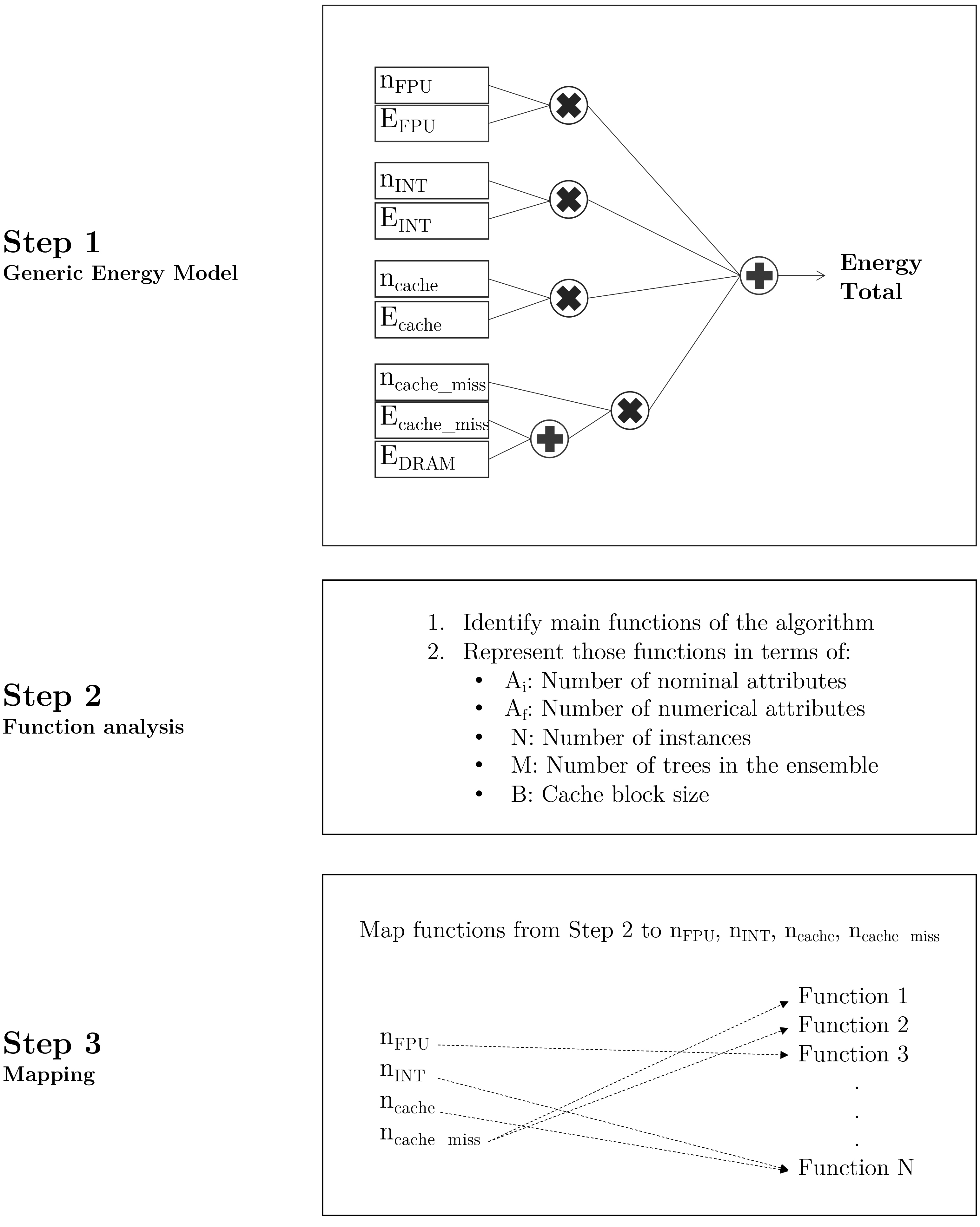
First, Step 1 formalizes the generic energy model, as a sum of the different operations (mapped then to algorithm functions) categorized by type of operation. Thus, the total energy of a model can be expressed as:
The operations are divided into integer, floating point operations, and DRAM and cache accesses. We consider a DRAM access everytime a cache miss occurs. The energy per access or per computation (
Step 2 focuses on identifying the main functions of the algorithm, and then representing them in terms of generic features such as number of attributes or size of the ensemble.
In Step 3 the goal is to map the functions from Step 2 to the different type of operations. For example, a function that counts the number of instances can be expressed as one integer operation per instance.
An example of how to apply these steps is shown in Section 4.2.
The process to create an energy model for any ensemble of other algorithms is summarized in Fig. 3. The goal is to combine the energy model of the ensemble and the energy model of the base algorithm for the ensemble. In the case of Online Bagging, for instance, we need to sum the energy model of Online Bagging plus the energy model of the Hoeffding tree with nmin adaptation. If another model is used in the ensemble, it can be substituted by the Hoeffding tree with nmin adaptation (dashed box).
Energy model approach for ensembles of Hoeffding trees with nmin adaptation. Steps: i) Obtain the energy model (following Fig. 2) for the general ensemble of trees; ii) Obtain the energy model of Hoeffding trees with nmin adaptation; iii) Sum the energy model variables. The energy model for Hoeffding trees (dashed box) can be substituted by the energy model of any other algorithm that is going to be part of the ensembles (for example Hoeffding Adaptive Trees [4]).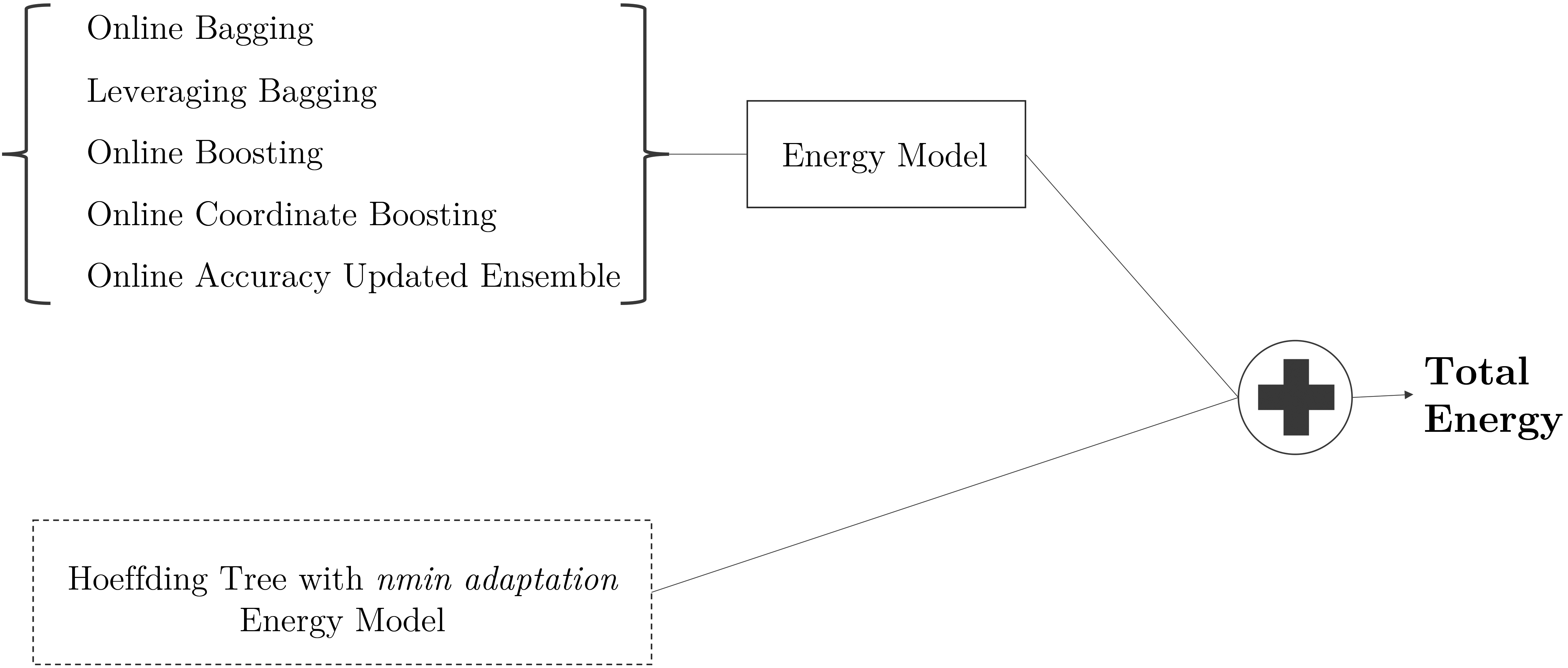
Energy model for the Hoeffding tree with nmin adaptation.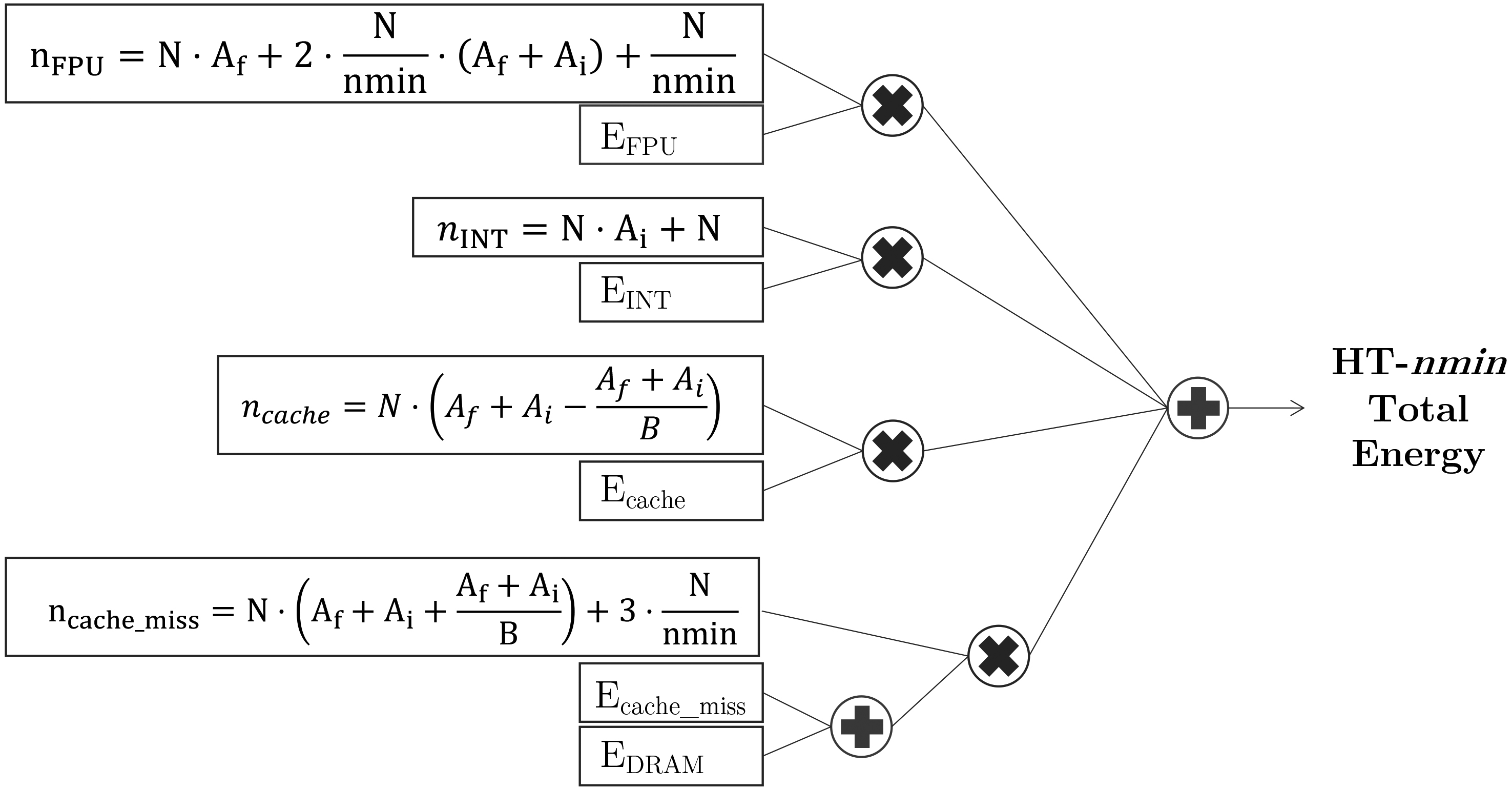
This section details, first, the energy model of Hoeffding Trees with nmin adaptation (Fig. 4), then the energy models of the ensembles: Online Bagging (Fig. 5), Leveraging Bagging (Fig. 6), Online Boosting (Fig. 7), Online Coordinate Boosting (Fig. 8), Online Accuracy Updated Ensemble (Fig. 9).
The energy consumption of Hoeffding trees with nmin adaptation (HT-nmin for the remainder of the paper), explained in detail in Section 3.2, is summarized with the energy model from Fig. 4.
The second step (Fig. 2) after defining the generic energy model is to identify the main functions of the HT-nmin. The HT-nmin algorithm spends energy on training (traversing the tree, updating the statistics, checking for a split, doing a split), and doing inference (traversing the tree, Naive Bayes or majority class prediction at the leaf). In particular:
Finally, those functions are mapped to the corresponding
What we believe is more important to observe from this energy model is the impact of the nmin parameter. The amount of times that the algorithm check for split, which involves a significant part of the energy consumption, depends on the value of nmin. That is why having a bad approximation of nmin incurs in high energy costs without increasing the predictive performance. This model is the input presented in the energy models of the ensembles from the following paragraphs.
Online Bagging, presented in Algorithm 4.2.2, was proposed by Oza and Russell [36] as a streaming version of traditional ensemble bagging. Bagging is one of the simplest ensemble methods to implement. Non-streaming bagging [9] builds a set of
This binomial distribution for large values of
[htb] Online Bagging(h,d)[1] each instance
This algorithm has two main functions, one involved in training the model, that depends on the base algorithm, and the other function that calculates
Leveraging Bagging
When data is evolving over time, it is important that models adapt to the changes in the stream and evolve over time. ADWIN bagging [7] is the online bagging method of Oza and Russell with the addition of the ADWIN algorithm [3] as a change detector and as an estimator for the weights of the boosting method. When a change is detected, the worst classifier of the ensemble of classifiers is removed and a new classifier is added to the ensemble. Leveraging Bagging [6], shown in Algorithm 5, extends ADWIN bagging by leveraging the performance of bagging with two randomization improvements: increasing resampling and using output detection codes. Leveraging bagging increases the weights of this resampling using a larger value
Online Bagging energy model based on the number of models (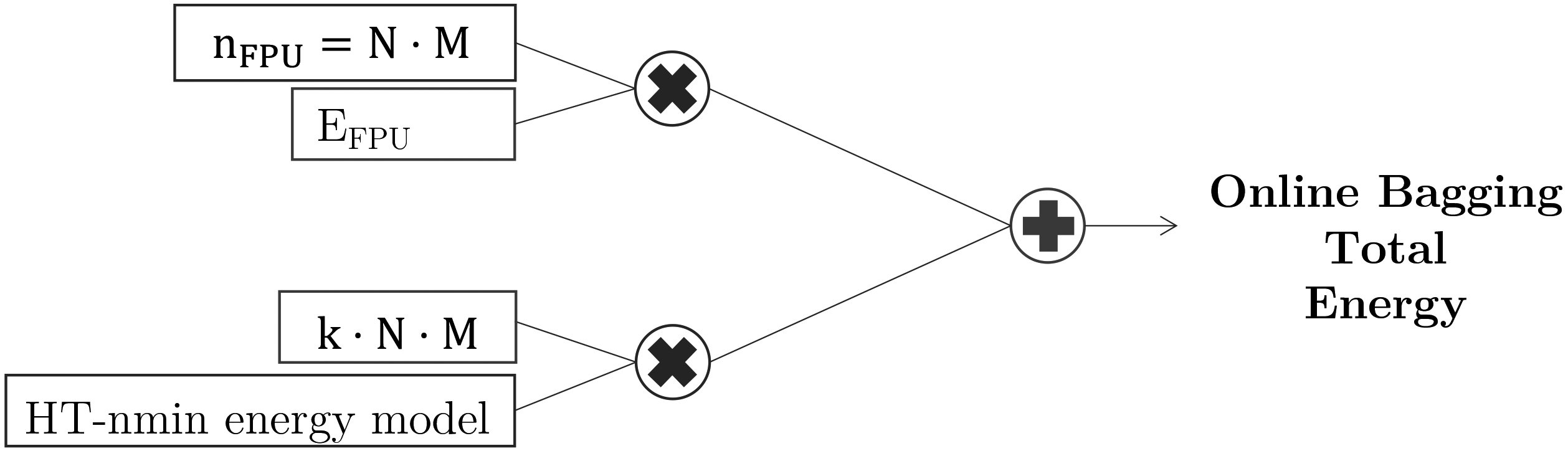
[ht] ADWIN.
Energy model for Leveraging Bagging. 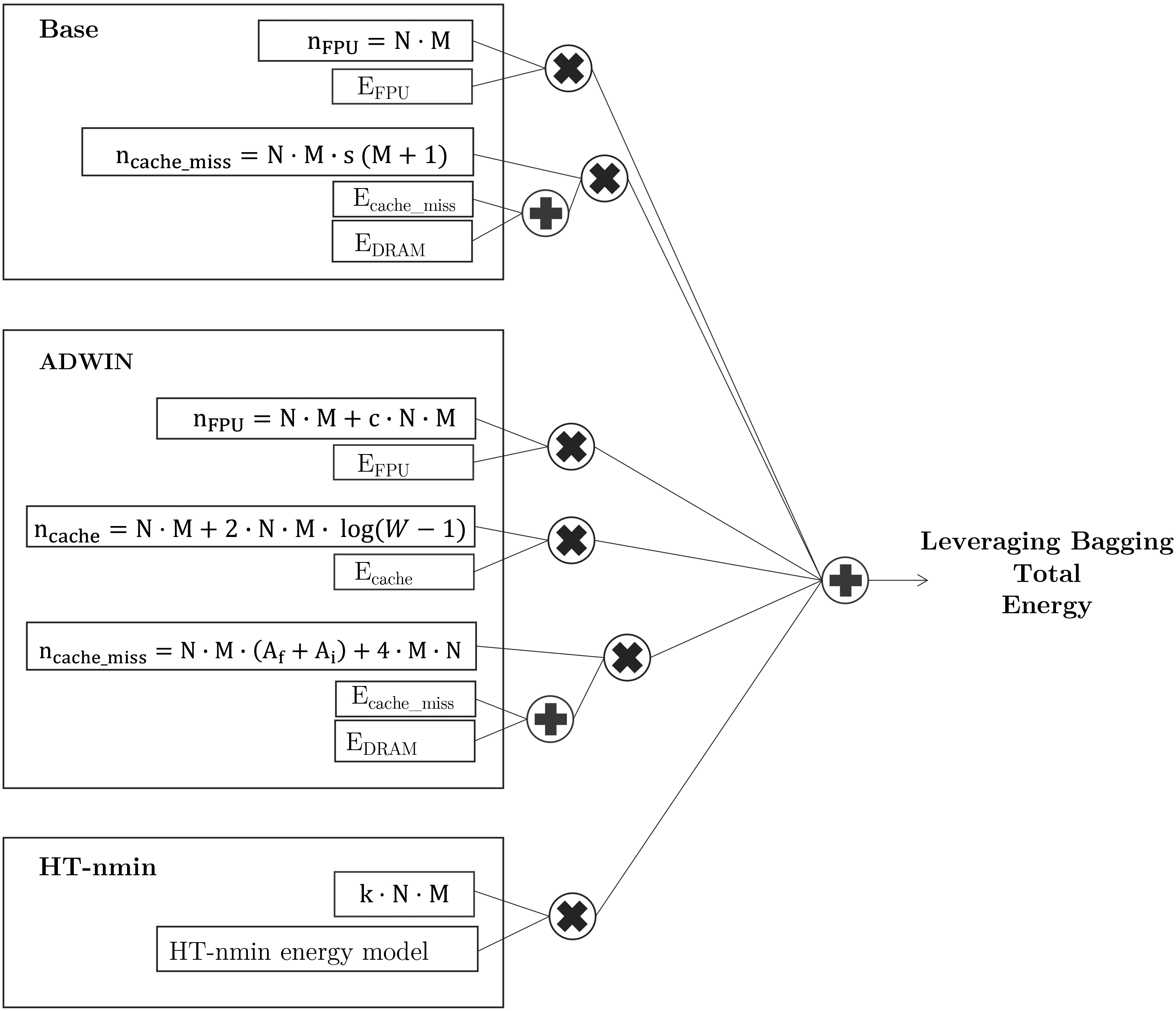
Leveraging Bagging has a similar energy consumption pattern than Online Bagging with the addition of the ADWIN detector and the output codes. The ADWIN detector introduces significant overhead since it has to keep track of the error. For every instance ADWIN calculates if model
The main functions of the baseline algorithm are: calculate
Figure 6 shows the energy model of the Leveraging Bagging algorithm, based on the function explanations presented in the previous list.
Online Boosting [34, 35] is an extension of boosting for streaming data, presented in Algorithm 4.2.4. The main difference with Online Bagging is that Online Boosting updates the
[ht] Online Boosting(h,d)[1]
Regarding its energy consumption and energy model, we observe that Online Boosting presents a similar energy consumption pattern than Online Bagging. Online Bagging introduces an extra memory access to update the weight, which we assume that the access is a DRAM access because each instance is updated sequentially, not fitting in cache. We assume one instance update per instance per model, the worst case scenario if all instances are classified incorrectly. The detailed energy model is presented in Fig. 7.
Online Boosting energy model based on the number of models (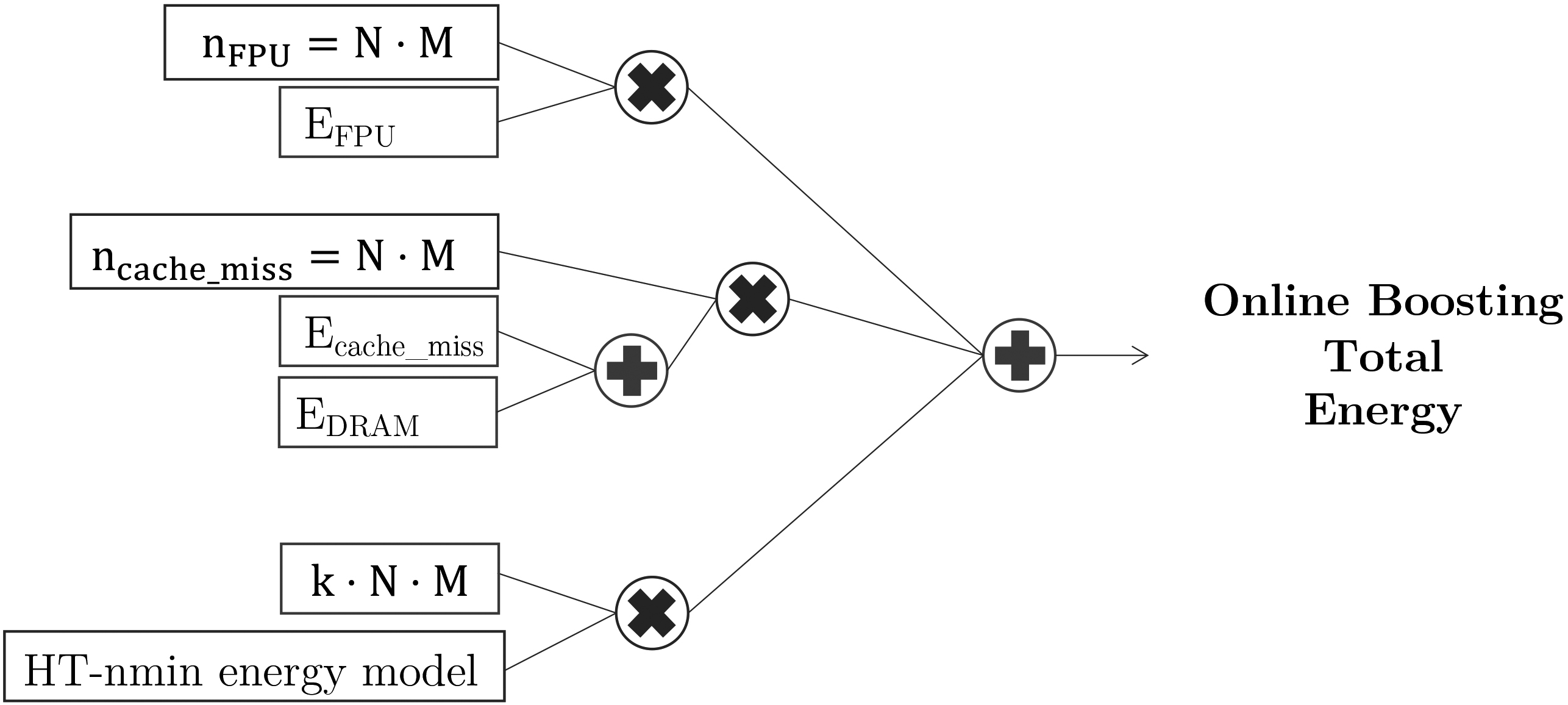
Online Coordinate Boosting [37](Algorithm 4.2.5) is an extension to Online Boosting, that uses a different procedure to update the weight, to yield a closer approximation to Freund and Schapire’s AdaBoost algorithm [17]. The weight update procedure is derived by minimizing AdaBoost’s loss when viewed in an incremental form.
From Algorithm 4.2.5 we can observe the different calculations in lines 8, 11, 13, 14, and 15. Once the weight is calculated, the HT-nmin algorithm is trained with weight
[h] Online Coordinate Boosting(h,x)[1]
where
In relation to energy consumption, this energy model, presented in Fig. 8 adds the extra floating point operations of calculating the values of
and
Since the sum of
Energy model for Online Coordinate Boosting.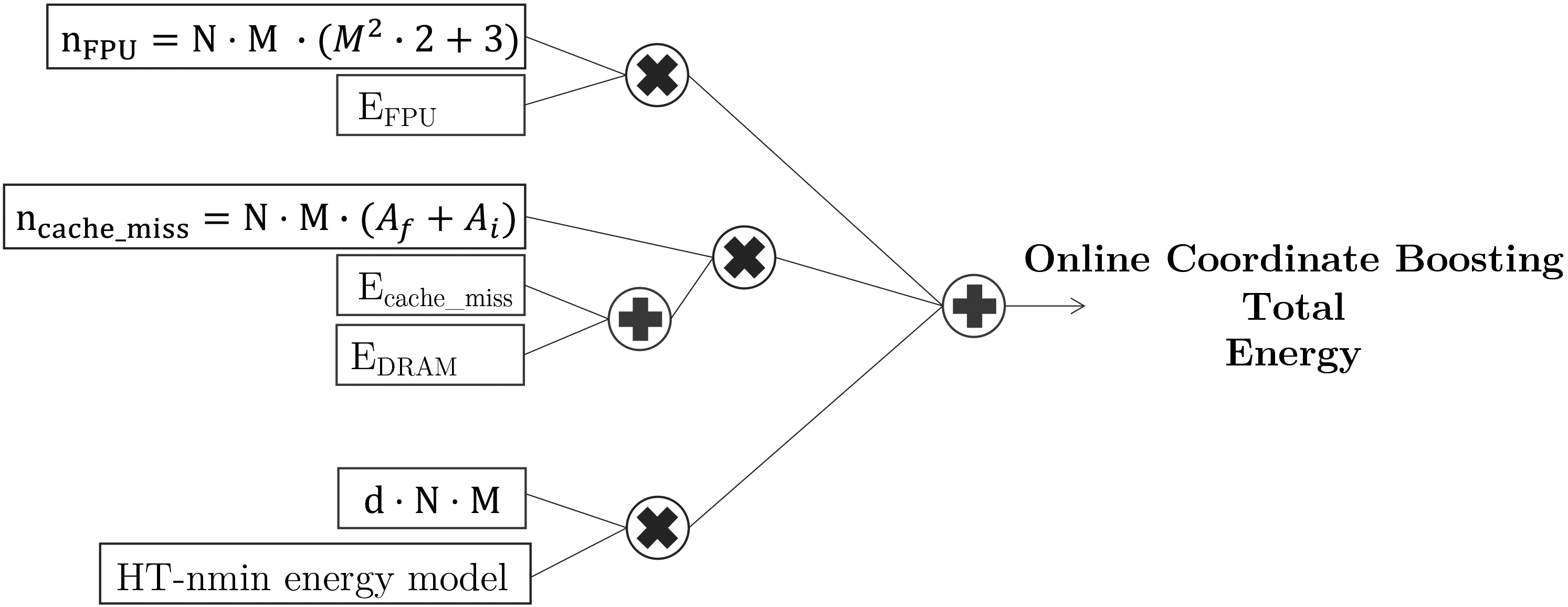
Batch-incremental methods create models from batches, and they remove them as memory fills up; they cannot learn instance-by-instance. The size of the batch must be chosen to provide a balance between best model accuracy (large batches) and best response to new instances (smaller batches). The Online Accuracy Updated Ensemble (OAUE) [11, 12], presented in Algorithm 4.2.6 maintains a weighted set of component classifiers and predicts the class of incoming examples by aggregating the predictions of components using a weighted voting rule. After processing a new example, each component classifier is weighted according to its accuracy and incrementally trained.
[ht] Online Accuracy Updated Ensemble.
all classifiers
Energy model for Online Accuracy Updated Ensemble.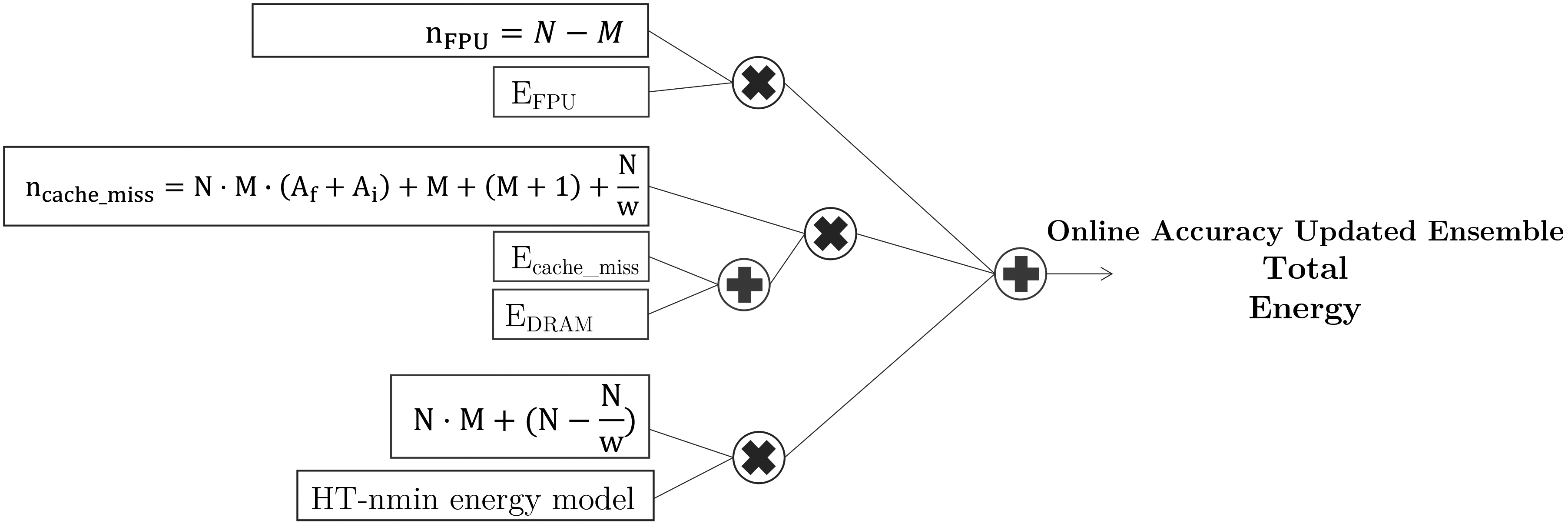
Regarding its energy consumption, we first present the main functions of the algorithm, to then present its energy patterns, combined in an energy model on Fig. 9. The main functions are: create a new classifier, calculate the prediction error, add classifier, weight classifier, and replace classifier.
We have performed several experiments to evaluate our proposed method, nmin adaptation, in ensembles of Hoeffding trees. The experiments have a dual purpose: i) first, to see how much energy consumption is reduced by applying the nmin adaptation method in ensembles of Hoeffding trees; ii) and second, to see how much accuracy is affected in case of this energy reduction. To fulfill those purposes, we have run a set of five different ensemble algorithms of Hoeffding trees, with and without nmin adaptation, and compared their energy consumption and accuracy. We have tested these algorithms over six synthetic datasets and five real world datasets, described in Table 1.
Synthetic and real world datasets.
and
represent the number of nominal and numerical attributes, respectively. The details of each dataset is presented in Section 5.1
Synthetic and real world datasets.
The ensembles used for this paper are: LeveragingBag, OCBoost, OnlineAccuracyUpdatedEnsemble, OzaBag, and OzaBoost. They have already been described in Section 4. All of them use the Hoeffding tree as the base classifier, with and without the nmin adaptation method.
The next subsections explain the datasets in more detail, together with the framework and tools for running the algorithms and measuring the energy consumption.
The synthetic datasets have been generated using the already available generators in MOA (Massive Online Analysis) [5]. The real world datasets are publicly available online. Each source is detailed with the explanation of the dataset.
RandomTree
The random tree dataset is inspired in the dataset proposed by the original authors of the Hoeffding tree algorithm [16]. The idea is to build a decision tree, by splitting on random attributes, and assigning random values to the leaves. The new examples are then sorted through the tree and labeled based on the values at the leaves.
Waveform
This dataset is from the UCI repository [15]. A wave is generated as a combination of two or three waves. The task if to predict which one of the three waves the instance represents.
RBF
The radial based function (RBF) dataset is created by selecting a number of centroids, each with a random center, class label and weight. Each new example randomly selects a center, considering that centers with higher weights are more likely to be chosen. The chosen centroid represents the class of the example. More details are given by [8].
LED
The attributes of this dataset represent each segment of a digit on a LED display. The goal is to predict which is the digit based on the segments, where there is a 10% chance for each attribute to be inverted [10].
Hyperplane
The hyperplane dataset is generated by creating a set of points that satisfies
Agrawal
The function generates one of ten different predefined loan functions. The dataset is described in the original paper [1].
airline
The airline dataset [27] predicts if a given flight will be delayed based on attributes such as airport of origin and airline.
Electricity
The electricity dataset is originally described in [22], and is frequently used in the study of performance comparisons. Each instance represents the change of the electricity price based on different attributes such as day of the week, based on the Australian New South Wales Electricity Market.
poker
The poker dataset is a normalized dataset available from the UCI repository. Each instance represents a hand consisting of five playing cards, where each card has two attributes; suit and rank.
Forest
The forest dataset contains the actual forest cover type for a given observation of 30
Accuracy results of running LeveragingBag, OCBoost, OnlineAccuracyUpdatedEnsemble (OAUE), OzaBag, and OzaBoost on ensembles of Hoeffding trees, with and without nmin. Accuracy is measured as the percentage of correctly classified instances. The Nmin and NoNmin columns represent running the algorithm with and without nmin adaptation respectively. Highest accuracy per dataset and algorithm are presented in bold
The CICIDS dataset is a cybersecurity dataset from 2017 where the task is to detect intrusions [40].
Environment
The framework used to run the algorithms is MOA (Massive Online Analysis). MOA has the most updated data stream mining algorithms, and is widely used in the field. To evaluate the algorithms in terms of accuracy, we have used the Evaluate Prequential option, which tests and then trains on subsets of data. This allows to see the accuracy increase in real time.
Measuring energy consumption is a complicated task. There are no simple ways to measure energy, since there are many hardware variables involved. Based on previous work and experience, we believe that the most straight forward approach to measure energy today is by using an interface provided by Intel called RAPL [14]. This interface allows the user to access specific hardware counters available in the processor, which saves energy related measurements of the processor and the DRAM. This approach does not introduce any overhead (in comparison to other approaches such as simulation based), and allows for real time energy measurements. This matches with the requirements in data stream mining. To use the Intel RAPL interface, we use the tool already available: Intel Power Gadget3
All the experiments have been run on a machine with an 3.5 GHz Intel Core i7, with 16 GB of RAM, running OSX. We ran the experiments five times and averaged the results.
The nmin adaptation method has been implemented in MOA, to make it openly available once the paper has been reviewed. We have used the implementation in MOA of the ensembles of Hoeffding trees, choosing the Hoeffding tree with nmin adaptation as the base classifier. In order to increase the reproducibility of our results, we have made available the code of the nmin adaptation, together with the code of all the experiments, the code used to create the tables and plots, and the datasets. It can be obtained in the following link:
Results and discussion
The accuracy and energy consumption results of running algorithms LeveragingBag, OCBoost, OnlineAccuracyUpdatedEnsemble, OZaBag, and OzaBag, on the datasets from Table 1, are presented in Tables 2 and 3, respectively.
Energy consumption results of running LeveragingBag, OCBoost, OnlineAccuracyUpdatedEnsemble (OAUE), OzaBag, and OzaBoost on ensembles of Hoeffding trees, with and without nmin. The energy is measured in joules(J). Lowest energy consumption per dataset and algorithm are presented in bold. The Nmin and NoNmin columns represent running the algorithm with and without nmin adaptation respectively
Energy consumption results of running LeveragingBag, OCBoost, OnlineAccuracyUpdatedEnsemble (OAUE), OzaBag, and OzaBoost on ensembles of Hoeffding trees, with and without nmin. The energy is measured in joules(J). Lowest energy consumption per dataset and algorithm are presented in bold. The Nmin and NoNmin columns represent running the algorithm with and without nmin adaptation respectively
Difference in accuracy(
Accuracy comparison between running the algorithms with and without nmin adaptation on all datasets. The results of each dataset are averaged for all algorithms.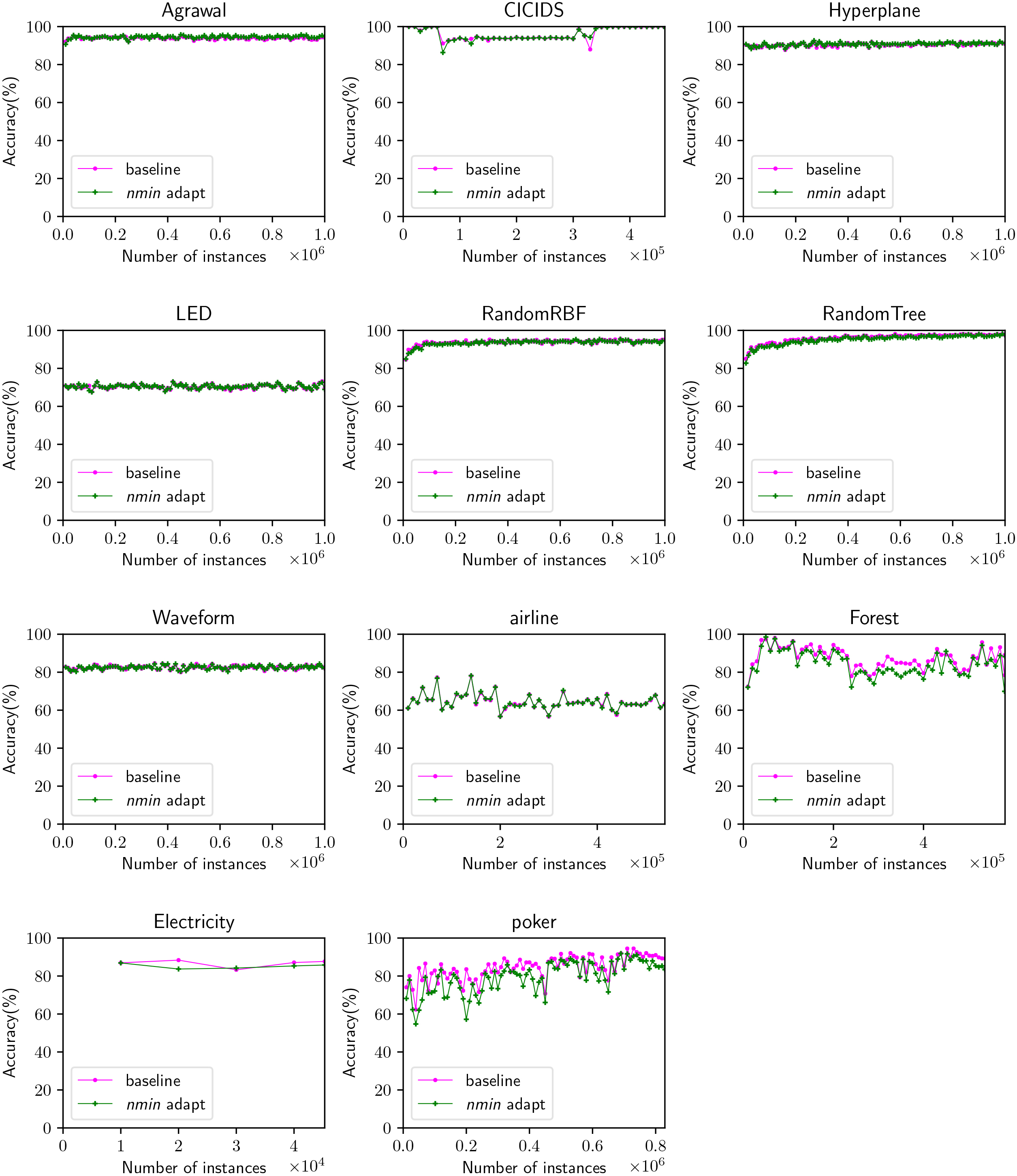
Energy consumption for all datasets and all algorithms, with and without nmin adaptation.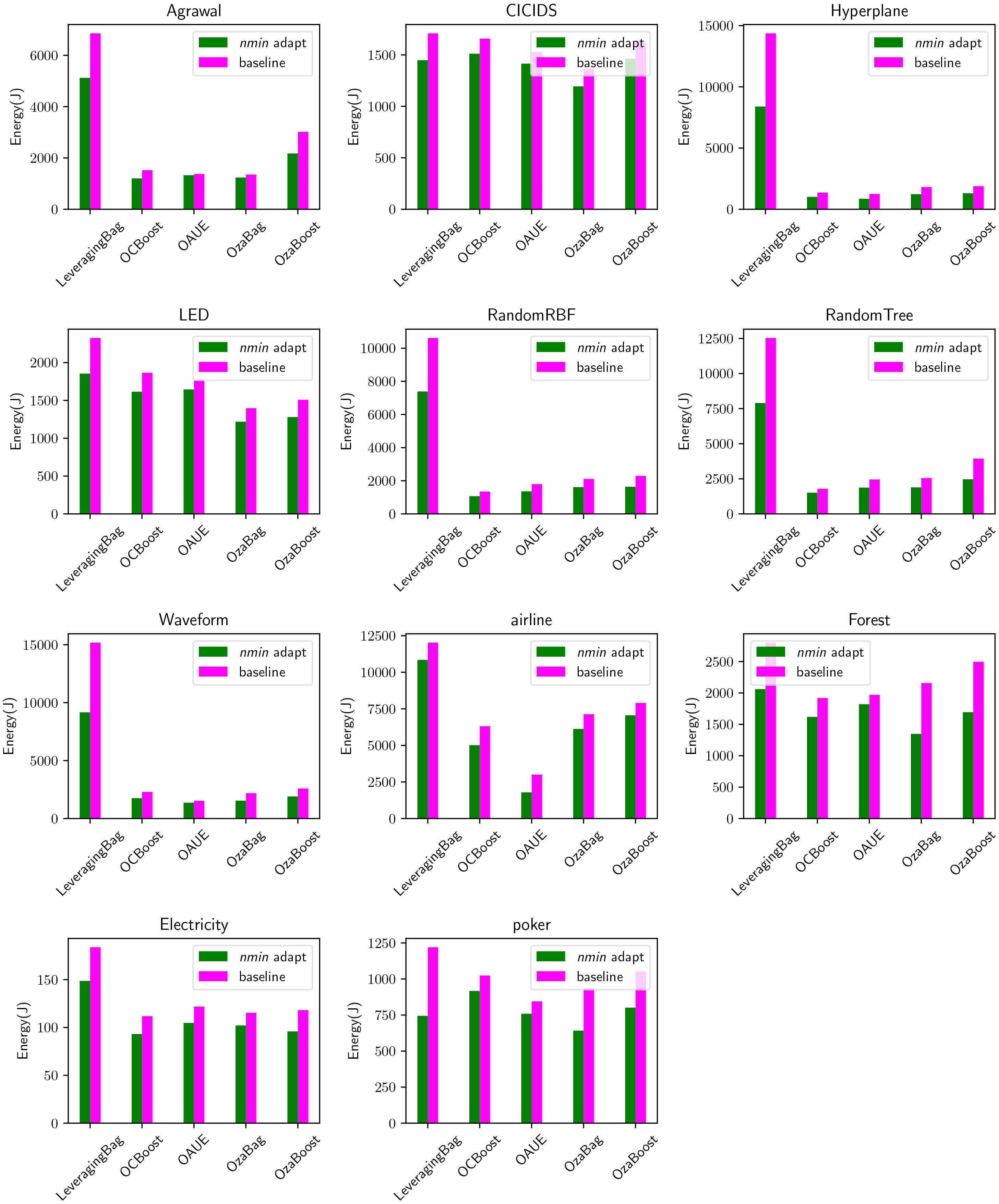
Energy consumption and accuracy comparison for each algorithm, averaged for all datasets and for the nmin adaptation and baseline setups.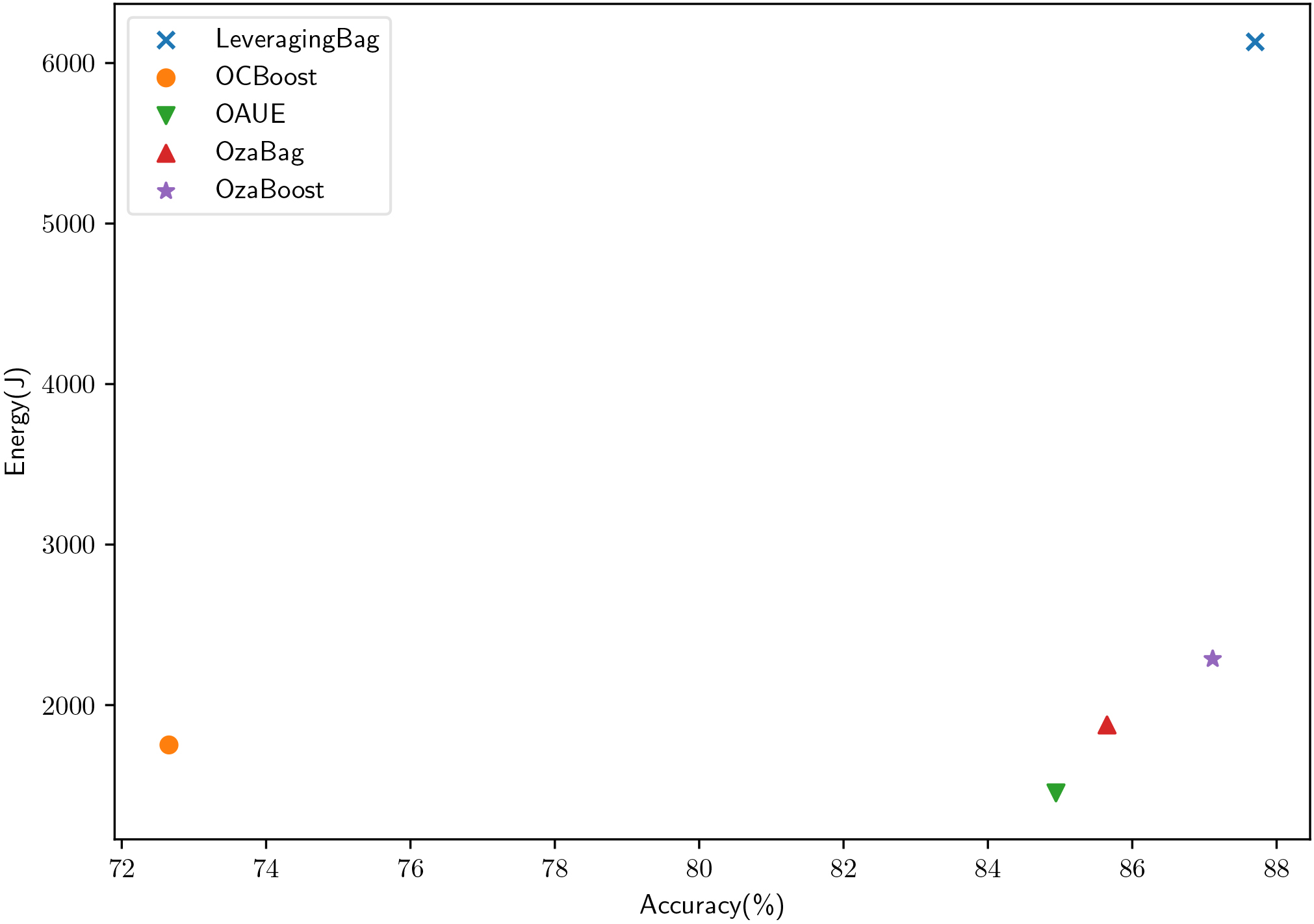
Table 4 presents the difference in accuracy and energy consumption between running the algorithm with and without nmin adaptation, our proposed method. The column
Looking at Table 4, we can see how for all algorithms and for all datasets nmin adaptation reduced the energy consumption by 21 percent, up to a 41 percent. Accuracy is affected by less than 1 percent on average. The poker dataset obtained the highest difference in accuracy between both methods, up to a 10 percent. However, the other datasets show how the original ensembles of Hoeffding trees and the version with nmin adaptation are comparable in terms of accuracy.
Figure 10 shows how accuracy increases with the number of instances. Each subplot represents all algorithms averaged for that particular dataset. Our goal with this figure is to show the difference between running the ensembles with and without nmin adaptation in terms of accuracy. We can observe how for most of the datasets (Agrawal, Hyperplane, LED, RandomRBF, RandomTree, Waveform, and airline) the difference is indiscernible, suggesting that the algorithm performs equally well for both the nmin adaptation approach and the standard approach. For the poker and forest dataset, we can see how nmin adaptation obtains lower accuracy than the standard approach. This was also visible in Table 2.
Figure 11 shows the energy consumption per dataset, per algorithm, with and without nmin adaptation. This figure clearly shows how all algorithms with nmin adaptation consume less energy than the standard version. This occurs in all datasets, even in datasets where the accuracy is higher for the nmin adaptation approach (e.g. Agrawal dataset, OzaBoost algorithm).
At a first glance, and without analyzing the results in depth, one could think that a higher accuracy requires a higher energy cost. However, our results show that there is not a direct relationship between accuracy increase and an increase in energy consumption. This can be observed in Fig. 12, which shows a comparison between accuracy and energy, per algorithm, averaged for all datasets, for the nmin adaptation and baseline setups. Looking also at Table 4, for instance at the OzaBoost algorithm, we can see how there is a high energy decrease (30 percent for the Hyperplane dataset) while still obtaining a higher accuracy (0.39 percent). Another algorithm with a high energy decrease is the OAUE for the airline dataset, where we decrease 40% the energy and accuracy is affected by 0.14 percent. A similar energy reduction is obtained in the poker dataset, for the LeveragingBag algorithm. However in this case the accuracy is significantly affected by 10%. These results are very promising, since they suggest that there is not a correlation between energy consumption and accuracy. Thus, there are ways, such as our current approach, to reduce the energy consumption of an algorithm without having to sacrifice accuracy. The importance lies on finding those hotspots that make the algorithm consume energy inefficiently.
In overall, our results show how nmin adaptation is able to reduce the energy consumption by 21 percent on average, affecting accuracy by less than one percent on average. This demonstrates that our solution is able to create more energy efficient ensembles of Hoeffding trees trading off less than one percent of accuracy.
This paper presents a simple, yet effective approach to reduce the energy consumption of ensembles of Hoeffding tree algorithms. This method, nmin adaptation, estimates the batch size of instances needed to check for a split, individually for each node. Thus, allowing the Hoeffding tree to grow faster in those branches where the confidence for choosing the best attribute is higher, and delaying the split in those branches where the confidence is lower.
We also present a generic approach to build theoretical energy models for any class of algorithms, together with energy models for the ensembles of Hoeffding trees used in this paper.
We conduct a set of experiments where we compare the accuracy and energy consumption of five ensembles of Hoeffding trees with and without nmin, on 11 publicly available datasets. The results show that nmin adaptation reduces the energy consumption significantly, on all datasets (up to a 41%, with 21% on average). This is achieved by trading off a few percentages of accuracy (up to a 10% for one particular dataset, on average of less than 1%). Our results also show that there is no clear correlation between a higher accuracy and a higher energy consumption. Thus, opening the possibility for more research to create more energy efficient algorithms without sacrificing accuracy.
While data stream mining approaches are focused on running on edge devices, still there has not been much research that tackle the energy efficiency of the approaches, which is a key variable for these devices. This study provides one step forward into achieving more energy efficient algorithms that are able to run in embedded devices. For future work, we plan on designing more energy efficient Hoeffding trees that are able to compete with high accurate current approaches[32].