




Abstract
After two years of pandemic-related cancellations, the World Computer Chess Championship returned in July 2022. The title of World Computer Chess Champion, first contested in 1974, was successfully defended by
Introduction
The World Computer Chess Championship (WCCC) is now 48 years old. The first event was held in 1974 in Stockholm as part of the annual International Federation for Information Processing (IFIP) conference. For the first 24 years, the event was held every three years, giving the programmers the time needed to make significant enhancements to their program. In 1982, Ken Thompson published a seemingly innocuous paper demonstrated the strong correlation between computing speed and chess performance (Thompson, 1982). The WCCC rules imposed no limits on the hardware that could be used by an entrant. Thus, Thompson’s paper accelerated the race for more powerful computing resources. The early years were dominated by computing speed, with the evolution of the winning programs from mainframes (e.g.,
Prior to
With the advent of so-called “deep learning” (now a decade old) and the success of the
The computer chess championships were held July 24–29, 2022, in Vienna, Austria as part of the annual International Joint Conference on Artificial Intelligence (IJCAI). The premier event was the 26th World Computer Chess Championship, the no-hardware-limit event that was first contested in 1974. Also contested were the 9th World Chess Software Championship (started in 2010, with all contestants running on identical hardware), and the World Computer Speed Chess Championship.
The Vienna results were:
World Computer Chess Champion: World Chess Software Champion: World Computer Speed Chess Champions:
Congratulations to the winners and thank you to all the participants.
This article summarizes the three chess championships and reports on our experiences and observations of the events.
The event
IJCAI generously agreed to include the world championships as a co-located event at their annual conference. The IJCAI series began in 1969 and is regarded as the longest-running top-ranked AI conference. IJCAI also hosted the two pre-pandemic chess events in 2018 (Stockholm) and 2019 (Macau).
The three chess championships were held at the Messe Wein convention centre in Vienna. The facilities were excellent, and the IJCAI local arrangements team did a superb job of addressing all our needs.
The tournament director was Jan Krabbenbos. He has been directing ICGA chess events since 2016. Jonathan Schaeffer was head of the appeals committee.
The IJCAI organizers enforced a masking rule to reduce pandemic concerns. Until the start of the championship, there was hope that this rule would be rescinded. It was not, and one chess participant decided to withdraw. There were six programs that participated in one or more of the chess championships (see Table 1).
Chess championship participants
Chess championship participants
There were five competitors. The WCCC has no limit on the computing resources can be used. Table 2 summarizes some of the important properties of the participants. The rules are at (Rules, 2022), the results are in Table 3, and more detail on the event is available at (WCCC, 2022).
There are several things to note from the result:
The following pair of games between
World Computer Chess Championship programs
World Computer Chess Championship programs
World Computer Chess Championship result
Black now sacrifices a piece to force a draw by repetition.
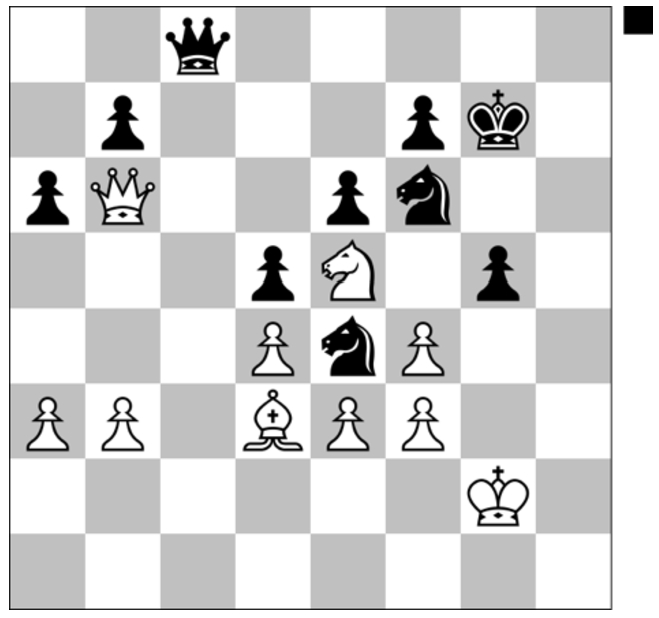
Position after 34. f3.
In the rematch,
The knight is fearless!
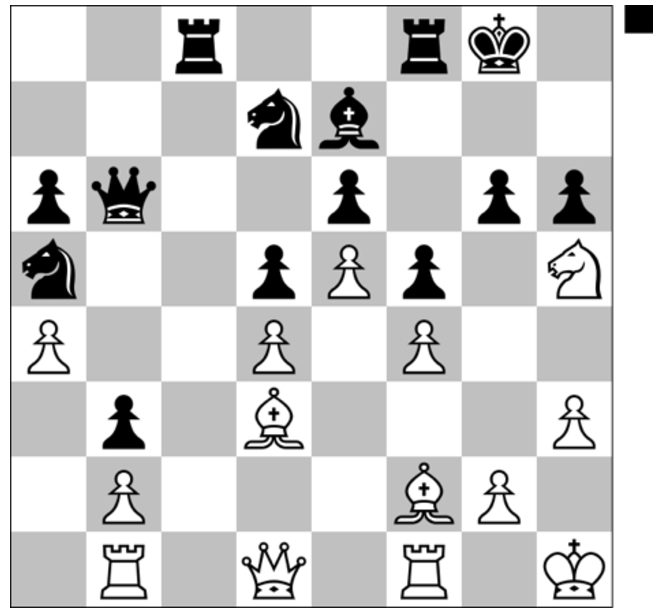
Position after 32. Nh5.
White brings the knight to safety before redeploying it with decisive effect.
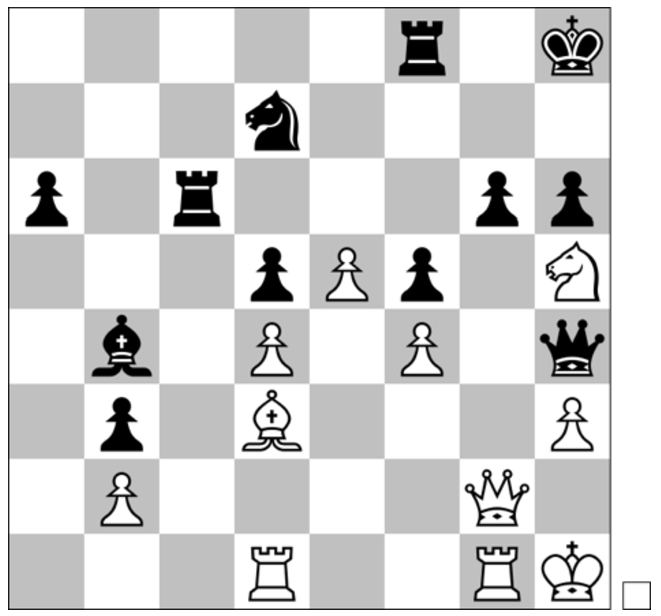
Position after 41. .. Qh4.
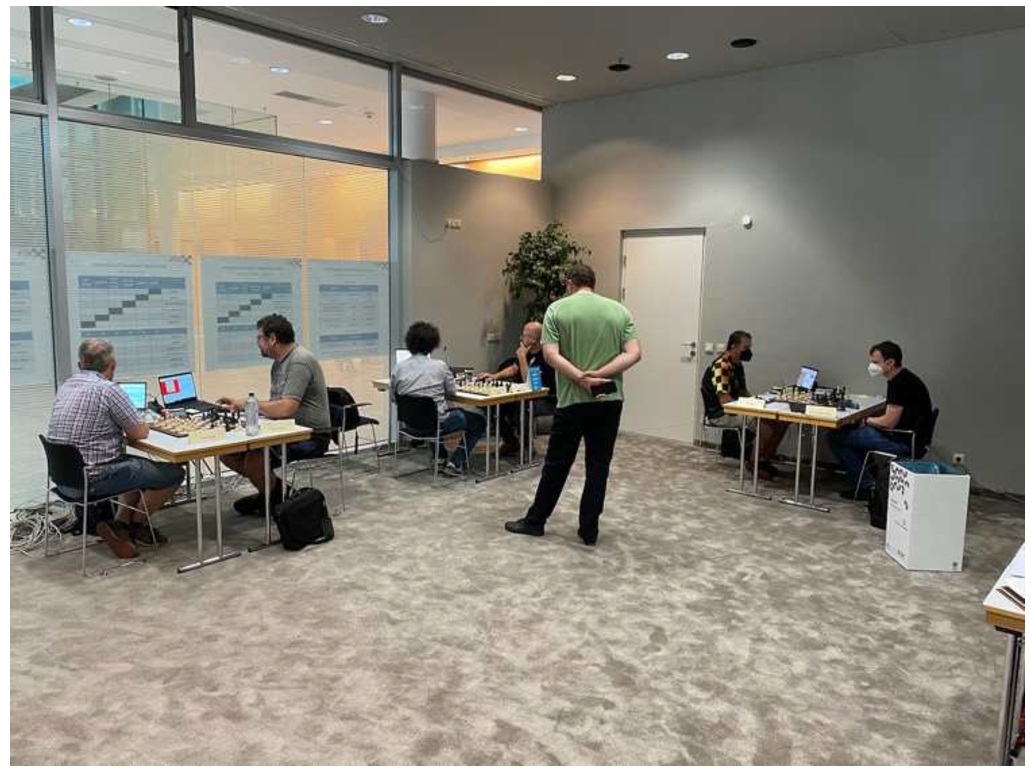
Three games underway. Photo: Jan Krabbenbos.
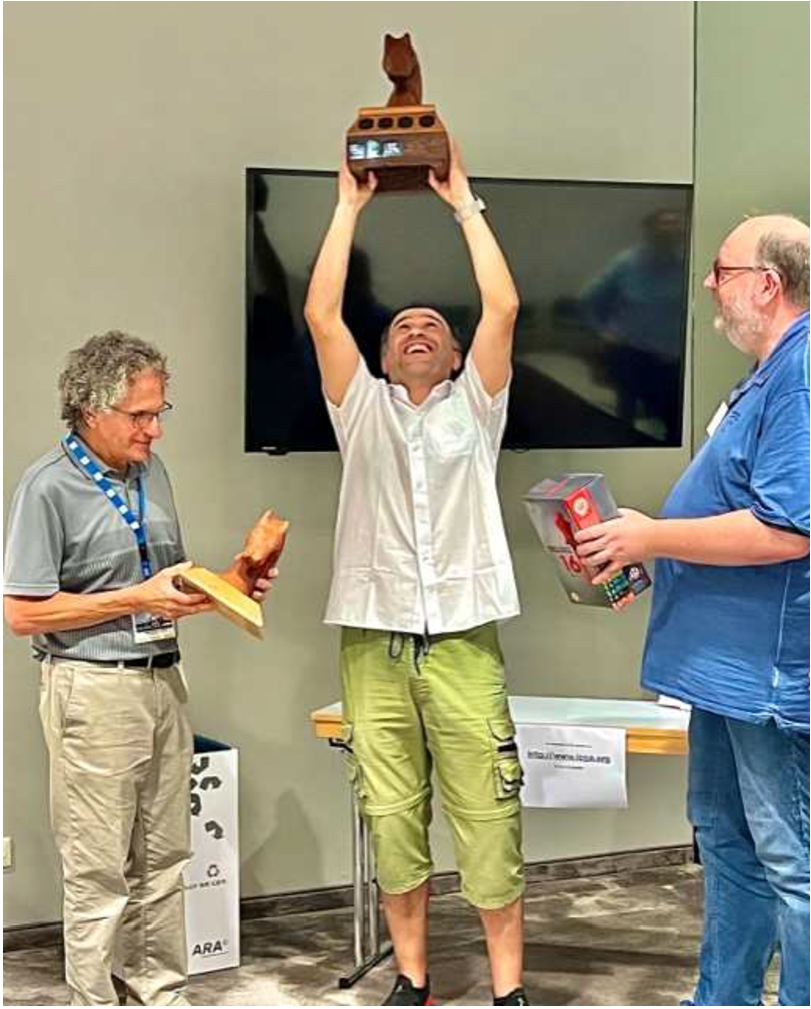
Triumphantly raising the Shannon Trophy, awarded to the winner of the World Computer Chess Championship. From left to right: Jonathan Schaeffer (ICGA President), Erdogan Gunes (
All participants used identical hardware: an AMD Ryzen 7 PRO 4750U processor with 32 GB of RAM. The rules are at (Rules, 2022), the results are in Table 4, and more detail on the event is available at (WCSC, 2022). One of the competition rounds is shown in Fig. 4.
There were six competitors, including the five WCCC participants.
World Chess Software Championship result
World Chess Software Championship result
One game stood out for a “stunning” move:
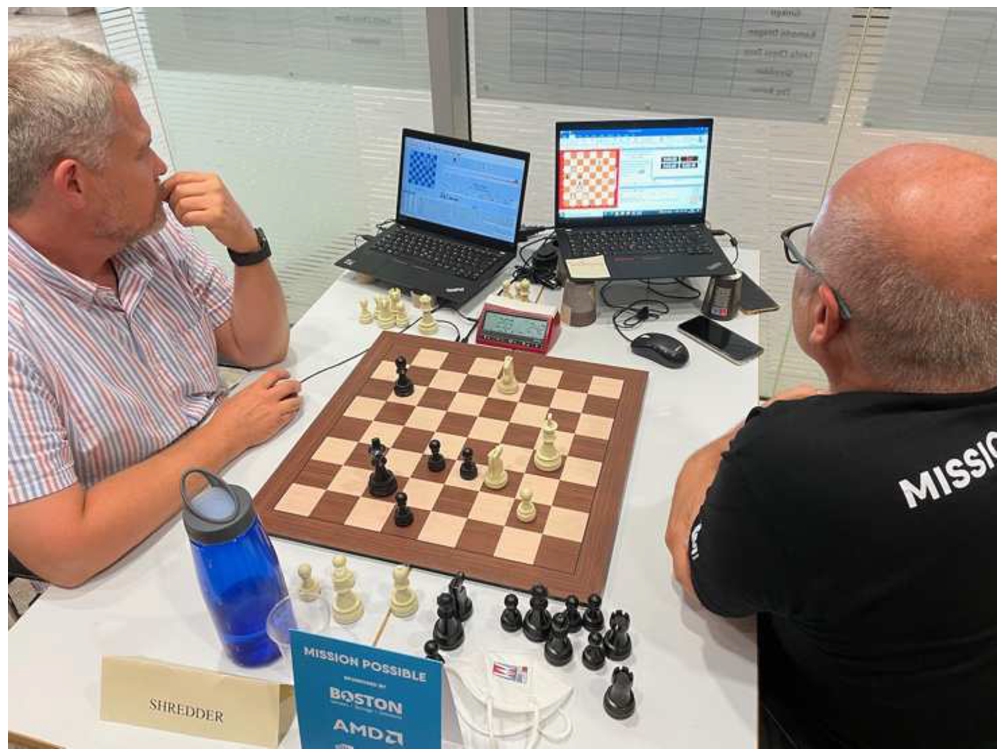
To everyone’s surprise
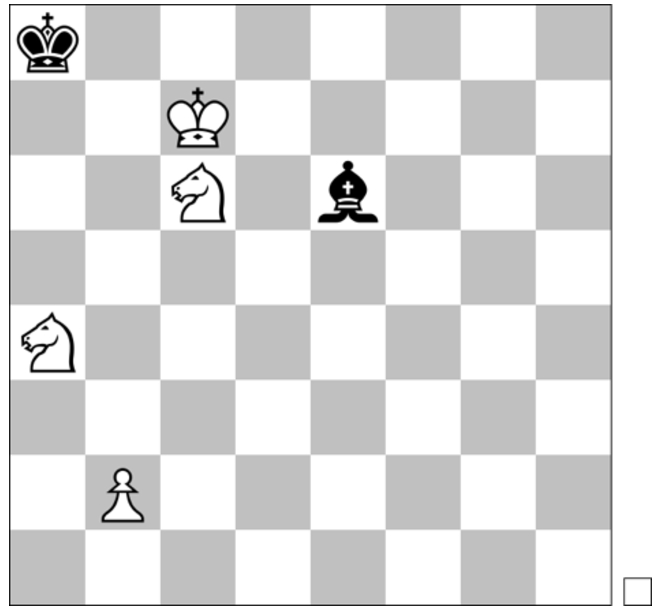
Position after 80. .. Be6.
With apologies to Stefan Meyer-Kahlen, it was accidental on our part that the three games shown in this report had
The speed chess championship used a time control of 5 minutes per side with 5 seconds per move. The rules are at (Rules, 2022), the results are in Table 5, and more detail on the event is available at (WCSCC, 2022).
Unfortunately, the double round robin concluded at the end of the day and the conference facility was closing. The decision was made to declare
World Computer Speed Chess Software Championship result
World Computer Speed Chess Software Championship result
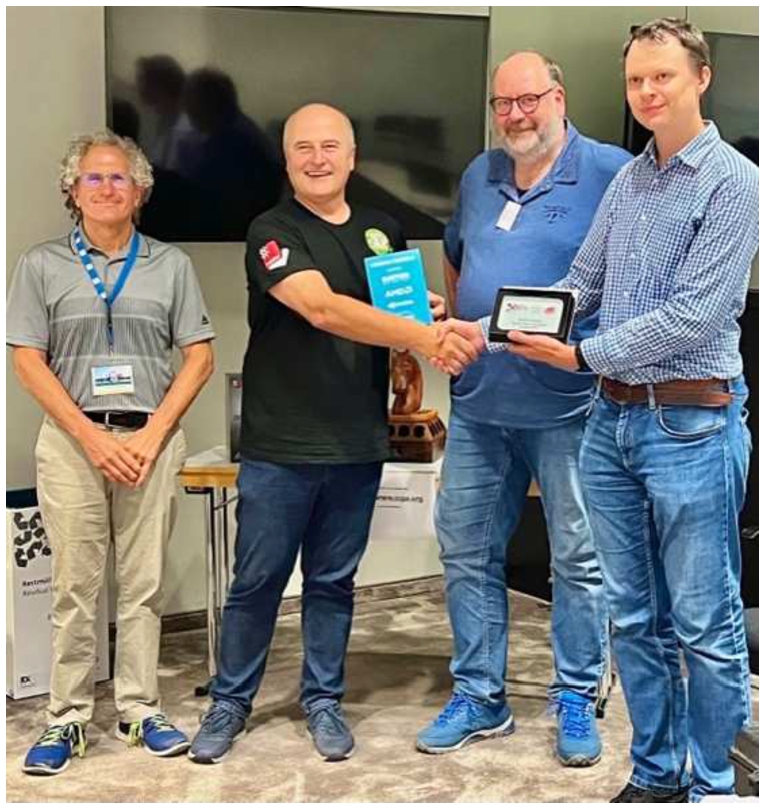
World Chess Software Champion
The WCCC events were held with a spirit of cooperation. There were no disputes, differences were accommodated, and everything went almost seamlessly. It was a pleasure to have (from the point of view of the tournament director and organizer) a stress-free event. (See Fig. 9.)
This year all three championships resulted in a tie for first place, with two of the events being decided by a series of playoff games (there was no time for a playoff in the speed chess event). These games did not yield a decisive result. Armageddon was used to decide the titles (White gets 6 minutes, Black gets 3. Black wins a drawn game).
Armageddon is an unsatisfactory way to decide on a title as important as that of World Champion. Given the constraints of a face-to-face competition (the event must conclude on time), we need to find a better way to break a tie. Some suggestions include:
Use of Fischer random chess (randomizing the location of pieces on the back rank for each side); Disallowing castling (an idea being popularized by former World Champion Vladimir Kramnik (Shah, 2020)); and Disabling the opening books (which might be hard to enforce. It seems to work for
We welcome your ideas!
At the WCCC banquet, we had a discussion as to whether a 4000 ELO rating was possible. One might argue “yes” because the history of computer chess shows that the top programs continue to accumulate ELO points, albeit at a slower rate these days. The “yes” side is supported by the long-running data from the Swedish rating list of the top computer programs (Swedish Chess Program Rating List, 2022).
One can argue “no” because the top programs are so strong that there rarely is a decisive game between them. This year three programs –
No conclusion was reached. It’s interesting to note that a similar discussion is happening with human players. Can the (Human) World Chess Champion reach a 2900 rating (Bendre et al., 2022)?
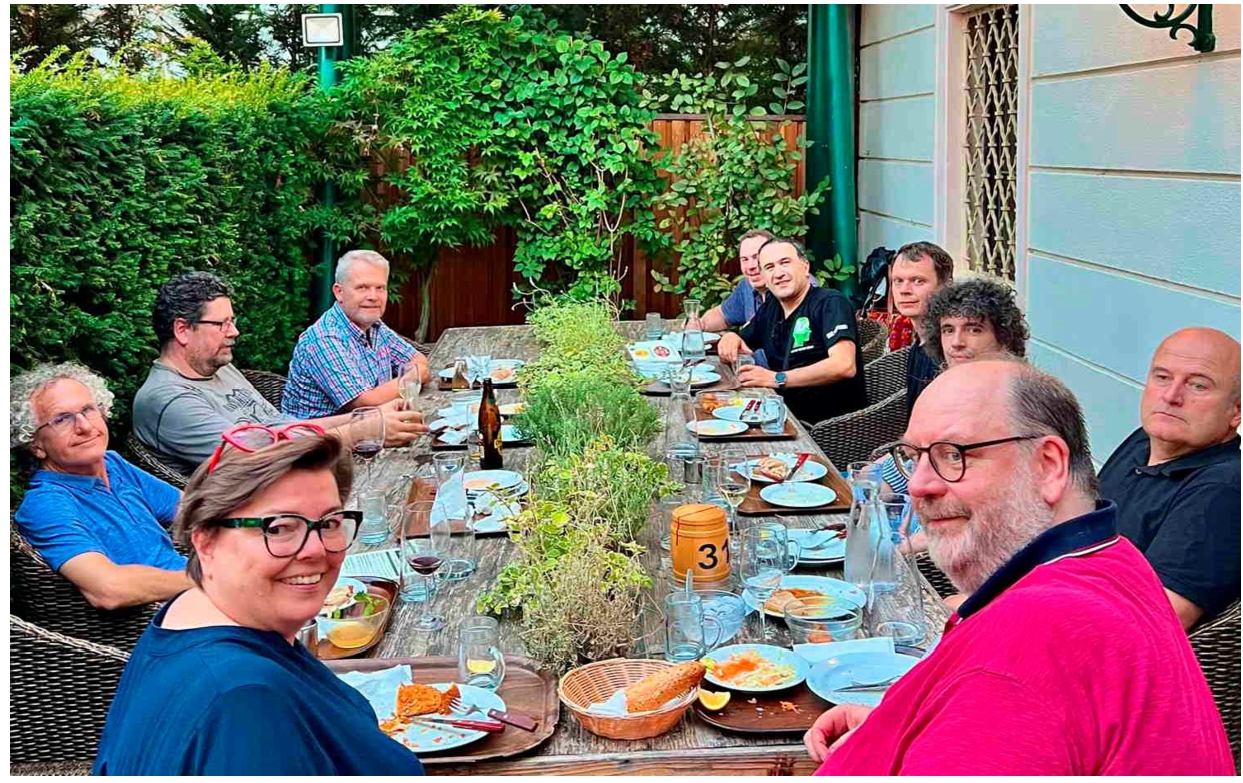
The Computer Chess banquet with the chess participants and organizers. Photo: Jennifer Schaeffer.
The WCCC is part of the longest running experiment in computing science history. It began with the first computer chess tournament in 1970 and continues to this day – 52 years and counting. In that time, we’ve seen the top program move from a rating of 1600 to almost 3600. It’s impressive to see that year after year the developers of the top programs find new ways to make their programs even stronger. Perhaps 4000 ELO is a possibility.
A challenge posed by having super-human chess programs is that they create an imposing barrier for anyone wanting to one day compete in the WCCC. Further, without continual improvement, a program that is competitive today is an also-ran tomorrow – as
At the time of this writing, there are no concrete plans in place for chess competitions in 2023. However, we hope to do something major in 2024 – the 50th anniversary of the first World Computer Chess Championship. We welcome your ideas on how to best celebrate this important milestone.
Footnotes
Acknowledgements
Our deepest appreciation to the IJCAI organizers and their local arrangements team for hosting the events and efficiently addressing all our needs. We thank the Technical University of Vienna for loaning us computers for the software championship and Digital Game Technology for loaning us the electronic boards and clocks for the live broadcast.
ChessBase kindly provided prizes for the winners of each tournament.
Thank you to Grace Krabbenbos who did so many things behind the scenes to make the events a success.