The Mahjong tournament of the 2022 Computer Olympiad was held from July 23 to 29, 2022. Five teams from Taiwan participated in the tournament. The information of these teams is listed in Table 1. The rules of Mahjong have many variants around the world. In this tournament, Taiwan Mahjong was adopted as the main reference of rules. Detailed rules can be found in Chen et al. (2022) and Shan et al. (2014).
Since five teams participated this year, there were a total of five matches and each team had a bye in each match. A match included 192 games. The score of a game was set to 1000/500, meaning that the winner of a game got a base score of 1000 points plus 500 points per tai, described in Shan et al. (2014). The team with the highest accumulated scores was the winner of the tournament. The tournament adopted the game-playing platform developed by Jr-Chang Chen’s team (Chen, 2022). To decrease the luck of randomness, the platform turned the fair mode on. That is, the same random seed was used to generate the initial wall four times. When a game was over, the initial hand was shifted to the next player to make sure the same initial hand was played by each player once. The time constraint for each program was five seconds per action. When a program used up its time, a dummy program would automatically take over the playing until the end of this game by simply getting a tile from the wall and then throwing it.
Zong-Han Lin, Jiun-Hong Chen, Yu-Chen Lin, Shun-Shii Lin
Jiun-Hong Chen
Taiwan
Results
The scores of each match are listed in Table 2. Congratulations to VeryLongCat. This team gained lots of points in matches 3, 4 and 5, and won the gold medal with 178.5k points. SimCat performed close to VeryLongCat in the first three matches, but the gap between these two teams was widen by 38.0k points in match 4. Finally, SimCat won the silver medal. Note that SimCat was the only team that got positive scores in all matches. FatesGate mainly gained points in match 3, but performed not well in match 5. Finally, FatesGate won the bronze medal with 82.5k points.
VeryLongCat and SimCat were both excellent at forming a ready hand quickly, which was a straightforward way to win a game in Mahjong. When the chance to win was low, FatesGate and Seofon designed methods to avoid to chuck, that is, to avoid discarding a tile the other players exactly needed to win immediately. These methods performed well when the programs’ ability of forming a ready hand was close. These characteristics made match 2 extremely intense. Although SimCat gained the most points in this match, from our observation, there was no big difference in strength among the above four programs.
The detailed scores of each match
Team
Match 1
Match 2
Match 3
Match 4
Match 5
Total Score
Rank
VeryLongCat
–
−4.5k
70.0k
70.5k
42.5k
178.5k
1
Sparrow
−40.0k
–
−69.5k
−103.0k
−50.5k
−263.0k
5
SimCat
66.0k
8.5k
–
32.5k
30.5k
137.5k
2
FatesGate
34.5k
6.0k
64.5k
–
−22.5k
82.5k
3
Seofon
−60.5k
−10.0k
−65.0k
0.0k
–
−135.5k
4
The search algorithms used by the teams are described as follows. VeryLongCat uses Expectimax tree search to compute the win rate in a simplified model, and uses expert knowledge for pruning (Chuang, 2015). SimCat uses Monte-Carlo sampling to compute the win rate in a simplified model (Chen et al., 2022). FatesGate uses Monte-Carlo sampling and hand decomposition to compute the win rate, and applies a chuck-avoiding method (Yeh, 2022). Seofon converts the game state to several sub-problems and solves them based on the minimum number of tiles to win (Lin, 2021).
Selected games
This report comments on two selected games. One is Game 186 in Match 2, where VeryLongCat won 11000 points, and the other is Game 384 in Match 5, which is the last game of this tournament. The format of game logs is described briefly as follows. The first line records the game’s wind (E: east, W: west, S: south, N: north), the player’s wind, start taking a tile from which part of the wall,1
Note that it has no effect in this tournament.
and the number of consecutive wins for the dealer. The second line lists the scores of the four players. The third line lists the IDs of the initial tiles in the wall in order. Note that the flowers are not used, so there are 136 IDs. The forth line records all actions in the game. Each action consists of a character indicating the player (E, W, S, N) who makes the action, a string indicating the type of the action (M: pick a.k.a. mo, MD: discard the picked tile, HD: discard from the hand, E: eat, P: pong, K: kong (exposed kong), DK: concealed kong, UK: upgraded kong, H: win by a discarded tile, SM: self-drawn win), and the numbers indicating the IDs of the tiles related to the action.
Game 1: VeryLongCat vs. FatesGate vs. Seofon vs. SimCat
1. S HD 440 2. W P 440 442 443 3. W HD 410 4. N M 170 5. N HD 412 6. E M 393 7. E HD 290 8. S M 230 9. S HD 430 10. W M 252 11. W HD 453 12. N M 441 13. N MD 441 14. E M 193 15. E HD 311 16. N P 311 312 310 17. N HD 452 18. E M 420 19. E MD 420 20. S M 210 21. S HD 450 22. W M 460 23. W HD 211 24. N M 390 25. N HD 471 26. S P 471 470 472 27. S HD 461 28. W P 461 460 463 29. W HD 382 30. N M 451 31. N MD 451 32. E M 153 33. E HD 383 34. S M 163 35. S HD 313 36. W M 370 37. W HD 321 38. N M 250 39. N MD 250 40. E M 171 [E E] 41. E HD 260 42. S M 352 43. S HD 293 44. W M 262 [W E] 45. W HD 370 46. N EL 380 370 390 47. N HD 362 48. E M 423 [W P] 49. E MD 423 50. S M 433 51. S MD 433 52. W M 143 53. W HD 190 54. N M 371 55. N MD 371 56. E M 282 57. E MD 282 58. S M 180 59. S HD 210 60. W M 421 61. W MD 421 62. N M 342 63. N HD 221 64. E M 132 65. E SM 110 121 141 153 160 171 183 193 271 272 273 322 330 340 391 393 132 self-drawn, VeryLongCat won
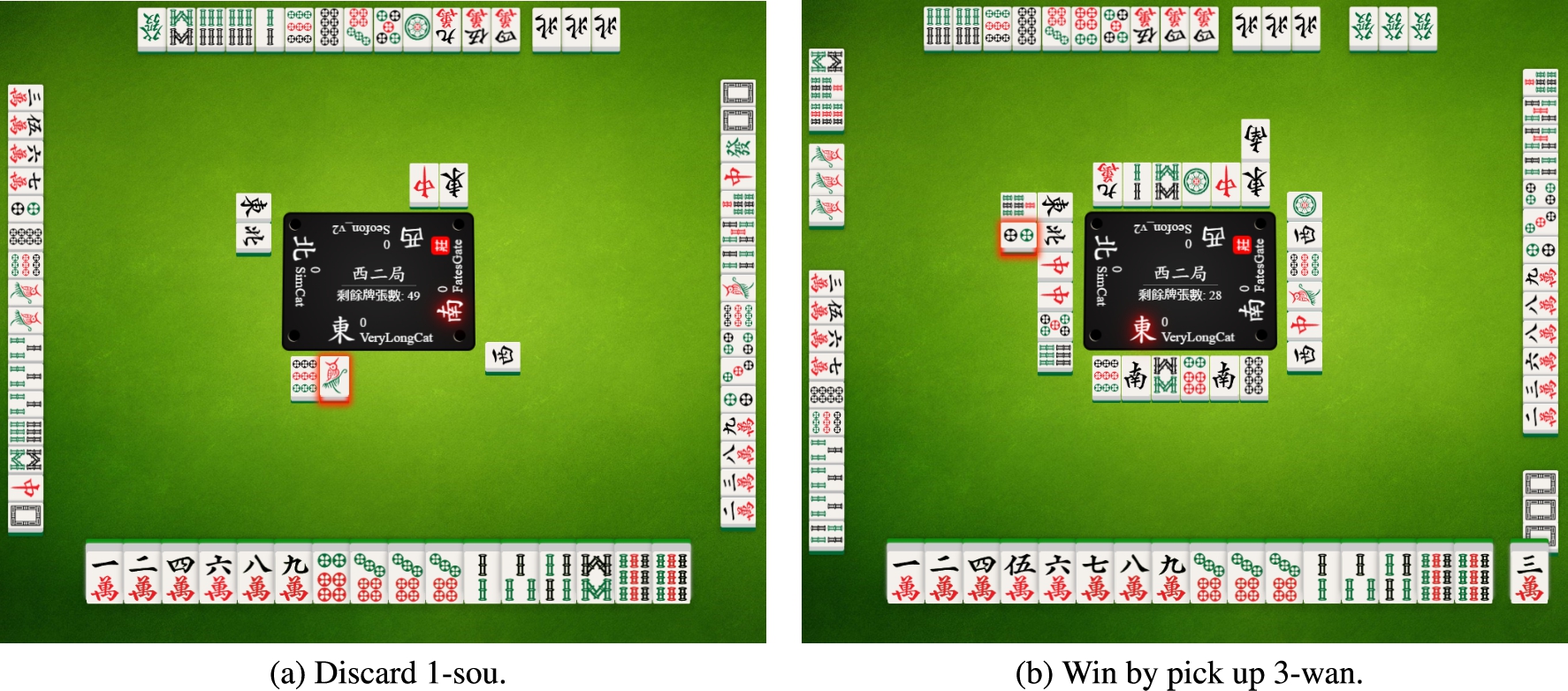
At the 15-th ply as shown in Fig. 1a, VeryLongCat decided to discard 1-sou, making itself harder to win. The reason was if the team could achieve a win, it can gain additional points by completing three sequences from 1-wan to 9-wan. Afterwards, VeryLongCat picked up 5-wan and 7-wan, and finally won the game with 11000 points by self-drawn the tile 3-wan at the 65-th ply, as shown in Fig. 1b.
VeryLongCat won Game 186 in Match 2.
Game 2: Sparrow vs. FatesGate vs. SimCat vs. VeryLongCat
1. N HD 422 2. E M 280 3. E HD 440 4. S M 272 5. S HD 430 6. W M 161 7. W HD 472 8. N M 151 9. N HD 433 10. E M 463 11. E HD 431 12. S M 452 13. S MD 452 14. W M 392 15. W HD 453 16. N M 273 17. N HD 442 18. E M 253 19. E HD 470 20. S M 420 21. S MD 420 22. W M 312 23. W HD 412 24. N M 132 25. N HD 473 26. E M 210 27. E HD 390 28. S ER 371 390 383 29. S HD 460 30. E P 460 462 463 31. E HD 280 32. S M 391 33. S MD 391 34. W M 170 [W E] 35. W HD 112 36. S P 112 110 111 37. S HD 181 38. W M 461 [N P,W E] 39. W MD 461 40. N M 261 41. N HD 120 42. S P 120 121 122 43. S HD 272 44. W M 223 45. W HD 163 46. N M 262 [N E] 47. N HD 261 48. E M 172 [E E] 49. E HD 292 50. S M 192 51. S HD 252 52. W M 421 53. W MD 421 54. N M 322 55. N HD 243 56. E M 410 [E P,E E] 57. E MD 410 58. S M 471 59. S MD 471 60. W M 423 61. W MD 423 62. N M 142 63. N HD 140 64. E M 193 65. E MD 193 66. S M 283 [S P] 67. S MD 283 68. W M 232 69. W HD 392 70. N M 360 71. N HD 320 72. E M 443 [E E] 73. E MD 443 74. S M 171 75. S HD 143 76. W M 330 [N P,W E] 77. W HD 211 78. N M 340 79. N HD 360 80. E M 342 81. E HD 210 82. S M 123 83. S UG 123 84. S M 263 85. S MD 263 86. W EM 250 263 270 87. W HD 312 88. N M 213 [N E] 89. N MD 213 90. E M 290 91. E MD 290 92. S M 131 93. S HD 190 94. W M 152 95. W HD 153 96. N M 393 [N P,N E] 97. N MD 393 98. E M 241 99. E HD 311 100. S M 451 101. S HD 191 102. W M 313 103. W MD 313 104. N M 351 [N E] 105. N SM 130 132 141 142 150 151 180 182 262 273 281 322 331 340 361 370 351 self-drawn, VeryLongCat won
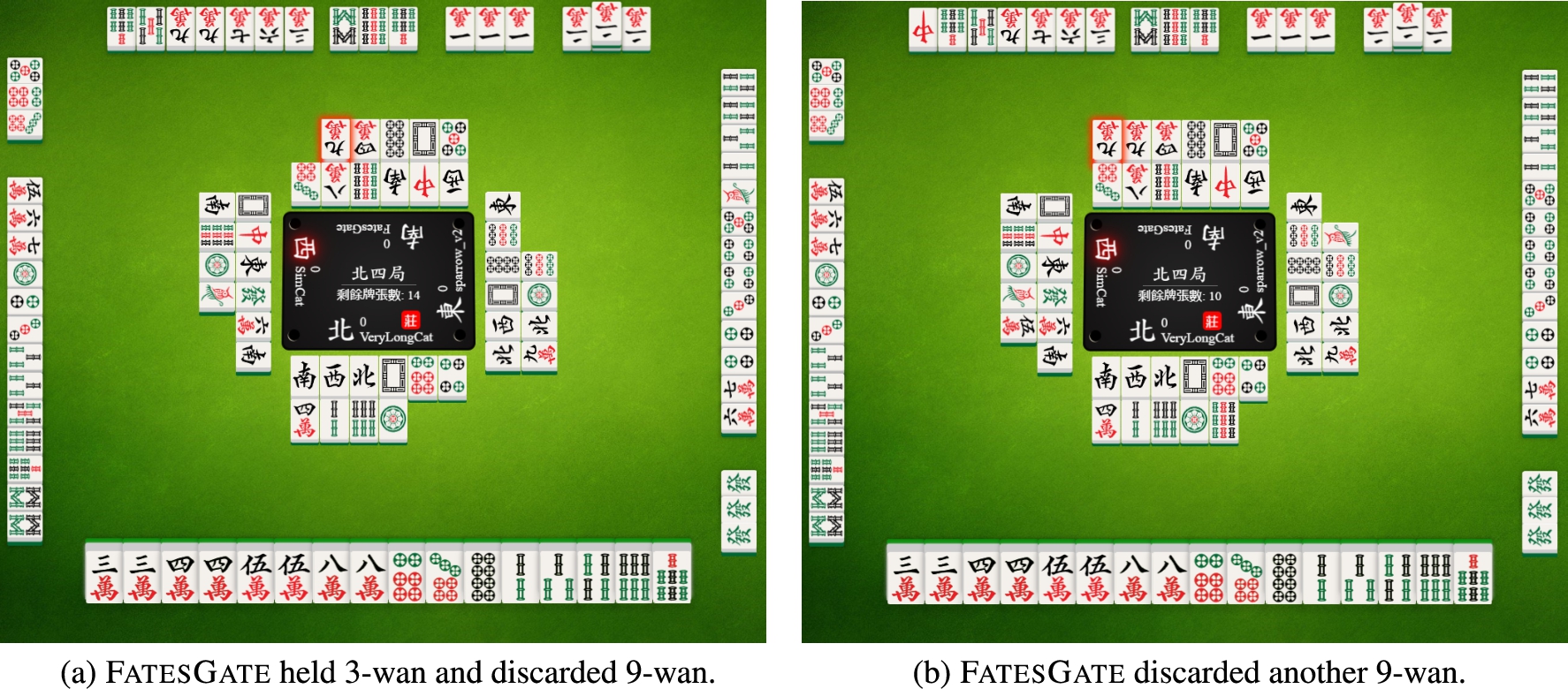
At the 93-th ply as shown in Fig. 2a, FatesGate decided to hold 3-wan and discarded 9-wan. This was a nice play for the following reason. To win the game, FatesGate’s hand needed at least two effective tiles that can form sequences. However, discarding 3-wan in that state was dangerous since 3-wan might be the exact tile other players needed to win. In addition, the remaining two tiles 9-wan formed a pair needed. It not only avoided a possible chuck but also kept the chance to win. At the 101-th ply as shown in Fig. 2b, FatesGate picked up the tile, red, decided to give up the small chance to win and thus discarded another 9-wan. Finally, VeryLongCat won this game by picking up 5-sou and gained 10500 points at the 105-th ply.
VeryLongCat won Game 384 in Match 5.
References
1.
Chen, J.-C., Tang, S.-C. & Wu, I-C. (2022). Monte-Carlo simulation for Mahjong. Journal of Information Science and Engineering, 38, 775–790.
2.
Chen, K.-C. (2022). Design and implementation of computer Mahjong platform. Master’s thesis, National Taipei University, New Taipei City, Taiwan.
3.
Chuang, L.-K. (2015). A study of Mahjong program design. Master’s thesis, National Chiao Tung University, Hsinchu, Taiwan.
4.
Lin, Z.-H. (2021). Using the enhancement strategy from discarded-tiles information to improve Mahjong program. Master’s thesis, National Taiwan Normal University, Taipei, Taiwan.