




Abstract
BACKGROUND:
It is asserted that the positive outcomes from employees are a result of positive gestures initiated by the organization. Consequently, organizations can strategize their practices in such a manner that would stimulate and amplify positive behavioral outcomes from employees ultimately leading to organizational effectiveness and ameliorated organizational sustainability.
OBJECTIVE:
The objective of the present study is to investigate the relationship between Perceived Organizational Virtuousness (POV) and Workplace Happiness (WPH), mediated by Job Satisfaction (JS) for creating sustainable organizations.
METHOD:
Quantitative research approach was adopted following a conclusive research design. Purposive (Non-probability) sampling technique was used, and data was collected from 470 employees from IT and ITeS sector companies of Delhi-NCR (India) using questionnaire. The statistical analysis was done using SmartPLS 4 for the data.
RESULTS:
The results revealed that employees, who perceive organizations as virtuous, tend to feel happy at the workplace. Also, the perceptions of Organizational Virtuousness were found to amplify the experiences of Workplace Happiness and it was also found that Job Satisfaction significantly mediates the stated relationship.
CONCLUSIONS:
The results of the study can help the managers and strategy makers to ensure well-being of employees and adding to their performance and effectiveness.
Keywords


Introduction
Organizations today operate in dynamic and changing environments that firmly emphasize on importance of flexibility, adaptation, and (social) innovation [1, 2]. Over the past 20 years, this has led to an increase in business and academic interest in creating sustainable organizations that can endure and simultaneously satisfy a triple bottom line of environmental, economic, and human performance [3, 4]. However, as compared to the environmental and economic aspects of sustainability, much lesser attention has been paid to its human component [5].
Organizations of the 21st century are thriving towards not only improved financial performance but also being more concerned towards the needs of their employees, and employee well-being is one of the concentrated areas of these organizations [6, 7]. However, organizations are still not able to escape financial and moral collapses [8, 9]. Presently, when most of our day today activities are being tangled by internet [10], the role of IT and ITeS sector cannot be underestimated [11].
The Information Technology (IT) industry is nearly four decades old in the Indian economy [12]. In company with various other sectors, the IT sector significantly aids in the expansion and development of our nation [13, 14]. This sector has emerged as boon in the world market and it has positioned itself centrally to the society and world as a whole [15, 16].
As per NASSCOM, 2022 report [17], India earns nearly 20 million rupees yearly by exporting the IT enabled services (ITeS) and related products. The Indian IT-ITeS industry contributed nearly 55 percent to the global service sourcing market comprising US$ 200–250 billion in 2019-20. The market size of IT industry had grown multiple times since the year 2008-09 to 2019-20 (approx. 67 billion to 191 billion US$). It is further expected that the revenue will develop in the succeeding years with an expediting rate of growth and might reach to 350 billion US dollars by 2025 [18].
The scenario in terms of human capital indicates that most industrialized nations are raising the retirement age as the proportion of elderly people rises [19, 20]. As a result, most workers will have to work for an extended period of time while fewer young people are entering the workforce. Due to the increasing complexity of the qualifications needed for jobs and the decreasing “half-life” of those qualifications, lifetime employment is no longer guaranteed [21]. For all of these reasons, the viability and competitive advantage of organizations are directly impacted by workforce sustainability, making it a matter of critical economic importance today. A sustainable workforce is especially necessary in highly innovative industries, such as knowledge-intensive businesses, which must contend with frequent technological (and organizational) changes as well as fierce international competition [22]. Today’s workforce must be motivated to “go the extra mile” and be proactive in (co)creating change by taking personal initiative and exhibiting creative and innovative work behavior. Simply being healthy and able to continue working is no longer sufficient. In other words, employee sustainability in modern organizations depends on innovative work behavior as well as their level of work engagement [23].
The current mindset and conception of prosperity must be changed in order to make genuine progress towards social and environmental sustainability, taking important factors like well-being and happiness into account [24]. Key metrics relating to health, the environment, and the standard of social interactions are just a few examples of how well-being can be defined [25]. According to researchers [26], “happiness that contributes to individual, community, or global well-being without exploiting other people, the environment, or future generations” [27] is what is meant by “sustainable happiness” [28].
In the domain of Organizational Behavior, theories related to rectifying acts have been replaced by theories that concentrate on creating spirals of positive behaviors and outcomes [29]. The virtue theory used in the present study emphasizes that the practices of extending virtuous behaviours can encourage engagement of stakeholders and promote healthier decision making. Virtue theory has also been used extensively in positive organizational scholarship. Bright et al. [30] and Cameron & Caza [31], highlighted that Virtue theory contributes towards developing a relevant connect between Virtuousness and behavioral outcomes further leading to outcomes such as Job Satisfaction.
Research attempts in the Positive Psychology domain have shifted the concentration of organizations from financial to human capital. Employee well-being is centric to organizations’ initiatives these days [32]. Following the trends, organizations are now focused on being virtuous and are trying to create better workplaces to reap the highest of productive outcomes. Organizational Virtuousness and Workplace Happiness are two such interrelated constructs that have become prominent in organizational research. Some researchers [33–37] have made efforts to make a place for these concepts to be investigated empirically. Previous studies [38–43] have claimed that Organizational virtuousness leads to Job satisfaction among employees; and perceptions of Organizational Virtuousness reinforce proactive work behaviour among employees. Further it is asserted that when employees experience honesty, trust, compassion, and respect from the organization, they tend to feel satisfied with the job. Satufet et al. [44] assert that when employees feel satisfied with their job, they tend to feel better in terms of well-being and happiness. Nierenberg et al. [45] claimed a positive association between Job satisfaction and Happiness at work. Hosie [46] asserted that happiness is an outcome of Job satisfaction.
Although the stated studies highlighted the association between Organizational Virtuousness and allied outcomes, the mediating role of Job Satisfaction between Perceived Organizational Virtuousness and Workplace Happiness was required to be empirically investigated. By analyzing the mediating role of Job Satisfaction in context of IT and ITeS sector, the findings of the present study made significant contributions in the domain of Positive Psychology. Hence, the present research is a novel attempt of examining the impact of Perceived Organizational Virtuousness (POV) on Workplace Happiness (WPH) through Job satisfaction (JS) as a mediator.
The study broadly tried to answer the following questions: Is there an association between employees’ perceptions of Organizational Virtuousness and their experiences of Workplace Happiness? Does Perceived Organizational Virtuousness significantly impact Workplace Happiness? and how does Job Satisfaction mediate the stated relationship for establishing organizational sustainability?
The present study is structured as follows: The constructs are defined in the initial part followed by a description of literature on proposed associations. Based on the literature, the theoretical model is framed for the study subsequently stating the methodology adopted. Data analysis and consequent outcomes have been discussed in the proceeding section and finally, the limitations and future research scope of the study have been mentioned in the concluding part.
Literature review
The present study examines the linkage between Perceived Organizational Virtuousness, Workplace Happiness, and Job Satisfaction within IT/ITeS organizations and how these linkages can contribute towards sustainability of organizations. Workplace Happiness is a driver of engagement and performance, while the researchers examined how Job Satisfaction mediates the relationship between Perceived Organizational Virtuousness and Workplace Happiness. Amid the dynamic IT/ITeS sector, cultivating these factors can contribute to sustainable practices, aligning economic, social, and environmental dimensions for organizational longevity. The following sections explains the Virtue Theory linkages with the constructs considered for the present study:
The Virtue theory
Following the ‘Virtue theory’ in Positive Organizational Scholarship and ‘Job Characteristics Model’ by Hackman & Oldham [47]; the theoretical model for investigating the association between Organizational Virtuousness and Workplace Happiness has been designed. Moreover, the positive social science movement by Bright et al. [48], which emphasize the identification of positive behaviors that are indicative of virtue as well as their associated factors, has accelerated modern research on virtues. Positive organisational behavior (POB) in particular [49] and positive psychology (PP) in general [50] have advanced the understanding of the positive qualities, feelings, and institutions that promote human flourishing. A research model to investigate the proposed relationships is a missing element in the literature of Organizational Virtuousness and its outcomes particularly in IT sector organizations. Ultimately, it is aimed that the mediating role of JS be explored in the stated relationship between POV and WPH.
Workplace happiness
The concept of Workplace Happiness is constrained in terms of being empirically investigated. It has been in the recent past only when the researchers have tried to explore the concept and investigate its association(s) with other variables. The factors leading to Workplace Happiness have been acknowledged differently by different researchers. Many believe that Workplace Happiness of employees is determined by tangible factors like salary, a good office, and extra benefits [50]. Cynthia Fisher [35] asserted that ‘Happiness’ is something beyond ‘Job Satisfaction’ as it includes intangible factors (eg; respect, trust, and fairness) also. It is believed that Workplace Happiness consists of something more than the tangibles. Intangibles like interesting job/work, appreciation for the work, and a sense of belongingness are the top three factors that employees look for when they are at work [50].
In the IT sector specifically, the determinants of Workplace Happiness have been categorized as work life balance, mental and physical well-being, and relationship with managers [51]. Other factors in software companies that contribute are vitality, personal resilience, personal happiness, well managed team and a trusting manager [52]. For the present study, five factors of Workplace Happiness have been considered; Work Culture, Work Characteristics, Work Life Balance [53], Supervisor Support, and Peer Support [54, 55].
The goal of happiness visioning is to increase happiness in seven key areas: relationships with family and friends, work, money, health, personal freedom, and values [56]. Organizations and government representatives provide local knowledge on the work’s viability and chances of acceptance, while work staff members contribute their prior experience and scholarly knowledge [57].
Perceived Organizational Virtuousness (POV)
Virtuousness has a strong relationship with happiness [58, 59]. Perceptions of Organizational Virtuousness leads to happiness among employees, and these employees are likely to report more affirmative cognitive assessment of their jobs and happiness experiences tied to the job [60]. Further researchers [61] investigated two American organizations to understand the association between virtuousness and happiness. The cultures and philosophies of these organizations were studied using qualitative research approach. Conclusively it was found that to create and maintain, happier, healthier and productive workplace, the emphasis of organizations must be on practicing positive psychology at the workplace(s). Organizational members and leaders play a vital role in realizing such workplace practices that promote happiness. They add that for being happy in general, people must be happy at work. Rego et al. [9] stated that when an organization displays virtuous actions, it promotes employee well-being, employees are further likely to display extra-role behavior(s) and support the organization in building a healthier and virtuous environment. Virtuousness in the organization(s) also has the traits to produce happiness among stakeholders [62]. When organizations perform virtuous acts, it leads to increase in positive effects and decreases the negative effects [34, 63–65].
Organizational virtuousness is something beyond socialization of employees. It encourages ethical development of employees [66]. In 2003, Cameron [29] stated that “Organizational virtuousness is intimately tied to what is good to and for human beings, it can create positive emotions, build social capital and spark pro-social behavior. It is capable of transforming the employee employer relationship and the subsequent employee reactions.” In the organizational context it tends to: (1) encourage a sense of meaning, well-being, and dignity of the individuals, (2) encourage harmonious relationships, (3) amplify positive behaviors, and (4) buffer the negative consequences of downfalls and promote resilience [30]. Following the study by Cameron et al. [67] the present study specified the following dimensions of Organizational Virtuousness: (a) Organizational optimism: It refers to the positive beliefs held by organizational members that they will be successful in not only doing well but doing good, even while encountering major challenges. (b) Organizational forgiveness: It refers to quick forgiveness of mistakes and is used as opportunity for learning in a context that is illustrated by high standards of performance. (c) Organizational trust: It indicates that organizational members are courteous, considerate, and respectful towards each other and leaders. (d) Organizational compassion: It means that organizational members care about each other, and that acts of compassion and concern are widespread in the organization. (e) Organizational integrity: It indicates that trustworthiness, honor, and honesty are spread across the organization.
Hence, to achieve desired performance and increase the experiences of happiness among employees, organizations should practice virtuousness.
Thus, it can be hypothesized that:
H1: Perceived Organizational Virtuousness has a significant impact on Workplace Happiness.
Job satisfaction
According to Asad & Faiz [38], the employees who experience virtuous acts and ethical climate in the organization, tend to go beyond their specified duties at work and their behaviors make them better satisfied with the job. Kooshki & Zeinabadi [39], also stated that Organizational Virtuousness leads to increased Organizational Commitment, better Job Attitudes, and better Job Satisfaction. Alipour & Aerab [68] and Buragohain & Hazarika [69] opined that Happiness and Satisfaction are positively related, and more feelings of hope and happiness lead to more satisfaction at job. Kosasih & Basit [70] found that HR factors are crucial to performance improvement, and they support public services. Job Satisfaction is said to have an important role in employees’ Workplace Happiness, better performance encourages happiness at the workplace. Al-Ali et al. [71] asserted that Job satisfaction has a positive influence on employees’ performance and thereby improves Job Happiness (JH). It was further claimed that Job Happiness plays a mediating role between employee performance and job satisfaction and turnover intention. Such findings from the researchers had guided the organization managements to implement the policies by human resources in the respective industry. Butt, Wen, & Hussain [72] asserted that when employees experience satisfaction at work, it promotes Happiness at work. Here, the role of organizational leaders is essential in facilitating the employees with safe working conditions, providing support in doing work, showing concern for well-being of employees. Such leadership behaviors improve employees’ satisfaction with the job and ultimately promotes employee happiness.
Researchers in the past few decades have analyzed the relationship between Organizational Virtuousness and Job satisfaction; and claimed that Organizational virtuousness leads to Job satisfaction among employees [38]. Further, it has been asserted that when employees experience honesty, trust, compassion, and respect from the organization; they tend to feel satisfied with the job [39].
The present study is an effort to examine the relationship between POV and WPH directly and with the intervention of JS as a mediator. Hence it is hypothesized that:
H2: Job satisfaction significantly mediates the relationship between Perceived Organizational Virtuousness and Workplace Happiness
Although, the studies by Weaver [73], Piccolo et al. [74], Satuf et al. [75], Hwang [76] and Thevanes & Jathurika [77] have attempted to justify the linkages between Job satisfaction and Happiness of employees in vivid job areas, an investigation of the linkage between POV and WPH with the mediating role of JS remains absent. Hence, the present study is a novel attempt in this direction. By testing the above stated hypotheses, the research study aimed to examine the impact of Perceived Organizational Virtuousness on Workplace Happiness within the context of various organizational settings; and to investigate the mediating role of Job Satisfaction in the relationship between Perceived Organizational Virtuousness and Workplace Happiness, with the overarching goal of elucidating how this mediation contributes to the establishment of organizational sustainability.
The conceptual model for analyzing the impact of Perceived organizational virtuousness on Workplace happiness mediated by Job satisfaction is shown in Fig. 1.
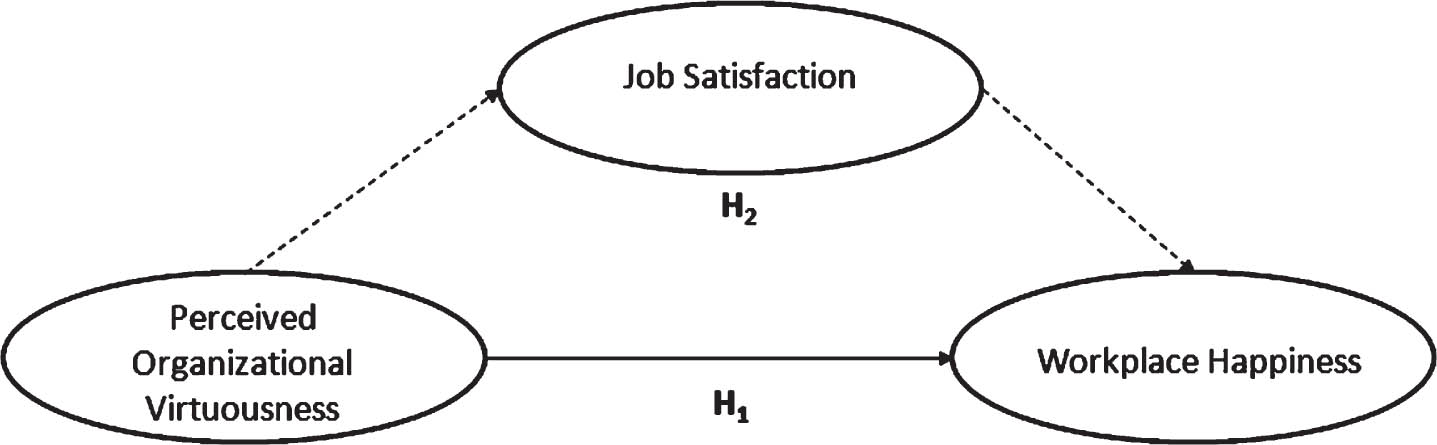
Conceptual model.
Research methodology involves various steps that a researcher generally follows to examine a research problem of the respective domain. It is a logical investigation of the research problem and as asserted by Kallet [78], it provides the information based on which the validity of a study can be determined. The following research method was adopted for the present study for establishing valuable results:
Research approach
Quantitative research approach was followed in the study with a conclusive research design. In this type of studies, research objectives and data requirements need to be clearly defined. Such research design provides a way to validate and enumerate findings of exploratory studies [79]. It is assumed that quantitative research approach/design adopted for the present study enabled to extract the true statistical nature of results as per the nature of variables and relationships to be investigated. The data was analyzed using PLS-SEM technique in SmartPLS 4 software by Ringle et al. [80].
Sampling technique and target population
Justifying the purpose of research and based on the judgments of the researcher, purposive (non-probability) sampling technique was used in the present study. The rationale for choosing the purposive sampling as a technique for the present study were that no sample frame of population for inclusion criteria was readily available.
The sampling unit of present study is all IT and ITeS sector companies of Delhi-NCR. The sampling unit in terms of respondents selection for present study is those employees of IT and ITeS sector companies of Delhi-NCR who have completed at least one year of organizational tenure in their present organization. The rationale for choosing such employees has been supported from recent research of Yap & Badri [53]. It is with the justification that employees start forming perceptions about the organization only when they have spent a time of at least one year in the organization. A total of 600 employees from Delhi-NCR (India) were approached with the support of a modified questionnaire. Out of the 530 responses received, 470 were found suitable for the study. The period of data collection for present study ranged from March 2021 to September 2021.This period remained less affected by Covid-19 pandemic as compared to the initial year of 2020; hence the results of present study remain varied and less affected by the scenario of pandemic.
Demographics of respondents
The study was carried out in Delhi-NCR for the IT and ITeS sector employees. Table 1 shows the detailed demographic profile of respondents for the present study. Employees with one year or more of organizational tenure were considered for being a participant of the study [53].
Respondents’ demographic profile
Respondents’ demographic profile
N = 470. Source: Primary data.
The 15 items measurement scale for measuring POV was developed by combining five factors namely Optimism, Trust, Compassion, Integrity, and Forgiveness dimensions following the study by Cameron et al. [67]. For measuring Job satisfaction, scale by Paul E. Spector [81] was adapted. The scale for Workplace Happiness was self-administered one which initially consisted of 22 items represented through five factors. However, the results of pilot testing made the items to be reduced to 18 following Gerbing and Anderson’s [82] scale development guidelines. The factors in this scale included Work culture, Work characteristics, Supervisor support, Peer support, and Work life balance. The questionnaire statements have been shown in Annexure I.
Descriptive statistics and correlation assessment
In this study, descriptive statistics (Table 2) were employed to provide a comprehensive overview of the dataset, comprising responses from a total of 470 participants. The primary constructs under investigation included Perceived Organizational Virtuousness, Workplace Happiness, and Job Satisfaction. For POV, participants’ mean scores ranged from 3.50 to 4.04. The standard deviations, ranged from 0.556 to 1.014. It signified the extent of variability within participants’ responses for each item. For WPH, the study evaluated respondents’ perspectives across 18 items, with mean scores varying from 3.49 to 3.87. The calculated standard deviations, ranged from 0.590 to 1.031. Collectively, the descriptive statistics for both POV and WPH unveil a coherent and reliable set of data, capturing respondents’ sentiments on these dimensions.
Descriptive statistics and correlation matrix
Descriptive statistics and correlation matrix
Furthermore, JS was evaluated through 9 items, where mean scores spanned from 2.89 to 3.71. The standard deviations, ranged from 0.537 to 1.025. Overall, these descriptive statistics provide a robust foundation for subsequent analyses, enabling a thorough exploration of the relationships and patterns within the constructs of Perceived Organizational Virtuousness, Workplace Happiness, and Job Satisfaction.
Table 2 also shows that the constructs Job Satisfaction (JS) and Perceived Organizational Virtuousness (POV) (r = 0.589), Job Satisfaction (JS) and Workplace Happiness (WPH) (r = 0.650), and Perceived Organizational Virtuousness (POV) and Workplace Happiness (WPH) (r = 0.819) are positively correlated with each other [83].
Reliability and validity assessment
A total of 41 items, including measures of Perceived Organizational Virtuousness (15 items), Workplace Happiness (18 items), and Job Satisfaction (9 items) were utilized. Results in Table 3 display the values of factorial loadings where almost all the factor loading of items were confined between the range of standardized factors loading (i.e., between 0.5 and 0.90). However, four items from the scale of Workplace Happiness and five items from Job Satisfaction scale have been removed at the initial stage for the factor loadings being below 0.5 [84, 85]. It was concluded that convergent validity for POV and JS items related with each construct was established because the average variance extracted (AVE) values were greater than 0.50 [86, 87]. Internal consistency reliability was deemed to be established when the composite reliability (CR) of all constructs was above 0.70 [88, 89]. The Cronbach’s value was greater than.70, indicating that all constructs’ reliability had been established [90, 91].
Reliability and validity assessment
Reliability and validity assessment
Additionally, the discriminant validity was computed using the HTMT index (Table 4). The HTMT ratio values were found to be below 0.85, which was required to prove discriminant validity [92].
Heterotrait-monotrait ratio
As a result, the analysis presented above demonstrated the validity and reliability of the items used to measure the study variables. The variance inflation factor (VIF) values for each construct were less than 5. Hence, the indicators did not have any issues with Collinearity [93].
The measures for model fit estimation by Ringle et al. [80] were used to investigate the association. In the present study, following findings have been revealed:
Table 5 shows the model fit indices of SRMR (Standardized Root Mean Square Residual) value is 0.077 which is a good indicator of model fit [91, 94]. The value of d_ULS and d_G are observed as 5.613 and 1.790 respectively. These values are as 95% bootstrapped quantile values of saturated and estimated model. NFI (Normed Fit Index) is an incremental fit measure that calculates Chi-square values of the model and compares it with useful standard [95]. The NFI value should be closer to 1 for a better model fit [94, 96]. The saturated model fit values and estimated model fit values were the same since the conceptual model had no free paths.
Model fit indices
Model fit indices
PLS-SEM was employed to estimate the structural model’s parameters (Fig. 2), and Table 6 presents the standardized values that the PLS algorithm computed. Following Hair et al. [97], the R square (R2), effect size (f2), beta coefficients (ß), and matching t values were obtained using the bootstrapping approach with a resample of 5,000 to evaluate the structural model. Coefficient of determination (R2) analysis indicated that 71.4% variance in the experiences of WPH is explained by POV and 34.7% of the variance of JS is explained by POV. Thus, the overall R2 was moderate for the structural model following Hair et al., [96]. The effect size being 1.019 represented large effect (f2) of POV on WPH [98].
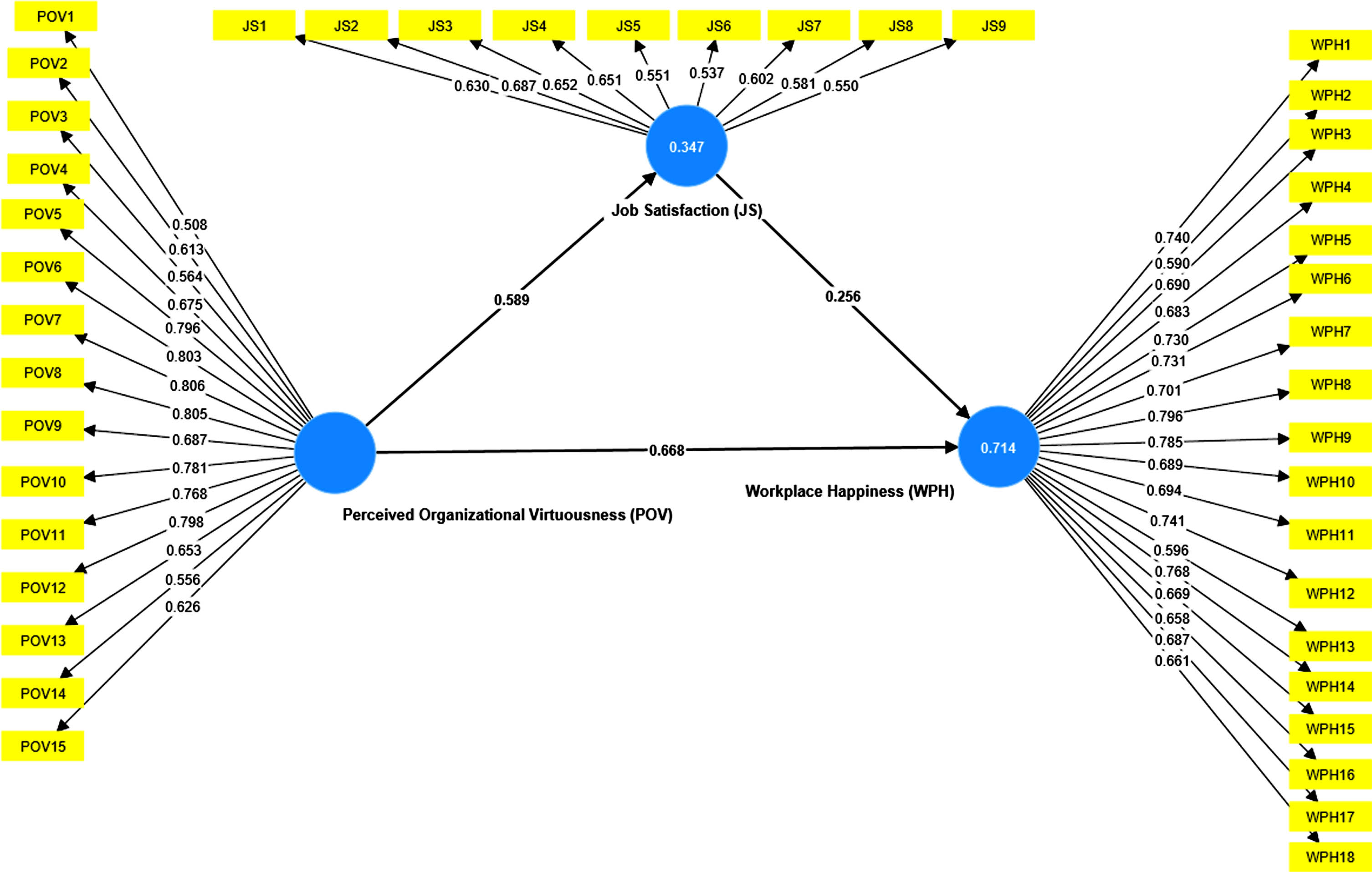
Impact of POV on WPH.
Direct, indirect, and total effect path coefficients
*p < 0.1, **p < 0.05, ***p < 0.01
The first objective of the study pertained to identification of existence of relationship between POV and WPH. The results from data analysis confirmed the existence of a positive and significant relationship between POV and WPH (β= 0.668, t-value = 16.912, p-value <0.01) (Table 6). Hence, it is concluded that when employees perceive their organization as virtuous, they tend to experience happiness at the workplace. So, for improving the experiences of WPH among employees it is important for organizations to display its virtuousness. In the sampled organizations, Compassion and Integrity are top two virtues contributing maximum for the employees’ Workplace Happiness.
The results of mediation analysis showed that the total effect of POV on WPH was significant (β= 0.151, t = 6.210, p < 0.01). Additionally, the indirect effect of POV on WPH through JS was also significant (β= 0.819, t = 38.879, p < 0.01). Hence it is concluded that this relationship between POV and WPH is partially mediated by JS.
Therefore, this current investigation yields interpretations that align with both Virtue Theory and the Job Characteristics Model. Specifically, perceptions of Organizational Virtuousness have a substantial impact on the experiences of employees within the IT and ITeS sectors. Additionally, the attributes associated with a given job play a crucial role in determining employee Workplace Happiness. Furthermore, the perception of Organizational Virtuousness by employees correlates positively with their satisfaction levels, ultimately culminating in enhanced experiences of workplace happiness.
The present study explored the existing antecedents of Workplace Happiness with reference to IT and ITeS sector employees. Five broader factors in this regard are identified namely Work Culture, Work Characteristics, Work life balance, Supervisor support, and Peer support. Researchers have investigated the relationship between OV and JS; and claimed that OV leads to JS among employees [38]. Additionally, Kooshki & Zeinabadi [39] asserted that when employees experience honesty, trust, compassion, and respect from the organization; they tend to feel satisfied with the job. With reference to the present study, it was found that there is a positive association between POV and WPH. While investigating the impact of POV on WPH it was revealed that when employees recognize their organization to be virtuous; they are likely to experience happiness at the workplace. Finally, while investigating the mediating role of JS in the relationship between POV and WPH, it was found that the direct impact of POV on WPH was higher and comparatively more significant than the mediation effect of JS stating that the effect is partial. But it does not mean that Job satisfaction does not promote happiness at work. Yet it confirms that Happiness at work is something beyond mere Job satisfaction. Eventually, it is asserted that happiness is the key to sustainability [99].
Theoretical and practical implications
The findings of this study carry substantial theoretical implications that resonate with a variety of stakeholders invested in advancing organizational performance [35, 61], mitigating the adverse consequences of downsizing [60], fostering a healthful work atmosphere, and cultivating considerate behaviors among staff members [9], as well as elevating commitment levels [100]. The growing emphasis on interventions that nurture and sustain employee work engagement within organizations is unsurprising. These interventions fall under the purview of positive psychology, encompassing intentional actions or strategies designed to (a) nurture positive subjective experiences, (b) cultivate positive character traits, (c) foster civic virtue and positive institutional practices, or (d) integrate elements of both (a) and (b) [101].
The realm of positive psychology has generated a myriad of activity-based interventions, which exhibit potential for bolstering overall happiness and, by extension, may prove invaluable in enhancing workplace happiness. By promoting a culture of workplace happiness, organizations can strategize effectively to retain their workforce, thereby mitigating the considerable costs associated with employee turnover [102, 103]. This proactive approach undertaken by organizations serves to inform policies and practices that prioritize employee well-being and retention [71].
Conceptually akin to happiness, work engagement holds parallels with the notions articulated by Diener, Suh, Lucas & Smith [104] whereby happiness embodies an amalgamation of emotional and cognitive states that encapsulate feelings of positivity. An organization’s enduring sustainability necessitates not only fiscal robustness but also institutional and moral integrity [5, 20].
Moreover, the concept of Workplace Happiness (WPH) bears implications for the physical and psychological well-being of individuals [105, 106]. Employees who experience WPH exhibit enhanced performance, improved stress-coping capabilities [107], healthier workplace relationships, greater job satisfaction [108, 109], and a propensity for cooperative behaviors [110]. The array of positive outcomes spans the spectrum of improved associations, bolstered immune systems, diminished sleep disturbances, reduced burnout rates, heightened self-control, enhanced self-regulation, heightened resilience, and an elevated pro-social disposition [104, 111–117].
In light of these findings, it becomes evident that organizations should actively strive for continuous improvement in fostering the well-being and happiness of their employees within the workplace. Such initiatives hold the promise of fostering employee well-being, culminating in a ripple effect that extends to enhanced performance, enriched workplace relationships, and improved physical and psychological health among employees.
Directions for future research
The present study attempted to (i) explore the relationship between POV and WPH in Indian context, (ii) investigate the impact of POV on WPH, and finally (iii) analyze the mediating role of JS in promoting WPH among IT and ITeS sector employees. Consequently, it is revealed that the proposed association of POV and WPH is positively directed and POV holds a significant impact on WPH. The mediating role of JS is also analyzed and it is found that although JS mediates the relationship but the POV’s direct effect on WPH is much stronger than the mediation effect of JS.
The study’s findings indicate that when employees view their organization as virtuous, believing it has strong values, it boosts their happiness at work. This is particularly significant in the Indian context. Additionally, the findings are at par with the Virtue Theory and the Job Characteristics Model where Workplace Happiness is an outcome of appropriate nature of job/job characteristics/work characteristics. Moreover, unlike previous research studies [39, 71] that simply measured the variables relationship, the present study also examined whether JS mediated the linkage between POV and WPH.
The findings of the present study hold relevant significance for the academics in terms of encouraging development of theories pertaining to the field of Positive Psychology. Academicians can pursue further research in similar direction and suggest strategies to industry for improving performance, organizational effectiveness, and promoting employee happiness at work and overall well-being. The factors exploration for Workplace Happiness in IT and ITeS sector can be further explored in context of other sectors.
Furthermore, the current investigation holds the potential to serve as a crucial tool for industry managers seeking to optimize their employees’ output. The study posits that by focusing on perceptions of Organizational Virtuousness and fostering Workplace Happiness, managers can pave the way for improved outcomes such as enhanced productivity, heightened customer satisfaction, elevated organizational performance, and the cultivation of positive attitudes.
Notably, these factors also function as buffers against the adverse effects of downsizing, as highlighted in the research by Bright, Cameron & Caza [30]. This perspective strengthens the strategic significance of our findings for managerial decision-making and organizational success. Overall, these implications highlight the practical relevance of the study’s outcomes for informed managerial decision-making, ultimately contributing to the success and well-being of both employees and organizations.
However, due to the limitations of the present study, it is suggested that future studies should not be concentrated for IT sector only and the proposed association should be investigated in context of other service sector organizations too. Cross-cultural studies [75] and studies across geographical regions [118] can also be conducted to generalize the findings of current study. One of the interesting findings of the study is that the perceptions of OV presence amply in the initial stages of organizational tenure. Future research can explore what strategies can organizations employ to sustain these perceptions throughout an employee’s later stages of organizational tenure.
Some other moderating and mediating variables can be explored to exist in the association between POV and WPH that can promote and enhance the experiences of Happiness at the workplace and overall well-being at work [115]. The factors affecting workplace happiness in IT and ITeS sector that are identified in the present study needs to be further explored for other industries too. A more rigorous validation of the WPH scale is suggested to the researchers of this domain. Conclusively is can be said that the findings of present study can form a base for future research studies for conducting qualitative, cross-sectional, and empirical studies in the areas where the present study is constrained.
Author contributions
CONCEPTION: Sonu Kumari
METHODOLOGY: Sonu Kumari
DATA COLLECTION: Sonu Kumari
INTERPRETATION OR ANALYSIS OF DATA: Sonu Kumari
PREPARATION OF THE MANUSCRIPT: Sonu Kumari and Kulwinder Kaur
REVISION FOR IMPORTANT INTELLECTUAL CONTENT: Kulwinder Kaur
SUPERVISION: Kulwinder Kaur
Footnotes
Acknowledgments
The authors declare no conflict of interest and no financial support for this research work.