




Abstract
BACKGROUND:
Sharing of knowledge and positive workplace behavior by employees are perquisites for the success of every organization. The present study realized the significance of knowledge sharing and positive behavior in a country like India where high-power distance culture is prevalent.
OBJECTIVE:
The present research aimed to investigate the influence of abusive supervision on knowledge hiding and employee organizational deviance. In addition mediating roles negative affectivity and employee silence were alsotested.
METHODS:
Data was gathered from 420 employees working in a service organization in India. SPSS vs. 23 and Amos vs. 24 were used for data analysis purposes. The techniques of SEM were applied to test the proposed hypotheses in the present research.
RESULTS:
The study found the positive and significant influence of abusive supervision on knowledge hiding, but the insignificant influence of abusive supervision on employee organizational deviance. The results also reflected the full mediating role of negative affectivity but the partial intervening or mediating role of employee silence between the relationships of abusive supervision with knowledge hiding and employees’ organizational deviance.
CONCLUSION:
The study suggested the management introduce various measures to reduce abusive supervision leading to negative consequences.
Keywords


Introduction
Knowledge hiding and organizational deviance by employees in the organization are becoming serious issues or challenges globally. [1] defined knowledge hiding as an act of concealing the information which is asked and done by individuals intentionally. Existing studies have demonstrated that playing dumb, rationalized, and evasive are the three dimensions of knowledge-hiding behavior [2–4]. In case employees play dumb, they pretend themselves as unknowledgeable about the needed information, on the other hand, evasive hiding involves providing of misleading information and hiding accurate information by the knowledge hider to the knowledge seeker [4, 5]. It may be simple when a person ignores small requests and may be complex when critical and required information is withheld. Further, organizational deviance is intentional behavior to violate the norms of the organization to harm its employees and corporation [6]. There are two basic types of deviance developed by [7] which are widely accepted as interpersonal and organizational. Organizational deviance is related to intentionally extending overtime and shirking hours. On the other hand, interpersonal deviance is associated with individuals such as verbal abuse and sexual harassment. It is key to distinguish interpersonal deviance because one deviant behavior is against the supervisors and another is targeted toward the other employees [8]. In the present research organizational deviance is considered while analyzing the reactions of employees to abusive supervision. Recent literature has focused on identifying the factors behind knowledge hiding because such behaviors hinder the success of an organization [9–11]. The factors encompass fear to lose position, extra benefits, interpersonal relationships, and workplace bullying as identified by [1, 11]. However, the existing literature has ignored the dark side of the Supervision style or leadership which need further examination [10, 12]. Thus, this study examines the relationship between abusive behavior on knowledge hiding behavior and organizational deviance as recommended by [13], due to a largely ignored area of research.
Theoretical background of the study
Abusive supervision
Abusive Supervision indicates the verbal and non-verbal hostile behavior of employers based on the reports of employees [14]. It does not encompass physical contact e.g. making humiliating criticisms, throwing angry tantrums, telling lies, and giving silent treatment. Existing literature on abusive supervision suggested that it is negatively associated with job satisfaction [15, 16], organizational commitment [17], creativity [18], work engagement [19, 20], psychological well-being [21], and emotional exhaustion [22, 23]. Employees in the organization withhold organizational citizenship behavior due to the abusive treatment of supervisors which also results in the commitment to counterproductive behavior. Thus, their contribution and passion to the organization are affected and exemplified due to abusive supervision as per several pieces of research.
Abusive supervision and knowledge hiding
Abusive supervisors are pessimistic, antagonistic, and rude in their behaviors as per the views of [24]. Such type of leadership behavior hurts the decision-making of employees with a free mind [15], voice behavior, job satisfaction [25] knowledge sharing quality, and quantity [12]. [26] also stated that supervisors may have a negative and positive effect on the attitudes of subordinates and their behavior. The subordinates are likely to choose strategies of avoiding coping [4] and rarely fight back for the protection of their resources when abusive behavior is faced [27]. COR theory supports these arguments. The theory states that an individual has the possession of personal characteristics, conditions, objects, and energies to complete the given tasks successfully [28] They try to protect these resources when they feel the threat of loss and loss because of stressors at the workplace [3, 4]. Negative supervisory behavior like abusive supervision enhances the level of stress in the workplace of employees that results in a reduction in their resources that lead to the hiding of these personal resources in the form of knowledge. Hence it can be proposed that
H1: Abusive supervision at the workplace has a positive and significant impact on Knowledge hiding by employees.
Abusive supervision and employee organizational deviance
Abusive Supervision is a driving factor for the deviant behavior of employees toward the organization [7]. Employees’ experiences at the workplace such as injustices, frustration, and personal threat are the primary factors influencing employees’ organizational deviance as dispersed by [6]. According to research conducted by [29], Abusive supervision encourages feelings of helplessness, frustration, and alienation. In the same tune [14] also suggested that abusive supervision has a negative influence on the perception of justice in the organization. Hence, it can be interpreted that employees’ deviance is also likely to be positively influenced by abusive supervision. As per the discussion of the above literature, we may expect that abusive supervision is associated with employees’ organizational deviance in two ways such as employees’ response against the supervisors by direct retaliation and secondly by engaging in displaced deviance towards the other individual and the organization. Thus, it can be proposed that
H2: Abusive Supervision has a negative and significant impact on employees’ organizational deviance.
Employee silence as a mediator between abusive supervision and knowledge hiding
Employees’ silence is a purposeful attempt to withhold ideas opinions and information about issues of the organization [2]. 85% of the working employees choose to stay silent on the problems occurring in the organization as per statistics. [30] especially in developing nations with high power gaps [31]. In a study conducted by [32], there is a negative relation between employees’ silence and their information-sharing behavior. Thus, it can be argued that employees perceive that their information and ideas are worthless and remain silent and start knowledge hiding ultimately. As per the COR theory, employees in organizations are propelled to conserve the present resources and make efforts to acquire new resources, that assist them in completing their tasks. But, when they feel stressed, they give more significance to protecting their current resources rather than gaining new resources as deliberated by [33]. An abusive supervision style is also a workplace stressor that continuously pressurizes human resources and is considered a threat to personal resources. Subordinates remain silent while protecting their resources in response to this. Further, this discourages information and knowledge sharing, thus leading to knowledge hiding for the preservation of their personal resources. Hence, the current research proposed that
H3: Employees’ silence plays a mediating role in the relationship between abusive supervision and Knowledge hiding.
Employee silence as a mediator between abusive supervision and employees’ organizational deviance
Existing literature on employees silence has recommended that silence of employees is a result of employees’ cognitive problems, like anxiety, work disengagement, job satisfaction [2], and negative organizational events [31], that have a negative effect on employees and performance of the organization [4]. Abusive behavior of supervisors at the workplace is also regarded as a negative event that results in silent employees [34]. In their research, [34], suggested that subordinates are exposed to workplace abuse and as result, they face an enhanced level of anxiety, fear, depression, emotional exhaustion, and distress. [35] also stated that employees feel pressurize and increased levels of anxiety when they are exposed to supervisory abuse. However, they do not respond to their supervisor due to their high position [4]. Moreover, subordinates rely on their supervisors for the acquisition of resources like job continuity and opportunities for development and opt to stay silent as a strategy to cope with [2]. The employees do not want to be held responsible for the problems at the workplace [36]. Their Silence has an effect on their well-being [37], task and contextual performance [38], and enhances stress [39] that boost psychological issues such as cynicism, deviant behavior, and disengagement [40]. Thus, the study proposed the hypothesis that
H4: Employee silence plays a mediating role in the relationship between Abusive supervision and employees’ organizational deviance.
Negative affectivity is the mediator between abusive supervision and knowledge hiding
[41] proposed the theory of affective events to understand the associations among affective events, attitudes and reactions, and the workplace behavior of employees and employers. AET (Affective events theory) explores the relationship between affective events and the behavior and attitudes that are experienced by the members of an organization. The theory by focusing on the incentives, structure, and consequences of emotional responses of an individual at the workplace, recommends that characteristics of a work environment may result in negative or positive work events that trigger an emotional response of an individual in form of their behavior and attitudes. Based on the AET theory, characteristics of the workplace such as leadership style can generate negative or positive affective events that influence the emotions of employees. [42] demonstrated that emotions are affected due to environmental events. Negative affectivity may generate a behavior of avoidance or knowledge hiding for the protection of their resources and threat or risk, which would lead to knowledge hiding. Thus, the abusive supervision style of leadership results in negative affect that directly prevent the employees from sharing knowledge and information, or knowledge-hiding behavior is propelled among employees facing abuse. Therefore, based on the above arguments the present study proposed that
H5: Negative affectivity plays a mediating role in the relationship between abusive supervision and Knowledge hiding.
Negative affectivity is the mediator between abusive supervision and employees’ organizational deviance
AET theory also explains the relationship between abusive supervision and workplace deviant behavior [43]. As deliberated by [44], hostile behavior ad a type of negative affect influenced the interpersonal fairness, abnormal behavior, and satisfaction level of employees significantly. The theory further suggests that the emotional reactions of employees at the workplace follow the events-emotions-attitude-behavior paradigm. Based on this theory, [16] also observed that negative affect/emotions fully mediated the association between abusive supervision and resistance of users. In this tune [45], also verified the mediating role of dissatisfaction in the relationship between abusive behavior and workplace deviant behavior of employees. Hence, the literature discussed above leads to the following hypothesis.
H6: Negative affectivity plays a mediating role in the relationship between abusive supervision and Employees’ organizational deviance.
Conceptual model of the study
The study proposed the following conceptual model (Fig. 1) based on the hypotheses. The proposed model explains the hypothetical relationships between the variables under research.
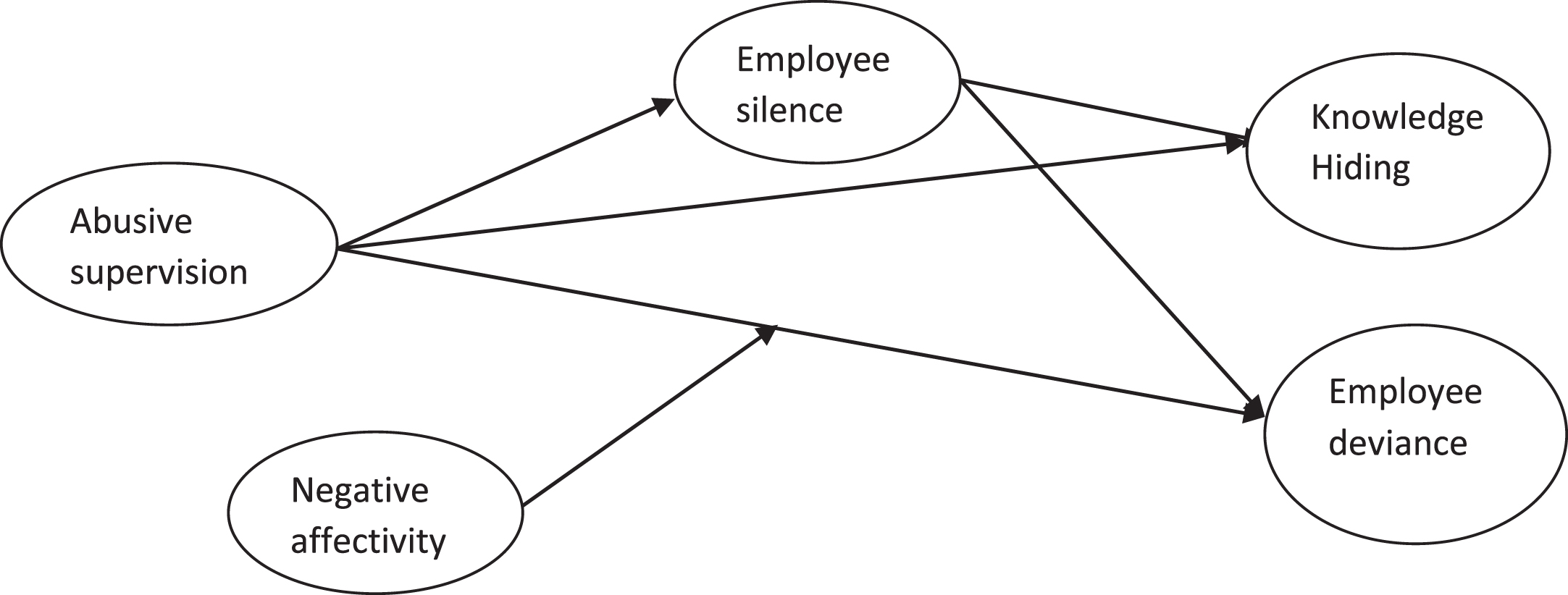
Conceptual Model of the study.
Sample and procedure
Sample selection
Data for the present research was gathered from 420 employees working in service organizations located in several geographical locations such as Delhi, Chandigarh, Mumbai, Ludhiana, Amritsar, Bangalore, and Hyderabad on convenience basis. Service Organizations were selected because this sector contributes to the economy significantly and most of the population moves to this sector for earning their livelihood. It is imperative to build an adequate working environment for increasing the contribution of this sector to the GDP of the country. This paper deals with the major concerns in working organizations arising in today’s era. A total of 530 questionnaires were dispersed to collect the data from the employees but only 420 valid responses were received by the researcher reflecting a response rate of 79.24%. 110 questionnaires with missing and inadequate information were discarded due to invalid responses.
Measuring instruments
The questionnaire was devised to gather the data of variables under research, namely, Abusive supervision, Employee silence, Negative affectivity, Knowledge hiding, and employee organizational deviance. A benefit of the survey method is coverage of a broader geographical area due to its flexibility [46]. The present research used a five-point scale (Likert scale) which was applied to evaluate each item of the variable under the survey, ranging from 5 to 1 (strongly disagree [5] to strongly agree [1]. The scales for measuring the constructs were adapted from the existing literature in full except the scale of employee organizational deviance of which only a subset of items was taken.
Abusive Supervision: The five items scale of abusive supervision was adapted from [43]. The Sample item encompasses, “My supervisor puts me down in front of others”.
Negative affectivity: The five items scale of negative affectivity was adapted from [47]. The sample item includes, ‘I feel irritable at the workplace”.
Employee Silence: The ten statements scale to measure employee silence was adapted from [48]. The questionnaire includes the sample item “I felt it was risky to speak up”.
Knowledge hiding: 3 items scale of abusive supervision was adapted from [48]. The sample statement includes, “I Withhold helpful information or knowledge from others due to the negative behavior of my supervisor”.
Employee organizational deviance: Employee organizational deviance was measured with the six items scale adapted from [48]. The sample item includes, “Employees in my organization intentionally arrive late”.
Analysis of data
In the current research, SPSS vs. 23 and AMOS vs. 24 were applied to inspect the proposed hypotheses. According to the study by [49, 50], the minimum sample size to test the hypotheses and apply the SEM should be 200. The study took a sample size of 420 employees. So, the sample size was adequate for conducting SEM.
Description of data
Table 1 depicts the demographic profile of the respondents. The study consists of a heterogeneous sample of a population varied in age, marital status, gender, organizational level, and qualification.
Demographic profile of the participants
Demographic profile of the participants
Source = Primary data.
Table 1 depicts that most of the respondents (27.61%) were from the age category of 31–35. While 57.38% of the total participants were males. The majority of the respondents (42.85%) were graduates and only 11.19% belonged to the category of the above super specialization. Most of the research participants (57.38%) were married and the left (42.61%) were unmarried. 52.61% of respondents were working at the middle level in their organization while only 14.04% were working at the low level.
Table no. 2 reflects the descriptive analysis of the sample taken i.e. Mean and standard deviation of the sample. Before moving to structural equation Modeling (SEM), inter-correlation among the latent variables was also tested using bivariate correlation. The results are displayed in Table 2 which indicates that AS has a positive and significant relationship with ES (r = 0.056, p < 0.05), NA (r = 0.063, p < 0.05), EOD (r = 0.087, p < 0.05) and KH (r = 0.456, p < 0.01). Further, all the variables were also found to be significantly related to each other in the direction expected. Thus, the fundamental base for the hypotheses testing was provided. The normality was also tested by examining the values of skewness and Kurtosis. The values were found to be lying in the threshold range of –1.5 and +1.5 [68], which reflect that the data was normal. So, parametric tests were applied for further analysis. The outcome values of the t-test and one-way ANOVA signified that the participants have indifferent perceptions regarding abusive supervision in terms of age, gender, marital status, level, and qualification. Hence, these demographic variables were controlled as shown in the Table 2.
Descriptive analysis of the sample
Note: N = 420, **p < 0.01 *p < 0.05. Source = Primary data, AS = Abusive Supervision; ES = Employee silence; NA = Negative affectivity; EOD = Employee organizational deviance; KH = Knowledge hiding.
The five-factors model (shown in Fig. 1) was examined and analyzed using the technique of confirmatory factor analysis (CFA) which also reflected the goodness of fit of data with fitness measures and their thresholds such as chi-square/df = 1070.483/366 = 2.925 < 3 (51), p < 0.01, GFI = 0.808 > 0.80 (52), CFI-0.912 > 0.9 (51), TLI = 0.922 > 0.90 (53, 54). RMSEA = 0.077 < 0.08 (55).
Reliability and validity
There are two essentialities for the goodness of fit of the model after model fit measures such as 1. Appropriateness of the sample size 2. Reliability of data [56]. The KMO test signifies the appropriateness of the sample size for the study. The results are displayed in Table 3 which reflects that the sample size research is adequate as the value of the KMO test (0.896) is above the prescribed limit of 0.8. The results and outcomes of the Bartlett test of sphericity also show a p-value < 0.001, which means that the variables formulating the factors are significant and satisfactory.
Exploratory Factor Analysis
Exploratory Factor Analysis
Extraction Method: Principal Component Analysis. Rotation Method: Varimax with Kaiser Normalization. a. Rotation converged in 5 iterations.
KMO and Bartlett’s Test (Appropriateness of the sample size)
Reliability of constructs (Variables)
Convergent and Discriminate validity of the latent constructs (variables)
Source = Amos output; Note: 1. ***p-value < 0.01; **p-value < 0.05 and *p-value < 0.10. 2. AS = Abusive Supervision; ES = Employee silence; NA = Negative affectivity; EOD = Employee organizational deviance; KH = Knowledge hiding, CR = Composite reliability, AVE = Average variance extracted, MSV = Maximum Shared variance.
The measure of Abusive supervision, Employee silence, Negative affectivity, Knowledge hiding, and Employee organizational deviance was put under unit dimensionality to validate the scale in the Indian context. The principal component analysis (PCA) method, which defines the total variance explained by the data, is applied to extract the minimum number of factors of Abusive supervision, Employee silence, Negative affectivity, Knowledge hiding, and Employee organizational deviance in the present study.
The rotated component matrix (Table 3) displays the extraction of factors with a factor loading of all the variables more than 0.6 [73]. So, all the statements were taken for further analysis.
The reliability was inspected using the coefficient of Cronbach’s alpha. The values of Cronbach’s alpha above 0.7 is regarded as good for the reliability of the questionnaire as per recommended by [71]. The reliability of the individual constructs was measured. Table no. 5 shows the values of Cronbach’s alpha indicating that the questionnaire was reliable because all the resultant values were found to be greater than 0.7.
Validity
Convergent and discriminate validity are the measures to assess the Construct validity of the measuring instruments. As per the research of [57] the latent variables have convergent validity if the factor loading of the single measuring statement on the corresponding factor is greater than 0.50 (>0.50), together with the values of composite reliability (CR) of the scale greater than 0.7 [51] and AVE i.e. Average variance extracted should be at least 0.5 and above [58]. In the current research, all of the variables satisfied the minimum perquisites [58]; thus, they have convergent validity as the factor loading of individual statements measuring the variables were greater than 0.6, had CR > 0.7, and the AVE was > 0.599 to 0.758. Hence, discriminant validity was also tested as recommended by [59] i.e. MSV should be less than AVE, and the square root of AVE for the construct is more than the correlation among them. Thus, resultant values revealed that the variables have both convergent and discriminant validity.
Structural model
After examining the reliability and validity of the latent constructs, the proposed model was moved forward for Structural model analysis. The outcome values of direct effects before mediation by using standardized path coefficients are reflected in Table 7.
Direct Effects before Mediation
Direct Effects before Mediation
Note: 1. ***p-value < 0.01; **p-value < 0.05 and *p-value < 0.10. 2. AS = Abusive Supervision; ES = Employee silence; NA = Negative affectivity; EOD = Employee organizational deviance; KH = Knowledge hiding.
Table 7 signifies the values of direct effect in the structural model before mediation. Abusive supervision has a significant and positive effect on knowledge hiding (estimate = 0.349, p < 0.05), but has an insignificant effect on employees’ organizational deviance ((estimate = 0.094, p > 0.05). Thus H1 was accepted or not rejected while H2 was rejected due to a p-value greater than 0.05.
The resultant values of structural model analysis (reflected in Table 8) signify the indirect effect of abusive supervision on knowledge hiding and employees’ organizational deviance through the mediating role of employee silence and negative affectivity. It was found that abusive supervision has a positive and significant effect on knowledge hiding and employees’ organizational deviance through employee silence and negative affectivity. Thus, both play a significant mediating role between the association of abusive supervision and knowledge hiding and the relationship between abusive supervision and employees’ organizational deviance, providing support to hypotheses (H3, H4, H5, and H6). Direct effects before mediation were analyzed to examine whether the mediation was full or partial. The outcomes of the analysis indicate that the mediation effect of employee silence is partial because a direct effect was also positive and significant as an indirect effect of abusive supervision. On the other hand, negative affectivity plays a fully mediating role in the relationship between abusive supervision and employee organizational deviance due to insignificant direct effects and significant and positive indirect effects of abusive supervision on employee organizational deviance.
Direct and Indirect effects after mediation
Note: 1. ***p-value < 0.01; **p-value < 0.05 and *p-value < 0.10. 2. AS = Abusive Supervision; ES = Employee silence; NA = Negative affectivity; EOD = Employee organizational deviance; KH = Knowledge hiding.
Employees’ deviant behavior and knowledge hiding have become critical issues for senior management. The present study aimed to examine the influence of abusive supervision on knowledge hiding and employee organizational deviant behavior through the mediating role of employee silence and negative affectivity. The research focused on the dark side of leadership style and its consequences in the form of knowledge hiding and deviance in behavior. The dysfunctional behavior of the supervisor that also leads to organizational deviant behavior and knowledge hiding by employees has not been explored in the existing literature [60]. The dysfunctional behavior is more prevalent, especially in countries with a culture of high power distance [31]. Moreover little is known about the boundary conditions and the mechanism of the relationship between abusive supervision style and employee organizational deviance and knowledge-hiding behavior [2, 3]. Thus, the present research tested the mediating role of employee silence and negative affectivity in their relationships. Firstly, the study found that abusive supervision has a positive and significant impact on the knowledge-hiding behavior of employees (H1). The results of the current research are supported by the findings of [22], who observed that abusive or self-focused leadership style is more prevalent in high-power distance culture countries. According to [60] employees in countries with high-power-gap are more probable to engage in retaliatory behavior when their supervisors follow a dysfunctional leadership style. Retaliatory behavior in the form of employee organizational deviance and knowledge-hiding behavior is a response to mistreatment, use of abusive language, and bad attitude of the employer [10]. Employees are likely to hide their knowledge to protect their personal and valuable resources when they are exposed to disrespectful treatment by their supervisor. The findings of [3] also supported the results who also conducted research by taking a sample size of 396 employees in high-power distance culture.
Secondly, the result of the study indicates the positive but insignificant impact of abusive supervision on employee organizational deviant behavior which leads to the rejection of 2nd hypothesis. As per the views of [14] supervisor and subordinate relationship is more significant than interpersonal relationships of employees at the workplace. The results are in tune with the findings of [61, 62] who found the positive effect of abusive supervision on employee deviance and stated that abused subordinates are more likely to show their resentment by involving in acts of deviant behavior against the employer and the organization. But the significance of the response by employees depends upon the intensity of workplace stressors that may be different in the organizations depending on the personal attributes of individuals [63]. According to current research, the effect is insignificant in the absence of any mechanism and boundary conditions.
Thirdly, in testing the mediating effect of employee silence on the relationship between abusive supervision and knowledge hiding, the study found a positive and significant partial mediating effect (H3). In this line, [64] deliberated that an abusive supervisory style is considered a workplace stressor. The negative or abusive behavior of supervisors increases the level of stress among the employees leading to diminishing the personal resources of employees [69]. The hierarchy of the organization keeps employees far to react and response this negative behavior [4], but they engage in silence which is defensive [31]. The silent behavior of employees allows them to knowledge hiding behavior from their colleagues and employers [2].
Fourth, the study found the significant and positive full mediating role of employee silence in the relationship between abusive supervision and employee organizational deviance (H4). Studies conducted by various researchers [26, 60] stated and highlighted the nations with a culture of high power gap where subordinates with higher rank use their chairs to degrade their subordinates by bullying, termination, and discrimination. Subordinates do not involve themselves in confrontation with their supervisors and hold defensive silence [31] which further leads to deviant behavior in the workplace.
Fifth, in the present research, the results dictated the positive and significant partial mediating role of negative affectivity between the relationship of abusive leadership and knowledge hiding (H5). Employees at the workplace expect fair and proper treatment while working, but when they perceive being mistreated by the employer, they regard it as a breach of faith which is serious [65] which results in negative affectivity and knowledge-hiding behavior among them ultimately.
The sixth, and last findings of the current research, indicated that negative affectivity also fully mediates and intervenes in the relationship between abusive supervision and employees’ organizational deviance (H6). [66] stated that subordinates, who feel consistent abuse and humiliation by their immediate supervisor, blame the organization for not developing and enforcing enough procedures to protect them from their tormentor. As a result, they feel irritated and that negative feelings force them to engage in workplace deviant behavior.
Implications
Theoretical implications
The current research has contributed to the existing literature in various ways. Firstly, the study explored the relationship between abusive supervision & knowledge hiding and abusive supervision and employee organizational deviance with the mediating role of negative affectivity and employee silence between both relationships. Past research in this field has tested the mediating effect of interpersonal justice [60], distrust [67], psychological contract violation [65], and Employee silence [64]. Nevertheless, how negative affectivity mediates the association between abusive supervision and knowledge-hiding behavior & employee organizational deviant behavior remained an unexplored area yet. The study realized the importance of maintaining faith and trust for protecting the employees from the tormentor. In the absence of adequate procedures to combat the supervisor’s hostile attitude, the subordinates feel negativity and preserve their personal and valuable resources in the form of knowledge hiding and behave in unwanted deviant manner at the workplace. The present research also contributes in the literature of employee silence also where it also plays a mediating role between the relationship of abusive supervision and workplace deviant behavior. It means that disrespectful behavior leads to defensive silence in employee results into deviant behavior; this relation has not been studied also in the previous literature to the best of our knowledge. The findings of the current study contributes in the literature of COR theory, which states that hostile or abusive supervision lead to personal threat of resources and employees engage in silent behavior to protect their resources (knowledge) which ultimately lead to knowledge hiding.
Practical implications
The study has significant implications for the policymakers and the management in the organization. According to [13], sharing valuable knowledge is critical for the success of the organization and when employees tend to stop this in response to abusive supervision, the problem occurs. Thus, there is a need for knowledge sharing at every step of the organization. The present study deliberated and shed the light on the consequences of the dismissive behavior of supervisors in the workplace. According to the findings, abusive or negative behavior by the employer always results in negative outcomes such as negative affectivity, employee silence, employee organizational deviance, and knowledge hiding. These negative outcomes could harm other individuals as well as the performance of the organization. Hence, the management is required to focus on the leadership style to reinforce the system of knowledge management. Measures to eliminate abusive supervision need to be implemented in the organizations such as 1. Training before promoting the employees at supervision level 2. Proper communication between superior and subordinate 3. Feedback system to report the mistreatment by the supervisors 4. Building healthy relationships between employers and employees. Hence management is recommended to provide regular training to its employees and arrange programs to reduce their high-power gap and communication barriers to build a healthy relationship between one and all. This can be done by bringing systematic modifications and interventions in the organization, carrying, tolerating [13], participating in decision-making programs, self-controlling of schedules, and delegating the authority of control [68].
Limitations and scope for future research
The study is not without limitations. Firstly, the cross-sectional research design used in the present context may hinder the causality of relationships among the variables. Hence future researchers can apply experimental research design and longitudinal research can be conducted to examine the change in perceptions of the individuals’ time. Secondly, the data for the present research was gathered and limited service organizations in India have a culture of high-power distance. Future researchers can compare the results of high-power distance culture and low-power distance culture for generalizability of the results and the same model can also be examined in other sectors like manufacturing and educational institutions. Thirdly, service and manufacturing organizations can also be compared. Fourth, future researchers can explore the dark side of leadership i.e. abusive supervision further by including the conditional effect of the psychological contract as moderating variable.
Conclusion
The present research is among the rare empirical studies that inspected the positive and significant association of abusive supervision with workplace deviance together with knowledge hiding. Additionally, the study has also investigated the indirect effect of negative affectivity and employee silence as mediators in defining the associations between the aforementioned focal constructs. The study suggested the management introduce various measures to reduce abusive supervision leading to negative consequences. Further, management is suggested to provide adequate training to each employee before moving them upward in the organizational hierarchy. There should be the removal of communication barriers by introducing a proper feedback system and building healthy relationships to encourage knowledge sharing. Thus, systematic modifications and interventions should be introduced in the organization to reduction the high- power gap.
Author contributions
CONCEPTION: Parvinder Kaur.
METHODOLOGY: Parvinder Kaur.
DATA COLLECTION: Parvinder Kaur.
DATA ANALYSIS AND INTERPRETATION: Parvinder Kaur.
REVISION FOR IMPORTANT INTELLECTUAL CONTENT: Ella Mittal.
SUPERVISION: Ella Mittal.
Footnotes
Acknowledgments
There is no acknowledgment of authors.