




Abstract
BACKGROUND:
This study was done after the COVID-19 pandemic that brough a lot of disruptions and changes in behaviors of employees. This study focused on behaviors of Z employees in the new normal environment after the COVID-19 pandemic. Generation Z presently form the biggest age group in Malaysia, accounting for 29% of the total population. They have their own way of behavior and working patterns that is different from previous generations. Despite the increasing number of Gen Z employees, there is a dearth of studies that examined the effect of workforce diversity and job meaningfulness on employee engagement and OCB after the COVID-19 pandemic.
OBJECTIVE:
This research aimed to find out the association between workforce diversity and job meaningfulness to employee engagement and Organization Citizenship Behavior (OCB) among Gen Z employees in Malaysia after the COVID-19 pandemic. This research also investigated the relationship between employee engagement and OCB.
METHODS:
This was a quantitative study, and a survey strategy was used to collect data from 160 respondents. SPSS and Smart-PLS were used to generate descriptive and inferential statistics.
RESULTS:
The results revealed that workforce diversity was the strongest predictor of employee engagement among Gen Z employees after the pandemic. Workforce diversity also had a significant impact on OCB. Comparatively, job meaningfulness had a significant impact only on employee engagement but there was also a significant impact of employee engagement on OCB.
CONCLUSIONS:
The study that was done after the pandemic is one of the first to examine the relationship between workforce diversity, job meaningfulness, employee engagement, and OCB and has extended the current literature through the focus on Generation Z employees. The results suggest that workforce diversity and job meaningfulness to be adopted by organizations to upgrade engagement of Gen Z employees after the COVID-19 pandemic. The increase in employee engagement post-COVID, will lead to lower employee turnover, improved productivity and motivation.



Introduction
This study was done after the COVID-19 pandemic. As reported by McKinsey, the COVID-19 pandemic has disrupted labour markets globally during and after the pandemic. One of the main disruptions is greater reliance on remote work. The report by McKinsey reported that 22% of U.S. jobs could be done remotely for 3–5 days a week, without loss of productivity. As reported by Harvard Business School, Covid killed the traditional workplace [1]. The pandemic pushed companies adopt new behaviours and there was a high increase in number of employees working remotely [2]. New ways of working have been adopted and organizations need reimagine their work in creating safe, productive, and enjoyable jobs for employees. Employees are leaving organizations for several reasons faster than organizations can replace them. Companies will need to restructure compensation packages to attract and retain employees [3]. Organizations have to accommodate changes to work patterns in the post-COVID era. Employees need to become accustomed to the flexibility that comes with virtual work. Most of the past studies on employee’s behaviour that include employee engagement and commitment were done during or before the pandemic [1]. This study will examine the effect of workforce diversity, job meaningfulness, employee engagement and OCB after the pandemic.
A report by Deloitte reported that businesses faced disruptions during and after the pandemic and they need to look at ways to boost employee engagement [4]. Organizations need to introduce work methods and policies that nurture the emotional connections between employees and their workplaces and motivate them. For instance, companies need to invest in diversity and inclusion increase innovation and create more adaptive teams [5]. There are books and articles published on engagement by scholars and researchers [6, 7]. Studies have shown the positive impact of employee engagement on organizations [7]. During the recent pandemic, employee engagement has become one of the most important tasks for leaders and human resource managers in organizations [7]. As stated in a study by Deloitte [8], organizations are fighting an uphill battle to design attractive workspaces, offer flexible benefits, and develop engaging corporate cultures in an effort to increase employee engagement. However, some studies have reported on the lower levels of employee engagement and its impact on the competitive advantage and performance of organizations [9]. The results of a survey by Gallup revealed that only 13 per cent of employees surveyed were classified as highly engaged, and 26 per cent were classified as actively disengaged. This is a cause for concern among organizations [10].
Organizational Citizenship Behaviour (OCB) is also one of the emerging areas of focus [11]. Organizations have been curious about how workers perceive and feel about their work and their willingness to contribute to the organization [12]. The best asset of any firm is the human resources that ensure the realization of the company’s objectives and vision. Studies have shown that OCB has a positive and significant effect on several outcomes, such as performance [13]. As reported in a study by Deloitte [8], organizations need to encourage corporate citizenship behaviour (OCB) to increase innovation among employees. Employees who participate in OCB are motivated to go beyond their normal duties to support the organization’s goals of efficiency and innovation. When OCB is high among employees, their desire to be a part of and contribute to a company’s success is high [14]. However, studies have shown the negative contribution of OCB. A study at the team level by Nielsen et al. [15] revealed that time-consuming OCB dimensions had negative relationships with performance. This shows inconsistencies in the results of past studies.
Generation Z is the population born between 1995 and 2012 [16]. Today, Generation Z has become the latest group in the workplace. In addition, Generation Z is presently the biggest age group in Malaysia, accounting for 29% of the total population. As one of the major groups in the population, Malaysia relies heavily on its contribution to the country [17]. This shows that there is ample evidence that Generation Z plays a vital role in the workplace, and as a result, this generation will take over the workplace in the next few years [18]. According to Parker and Igielnik [19], Generation Z is more diverse in ethnicity and race than any older age group, and they are believed to be the most educated generation to date. Generation Z is also known as the first true digital natives. They have been exposed to technology from birth [20]. In the workplace, they are eager to accept job challenges if they feel worth it [17]. Malaysian Generation Z’s unique characteristics and behaviours as employees provide special challenges for organizations. As stated in a survey by Deloitte [21], entire industries and businesses will rise and fall in the wake of Generation Z. The report further stated that only a few organizations are ready for it. In order to attract and retain Generation Z talent, organizations need to have a new mindset and be ready to adopt a speed of evolution. Therefore, it is worth doing a study on the engagement and commitment of Generation Z employees.
Some studies have looked at the relationship between workplace diversity, job meaningfulness, employee engagement, and OCB of various generations of employees. The survey by Deloitte [21] highlighted that Generation Z employees highly value diversity. The report further stated that diversity matters to them through gender and race. Based on a past study by Bizri [22], diversity management can bring a considerable and positive effect on normative commitment, emotional commitment, job engagement, and organizational citizenship behaviour. Research by Goswami and Goswami [23] also revealed a positive association between workforce diversity and employee engagement. Job meaningfulness is another important construct. Currently, employees are looking for more meaningful work but finding it difficult and making purpose real for employees is critical for the success of organizations [24]. Through the increase in job meaningfulness, organizations can achieve greater levels of innovation and transformation and employee retention. Therefore, they participate in organizational activities to show work-related constructive results [25]. Another report by Deloitte [8] highlighted that employee engagement is gaining importance and provides workspaces to achieve higher engagement. Employee engagement can also lead to organizational citizenship behaviour because it emphasizes employee participation and commitment, which is certainly beyond the given parameters of any company [11]. Past studies [26, 27] have shown that OCB has a significant relationship with employee engagement. Sharma [28] reported on the indirect effect of job meaningfulness on OCB. Moreover, past research by Goswami and Goswami [23] also found a positive correlation between workforce diversity and employee engagement.
The disruptions brought by the COVID-19 resulted in changes in employees’ behaviors and it is important for organizations to boost employee engagement and commitment. This study focused on identifying the impact of impact of workforce diversity and job meaningfulness on employee engagement and OCB during the post COVID-19 crisis that are very much relevant for Generation-Z employee retention, productivity, and motivation. Despite the importance of the effect of workforce diversity and job meaningfulness on employee engagement and OCB, there is a dearth of studies that have empirically tested the influence of workforce diversity and job meaningfulness on employee engagement and OCB of Generation Z employees in Malaysia after the COVID-19 pandemic. Therefore, this study will provide a better understanding of the influence of workforce diversity, job meaningfulness, and employee engagement on the organizational citizenship behaviour of Gen Z employees in Kuala Lumpur, Malaysia. This will enable organizations to attract, engage and retain Generation Z talent.
Literature review
Employee engagement
Employee engagement, which has been described in various ways, is the positive psychological existence of employees at work. Kahn [29] claimed that employee engagement is the level of employee involvement and commitment to the firm and its values, coined the word. According to Kahn [29], employees use and express their physical, cognitive, emotional, and spiritual identities when performing a task. Additionally, Schaufeli et al. [30] described work engagement as a fulfilling, optimistic, work-related mentality that is focused on one’s work and characterized by three dimensions, namely dedication, vigour, and absorption. According to a study by Saks [26], employee engagement is a measure of the level of conscientiousness and dedication of employees to their work. It is a confirmation of how they feel about their jobs, as well as of their drive, effort, and commitment.
Organizational citizenship behaviour
The definition of organizational citizenship behaviour (OCB) varies among scholars and researchers. Bateman and Organ [31x] were the first to establish the idea of OCB. They held the opinion that OCB is intended more for the supervisor than the organization. Bateman and Organ [31] defined OCB as an effective role behaviour that is outside the daily job scope of an employee. OCB was further defined by Organ [32] as individual behaviour, which is a discretionary behaviour that is not directly or explicitly characterized by a formal incentive strategy and promotes the effective functioning of the organization. According to Van et al. [33], OCB refers to any action that is advantageous to the company or that is intended to benefit the organization. According to Bolino et al. [34], OCB refers to employee behaviours that are less likely to be formally connected to organizational rewards and benefit the business by promoting a positive social and psychological environment. This contrasts with work performance or in-role behaviour. Additionally, according to Thiruvebnkadamand and Durairaj [35], OCB has long been seen as a crucial component of successful organizational performance. It is an attempt by employees to go above and beyond the normal requirements of their position.
Workforce diversity
Diversity can refer to the existence of a mix of different characteristics in employees that shape their identities, such as race, ethnicity, gender, or cultural background. It can also refer to differences in skills and personality traits. The term “diversity” is synonymous with the diversity of the workforce [36]. Diversity, according to Harris et al. [37], is the term used to describe the variations in social and cultural traits among people who coexist in a setting like a workplace or organization. Additionally, the term “workforce diversity” refers to the coexistence of employees from various sociocultural backgrounds [38]. According to Barak [39], employee diversity is the recognition, understanding, tolerance, respect, and acceptance of human variations in a range of categories, including race, gender, age, intellectual and physical ability, ethnicity, socioeconomic background, and religion. According to Barak [39], disparities among employees might also exist regarding values, occupations, organizational roles, and behavioural patterns.
Job meaningfulness
According to Hansson [40], job meaningfulness is distinct from the meaning of a job; instead, the former focuses on the methods and procedures for realizing the source of the latter, that is, the meaning of the job. An employee experiences a piece of work as meaningful if they believe it to be personally relevant and highly valued [41]. The positive and significant contributions that work makes to a person’s life and the personal happiness that comes from work is how Mowday et al. [42] defined the meaningfulness of employment. Additionally, employment meaningfulness suggests that when people feel like their work has significance, they will be more loyal and motivated to achieve their goals [28]. Past academic studies [41], [43] have revealed that, in addition to organizational aspects like job design, interpersonal relationships, organizational culture, a sense of security, and employees’ values and beliefs increase the meaningfulness of their work. Kaur and Mittal [25] stated that meaningfulness of work leads to positive work-related outcomes, such as dedicated, productive, satisfied, reliable, and loyal employees. This shows that the ability of employees to achieve organizational goals is improved job meaningfulness. Steger et al. [44] further stated that employees who are engaged in meaningful work are better satisfied and highly committed because they feel that their work has significance.
Relationship between workforce diversity and employee engagement
Based on past studies, workforce diversity is significantly and positively associated with employee engagement [45, 46]. The study by Downey et al. [47] that used a sample of 4,597 health sector employees revealed that diversity practices were positively and significantly related to a trusting climate that led to a positive and significant influence on employee engagement. Downey et al. [47] added that employee diversity practices within organizations would encourage employees from different backgrounds, and the benefits can be substantial. Practices of workforce diversity can show employees that organizations are concerned about their own well-being and value their distinct characteristics. In turn, employees will show their appreciation by becoming more engaged in an organization [47]. The study by Goswami and Kishore [45], with 383 respondents from the private sector in India, revealed that workforce diversity was positively and significantly associated with workplace inclusion, and workplace inclusion was significantly associated with employee engagement. Another study by Sifatu et al. [48] confirmed a positive mediating role between employee engagement and innovative work behaviour.
Interestingly, a review of past studies by Narayanan and Raina [46] found that age and generational differences were positively linked to employee engagement. However, gender and other variables did not reveal any significant association. have any significant impact. This shows that the different facets of workforce diversity can have differing impacts on the work engagement of employees. The goal of this study is to understand whether workforce diversity influences employee engagement through the following hypothesis:
H1: There is a significant relationship between workforce diversity and employee engagement among Gen Z employees in Kuala Lumpur, Malaysia.
Relationship between job meaningfulness and employee engagement
Past studies have revealed that there is a positive and significant association between job meaningfulness and employee engagement [25, 49]. Kahn [29] stated that workers are more engaged when working in an atmosphere that encourages meaningfulness, psychological safety, and availability. Fairlie [50] claimed that meaningful jobs play an essential role in boosting employee engagement. According to Rosso et al. [41], a person’s assessment of whether their job is meaningful and significant is referred to as a meaningful job. A study by Panda et al. [49] collected data from 209 executives and thirty-eight supervisors. The study revealed that job meaningfulness positively mediated the relationship between employee engagement and job performance. Similarly, another study by Kaur and Mittal [25] revealed a positive and significant association between job meaningfulness and employee engagement. This showed that employees who find their job highly meaningful are also emotionally, psychologically, and cognitively engaged. Finding a job as meaningful increases psychological empowerment feelings, and these feelings will lead to proactive behaviors [51] that include higher levels of engagement [52]. Therefore, job meaningfulness is another crucial workplace resource that may have a big impact on workers in a variety of ways [50]. This research attempts to test the potential direct impact of job meaningfulness on employee engagement through the following hypotheses:
H2: There is a significant relationship between job meaningfulness and employee engagement among Gen Z employees in Kuala Lumpur, Malaysia.
Relationship between workforce diversity and organizational citizenship behaviour
Many experts and researchers believe that a diverse workforce may lead to either a significant or non-significant impact on organizational citizenship behavior [36, 54]. Researchers and scholars have argued that employees will reciprocate with desirable behaviours when the diverse workforce is managed effectively by organizations [55x]. The study by Bizri [22], which was done with respondents from the banking sector, revealed that diversity management positively impacted the affective commitment of employees to the organization and work engagement. Subsequently, this positively influenced the OCB of employees, which in turn positively impacts employees’ OCB. The different demographic factors associated with workforce diversity can have differing outcomes. The results of a study by Moon [56] revealed that gender and functional diversity were not significantly related to OCB. However, factors such as racial climate, tenure diversity, and their interactions with transformational leadership climate revealed mixed results.
However, past studies have revealed that workforce diversity can sometimes lead to negative and non-significant outcomes). The study by Khan and Jabeen [36] that was done in Pakistan with 368 respondents revealed that workforce diversity actually reduces OCB behaviour, but this association can be strengthened by including inclusion as a mediator. Chattopadhyay et al. [57] argued that a high level of workforce diversity leads to a lack of credibility, which reduces the level of interaction and OCB among various employees. In addition, González and Garazo [58] noted a negative correlation between workforce diversity and OCB, albeit mediated by trust. Therefore, based on the above literature and to empirically examine the relationship, the following hypothesis is proposed:
H3: There is a significant relationship between workforce diversity and organizational citizenship behaviour among Gen Z employees in Kuala Lumpur, Malaysia.
Relationship between job meaningfulness and organizational citizenship behaviour
Studies by scholars and researchers have generally found a significant and positive relationship between job meaningfulness and OCB [28, 59]. The study by Sharma [28] revealed a positive and significant association between the meaningfulness of work and perceived organizational prestige on the OCB of managerial employees. The study by Sharma [28] pointed out that when an employee perceives his or her work to be important, the employee is more likely to devote more time and effort to it. When employees feel a sense of purpose in their job, they become more devoted to the organization they work for and have a greater desire to produce outcomes [60]. According to research by Diefendorff, et., [61], employees who are very highly engaged or involved in their jobs are more likely to display higher levels of OCB. Other researchers have also come to a similar conclusion that organizations can enhance the OCB of employees by assigning meaningful work that would make them feel like they were making a valuable contribution [62, 63]. As a result, the following hypotheses were developed for further empirical testing to see whether job meaningfulness has a direct influence on OCB:
H4: There is a significant relationship between job meaningfulness and organizational citizenship behaviour among Gen Z employees in Kuala Lumpur, Malaysia.
Relationship between employee engagement and organizational citizenship behaviour
Past researchers and scholars [11, 27] have identified a positive and significant relationship between employee engagement and OCB. Based on past research [11], employee engagement is related to OCB as it emphasizes employee participation and commitment, which is certainly beyond the given parameters of any organization. The more active employees are involved in work, the more likely it is to show higher levels of OCB and better performance [11]. Similarly, the study by Ariani [12] showed that there was a positive and significant association between employee engagement and OCB. The result also indicated that employee engagement reduces counterproductive behaviours, and there were no differences in employee engagement based on gender. The review by Sahoo and Mohanty [64] and revealed that employee engagement was a strong predictor of OCB.
The dimensions of OCB characterize employee engagement. Studies have shown that the most strongly associated OCB dimension with employee engagement is the “taking initiatives personally” dimension. This dimension alludes to putting in extra effort by the employee [11]. Consequently, based on the above review, the following hypothesis is postulated as follows to test the relationship:
H5: There is a significant relationship between employee engagement and organizational citizenship behaviour among Gen Z employees in Kuala Lumpur, Malaysia.
Methodology and research design
Research design
This research followed the positivist philosophy because there was single truth and measurement available [65]. The deductive research approach was adopted instead of the inductive research approach because this study started with a theory. This was a quantitative study, and primary data was collected by using a self-administered questionnaire. The survey method was appropriate data from the target population, who were Generation Z employees. In this cross-sectional study, non-probability sampling was more appropriate as a listing of sampling elements was not readily available. After data cleansing, the data analysis was done using the SPSS software tool.
Target population, sampling, and sample size
Saunders et al. [65] believed that gathering data from the entire population is impossible; therefore, sampling is required. In this study, the convenience sampling approach was more appropriate [65]. The target population was Generation Y employees in Kuala Lumpur. Based on the formula by Green [66], the sample size was calculated by using the formula “50 + 8m”, where “m” is the number of independent variables. In this study, there are three independent variables. Hence, the recommended sample size for this research is 74 respondents (50 + (8 * 3) = 74). For Structural Equation Modelling, Hair et al. [67] recommended a sample size in the range of 100 to 500 respondents as an appropriate sample size but further asserted that the size would grow depending on the model complexity and the basic measurement characteristics.
Instrumentation
The key to obtaining good data through a survey is to develop a good survey questionnaire. According to Saunders et al. [65], the benefits of using questionnaires are that they are easy to use, low cost, less bias, and more anonymity. The survey questionnaires were designed and consisted of five sections and a total of 63 questions. Section A used nominal and ordinal scales to ask respondents about their profile data, such as gender, age, education level, and work experience. The remaining sections included questions related to the dependent and independent variables of this study by using a five-point Likert Scale (1 = Strongly Disagree; 2 = Disagree; 3 = Neutral; 4 = Agree; 5 = Strongly Agree). For Section B, the researcher employed a 16-item scale from Lee & Allen [68] to measure the OCB. In Section C, the questions for employee engagement used the 17 items of the Work Engagement Scale adapted from Schaufeli and Bakker [69]. The workforce diversity measurement was based on the study by Chew et al. [70]. The measurement of job meaningfulness was based on the 10-item of Work and Meaning Inventory (WAMI) developed by Steger et al. [44].
Data collection and data analysis
Data was collected by using a survey strategy, and self-administered questionnaires were distributed. The use of survey questionnaires enables access to many respondents at the same time [71]. The response rate was slow, and after three months, a total of 164 completed survey questionnaires were received from respondents. Editing and coding followed, and four questionnaires were dropped. Data analysis was done using the SPSS system and the SmartPLS system. For validity, reliability, and hypothesis testing, SmartPLS was utilized. In the first step, the measurement model was analyzed to evaluate the internal consistency reliability, reliability indicator, discriminant validity as well as convergent validity. After that, in the second stage, the structural model of this study was analyzed to test the hypothesis [72].
Results
Respondents profile
There were 160 respondents in this study. there were 73 (45.6%) male respondents, and 87 (54.4%) female respondents in this research study. The respondents were in the 18- to 27-year-old employee group. The first age group was from 18 to 20 years old, with 17 respondents (10.6%). In the second age group, 108 respondents (67.5%) were between the ages of 21 to 23. The final age group was from 24 to 27 years old, with 35 respondents (21.9%). It can be determined that most respondents belonged to the second age group, which consists of employees between the ages of 21 and 23. Most of the respondents were graduates (61%).
Reliability testing
According to the research of Hair et al. [72], the higher the values of indicators, the greater the reliability values. Cronbach’s Alpha Reliability Coefficient (α) was used to establish the internal consistency reliability of data in this research (Table 1). Hair et al. [72] stated that the acceptable Cronbach’s Alpha score was 0.7 or above, and the larger the Cronbach’s Alpha value, the more reliable the measurement for each construct. In this study, all Cronbach’s Alpha values were greater than the minimum requirement (0.7). The Cronbach alpha values were for OCB (0.932), employee engagement (0.951), workforce diversity (0.923), and job meaningfulness (0.917). Hair et al stated that the reliability which is higher than 0.9 is regarded as excellent, higher than 0.8 is fine, higher than 0.7 is adequate, higher than 0.6 is doubtful, and lower than 0.5 is substandard [77]. Therefore, the reliability of the data was established. This was further supported by Jöreskog’s rho (ρc). According to this research, Jöreskog’s rho (ρc) score for all the constructs was above 0.9. As such, all values of Jöreskog’s rho (ρc) have met the requirements, indicating that the data in this study were reliable and significant for internal consistency reliability.
Internal consistency reliability
Internal consistency reliability
Validity was analyzed and examined based on the AVE. The AVE is calculated as the mean of the squared loadings of each indicator associated with a construct. In addition, a minimum AVE score of 0.5 is required to establish convergent validity. In this study, all AVE values were above 0.5, where OCB (0.501), Employee Engagement (0.56), Workforce Diversity (0.502), and finally, Job Meaningfulness (0.601) (Table 2). Therefore, convergent validity was established.
Convergent Validity
Convergent Validity
The objective of testing the discriminant validity was to check the association of constructs and the distinctiveness of the constructs in the study. The result of the discriminant validity was to establish that constructs in the study are not highly correlated with other constructs in the study. This study analyzed the discriminant validity based on the cross-loadings and the Heterotrait-Monotrait (HTMT) Ratio. As suggested by Henseler et al. [76], the threshold HTMT value must be below 0.90. In cases where the HTMT value is above 0.90, there exists a lack of discriminant validity. In this study, all the HTMT values were below the cut-off of the HTMT value of 0.9 (Table 3). Therefore, the constructs in this study are distinct. Therefore, discriminant validity wasestablished.
Heterotrait-Monotrait Ratio (HTMT)
Heterotrait-Monotrait Ratio (HTMT)
Another way to demonstrate the discriminant validity was to use cross-loadings to present a comparison between the loadings of indicators and the other variables, which were OCB, employee engagement, workforce diversity, and job meaningfulness. Furthermore, according to Hair et al. [72] and Sarstedt et al. [73], discriminant validity is achieved if the value of the indicator’s loadings is always the greatest value among the value of constructs associated with the indicator and the construct. The loading values of the indicators were always the greatest among the relevant construct values. Thus, it was shown that discriminant validity was achieved in this study.
In research, multicollinearity occurs when two or even more variables in a multiple regression model are linearly or significantly connected. The Variance Inflation Factor (VIF) must be examined to quantify the collinearity concerns for each indicator of the structure. The collinearity issue would occur if the VIF value reached or exceeded five [74]. In this study, all the VIF values were below 4. The highest was 3.166. Therefore, the issue of multicollinearity does not exist in this study. Among all indicators, E12 has the highest VIF value of 3.166. None of the indicators had a VIF value of more than 5, indicating that there is no collinearity problem in this study (Table 4).
Variance inflation factor (VIF)
Variance inflation factor (VIF)
In this study, the coefficient of determination was employed to see how much of the variation in the criterion variable could be explained by the predictor variable. As stated by Chin [75], values of R 2 more than 0.67 show strong prediction accuracy, and R 2 values between 0.33 and 0.67 indicate a moderate impact. In this study, the R 2 value of Employee Engagement was 0.666, while the R 2 value of Organization Citizenship Behaviour was 0.681. Thus, the constructs indicated showed a high impact and accounted for high variation in the criterion variables, namely employee engagement and OCB (Table 5).
Coefficient of determination
Coefficient of determination
The path coefficient was used to determine the significance and relevance of the relationship in the structural model assessment [73]. Bootstrapping creates subsamples, and in this study, there were 5000 subsamples. As shown in the measurement model, the path coefficients of Job Meaningfulness and Workforce Diversity toward Employee Engagement were 0.3 and 0.553, respectively. The path coefficients of Employee Engagement and Workforce Diversity towards OCB were 0.537 and 0.368, respectively. To show a meaningful relationship, the T-values projected from the bootstrapping should be more than 1.960. On the other hand, P-values less than 0.05 also indicate a significant relationship [72]. Therefore, hypotheses H1, H2, and H3 are supported. However, the path coefficient of Job Meaningfulness towards OCB was –0.043 and insignificant (p > 0.05). Therefore, this hypothesis H4 was not supported. There was also a positive and significant relationship between employee engagement and OCB (Table 6 and Fig. 1).
Path Coefficient
Path Coefficient
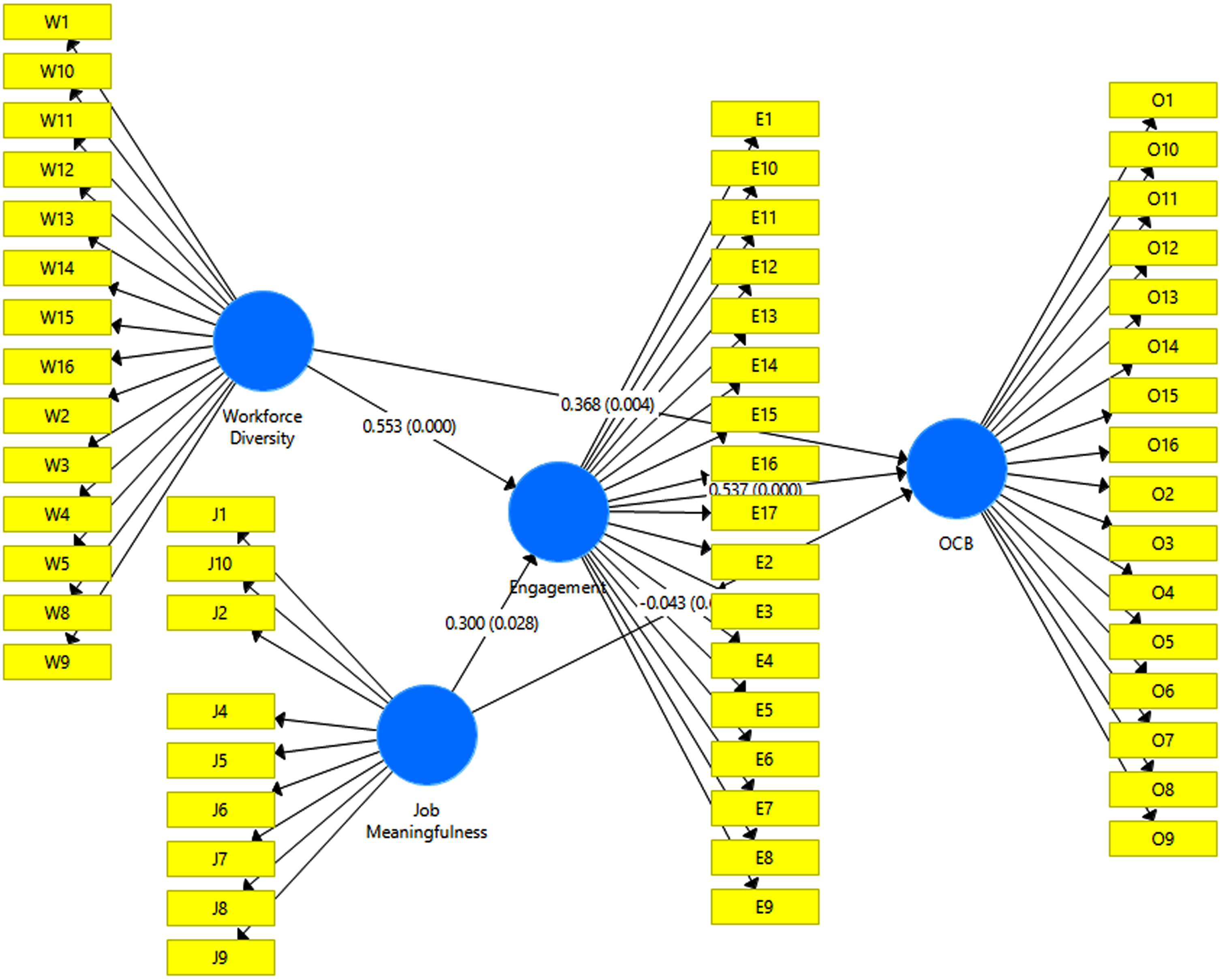
Path diagram after bootstrapping.
Discussion
The first research question involved the association between workforce diversity and employee engagement among Gen Z employees after the pandemic. A significant and positive correlation coefficient was found between workforce diversity and employee engagement (β= 0.553, t–value = 4.486, p = 0.000). This result was found to be consistent with previous research [45, 46].
The report by McKinsey reported that diversity is critical for business recovery and resilience [5]. As explained by Downey et al. [47], employee diversity practices within organizations will encourage employees from different backgrounds, and the benefits can be substantial. Practices of workforce diversity can show employees that the organization is concerned about their own well-being and value their contribution. In turn, employees will show their appreciation by becoming more engaged in an organization [47]. The results of this study showed that workforce diversity had the highest impact on employee engagement. The result proved that employee engagement is an important issue most companies face today, and workforce diversity is an important predictor of employee engagement. The results confirmed that the qualities that characterize diverse organizations, that is innovation and resilience are much needed today.
The second hypothesis was to examine whether job meaningfulness is a significant predictor of employee engagement among Gen Z employees in Kuala Lumpur, Malaysia. The result showed that there is a significant and positive correlation between job meaningfulness and employee engagement (β= 0.3, t-value = 2.2, p = 0.028). This finding was found to be in line with previous studies [25, 49]. The findings supported that statement by Kahn [29], who asserted that employees are better engaged when they work in an atmosphere that encourages meaningfulness, psychological safety, and availability. The results showed that a meaningful job plays an essential role in boosting employee engagement, and this was supported in other studies by Fairlie [50] and Rosso et al. [41]. The results also showed that employees who find their job highly meaningful are also emotionally, psychologically, and cognitively engaged. Past researchers also affirmed that finding a meaningful job increases psychological empowerment, and these feelings will lead to proactive behaviors [25, 51].
The third hypothesis examined the association between workforce diversity and OCB among Gen Z employees in Kuala Lumpur, Malaysia. Based on the findings, there is a significant and positive relationship between workforce diversity and OCB (β= 0.368, t-value = 2.9, p = 0.004). This outcome was discovered to be consistent with previous studies [36, 54]. Employees are expected to reciprocate with desirable behaviours when organizations manage a diverse workforce effectively. This outcome is similar to a study by Richard [55]. The results further support the notion that workforce diversity management will increase employees’ affective commitment to the organization, which in turn positively impacts employees’ OCB. This was also confirmed in a study by Bizri [22]. Diversity in the workplace has led to inclusion practices. The results of a study by Panicker et al. revealed that employees irrespective of their gender or category or generation are aware of the importance and impact of diversity on their organization [78]. Like the results of this study, the study by Panicker et al. found a significant association between inclusive workplaces that encompass diversity and OCB.
The fourth hypothesis examined the association between job meaningfulness and OCB among Gen Z employees in Kuala Lumpur, Malaysia. The results revealed that there was no significant and positive relationship between job meaningfulness and OCB (β= –0.043, t-value = 0.412, p = 0.68). This result was also found to be inconsistent with most past studies [28, 59]. In this study, the impact of job meaningfulness on OCB was low and insignificant. One possible explanation for the deviation may be that Gen Z has different values compared to baby boomers and millennials. The employees in Gen Z may be more concerned about work-life balance than the value of the job. When employees find their job to be valuable, they are more likely to devote more time and energy to the job, and this can be linked to OCB [28].
The fifth hypothesis examined the relationship between employee engagement and OCB among Gen Z employees in Kuala Lumpur, Malaysia. The findings indicated that there is a significant and positive relationship between employee engagement and OCB (β= 0.537, t-value = 5.316, p = 0.000). This result was revealed to be in line with most past studies [11], [27], which have identified a positive and significant relationship between employee engagement and OCB. In this study, a strong association between employee engagement and OCB reflects higher employee participation and commitment. The more active employees are involved in work, the more likely it is to show higher levels of OCB and better performance. Similar findings were also revealed in a study by [11]. Higher levels of employee engagement can lead to improved performance. The study by Uddin et al. revealed that employee engagement was associated with OCB and OCB was a mediator between employee engagement and performance [79]. This shows that employees who are highly engaged are likely to have higher commitment and performance.
Implications
The aim of this paper is to analyze the impact of workforce diversity and job meaningfulness on employee engagement and OCB of Generation employees Z in Malaysia. The results suggested that compared to older generations, Generation-Z workers believe that workforce diversity will improve employee engagement and OCB after the COVID-19 pandemic. Employee engagement is an important concern for organizations globally after the COVID-19 pandemic. In this study, it was proven that in today’s globalized environment, other than workforce diversity, job meaningfulness is also an important predictor of employee engagement. Furthermore, this study also proved that workforce diversity had the highest impact on employee engagement of Gen Z employees. Workforce diversity was also a significant predictor of OCB. Therefore, organizations practicing workforce diversity would be highly appealing to Gen Z employees to increase their engagement and OCB. This would subsequently lead to talent retention and productivity. Human Resource (HR) managers and organizations should place more focus on workplace diversity as a key driver of employee engagement. Organizations need to reflect on how workforce diversity and job meaningfulness can be applied as a predictor of employee engagement. HR managers and organizations should support and put into practice workforce diversity and job meaningfulness to improve employee engagement. Based on the results of this study, employee engagement will further strengthen OCB. The Hr. Managers and organization leaders must ensure the organization’s policies and procedures to strengthen employee engagement and OCB further.
From the theoretical perspective, this research is of great significance in filling the knowledge gap in research. There is a paucity of research on the relationship between workforce diversity, job meaningfulness, employee engagement, and OCB of Gen Z employees after the COVID-19 pandemic. The results supported the underpinning theories of this research, namely employee engagement theory and social identity theory. A broader understanding of the relationships between workforce diversity, job meaningfulness, employee engagement, and OCB will be beneficial to academicians, practitioners, and future researchers.
Conclusion
This study examined the impact of workforce diversity and job meaningfulness on employee engagement and OCB of Gen Z employees after the pandemic. The findings provided useful insights and practical implications to increase the engagement and OCB of Gen Z employees. Workforce diversity plays a significant role in increasing the engagement and OCB of Gen Z employees. Job meaningfulness meanwhile only had an impact on employee engagement. Human resource managers and organizations should encourage and support workforce diversity to stimulate engagement and OCB of Gen Z employees. Due to changes in employee’s behavior after the pandemic, it is important to study employee engagement. In addition, Gen Z is becoming the largest percentage of employees and their engagement is particularly important. Organizations should note the factors that increase employee engagement and support practices that can boost the engagement and OCB of Gen Z employees. These practices will increase talent retention and performance.
Limitations and future research
This research was carried out to better understand the influence of workforce diversity, job meaningfulness, and employee engagement on organizational citizenship behaviour among Generation Z employees in Kuala Lumpur, Malaysia. However, a number of limitations were noted that can pave the direction for future research. This study did not consider the components that makeup workforce diversity. Future studies should consider the other components of workforce diversity, such as religious diversity. Secondly, this study did not include any moderators and mediators. Future studies should consider moderators such as gender and mediators. Thirdly, this research only examined four variables: OCB, employee engagement, workforce diversity, and job meaningfulness. This study did not include other variables, such as flexible work arrangements, training, and career growth opportunities. For better results, future studies should include other variables.