




Abstract
BACKGROUND:
Natural disasters such as earthquakes have imposed particular problems on small and medium-sized enterprises (SMEs), including on their journey to recovery. Business recovery is a term that has numerous theoretical and practical applications and is frequently regarded as the most elusive stage of a disaster cycle. Hence, it necessitates an exploration.
OBJECTIVE:
This study examines the determinants of business recovery in the aftermath of a disaster. A framework synthesized from the literature review and hypotheses developed demonstrate factors that drive business recovery.
METHODS:
This study used an explanatory approach that laid quantitative foundations. The study also tested relevant hypotheses with a statistical approach using the PLS-SEM technique. An off-line survey was conducted using data collected from 272 SMEs in tourism affected by the 2018 Lombok earthquake in Indonesia. The data were analyzed with SmartPLS to test the effects of knowledge management, mitigation strategy, business adaptability, business recovery, and government support.
RESULTS:
The results indicate that knowledge management, mitigation strategy and business adaptability are determinants of business recovery. However, government support has no influence in leveraging those three determinants of business recovery. This finding may indicate that SMEs that possess a strong level of knowledge management with the ability to formulate a mitigating strategy as well as adapt to certain changes are more likely to succeed in recovering their businesses. In addition, whether or not government support is viable, independently managed SMEs are more likely to progressively perform and be less dependent on aid from other entities on their road to recovery.
CONCLUSIONS:
KM and mitigation strategy function as determinants of business adaptability subsequent to SMEs’ recovery. On the basis of the resource-based view (RBV), mitigation strategy and business adaptability are influential resources that can leverage firms’ potential for in the quest of competitive advantage and facing environmental turbulence. Nonetheless, government support remains a challenge in the survival of SMEs to cope with the negative impact caused by disaster. Thus, government should strengthen the awareness towards such issue as well as providing much more holistic support in the future particularly to educate SMEs on the importance of mitigation strategy in prior to a disaster.
Keywords





Introduction
A successful business recovery must be well structured and well considered, since a successful recovery is an avenue to converting threats into opportunities. An important aspect of a successful recovery is formulating a low-cost and easily implemented strategy with limited resources, particularly for small and medium-sized enterprises (SMEs) since it will enable them to recover more easily and maintain post-disaster resilience. Business recovery is a concept involving many theoretical and operational interpretations [1] and is often considered the most elusive phase of the disaster cycle [2–4]. Business viability is another important part of a community’s economic recovery after experiencing a disruption, because businesses provide jobs, goods, and services, as well as income in the form of taxes to the government. Post-disaster recovery of an enterprise will affect socioeconomic conditions, which include market demand for labor, goods, and services, and trends in capital investment [5]. Although recovery and reopening of a business may sound alike, the two terms differ in meaning. While business recovery aims to optimize any types of resources in the short term in the aftermath of a particular event, reopening of a business is the output of an accumulative process of recovery that results in the “business is at least surviving” and the “business has successfully” adapted to the new post-disaster economic environment [6]. Moreover, researchers [6] suggest that firm-centric indicators are both qualitative and quantitative, such as (1) a business’s financial status, productivity, or employment levels; and (2) cash flow or revenue, which may be used to depict a successful business recovery.
In view of the important determinants of business recovery, this study considered three factors that could emerge as a focus in entrepreneurship studies: (1) knowledge management (KM), (2) mitigation, and (3) adaptability. It is believed that SMEs with limited resources may opt for KM as a solution for their strategic actions, since the role it has in a firm’s learning processes has been recognized as an important tool that increases the possibility of adaptation and firm resilience [7, 8]. It also performs an important role in identifying and recording various lessons learned about disasters [9], so that businesses can adapt to changes in the environment. For that reason, firms need tacit and explicit knowledge in which the synergies of both assist to determine decision-making [10]. Another important aspect is the form of mitigation, which is needed to cope with internal or external disturbances, including natural disasters. Firms can reduce the impact of environmental hazards through adjustments by adopting mitigation measures [11, 12]. Hence, knowledge about business organizations’ behavior is crucial to an understanding of crisis handling during turbulent condition. An owner’s productive knowledge about business firms’ resources, entrepreneurial factors, dynamic capabilities, innovativeness, and coping strategies to combat adverse effects plays an indispensable role in surviving a crisis [12].
In the aftermath of a disaster, many factors cause firms to choose to survive, reconstruct, or give up [13]. Thus, responding and solving problems quickly is vital and depends on the responsiveness and internal capacity of the firm [14]. According to Kartez and Lindell [15], a mitigation plan can foster adaptive behavior when a disaster occurs. Mitigation and adaptation are sometimes difficult to separate: mitigation aims to reduce negative impacts, whereas adaptation reduces the severity of disastrous events [16]. Moreover, the business managers’ or owners’ point of view is critical because their concern is to reduce the environment turbulence (i.e., pandemic) spillover effects when opting for coping strategies during a crisis [12]. Apart from that, studies related to crisis management are rarely carried out by researchers, particularly investigating the roles of scientific approach within the industry wide [17]. Since adaptation is a reflection of mitigation, a high adaptive capacity supported by an appropriate mitigation strategy (or vice versa) is required. While those three aspects (KM, mitigation, and adaptation) are internally driven factors, there are also external drivers of business recovery, such as government support.
Government support is considered a form of business solution for businesses that had not been insured prior to the disaster in performing the recovery process. Almost all approaches to the problems of disaster loss have concluded that the amount and nature of loss compels the government to provide solutions to such problems, either to reduce the level of losses or to reduce exposure to losses, and assist businesses to adapt to conditions for their continuity [18]. Furthermore, government support is critical as an avenue of capacity building for SMEs to conduct initial risk assessments and develop risk mechanisms, such as a business continuity/contingency plan, through conventional and non-conventional education [19]. Governments can also play an essential part in providing support for SMEs to keep them active in order to combat adverse impacts during the crisis, given that they are the catalyst of economic activities on a large scale that boosts economic growth in many countries. These combined efforts are productive in fighting against a crisis’s adverse effects on businesses [12]. Therefore, in light of the limitations of SMEs, they may not have the capacity to build resilience to natural disasters without government support. Due to that reason, this study has the objective (1) to provide an empirical fact on the factors that determine business recovery of SMEs’ that had experienced and devastating outcomes as a result of a disaster; and, (2) to explore whether or not government support play a role in enhancing SMEs’ business recovery. Following that objective, a few relevant research questions follow the logics of this study:
RQ1: Do KM and mitigation strategies leverage the adaptability of SMEs in the post-disaster period?
RQ2: Does business adaptation improve SMEs’ ability to recover?
RQ3: Does government support strengthen KM, business adaptation, and mitigation strategies on the road to recovery?
Theoretical review and framework
Business recovery in the aftermath of a disaster
Studies on natural disasters and their impact on business first appeared in the literature during the late 1990 s. Several studies have tried to determine the factors that predict the success of post-disaster business recovery [6, 20–25]. These studies include firms that experienced devastating consequences, changes, and adjustments to the post-disaster conditions. Furthermore, it has been mentioned in the literature that conventional strategic management is currently incapable of dealing with many questions about firm management in disrupted conditions. Since business recovery takes a long time to implement, there is a growing consensus among researchers that recovery is a process that may not have an end point [4]. In the post-period of a disastrous event, many businesses in places that were hit hard by natural disasters experience a drawback and heavy impacts so that loss in the economic value of the retail, hospitality, and tourism sectors become evident [5]. Also, disruption has significantly impacted business continuity performance that arises as a consequence of environmental changes [26]. According to these conditions, a firm’s resilience as capability and unique dynamics must determine a quick response in the quest for survival and continuity.
Despite the severe impact of environmental hazards, firms need to adapt to changes in internal and external environments in the best way when facing disasters or crisis situations [22–25]. As environmental hazards emerge, they pose a tremendous threat to a firm’s existence under vulnerable circumstances [20]. In the case of an earthquake that shook the region of Canterbury, New Zealand, the disaster has had a severe impact on the livelihood of the community, including businesses [5, 24]. In an effort to navigate or circumvent the impact of the disaster, the resilience of business owners has been necessary to overcome difficulties brought about by the new business environment [24]. Furthermore, as mentioned by Abbas et al. [17], forecasting methods for business operations are needed to counter environmental crises such as the pandemic situation. In essence, in certain conditions, firms’ ability to cope with environmental hazards increases their ability to survive, and to pivot the severity of the impact of environmental hazards [11, 12]. Business viability is another important part of the community’s economic recovery after experiencing a disruption because businesses provide jobs, goods, and services, as well as income in the form of taxes for the government. Ultimately, it leads to the firms’ sustainable performance, leveraging business owners or managers to make innovative decisions to revive their economic gains [12].
The knowledge management (KM) imperative
KM is a systematic process with a set of strategies and practices implemented in firms to identify, create, organize, store, distribute, and enable the adoption of knowledge [27–29]. KM in firms is the application of collective knowledge in the entire workforce to rationally achieve organizational goals and facilitate the process by which knowledge is created, shared, and applied [27]. In its implementation, a firm’s KM involves many forms of activities, such as internal discussions about work, discussion forums, program monitoring, and professional training within four main activities: creation, retrieval/storage, transfer, and application [28]. Thus, KM is obtained as a strategy and process in companies to identify, capture, and inject the knowledge into the company’s memory [29, 30]. Eventually, knowledge extends coherently as it becomes a strength of a firm’s attribution. A firm’s ability to make use of its knowledge is related to how well the firm acts flexibly. This connects well with the firm’s capability to distribute a new perspective to every managerial level and function within the firm, with levels of learning in the form of the firm’s attributes, such as norms, protocols, products, processes, and structure [30].
In the context of resource-based theory (RBT), KM is a potent resource for promoting the use of knowledge of technology and skilled personnel in leveraging an intended outcome in any type of firm [32, 33]. Furthermore, RBT posits that resources that are difficult to imitate and become a distinct attribution of the firm subsequently drive firms to achieve a sustainable competitive advantage [33]. In this sense, the mobilization of commitments injected into a firm of strengthening KM practices can assist them to perform better as well as to overcome barriers in turbulent events. Interaction between KM and firm adaptation triggers a potential strategy change of SME owners or managers in implementing KM-based activities to adapt to environment shocks. Thus, knowledge-based economic activities become resources that can help to maintain business existence when facing various kinds of external environment pressures. A successful business adaptation requires creation of strategic flexibility, which can be facilitated by learning [34] as well as meeting the challenges of developing a KM system in order to adapt to changes brought by a state of uncertainty [35, 36]. KM strategies and a firm’s organizational learning are recognized as important tools that can increase the plausibility of adaptation and firm resilience [7] and act as integral parts of identifying, recording, and sharing disaster lessons [9]. In addition, the practice of using knowledge as a basis for organizational reference in making decisions affects firms’ current and future effectiveness [36].
Mitigation strategy toward a disaster
Mitigation is an integral sequence in disaster management. Its planning is based on previous and potential disasters, since mitigation or risk reduction activities include structural and non-structural measures taken to limit the adverse effects of natural hazards [37, 38]. Preparedness relates to precautions taken prior to a disaster in order to ensure an effective response, including the issuance of timely and effective early warnings and the temporary evacuation of people and property in locations vulnerable to disasters [39]. When environment dynamics cause deviation of a firm’s goals, risks are likely to occur [40] and action must be taken immediately to avoid or minimize devastating outcomes of a disaster. As contended by Atmanand [39], mitigation includes structural and non-structural measures taken to limit the adverse impacts of natural hazards, environmental degradation, and technological risks. It is categorized into active and passive mitigation. Active hazard mitigation comprises proactive actions taken by firms to reduce the impact of environmental hazards, whereas passive hazard mitigation comprises steps in discussing actions that will and must be taken [11]. Mitigation activities to protect and maintain a company’s sustainability can be done by undertaking structural and non-structural actions. Mitigation strategies must support each other and synergize in the quest to boost a positive outcome. Thus, firms that adopt active mitigation are likely to have a greater chance of survival than those with a passive-type mitigation strategy [12].
The relevance of business adaptability in a post-disaster
A firm’s ability to adapt is challenged when it must select a suitable strategy to manage its structure, procedures, or other attributes when anticipating environmental dynamics in the quest for survival. Adaptability of the firm emphasizes the importance of reconstructing resources and processes to respond to external changes [41], solve problems, respond rapidly, and strengthen its internal capacities [42–44]. Furthermore, adaptation is the capacity to respond to changes in the environment, and relates systematically to internal structures and procedures as well as the combined capacity for appropriate change possibilities [41].
The most significant factor in a firm’s resilience is entrepreneurial skill in adapting to new circumstances [18]. Within the scope of an organizational context, an adaptive capacity refers to the ability to cope with unknown circumstances [42]. Indeed, an adaptive capacity for firms are crucial since it enables them to be better positioned for dealing with environmental changes, and thus firms can continuously develop and apply new knowledge relevant to their field of operation [45, 46]. A potential advantage when firms focus on adaptive capacity is adaptive behavior, which assists them to identify external changes by exploiting available resources. According to Woods and Wreathall [47], two premises of firm’s adaptive capacity and capabilities are (a) responding or recovering by using predetermined plans and capabilities, demonstrated through business sustainability and risk management; and (b) developing new capabilities to respond to dynamic change.
The role of government support in bolstering business recovery
In the midst of a disaster, governments have a crucial role in mobilizing resilience in SMEs in order for them to thrive through interventions such as regulations, infrastructure, and investment climate as a result of policy intervention [48]. Moreover, government can assist to increase the purchasing power as well as adaptability of those affected via social assistance programs to aid SME resilience [49]. For this reason, post-earthquake support for business recovery—particularly by local governments—is indeed required, mainly regarding SME business recovery strategies. In providing support, the government will relieve the company’s business losses so it continue its business functions. It is imperative that government and non-governmental firms pay more attention and provide more support through recovery schemes, which may assist SMEs to leverage economic recovery in a particular community. Furthermore, financial, technical, and political support can be better allocated from central-level institutions, which generally have greater capacity and decision-making power than disaster-affected local governments [50]. According to Col [51], two key concepts describe the role of local governments in dealing with disasters: comprehensive emergency management and an integrated approach. In comprehensive emergency management, governments act comprehensively when coordinating the four phases of emergency management: mitigation, preparedness, response, and recovery [51]. Ultimately, governments may coordinate planning and hazard assessment strategies, resource mobilization, and operations, both laterally and vertically [51].
Methodology
This study used an explanatory approach that laid the foundations on a quantitative basis. The study also tested relevant hypotheses with a statistical approach using the partial least squares–structural equation modeling (PLS-SEM) technique. The PLS-SEM technique is a powerful method because it offers great potential for researchers in the field of entrepreneurship. In fact, Hair et al. [52 p143] noted, “The PLS-SEM technique is more robust with fewer identification problems, works with much smaller or larger samples, and easily incorporates formative and reflective constructs”. In comparison with other structural equation analysis methods, such as covariance-based SEM (CB-SEM), PLS-SEM estimates a structural model more strongly, in a condition in which assumptions are violated [53]. Despite the contention that CB-SEM is more effective than PLS-SEM for analyzing a factor-based model [53], the use of PLS-SEM is beneficial because it is more effective for (1) analyzing composite-based models [53] and (2) maximizing the variance explained in the dependent variable(s) [52]. Most importantly, the statistical output shown by CB-SEM and PLS-SEM are similar [53]. Understanding the functionality of PLS-SEM is important because it has the ability to develop or build a hypothesis, predict a complex situation, and facilitate the multivariate data analysis [52]. Furthermore, if formal theory and the appropriate sample size are not available, SEM-PLS can still work, but CB-SEM does not give a proper model fit [53]. Finally, in the words of Hair [53 p4], “both the methods are complementary, not competitive.” An autonomous choice of the method to be used depends on the goal of the research. If the existing theory needs to be tested and confirmed, CB-SEM is most appropriate. In contrast, for theory development as well as prediction purposes, PLS-SEM is the more appropriate choice [54]. Hence, this study has found strong justification for using PLS-SEM facilitated by SmartPLS software. In obtaining the samples used in this study, a probability sampling technique was performed. In support of Cresswell and Cresswell’s [55] argument, this type of sampling is efficient in time, cost, and effort, and offers a greater possibility of obtaining accurate results. A total population of 847 SMEs that were affected by the Lombok earthquake in the tourism sector on Lombok Island, Indonesia, was determined as a sampling frame in this study. Slovin’s formula to determine sample size via the simple random sampling method was employed, as follows:
Thus, a total of 272 owners or managers of SMEs in the tourism sector registered via the database of the Provincial Government of West Nusa Tenggara, Indonesia, was determined as respondent of this study. Moreover, this study used robust constructs validated by several previous studies. To clearly articulate the concepts used in this study (KM, mitigation strategy, business adaptation, business recovery, and government support), the constructs were adopted from relevant concepts in the literature prior to the development of the questionnaire. The study also used scales that have been validated and empirically tested in previous studies. The scales were (1) a 19-item KM scale, represented by four knowledge dimensions (i.e., acquisition, creation, sharing, and storage) from a study by Mafabi et al. [56]); (2) a 10-item mitigation strategy scale [11], represented by active and passive mitigation strategies; (3) a 6-item business adaptability scale from a study by Chowdhury et al.’s [57], who postulated the adaptive resilience context—justified in the context of this study by assessing dimensions of internal resource reconstruction and decision-making strategy; and (4) an 11-item business recovery scale from Asgary et al.’s (2012) study [20], which postulates three dimensions: financial conditions, operational capability, and overall operational conditional. In addition, the construct of government support was adopted from De Mel et al.’s [21] empirical study, covering three dimensions: reconstruction grants, development loans, and insurance coverage. Therefore, this study employed a 7-item scale that represents government support. In addition, all of the constructs in this study were measured using a 5-point Likert-type scale that aims to obtain respondent’s agreeableness over sets of statement in the surveyquestionnaire.
Following an extensive conceptual review and discussion of the methodology undertaken in this study, it was important for the research questions to be highlighted through development of relevant hypotheses. The hypotheses (as depicted in Fig. 1) considered relevant in this study are:
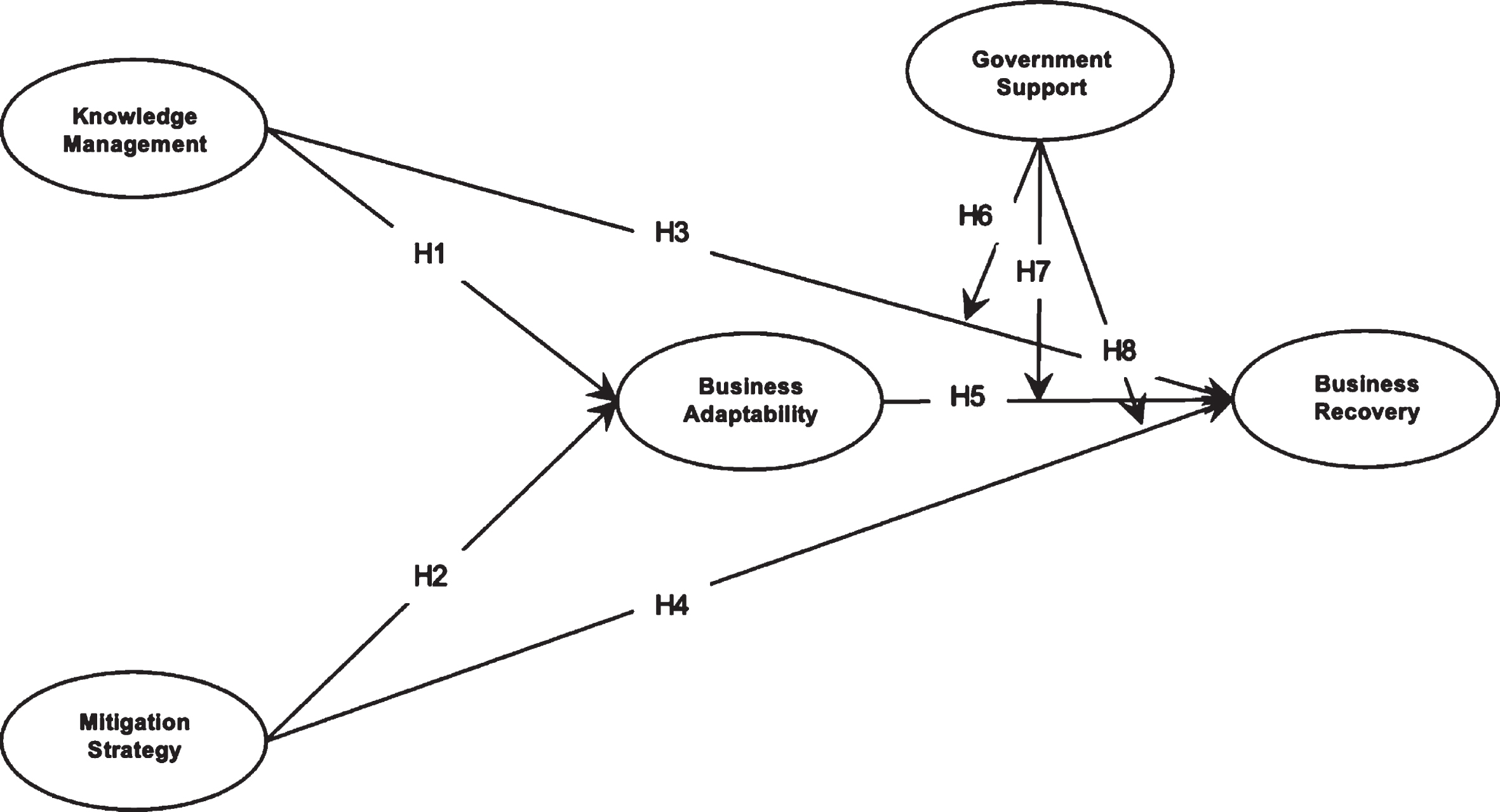
Conceptual framework.
KM has a positive impact on business adaptability. Mitigation strategy has a positive effect on business adaptability. KM has a positive impact on business recovery. Mitigation strategy has a positive effect on business recovery. Business adaptability has a significant impact on business recovery. Government support moderates the relationship between KM and business recovery. Government support moderates the relationship between mitigation strategy and business recovery. Government support moderates the relationship between business adaptability and business recovery.
Data processing was conducted using a PLS-SEM-based method, with the SmartPLS software 2.0 M3 version. The steps in PLS include designing the outer and inner models and testing the hypothesis. A total of 272 respondents were characterized based on some demographic information. Respondents in this study consisted of owners (n = 115) and managers (n = 157) from various SMEs, such as accommodation services, restaurants/caf
The data were analyzed using the outer model. Outer models aim to identify characteristics of a construct with its manifest variable by assessing convergent validity, discriminant validity, and composite reliability. Convergent validity aims to identify the correlation between the estimated component scores. The individual reflective measure is considered strong if it obtains a correlation coefficient of more than 0.70. However, for research in the early stages of developing a measurement scale, a loading value between 0.5 to 0.6 is still considered acceptable [59]. In this study, a loading factor threshold of 0.70 was employed. Table 2 shows that the loading factor value is greater than 0.70, which meets the convergent validity criteria. An average variance extracted (AVE) value greater than 0.50 indicates a sufficient level of convergent validity, which means that the latent variable explains more than half of the variance [60]. The result of the output (loading factor) from all indicators was valid with values greater than 0.70 on the basis of Hair et al.’s [60] rule of thumb (see Table 2).
Convergent validity, discriminant validity and composite reliability
Convergent validity, discriminant validity and composite reliability
In the next sequence, the outer model is compared with discriminant validity and AVE coefficient. The measurement model was assessed on the basis of the cross-loading measurement toward the construct used in this study. From the cross-loading value, it was confirmed that all the constituent indicators of each variable in this study met discriminant validity since the AVE value was greater than 0.5, as shown in Table 2. Reliability testing was also performed by examining the value of composite reliability from the indicator that measures the construct to determine the stability and consistency of the instrument used. The instrument meets composite reliability when it has a composite reliability coefficient greater than 0.7 and is said to meet internal consistency reliability when it has a Cronbach’s alpha coefficient above 0.60 [60]. Table 2 shows that all constructs had composite reliability and Cronbach’s alpha values greater than 0.6.
In the second stage of the structural model analysis, inner model testing was employed. To examine the influence between latent constructs before interpreting the results of the hypothesis testing, the model should have an adequate goodness of fit, R-square, Q-square, path tests coefficient, and hypothesis testing. The accuracy of the structural model was evaluated by R-square to adjust how much the endogenous variables were influenced by other variables. This study demonstrated that the R-square as the coefficient determination of KM was 0.481 (KM→adaptability) and 0.813 (KM→mitigation strategy), respectively. Assessing the overall goodness of fit is determined by Q2 as a measure of predictive relevance. The premise of this measure is that the higher Q2 value has, the fitter the model is for use in prediction. This premise was based on relevant technique used in previous study [83] in assessing Q2. The predictive relevance (Q2) suggests that the proposed model might predict the study’s endogenous latent constructs. The predictive relevance (Q2) values calculated reflect the path model’s quality, and it must be (>0) greater than zero for the specific endogenous latent construct. Thus, the Q2 value is calculated as follows:
Results of the bootstrapping test from PLS analysis are shown in Table 3, with a significance level (α) of 5% . Results of hypothesis testing were obtained in two stages: by directly calculating the effect of the independent variable on the dependent variable, and by calculating the effect of the moderating variable.
The PLS bootstrapping test
From the study’s findings, eight statistical relationships were determined. Regarding the first hypothesis, this study found that KM has a strong influence on business adaptability (β=0.277; p < 0.001). This finding supports previous research that found that KM has a significant effect on a firm’s adaptability [61–66]. It was also found that the dimensions of KM, such as knowledge acquisition, knowledge creation, knowledge sharing, and knowledge storage, were significant predictors of the dimensions of a firm’s adaptation. For SMEs, KM is a profound resource that can improve and strengthen their adaptability when experiencing disruptions. Furthermore, maintaining a knowledge storage system should be a priority for SMEs so they will be better placed in disruptive situations such as a post-earthquake disaster. Hence, in the event of a disruption such as a natural disaster, SMEs with a strong level of KM will be able to re-access and make use of their potential sources of knowledge to strive, rebound, and recover from the situation.
In the second hypothesis test, it was found that mitigation strategy has a strong effect on business adaptability (β=0.461; p < 0.001). The results of this study support the view of Godschalk et al. [63] and Tierney and Oliver-Smith [64], who argue that hazard mitigation and preparedness plays a role in reducing disaster risk, increasing business resilience, and being able to adapt to natural disasters. This finding assumes that the relationship between mitigation and adaptation is complementary. When mitigation readiness is high, it will facilitate SMEs’ development of better adaptation strategies and challenge adverse effects caused by the disaster. It is important to note that mitigation preparedness and strategy are avenues through which to recover from negative impacts beyond human capabilities, whereas adaptation is a strategic action to help manage inevitable things to create new opportunities, value, and business continuity. The results of this study strengthen the study of De Oca [67], who strongly emphasized that mitigation strategy has a positive impact on the adaptability of SMEs in handling catastrophic situations.
With regard to the third hypothesis that depicted the relevance between KM and business recovery, the finding indicated that KM has a significant effect on business recovery (β=0.132; p < 0.05). The results of this study concur with a study by Khan and Sayem [61], who argued that knowledge can significantly support disaster recovery activities. Knowledge on environment disaster is also able to educate the business community and other individuals in the quest for recovery efforts [68]. Since business recovery teams should be knowledgeable about their plans and tasks, enabling them to act independently in solving organizational problems when disaster occurs is pivotal [67]. Also, the deployment of strategies will support the resumption of business operations and firm functions [69]. And thus, KM will contribute to the firm in terms of strategic planning, decision-making, problem-solving, administrative management, and reacting to risks [70]. Apart from that of KM optimalization, usage of social media technology as means of strategy diversification can assist businesses to interact and communicate with customers, suppliers, retailers, and other stakeholders in the quest of adapting to “the new normal” of business landscape [71, 84].
Regarding the fourth hypothesis, mitigation strategy had a significant effect on business recovery with a path coefficient value of β=0.476; p < 0.001. A possible explanation for this finding is that a mitigation strategy may be seen as a feasible way to reduce the impact of disasters. Also, it was confirmed that preparing mitigation strategy prior to a disaster, significantly strengthens SMEs’ business recovery. However, recovery is a long process, during which the resources and capabilities of SMEs continue to slowly change in a more positive direction. The results in this study support previous research from De Oca [67] and Tyler and Sadiq [72], who found that mitigation strategies and their application have a positive impact on business recovery caused by disasters. The effectiveness of the mitigation strategy is determined by the ability to provide measurable preventive efforts in dealing with disasters [73]. In addition, small businesses with more experience recover faster than those who did not take mitigative action or lacked awareness.
With regard to the impact of business adaptability on business recovery as the fifth hypothesis, the findings showed a significant effect with a path coefficient value of β=0.390; p-value<0.000. This is an indication that SMEs’ ability to adapt to environmental changes reflects their ability to determine their strategy, respond, and provide feedback by reconfiguring their resources. The results of this study support a study by Dahlhamer et al. [74], who found that SMEs tend to be more agile and better at adapting to post-disaster economic conditions compared to large businesses. This finding is also consistent with previous research regarding strengthening adaptability in the quest to accelerate and reinforce the business recovery process. As previous research [55, 75] has confirmed, businesses that are able to resist and succeed are influenced by their ability to adapt to changes. In contrast, businesses that possess limited capacity to adapt to certain changes are likely to become more vulnerable and eventually be unable to recover [76, 82].
In addition, this finding supports and strengthens previous work that emphasized that business recovery in the tourism sector is significantly influenced by post-disaster adaptation capabilities [54, 84].
In terms of the moderating role of government support as determined in three hypotheses (H6, H7, H8), this study found no statistical significance among the three predictors involved. Government support was not statistically significant in moderating (1) KM with business recovery (β=0.090; p-value=0.113, p-value>0.10); (2) mitigation strategy with business recovery (β=–0.030; p-value=0.627, p-value>0.10); and (3) business adaptability with business recovery (β=–0.243; p-value=0.521, p-value>0.10). Moreover, the multi-group approach (see Table 3, Fig. 2) showed that government support did not strengthen the effects of mitigation and adaptability in business recovery. Although, the variable of government support has a theoretical potential as a moderating variable, it was not the case found in this study. The government support variable is said to be a pseudo moderating variable and does not act as an explanatory variable; further, it does not have a significant effect on business recovery. The insignificant government support as the moderator of these relationships (see Fig. 3) may have been influenced by the fact that 82% of the SMEs affected were experienced firms (i.e., 15 years in operation). As an illustration, a firm’s business length in operation is likely to leverage the awareness of the firm’s KM. Relatively experienced firms may possess higher level of awareness in managing their KM as well as a mature, comprehensive orientation toward KM activities. Hence, this type of firm will be better balanced than its younger counterparts [78–81]. Furthermore, a firm’s length of business in operation will also affect its ability to manage KM, mitigation strategies, and business adaptability. In particular, firms that had experienced a disastrous event previously (i.e., the Lombok earthquake in 2000) were likely to possess more capability in designing solutions and contributing to their business continuity than those who were inexperienced, as found in previous research [79]. Following such a condition, experienced SMEs are less likely to depend on government interventions such as financial aid despite their availability.
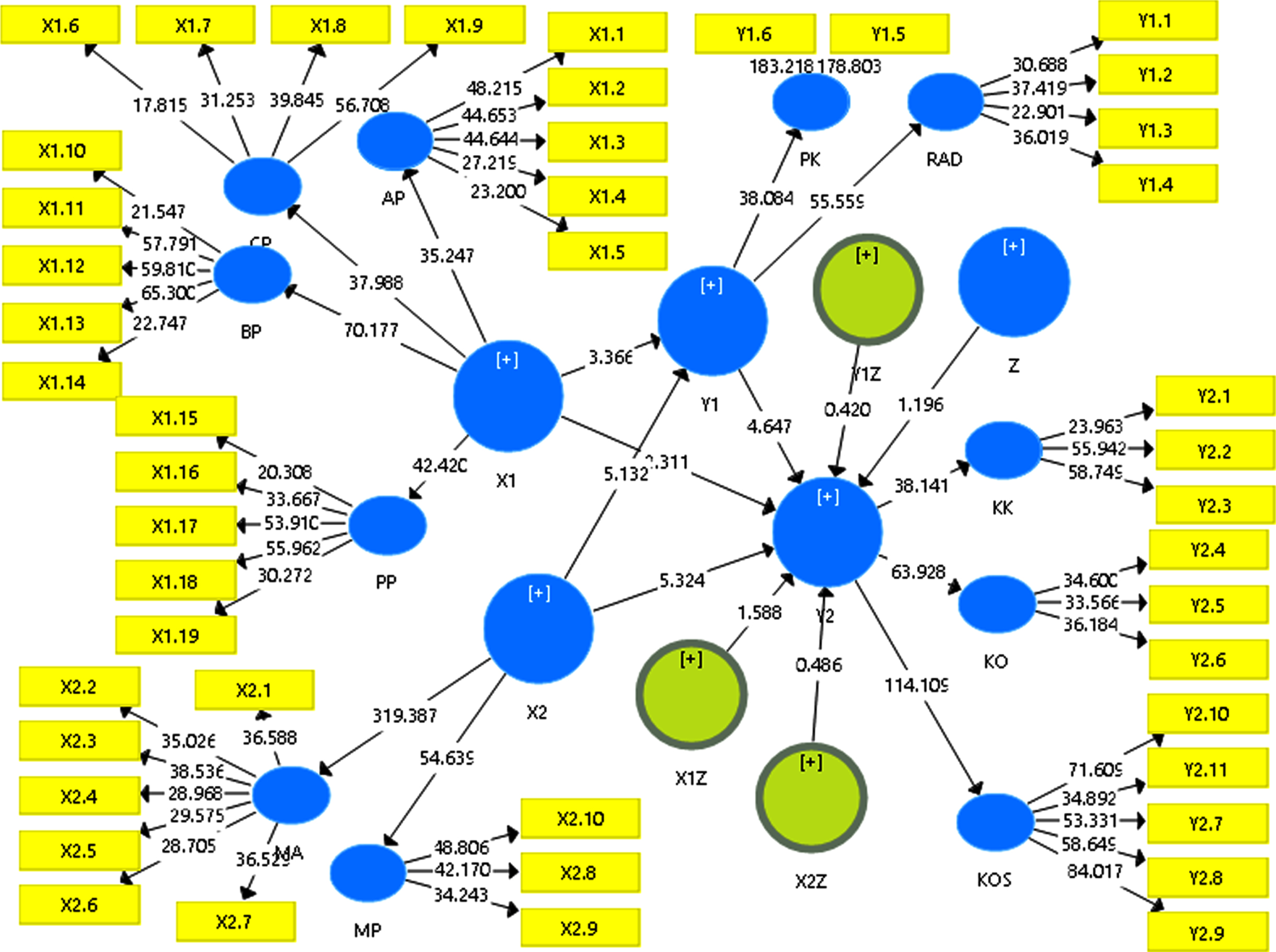
Inner structural model output.
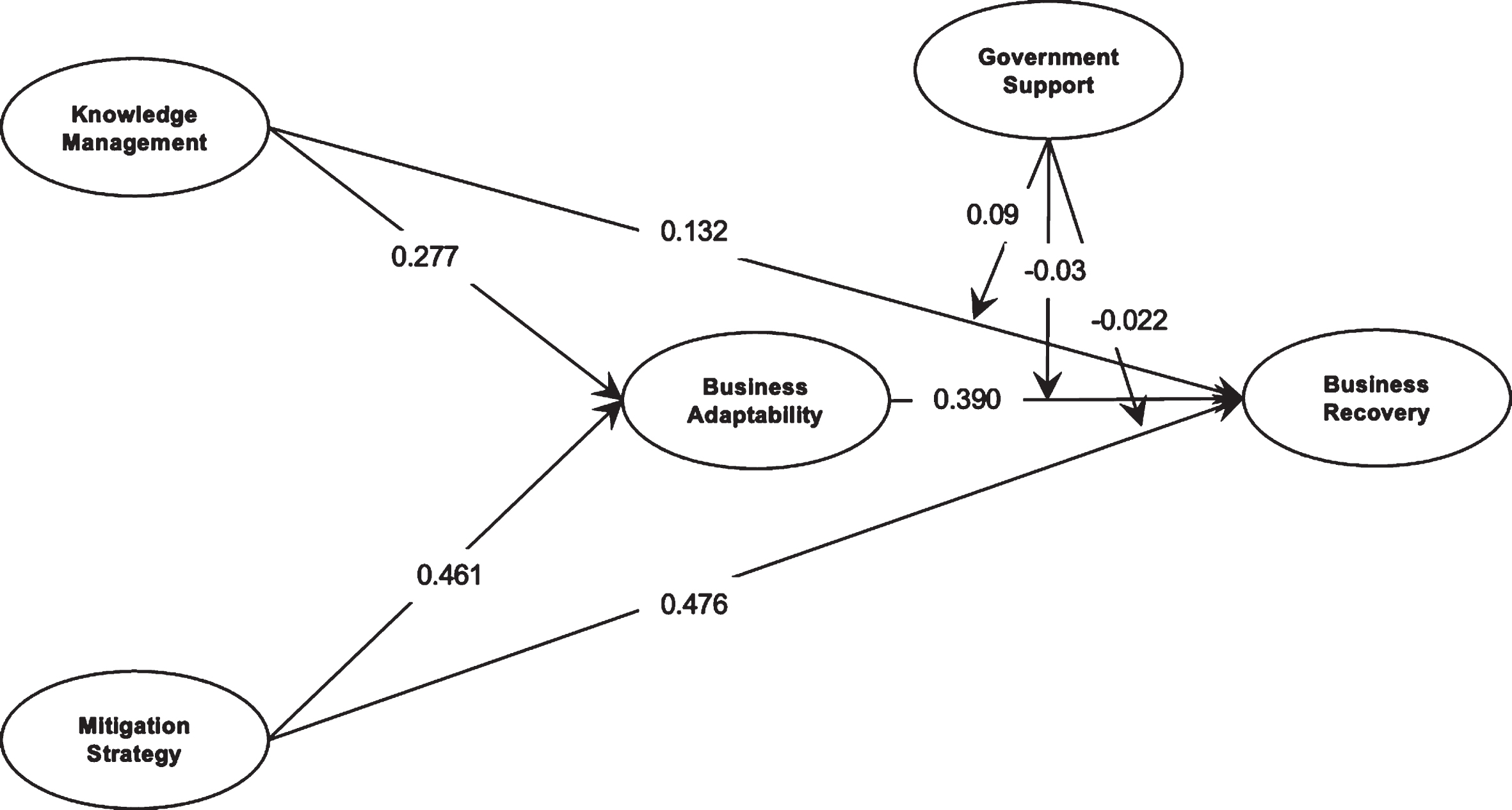
Outer structural model and path coefficient.
Moreover, firm size and type of business may determine better KM implementation, mitigation activities, and adaptability. In fact, accommodation service SMEs who possesses stronger KM, mitigation strategies, and insurance are classified as medium-scale businesses (13%), which are not supported by their SME managers’ working experience. Experience will also have an impact on tacit knowledge or explicit knowledge, especially in anticipating possible threats to business sustainability. This study result supports Runyan’s notion [19] that SMEs who do not have either a product or an operating portfolio, or a comprehensive plan to mitigate their risk, have small cash reserves and are less able to distribute risk through insurance. The impact will be noticed in their post-disaster adaptability. Another possible influential factor is the amount of support they are offered. Despite the fact that all of the businesses received financial aid from the government, it was considered insignificant due to a very small amount of aid that could support the SMEs in their path of recovery (see Table 1) as indicated in this study. Furthermore, 59% of respondents received debt postponement, tax relief, or tax write-offs; however, they had no significant impact. This finding is consistent with Runyan’s [19] view that business disaster support in the form of loans puts an additional burden and pressure on recovering businesses. However, this finding contradicts Rose and Krausmann’s [79] view that governments at various levels must play a key role in economic recovery.
Respondents demography
In conclusion, this study indicates that KM and mitigation strategy are determinants of business adaptability subsequent to business recovery. This means that the stronger the level of knowledge injected and possessed by SME owners, the better placed they are to adapt their business when facing an economic shakedown. Furthermore, mitigation strategies assist SMEs to thrive in the quest for survival and adapt to changes in the environment. Likewise, mitigation strategies can improve adaptability in the post-disaster period. These results corroborate the resource-based view that knowledge is an influential type of resource that can leverage firms’ potential for gaining competitive advantage [32, 34].
Although business adaptability significantly affected business recovery, government support had no significance in moderating the relationship between KM, mitigation strategies, and business adaptability and business recovery. Regardless of government support, SMEs that possessed a strong knowledge base, mitigation strategy, and ability to adapt were able to find their way and strengthen their business in the quest for recovery. Thus, business recovery can be determined by providing a strong case for KM, mitigation strategies, and as business adaptability. These findings provide empirical evidence for a foundation of a practical contribution and may be beneficial for SME owners as well as government as a policymaker, particularly in an emerging economy context. For SME owner or manager, the ability to enhance their knowledge as well as mitigation strategy via attending training is crucial since these are profound resources that they must obtain and strengthen. For government, efforts and policies are indeed needed in order to leverage the capability of SMEs particularly in an aftermath of a disaster via increasing budget allocation that focuses on (1) mitigating the impact from turbulent situations; (2) education and training that can augment SMEs resilience and adaptation; and (3) rebuilding, reconstructing and recovering physical or non-physical resources that assists SMEs’ survival or continuity.
In the light of the conclusion been drawn, this study is not without limitations. For instance, the results of this study should be interpreted carefully to avoid overstated assumptions. This is due to the fact that a single geographic location was sampled in this study which took place in Lombok Island, Indonesia, which might result differently in other geographical or cultural settings. Furthermore, most of the measurement utilized were based on established scales based on studies in developed economies which might stimulate different result particularly in emerging economies.
Despite the limitations, future research maybe useful to expand the present study by adapting the approaches used in this study to other emerging economy which are prone to disaster. Furthermore, the view of entrepreneurial marketing maybe useful to unravel strategic approaches undertaken in order to for SMEs to survive and to obtain a successful recovery as mentioned in a previous literature [24]. Finally, as government support was found to be insignificant in moderating a successful recovery for SMEs, future research should emphasize on this issue to explore in-depth and uncover explanations behind such finding.
Footnotes
Acknowledgments
The authors would like to thank the Institution for Research and Community Service (LPPM), Brawijaya University and the State Islamic University in Mataram for their contribution in funding the research undertaken under the scholarship contract No:2174/SJ/B.II.4/Kp.02.3/3/2018. Also, the authors appreciate the contributions made by anonymous reviewers for their valuable feedback.
Author contributions
CONCEPTION: Erma Yanuarni and Mohammad Iqbal.
METHODOLOGY: Mohammad Iqbal, Endang Siti Astuti and Mukhammad Kholid Mawardi.
DATA COLLECTION: Erma Yanuarni and Mukhammad Kholid Mawardi.
INTERPRETATION OR ANALYSIS OF DATA: Erma Yanuarni and Mohammad Iqbal.
PREPARATION OF THE MANUSCRIPT: Erma Yanuarni, Mohammad Iqbal and Rizal Alfisyahr.
REVISION FOR IMPORTANT INTELLECTUAL CONTENT: Mohammad Iqbal and Rizal Alfisyahr.
SUPERVISION: Endang Siti Astuti, Mohammad Iqbal and Mukhammad Kholid Mawardi.
Appendix
Construct measurement
Variables
Dimensions &Items
Knowledge Management (Mafabi et al., 2012)
1. We acquire knowledge through team work
2. We can locate the source of information that we need
3. We do not learn from our successes for future reference (reverse worded)
4. We gain knowledge from consultancy undertaken
5. We employ people deemed to have the expertise we need
1. We train our staff
2. Our staff do not generate useful ideas out of performance mistakes
3. We brainstorm to generate useful ideas for our organisation
4. We do research for our organisation
1. We do not conduct regular meetings to exchange experiences
2. Some of our staff discuss issues with professional associations
3. We use newsletters to disseminate information
4. We exchange information with stakeholders
5. Knowledgeable staff share their ideas with other staff
1. We have a system for keeping information
2. We have a system for retrieving information
3. Our staff have access to information required
4. Staff can access information on-line
5. We update our knowledge databases
Mitigation Strategy (Sadiq, 2011)
1. We visit socialization and training courses preparation for disaster
2. We conduct mitigation training courses internally
3. Our employee attended mitigation training courses outside the company
4. In the post disaster, we informed the customers on how our business is impacted by the disaster
5. We assess or evaluate vulnerability to disasters or estimated potential losses from the disaster
6. Our enterprise opted a safe non-structural mitigation (securing operational equipment, computers, production facilities)
7. Our enterprise opted to strengthen the structure of the buildings/production site prior to a disaster
1. A potential disaster is frequently mentioned in small businesses meetings
2. Short-term responses to disasters are frequently discussed small businesses meetings
3. Long-term strategies for recovery from disasters are frequently discussed small businesses meetings
Business Adaptability (Chowdury et al., 2018)
In the aftermath of the disaster, our business still possesses useful resources to be utilized (financial capital, inventories, production line, employees)
4. If key people were unavailable, there are always others who could fill their role
5. There would be good leadership within our business if we were struck by a crisis
6. We possess the ability to use knowledge in novel ways
1. We make tough decisions to continue our business
2. After the disaster, we have determined a strategy for our business to operate in crisis situation
Business Recovery (Asgary et al., 2012)
1. Our business suffers from a revenue decrease in the post disaster
2. Our business suffers from a profit loss in the post disaster
3. Our physical asset value have decreased in the post disaster
Before the disaster, our business could have met an optimum demand for products/services
4. In the post disaster until present, our business has met an optimum demand for products/services
5. In the post disaster, the number of our employee has decreased
1. The disaster had a positive impact on our business and encourages creativity on our activities
2. In the post disaster, our overall organizational condition has fully recovered
3. At present, we are still in the process of restoring our business to fully recover
4. At present, our business is still trying to survive its operational activities
5. The disaster has impacted negative to our business (reverse worded)
Government Support (De Mel et al., 2011)
1. Infrastructure construction can be organized from reconstruction aid
2. Some business losses can be covered from reconstruction to aid
1. Government loans are obtained for infrastructure reconstruction
2. Government loans are obtained to cover business losses
3. The linkage between losses suffered and government loans received is interrelated
1. All business losses are covered by the insurance
2. Part of the business losses can be covered by the NGO assistance