




Abstract
BACKGROUND:
With greater uncertainties and economic divides in Indian formal and Informal economies; the lockdown in its unprecedented ways severely knocked the crucial vulnerabilities of majorly the informal sector of the economy.
METHODS:
The study was conducted across the Indian population who have suffered from the bad impact of COVID-19 and the lockdown. The data collection process was conducted during the COVID-19 outbreak from June 2020 to October 2020. Multiple regression analysis and independent-sample t-test were applied to test the hypothesis.
RESULTS:
The study closely highlights the role of the government system towards non-government organizations those who played a crucial role in the welfare of the informal workers. The results suggest that the most affected group of people in the COVID-19 lockdown are the informal workers who were working on daily wages for their bread and butter. The government endeavor was also found significant in supporting the informal workers.





Introduction
The global virus pandemic has disrupted the world in unprecedented ways. The aggregated impacts of COVID-19 on social and economic setbacks over the world are beyond imagination [1]. Its imminent and looming impact has created havoc in human civilization, governments, economies, health systems, social structures, and the very resilience of the world as one united civilization. To mitigate the virus spread, the nationwide first lockdown in India was imposed on 24th March 2020 [2] as a fast-giving remedial strategy to break the chain which resulted in mandatory closures of workplaces, internal movements of the population, blocking of the transport movements, shutting down of the formal & informal activities throughout the nation. The sudden health emergency in a large population battered the Indian economy by deepening the condition of relative & absolute poverty [3] and shrinking the employment rate drastically with one crore Indians becoming jobless and further declining income of 97% of households [4, 5]. With greater uncertainties and economic divides in Indian formal and Informal economies; the lockdown in its unprecedented ways severely knocked the crucial vulnerabilities of majorly the informal sector of the economy which constitutes 90% of the 500 million working population in India [6, 7] due to its deep structural flaws. It further sharpened the worries for informal workers more adversely in the COVID-19-led lockdown as they were a highly unregulated, insecure and disadvantaged population where many were out of the formal records of the government and hence the resilience to reach out to them initially declined.
The informal sector employs around 90% of India’s labor, and there is neither a minimum wage nor any type of societal security [50]. Most of them are living in or near poverty, and others are in extremely poor conditions. The informal sector, which is defined by low productivity and few opportunities to escape poverty, absorbs the bulk of workers and commuters [51]. The lack of an accommodating governed primarily and policy regime to accommodate their unique needs and concerns is lamented in many international and local reviews looking at the issues facing India’s informal workers. Only the informal sectors in which a clear worker or working relationship may be seen are subject to the current worker regulations that address the work, working conditions, and welfare of the workers [31]. A sizable portion of the workforce is self-employed, and a large spectrum of legal and informal economic activities conceal the worker relationship. Other than the unorganized Workers Social Security Act, 2008 (Ghosh, 2013), benefits are largely not received by the workers due to the informality of the contracts and lack of knowledge about social security provisions like those in the Employees’ Compensation Act (1923), Employees State Insurance Act (1948), Employees Provident Fund Act (1951), or the Maternity Benefit Act (1961) [52, 53], informal workers are not protected by worker protections. The Government of India has developed a National Policy for Domestic Workers, but it has not yet been implemented. This policy was intended to explicitly guarantee the rights and welfare security of the workers by legislative measures. More than ten jobs per week ended up quitting around 80% of the domestic workers were practically jobless, and half of those reported having trouble getting medical treatment throughout the pandemic [54].
The informal sector was broken into multi-faceted layers with its precarious and undervalued work and the non-availability of social protection & safety nets for them [8, 9]. The government-financial package during the lockdown just provided supplementary credit reliefs for MSMEs (Micro, Small & Medium Enterprises) [10, 11] while leaving the workers grime for employment when the demand for work was hammered and various enterprises were shutting down. The unavailability of reliable data and registered informal population for procuring social schemes like the public distribution system (PDS) and for largest livelihood scheme- MGNREGA (“Mahatma Gandhi National Rural Employment Guarantee”) made it more difficult for the informal workers to sustain their daily employment and gain immediate interventions. The closures of worksites and fall in demand for daily waged employment especially at construction sites, in household works, unregistered firms, street vending and other cumulative works in unorganized sectors were left in dilemma to fight the virus or die of hunger with no or insignificant savings.
The shutdown in India was undoubtedly a successful pandemic control measure, but it was implemented hastily and without adequate planning. Workers in the unregulated sector could experience an abrupt income decline [55]. People from the informal sector, who are typically from low-income, marginalized groups, typically have restricted access to healthcare. There is evidence that Covid-19 effects on workers and residents are influenced by socioeconomic factors. Following the lockdown, these workers faced immediate problems with food, shelter, lost earnings, worry of contracting an infection, and anxiety. Poorness and being far from home are two problems that informal workers must deal with. Because of a lack of identification and residency documents, many programs intended for the informal sectors or workers do not reach them. The fact that immigrants’ financial, societal, and political rights are not being fully upheld, despite the fact that they are legally considered citizens, is a severe problem [56]. As a result, thousands of them began fleeing to their hometowns from various cities. Many workers died as a result of stress on the job, hunger, an accident, comorbid conditions, or even suicide [57]. Many had to go hundreds of kilometers on foot because there was no public transportation to get to their home communities. Those who returned to their hometowns were mistreated by the authorities and the villagers because they were viewed as carriers of the virus.
Migrant workers’ crises were much evidence of how even Urban India was highly dependent on those informal rural workforces which were highly undocumented [11]. For them, it was more about existential rights; ‘Right to live’, ‘Right to Food’, and ‘Right to security. The two-prolonged crises for informal workers were observed during the lockdown i.e., no production of work to no consumption of food. India being home to 90% of the entire workforce as informal (Employment Policy Department, 2019 working paper no.254, international labor organization) disproportionally dealt with social tensions, mental distresses, starvation, social negligence and survival. The lockdown has been also harsh to manufacturing units that are labor-intensive and where low-skilled women are more engaged. The ISST (Institute of Social Studies Trust) Survey, 2020 depicted that the lockdown highly immolated the earnings of women informal workers with around 83% of respondents of the survey observing severe income fall to the loss of jobs. It exposed the preexisting gender-based inequalities within the unacknowledged & invisible employment for women in the labor market especially women in poor households where they are more likely to work in most vulnerable categories such as self-employed domestic work, street vending, workers as waste pickers and others. Hence, with India’s multiple handicaps of large informal employment with gender biased-gaps; there is a daunting need to evaluate and assess the exacerbation of the vulnerabilities of the informal sectors firmly with not just articulating economic fallout but rather addressing the multi-layer magnitude of the unprepared structural collapse during the nation-wide lockdown leading to measuring the precariat informal working population’s varied impacts (social, psychological, economical and healthcare disruptions). The following are the research questions offered for this study based on this discussion:
How does COVID-19 affect informal workers?
Is the position of gender-based informal workers truly pitiful during COVID-19 when analyzed on level of satisfaction?
The following research objectives are framed to obtain solutions to these research questions: To study the impact of the nationwide COVID-19 lockdown on the severely affected ‘informal workers’ given the containment measures applied and no work movements.
To evaluate the added risks of COVID-19 faced more by women informal workers as a gender-specific moderating factor.
To critically analyze the informal worker’s sufferings with respect to their needs and perceptions during the lockdown across different parameters: economic, social, psychological and health-care accessibility.
This study examined how migrants and informal workers suffered during the epidemic in order to develop a plan for reducing the societal and economic effects of Covid-19. Additionally, it is necessary to integrate interventions including the federal, state, local, and civil service entities in order to design strategies at the macro and micro levels to address the covid problem of informal workers. The following structure of this study has been followed. In the next section, the literature review has been outlined including the design of a research model and the development of the theoretical framework and research hypotheses. Further, it examines the research technique utilized, defines the sample and data sources, and explains how the variables included in the study were measured. Following that, the acquired results are given and discussed, followed by the study’s key implications, conclusions, and limits for future research.
Literature review
Informal workers, economy, and COVID-19
The labor market of the Indian economy has always dealt with dualism factors of formal and informal contradictions [12] and suffers from inequalities of wage factors, lesser job security, and massive occupational vulnerabilities even before the pandemic [13]. As per the labor force periodic survey 2017-18, 88% of employed women are in the informal sector and among that 40% of women in the informal sector are domestic workers or home-based workers. Gender-wise division of informal works states that most of the women are involved in domestic work and street vendor work. It is worth mentioning that very few females are employed in construction work where men’s workforces are very high. Man in construction work acts as key players whereas women workers are supporters. With such a large informal working population and chronic gender-based occupational segregation, it goes without saying that the COVID-19 pandemic is exacerbating pre-existing inequalities and exposing vulnerabilities in every sphere, from health to the economy, security to social protection, with women bearing the brunt of the consequences simply due to gendered norms. Hardships by substantially mentioning the outbreak of COVID-19 on the economic perspectives of the labor market but not able to cater to its varied layers/dimensions and challenges faced by the already whacked & disadvantaged-informal sector of the Indian economy which employs 90% of its working population in the informal sector [14]; as for them it was more than the crises-it was about their very existence.
Lockdown and the condition of informal workers
The lockdown has widened the deep-rooted unequal informalities in the informal Indian market with poor development indicators. Amongst the heterogeneous factors of the lockdown crises-the dimension of employment loss was the biggest one. Likewise, the Centre for Monitoring Indian Economy (CMIE), in April 2020, evaluated that the Indian economy lost overall 121.5 million jobs out of which 91.2 million were informal jobs such as daily wage laborers, domestic household keepers, street vendors, small traders, self-employed workers etc. The length and impacts of this epidemic are still unknown, as is whether further waves may return in the months and years ahead. Many organizations will likely close or reduce their operations as a result of its influence, and their development will be severely hampered for many years. The incomes of many people heavily crashed pertaining to no market demand and total supply disruption during the lockdown [15, 16]. Many daily household workers especially women working in daily chorus activities were restricted from entering societies by their resident welfare associations resulting in partial or complete loss of their daily sources of income. The studies like [17] and SKOCH Group in collaboration with the Federation of Indian Micro, Small and Medium Enterprises revealed that mostly informal laborers working in MSMEs suffered from 25–30 million job losses due to the firm closures and the ‘wait and see behavioral-approach [18] of many small and medium enterprises in India. The large exodus of migrant workers who migrated from their workstations to their native places barefoot to sustain themselves was unimaginable due to the complete loss of earning options during the lockdown. The announcement of the fiscal stimulus was related to loan reliefs and giving certain guarantees and transferring relief funds by direct bank transfers (DBTs). On the contrary, there were no emergency grants provided directly to the informal workers in India because of the persisting factor that they were missing from the government data.
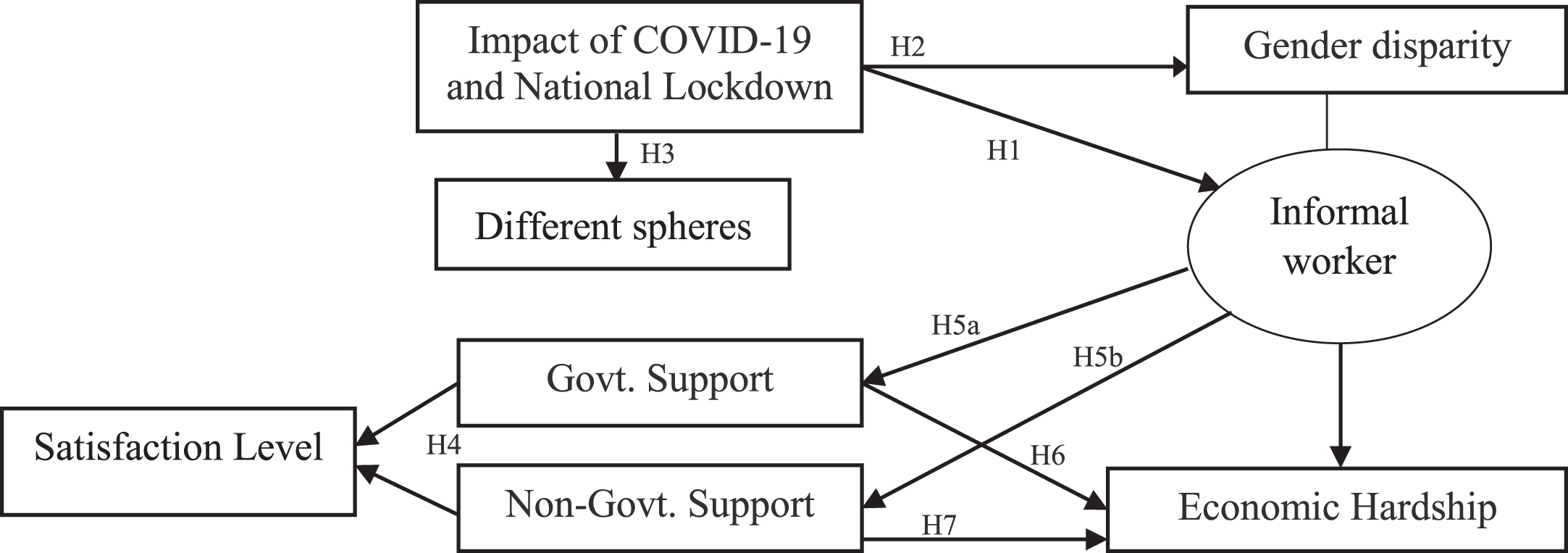
Theoretical framework.
The low-paid workers were on the extreme edge to acquire daily meals for their families as unemployment had led to the exhaustion of their wages with no saving alternatives. India ranked 94th out of 107 countries in the Global Hunger Index in 2020 and the pandemic has doubled the number of food-insecure people in India [19]; which is an indicator of how the lockdown-led food and habitat crises and structural incompetence in dealings of even local-level emergencies [20] have worsened their existing horrible situations. Not to forget India’s undernutrition and malnutrition co-existing problems in rural areas and urban slums adding to doubling the effects satisfaction level due to the interrupted food supply chains in government schemes like mid-day meals, Take-Home Ration (THR) under ICDS especially for low wage-earners ‘children during the lockdown [21–23]. Lytras and Tsiodras [24] mentioned that the condition of the small contracted, non-permanent homes available for the informal workers which were mostly rented especially in slum areas with no isolation possibility made it impossible to secure their homes due to the loss of jobs or themselves from the virus [25].
The precarity of gender-based disparities already existed in the labor market [26] of which the International Labor Organization (ILO) brief report on the Impact of lockdown measures on the informal economy estimated that women were at high-risk factors [27] observed gender disparity was high during the lockdown where 83% of women informal workers in India faced the pandemic devastation whereby their earnings dropped drastically and there was lack of access to finance to them. The devastation of others faced vulnerabilities like taking care of their children’s needs by themselves especially in the absence of their husbands during the shutdown was left unmeasured [28]. The availability of a highly disproportionate burden of public health services that informal workers mostly rely upon is left unmeasured. Hence, the research raises a rigid focus on the more acute tragedy of the pandemic for informal workers with inferential and insufficient availability of data and evaluating the added social exclusion and inequalities [9, 29] faced by them during the period of lockdown. The most available literature and the mentioned sources of studies like [30–33] have investigated how the negative and persistent impact of the COVID-19 pandemic destruction has drastically worsened the Indian economy and particularly informal workers’. Gender-based informal workers’ mental and financial condition has been studied but there are very few studies that talked about the satisfaction level of informal workers, their needs, and the movement of workers due to lockdown. This research aims to know the impact of nationwide COVID-19 lockdown on the severely affected ‘informal workers’ given the containment measures applied and no work movements; The added risks of COVID-19 faced by the gender-based informal workers; and the informal worker’s sufferings with respect to their needs and perceptions during the lockdown across different parameters: economic, social, psychological and health-care accessibility. Their needs and perceptions during the lockdown across different parameters: economic, social, psychological and health- care accessibility. In order to examine the above discussion, we have framed the hypotheses stated below and the theoretical framework is shown in Fig. 1:
The nationwide lockdown impacted the informal workers.
Covid-19 led lockdown impacted gender-based informal workers unequally.
The lockdown led to varied- effects across different spheres such as job status, reduction of the level of employment, lack of money, alternate plans to arrange food, problems faced procuring food through government support, and aggregate household expenditure simultaneously.
The satisfaction level across gender categories is high with government and non-government organizations supporting informal workers’ day-to-day life.
Across the gender categories, the level of government support and economic hardships are high to support informal workers’ day-to-day life.
There is a positive and significant relationship between the level of government support and economic hardships.
There is a positive and significant relationship between the level of non-government support and economic hardships.
Research methodology
During the Period of Lockdown, the impact of COVID-19 was measured on the informal worker and economic hardships having the support of government and non-government support. Many variables are measured. The study was conducted across the Indian population such as informal workers mainly migrant workers, and daily wage workers who have suffered from the bad impact of COVID-19 and the lockdown. To measure the levels of each variable, we used a five-point Likert scale (1-strongly disagree, 2-disagree, 3-neutral, 4-agree, 5-strongly agree). This empirical investigation has been conducted online and the questionnaire was sent using google Forms after an executed preliminary study was conducted successfully. In the next stage, this questionnaire was pre-tested with 30 respondents who agreed to participate. To confirm the measures’ reliability and validity, a preliminary reliability test was done using SPSS. After their suggestions, the improved and modified questionnaire was considered as the final questionnaire and it was sent to 890 respondents but received only 705 responses.
The data collection process was conducted during the COVID-19 outbreak from June 2020 to October 2020. During data cleaning, we found 58 responses were missing so it was deleted and a 647 sample size is considered for final analysis with a response rate of 72 percent. This sample size based on the survey is satisfactory [34–38]. Further, to avoid biasness, no direct questions were asked, thus the performance and personal growth will not be affected by any kind of biasness. The items/questionnaire, measured on a five-point Likert scale were considered [39–42]. The sampling technique led to a designated sample size to avoid the biasedness of the sampling [40]. Thus, we checked and examined the method biases and then make a decision [41, 42]. The online data-gathering survey employed a structured questionnaire. The questionnaire comprised two sections as demographic details of the respondents, define and measure the variables. Table 1 summarises the demographic details of the respondents.
Demographic characteristics of respondents (N = 647)
Demographic characteristics of respondents (N = 647)
Descriptive study
The data have been received from the different occupations. We selected 20 professions where COVID affected them majorly and some of the workers lost their jobs. They are from different areas. The occupation of all respondents is provided in the frequency table (Table 2). Their job status is different while some of them are continuing with full salary and with partial cut in salary. Others are continuing with half of the salary cut and with more than half the salary cut. The job statuses of the respondents are shown in Table 3. From the results, only 202 workers are getting a full salary, 227 are with a partial cut in salary, 151 are with half of the salary cut, and 67 are with more than half salary cut.
Occupation of the respondents
Occupation of the respondents
Job status of the respondents
During the national lockdown, the informal workers suffered the most due to a lack of work on a daily basis. Perceive about the nature of the reduction of the level of employment and the levels of their salary are varied, as the frequency of the data has been shown in Table 4. Similarly, the results of the perception of getting a job in the future in the next one to three months are different from what workers are thinking (shown in Table 5). The post-effect of COVID-19 would be challenging for those who lost their jobs. The results of this study show that in context to perception, it would be a better scenario to get a job. The consequences of the extreme situation of survival during lockdown are shown in Table 6. The unemployed cases face different challenges and, in that case, the condition of informal workers was found poor. There are many alternate plans to procure food (data shown in Table 7) from various sources of support to survive such as Government support, Friends/Relatives support, selling out a parental property, social security support provided by the organization, Loans from banks/ financial institution, Support from NGOs, and Support from Religious Institutions like Temple, Gurudwara, Church, Masjid etc.
Perceive the nature of the reduction of the level of employment/salary
Perception of getting a job in the future in 1– 3 month
Extreme situation of survival during lockdown
Alternate plan to procure food
The informal workers received the support to survive through the ‘Jan Dhan Account Transfer’ (459 workers received). These workers spend their savings and pay wherever it is needed. In some cases, they had to borrow money from relatives, and friends to buy essentials. All sources of revenue have ceased, but spending continues at the same rate. Different costs must be paid, and this cannot be overlooked. These are healthcare costs (Medicine, hospitalization, immunity boosters’ products etc.), Children’s education (internet, mobile etc.), Debt-Interest related payments, an increase in the cost of travel (conveyance cost), Hygiene related costs, an increase in prices of essential commodities. The frequency table of overall support during the COVID-19 Lockdown is shown in Table 8. Table 9 shows the impact on informal workers’ overall spending during the COVID-19 lockdown while Table 10 shows the Increment in overall spending.
The overall support during COVID-19 Lockdown
Impact on overall spending during COVID-19 Lockdown
Increase in overall spending
In the present study, there were 353 male workers and 294 female workers who participated to check the level of satisfaction across the gender categories with government and non-government organizations. An independent sample t-test was applied to test the hypothesis [43–45]. It was run to determine if there were differences in scores of male and female workers. Tables 11 12 present the level of satisfaction with government and non-government organizational support respectively across the gender category. We checked all the assumptions for model fit and found it suitable for the final data analysis where it follows. The level of significance (>0.05, 2-tailed) shows that the scores were statistically insignificant and there is no difference between male and female workers. It has been hypothesized in H4 and results revealed that male and female workers are the same for all variables given in Tables 11 12. The mean and standard deviation values are high for both types of workers. In this case, it suggests that gender categories majorly both (male and female) and their level of satisfaction with government support and non-government support got affected. The results of group statistics are shown in Table 13.
Level of Satisfaction with government organizational support across gender category
Level of Satisfaction with non-government organizational support across the gender category
Group Statistics
In the same scenario, there were 353 male workers and 294 female workers who participated to check the level of satisfaction across the gender categories with government support and economic hardships. Thus, an independent sample t-test was applied to test the hypothesis [43–45]. It was run to determine if there were differences in scores of male and female workers for government support and economic hardships. Table 14 shows the level of satisfaction with government support and non-government organizational support and economic hardships across the gender category. We checked all the assumptions for model fit and found it suitable for the final data analysis where it follows. The level of significance (>0.05, 2-tailed) shows that the scores were statistically not significant difference between male and female workers. It has been hypothesized in H5 and results revealed that male and female workers are the same things for all variables given in Table 14. The mean and standard deviation values are high for both types of workers. In this case, it suggests that gender categories majorly both (male and female) and their level of satisfaction with government support and economic hardships got affected. This means that the government in India was able to deal with the day-to-day challenges of life with the help of food and other essential support during the time of Covid-19. Moreover, the level of economic hardship to support informal workers’ day-to-day life was also found significant in the study. It suggests that the higher level of economic hardship is more challenging in dealing with the problems of informal workers and vice-versa.
Occupation Independent Samples t-Test
Multiple Regression analysis was used to evaluate the relationship between independent and dependent variables [35, 46]. In this case, two independent variables and one dependent variable have been considered with an adequate sample size to perform this analysis. We checked all the assumptions of multiple regression analysis. Table 15 shows the bivariate correlation matrices for the level of government, non-government organizational support and economic hardship. Tables 16, 17 and 18 summarize the model and data analysis of results based on regression analysis. In this analysis model, the multiple regression coefficients (R) for one dependent variable (economic hardships) are 0.939, indicating a high degree of predictability. The values of coefficients of determination (R2) are 0.882 as presented in Table 16. This explained the level of government and non-government support could significantly account for 88.2% of independent variables (economic hardships). Now, from multiple regression analysis, the F-ratio verifies that the aggregate regression model matches the data. F (2, 646)=2398.745, and p levels indicate that the independent variables (level of satisfaction with respect to government and non-government support) to predict the dependent variable (economic hardships) were found statistically significant and also evidenced that the regression model fits well with the data. Standard regression coefficients for the level of government support (β=0.544, p < .01), and non-government support (β=0.433, p < .01), are correlated to measure economic hardships. Thus, the correlation and significant findings indicate that levels of government and non-government support are positively associated with economic hardships. That means that a higher satisfaction level with respect to government support reduced the economic hardship of the informal workers and vice-versa.
Bivariate correlation matrices for the level of government, non-government organizational support and economic hardship
**Correlation is significant at the 0.01 level (2-tailed).
Model summary
aPredictors: (Constant), Non-govt. support, Level of Government Support.
ANOVA
aDependent Variable: Economic Hardships. bPredictors: (Constant), Non-govt. support, Level of Government Support.
Co-efficientsa
aDependent variable: Economic hardships.
In the present study, it has been found that the informal workers were significantly affected by the Covid-19 measures taken by the governments in form of various restrictions specifically nationwide lockdowns. The informal workers are the most vulnerable to any economic disasters which take place in any developing country like India. Interestingly, India has the highest number of informal workers working in different sectors and unorganized industries. In the study, it is found that the nation-wide lockdown has impacted the informal workers. This particular hypothesis was also supported in a previous study [47]. The informal workers have suffered the most due to a lack of work on a daily basis. Similarly, the study based on the results found that in context to gender parameter women-informal workers has been also affected by the lockdown because of Covid-19. Informal women workers specifically those who were earning the livelihood for the entire family were more impacted by the lockdowns in India. The results of the study on the gender parameter especially women informal workers were found to support the study conducted in the Indian labor market during the lockdown [48]. The condition of women informal workers was found poor. It was because of the closure of the unorganized sectors such as small schools and restrictions from landlords towards household work, baby care jobs and many other areas of work where women informal workers were in demand. The families led by women informal workers got suffered badly for months.
Hypothesis results
Hypothesis results
The present study also found a positive relationship between the lockdown and varied effects across different spheres. These different spheres are job status, reduction of the level of employment, lack of money, alternate plans to arrange food, problems faced procuring food through government support, and aggregate household expenditure simultaneously. The literature in support of the hypothesis can be verified in the published study based on the informal workers in India [49]. In the present study, it has been also verified that the level of satisfaction across the gender categories with government and non-government organizations in supporting informal workers was found positive. In this case, it suggests that gender categories majorly both (male and female) and their level of satisfaction with government support and non-government support got affected.
The results suggest that government measures have impacted more to the informal workers more as compared to non-governmental support. A previous study highlights the task of the government organizations that supported food vendors in South Africa and India. Another example is the waste pickers who were also supported by the government in India and Brazil. Not only the government but, also non-governmental bodies such as private business houses, civil societies and other cooperatives were taking care of these informal workers in terms of relief measures, food, and safety precautions for waste picking [49]. In this case, hypothesis four is also supported by the previous study. The next argument studied in the article is about the level of government support to support informal workers’ day-to-day life which is also found statistically significant. This means that the government in India was able to deal with the day-to-day challenges of life with the help of food and other essential support during the time of Covid-19. Moreover, the level of economic hardship to support informal workers’ day-to-day life was also found significant in the study. It suggests that the higher level of economic hardship is more challenging in dealing with the problems of informal workers and vice-versa. The relationship between the satisfaction level with respect to government support for economic hardship was also found significant and positive. That means that a higher satisfaction level with respect to government support reduced the economic hardship of the informal workers and vice-versa. The hypothesis result is given in Table 19.
The study closely highlights the role of the government system towards non-government organizations those who played a crucial role in the welfare of the informal workers. The most affected group of people in the Covid-19 lockdown are the informal workers who were working on daily wages for their bread and butter. But, because of the lockdown and several other restrictions, the entire structure of the unorganized workforce got collapsed. In India majority of the workers are working in the informal sectors and hence it is also one of the major causes of poverty specifically during the time of crisis in the country. The social exclusion and inequalities faced by informal workers during the Covid-19 pandemic are a very desperate part of it. These exclusions and inequalities were well taken care of by the non-governmental organizations. Several non-government organizations (NGOs) came up front and support this section of society. The government endeavor was also found significant in supporting the informal workers. But it is true that there is a lot more was left undone and emergency migration took place among the informal workers. In this migration process, certain casualties among the informal workers were also seen. These incidents question why there are still many reforms that are still required for the welfare of the informal workers in India. The informal workers working in the unorganized sectors were also not on record that perhaps also increasing chaos in the government system and which also made the delay in providing the appropriate solutions to the problems of the informal workers during the time of lockdowns. These issues and the government’s sudden action on the nationwide lockdown made the problem even worst for the workers. These issues led to forcefully migrating the workers from the urban areas to their native lands. The entire initial migration process was not led by the government systems and it was not even supported by any means by the government. The quick decisions of the government confused the rest of the systems including transportation and this even created more load on the informal workers.
There is uncertainty around the length of this crisis, the harm it will do to life, work, and the economy, as well as the accessibility of fundamental healthcare services. Given its scope and scale, managing India’s informal workers during and after a lockdown is a significant difficulty. This research study indicates that in order to address the covid dilemma of migrant workers, it is necessary to formulate regulations at the micro and macro level for the state, local, and administration of organizations. It’s time for the federal and state governments to work together more closely. To combat the pandemic, additional organizations and governing bodies must be enlisted, and they must accept the assistance of NGOs, businesses, and other self-help organizations. The most urgent task is to maintain better cleanliness and sanitation while providing food and other necessities at camps and shelters. Another essential element of prevention is the provision of fundamental medical care and preventative supplies (such as masks, hand sanitizers, gloves, etc.). Another difficult issue facing the government is properly identifying potentially infected people, placing them in quarantine, and keeping social distance from migrants to stop the spread of infection. Each state’s local level must collaborate with social care professionals and non-profit organizations to offer counseling and psychological help to the informal worker experiencing distress. Both the freeway camps and the returning workers in the villages have a burning need for the creation of an accurate database for the stranded labor at their destinations. To disburse the benefits of social assistance schemes for current and future management demands, data on the quantity and characteristics of migrants in camps and at-home quarantine are essential. Such efforts must be taken to combat these unheard-of events, like pandemics.
Conclusions, limitations, and future scope
The entire study revolves around the nationwide lockdown in India because of the acceleration of the covid-19 cases. Another aspect covered in the study is the most important economic pillar of our economy i.e., informal workers. These informal workers are the highest in size among the entire workforce in India and hence they are imperative for social inclusion and equality. The economy of India is very much supported by informal workers. Therefore, the present study is imperative to be presented in the knowledge base. The focal point of the study was the involvement of the government and non-government organizations in mitigating the problems of the informal workers. The covid-19 lockdown has impacted badly the informal workers despite their gender and specifically, the results suggest that the women workers were more affected. The role of the government organization was found better in comparison to the non-government organizations. It is because of the present policies of the government and their methodology. But, at the ground level, informal workers have faced big problems especially migrating to their homelands. The lessons learn from this pandemic to the government and non-government organizations are a lot more. These experiences and lessons are significant in not repeating and leaving the loopholes while serving the significant economic pillars of the country. There should be more specific policies toward informal workers’ inclusion and authorities should realize the significance of informal workers. The study presents the gender parameter status of women workers in the informal sector. It suggests the government and other corporations pay specific attention to the workforce, facilities and pay structure of informal women workers. This study can be used to show the condition of female workers in India and bring a change in social thinking and perception of people towards women.
The study is limited to the Indian Informal sector and focused on women informal workers more hence, the conclusion can’t be the same for all the sectors and countries. The result may differ for various sectors and geographical boundaries.
Footnotes
Appendix A: Occupation $d frequencies
aGroup. Appendix B: Occupation $d*gender cross tabulation Percentages and totals are based on responses. aGroup. Appendix C: Occupation Occupation*$d Cross tabulation Appendix C: Occupation Occupation*$d Cross tabulation Chi Square value at 5% level of significant and 108 DF = 32.6984. Percentages and totals are based on responses. aGroup. Appendix D: Abbreviations (Complete explanations of the abbreviations used in this study)
Responses
Percent of
N
Percent
cases
$da
Not aware that this was available (lack of information)
501
19.0%
77.4%
Lack of documentations
529
20.1%
81.8%
Citizenship/migrant status
253
9.6%
39.1%
Fear of stigma and social repercussions
361
13.7%
55.8%
Not eligible
217
8.2%
33.5%
Political favoritism/corruption
389
14.7%
60.1%
Did not face any problems
388
14.7%
60.0%
Total
2638
100.0%
407.7%
Gender Category
Total
Male
Female
Third
Gender
$da
Not aware that this was available (lack of information)
261
228
12
501
Lack of documentations
293
226
10
529
Citizenship/migrant status
144
101
8
253
Fear of stigma and social repercussions
203
149
9
361
Not eligible
127
82
8
217
Political favoritism/corruption
209
170
10
389
Did not face any problems
209
169
10
388
Total
1446
1125
67
2638
$da
Total
Not aware that this was available (lack of information)
Lack of documentations
Citizen-ship/migrant status
Fear of stigma and social repercussions
Not eligible
Political favoritism/corruption
Did not face any problems
Occupation
Domestic worker/help
27
22
12
15
7
17
12
112
Street vendor
47
54
30
38
27
40
42
278
Auto/Taxi driver
54
56
27
39
24
40
44
284
Painter
27
25
11
18
8
19
20
128
Security Guard/Watchman
62
75
35
50
28
52
53
355
Tailor
6
9
4
7
5
8
7
46
Cobbler
7
7
2
4
2
4
4
30
Garbage Collector/Waste picker
9
9
3
5
3
6
4
39
Barber/Haircut/Salon
34
37
21
27
16
29
24
188
$da
Total
Not aware that this was available (lack of information)
Lack of documentations
Citizen-ship/migrant status
Fear of stigma and social repercussions
Not eligible
Political favoritism/corruption
Did not face any problems
Home based worker (garment worker, embroiderers, food processor, kite maker etc.)
7
9
4
5
4
6
7
42
Masseuse
14
16
6
9
3
9
9
66
Cycle/motorcycle/car repairs
19
20
12
14
9
15
15
104
Rickshaw Puller
24
25
9
17
9
20
23
127
General employment (e.g. worker at construction sites, office helper, floor cleaner, cooking at restaurants etc.)
31
30
12
16
11
17
22
139
Plumber
41
44
23
32
16
32
29
217
Electrical
64
63
27
43
28
45
42
312
Carpenter
4
6
3
5
5
5
5
33
Dry cleaner/Laundry /Ironing services
5
5
2
4
3
4
4
27
House shifting services (Packers and Movers)
6
9
6
8
5
8
8
50
Agricultural worker
13
8
4
5
4
13
14
61
Total
501
529
253
361
217
389
388
2638
COVID -19
Coronavirus Disease 2019
WHO
World Health Organization
IMF
International Monetary Fund
PDS
Public Distribution System
MGNREGA
Mahatma Gandhi National Rural Employment Guarantee
MSMEs
Micro, Small &Medium Enterprises
CMIE
Centre for Monitoring Indian Economy
DBT
Direct Bank Transfer
ILO
International Labour Organization
ITI
Industrial Training Institute
N
Number
SD
Standard Deviation
NGO
Non-government Organization
EH
Economic Hardship
ANOVA
Analysis of Variance
SKOCH
Sameer Kochhar