




Abstract
BACKGROUND:
The renewed advent of Artificial Intelligence (AI) is inducing profound changes in the classic categories of technology professions and is creating the need for new specific skills.
OBJECTIVE:
Identify the gaps in terms of skills between academic training on AI in French engineering and Business Schools, and the requirements of the labour market.
METHOD:
Extraction of AI training contents from the schools’ websites and scraping of a job advertisements’ website. Then, analysis based on a text mining approach with a Python code for Natural Language Processing.
RESULTS:
Categorization of occupations related to AI. Characterization of three classes of skills for the AI market: Technical, Soft and Interdisciplinary. Skills’ gaps concern some professional certifications and the mastery of specific tools, research abilities, and awareness of ethical and regulatory dimensions of AI.
CONCLUSIONS:
A deep analysis using algorithms for Natural Language Processing. Results that provide a better understanding of the AI capability components at the individual and the organizational levels. A study that can help shape educational programs to respond to the AI market requirements.
Keywords


Introduction
Business environments are increasingly turbulent with incessant technological advances and unpredictable customer behavior [1]. In this respect, firms in all industries are becoming more interested in the data they produce or can collect externally to improve their performance and align with market changes [2]. Indeed, the evolution of Information Technologies (IT) and the use of the Internet of Things (IoT) generates an enormous amount of data that companies are striving to exploit and make intelligible through Artificial Intelligence (AI) [3]. They are thus engaged in projects to design new approaches both in data processing and in organizational and managerial configurations [4] in order to fully integrate this new resource into their Information Systems [5]. AI has attracted both practitioners and researchers’ attention in technical and human sciences over the last two decades [6]. It has grown enormously since 2010 thanks to the various data and computing power that did not exist before, and its development is still far from complete. By 2025, the AI market will be worth $90 billion, compared to $7 billion in 2018 [7].
AI is present in many areas and applications related to research and innovation such as financial systems, government decisions, medical sector, etc. Its renewed advent is inducing profound changes in the classic categories of IT professions and is creating the need for new specific skills, for instance in terms of data collection, data mining, or data quality management [8]. Indeed, a recent global survey conducted by IBM has concluded that in the next three years, approximately 120 million jobs will have to adapt to the advances in AI, and this only for the 10 most dynamic economies on the planet [9]. Therefore, it is wise to question whether academic institutions are aligned with the accelerated integration of AI in firms and thus whether they are properly preparing engineering and management students for the contemporary needs of the job market in terms of AI.
To answer this question gap, we mobilize a text mining approach enabling the analysis of job offers and academic training content in France, and the evaluation of the gaps between these two actors of the AI employment value chain. The results of this analysis contribute to the theoretical corpus around AI by providing a refined vision of the categories of occupations related to this technology and the types of skills to operate in the discipline of AI. In fact, most previous studies adopted a generic perspective by analyzing the needs of the labour market in terms of IT skills, without paying particular attention to the emerging specificities of AI (e.g. [10–12]). The few studies that focused on this technology used an empirical approach based on interviews and survey questionnaires (e.g. [13, 14]). They mainly highlighted needs in terms of soft skills and did not identify the potential disparities between the professionals’ requirements and the academic content. In contrast to this extant research, our approach covers a mass of data that is not limited to a particular sector and is based on an objective analysis that is independent of researchers’ interpretation biases. Accordingly, we provide a better understanding of the skills needed to build an AI capability [15] at the individual level, but also at the organizational level by considering the types of professions required in firms to capitalize on AI. From a practical standpoint, this study establishes an overall picture of the AI labour market in France, which can be used to improve or build educational programs and guide individuals who wish to become AI professionals to prepare for the job market.
This paper is structured as follows. Section 2 is devoted to our theoretical foundation while section 3 explains our methodological approach. The results are then presented and discussed in section 4. Finally, this paper is concluded with its main implications, limitations and research perspectives.
Theoretical foundations
Origins and evolution of AI
The term Artificial Intelligence (AI) includes all the theories and techniques used to build machines capable of simulating human intelligence [16]. Table 1 describes the most important breakthroughs in AI research over time that we detail in the following paragraphs.
Important advances in AI research over time
Important advances in AI research over time
The birth of AI coincides with the appearance of computers in the 1940s and 1950s, the emergence of the theories of connectionism and cognitivism, and the discussions about the possibility of creating an artificial brain. Indeed, a memo by Warren Weaver [31] on automatic translation of languages suggested that a machine could very well perform a task that falls within the scope of human intelligence. Similarly, Alan Turing’s article [18] explored the issue of determining whether a machine is conscious or not. The Turing Test, which evaluates the ability of a machine to hold a human conversation, is derived from this article. The formalization of AI as a true scientific field dates back to 1956, during a conference organized in the United Sates at Dartmouth College [32]. Subsequently, this field reached prestigious universities such as Stanford and MIT.
In the mid-1960s, AI research was mainly funded by the US Department of Defense and concentrated in a few specialized laboratories around the world. In 1974, an “AI Winter” occurred as many experts failed to deliver their promises on AI development and applications. As a result, the British and American governments reduced their funding for research in this field [22]. In the 1980s, the success of the expert systems led to the revival of AI research projects. An expert system is a software that is capable of reproducing the cognitive mechanisms of a human expert in a particular field based on a set of rules. Due to this success, the AI market reached a value of one billion dollars, which has motivated different governments to financially support academic projects again [33]. The exponential development of computing performance according to Moore’s Law made it possible, between 1990 and 2000, to exploit AI in previously uncommon areas such as mineral research or medical diagnosis. It was not until 1997 that a real media release took place when the famous AI Deep Blue created by IBM beat Garry Kasparov, the world chess champion [34].
Between 2000 and 2010, AI continued to grow with the development of connectivity and mobility, and the increased accessibility to personal computers, Internet, smartphones, etc. Since 2010, Moore’s Law has been guiding the progress of AI, supported by data processing. Indeed, to perform a task, a system only needs rules: when it comes to thinking or delivering the right answer, it needs to learn. The problem of AI was no longer to have the brains for systems’ development, but to have data to process. Thus, researchers developed new processes for Deep Learning which, fed by the data, achieved exceptional performance and enabled the launch diversified projects [35]. Today, data management allows AI to be applied to understand X-rays better than doctors, drive cars, do translation, play complex video games, create music, see through a wall, imagine a missing part of a photograph, etc. The fields where AI performs well are constantly growing, which raises many questions about the professional role of human beings in the future [36].
It is difficult to understand and grasp all areas of application for AI, because of their diversity and their overlapping. We therefore list the most common applications of AI today. This technology can be found in expert systems capable of simulating the behavior of a human expert who performs a specific task. AI is also widely used for the symbolic representation of knowledge in order to manipulate it through software. A third common application is Natural Language Processing (NLP) to understand a text independently of the language in which it is written [37]. AI additionally allows the resolution of complex problems found for example in games, and the recognition of speech, handwriting, or faces, for which neural networks are particularly efficient [38]. Finally, robotics is a dazzling use of AI with robots that react according to their environment, learn to recognize faces, follow moving objects and respond to sound and visual stimuli [39]. All of these applications are based on learning, as an algorithm or software should have autonomous learning capabilities to be considered intelligent [35].
The presence of these AI applications varies according to the company’s sector of activity. Obviously, the sectors and processes that intensively use AI are those that generate the most data. We find it in the field of Marketing, especially for customer targeting, improving customer experiences using chatbot, and for e-commerce recommendation engines. AI is also used in Finance to perform high frequency trading, market analysis or even to develop advising robots. More specifically, in banking institutions, it can detect fraudulent transactions and calculate credit points to determine a customer’s financial profile [40]. In addition, AI is strongly mobilized in social media to train neural networks to recognize faces and to moderate audiovisual content and comments [41]. Moreover, the medical sector increasingly integrates AI technologies for diagnosis by taking into account patients’ history and allowing a better cross-referencing of medical specialties, or even for the automatic calculation of bone age from the X-ray of a hand [42]. The entertainment industry is also one of the biggest users of AI, which is integrated in gaming robots, augmented reality, and media content recommendation processes [38]. Finally, the recent emergence of IoT opens up the prospects for new uses of AI in home automation, farming, drones and autonomous cars [3].
Thus, AI techniques and their applications are constantly evolving and therefore require an evolution of professions. Indeed, several job positions are being transformed or completely replaced by AI technologies [9]. These include the professions of the past (e.g. assembly line workers, cashiers), those that are currently being automated (e.g. professional drivers, offshore professions) and those that will be automated later (health, auditing, etc.). In addition, the advent of AI is leading to the creation of new jobs related to algorithmic, emotional or data processing, such as Data Scientist, Big Data Developer or Data Manager [43]. Consequently, a major question arises concerning the readiness of academic institutions to train students in line with these rapid changes in the job market. However, no research performed an exhaustive analysis of the potential gap that exists between the needs of the recruiting firms and the skills developed in academic training focused on AI.
Few previous studies provided a partial answer to this question. On the one hand, the authors who performed a gap analysis focused on the IT sector as a whole including AI, but without providing a refined analysis of AI needs and skills. [11] studied the demand of IT professionals by exploring job offers and identified the most taught IT skills such as programming languages, databases and networks. [10] compared IT professional skills found in academic and professional literature, while [44] determined IT skill gaps from candidate profiles on social networks and job offers. On the other hand, studies that looked at skill requirements for AI in particular analyzed the needs of the job market without comparing them with the content of academic training. [45] used Latent Semantic Indexing to construct a taxonomy of Business Intelligence and Big Data skills from job offers. Other researchers used interviews and questionnaires to identify the skills required to be an AI professional ([13, 14]). They pointed out the soft skills needed, discussed the role of AI in IT education, and presented recommendations for the integration of AI in academic programs. The present research therefore complement these previous studies that provided a relative reading of AI skills needed by the job market. We propose to use a text mining approach that is independent of researchers’ interpretation biases, to draw up an overview of recruiting firms’ requirements in terms of AI competencies. We also carry out a comparison between these professional requirements and the content of academic training to formulate concrete proposals for adjusting the pedagogic offer in light of the emerging professions and the subsequent skills needed.
Methodology
To address our research question, we focused on the French AI training and job market for several reasons. On the one hand, France is very representative of this market. Regarding AI professionals, most of the major multinational players in this technology operate in French soil and the number of startups created around AI has increased by 38% in 2019 [46]. Regarding AI training, France is a key player in the international academic market because of the high concentration of IT courses in schools and the partnerships they have developed with the international academic ecosystem [47]. On the other hand, France is particularly impacted by the changes brought by AI. Indeed, more than 2 million workers have to adapt their profiles and missions to the advances of this technology [9]. In addition, the rapid advent of AI induces important needs that the labour market struggles to meet [48], thus proving the inadequacy of academic training to the emerging AI professions. We explain in the following paragraphs our approach to collecting and analyzing academic contents and job offers related to AI.
Data collection
To extract the content of courses in France integrating AI, we identified the French engineering and business schools that offer such training. In this respect, we considered the Figaro rankings (Ranking of the best business schools in 2020 and the 2020 ranking of French engineering schools) and looked at whether each of these schools offered courses in AI. We then retrieved the brochures of the AI specialized curricula of these engineering and business schools. To allow a more refined analysis of training content in France, we also retrieved the syllabi of AI courses in these schools aside of specialized AI curricula. This process resulted in 33 extracted documents. Finally, we formatted them in.txt to enable their analysis by an algorithm.
For the extraction of the job offers, we chose the website www.indeed.fr as it is considered as the most complete and up-to-date database for job advertisements in France. Other platforms such as LinkedIn are often used by some firms as an additional means to broadcast the same offers posted on Indeed. We employed a script developed with Python to scrap the content of the selected website. The script allows to perform a job search with chosen keywords, in our case “Artificial Intelligence; AI; and/or Data Science” in French and English. To form an accurate dataset of job offers with the least possible redundancies, we scanned the entire site and made an extract for each month starting with June 2020 and comparing it with the preceding month. This approach showed that companies tend to repost the same job offers every one to three months in order to always appear in the first search results on the website and ensure better visibility to candidates. Therefore, we restricted the considered time span to March to June 2020, as it was the most appropriate interval to take into account the job market dynamics and avoid redundant job postings. The extracted data progressively fed a table with a job offer Id, its title and a description that concatenates all the available information about the offer. By going through the 307 job postings resulting from this process, we established that some of them corresponded to positions citing AI as a skill and not to AI occupations per se. As we are concerned by the second category in our research, we manually filtered the job offers as an automated analysis algorithm would have been inefficient given the small size of our sample. This process finally resulted in 281 job offers centered on AI.
Data analysis
To ensure consistency in the analysis, the content of the job and training offers in French has been translated into English via DeepL, a highly recommended translator using convolutional neural networks [49]. We relied on keyword extraction to analyze these contents. In this respect, we developed a Python code to process English text and identify its keywords based on NLP (Natural Language Processing). The NLP vectorizes the words and makes them understandable by an algorithm that can decipher, interpret and give meaning to human language. Our code analyzed all the words in the text, their frequency, their environment, their nature and function, and was able to produce the most relevant keywords as a result. This process allowed us to identify, within the training brochures and the job offers, elements associated with the level of training, its nature, and the listed skills. Finally, we manually sorted the extracted keywords because some of them remained incoherent, despite our efforts to optimize the code. Indeed, the use of NLP is not perfect and sometimes leads to errors that must be managed humanely in post-processing.
In addition, we analyzed the titles of the job offers to identify the emerging professions in AI. We used an automated learning approach to filter the titles and classify them into categories. This approach consists of a textual categorization process, which automatically constructs a classifier by learning the characteristics of the content categories from a set of pre-classified documents [50]. We experimented several classifiers and concluded that the Support Vector Machine classifier was the most accurate.
Results and discussion
Distribution of AI professions
Our resulting classification of job offers (Fig. 1) on AI shows that
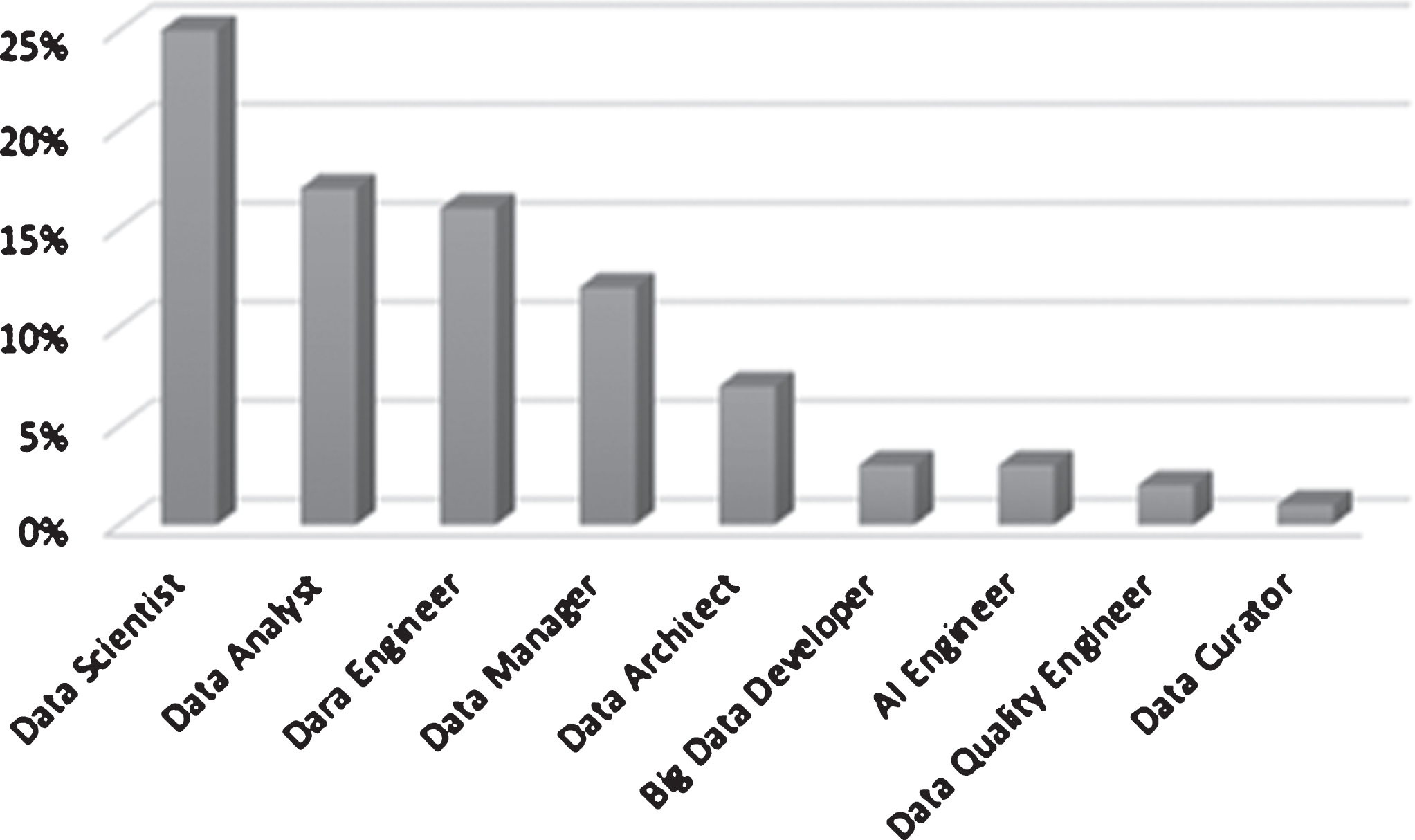
Categories of AI professions.
As depicted in Table 2, based on the keywords extracted from the job offers, we characterized the market prerequisites in terms of the nature of training. We concluded that firms most often require a candidate with a
The job market vs. the academic offer in terms of the training characteristics
The job market vs. the academic offer in terms of the training characteristics
As for the level of training, the vast majority of job postings request a
Figure 2 summarizes the most frequent skills in the AI job advertisements while the overall skills that emerged from our analysis are introduced in Table 3. These skills can be divided into three categories namely Technical, Soft and Interdisciplinary skills. We analyze below the composition of these categories and compare them with the content of academic trainings.
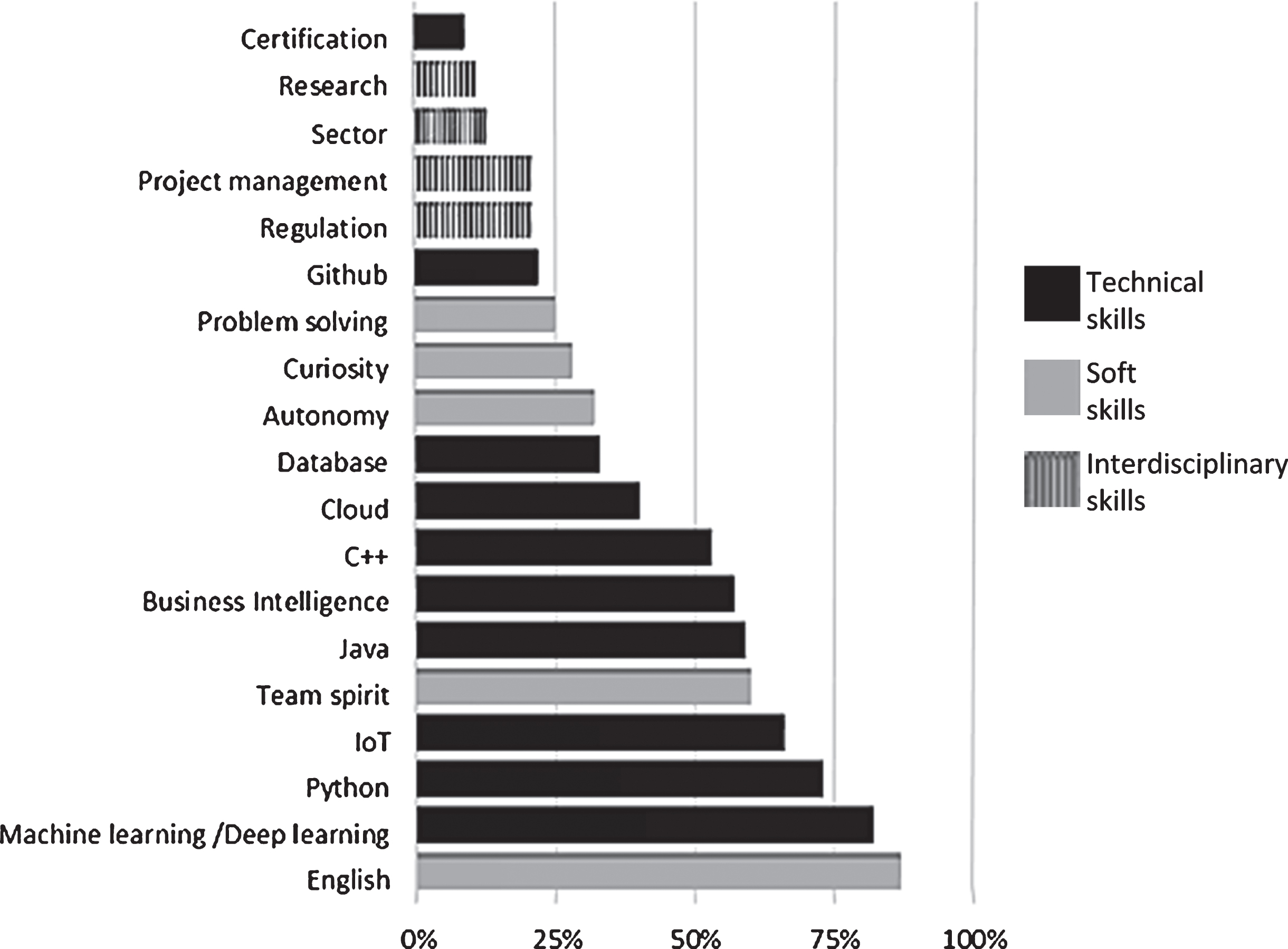
Word frequencies in AI job offers.
Overview of Skills required by the AI Job Market
First, Fig. 2 shows that Secondly, all job offers highlight needs in terms of Thirdly, several job offers (22%) stress the need to master The fourth category of technical skills corresponds to Finally, job offers abound with a plethora of
In addition to technical skills, the majority of job offers require
The most frequently cited prerequisites are related to the Then, the job offers underline prerequisites in terms of the
Finally, our analysis highlighted the need for three sub-categories of Several job offers require the candidate to be Then, we found interdisciplinary skills related to the Finally, we were surprised by the fact that 11% of the job offers require
Technological advances in AI are revolutionizing firms’ activities and giving rise to specific skill requirements. The purpose of this study was to analyze the extent to which higher education is responding to the emerging needs in terms of skills for the AI labour market. Our results suggest that the competencies required to operate in AI fall within three categories: technical, interdisciplinary and soft skills. For the technical skills, there is an overall balance between academic courses and job offers in Data Science, programming languages, mastery of digital technologies and of parallel techniques such as databases. Nevertheless, schools should strive to certify their graduates and to ensure their mastery of the tools that are highly demanded by the job market. We also noted a gap in terms of interdisciplinary skills, namely research and sectoral knowledge in all curricula, and human and social sciences specifically within engineering schools. Therefore, institutions must invest in the development of these skills among their students as well as in the expansion of their cognitive abilities. In particular, technical programs must sensitize students to the ethical and regulatory issues of AI to enable its responsible implementation. These results help advancing both academic and practical knowledge and provide avenues for future research as explained below.
Theoretical implications
From a theoretical standpoint, we complement prior studies that examined some skills acquired by students enrolled in AI [53] and IT programs ([54, 55]) by providing an overview of emerging professions centered on AI and a categorization of the skills required to operate in this field. Our results would guide graduates towards some of the most critical competencies in the 21st century [56], particularly by helping them build an AI capability [15] at the individual level. This study also supports the establishment of such capability at the organizational level by raising companies’ awareness of AI professions and the combination of skills that should be developed internally through employees’ engagement and reciprocity [57] as well as top management support in order to capitalize on this emerging technology.
Practical implications
From a practical standpoint, this research first helps higher education institutions to align academic training on AI with the job market needs [58] and provides educators with an overview of the critical skills that they should strive to reach as learning outcomes of their courses [59]. Our results would also promote the integration of graduates in the job market by sensitizing them to the AI related competencies they need to develop even autonomously to fill potential gaps in their academic curricula. In addition, through this interdisciplinary study, companies can be informed on the important AI skills and occupations regardless of the operating sectors, thus allowing a cross-fertilization of good practices. At the country level, the present research may help French institutions to develop constructive partnerships for AI programs with other developed countries whose AI labour markets possess similar dynamics. These partnerships should be established to allow students acquire the skills lacking in their training within their original institutions. By applying a similar analysis at the level of each partnering country, it would be possible to build an educational ecosystem around AI among developed countries that promotes their complementarity by enabling students access country-specific sets of skills through academic exchanges. Our results can also be beneficial to developing countries to optimize their construction of school programs in AI and the organization of the labour market in order to capitalize on the contributions of this technology.
Limitations and future research avenues
This study has several limitations that pave the way for future research. In fact, it would be interesting to conduct a refined analysis of our sample in order to establish a breakdown of skill requirements by level of experience and by profession category. Then, our sample can be expanded in three ways to yield new results. Firstly, the analysis can cover international AI courses that constitute an input of competencies for students in France as several schools established academic partnerships internationally. Secondly, the scope can be extended by including university Master and Doctorate level programs that represent a significant part of future AI recruits. Thirdly, it would be interesting to include in the sample of job offers those in the IT field integrating AI but that do not constitute jobs centered on this technology. This will raise awareness of other academic training in IT to the interdisciplinary nature of AI and promote its integration into these curricula. A last limitation concerns our translation from French to English of job offers and academic training content to ensure a consistent analysis. This step, although essential, can lead to errors and thus to misunderstandings or inconsistencies in the analysis algorithm. We used DeepL for translation which relies on convolutional neural networks and is highly recommended for this kind of application. It would be interesting to deepen the work by mobilizing other translators and comparing the results.
Footnotes
Acknowledgments
The authors have no acknowledgments.
Author contributions
CONCEPTION: Lamiae Benhayoun and Daniel Lang
METHODOLOGY: Lamiae Benhayoun
DATA COLLECTION: Lamiae Benhayoun
INTERPRETATION OR ANALYSIS OF DATA: Lamiae Benhayoun and Daniel Lang
PREPARATION OF THE MANUSCRIPT: Lamiae Benhayoun
REVISION FOR IMPORTANT INTELLECTUAL CONTENT: Lamiae Benhayoun and Daniel Lang
SUPERVISION: Lamiae Benhayoun and Daniel Lang