




Abstract
BACKGROUND:
Despite the obvious importance of emotional labor for employees, organizations, and customers, a lack of coherence and clarity around the construct has impeded its development.
OBJECTIVE:
Our study aims to provide a comprehensive review of emotional labor spanning about 40 years.
METHODS:
Our study used a qualitative literature review method along with a theoretically derived path diagram of key emotional labor constructs. We also used meta-analysis to explore the relationship between emotional labor and outcomes in different national contexts.
RESULTS:
We expect our research to expand the field in five different ways. First, we review contemporary theoretical conceptualizations of emotional labor and its dimensions. Second, we summarize seven existing measures of emotional labor in light of their contents. Third, we map the theoretical and nomological network of emotional labor about its antecedents, outcomes, moderators, mediators. Fourth, we use meta-analysis to explore the relationship between emotional labor and other variables in different contexts. Finally, we conclude by showing a detailed future research agenda to bring the field forward from different perspectives, including theoretical and empirical advancement.
CONCLUSIONS:
Overall, our review provides a whole picture of where the literature has been and where it should go.


Introduction
Approximately 40 years ago, Hochschild [1] proposed that the service sector was creating a new form of labor –emotional labor (EL) –where the worker manages feelings and expressions to help the organization profit. Since her groundbreaking work, the evolving concept of –emotional labor has sparked the interest of researchers and practitioners. The primary reasons for such interest are mainly due to increased competition among service providers and the overall growth of the service economy [2]. Nowadays, the services sector plays an increasingly important role in the global economy and countries’ growth and development. Accurately, services currently account for around three-quarters of GDP in developed economies, and many developing economies are becoming increasingly services-based. In a variety of service organizations, such as hotels, banks, hospitals, airports, stores, call centers, classrooms, in all these workplaces, employees always do emotional labor in the process of customer interaction [3–7]. Moreover, although the service sector is often regarded as the focus of emotional labor research, many researchers consider emotional labor to be a central component of any job requiring interpersonal contact [8]. Thus, the ideas of emotional labor can be applied to a majority of the current workforce.
As the research continues, researchers’ interest in the concept of emotional labor has grown exponentially in academia. As early as in 2012, the lucid introduction by Alicia, et al. [9] of the 10,000 mentions of emotional labor in academic articles, 506 of them with the term in the title. As of 2020, close to 3270, research titles have included the term “emotional labor,” according to Google Scholar. In fact, research on emotional labor can be divided into three development phases. The first phase focused on the conceptual development of emotional labor, focusing on the works of Hochschild [1], Ashforth and Humphrey [2], Morris and Feldman [10] and Morris and Feldman [11]. Second, previous achievements and various conclusions have been made in the measurement stage where the research focused on developing measures of emotional labor and testing relationships between emotional labor and antecedents and outcomes via cross-sectional research [12, 13]. We are currently into the third phase of emotional labor research, which is the model development phase where more sophisticated and novel research designs are being utilized to go beyond simple relationships with outcomes to understand the antecedents, consequences, mediating mechanisms, and boundary conditions of emotional labor [5, 14]. In addition, different conclusions from previous studies, the use of rich theoretical perspectives, and complicated relationships among variables are distinctive features of this stage. In this article, we aim to review the emotional labor literature to create a holistic picture of where it has been and where it will go.
There are five main justifications why we consider it necessary to conduct a comprehensive systematic review of the study of emotional labor. First, since the pioneering work by Hochschild [1] laid a foundation for the development of emotional labor theory, research has demonstrated the empirical and theoretical differentiation of emotional labor. Despite the increasing academic interest in emotional labor, there is still a lack of coherence and clarity in the field. Although the majority of advances have appeared in management journals (e.g., Academy of Management Review [10], Academy of Management Journal [15–17]), research on emotional labor has also appeared in other disciplines, including psychology, sociology, management, and marketing. With four decades of study, we consider the time to be right to take stock of the emotional labor field by gathering experts’ perspectives from various disciplines and theoretical orientations. Thus, this research is fragmented across disciplines and yet to be integrated. Second, there are currently seven main measures of emotional labor worldwide, most of which are yet to be reviewed. We, therefore, provide our evaluation of the seven measures to form the basis of contents. Third, a large number of empirical studies show a significant relationship between emotional labor and outcomes [18–20], and we believe that the time is ripe for a systematic literature review on the nomological network of emotional labor. Fourth, using the meta-analysis method to examine the relationship between emotional labor and other variables in different national contexts has not been deeply discussed, and thus, we know little about the differences of emotional labor under different cultural backgrounds. Finally, to the best of our knowledge, the comprehensive literature review of emotional labor is scarce, highlighting the importance and urgency of our article.
Considering the rationale of this review, we considered four significant questions in our literature analysis: How is emotional labor understood and defined within the literature based on different perspectives and cultures? How is emotional labor measured? What do we know about emotional labor through existing empirical research? What is the future of emotional labor research?
To solve these problems, we conducted a systematic literature review to identify relevant literature on emotional labor. To include an article in our review, it must include emotional labor as a key variable or subject area. We searched seven databases (EBSCO Host, Emerald, Google Scholar, Science Direct, ProQuest, PsycINFO, and Web of Science) using the keywords emotional labor, emotion regulation, and emotional display rules. We also examined the reference lists of all retrieved articles to identify additional literature that was not included in our database search. Moreover, we searched for research on emotional labor in top-tier journals, including Academy of Management Journal, Journal of Applied Psychology, Journal of Management, Journal of Behavior, Personnel Psychology, Journal of Management Studies, Cornell Hospitality Quarterly and International Journal of Hospitality Management. Our review spans about 40 years (1983 to 2020) as 1983 was when Hochschild’s named emotional labor [1].
According to our research questions, this article is divided into five sections. First, a brief definition and dimensions of the construct of emotional labor are described. In the second section, an overview is given of the primary measurement tools of emotional labor that have been used or adapted. The third section maps the nomological network by reviewing empirical work on emotional labor by focusing on the theories used, antecedents, outcomes, as well as the mechanisms of the construct. The fourth section shows the results of the meta-analysis of emotional labor in different national contexts. Finally, we suggest directions for future research and point out the deficiency of existing research through both theoretical and empirical advancement. Overall, this article aims to provide a comprehensive (qualitative and quantitative) review of the key content and empirical articles on emotional labor published as well as an assessment of these research efforts.
Definition and dimensions of emotional labor
Hochschild defines emotional labor as face-to-face or voice-to-voice interaction [1]. Meanwhile, Hochschild’s definition of emotional labor implicitly presumes that servicers more or less consciously and painstakingly attempt to manage emotion by engaging in surface acting (employees modify their displays without shaping inner feelings) or deep acting (employees modify internal feelings to be consistent with display rules). Ashforth and Humphrey [2] defined emotional labor as expressing socially desired emotions during service transactions. In addition, they viewed the expression of genuine emotion (one spontaneously and genuinely experiences and expresses the expected emotion) as a third means of accomplishing emotional labor based on surface acting and deep acting. A service agent might naturally feel what he or she should express without stirring up emotions discussed by Hochschild [2]. Their definition both emphasizes behavior and decouples the experience of emotion from the expression of emotion, which differs somewhat from Hochschild’s [1] definition of emotional labor. Furthermore, Morris and Feldman defined emotional labor as the effort, planning, and control needed to express organizationally desired emotion during interpersonal transactions [10, 11]. According to this definition, emotional labor has four dimensions: frequency of appropriate emotional display, attentiveness to required display rules, a variety of emotions to be displayed, and emotional dissonance [10]. Their definition is not only embedded in an interactionist model of emotion but also consistent with the interactionist model of emotion. Importantly, this definition provides some standards or rules that specify how and when emotions should be expressed, contributing to the further study of emotional labor. Later, emotional labor is divided into three dimensions, namely frequency of emotional labor, duration of emotional labor, and emotional dissonance. They both emphasized the external behavioral displays of employees [21]. To further simplify the definition of emotional labor, Grandey defined emotional labor as “the process of regulating both feelings and expressions for organizational goals” [22] (p. 97) with a focus on surface and deep acting. Schaubroeck and Jones [13] defined emotional labor as operationalized requirements from the dimensions of suppressing negative efference and expressing positive efference. In general, the definition of emotional labor tends to specific and rigid. It focuses not only on the behavioral outcomes that meet organizational requirements and expectations but also on the dynamic process of emotional regulation or management. Overall, these definitions of emotional labor show that the expression of emotions, once determined by individuals, has become a commodity in the market [10].
Cross-cultural differences in emotional labor
Cultural context shapes and influences the emotional expression of people [23]. First, emotions are more essential signifiers of social relations in collectivistic cultures [24–26], social role and position are more likely to influence their expression or suppression. In individualistic cultures, on the other hand, emotions are important not as indicators of social position and relation but in their own right and own sake [23], because they are believed to reflect the true and inner self. Furthermore, collectivistic norms of politeness toward strangers and social harmony with in-group members might lead to the masking of negative emotions and the enforcement of smiling and congeniality [27] consciously or unconsciously. On the other hand, individualistic prescriptions might underline the importance of expressing one’s authentic emotions, regardless of their valence [23]. Second, cultural differences in the perceived personal and interpersonal significance of emotion are also reflected in culture-specific patterns of expression [28]. Members of collectivist cultures tend to downplay their emotions more than members of individualistic cultures [29]. Matsumoto et al. [30] found that Japanese participants reported fewer emotion-associated bodily expressions, verbal reactions (except in the case of joy), and physiological symptoms than North Americans or Europeans. Third, the difference of regulation strategies can be understood from the respective cultural models [31]. In independent cultures, surface acting may be equated with hiding one’s inner feelings, which may be seen as a loss of identity and, in that sense, less preferable than deep acting [2]. In interdependent cultures, on the other hand, deep acting and surface acting can be regarded as potential feasible strategies to achieve the goal of harmonious relationships, and therefore receive equal attention. Consistently, research has also yielded different relationships between deep acting and surface acting for independent and interdependent cultural contexts, respectively: re-appraisal and suppression are negatively correlated in independent, and positively correlated in interdependent cultures [32]. Fourth, the cost of emotional labor is different in different cultures. A cross-national survey study [33] yielded higher costs from emotion regulation in the workplace for American than Chinese service workers. Emotional labor, and particularly surface acting, was personally more costly in terms of job burnout to the American than to the Chinese employees. In fact, emotional labor is less stressful and less costly for people in interdependent than independent cultures. Emotion regulation in Chinese employees could even lead to a higher level of psychological well-being.
Measures of emotional labor
To the best of our knowledge, there are mainly seven measures of emotional labor in extant literature. Kruml and Geddes [34] empirically identified the dimensions and initiated the development of a measure of emotional labor. Their scale had ten items that measured emotive dissonance, emotive effort, and emotional attachment. In the current study of emotional labor, Brotheridge and Lee [21]’ s scale appears most frequently [35]. Emotional Labor Scale (ELS) was tested on samples of 296 and 238 respondents. The ELS is a 15-item self-report questionnaire that measures six facets of emotional display in the workplace, including the frequency, intensity, and variety of emotional display, the duration of interaction, and surface and deep acting. The ELS had good convergent and discriminant validity. Glomb and Tews [36] designed a conceptually grounded, psychometrically sound instrument to measure emotional labor with an emphasis on the experience of discrete emotions—the Discrete Emotions Emotional Labor Scale (DEELS). This conceptualization and operationalization of emotional labor depart from previous efforts because it focuses on the behavior of emotional expression, encompassing genuine, faked, and suppressed positive and negative emotional displays. Diefendorff et al. [37]’s scale of emotional labor was adapted from Grandey [38] and Kruml and Geddes [34]. The scale included three dimensions of surface acting, deep acting, and expression of naturally felt emotions, with 14 items. In addition, researchers refined emotional labor and developed a series of emotional labor scales based on different people and specific situations. Particularly, Chu and Murrmann [39] developed and validated a 19-item instrument (Hospitality Emotional Labor Scale, HELS), including two dimensions of emotive dissonance and emotive effort for assessing employees’ perception of emotional labor in hospitality organizations. Cukur [40] developed and validated an instrument to measure emotional labor among teachers (Teacher Emotional Labor Scale, TELS), emphasizing emotion regulation strategies during critical work events. 20-item self-report scale supported the four-dimensional structure of emotional labor separating surface acting, deep acting, automatic emotion regulation, and emotional deviance. Moreover, Yang et al. [41] identified four dimensions: surface acting, deep acting, expression of naturally felt emotions and emotion termination, and established the emotional labor scale with 16 items in the Chinese context. In Appendix A, we present these scales.
Nomological network of emotional labor research
Theories utilized in emotional labor research
The theoretical frameworks for empirical research on emotional labor predominately draw from emotion regulation theory. Emotion regulation theory, defined as “the processes by which individuals influence which emotions they have, when they have them, and how they experience and express these emotions” [42] (p.275), provides a beneficial guiding framework for emotional labor. According to the emotion regulation theory proposed by Gross [42, 43], the individual can regulate emotions at two points. At the first intervening point, an individual can engage in antecedent-focused emotion regulation, where the individual modifies the situation or the perception of the situation in order to adjust emotions. At the second intervention point, an individual could engage in response-focused emotion regulation. In this process, the person tends an emotional response but manipulates how he or she shows that emotional response by “directly influencing physiological, experiential, or behavioral responding” [42] (p.285). Not only that, emotion regulation theory clearly explained why emotional labor might lead to negative outcomes such as burnout and stress.
Although emotion regulation theory has provided an important base for emotional labor research, more and more theories began to be used to explain emotional labor, which promotes the prosperity of emotional labor research [44–46]. Emotional labor, as a stressor throughout the literature, leads to a result of inadequate resources. Conservation of Resources (COR) theory is an overarching framework encompassing resources, the motivational use of those resources, and the strain resulting from a lack of, or threat. Specifically, COR theory assumes that individuals make an effort to obtain, retain, and protect resources, especially resources that they value and are central to fulfilling their core needs and objectives [47]. According to COR theory, stress is experienced after negative events if resources have been threatened, lost, and/or not gained after significant previous investment. The COR suggests that the physical, mental, and emotional well-being of people are resources exposed to loss or depletion by the stress of performing emotional labor. That is, emotional labor leads to the loss of resources and has various negative outcomes such as burnout, negative affect, and low level of performance.
Affective events theory [48] explains that certain events in the workplace elicit certain emotions, causing spontaneously affect-directed behaviors. Rupp and Spencer [49] have argued for emotional labor as an affect-driven behavior. Grandey et al. [50] cite interpersonal stressors or conflicts as examples for affective workplace events that lead to emotional labor. Rupp et al. [51] drew on affective events theory to explain why individuals’ emotional labor is impacted by customer interpersonal and informational injustices. Spencer and Rupp [52] used an affective events theory framework to examine how the experience of customer injustice may be viewed as an affective event that can spur discrete emotions such as anger and guilt. Such emotions lead directly to affect-laden behaviors—such as emotional labor—that carefully map onto the affect-driven behaviors proposed in affective events theory.
Social exchange theory [53] is based on the norm of reciprocity [54] in which an organization provides valued resources and support in exchange for resources and support received from the employees. When employees gain access to organizational resources, they need to reward the organization’s support by increasing their efforts. In jobs prone to high levels of emotional labor, this work effort may be manifested through the enactment of organizationally imposed emotional displays that facilitate the achievement of organizational goals. In addition, Yang et al. [55] posited that subordinates could engage in emotional labor directed at their leaders, and in doing so, shape their relationships with their leaders. Drawing upon the social exchange theory, individuals will seek to distance themselves from unrewarding and even socially costly relationships. Thus, Becker et al. [46] explained the positive relationship between emotional labor and turnover.
Antecedents of emotional labor
Antecedents of emotional labor are broadly divided into two aspects, one is related to individual employees, and the other is external factors other than individuals (e.g., customer [56], organization [57], and culture [14]). However, thus far, in the emotional labor literature, our knowledge is more limited to individual differences and affective states. Although there has been some innovative conceptual work on the antecedents of emotional labor by Lam [58], Luo [14], Lu [59], and Shapoval [57], who suggested fit, leadership, and organizational injustice that may predict emotional labor. It needs to be emphasized that many antecedents related to emotional labor had studied the relevant relationship and influence of surface acting and deep acting, and paid attention to the dimensions of emotional labor. For instance, Lu et al. [59] showed that servant leadership related negatively to surface acting but related positively to deep acting. In Dahling and Perez [61]’s study, they found that age was positively related to the use of deep acting and the expression of naturally felt emotions, and negatively related to surface acting. Grandey [38] demonstrated that affective delivery ratings were negatively related to surface acting but positively related to deep acting.
To analyze if the individual differences influence emotional labor, researchers generally choose front-line employees. For example, police-officers [3], nurses [7], hotel workers [60], and airline personnel [5] have different and obvious emotion display rules. Researchers have developed hypotheses concerning the relationships between age [61], emotional intelligence [20], person-job fit, person-organization fit [58], and specific emotional labor strategies (surface acting and deep acting). Research showed that employees who were high emotional intelligence, person-job fit, and elder worker were more likely than others to take deep acting, while individuals with relatively low emotional intelligence, person-job fit, and younger workers were more likely than others to take surface acting. In addition, employees’ affective factors [20, 63], as the more common antecedents, directly influence emotional labor behavior. Overall, it is difficult for the antecedents of emotional labor to go beyond the individual, organization, customer, and affectivity. Therefore, we call upon future studies and meta-analyses to analyze promising antecedents (e.g., leader) to create and expand a more holistic picture of emotional labor theory and research in the category.
Outcomes of emotional labor
While progress has been made on outcomes of employees’ emotional labor, the results of these empirical studies can be divided into three aspects according to different influencing subjects, namely employees, organizations, and customers. The specific outcomes variables of emotional labor can be found in Fig. 1.
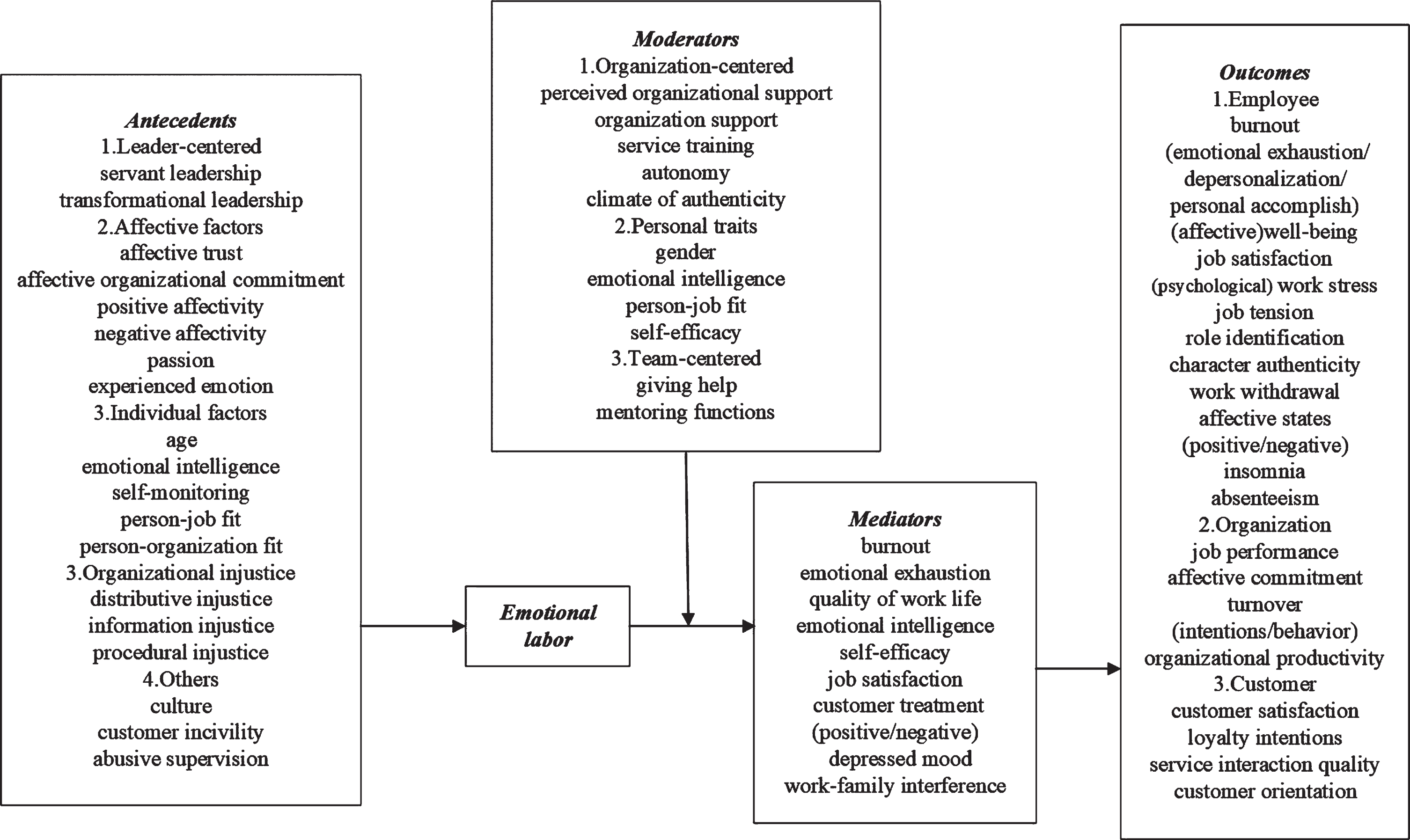
The nomological network of emotional labor research.
The relationships between emotional labor and employee outcomes (e.g., burnout, job satisfaction, well-being, and affective states) are the most examined in the emotional labor nomological network. Furthermore, surface acting is found to be positively associated with burnout [23, 64] (e.g., less personal accomplishment, more depersonalization, and more emotional exhaustion), job tension [20], work withdrawal [65], negative affective states [65] and insomnia [27], as well as absenteeism [66]. Deep acting is positively related to personal accomplishment [64], positive affective states [65], job satisfaction [67], (affective) well-being [68], Additionally, Pugliesi indicated that “both forms of emotional labor had uniformly negative effects on workers” [12] (p. 125). However, most research results indicate that surface acting has more negative effects on individuals than deep acting. Deep acting may bring some positive outcomes to the employees themselves [67, 69] (e.g., job satisfaction, well-being, role identification), or have a nonsignificant relationship with negative influences [67, 70] (e.g., job satisfaction, emotional exhaustion). Because surface acting can lead to unreal feelings and psychological tension, while deep acting can lead to positive experiences and feelings.
Outcomes of organization
Given that emotional labor is an appropriate expression of emotion, it expresses the organizationally desired emotion during interpersonal transactions [10]. Therefore, it is not surprising that emotional labor is found to be positively associated with organizational performance, including organizational productivity and job performance. Research also reveals that surface acting is positively lined with an affective commitment to the organization [71], and turnover intentions [19]. In terms of turnover behaviors, Goodwin et al. [72] had found that surface acting was directly related to employee turnover, and deep acting was not linked to turnover. Chau et al. [19] ’s research results showed that turnover intentions mediated the relationship between deep acting or surface acting and actual turnover. In the same vein, surface acting had indirect effects on turnover behaviors through negative attitudes, including turnover intentions.
Outcomes of customer
How the service provider acts and speaks with the customer has attracted increasing attention. Customers are the main object of emotional labor for service providers. Researching the relationship between emotional labor and customers has also become an indispensable part of emotional labor outcomes. From the customers’ perspective, most empirical studies on outcomes of emotional labor have focused on the relationships between customer satisfaction [58], future loyalty intentions [16], service interaction quality [73], and emotional labor. Deep acting is highly positively related to customer satisfaction, loyalty intentions, service quality, and customer treatment [74]. What cannot be ignored is that customer orientation, as an innovative research achievement, enriches the research content of emotional labor. Lee et al. [5] revealed that deep acting positively affects customer orientation, while surface acting affects customer orientation negatively. However, a close look at the customer orientation literature shows that the research fails to identify causal relationships between emotional labor and customer orientation.
Moderators in emotional labor research
A promising start has been made in unpacking the boundary conditions in which emotional labor processes. At the organizational level, the industry the occupation emotional labor requirements, and employees’ views of the overall culture of the organization (perceived organizational support, autonomy, the climate of authenticity) influence the effectiveness of emotional labor on the service performance of the organization, and employees’ job satisfaction, emotional exhaustion, and well-being. More specifically, autonomy was a significant moderator of the relationships between emotional labor strategies and the personal outcomes of emotional exhaustion, affective well-being, and job satisfaction [68]. Autonomy served to alleviate negative outcomes for individuals who used emotional labor strategies often. Perceived organizational support plays a moderating role in the relationship between emotional labor and job satisfaction, job performance. The negative impact of emotional labor on job satisfaction and job performance was significantly reduced by perceived organizational support [75]. A work unit with a climate of authenticity among one’ s coworkers can buffer against strain from emotional labor [76].
Regarding personal traits, the relationship between organizational injustice and emotional labor was moderated by gender [57]. Females were more likely to experience negative consequences when engaging in surface acting, according to Johnson and Spector [68]. Two previous studies examined the moderator role of emotional intelligence and found that it played an important role in the relationship between surface acting and outcomes such as emotional exhaustion, work-family conflict, work-family enrichment [62, 77]. In turn, Johnson and Spector [68] found that emotional intelligence did not moderate the relationship between emotional labor strategies and personal outcomes. Thus, inconsistent conclusions suggest that future research needs further to explore the role of emotional intelligence as a moderator.
At a team level, team help, and team mentoring functions have been analyzed as moderators in the relationships between emotional labor and outcomes [78, 79]. However, it can be seen that team-related moderators are the least common in the emotional labor literature compared to individual and organizational variables.
In addition, in analyzing a large number of hypotheses that have been published, two patterns emerged. The first, and most common, was that the moderation paths were significant, and the mediation paths were also made sense. These mediators tended to be employee-related variables or customer-related variables such as work-family interference [80], emotional intelligence [81], self-efficacy [82], job satisfaction [83], quality of work-life [84], depressed mood [20], and customer treatment [74]. Second, some mediation paths were not significant (e.g., the mediating effect of burnout was not documented in the relationship between surface behavior and work-family conflict [85]). In sum, we encourage future research to include and report non-significant findings to have a more comprehensive understanding of the influence of emotional labor.
We map the theoretical and nomological network of emotional labor about its antecedents, outcomes, moderators, mediators in Fig. 1 and Table 1.
The empirical research on emotional labor
The empirical research on emotional labor
We further integrated research findings on the relationships between emotional labor and outcome variables in different national contexts, statistically in the form of a meta-analysis. Specifically, we explored the relationship between emotional labor and job satisfaction and emotional exhaustion under the East and West’s diverse cultural backgrounds. Each correlation was corrected for attenuation due to unreliability in predictor and outcome variables. Following corrections, we estimated the sample-weighted mean of these correlations. Both the raw (r) and reliability-corrected (ρ) correlations are presented throughout our analyses. Table 2 demonstrates the relationships between emotional labor constructs. As can be seen, surface acting had a significantly negative relationship with job satisfaction (ρ= –0.305), while deep acting was positively correlated with job satisfaction, but not significantly (ρ= –0.078). Surface acting had a significantly positive relationship with emotional exhaustion (ρ= 0.251), and deep acting was positively correlated with emotional exhaustion, but not significantly (ρ= 0.025).
Relationships among emotional labor and job satisfaction and emotional exhaustion
Relationships among emotional labor and job satisfaction and emotional exhaustion
Note: SA = surface acting; JS = job satisfaction; DA = deep acting; EE = emotional exhaustion.
In addition, the random-effect model is used to estimate the effects of eastern and Western countries. Then, the fixed-effect model’s two groups of literature were tested to calculate the significance of the Q value. If the Q value is significant, the difference between groups is significant. The results are shown in Tables 3, 4, 5, and 6. In the random-effect model, the relationship between surface acting and job satisfaction in the Eastern countries and the relationship between surface acting and job satisfaction in the Western countries are negative, respectively (ρ= –0.315; ρ= –0.253). In the random-effect model, the relationship between deep acting and job satisfaction in the Eastern countries and the relationship between deep acting and job satisfaction in the Western countries are negative, respectively (ρ= 0.329; ρ= –0.057). In the fixed-effect model, there is no significant difference between surface acting and job satisfaction in Eastern and Western countries (Q = 2.53, p > 0.05). In the fixed-effect model, there is significant difference between deep acting and job satisfaction in Eastern and Western countries (Q = 48.82, p < 0.01). In the random-effect model, the relationship between surface acting and emotional exhaustion in the Eastern countries and the relationship between surface acting and emotional exhaustion in the Western countries are negative, respectively (ρ= 0.236; ρ= –0.256). In the random-effect model, the relationship between deep acting and emotional exhaustion in the Eastern countries and the relationship between deep acting and emotional exhaustion in the Western countries are negative, respectively (ρ= –0.121; ρ= 0.103). In the fixed-effect model, there is significant difference between surface acting and emotional exhaustion in Eastern and Western countries (Q = 163.70, p < 0.01). In the fixed-effect model, there is significant difference between deep acting and emotional exhaustion in Eastern and Western countries (Q = 29.26, p < 0.01).
Random-effect models of emotional labor and job satisfaction
Fixed-effect models of emotional labor and job satisfaction
Random-effect models of emotional labor and emotional exhaustion
Fixed-effect models of emotional labor and emotional exhaustion
To date, there are nine literature reviews of emotional labor, and they have provided important insights into the literature. Three of these are meta-analyses on the limited predictors and outcomes of emotional labor. More specifically, Bono and Vey [70] reviewed the effects of emotional labor on employee workplace attitudes and behaviors as correlates (emotional exhaustion, depersonalization, personal accomplishment, physical complaints, role internalization, self-esteem, and job satisfaction). Hülsheger and Schewe [86] provided a quantitative review of the link of emotional labor (emotion–rule dissonance, surface acting, and deep acting) with well-being and performance outcomes. Mesmer-Magnus et al. [87] understood various aspects of emotional labor through the underlying discordance versus congruence in felt versus displayed emotions and demonstrated that discordant emotional labor states are associated with a range of harmful consequences (health-, attitudinal-, and performance-related) by meta-analytic results.
The other six literature reviews focused predominantly on specific topics in emotional labor research. Grandey [88] reviewed and compared previous perspectives of emotional labor, to provide a definition of emotional labor that integrates these perspectives to discuss emotion regulation as a guiding theory for understanding the mechanisms of emotional labor. Wharton [89] only reviewed theory and research on emotional labor with a particular focus on its contributions to sociological understandings of workers and jobs, which failed to provide enriching insights and guidance from the perspective of multi-disciplinary. Grandey [90] reviewed emotional labor’s (a) construct development and measurement, (b) chronic and momentary determinants, (c) prediction of employee well-being, and (d) influence on organizational performance. They also introduced emotional labor as a dynamic integration of three components (i.e., emotional requirements, emotion regulation, and emotion performance). Jeung et al. [91]’s literature review was conducted to investigate the association between emotional labor and burnout and explore the role of personality in this relationship. Ye and Chen [92] reviewed the literature of Chinese and foreign teachers’ emotional labor research. Humphrey et al. [69] reviewed the bright side of emotional labor.
While contributing to the development of emotional labor, findings of these nine-literature reviews also leave notable research gaps. First, there is a call for an updated literature review as some important variables have not been captured in the extant review. New correlates of emotional labor have been investigated (e.g., specific leader behaviors [93]). There are also outcome variables that have received increasing scholarly attention but were not included in the previous literature review. For example, emotional labor plays an important role in influencing customers’ attitudes and behaviors (e.g., customer satisfaction [94]). Conduct an updated literature review aiming to investigate comprehensive predictors, mediators, moderators, and outcomes of emotional labor, thus helping extend the nomological network of emotional labor research. Second, we also reviewed three important aspects of emotional labor (1) the definition of emotional labor (2) the measurement of emotional labor (3) cross-cultural differences in emotional labor, which provides a clearer understanding of the nature of emotional labor.
Obviously, we are pleased with the attention and progress devoted to the study of emotional labor. Both empirical and theoretical richness is added to the broader academic conversation about emotional labor, whereas emotional labor appears to have increased our understanding of emotions in the workplace, especially in the service interaction [2, 95]. Many empirical and theoretical issues restrain our enthusiasm or cause us to reconsider the contributions to date. Of primary concern are the following areas that require more work.
Advances in research design and analysis for future research
The overreliance on self-reports and single-time studies in the emotional labor field raises severe warnings about the implications of these findings, especially since none of these studies address endogeneity and common method bias in their design. It is not unique to emotional labor, and there have been some efforts to improve survey design in the emotional area. We recommend some methods to strengthen survey designs in emotional labor research to match the research method with the research problem.
Multi-source, multi-wave studies
During the design phase, the researchers should collect data from multiple time points to reduce common method deviations from multiple sources. In addition, it is generally admitted that causes precede their effects in time. It usually justifies the preference for longitudinal studies over cross-sectional ones. Because causal inference requires following the same individuals over time, and no causal inference can be drawn from cross-sectional data. That is, longitudinal data are required for testing causal conclusions, especially needed in emotional labor research. As the relationship between the frontline employees and the customers matures over time, we would expect to see the dynamic change of emotional labor and the corresponding change of its outcomes. Such a design also would help isolate customers’ and leaders’ characteristics and behaviors that influence employees’ emotional labor from the influence of emotional labor on customers and leaders [96]. If emotional labor and customers’ behavior or leaders’ behavior are assessed at three or more periods, latent change analysis to capture reciprocal spiraling effects would also be possible. Further, this would allow the researcher to test for reverse causation, which has yet to be established in emotional labor.
Experience sampling methodology
Researchers have sought to implement longitudinal designs through experience sampling methodology (ESM), which allows researchers to repeatedly sample individuals’ immediate experiences in their natural environment. Researchers typically employ ESM to survey participants regularly (i.e., every few hours up to daily) across 1 to 2 weeks and even four weeks [97]. Using ESM, researchers can avoid common methodological biases associated with cross-sectional survey design and memory biases, in which individuals must recall specific behaviors [97] or events. While this method has been used for research on the emotion field, it is just beginning to be utilized in emotional research. In addition, data collection tools are becoming more diverse and convenient. For example, Gabriel and Diefendorff [17] utilized a call center simulation to examine how customer incivility changes impacted on continuous measures (captured every 200 milliseconds) of participants felt emotions, surface acting, deep acting. They collected continuous ratings of via a program in EPrime 2.0 Professional that enabled us to playback recordings of the calls and have participants provide continuous ratings of how they felt, how much they surface acted, and how much they deep acted.
Including competing variables
Researchers should consider including as many competing variables within their research design to demonstrate the accrue effects of emotional labor. Through this method, we attempt to capture the true effects of emotional labor. If we introduce multiple mediation variables, we can accurately capture the effects of different mechanisms and compare their effects in the relationships between emotional labor and outcomes. In addition, researchers need to deal with the potential that emotional labor is an endogenous independent variable within their designs. As endogeneity is not dealt with across the vast majority of emotional labor studies, we wondered if emotional labor truly predicts y (outcomes), as there could be an infinite amount of potential causes of Y, which have not been modeled. Including an instrumental variable helps purge emotional labor models of endogeneity bias, which could not depend on other variables. The instrumental variables should satisfy the following criteria: a) strongly predicts emotional labor (assuming emotional labor is the independent variable) is unrelated to the outcome variables measured in the study. Some potential example instrumental variables could include individuals’ personalities, positive emotions, and negative emotions.
Experimental designs
A randomized experimental approach with manipulations also would be useful to test assumptions and contribute to findings of causal relationships among constructs. The use of experimental designs is gaining attention in management research. Scenarios can induce a participant’s vivid interpretation of a problem situation in a real-time setting. They allow participants to make decisions that closely reflect their actual intentions and reactions in realistic situations. The context maintains flexibility as scenarios are based on simple language understood by participants. Scenario-based designs are participant-centered and allow participants to reflect on alternatives in the real-world. The use of scenarios has the advantages of reducing recall biases, controlling the impact of irrelevant variables, and ensuring higher internal reliability. More specifically, experimental designs have made recent strides in the study of employees’ emotional labor. Mahoney [98] used a scenario-based experiment to examine relationships between positive display rules, personality, emotional labor, and performance.
Theoretical advances in future research
The bright side of emotional labor
Lots of researchers have documented how faking emotions in the name of customer service is bad for employees. We acknowledge that emotional labor often has negative effects on employees’ well-being, job satisfaction [99], and performance and has positive effects on their burnout, emotional exhaustion [100], and stressor. However, more and more evidence is emerging and pointing out that emotional labor can benefit some conditions. For instance, Hülsheger and Schewe [86] concluded that emotional labor in the form of deep acting improves performance without causing a reduction in well-being. Wang et al. [101] found that deep acting had a positive relationship with job satisfaction. Kammeyer-Mueller et al. [67] used a meta-analytic structural model and demonstrated that deep acting was unrelated to stress/emotional exhaustion and positively related to job satisfaction and job performance. Humphrey et al. [69] suggested a significant upside to the role of identity in emotional labor. Surface and, especially, deep acting are often used to uphold and reinforce a valued identity, thereby facilitating the sense that one is actually being true to oneself. Much more research still needs to be carried out about the negative effects of emotional labor. For example, researchers can focus on natural and genuine emotional labor. More research needs to be accomplished on the genesis and dynamics of this more positive form of emotional labor, and include it in their studies of emotional labor, rather than limited to surface acting and deep acting. The important role of identities and identification in the emotional labor process should be further in an ongoing manner. In addition, some scholars have indicated that in all seemingly monotonic positive or negative relations, there may exist context-specific inflection points that provide clues that previous research has failed to investigate the nature of emotional labor comprehensively. For example, Goodwin et al. [72] indicated that deep acting was not linked to the outcome of turnover. However, a result showed that turnover intentions mediated the relationship between deep acting and actual turnover, according to Chau et al. [19]’s research. Faced with inconsistent conclusions in previous literature, non-linear relationship and more various relationships between emotional labor and its antecedents or consequences may exist.
The dynamic of emotional labor
Although much has been learned about the relations among emotional labor variables (see meta-analyses by Hülsheger and Schewe [86]; Kammeyer-Mueller et al. [67]; Mesmer-Magnus et al. [87]), most research focused on broader, trait-level conceptualizations of the constructs (that is, “in general” levels of emotion regulation, dispositional affect, and emotional performance: Brotheridge and Grandey [64], Brotheridge and Lee [102], Grandey [38]). Recently, research has considered the relationships among emotional labor constructs over briefer periods. For example, Wagner et al. [27] explored drivers’ emotional labor during work shifts. The extant cross-sectional and longitudinal research studies demonstrate that individuals differ from one another in their average levels of emotional labor, but also that a given individual may differ in his or her specific level of emotional labor at any given point in time. At an even more finely grained level of analysis, capturing and describing dynamic processes of emotional labor is necessary. Some related questions remain unanswered. How does emotional labor change over time? How employees use different emotional labor tactics over time? More careful consideration of temporal issues is needed in emotional labor theory and research. Gabriel and Diefendorff [17] are the first to provide empirical evidence of moment-to-moment, within-episode changes in emotional labor variables, capturing the ebb and flow of felt emotions, emotion regulation, and vocal tone during a customer service interaction.
The multilevel of emotional labor
Recent advances in emotional labor research have spanned all levels of organizational analysis. However, the discussion of emotional labor at group-level questions needs a step further development. The issue of whether emotional labor can be generalized to the group itself remains an open question. In other words, for team members who are better at emotional labor, is it possible to translate this emotional labor into higher team performance and efficiency. We should turn our attention toward understanding collective emotional labor. Also, the general organizational literature, except for a few [103], has not paid sufficient attention to emotional labor and its organizational implications. A few studies have viewed emotional labor as an individual stressor and speculated that the organization-level emotional labor pattern might negatively affect firms’ productivity and performance based on individual-level findings and theories. However, the conceptual and empirical patterns identified at one level may not automatically apply to another level (cf. multilevel homology versus heterogeneity). Further research should extend the research on individual emotional labor to the team level and organization level by conceptualizing it as the injunctive social norm (i.e., team emotional labor, and firm emotional labor).
The spillover and crossover of emotional labor
The workplace is not an island in employees’ lives: attitudes, stress, emotions, and behaviors spillover between work and family domains [104]. For instance, Yanchus et al. [77] examined emotional labor also in the family domain, arguing that there are also expected behaviors in the family, which may create another form of emotional labor. However, despite the growing interest in analyzing emotional labor at work, only a few studies have examined emotional labor at home. Moreover, there is a lack of research on how the work environment affects those with whom employees interact outside the work domain, such as their partners and their family [105]. Spillover refers to a process in which “reactions experienced in the work domain are transferred to and interfere with the non-work domain” [106] (p. 267). Crossover refers to a process in which job emotions, attitudes, and even behaviors are transmitted from job incumbents to other people, which occurs within a particular domain [107]. Sanz-Vergel et al. [108] are the first to investigate the spillover and crossover of emotional labor. However, research on the spillover and crossover of emotional labor is far from enough. How does emotional labor at work spill over into the home domain over time? How does emotional labor in the family spread to the organization over time? Moreover, the emotional contagion process [109] may explain the crossover of emotional labor. If an employee’s partner engages in surface acting at home, it is more likely that she/he performs this type of emotional labor as a negative reaction to the lack of authenticity or an automatic imitation. In further, more theoretical perspectives should be incorporated to provide a complete picture of the spillover and crossover of emotional labor.
Conclusion
In response to this increased interest in emotional labor, and the proliferation of studies, our objectives for this paper were five-fold. First, we reviewed how emotional labor was understood in different perspectives and cultures. Second, we presented a whole of the measures used in emotional labor research. Third, we mapped the nomological network of emotional labor research, offering scholars an overview of what has been studied thus far. Fourth, we provided a meta-analysis of emotional labor in different national context. Finally, we detailed a research agenda explicitly targeted to improve how the field studies emotional labor. The review has demonstrated that the emotional labor field has made progress in the last 40 years; however, emotional labor still has its gaps. We hope by heeding the advice offered in this review to resolve these problems, the emotional labor research can continue to offer significant insights to further research.
Footnotes
Acknowledgments
The authors are grateful for the financial support from the National Natural Science Foundation of China (71572170).
Author contributions
Conception: Chunjiang Yang
Interpretation or analysis of data: Chunjiang Yang and Aobo Chen
Preparation the manuscript: Chunjiang Yang
Revision of important intelectual contents: Chunjiang Yang and Aobo Chen
Supervision: Chunjiang Yang
