In [1] Karanwal et al. introduced the novel color descriptor in Face Recognition (FR) called as Fused Local Color Pattern (FLCP). In FLCP, the RGB color format is utilized for extracting features. From R, G and B channels, the MRELBP-NI, 6 6 MB-LBP and RD-LBP are imposed for feature extraction and then all are integrated to form the FLCP size. FLCP beats the accuracy of various methods. The one major shortcoming observed in [1] is that the basic format RGB is used for extracting features. Literature suggests that other hybrid formats achieves better recognition rates than RGB. Motivated from literature, the proposed work uses the hybrid color space format RCrQ for feature extraction. In this format R channel is taken from RGB, Cr channel is taken from YCbCr and Q channel is taken from YIQ. On R channel, MRELBP-NI is imposed for extracting features, On Cr channel 6 6 MB-LBP is imposed and on Q channel RD-LBP is imposed for extracting features. Then all channel features are joined to build the robust and discriminant feature called as Robust And Discriminant Local Color Pattern (RADLCP). Compression and matching is assisted from PCA and SVMs. For evaluating results GT face dataset is used. Results proves the potency of RADLCP in contrast to gray scale based implemented descriptors. RADLCP also beats the results of FLCP. Several literature techniques are also outclassed by RADLCP. For evaluating all the results MATLAB R2021a is used.
The prominence of local descriptors is justified by results achieved by them in different applications. The accuracy and computational complexity of these local descriptors are quite remarkable. Some of these applications in which these descriptors are tested and evaluated are Face Recognition (FR), Object Recognition (OR), Palmprint Recognition (PR), Texture Analysis (TA), Scene Matching (SM) and Ear Recognition (ER). Apart from these the local descriptors has also proven its ability in the multimodal biometric systems. In multimodal biometric systems two or more biometric traits are used for building the feature size. The local descriptors forms their feature size by extracting and joining the features from different image portions. These image portions are ear, eyes, nose, mouth and forehead. Most of the local approaches builds their methodology by deploying the small patches on the pixels regions. This makes local descriptors much effective and efficient than the global approaches, where they operates on the entire image for the feature extraction. Although the task of feature reduction is well performed from the global descriptors. In unconstrained conditions the local descriptors performs better than the global descriptors. The hybrid one is better than either of two. The unconstrained conditions are caused by the various image transformations and these are light, emotion, pose, blur, noise, corruption and occlusion. One of the successful local descriptor exists in literature is Local Binary Pattern (LBP) [2]. LBP was originally invented for TA and then it is used successfully in other applications also. LBP is the first descriptor which works on the gray pixels by using the small 3 3 patch. This methodology proves very effective and achieves impressive results. In LBP, the neighbors are transformed to 1 by comparing the neighbors with center pixel else 0 is given as the label. By putting weights and adding values builds the LBP image from which the histogram size is derived. LBP possesses various advantages and these are invariance monotonic property and less complex algorithm. After LBP emergence, various disadvantages are also observed by the researchers and these are limited spatial patch, large size generation after the feature extraction, noisy function (thresholding) and ineffective in worse lightning changes.
This results in various LBP variants and these LBP variants beats the performance of LBP and many others. Description of some of the LBP variants are defined as: Shakoor et al. developed the feature selection and mapping of LBP to resolve feature size problem. Precisely by proposing mapping methods the feature reduction is done and then these features are mapped into the histogram. All developed methods are light & rotation invariant. Furthermore the discriminant features are selected by using the method called as constrained method. On various datasets the proposed methods proves its potency [3]. Karanwal et al. proposed the Triangle LBP (TLBP) and Orthogonal LBP (OLBP) for two different challenges i.e. pose and expression variations. TLBP feature extraction is done in the vertical and horizontal directions by utilizing 5 3 and 3 5 image patches by triangle rotation in 180∘ and 0∘ degree directions. For extracting OLBP features the orthogonal locations are used. To build a discriminant feature size both features are merged and called as TAO-LBP. On five datasets TAO-LBP justify it’s potent [4].
In passing years, the deep learning methods has attracted the lot of attention in FR application. The robustness and discriminativity achieved by them (in unconstrained conditions) is the prime reason behind this. On most cases, the deep learning methods proves better than the local and global methods. The influential structure and concept makes this possible. Some of the popular deep learning methods used successfully in literature are AlexNet, CNN, VGG and LetNet. CNN build its size by using the final layers (completely connected) of pre-trained CNN models. The other layers activation function can also be used for extracting the features. These are softmax function and classification layers. There are several demerits observed in the deep learning methods and these are: their computational cost is on the larger side, training data requirement in huge amount and difficulty in adapting the parameter settings. These factors cannot allow to impose the deep learning framework in the proposed work. Besides these there are some local descriptors which proven out better than these deep learning methods in the unconstrained conditions, in terms of accuracy and computational cost. This allows to develop the novel local descriptor in different unconstrained conditions. Literature also suggests the incorporation of local descriptors with deep learning methods. The results of such methods are quite astonishing.
In recent times, the color based local descriptors has gathered significant attention in FR. The color based descriptors outperforms comprehensively the gray scale based descriptors and also the other ones. There are different ways in which the color based feature descriptors are created. Some uses the traditional color formats for feature extraction like RGB, YCbCr, YIQ, Lab etc. Others make the hybrid combination from the different color formats for feature extraction. All these work attain good results with respect to the challenge they were implemented. The main objective is to find the discriminant and the robust hybrid format for the feature extraction. In proposed work the robust and discriminant hybrid format is created and then used for feature extraction. The extraction of features are done by three well known descriptors and then steps of compression and matching are done. The major contributions of the invented work are given in the next paragraph.
In [1] Karanwal et al. introduced the novel color descriptor in Face Recognition (FR) called as Fused Local Color Pattern (FLCP). In FLCP, the RGB color format is utilized for extracting features. From R, G and B channels, the MRELBP-NI [5], 6 6 MB-LBP [6] and RD-LBP [7] are imposed for feature extraction and then all are integrated to form the FLCP size. FLCP beats the accuracy of various methods. The one major shortcoming observed in [1] is that the basic format RGB is used for extracting features. Literature suggests that other hybrid format achieves better recognition rates than RGB. Motivated from literature, the proposed work uses the hybrid color space format RCrQ for feature extraction. In this format R channel is taken from RGB, Cr channel is taken from YCbCr and Q channel is taken from YIQ. On R channel, MRELBP-NI is imposed for extracting features, On Cr channel 6 6 MB-LBP is imposed and on Q channel RD-LBP is imposed for extracting features. Then all channel features are joined to build the robust and discriminant feature called as Robust And Discriminant Local Color Pattern (RADLCP). Compression and matching is assisted from PCA [8] and SVMs [9]. For evaluating results GT [10] face dataset is used. Results proves the potency of the RADLCP in contrast to the gray scale based implemented descriptors. RADLCP also beats the results of FLCP. Several literature techniques are also outclassed by RADLCP. For evaluating all the results MATLAB R2021a is used.
Road map: Some of the related works are discussed in Section 2, description of all descriptors are defined in Section 3, results are evaluated and posted in Section 4, discussions are given in Section 5 with conclusions and future directions in Section 6.
Related works
Khanna et al. proposed novel method for Expression Recognition (ER), by using LBP and STFT techniques. For acquiring local set of features LBP is used and for acquiring frequency set of features the STFT is used. The amalgamated features of LBP and STFT is made compacted by FDR, chi square test and variance threshold. For matching those features the SVMs is used. Results conducted on various datasets proves the capability of merged feature [11]. Latha et al. imposed the new color descriptor MCLBP for Image Retrieval (IR). For strengthing the CBIR system, the HSV color format statistical features are generated by using standard deviation and mean for developing the feature size. By using MLCP and HSV color format there is immense improvement in the recognition accuracy. On various benchmark datasets the invented method proves its potent by defeating the accuracy of various others [12]. Shakoor et al. developed the feature selection and mapping of LBP to resolve feature size problem. Precisely by proposing mapping methods the feature reduction is done and then these features are mapped into the histogram. All developed methods are light & rotation invariant. Furthermore the discriminant features are selected by using the method called as constrained method. On various datasets the proposed methods proves its potency [3]. Karanwal et al. [4] proposed the Triangle LBP (TLBP) and Orthogonal LBP (OLBP) for two different challenges i.e. pose and expression variations. TLBP feature extraction is done in the vertical and horizontal directions by utilizing 5 3 and 3 5 image patches by triangle rotation in 180∘ and 0∘ degree directions. For extracting OLBP features the orthogonal locations are used. To build a discriminant feature size both features are merged and called as TAO-LBP. On five datasets TAO-LBP justify it’s potent. Luo et al. developed the novel method Improved LBP (ILBP) to overcome the shortcomings of LBP. In ILBP, the descriptor is developed with 2 operators and these are LBP based on ranking magnitude and segmentation operator of the global threshold. In contrast to other methods the ILBP much finer than others [13]. Karanwal et al. presented the ILBP for FR. ILBP is proposed to complement the LBP, as LBP doesn’t build the balanced transformed image for feature extraction. ILBP considered two major steps and these are (i) mean statistic is utilized for the neighbor’s comparison and (ii) negative threshold is used for comparison. As a results the transformed image generates much finer histogram feature than LBP and various others. ORL and GT are the two datasets utilized for the evaluation purpose [14]. Wajih et al. introduced novel method Center Symmetric LBCNN (CS-LBCNN) for recognition of handwritten bilingual digit. CS-LBCNN addresses the issue of LBCNN. Additionally the improved version of CS-LBPCNN is also produced to resolves the issue of 0 thresholding function. This improved version is called as TCS-LBPCNN. The developed methods are compared to the various other methods to check its efficacy. The developed methods proves better than the various existing LBCNN models [15]. Karanwal et al. introduced two variants of LBP in FR called as ND-LBP and NM-LBP. In former descriptor neighbor pixels are compared lined up in the direction clockwise, for building its feature size. In latter one, the comparison is done among neighbors and mean to build its feature size. Further the features of ND-LBP and NM-LBP are merged to build the discriminant face descriptor called as ND-LBP+NM-LBP. For compaction and matching PCA and SVMs are used. Results done on ORL and GT datasets shows that the fused descriptor conquer the accuracy of individual descriptors and various methods from literature [16].
Wei et al. presented the novel IR method by integrating the deep and texture features. Initially HOG features are generated based on LBP by utilizing full directional derivative (IInd order), in which more gradient details are extracted through emotion simplification method of derivative (full directional). Then quaternion emotion technique is proposed for color image and Hu moments are generated, which is the color image representation by merging the color and texture details. Ultimately the deep features are derived from the enhanced VGG. The all above defined features are joined for retrieval operation. On there datasets, the invented method justifies its ability [17]. Vu et al. proposed the FR which is mask based, by merging the CNN and LBP. First, the RetinaFace (CNN technique) is used as the efficient and fast encoder, which learns jointly the extra-supervised and self-supervised features from multiple scales. Furthermore, LBP features derived from nose, eyebrows, forehead and eyes are joined with the earlier extracted features from RetinaFace. Results conducted on various datasets confirms the capability of the developed method, which beats the accuracy of the various techniques [18]. Sajwan et al. discovered the novel color IR method by using Diagonal LBP (DLBP) and the new distance metric. In DLBP, the diagonal LBP features are extracted and the color format used is L*a*b*. On Wang-1k dataset, the DLBP justifies its capability be defeating various other methods [19]. Ganguly et al. [20] developed the Copy Move Forgery Detection (CMFD) method by using LTrP. First the image is decomposed in different blocks and then LTrP features are extracted from every block. All are integrated to form single vector. Then lexicographic sorting is performed for the features generated from the blocks and same blocks are recognized by feature matching from neighbor blocks. The falsely matched blocks are eliminated by utilizing the outlier removal concept called as Shift Vector Aided (SVA). Results on two datasets shows that the invented methods procures better accuracy than the compared ones. Lu et al. presented the color based LBP feature for FR called as TCLBP. In persisting techniques, the inter-channel details are encoded on color channel pairs by deploying the similar spatial structure as used in the encoding of intra channel. As a result the high dimensional size is created and it is not effective in encoding the details of inter channel. Furthermore the pixel difference values along color components are not proper measure if they are numerically not comparable. In TCLBP, the inter-channel details are encoded more efficiently and effectively. On four datasets the TCLBP justify its ability by defeating various others [21].
Karanwal et al. imposed the three LBP variants in FR called as MLBP, MnLBP and CLP. MLBP form its code by comparing the neighbors with the whole patch mean. MnLBP form its code by comparing the neighbors with whole patch median. Both mean and median achieves better results than the LBP, in which center pixel is used for comparison. Further, to make the more informative and effective face descriptor, the features of LBP, MLBP and MnLBP are merged in one framework called as CLP. CLP beats the results of alone descriptors and it also conquers several literature methods. PCA and SVMs are utilized for the compaction and matching. The datasets used for evaluation are ORL and GT [22]. Karanwal et al. presented the MB-ZZLBP in FR. In first step, the mean computation is done from different regions (2 2) of 6 6 patch. Then zigzag oriented pixels are collated with each other. Specifically, the differentiation is conducted among the higher & lower order pixels (higher-lower). For difference value higher or similar to 0, the 1 is given as the label else 0 is given. Then by putting weights, the MB-ZZLBP code is formed. Results on various datasets proves the capability of the MB-ZZLBP [23]. Chaudhari et al. proposed the method for classification of banana disease by utilizing LBP and GLCM. LBP acquire local features therefore it generates good performance. GLCM is utilized for making the size of feature. Results proves the invented method is better than others [24]. Karanwal et al. introduced the BILBD descriptor for FR, by utilizing the services from three descriptors. These three are MRELBP-NI, RD-LBP and LPQ. In MRELBP-NI, the micro and macro essential are captured effectively therefore it is discriminant than the other descriptors. RD-LBP acquire the radial details, through the pixel difference between higher and lower scales. LPQ acquire the frequency domain details by using STFT in each neighborhood patch. All these three are effective methods therefore there features are merged into one framework. The merged one is called as BILBD. Results on 3 datasets justify its potent by defeating the various methods [25]. Arican et al. presented RGB-D descriptor for OR. In RGB-D, the extraction of features is accomplished by using Bag of Words (BoW), which is novel and efficient technique persisting in literature. This technique develops far better accuracy than the original. The RGB-D results are very encouraging [26]. Shu et al. developed the novel color descriptor MCLBP for TA. To reflect the dependency and correlation between different channels, the MCLBP joins the texture properties of single channel with multi-channel color details. Further, the color differences are decomposed into signs and magnitude of color difference which extends MCLBP to MCLBP+M. Finally the ultimate feature size is produced by joining the sign and magnitude features of color difference. On five datasets the descriptors proves its capability by defeating the various others [27].
Discussion of the supplemental descriptors
MRELBP-NI
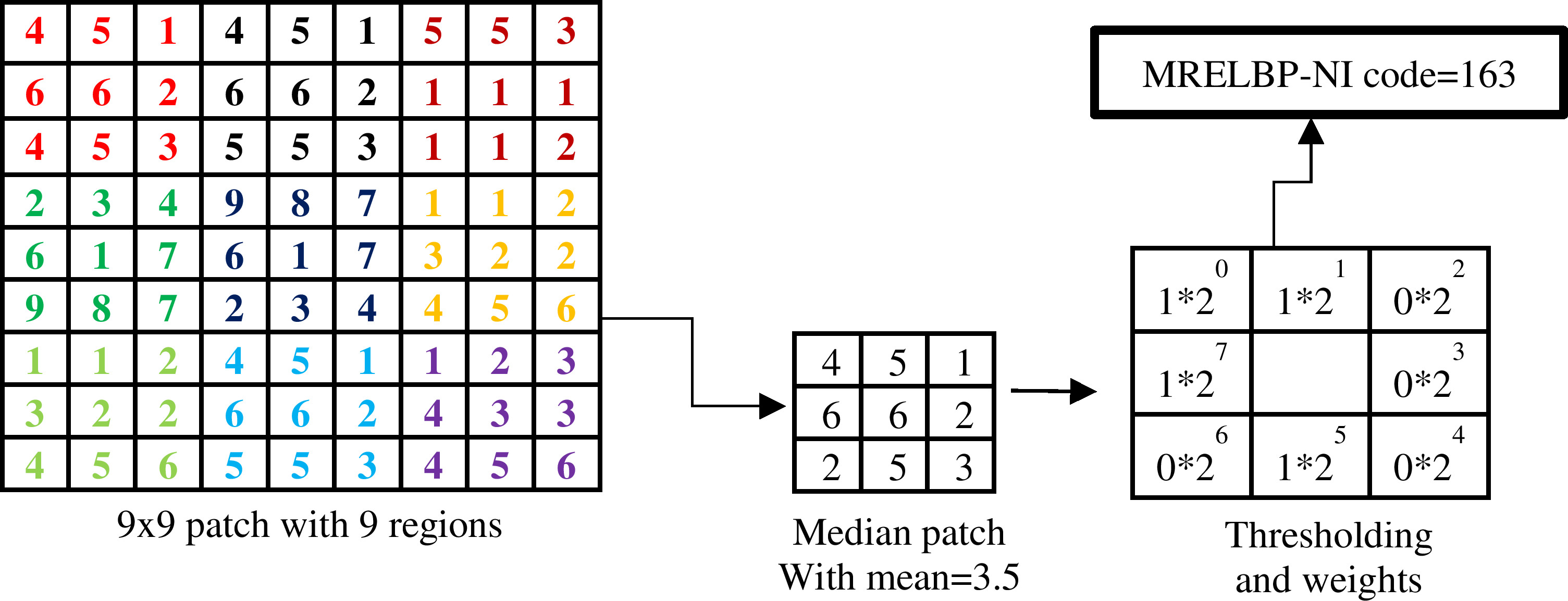
This descriptor [5] is very impressive in unconstrained conditions as macrostructure and microstructure essentials are acquired. The higher and lower scale features, both are used for the making of the MRELBP-NI feature size. By taking 9 9 patch, the median values are generated in the 9 regions. After generating medians, 3 3 patch evolves. Then neighborhood medians are thresholded to 1 for median values higher or similar to mean of those else 0 is granted. The 8 bit size pattern evolves and that is transformed to decimal code by binomial weights allocation. The decimal code generation for every location generates map image and that results in size of 256. In Eq. (1), the MRELBP-NI code generation procedure is shown for single location and Eq. (2) generates mean value. The variables The variables , , and signifies the size of neighbor, radius, median filter and mean. Figure 1 shows the MRELBP-NI example.
MRELBP-NI example.
6 6 MB-LBP
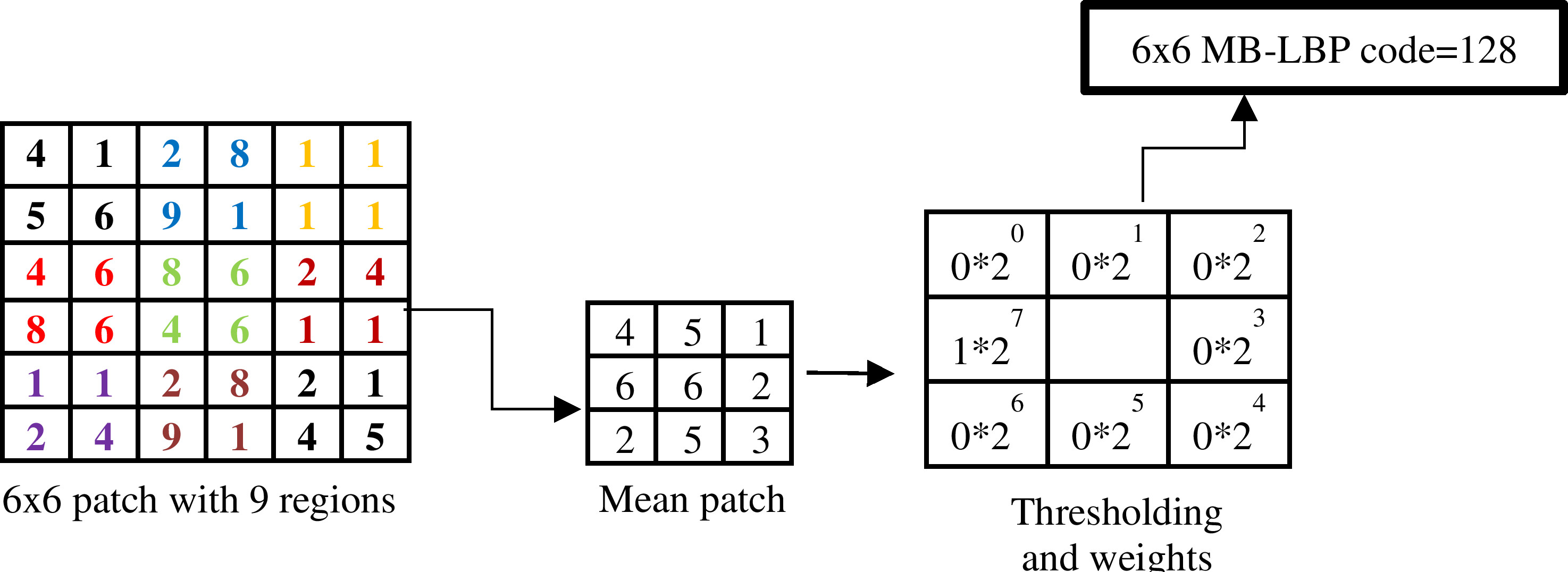
This descriptor [6] is very impressive in unconstrained conditions as macrostructure and microstructure essentials are acquired. MB-LBP utilizes different scales of filters to form its size. In this work the scale size utilized is 6 6. In 6 6 MB-LBP, there are 9 regions and each region size is 2 2. Initially, mean is generated in all locations of 9 9 patch. This forms the 3 3 mean patch. Then neighbors are thresholded to 1 for mean values larger or same to the center else 0 is granted. The 8 bit size pattern evolves and that is transformed to decimal code by binomial weights allocation. The decimal code generation for every location generates map image and that results in size of 256. In Eq. (3), the mean generation procedure is displayed and Eq. (4) generates the 6 6 MB-LBP code for single location. The variables and in Eq. (3) specifies the region size and mean. The variables , , and signifies the size of neighbor, radius, sole places of pixels and center pixel. Figure 2 shows the 6 6 MB-LBP example.
6 6 MB-LBP example.
RD-LBP
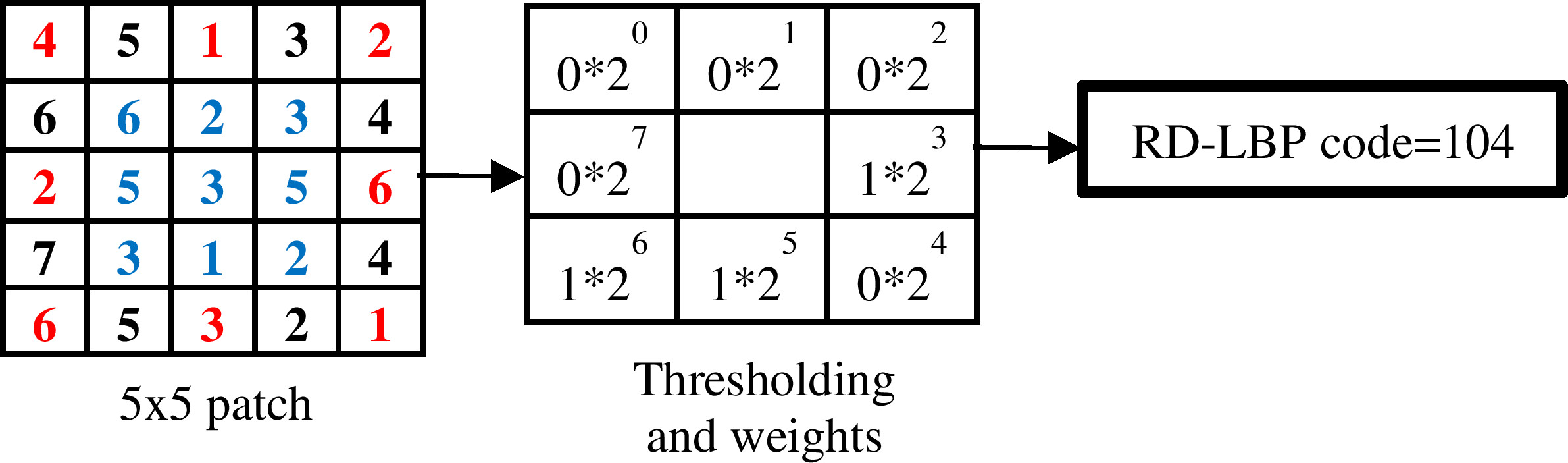
In RD-LBP [7], neighborhoods difference (among two radial pixels, by differentiating the lower scale from the higher scale) is thresholded to 1 for value larger or same to 0 else 0 is given. The 8 bit size pattern evolves and that is transformed to decimal code by binomial weights allocation. The decimal code generation for every location generates map image and that results in size of 256. In Eq. (5), the RD-LBP code generation procedure is shown for single location. The variables , , , and signifies the size of neighbor, radius ( and ), pixels placed at scale and pixels placed at scale . Figure 3 shows RD-LBP example.
RG-LBP example.
Fused Local Color Pattern (FLCP)
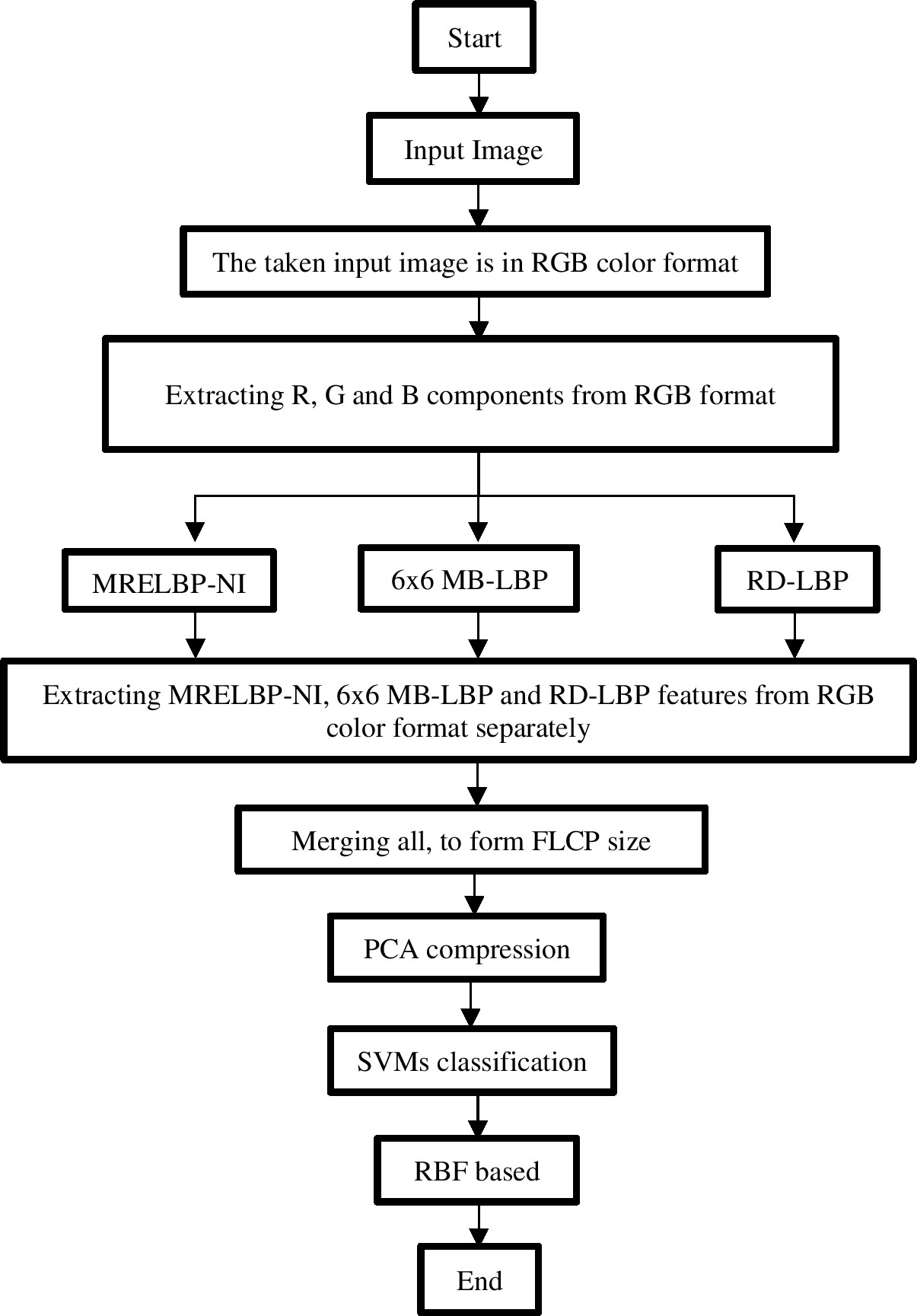
In [1], Karanwal et al. developed the color descriptor so-called FLCP. In literature plenty full of color descriptors has been suggested and implemented therefore the idea which was explored in [1] was motivated from the literature. In FLCP, the RGB color format is used for evaluation. Precisely from R component, MRELBP-NI is imposed for extracting features. From G component 6 6 MB-LBP is imposed and from B component the RD-LBP is imposed for extracting features.
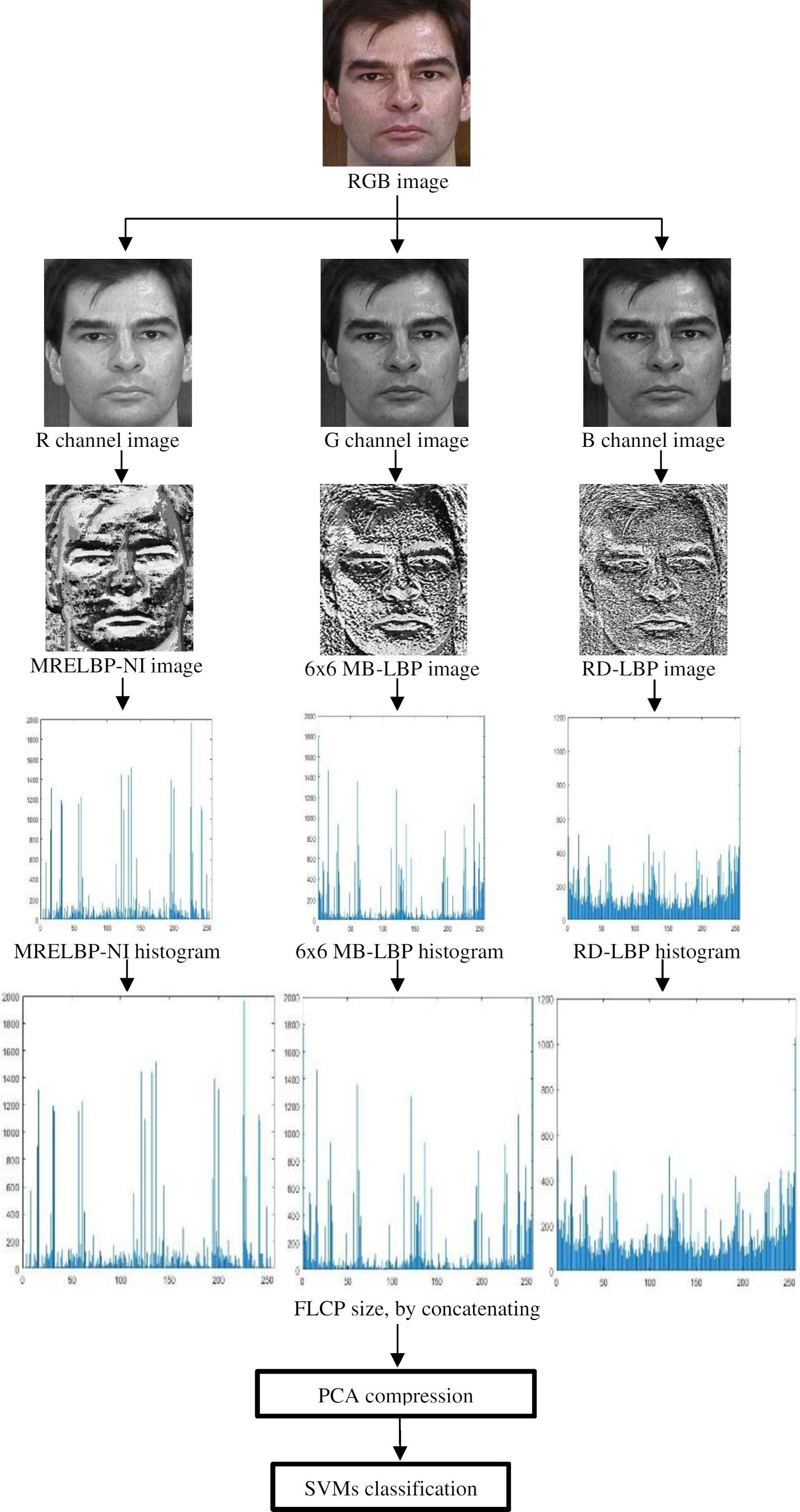
Ultimately all extracted features from the RGB channel are merged into one framework called as FLCP. Each one have the size of 256. Therefore FLCP builds the size of 768. Compression and classification steps is assisted from PCA and SVMs. FLCP proves it’s potent by defeating the accuracy of various methods. Figure 4 communicates the color FR framework developed in [1]. Figure 5 shows the flowchart of the work invented in [1].
Robust And Discriminant Local Color Pattern (RADLCP)
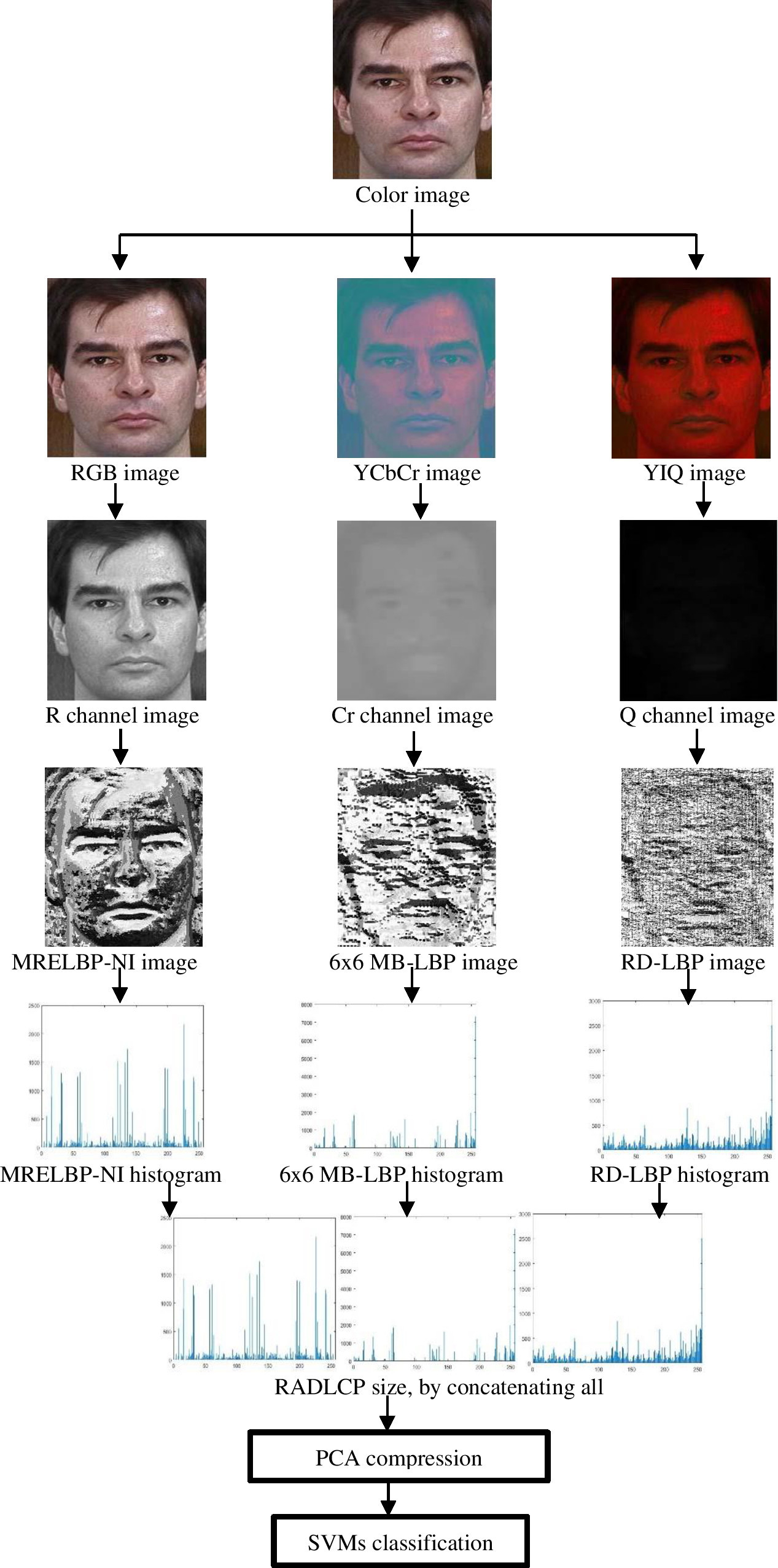
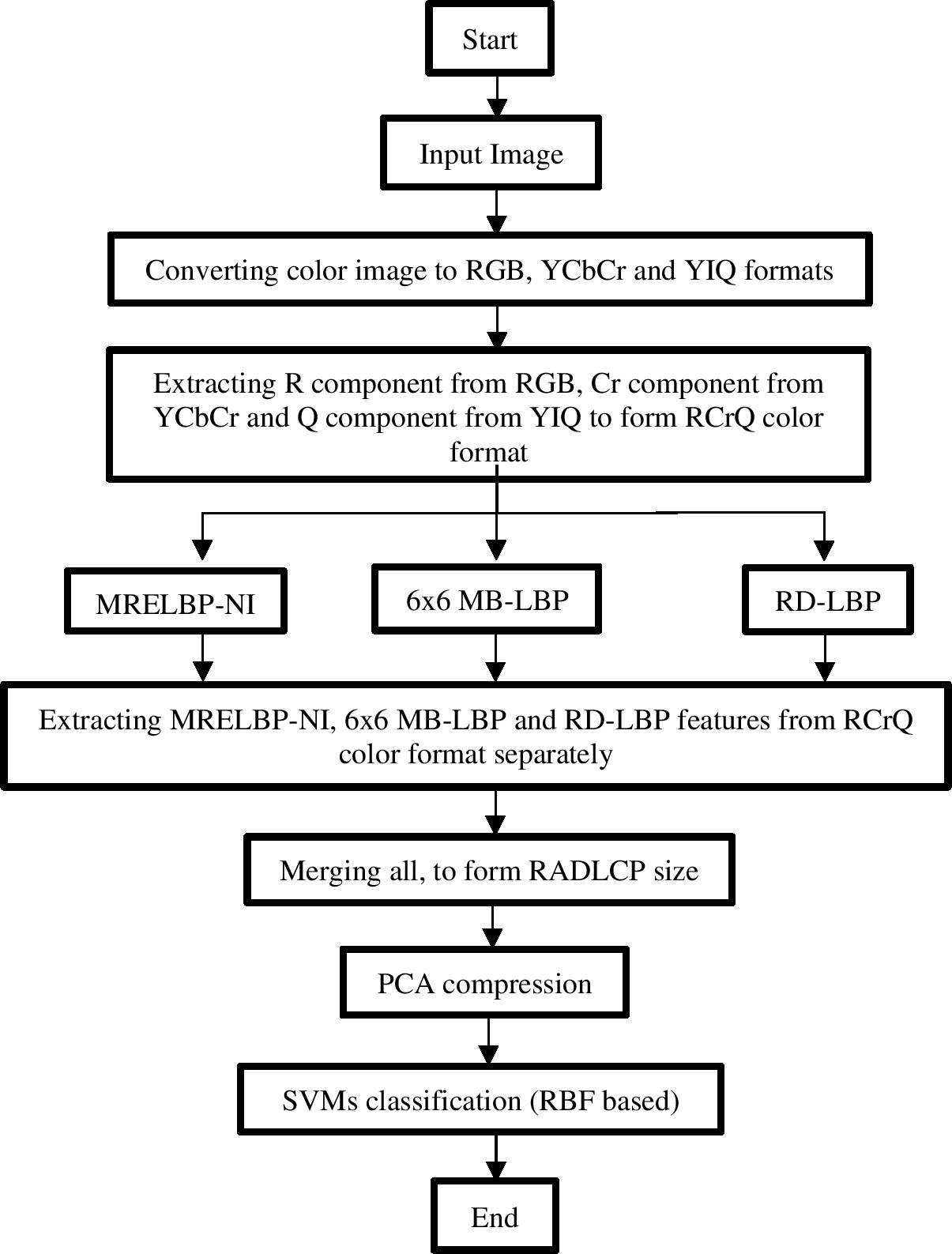
In [1], Karanwal et al. developed the novel color descriptor FLCP. FLCP justifies its potent by defeating the accuracy of various methods. But after evaluating carefully the descriptor invented in [1], the one major shortcoming observed in FLCP is that the color feature size is derived from the RGB color format. Literature suggest that RGB is the basic format and it is not discriminative as the other color formats. Therefore in the proposed work more discriminative color format is derived RCrQ, by taking R from RGB, Cr from YCbCr and Q from YIQ. RCrQ is more discriminant color format than RGB. Further from R component, MRELBP-NI is imposed for extracting features. From Cr component 6 6 MB-LBP is imposed and from Q component RD-LBP is imposed for extracting features. Ultimately all extracted features from RCrQ channel are merged into one framework called as RADLCP. Each one have the size of 256. Therefore RADLCP builds the size of 768. Compression and classification steps is assisted from PCA and SVMs. RADLCP proves its potent by defeating the accuracy of various methods. Figure 6 communicates the proposed color FR framework. Figure 7 shows the flowchart of the proposed work.
Proposed FR framework.
The flow chart of the proposed work.
Results
Specification of the used dataset
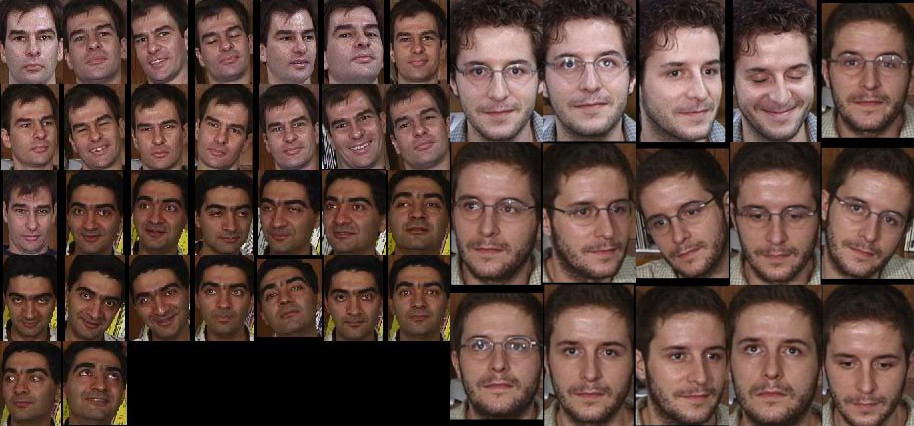
Some images of GT dataset
The dataset utilized for evaluation is Georgia Technology (GT). One of the oldest and color dataset available in the literature. So far it has been by various researchers in their works. This dataset is very challenging as it possesses various image transformations in the captured images. To build discriminant descriptor in such image transformations is the very challenging task. The detailed description of GT is defined as: GT dataset is built from 50 individuals and each individual possesses 15 distinct images therefore the aggregate number of images are 750. The four different challenges in which GT images are taken are light, emotion, pose and scale variations. All the challenges are on the extreme side (higher side). Due to persistence of the scale variations the image resolution is inconsistent in the GT dataset. Some set of GT dataset images are conveyed in Fig. 8.
Characteristics of the feature elements
Out of four compared descriptors, the first three are evaluated as gray scale comparison and the fourth one is the color based descriptor. These four descriptors are MRELBP-NI, 6 6 MB-LBP, RD-LBP and FLCP. For former three, the images are converted to gray scale and then they are downsampled to 52 48 size. The feature size built from these three are 256. To implement FLCP, the color samples are resized to 52 48 and then R, G and B components are extracted for generating the features. The R channel is kept for MRELBP-NI feature extraction, G component is kept for 6 6 MB-LBP feature extraction and B component is kept for RD-LBP feature extraction. The size from all component are integrated to form the size of FLCP. Therefore FLCP builds the size of 768. For the proposed descriptor RADLCP, the most discriminant color format is used and that is RCrQ. The R component is taken from RGB, Cr component is taken from YCbCr and Q component is taken from YIQ. Then the color samples are resized to 52 48 for extraction features. The R channel is kept for MRELBP-NI feature extraction, Cr component is kept for 6 6 MB-LBP feature extraction and Q component is kept for RD-LBP feature extraction. The size from all component are integrated to form the size of RADLCP. Therefore RADLCP builds the size of 768. The size of all five descriptors are shortened by using PCA. Therefore after PCA the size taken by RBF classifier for evaluation is 25. For all evaluation the matlab environment used is R2021a. The system specifications are as defined: It contains 6 GB of RAM with 64 bit windows 10 pro operating system. The processor is Intel Core i5.
Generation of accuracy on different subsets
The accuracy is the performance metric, which has been taken for evaluating all the descriptors. Most of the literature work implement and evaluate their methods by measuring the accuracy of their methods. Therefore the performance metric accuracy has been utilized in the proposed work. The formula for accuracy generation is displayed in Eq. (6). The elements used in Eq. (6) are ACC, ICMS and TST. The specification of these parameters are accuracy, incorrect matches and test size.
The remaining element TRG used for the description of training size. Some examples of ACC computation is defined as: When 4 sample TRG value is used for each then 11 samples remains for TST. Which means 200 are TRG and 550 are TST. As ACC is estimated on TST and if the FC produced are 200 then ACC (550 200)/550 63.63. When 5 samples TRG value is used for each then 10 samples remains for TST. Which means 250 are TRG and 500 are TST. As ACC is estimated on TST and if the FC produced are 150 then ACC (500 150)/500 70.00. When 6 samples TRG value is used for each the 9 samples remains for TST. Which means 300 are TRG and 450 are TST. As ACC is recorded on TST and if FC produced are 120 then ACC (450 120)/450 73.33. In similar way the ACC is computed on every taken subset.
ACC investigation on GT
SVMs method
RBF classifier
TRG properties
TRG 7
TRG 8
TRG 9
Description
ACC in %
MRELBP-NI
77.25
78.28
81.66
6 6 MB-LBP
76.50
78.28
81.00
RD-LBP
74.00
76.57
80.33
FLCP
87.50
90.28
91.66
RADLCP
89.50
91.71
93.33
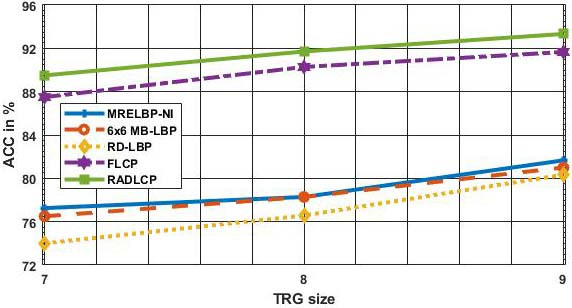
Graph analysis of all descriptors.
On GT, TRG 7:9 and TST 8:6. So the three formed subsets are 7/8, 8/7 and 9/6. For 7 sample TRG value, the 8 samples are evaluated for TST. For 8 samples TRG values, the 7 samples are evaluated for TST and for 9 samples TRG values, the 6 samples are evaluated for TST. ACC is recorded on these three subsets. The supreme/finest ACC is estimated on every subset after the running of classifier 30 times. All obtained ACC is displayed in Table 1. Table 1 shows that RADLCP is most discriminant among all. RADLCP beats ACC of all the other 4 compared ones. RADLCP achieves the ACC of [89.50% 91.71% 93.33%] on TRG 7:9. These ACC are higher and better than the compared ones. The compared descriptors i.e. MRELBP-NI, 6 6 MB-LBP, RD-LBP and FLCP achieves the ACC of [77.25% 78.28% 81.66%], [76.50% 78.28% 81.00%], [74.00% 76.57% 80.33%] and [87.50% 90.28% 91.66%], chronologically as mentioned earlier. This proves the RADLCP potent than the other compared ones. The ACC investigation through graph is displayed in Fig. 9. The matching algorithm used for evaluating all descriptors is SVMs (RBF). SVMs is very effective technique and used in many applications to evaluate the results therefore SVMs is considered for the evaluation purpose. The holdout method is used for partitioning of TRG and TST sizes and coding strategy used is one vs all. For creating multiclass models there is the requirement of some technique which creates these models and the best model for that is ECOC. Therefore multiclass models are generated by using ECOC. ECOC is also very effective method. Table 2 shows the parameter settings of the invented work.
The parameter settings
Parameters of feature size and system
Elements of classification
Platform
MRELBP-NI size 256, extracted and derived from the R component of RGB color format. 6 6 MB-LBP size 256, extracted and derived from the Cr component of YCbCr color format. RD-LBP size 256, extracted and derived from the Q component of YIQ color format. FLCP size 768, created, derived and fused from the R, G and B components of the RGB color format. RADLCP size 768, extracted, derived and merged from the R, Cr and Q components of the RCrQ color format. For creating the RADLCP size, best hybrid color format is created by using the different components from the three color space formats. This hybrid color format is RCrQ.
The classification algorithm does not deployed on the original image size of the descriptor.
MATLAB R2021a
PCA is deployed to all for feature compaction. So after PCA, size is 25.
After PCA feature compaction RBF is used for classification. RBF is SVMs based technique and used in many applications therefore it is used for evaluation. RBF taken parameters are Holdout, Kernel Function, Box Constraint and Kernel Scale. Holdout is used for partitioning the training and test subsets, Kernel function utilized is Gaussian. Box Constraint and Kernel Scale values are 2 and 4. These are the parameters inserted in SVMs template, which is then taken by ECOC for execution. ECOC is the error correcting output code used for forming the multiclass models. The multiclass models are essential in developing the FR application. Coding strategy used is one vs all.
MATLAB R2021a
The tool “plottools” is used for creating the graph in MATLAB R2021a.
Comparison of accuracy with literature techniques
On GT, 21 techniques are compared against RADLCP. These techniques follows the same evaluation settings as RADLCP possesses. Although they are local and non-local based techniques. The idea is to compare the ACC of different set of techniques on the considered subsets of training and test size. Their ACC illustration is defined as. DL [28], OVSFC-DL [28] and K-SVD [28] secures the ACC rate of 70.80%, 68.03% and 65.70% when TRG 9. CZZBP [29], CMBZZBP [29], LDBP [30], LNDBP [30], LDBP+LNDBP [30], FDLPP [32], FLPP [32], RLBP [33], MBP [33], GBSBP [34], GBSBP+LPQ [34], Anti-L1L2 [36] and DSRL2 [33] secures the ACC of [79.00% 80.57% 81.66%], [85.50% 86.85% 87.00%], [84.20% 86.50% 88.00%], [82.20% 85.10% 87.30%], [86.00% 88.50% 89.00%], [83.08% 86.19% 86.33%], [72.50% 75.32% 76.22%], [83.75% 85.42% 87.00%], [82.00% 83.14% 84.66%], [83.75% 85.71% 86.33%], [88.25% 88.28% 89.66%], [63.00% 64.00% 68.00%] and [58.00% 59.71% 61.67%] when TRG 7:9. Kernel [31], CF [31], LC-LBP [35], VELBP [35] and KSR [37] achieves the ACC of [67.00% 69.14%], [70.00% 70.29%], [68.25% 71.71%], [74.50% 76.85%] and [69.50% 73.71%] on TRG 7:8. The invented RADLCP conquer the ACC of the techniques on respective TRG value. This proves the RADLCP potent against the 21 compared techniques. RADLCP proves better than 21. Table 3 shows all the ACC comparison.
This work extends the work invented in [1]. In [1], a novel descriptor FLCP is introduced for FR in different unconstrained conditions. FLCP is the color based descriptor and its features are extracted from RGB color format. The R component is preserved for MRELBP-NI feature extraction, G component is preserved from 6 6 MB-LBP feature extraction and B component is preserved from RD-LBP feature extraction. Further all component features are merged to form the FLCP size. FLCP beats the results of various descriptors. After evaluating carefully the descriptor invented in [1], the one major shortcoming observed is that color format RGB is used for extracting features. If more robust and discriminant hybrid color format is used then accuracy improvement is assured.
In proposed work a novel descriptor RADLCP is introduced for the FR by using the robust color format. Precisely, more discriminant hybrid color format RCrQ is created by taking R, Cr and Q components from RGB, YCbCr and YIQ color formats. Then R component is preserved for MRELBP-NI feature extraction, Cr component is preserved from 6 6 MB-LBP feature extraction and Q component is preserved from RD-LBP feature extraction. Further all component features are merged to form RADLCP size. The compaction and classification steps are attained from PCA and SVMs. SVMs is very effective technique and used in many applications to evaluate the results therefore SVMs is considered for the evaluation purpose. Results are conducted on GT face dataset.
The results analysis is performed in two phases. In first phase, the four descriptors are implemented and used for comparison. These four are MRELBP-NI, 6 6 MB-LBP, RD-LBP and FLCP. First three are gray scale descriptors and last one is the color descriptor. RADLCP outclassed the ACC of all compared descriptors. The results achieved by RADLCP is [89.50% 91.71% 93.33%] on TRG 7:9. The other descriptors procures the ACC rate of [77.25% 78.28% 81.66%], [76.50% 78.28% 81.00%], [74.00% 76.57% 80.33%] and [87.50% 90.28% 91.66%]. All these descriptors are tested on same parameter settings in which the RADLCP is evaluated. In second phase, 21 techniques are picked from literature and used for comparison. These 21 techniques are tested on the same TRG value in which the RADLCP is tested. Although their implementation protocols may be different. RADLCP conquer the ACC of all 21 techniques on the respective training size. This proves the potent of RADLCP in both phases. RADLCP proven as the robust and discriminant face descriptor.
Conclusions and future directions
This work introduced the novel local color descriptor for FR so-called RADLCP. RADLCP is the novel color local descriptor which has been inspired from the fusion of multiple descriptors in color space. The proposed work used the robust and discriminant hybrid color format for making the RADLCP size. In [1] Karanwal et al. introduced the novel color descriptor in Face Recognition (FR) called as Fused Local Color Pattern (FLCP). In FLCP, the RGB color format is utilized for extracting features. From R, G and B channels, the MRELBP-NI, 6 6 MB-LBP and RD-LBP are imposed for feature extraction and then all are integrated to form the FLCP size. FLCP beats the ACC of various methods. The individual gray scale descriptors are outclassed and various literature methods are also outclassed. The one major shortcoming observed in [1] is that the basic format RGB is used for extracting features. Literature suggests that other hybrid format achieves better recognition rates than RGB.
Motivated from literature, the proposed work uses the hybrid color space format RCrQ for feature extraction. In this format R channel is taken from RGB, Cr channel is taken from YCbCr and Q channel is taken from YIQ. On R channel, MRELBP-NI is imposed for extracting features, On Cr channel 6 6 MB-LBP is imposed and on Q channel RD-LBP is imposed for extracting features. Then all channel features are joined to build the robust and discriminant feature called as Robust And Discriminant Local Color Pattern (RADLCP). Compression and matching is assisted from PCA and SVMs. For evaluating results GT face dataset is used. Results proves the potency of the RADLCP in contrast to the gray scale based implemented descriptors. RADLCP also beats the results of FLCP. Several literature techniques are also outclassed by RADLCP. RADLCP achieves the ACC of [89.50% 91.71% 93.33%] on TRG=7:9. The other descriptors procures the ACC rate of [77.25% 78.28% 81.66%], [76.50% 78.28% 81.00%], [74.00% 76.57% 80.33%] and [87.50% 90.28% 91.66%]. All these descriptors are tested on same parameter settings in which the RADLCP is evaluated. The 21 techniques are picked from literature and used for comparison. These 21 techniques are tested on the same TRG value on which the RADLCP is tested. Although their implementation protocols may be different. RADLCP conquer the ACC of all 21 techniques on the respective training size. This proves the potent of RADLCP in both phases. RADLCP proven as the robust and discriminant face descriptor. For evaluating all the results MATLAB R2021a is used.
There are some places where some important essentials are missed out in proposed work. First, extraction of features regionally are not performed in the proposed work. Second, some large scale datasets can be used in the proposed work third, testing on other applications. Fourth, some better global methods could be used for feature compression. Fifth, testing on the other challenges such as noise, blur and age. Sixth, the usage of some other classifiers such as polynomial (SVMs), Nearest Neighbor (NN), Naïve Bayes (NB) and Neural Networks (NNs). All these points develops the scope of the future research and which will be completed in the forthcoming article. Additionally, the other novel local descriptor will be assured in the upcoming article. This novel descriptor will be robust and discriminant in various unconstrained conditions.
References
1.
KaranwalS., A Novel Color Descriptor for Face Recognition, in: Proceedings of International Conference on Soft Computing and Pattern Recognition (SoCPaR) (2022).
2.
OjalaT.PietikainenM. and HarwoodD., A comparative study of texture measures with classification based on featured distributions, Pattern Recognition29(1) (1996), 51–59.
3.
ShakoorM.H.BoostaniR.SabetiM. and MohammadiM., Feature selection and mapping of local binary pattern for texture classification, Multimedia Tools and Applications82 (2023), 7639–7676.
4.
KaranwalS. and DiwakarM., Triangle and orthogonal local binary pattern for face recognition, Multimedia Tools and Applications (2023).
5.
LiuL.LaoS.FieguthP.GuoY.WangX. and PietikainenM., Median Robust Extended Local Binary Pattern for Texture Classification, IEEE Transactions on Image Processing25(3) (2016), 1368–1381.
6.
LiaoS.ZhuX.LeiZ.ZhangL. and LiS.Z., Learning Multiscale Block Local Binary Pattern for Face Recognition, in: Proceedings of International Conference on Biometrics (ICB) (2007), 828–837.
7.
LiuL.ZhaoL.LongY.KuangG. and FieguthP., Extended Local Binary Pattern for texture classification, Image and Vision Computing30(2) (2012), 86–99.
8.
KravchikM. and ShabtaiA., Efficient Cyber Attack Detection in Industrial Control Systems Using Light Wight Neural Networks and Principal Component Analysis, IEEE Transactions on Dependable and Secure Computing (2021).
9.
HazarikaB.B. and GuptaD., Density Weighted-SVMs for binary class imbalance learning, Neural Computing and Applications33 (2021), 4243–4261.
10.
http://www.anefian.com/research/face_reco.htm.
11.
KhannaK.GambhirS. and GambhirM., A novel technique for image classification using Short Time Fourier Transform and Local Binary Pattern, Multimedia Tools and Applications81 (2022), 20705–20718.
12.
LathaD. and SheelaC.J.J., Enhanced hybrid Content Based Image Retrieval based on multichannel Local Binary Pattern oriented color descriptor and HSV color statistical feature, Multimedia Tools and Applications81 (2022), 23801–23818.
13.
LuoY.SaJ.SongY.JaingH.ZhangC. and ZhangZ., Texture classification combining improved local binary pattern and threshold segmentation, Multimedia Tools and Applications (2023).
14.
KaranwalS., Improved Local Binary Pattern for Face Recognition, in: Proceedings of the International Conference on Deep Learning Artificial Intelligence and Robotics (ICDLAIR) (2022), 86–96.
15.
WajihE.A. and GhazaliR., Threshold center-symmetric local binary convolutional neural networks for bilingual handwritten digit recognition, Knowledge Based Systems259 (2023).
16.
KaranwalS., Fusion of Two Novel Local Descriptors for Face Recognition in Distinct Challenges, in: Proceedings of the International Conference on Smart Technologies and Systems for Next Generation Computing (ICSTSN) (2022).
17.
WeiW.WangW.YangY. and WangY., A novel color image retrieval method based on texture and deep features, Multimedia Tools and Applications81 (2022), 659–679.
18.
VuH.N.NguyenM.H. and PhamC., Masked Face Recognition with Convolutional Neural Networks and Local Binary Pattern, Applied Intelligence52 (2022), 5497–5512.
19.
SajwanV. and RanjanR., A Novel Feature Descriptor: Color Texture Description with Diagonal Local Binary Patterns Using New Distance Metric for Image Retrieval, in: Congress on Intelligent Systems (CIS) (2022).
20.
GangulyS.MandalS.MalakarS. and SarkarR., Copy-move forgery detection using local tetra pattern based texture descriptor, Multimedia Tools and Applications (2023).
21.
LuZ.JiangX. and KotA., A novel LBP-based Color descriptor for face recognition, in: Proceedings of the International Conference on IEEE International Conference on Acoustics, Speech and Signal Processing (ICASSP) (2017).
22.
KaranwalS., Combined Local Pattern (CLP): A Novel Descriptor for Face Recognition, in: Proceedings of the International Conference on Inventive Research in Computing Applications (ICIRCA) (2022).
23.
KaranwalS. and DiwakarM., Multiscale Block-Zig Zag Local Binary Pattern for Face Recognition, in: Proceedings of the International Conference on Machine Learning, Advances in Computing, Renewable Energy and Communication (MARC) (2021), 613–622.
24.
ChaudhariV.DawoodiH.H. and PatilM.P., Banana Leaf Disease Recognition based on Local Binary Pattern, in: Proceedings of the International Conference on Smart Trends in Computing and Communications (STCC) (2021), 653–661.
25.
KaranwalS. and DiwakarM., Blur Invariant Local Binary Descriptor for Face Recognition, Journal of Information Assurance and Security17(1) (2022).
26.
AricanE. and AydinT., An RGB-D Descriptor for Object Classification, Romanian Journal of Information Science and Technology (2022).
27.
ShuX.SongZ.ShiJ.HuangS. and WuX.J., Multiple channels local binary pattern for color texture representation & classification, Signal Processing: Image Communication (2021).
28.
ZhangY.LiuW.FanH.ZouY.CuiZ. and WangQ., Dictionary learning and face recognition based on sample expansion, Applied Intelligence (2021).
29.
KaranwalS. and DiwakarM., Two novel color local descriptors for face recognition, Optik-International Journal for Light and Electron Optics226(2) (2021).
30.
KaranwalS. and RokaS., Robust Face Descriptor under unconstrained conditions, in: Proceedings of the International Conference on Sustainable Computing (SUSCOM) (2022).
31.
ZengS.YangX. and GouJ., Using Kernel Sparse Representation to Perform Coarse-to-Fine Recognition of Face Images, Optik-International Journal for Light and Electron Optics140 (2017), 528–535.
32.
RanR.FengJ.ZhangS. and FangB., A General Matrix of th Function Dimensionality Reduction Framework and the Extension for Manifold Learning, IEEE Transactions on the Cybernetics52(4) (2022), 2137–2148.
33.
KaranwalS., Robust Local Binary Pattern for face recognition in different challenges, Multimedia Tools and Applications (2022).
34.
KaranwalS., Graph Based Structure Binary Pattern for Face Analysis, Optik-International Journal for Light and Electron Optics241 (2021).
35.
KaranwalS., A comparative study of 14 state of art descriptors for face recognition, Multimedia Tools and Applications80 (2021), 12195–12234.
36.
ZengS.GouJ. and DengL., An antinoise Sparse Representation method for Robust Face Recognition via joint l1 and l2 regularization, Expert Systems With Applications82 (2017), 1–9.
37.
ZhangK.PengY. and LiuS., Discriminative Face Recognition via Kernel Sparse Representation, Multimedia Tools and Applications77 (2018), 32243–32256.