




Abstract
BACKGROUND:
Urinary tract infections (UTIs) are currently posing a worldwide health concern by affecting millions of people. The genetic variant rs2234671 in the CXCR1-interleukin-8 receptor is closely related to a raised UTI risk.
OBJECTIVES:
In this work, the impact of CXCR1 (rs2234671) on UTI individuals was examined.
METHODS:
The demographic features of 30 recurrent UTI patients and 20 controls were thoroughly investigated. Bacterial isolation and identification were performed by the implementation of cultural and biochemical methods. DNA extraction, purification of all samples from both patients and healthy people, and IL-8 rs2234671 (C/G) SNP genotyping using T-ARMS-PCR were performed. The significance of the results was evaluated by carrying out a statistical analysis.
FINDINGS:
The patient’s average age was 34.63
MAIN CONCLUSIONS:
Although no significant association between CXCR1 (rs2234671) and UTI was found, the GG genotype may point to the increasing probability of UTI risk. Additional research is required to confirm and expand these conclusions.
Introduction
The rise of urinary tract infections (UTIs) between all ages and genders of patients has been accompanied by a sharp increase in the prevalence of pathogenic bacterial issues, which could be regarded as symptomatic or asymptomatic clinical signs of the patients [1, 2, 3]. However, UTIs are typically manifested more frequently in women than men [4, 5]. According to a recent work in the literature, it has been demonstrated that there are many bacterial infections, which could individually or together cause infection at different parts of the urinary tract (UT).
Escherichia coli (E. Coli) is a Gram-negative rod-shaped, anaerobic bacterium, which has been detected with UTI. Consequently, a strong relationship between E. Coli and UTI has been reported in the previously reported works in the literature, which confirmed that UT is mainly infected by E. Coli with high percent in comparison with other bacteria and can cause different diseases including cystitis, urethritis, and pyelonephritis [6, 7, 8, 9].
Another issue with this approach is that UTI could be induced by Proteus mirabilis [10, 11]. This bacterium is a Gram-negative rod-shaped bacterium and is characterized by motility and urease production [12], which could potentially increase the pathogenesis in the UTI. Before the infection, bacteria should be adhered to the epithelial cells or tissue of UT using MR/P fimbriae and the alkalinized urea by urease could lead to nephrolithiasis, and urolithiasis of UT [10, 13, 14]. Furthermore, Enterococcus faecalis (E. faecalis) is streptococcus and a Gram-positive, indicating that it normally inhabits the gastrointestinal tracts of humans and animals [15, 16]. It is considered the most common bacteria in UTI, and in cases is resistant to drugs and difficult to treat with antibiotics [17, 18]. E. faecalis possesses virulence factors after adhering to epithelial of UT that are associated with the aggregation substance and the expression of proteins’ surface, which mediate the adherence of the E. faecalis on renal epithelial cells [19, 20]. Moreover, Pseudomonas aeruginosa is facultative anaerobic, Gram negative, and rod in shaped bacterium, which is involved with UTI in particular elderly and catheterized patients [21, 22]. Furthermore, Pseudomonas aeruginosa is associated with asymptotic clinical signs and resistance to antibiotics [23]. Similarly, Klebsiella pneumoniae has been detected with UTI of patients, and is a Gram-negative, facultative anaerobic, rod-shaped bacterium, which could be encapsulated and lactose-fermenting non-motile [24, 25]. UTI with Klebsiella pneumoniae could be accompanied by severe clinical symptoms, and it is majorly outbroken among patients in hospitals [26]. Apparently, Klebsiella pneumoniae is a bacterium that displays high pathogenesis due to the existence of many virulence factors including capsule, lipopolysaccharide, iron acquisition systems, adhesins, biofilm formation, and it is also highly resistant to innate immune response [27, 28, 29]. However, many works in the literature have confirmed that the age of patients is not related to the average infection rate of Escherichia coli, Proteus mirabilis, Enterococcus faecalis, and Klebsiella pneumoniae [30, 31], and these bacterial infections might be connected with diverse other reasons associated with the medical history of the patients.
The risk associations of the rs2234671 polymorphisms of the CXCR1 gene with different diseases, which is a well-known example of breast cancer, have been investigated by many works in the literature. More specifically, perihilar cholangiocarcinoma, urinary tract infections, and metastatic colorectal cancer [32, 33, 34], and single nucleotides have been detected by the genotypes of GC, GG, CC, and G and C alleles, respectively [35, 36]. Although the risk factors of the rs2234671 polymorphisms of the CXCR1 gene concerning UTI have been explored, the genotype and allele frequency for the cxcr1 SNP (rs2234671) in relation to certain bacteria have not been specifically examined. Therefore, the purpose of this work was to assess the risk factor of the CXCR1 SNP (rs2234671) in patients with bacterial infections.
Materials and methods
Samples collection
The methods used to collect the demographic features of recurrent UTI patients and controls in the described study can be broken down into two main categories:
Medical records review: This likely involved reviewing the patients’ medical charts to extract information such as age, sex, date of UTI diagnosis, number of previous UTI episodes, and any relevant medical history. Patient interviews: Patients might have been interviewed to gather additional information about their lifestyle habits, diet, sexual history, and any potential risk factors for UTIs.
Thirty specimens were collected from patients diagnosed with recurrent UTIs between March and April 2023 at the Microbiology laboratory in Al-Diwanyiah Hospital, Qadisiyah province, Iraq. Among these patients, 10 males and 20 females ranged in age from 30 to 50 years. Additionally, 20 specimens were obtained from healthy individuals, comprising 6 males and 14 females, with ages ranging from 30 to 45 years. The blood specimens used to identify CXCR1 SNP (rs2234671) gene polymorphisms, and the patient’s urine samples were collected in clean containers for bacterial isolation. The whole blood specimens of 5 ml were collected from each patient and healthy individual.
Bacterial isolation method
A bacterial isolation method was used to isolate bacteria from urine specimens by using MacConkey agar and mannitol salt agar for the isolation of E. coli, Proteus mirabilis, Enterococcus faecalis, Klebsiella pneumoniae, and Pseudomonas aeruginosa. Particularly, the method involved streaking a sterile loopful of urine onto the surface of a MacConkey agar plate and a mannitol salt agar plate, followed by incubation at 37∘C for 24 h. After incubation, the plates were examined for bacterial growth. E. coli colonies were large, pink to red with clear borders, while Proteus mirabilis colonies were swarming and colourless. On the contrary, Enterococcus faecalis colonies were small, and white with a narrow zone of salt tolerance, while and Klebsiella pneumoniae colonies were large, mucoid, pink to red. Pseudomonas aeruginosa colonies were green with a sweetish odour. Gram staining was also performed to determine if the bacterial colonies were Gram-positive or Gram-negative. On top of that, further biochemical assays (TSI, IMViC, Indole, MR-VP, Citrate Utilization, Urease and Motility Test) as well as Vitek2 system were conducted to validate the bacterial identification. The presence of any of the following bacteria in a urine specimen indicated a UTI.
Blood DNA Extraction
The genomic DNA was isolated from frozen blood samples using the gSYAN DNA extraction kit from Geneaid, USA, following the directions provided by the company. The obtained blood genomic DNA was assessed using Nanodrop (THERMO. USA), which determined the concentration of DNA (in ng/
The sequence and amplicon size of the Tetra-ARMS-PCR Primers used for IL-8- IL-8 rs2234671 (C/G) gene polymorphism (Macrogen Company. Korea)
The sequence and amplicon size of the Tetra-ARMS-PCR Primers used for IL-8- IL-8 rs2234671 (C/G) gene polymorphism (Macrogen Company. Korea)
The IL-8 rs2234671 (C/G) SNP genotype was determined using the T-ARMS-PCR. The primer for genotyping the polymorphism was provided by (Macrogen Company. Korea) and is listed in Table 1. A reaction mixture of 25
Statistical analysis
The data were gathered, summarized, analysed, and presented using Statistical Package for Social Sciences (SPSS) version 26 and Microsoft Office Excel 2010 software packages. The numeric data were presented as mean and standard deviation after carrying out the Kolmogorov-Smirnov normality test. Various statistical tests, such as the independent sample t-test was used to compare the mean age of patients and control subjects and chi-square test was used to compare the frequency distribution of patients and control subjects according to age, gender, recurrent infection, and bacterial isolation results as well as to analyse typically and non-normally distributed variables and study the associations between categorical variables. Hardy-Weinberg equilibrium was applied to CXCR1-interleukin-8 receptor (rs2234671) genotype distribution within the control group. Odds ratios (ORs) and 95% confidence intervals (CIs) were calculated to assess the risk for UTI associated with different genotypes.
Ethical approval
The ethical principles derived from the Declaration of Helsinki were used to conduct the study. The patient’s verbal and analytical consent was obtained prior to the sample collection. The local ethics committee examined and approved the study protocol, subject information, and permission form as per Project No. B230201 on 7/2/2022 to obtain this approval.
Demographic features of patients with recurrent urinary tract infection and control individuals
Demographic features of patients with recurrent urinary tract infection and control individuals
n: number of cases; SD: standard deviation; †: independent samples
The distribution of patients experiencing recurrent urinary tract infections was analysed based on their gender and age.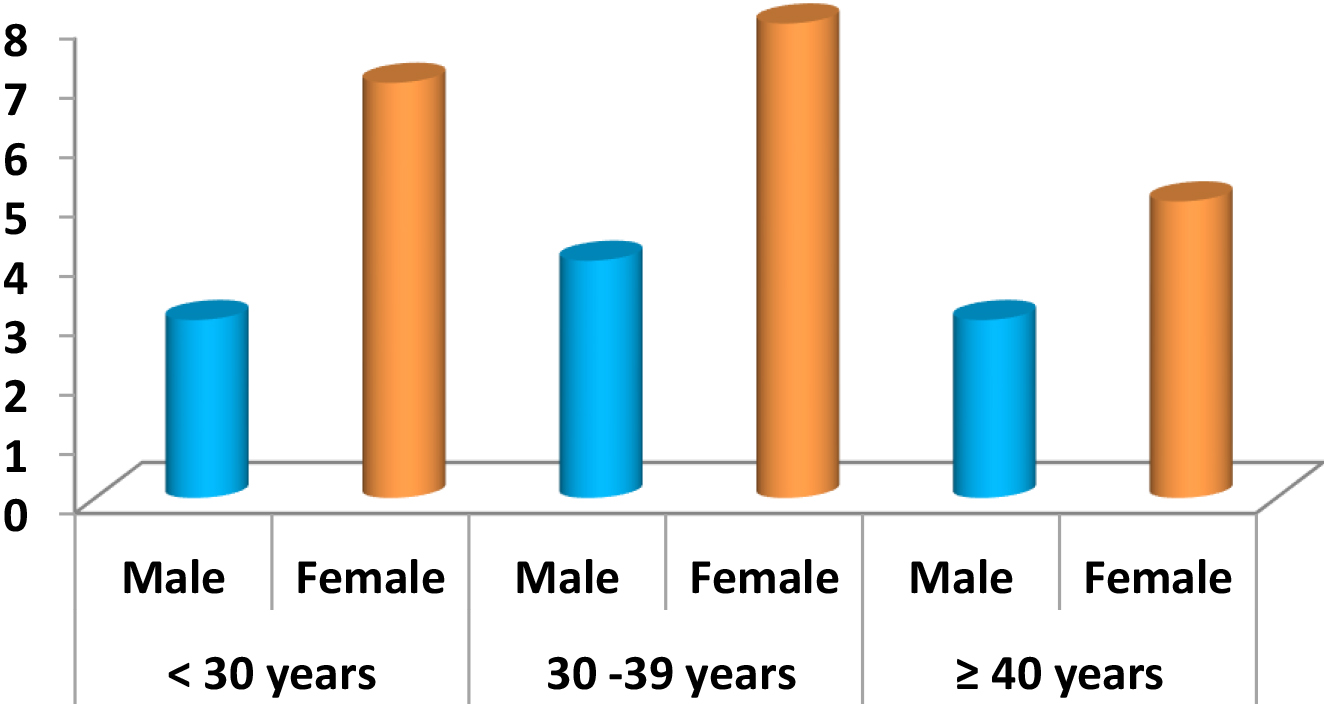
Demographic features of patients and control individuals
The current study included 30 patients who had experienced multiple urinary tract infections and 20 control participants who were in good health. In Table 2, the demographic features of both patients and control persons are displayed The average age of patients was 34.63
Frequency distribution of patients based on repeated infection
Frequency distribution of patients based on repeated infection
n: number of cases.
In Table 3 the frequency distribution of patients based on recurrent infection is presented. Out of the total number of patients, 17 (56.7%) had positive recurrent infections, while 13 (43.3%) had negative recurrent infections.
Pie chart showing the frequency distribution of bacterial species according to the bacterial isolation results.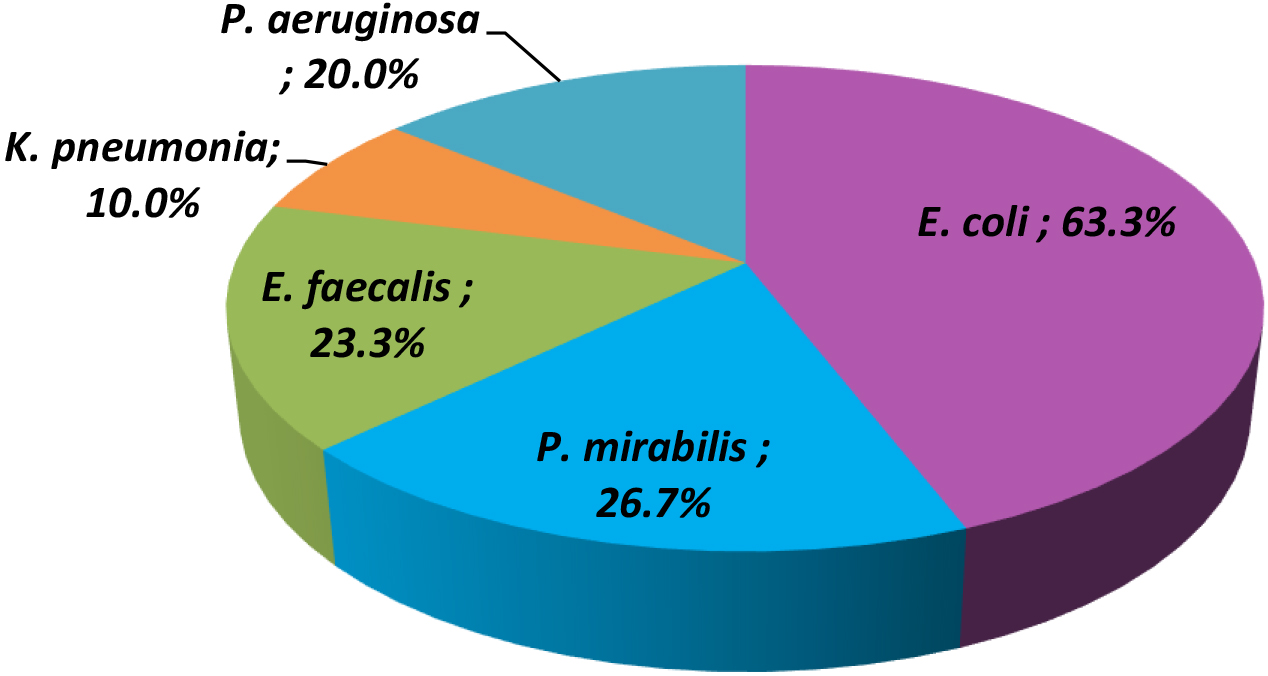
Comparison of the frequency distribution according to the age and mean age of patients with repeated UTI based on bacterial isolation
SD: standard deviation; n: number of cases;
Hardy Weinberg equation of rs2234671 SNP
An agarose gel electrophoresis image was used to analyse the T-ARMS-PCR product for the CXCR1-interleukin-8 receptor (rs2234671) gene polymorphism. The marker M has a size range of 2000 to 100 base pairs. The lane (CC) wild type homozygote exhibited solely the C allele in the 215 bp T-ARMS-PCR product. The homozygous lane (GG) mutant type only displayed the A allele at the 189 bp T-ARMS-PCR product. On the other hand, the heterozygous lane (CG) showed both the C and G alleles at the 215 bp and 189 bp T-ARMS-PCR products. The external internal controls were detected in the 354 bp T-ARMS-PCR product.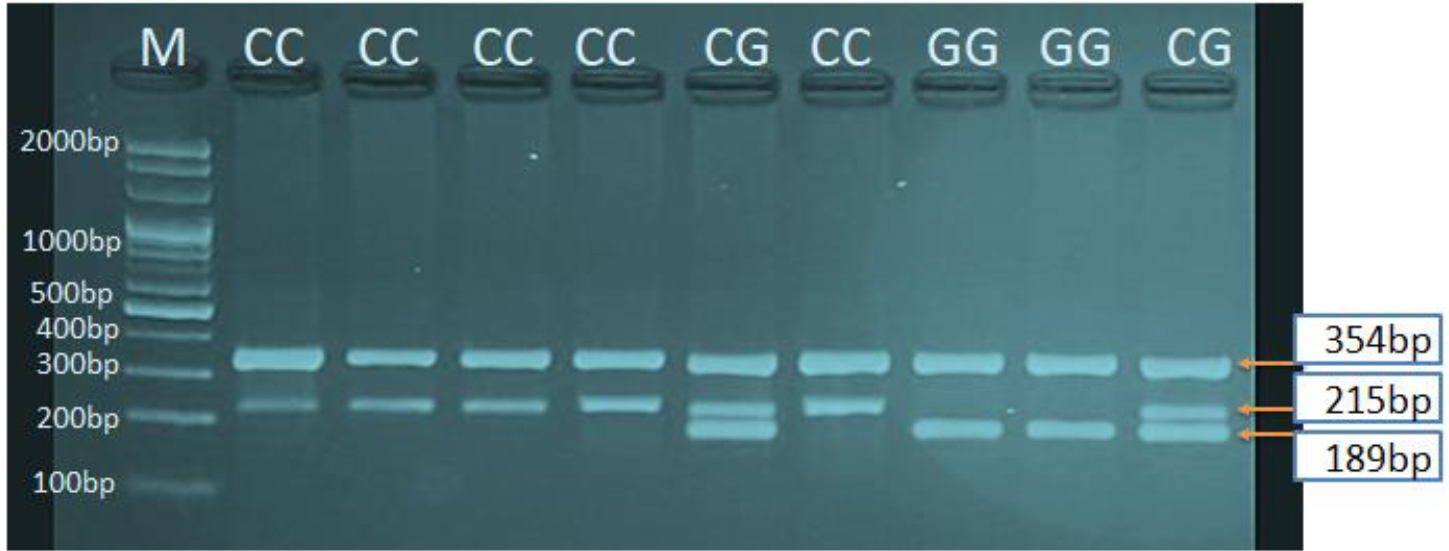
The results of the frequency distribution of patients with repeated UTI based on bacterial isolation are shown in Fig. 2. As can be observed, the bacterial isolation for Escherichia coli was reported in 19 (63.3%), the Proteus mirabilis showed in 8 (26.7%); the Enterococcus faecalis showed in 7 (23.3%); the K. pneumonia and
Pseudomonas aeruginosa were found in 3 (10.0%) and 6 (20.0%), respectively. A comparison of the frequency distribution according to the age and mean age of patients with repeated UTI based on bacterial isolation results is presented in Table 4. No significant association between the age and bacterial isolation results was detected in both frequency (
The of CXCR1-interleukin-8 receptor (rs2234671) gene polymorphism results
Comparison of the frequency distribution according to the gender of patients with repeated UTI based on bacterial isolation results
Comparison of the frequency distribution according to the gender of patients with repeated UTI based on bacterial isolation results
SD: standard deviation;
The distribution of CXCR1 (rs2234671) gene polymorphism was detected by using the ARMS-PCR technique. The genotype distribution had no deviation from Hardy-Weinberg equilibrium. The Hardy-Weinberg equation was used to analyse the distribution of the CXCR1-interleukin-8 receptor (rs2234671) genotypes (CC, CG, and GG) within the control group. The results of this analysis are presented in Table 3.5. The homozygous wild genotype CC was observed in 13 out of 20 control subjects. The heterozygous CG genotype was observed in 4 out of 20 control patients, whereas the homozygous mutant GG genotype was observed in 3 out of 20 control subjects (Table 6). The distribution of the control patients based on CXCR1-interleukin-8 receptor (rs2234671) genotypes did not show a significant difference compared to the expected distribution (
In Table 7 a comparison of the genotypes and allele frequencies for the CXCR1-interleukin-8 receptor SNP (rs2234671) between patients and healthy control individuals is presented. In the co-dominant mode, no significant difference in the frequency distribution of genotypes between the patients and control groups (
CXCR1-interleukin-8 receptor (rs2234671) genotype frequency in patients and healthy control
CXCR1-interleukin-8 receptor (rs2234671) genotype frequency in patients and healthy control
Comparison of the frequency distribution of socio-demographic features of patients with repeated UTI based on the results of ARMS-PCR
A comparison of the frequency distribution of socio-demographic features of patients with repeated UTI according to results of ARMS-PCR is presented in Table 8. The average age of patients with CC genotype CT genotype, and GG genotype was 34.78
Comparison between the ARMS-PCR findings according to the bacterial isolation results
Comparison between the ARMS-PCR findings according to the bacterial isolation results
SD: standard deviation;
The frequency distribution of the ARMS-PCR findings in patients with recurrent urinary tract infections was compared based on the bacterial isolation results. The results are presented in Table 9. The current findings indicate that there was no statistically significant correlation between the ARMS-PCR findings and the outcomes of bacterial isolation (
Discussion
According to epidemiology studies, the urinary tract infections studies are considered a common disease for different ages and gender [37, 38]. Nonetheless, there is a growing body of evidence suggesting that age has no influence on the infection of UTI. Taking into account that age could affect the renal functional exacerbation of the urinary system [39], it was recently found that there is no statistically significant disparity in the age distribution between patients and control subjects. However, this study only covered adult patients.
The sex of the patients’ group did not show any significant variation in the frequency distribution of patients and control groups. However, it affected women patients, which is in direct agreement with the respective works in the literature where it has been found that UTIs in women are more significant than men [40]. In any case, the clinical signs of bacterial infections in men are similar in women [41].
Equally important is also the fact that there is a strong correlation for patients between recurrent urinary tract infection and anatomical or functional abnormality of the urinary tract, and genetic factors [42, 43]. These cases have been recorded with children suffer from micturition and hypertension of urine, which may lead to different PH of urine and could be predisposed with the right conditions for bacterial infections and susceptibility to recurrence. Besides, in elderly women, in addition to young women, genetic factors may play a role in the recurrence of UTI and kidney diseases [44, 45, 46]. The frequency distribution of patients with recurrent infection did not show any significant differences between patients in this work, perhaps due to the variation in parameters and conditions.
It is also interesting to notice that in this work, the highest infection of the urinary system of the patients was Escherichia coli (63.3%), and more bacteria with less infected percentage were identified including Proteus mirabilis (26.7%), Enterococcus faecalis, Klebsiella pneumonia (10.0%) and Pseudomonas aeruginosa (20.0%) respectively. This outcome is also consistent with the literature [47, 48, 49]. This result confirmed that Escherichia coli is considered the underlying reason for the majority of patients with UTI. However, age, gender, and recurrent urinary tract infections among patients have not been associated with different species of bacteria.
The correlation between polymorphisms in the interleukin 8-receptor gene (CXCR1 and CXCR2) and urinary tract infection has been also examined by various works in the literature [50, 51], In this work, the study centers on the associations of the distribution of CXCR1-interleukin-8 receptor SNP (rs2234671) among patients in relation to age and gender were explored, and three genotypes CC, GC, GG and two alleles C and G were detected. Nevertheless, our result indicated that SNP (rs2234671) was not different among patients with UTI according to the age and gender even though our work was conducted on adult patients. In any case, it coincided with previous studies for children [52]. However, in another work for children in the literature, it was demonstrated that the CXCR1 +2608 C allele, AA genotype and A allele of the IL-8 SNP might increase the susceptibility to acute pyelonephritis [53, 54].
Furthermore, our work noticed that genotypes and alleles of interleukin 8-receptor (CXCR1) SNP (rs2234671) have no alterations between the group of patients suffering from UTI and the healthy subject, which confirmed that CXCR1-interleukin-8 receptor SNP (rs2234671) has no associated risk factor for susceptibility to UTI of patients [50]. However, this result contradicts the respective outcomes in the literature suggesting that the patient’s carrier of rs2234671 C allele has more risk of acute pyelonephritis for Iraqi women [33]. These controversies could be explained by taking into account that the different works in the literature do not study accompanied diseases of patients with UTI in relation to interleukin 8-receptor (CXCR1) SNP (rs2234671). Therefore, more parameters should be studied and compared to attain more reliable results. Furthermore, no piece of evidence in the present work confirmed that particular bacterial reasons have a risk factor and association with genotypes or any alleles of (CXCR1) SNP (rs2234671) among patients.
Conclusions
In this work, it was demonstrated that age and sex do not affect recurrent infection and UTI, and there are many bacteria that could be caused by UTI including Escherichia coli, Proteus mirabilis, Enterococcus faecalis, Klebsiella pneumonia and Pseudomonas aeruginosa. Correspondingly, CXCR1-interleukin-8 receptor SNP (rs2234671) does not reveal any risk factor for patients with UTI. While the finding mentions the non-significant association between CXCL1 (rs2234671) and UTI, it could be further enriched by exploring potential biological mechanisms that might explain this lack of association. For example, maybe there are other genetic factors or environmental influences that could be modulating the effect of CXCL1 on UTI susceptibility. So, the finding suggests further research is needed. It could be strengthened by providing specific recommendations for future studies, such as investigating the role of other CXCL1 polymorphisms, exploring gene-environment interactions, or focusing on specific subgroups of patients. However, further investigations are needed to better understand the underlying origins of UTIs. Sexual activity, hygiene practices, and underlying medical conditions could be explored in future research. Personalized risk assessment: Identifying individual risk factors beyond age and gender could help healthcare professionals tailor preventive strategies for patients susceptible to recurrent UTIs.
Footnotes
Acknowledgments
The authors would like to thank the staff members of Veterinary medicine College and College of Biotechnology college for their assistance. In addition, we intend to acknowledge the arbitrators for their sober understanding of the article and their insightfulness observation.
Conflict of interest
There is no conflict of interest to report.
Author contributions
HHN, MJK and HA – Conceptualisation; HHN, MJK and HA – Interpretation or analysis of data; HHN and MJK – Formal analysis and investigation; HHN – Resources, funding acquisition and supervision; HHN – Writing original draft preparation; HHN, MJK and HA – writing review and editing.