




Abstract
Love and sexuality are important themes in the generation of narratives, which is our research objective. In the development of tools to generate narratives, we consider robot-related technology that tells stories as an application of narrative generation. The purpose of this paper is to present prototyping systems that generate narrative expression based on the concepts of love, sex, and sexuality using a technique for narrative generation called “coloring.” The coloring technique in narrative generation is a group of methods through which a certain atmosphere is given to a story by interspersing words and language representations. Although there are various concrete methods in the coloring technique as one of several general narrative generation techniques, this paper proposes three methods related to love, sex, and sexuality: the use of noun, adjective, and adjective-verb conceptual dictionaries. We conducted several experiments using these coloring methods. Additionally, for system implementation, we utilized a narrative generation framework called “story techniques included in a story,” which was developed based on our concept of the automatic narrative generation game, s-expression in the Lisp programming language, and Minsky’s frame theory. In the future, these prototypes will serve as stepping stones for a system that generates narratives based on specific themes.
Keywords
Introduction
In the field of artificial intelligence, story-generation studies have been ongoing for more than 50 years (Gervás, 2013). Gervás mentions the need for narratology in future story generation studies, and is developing story generation systems that aim to integrate the fields of narratology and artificial intelligence. We have likewise continued the study of narrative generation by introducing narratology from the 1990s and systematically collecting the results (Ogata, 2019, 2020). Explanation generation and unchiku (in-depth and unfamiliar knowledge) generation (Ono & Ogata, 2020) in narrative generation that we have conducted in the relationship between love and sexuality has also been conducted as a part of the narrative generation study introducing narratology. Love, sex, or sexuality, which we refer to as important themes in narratives. The themes of love and sex have been dealt with in the narratives of all periods and in all classical literature. In Japan, for example, Genji Monogatari (The Tale of Genji) focused on diverse sexual love between men and women, and Torikahebaya Monogatari (The Changelings) explored the theme of sexual reversal between men and women. Nanshoku Okagami (The Great Mirror of Male Love) boldly described sexual love between men. Thus, various expressions of sexuality exist in narratives. We also considered the relationship between games and narrative generation to develop an automatic narrative generation game. The game system is the background of the system proposed in this study. Because a game is a type of play, we refer to Groos’s (1901) book, which was cited by Natsume (2007a, 2007b) in his essay Bungaku-ron. Groos’s classification of plays considers the courtship behaviors of animals and arts expressing sexual love. Thus, the topics of love and sex have been explored in a wide range of fields.
Although our future plans of the systems proposed in this paper include a combination of robot technologies, the theme of love and sex between robots and humans has also begun to be considered. For instance, Bendel (2020) considered the possibility in areas such as the military, science, and art, where the use of robots for sexual purposes has not been sufficiently studied. The International Congress on Love & Sex with Robots, organized by Levy (2009), discussed themes of social positioning of love and sexuality in ethics, law, and various genres beyond the technological aspects. For instance, McCarthy and Leiman (2021) considered the necessity of laws pertaining to robots designed for sexual acts in the contexts of the care and treatment of functional disorders, assistance of the elderly and handicapped, resolution of anxiety in sexual orientation, and other topics. Thus, the themes of sexuality are important not only in fields of narrative and art but also in a social sense.
This study proposes systems that intersperse sexual information in narratives for robotic applications. We refer to this method of interspersing information into narratives as coloring (Ono, Kawai, & Ogata, 2022). Coloring is a technique that tints a narrative into a certain atmosphere. In this study, we used the technique of coloring a story with an atmosphere of sexuality. In particular, we propose systems that conduct more complex coloring using various methods by applying the abovementioned framework of an automatic narrative generation game.
Section 2 describes the theoretical background of this study. Section 3 explains the overall process of story generation proposed in this study, and Section 4 introduces an overview of the coloring technique and discusses its extension. Section 5 presents the experimental system implementation using the above coloring methods, and Section 6 summarizes the results and discusses future directions of research. Moreover, we discuss the application of the proposed story-generation mechanism to robot technology using coloring and other techniques. Finally, we conclude the paper in Section 7.
Theoretical backgrounds
This section shows definition of narrative (Section 2.1) and explains the theoretical background of this study (Section 2.2–2.3). The theoretical background of this study is based on (1) automatic story generation games (Section 2.2), (2) s-expressions in the Lisp programming language (Section 2.3), and (3) frame representations (Section 2.4).
Narrative, story and explanation
The word narrative has many meanings and Genette (1985) has isolated three meanings for mixed narratives. Here, a narrative is a structured grouping of multiple events. A narrative also has events that took place in it and a structure for telling them. In this paper, the chronological sequence of events in a narrative is called a story. A narrative also includes plots that indicate how the story is told, such as recollections and omissions. In the method proposed here, the temporal flow of the story as perceived by the recipient of the narrative can be disrupted by inserting an explanation that describes the nature of a particular matter. However, since no operation is performed to rearrange the temporal sequence of events, the term story is used in this paper.
Automatic narrative generation game
The automatic story generation game was developed by Ono and Ogata (2017, 2018, 2021a) using the Table-talk Role Playing Game (TRPG). The TRPG is an analog game that originated as a role-playing game, a genre of video games. As shown in Fig. 1, this game includes players and a gamemaster. Each player plays the role of a character in a story, and the game is played mainly through dialogue.
The gamemaster prepares a story that progresses according to game’s rules. The prepared story often has gaps in which players can intervene, and their actions can bring surprise to the gamemaster that transforms the story’s framework. Consequently, the gamemaster’s expected outcome may transform to something different through changes that range from trivial to fundamental.
Figure 2 shows the proposed model, focusing on “the story as a generation system” (Ono & Ogata, 2021b, 2021c). The author in this figure is a mechanism located outside the proposed model, and is responsible for extending or editing the tree structure of the story. The characters in this model are data inside the story that extend or edit the tree structure generated by the author, sometimes to the extent of breaking the structure. In addition, when there several characters are present, each has different characteristics, and they may overwrite each other’s generated results.
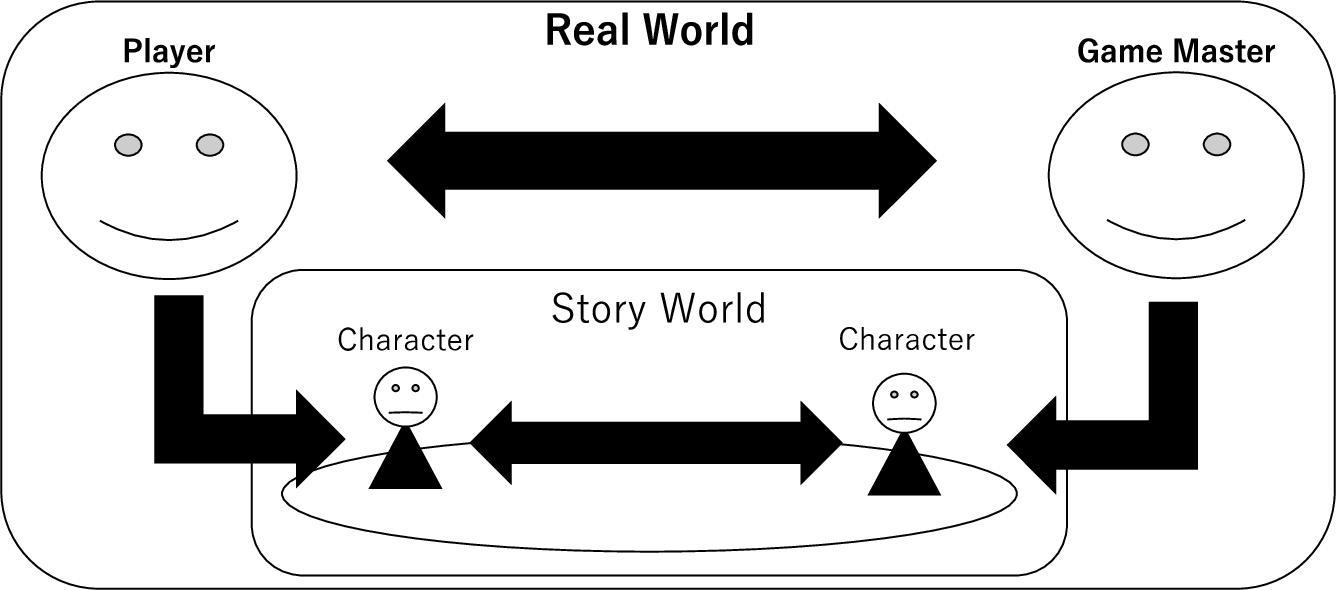
Game structure of a table-top role playing game.
In this model, the story generation mechanism is embedded in the story’s structure. The model is also influenced by the role-playing mechanic and the Lisp s-expressions discussed in the following section. This coloring technique works within the framework of “the story as a generative system.” In other words, this study proposes a method of story generation that embeds coloring techniques to spread sexual terms and representations in the framework of “the story as a generation system.”
Because the automatic story generation game is a system that models the player and game master in a TRPG, the two types of subjects form key modules, interact with each other, and generate stories. Figure 3 shows a diagram of an automatic story-generation game with the keyword “the story as a generation system.” In the proposed model, the characters correspond to the players and the author is equivalent to the game master.
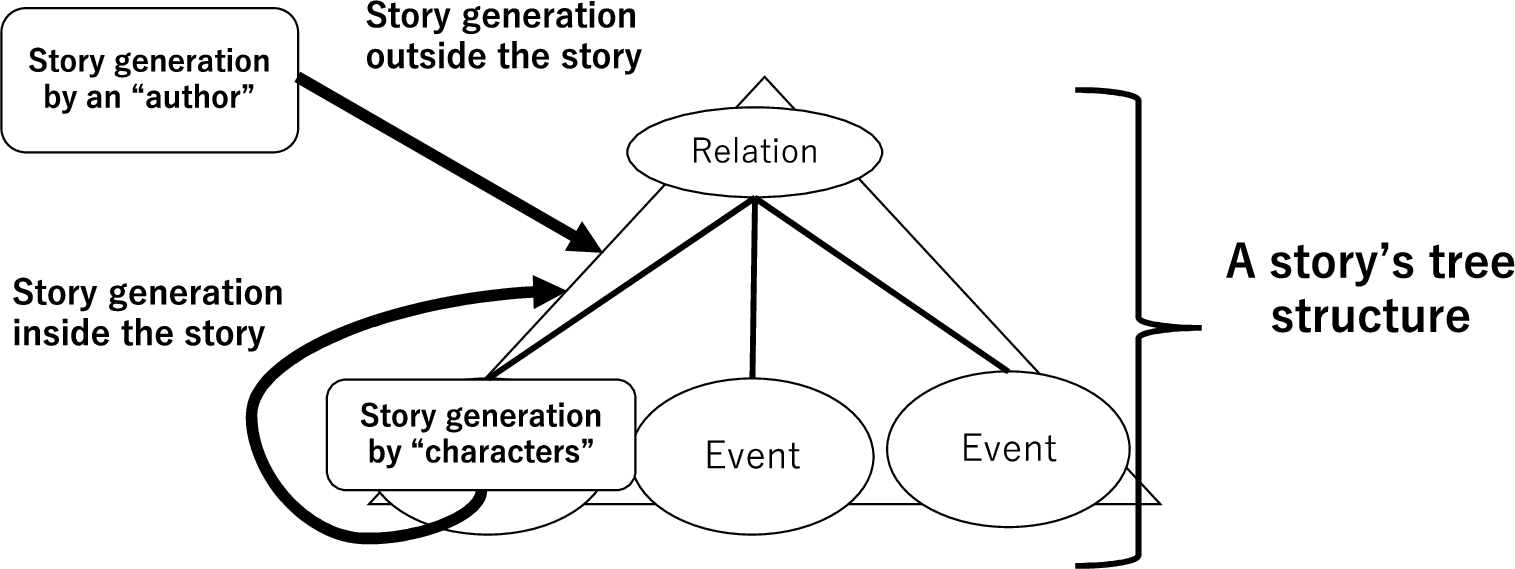
Story generation method using techniques included in a story.
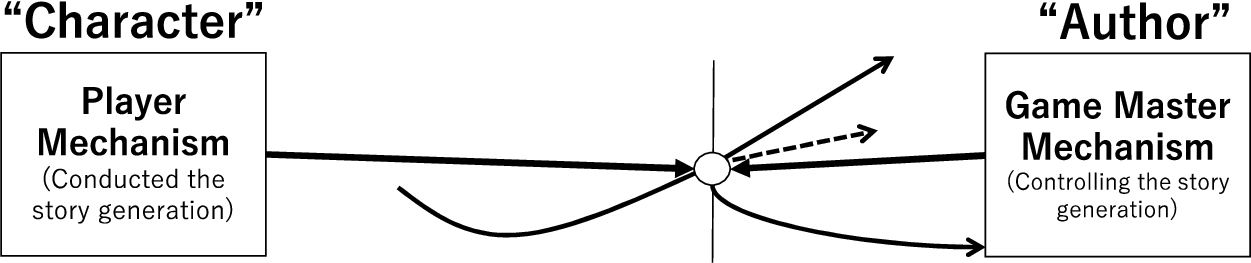
Author and characters making a story in an automatic narrative generation game.
Lisp is a functional programming language that was developed by John McCarthy in 1958. The common version of Lisp used for system development is an integrated form of the language’s diverse dialects. One major characteristic of Lisp is the s-expression, which is a way of expressing data using a list structure or set of symbols. In most programming languages, data such as values and characters are classified as types according to their categories, whereas functions are treated as procedures, and are not considered a data type. However, as shown in Fig. 4, a list expressed as an S-expression can be treated as a function or datum depending on how it is evaluated. More specifically, as shown in Fig. 5, if the symbol of the first element in the list is associated with a procedure, the expression can be evaluated as a function. The characters represented in the frame representation described in Section 2.3 have procedures related to story generation, whereas the characters function as a story generation system based on certain conditions. This mechanism is useful for representing daemons, which are described in Section 2.4, and in the proposed system the characters are both an element of the story and driven as a story-generating mechanism.
Frame representation
Frame representation is a method of knowledge representation proposed by Minsky (1974) through which general information about an object is described as a framework. Each frame has one or more slots to describe information, with each slot being assigned a concrete value or procedure to obtain a concrete value, called a daemon. As shown in Fig. 6, a concrete value is a property that an object may possess. In contrast, a daemon operates based on certain conditions to assign specific values to slots. For example, when the weight value in Fig. 6 changes, a daemon divides the weight by the square of the height and assigns the result to the BMI slot. In the model proposed in this paper, the characters in a story have attributes that represent their characteristics, and one or more characters have a technique for story generation. The daemon in frame representation is used to express the functions of the player as indicated in Section 2.1.
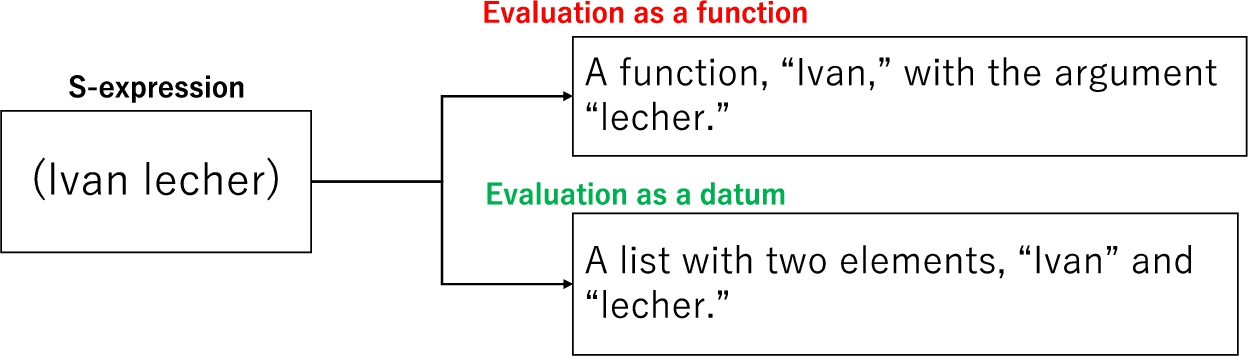
Example of S-expression.
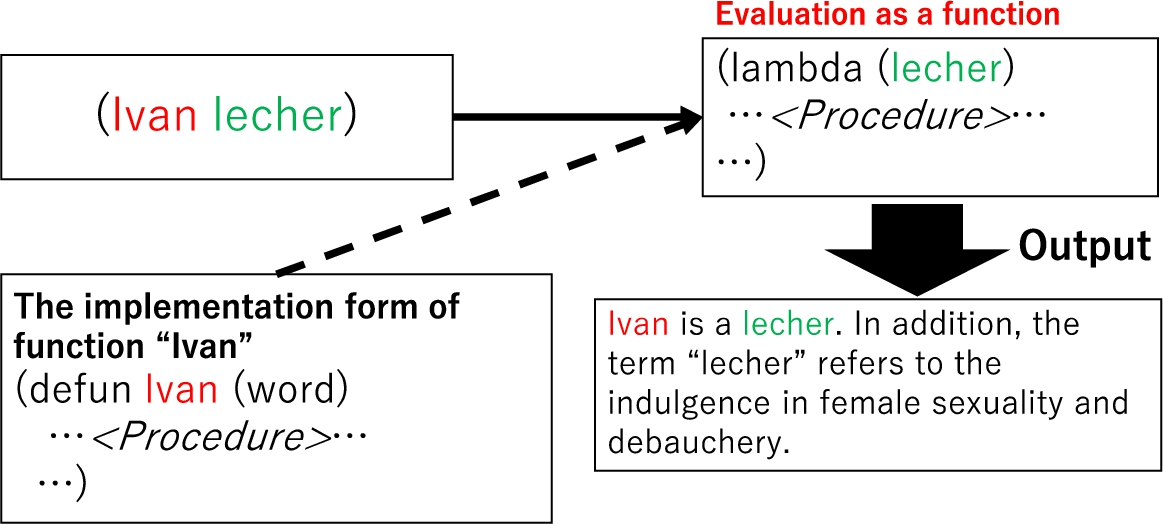
Example of evaluated S-expression as a function.
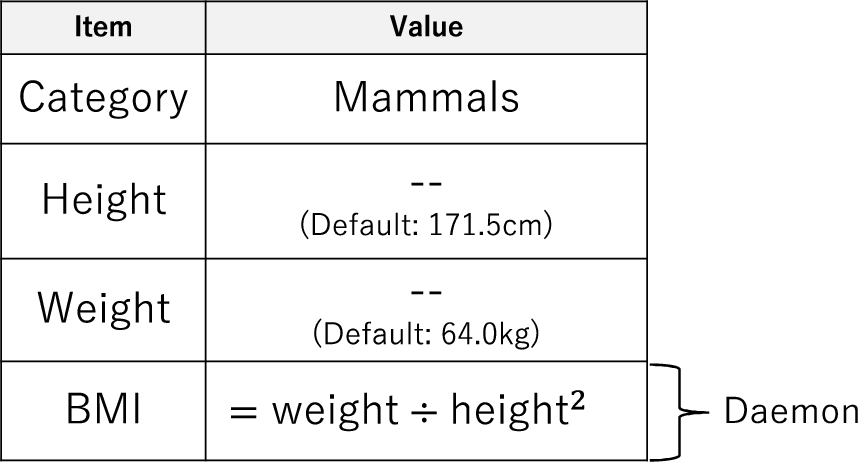
Daemon in a frame representation (a human).
Next, we explain the flow of story generation in the proposed model. The model generates stories in the order shown in Fig. 7. The following subsections describe these three steps and their order.
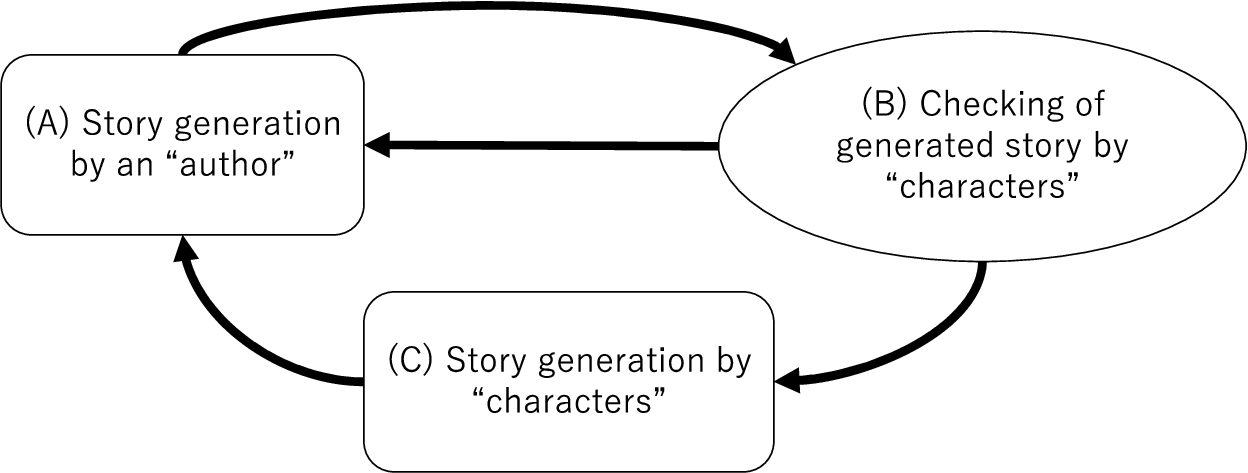
Story generation cycle in the proposed model.
The tree structure shown in Fig. 8 represents the structure and expansion of a story. This structure follows the method in the Integrated Story Generation System (INGS) by Ogata (2019; 2020). Each middle node represents a relationship (e.g., a cause-effect relationship) that connects event concepts, and each terminal node represents an event concept in the story. The tree structure of a story inside the system is represented by a hierarchical list, as shown in Fig. 9.
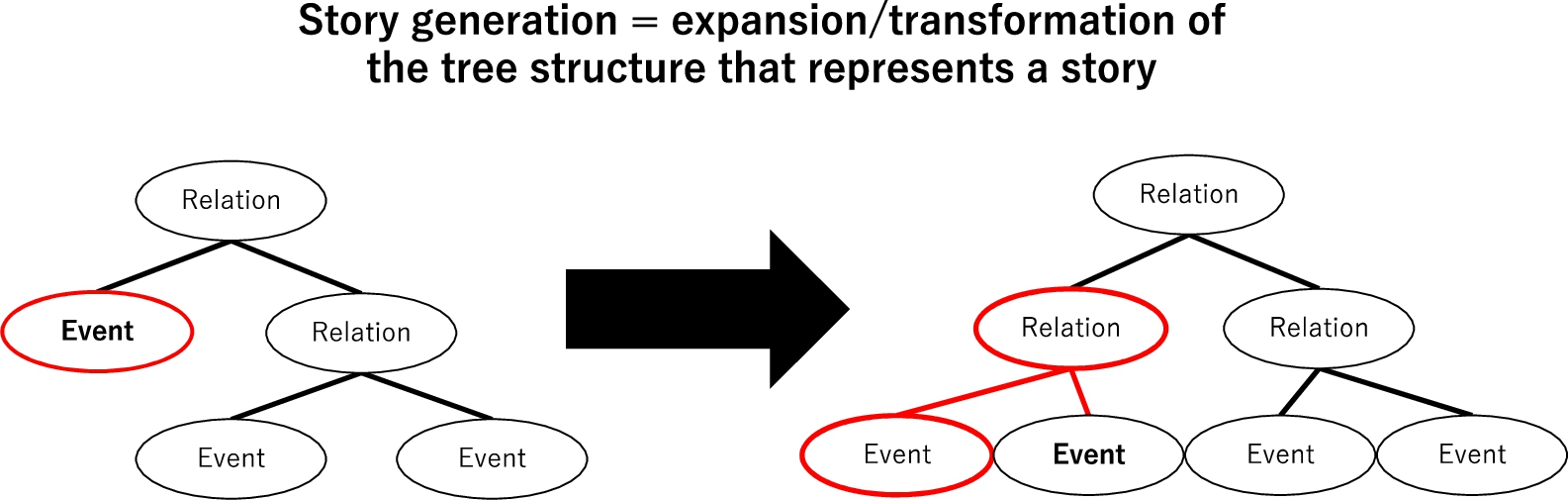
Story generation process by expanding and transforming a story structure.
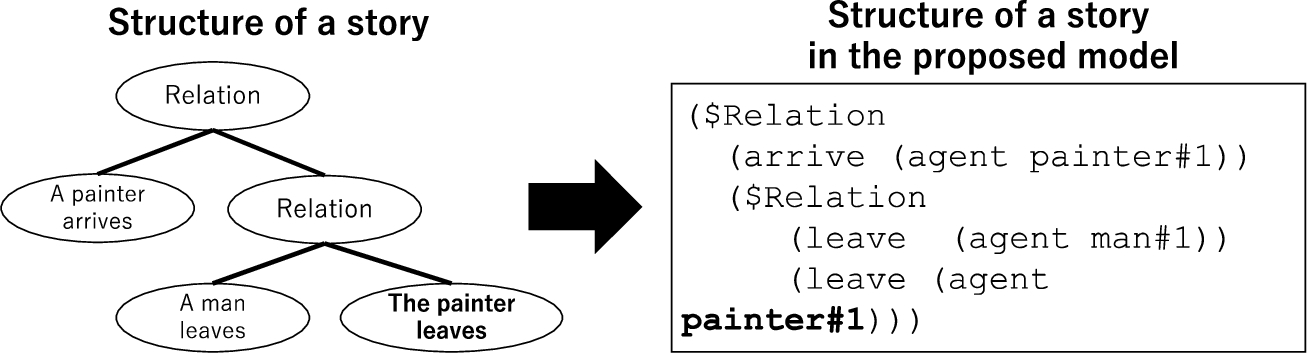
List structure that represents a story.
As shown in Fig. 8, story generation corresponds to the extension or transformation of a story-tree structure. We propose diverse story techniques (Ogata, 2019; 2020) as procedures. The coloring technique, introduced in Section 4 of this paper, is one such story technique. In this study, we treated coloring as a technique used by characters. In addition, the expansion and editing methods of a story by the author were not treated as a black box in this study. In the example shown in Section 5, “story generation by the author” shows story generation by characters by fixing certain events to be inserted in specific positions in the story.
In this example, we began the process from a stage in which the next story has already been generated. This story was prepared by cutting a segment of the story generation result using KOSERUBE (Imabuchi & Ogata, 2013). All coloring methods were used in this system. (In this paper, our system uses only Japanese language. Therefore, we attached Japanese pronunciation and translated sentences (English) for Japanese words and sentences except for long sentences).
従兄が花園で遊びに出かけた。 [Itoko ga hanazono de asobi ni dekaketa.] たわけ者が飛出しナイフ を窓ぎわに置いた。 [Tawakemono ga tobobidashi-naifu wo madogiwa ni oita.] イワンという名前の画 家が出国した。 [Ivan to iu namae no gaka ga shukkokushita.] イワンが冒険をたわけ者と競争した。 [Ivan ga bouken wo tawakemono to kyousoushita.] たわけ者が暴れた。 [Tawakemono ga abareta.] イワンに傷が付いた。[Ivan ni kizu ga tsuita.] たわけ者がイワンに競争で負けた。 [Tawakemono ga Ivan ni kyousou de maketa.] イワンが魔法の杖を利用した。 [Ivan ga mahou no tsue wo riyousita.] 魔法の杖が砕けた。 [Mahou no tsue ga kudaketa.] [The cousin went outside to play in the flower garden. An idiot jumped out and a knife was placed on the window sill. The painter, Ivan, left the country. Ivan competed with the wrongdoer for the adventure. The ruffian went on rampage. Ivan received a scar. The trickster defeated Ivan in a competition. Ivan used his magic wand. The magic wand shattered.]
In this example, the story generation mechanism by the author appends the following four events in sequence, one per cycle, to the end of the story: 「イワンがたわけ者から城に逃げた。」 [Ivan ga tawakemono kara shiro ni nigeta.; “Ivan fled to the castle from the devil.”], 「メロスという名前の男が言い張 った。」 [Meros toiu namae no otoko ga iihatta.; “A man named Meros insisted’.”], 「メロスが報酬を親 王に要求した。」 [Meros ga houshu wo shinou ni youkyu shita.; “Meros demanded a reward from the king.”], 「親王がイワンと会った。」 [Shinou ga Ivan to atta; “The king met with Ivan.”]. Figure 10 shows that, in the first cycle, the first event is inserted into the story.
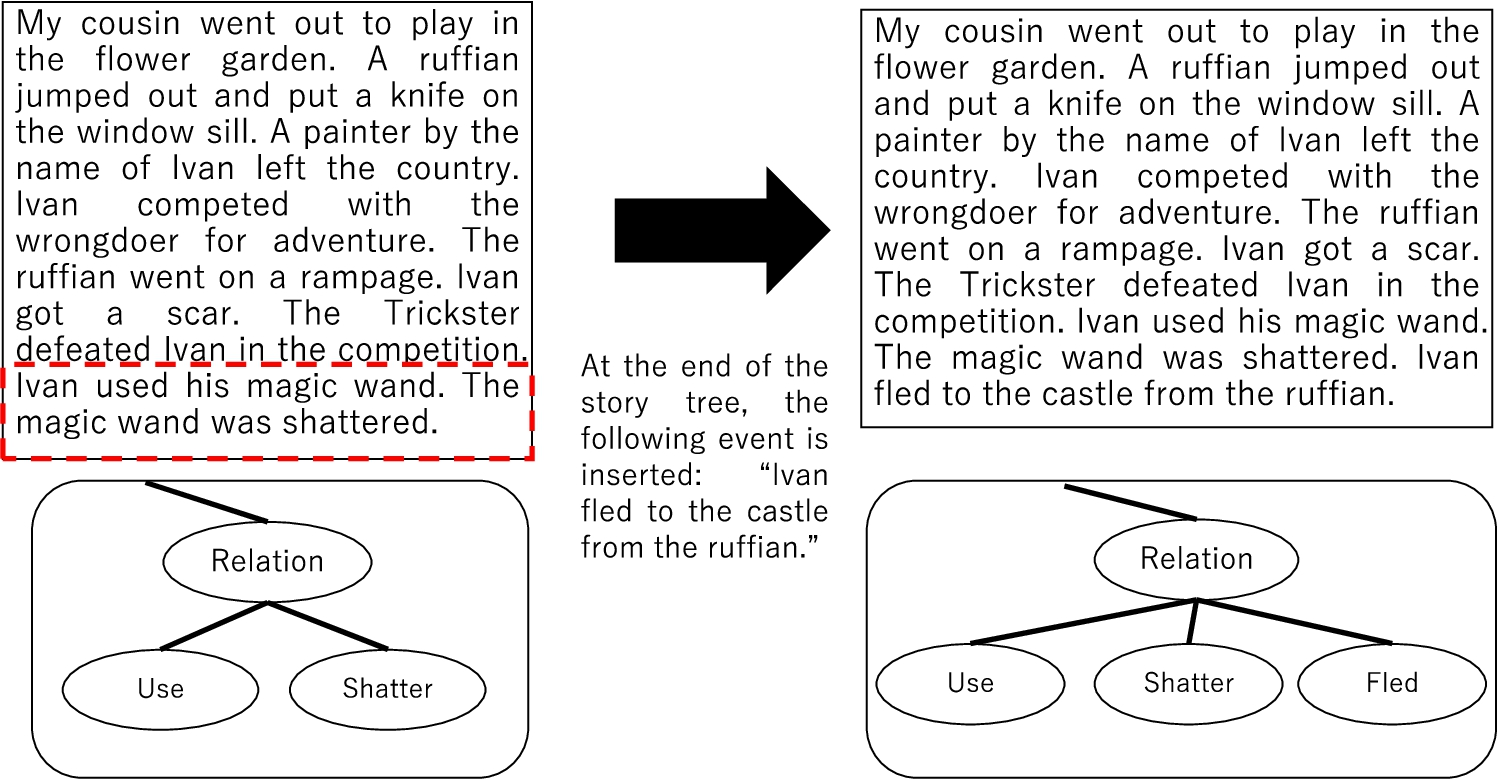
Story generation by an author.
In the proposed model, a character may have information regarding story generation in addition to their personal attributes. In Fig. 11, the four slots enclosed by the frame contain information concerning story generation, whereas the other slots hold the character’s attributes. The definitions of the four slots are as follows:
Figure 12 illustrates the relationship between these four slots. The procedure stored in the stimulus takes the stories before and after generation by the author as arguments, and measures the difference between the two stories. If the measurement result satisfies the condition defined by the procedure stored in the stimulus, the attribute value increases. The attribute value is then compared with the threshold value. If the attribute value is equal to the threshold value, the story technique is used, and the attribute value is set to zero. Generation using the story technique is described in Section 3.3. If the attribute value is less than the threshold, no action is taken. In either case, the procedure returns to the story generation by the author, as described in Section 3.1.
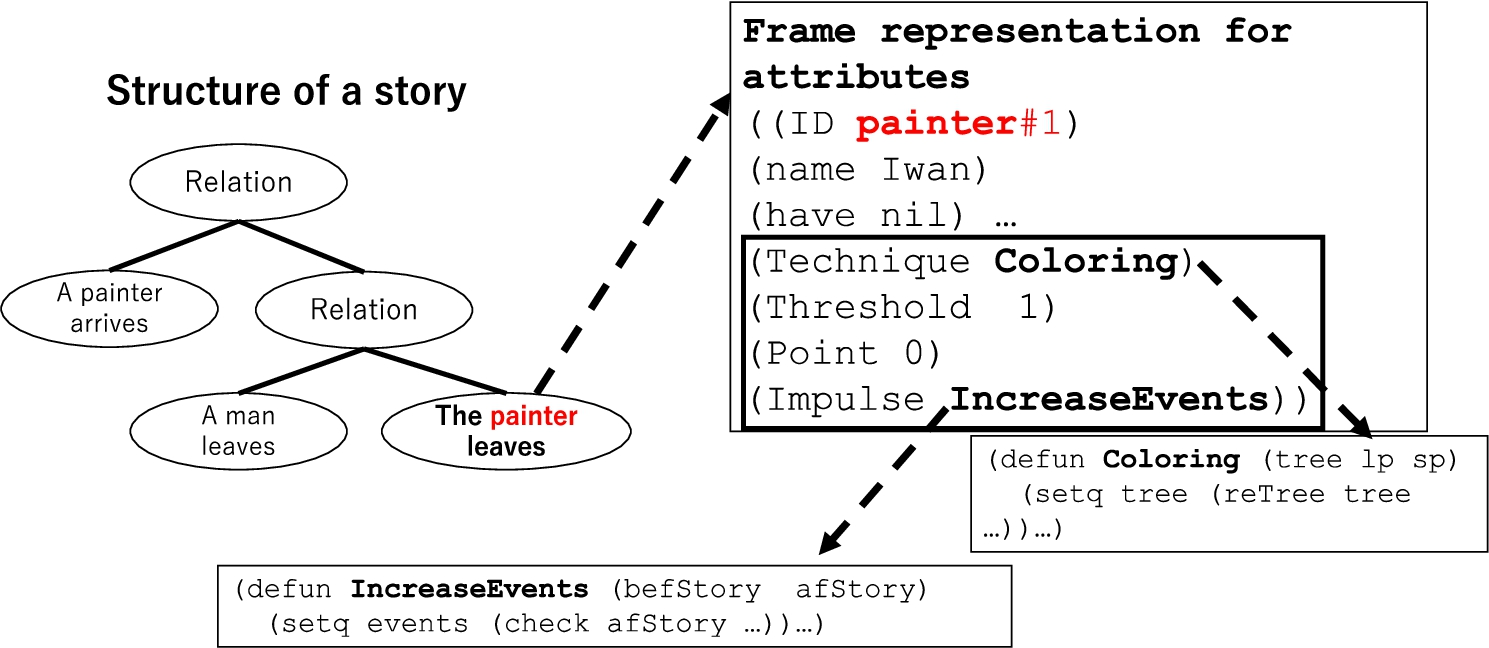
Character frame in a story structure.
A character with the story technique has the frame shown in the following description. Although other characters are present in the story, the story generation presented in Section 3 includes only Ivan as a character with the story technique. This character drives the coloring of sexuality whenever an additional event occurs in the story.
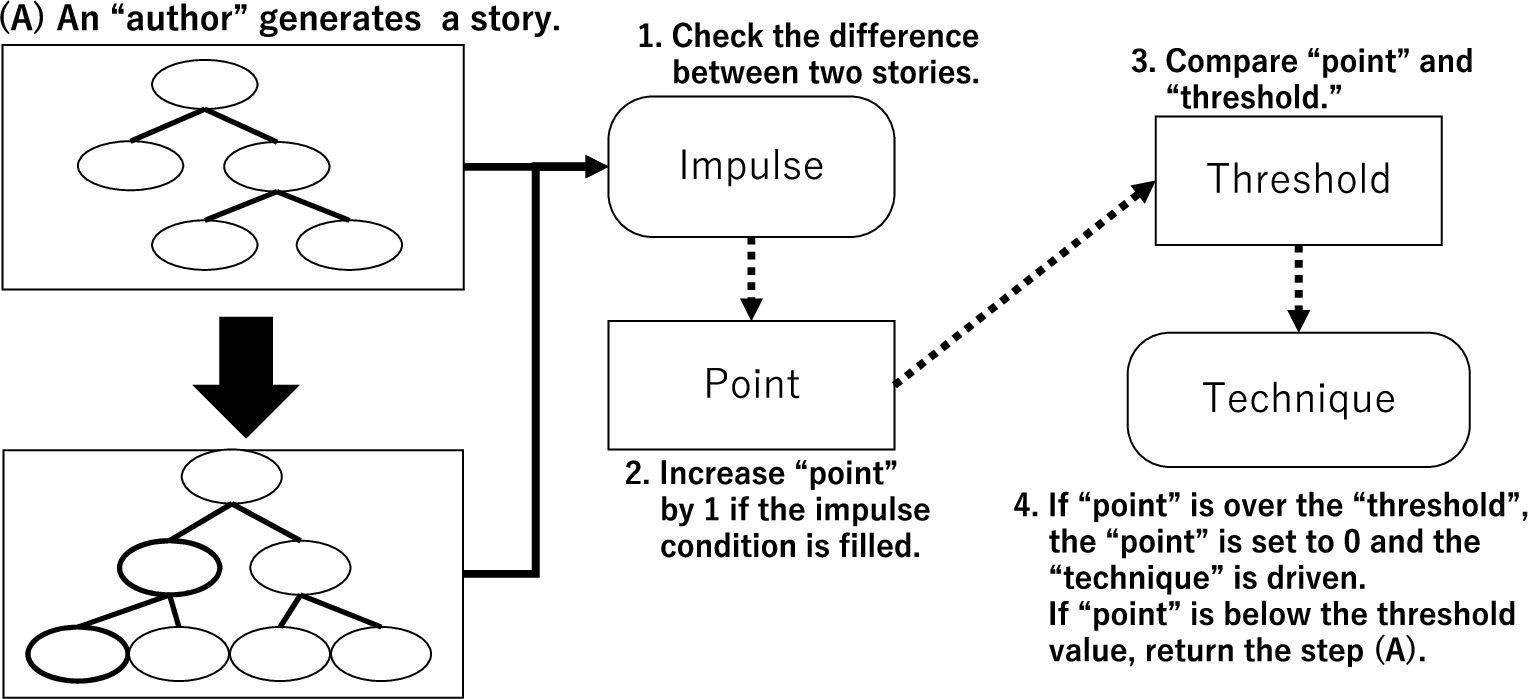
Relationships among impulse, point, threshold, and technique.
The driven story technique uses one node of the tree structure as an argument to perform story generation, as shown in Fig. 13. The selected nodes are limited to those that can be extended or edited by the driven story technique, and any one of these nodes may be selected. In this study, characters employed the coloring technique described in Section 4. By using story techniques other than coloring, we can develop a story generation different from the one described here.
After the author generates the story, the characters drive the procedure stored in the stimulus to check the story expansion or edits, as shown in Fig. 14. In this case, the number of events in the story increases by 1 because of the author’s expansion. Therefore, the condition of the procedure stored in the stimulus is satisfied, and the attribute of Ivan likewise increases by 1. The threshold and attribute values are then compared. If the two values are equal, the story technique is used. In this case, the technique in question is a coloring related to sexuality, applied to Ivan himself. This cycle is repeated four times. Figure 15 shows the story before and after this series of processes. Here, bold text denotes events added to the story, whereas underlined text represents the results of coloring.
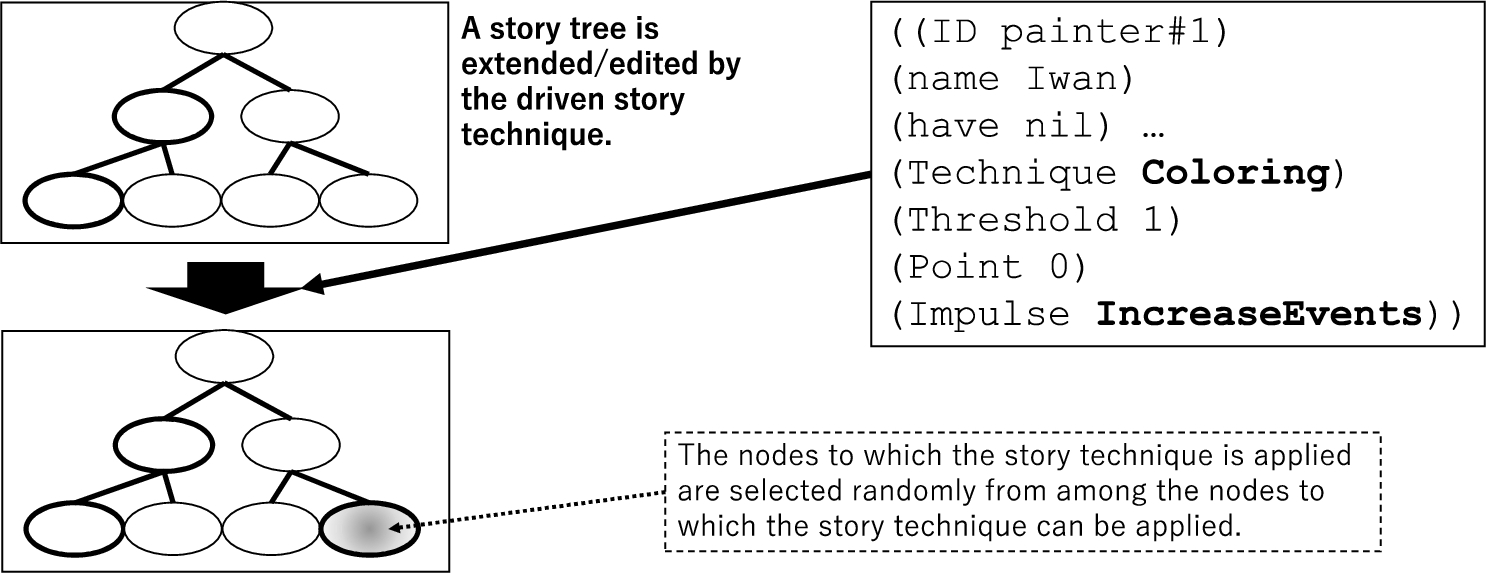
Driving mechanism of a story technique.
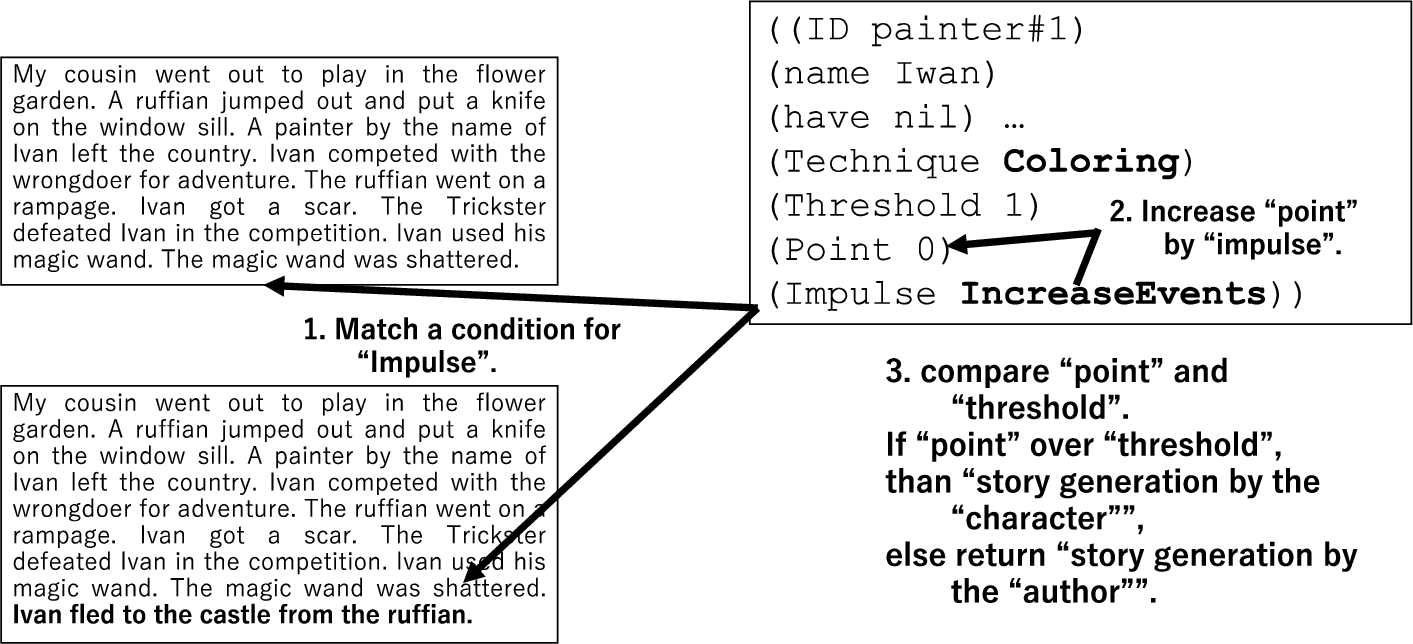
Checking the change in a story by characters.
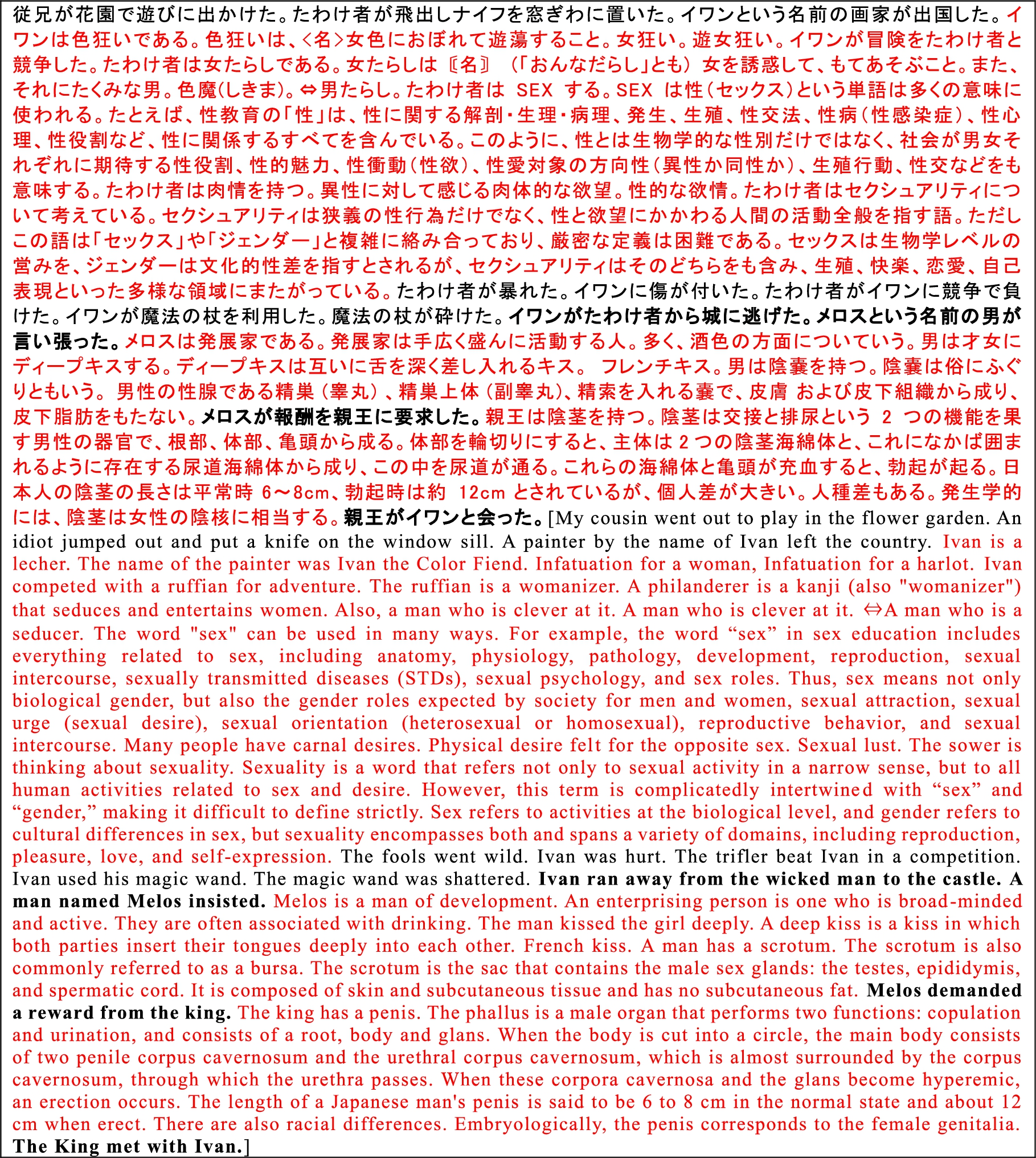
Comparison between the original and colored stories.
This section introduces the proposed coloring technique. The different methods in this technique are as follows: (1) In Section 4.1, we introduce a coloring method based on a previous study (Ono, Kawai & Ogata, 2022), which uses the noun concepts of sexuality. (2) In Section 4.2, we focus on a method that use adjectives and verbs. (3) In Section 4.3, we consider a coloring method using other stories. Moreover, (4) In Section 4.4, we extend a coloring method that use adjectives and verbs.
Coloring method using noun concepts
The coloring technique is a narrative technique proposed by us based on a method in novels described by Shimada (2009). The coloring technique is a narrative technique proposed by us based on a method in novels described by Shimada (2009). For example, Shimada quotes I’m Sorry, Mama by Natsuo Kirino1 as follows.
“アダムは不安そうな声を出した。アイ子は構わず、アダムの下着を剥がした。肉厚の体が現れた。
胸毛が渦巻き、臍を取り巻き、下腹部まで伸び、股間を通って背中まで伸びている。獣みたいだ。
アイ 子は可笑しくなって、アダムの禿頭の上に肉塊を載せた。
「ほら、似合う。あんたは獣だから」
アダムは肉から流れる血をたらたらと眉間に垂らしながら笑った。見る見るうちに、ずんぐりと埋も
れていたペニスが勃起した。”
[Adam sounded worried. Aiko didn’t care and pulled off Adam’s underwear. A thick, fleshy body was revealed. Chest hair swirled around his navel, extending down to his lower abdomen, through his crotch and down his back. He looks like a beast. Aiko found it funny and placed the mass of flesh on Adam’s bald head.
‘See, you look good. You’re a beast.’
Adam laughed, blood dripping from his flesh onto his brow. As he watched, his sloppily buried penis became erect.]
I’m sorry, mama, pp.90–91, (Kirino, 2007)
In this instance, the lumps of flesh and flowing blood are treated as symbols of bestial life, thereby giving the reader the impression of a wild sexual love affair from the text. The coloring we propose not only deals with impressions based on certain colors, but also with elements that symbolize certain impressions.
Coloring in the field of Love and Sex with Robot has a double meaning: it means not only coloring the story with a certain mood, but also coloring it with sexual desire. In the field of Love and Sex with Robot, coloring has a double meaning: it means not only coloring the story with a certain mood, but also coloring it with sexual desire.
In Japanese, the character for color not only refers to the visual stimulus color, but may also refer to sexual desire. For example, the Japanese word irogurui (色狂い) means “lecher.” Iro (色) is color and gurui (狂い) is madness. Irogurui (色狂い) means infatuation for color. However, this iro (色) is not color, but sexual desire.
As a concrete attempt to color, we implemented a method based on the concurrence relationships of noun concepts (Ono, Kawai & Ogata, 2022). We used concepts stored in the noun conceptual dictionary of the INGS (Ogata, 2015). Figure 16 presents an outline of the coloring technique. In coloring, the event concept in the story structure is used as an argument. A noun concept related to sexuality is given to a character, and an explanation of the noun concept is inserted into the story. Figure 17 shows an example of the coloring technique. The algorithm is as follows:
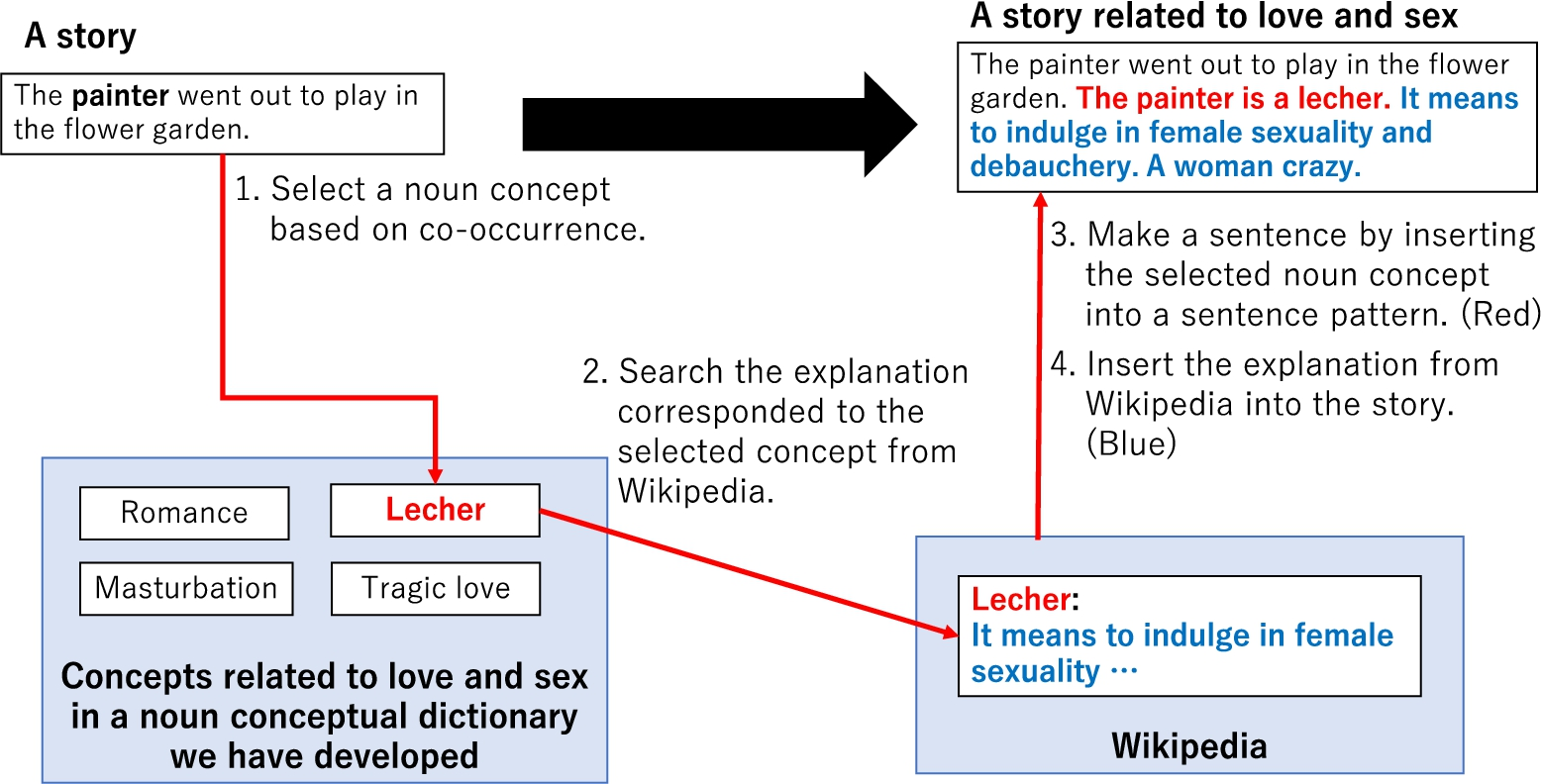
Coloring process using noun concepts related to love and sex.
This technique refers to the character in the event concept of an argument. The technique obtains concurrence information between the characters and all noun concepts related to sexuality shown in Table 2 in Ono, Kawai, & Ogata (2022), and selects the noun concept with the highest concurrence value. If the highest value is shared by multiple concepts, the selection is made based on the order in which the concepts are stored.
This technique provides an explanation corresponding to the selected noun concept. This explanation is obtained from web encyclopedias and dictionaries, including Wikipedia (Japanese version,
This technique generates sentences by applying the selected noun concept to a sentence pattern. The generated sentences are concatenated immediately after the event concept is taken as an argument.
This technique inserts the obtained explanation immediately after the sentences are generated by the noun concept.
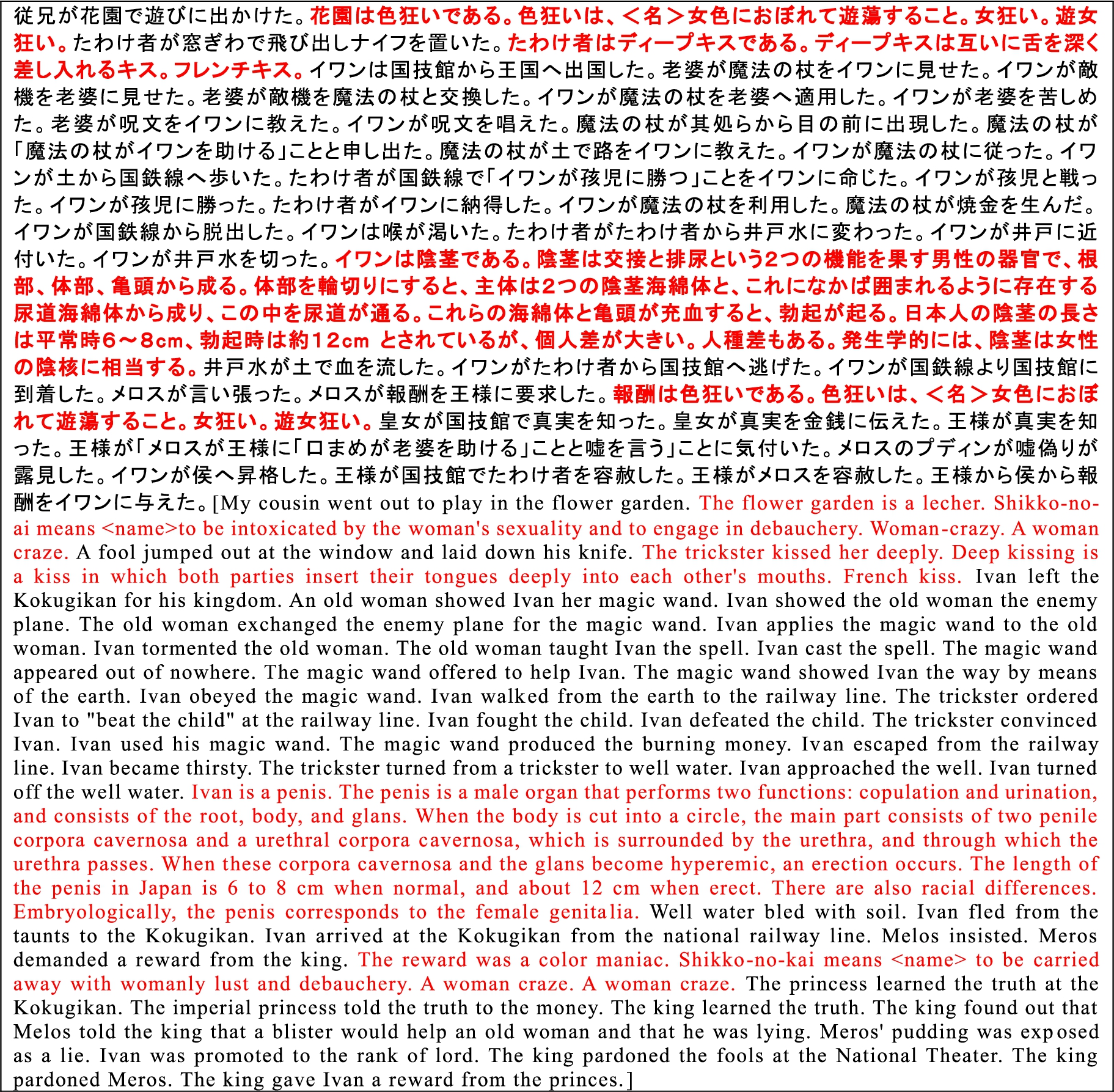
Example of the coloring technique.
This method, which serves as the predecessor of the method described in Section 4.4, selects a single color, followed by adjectives from the color image scale (Kobayashi, 1981). For each selected adjective or adjectival verb, a noun concept related to sexuality is added to the attribute of the person to be colored. The physical part to be selected is determined randomly. The varying attribute is the appearance slot.
This implementation of the coloring technique can be extended depending on the data used and the way in which they are combined into the story. Of the methods presented here, we focus on combining adjectives and adjective verbs with colors. The coloring was prototyped for story generation with multiple characters, as described in Section 5.
This type of coloring method rewrites the characters’ attribute frames. In particular, it colors the characters using the adjective and adjectival verb concepts based on the color image scale2 (Kobayashi, 1981) – a scale that summarizes the common image of a color. The colors are plotted in two-dimensional space with a warm-cool horizontal axis and a soft-hard vertical axis. All modifiers, such as adjectives and adjectival verbs, are plotted in the same space. This allows us to identify the type of image evoked by a particular color or color scheme. We used this information to study how to apply colors that evoke specific images. For example, for the coloring of blue, we used adjectives and adjectival verbs that are located at the same coordinates as blue, and color schemes that contain blue.
Coloring by modifier concepts is performed by specifying a color. The input is a single-event concept, and the procedure rewrites the content of the attribute frame of the person (agent) in the input. Specifically, it adds a modifier concept for a specified color to the slot of the attribute frame. Events based on modifier concepts are then added to the tree structure of the story. Here, we use the modifiers “cool,” “clean,” and “pure” for blue. These are adjectival concepts that correspond to image words on the cool side of the color image scale. Figure 18 shown an example of coloring by modifier concepts.
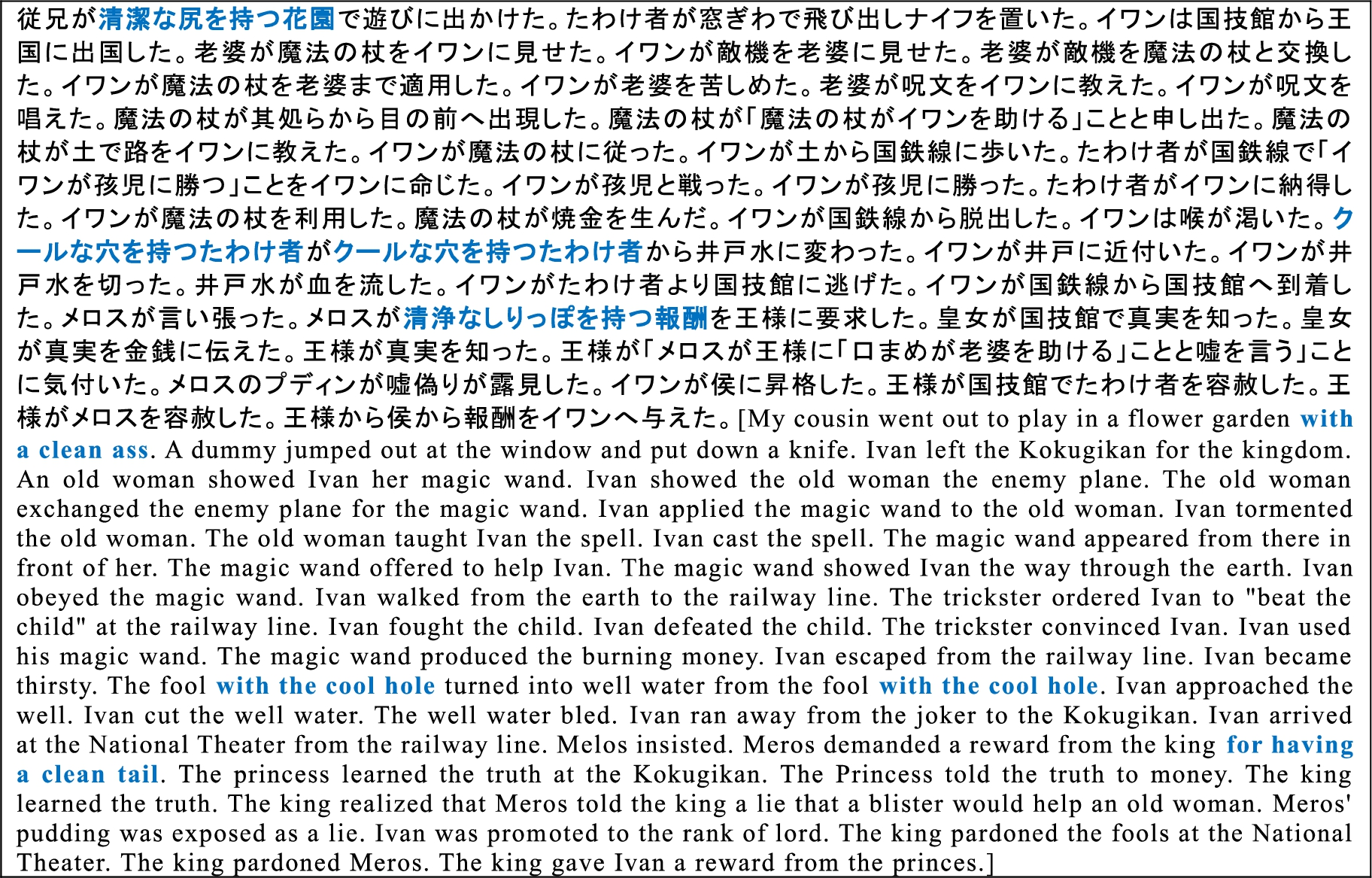
Example of the coloring method using adjectives and adjectival verbs.
Although coloring is usually achieved by inserting data to be used in the story’s structure, we propose a method that replaces existing elements in a story with different data. The characters, locations, and objects in the story are replaced with other words. We obtained elements for this method from our analysis of the Dōjōji legend (Kawai, Ono, & Ogata, 2021, 2022). The legend of Dōjōji is a love story originally written in Dainippon Hokkekyo Genki (Miraculous Tales of the Lotus Sutra from Japan), which has been handed down to the present in various forms, such as nō, ningyō-jōruri, and kabuki dance. This legend tells the story of a Buddhist monk named Anchin, who breaks his promise to a woman named Kiyohime on a visit to Kumano; consequently, Kiyohime, transformed into a snake by her anger, burns down the bell of the Dōjōji temple where he had fled.
A work may be specified for coloring by element substitution. The input is a single-event concept, and the procedure replaces the person (agent) and location in the input event concept with the components of the specified work. Here, the legend of Dōjōji was specified as the data for coloring, and the story’s main characters (Anchin and Kiyohime) as well as the locations of Dōjōji and Kumano were used as substitution elements.
The objective is to create simple sentence representations that modify the characters, locations, and objects that appear in the legend of Dōjōji. This system uses formulaic sentences in its sentence representation. Table 1 shown the formulaic sentences. The formulation is based on an analysis of the legend of Dōjōji presented by Kawai et al. (2022). Figure 19 shown an example of Coloring method by exchanging of elements in a story.
Sentences for coloring method by exchanging of elements in a story
Sentences for coloring method by exchanging of elements in a story
(Continued)
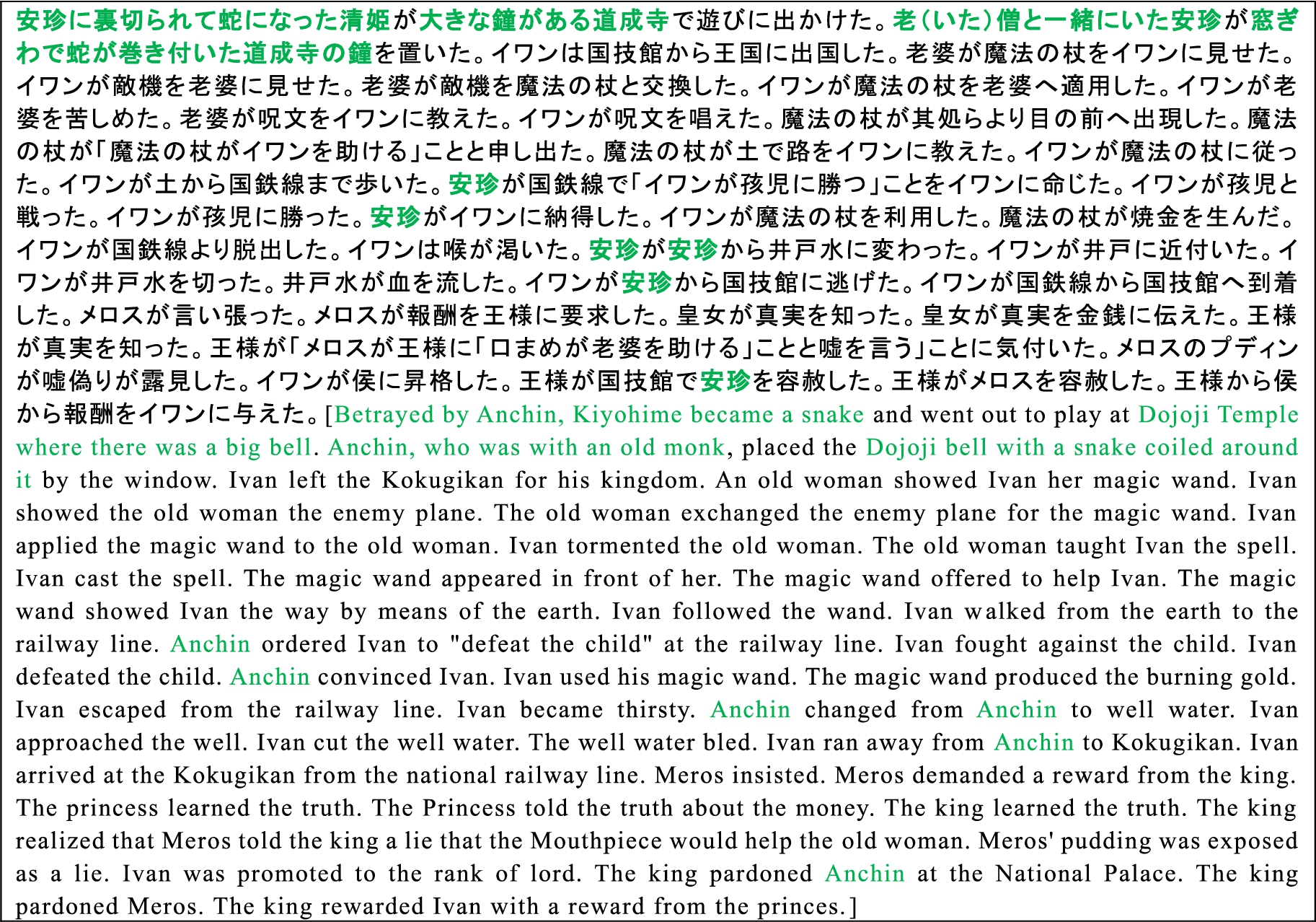
Example of the coloring method that exchanges elements in a story.
The basic form of this method is equivalent to the adjective/pronoun-based coloring method described in Section 4.2. However, the number of specified colors is increased. To increase the number of colors and incorporate color imagery related to sexuality, multiple colors were used based on images of downtown areas in Japan. In addition, standardized text was prepared to express the mood of the images in the text.
To represent sexuality, we examined how we could approach coloring using adjectives. Here, we take the color codes that make up a particular image and compare the results with the color image scale.
Although this method selects adjectives and adjectival verbs from values with perfectly matching color codes, it does not necessarily match the color codes obtained from the image. Therefore, we attempted to match similar colors using color adjacency. HSV, which stands for hue, saturation (chroma), and value (brightness), is a method of expressing color as a quantity. In this study, we used hue to calculate the adjacency of colors. To obtain the RGB color code, we used the Image Color Picker tool (
The image we prepared to obtain colors related to sexuality is of 歌舞伎町 [Kabukichō]3 (Shinjuku, Tokyo), a famous downtown area in Japan. The color code obtained from this image is shown in Fig. 20. Colors with a V value of 70% or higher when expressed in the HSV are shown in Fig. 21.
When a color is selected, the mechanism searches for its position on the color image scale map. The scheme of the color image scale map contains 16 categories, each of which includes one or more color scheme patterns, including three colors. The mechanism compares the colors in Fig. 21 with those included in the color scheme to search for the position of the colors acquired from Kabukichō in the color scale map. When the mechanism is unable to find the same color in the parameters, it searches for a color in which the value of hue is within the range of ±36. Next, the mechanism searches for a color scheme that matches the selected color, prioritizing the color schemes in categories adjacent to the specified category. For example, to match a color scheme from the gorgeous category, the mechanism chooses schemes from the casual and chic categories. In the next step, the mechanism determines the candidate of the adjectives and adjective verbs included in the gorgeous category. The following list details three categories of color schemes and related adjectives and adjectival verbs based on Kobayashi (1981). Because Kobayashi uses words of modification beyond the range of adjectives and adjectival verbs, we also included such words in this mechanism. Gorgeous Category The adjectives and adjective verbs based on the color scheme related to 魅惑的な [miwakutekina; attractive]: あでやかな [adeyakana; florid], 艶っぽい [tsuyappoi; amorous], 華麗な [kareina; brilliant], セクシーな [sekushiina; sexy], 魅力的な [miryokutekina; attractive] The adjectives and adjective verbs based on the color scheme related to 豊潤な [hojun’na; abundant] in the color scheme of “gorgeous”: 豊かな [yutakana; rich], 装飾的な [soushokutekina; decorative], 豊潤な [hojun’na; abundant] The adjectives and adjective verbs based on the color scheme related to 豪華な [goukana; gorgeous]: 豪華な [goukana; gorgeous], 贅沢な [zeitakuna; luxurious], 円熟した [enjukushita; mellow], こってりした [kotterishita; lush], 充満した [jumanshita; full] Casual Category The adjectives and adjective verbs based on the color scheme related to ポップな [pop]: 陽気な [youkina; cheerful], 快活な [kaikatsuna; vivacious], はつらつとした [hatsuratsutoshita; lively] Chic Category The adjectives and adjective verbs based on the color scheme related to 風流な [huryuna; elegant]: 風流な [huryuna; elegant], 枯れた [kareta; withered], ひなびた [hinabita; rustic]
The following description is a method that inserts erotic words related to love and sex into an original story, and combines the words with adjectives and adjectival verbs. When erotic words already exist in the story, this method is not necessary. The purpose of the mechanism is to assign the aforementioned adjectives and adjectival verbs to all noun concepts in the story. The mechanism selects one descriptor that has not yet been selected to combine the selected word with a specific noun concept. If all adjectives and adjective verbs have been selected, the same words can be selected again. Next, the noun concepts associated with adjectives and adjectival verbs are further combined with erotic noun concepts related to love and sex, as the original noun concepts are not always erotic. In particular, the aforementioned descriptors are associated with case elements, including “agent,” “object,” and “location,” in the events of the original story described in the following section. Moreover, the events have attributes, such as “looks,” “appearance,” “atmosphere,” and “personality,” and the mechanism selects the appropriate erotic noun concepts using Table 2.
The proposed system requires the generation of concepts related to love and sex. The mechanism includes candidates for the concepts in Table 2 according to attributes and topics:
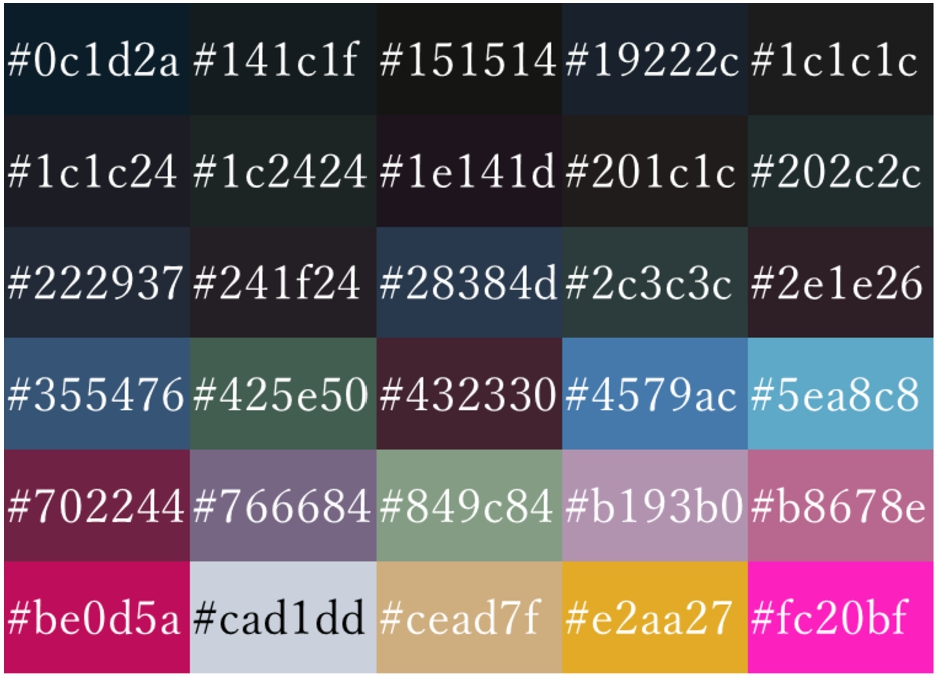
Colors of Kabuki-chō.

Colors used.
Candidates of noun concepts according to attributes and topics
(Continued)
Based on the story presented in Fig. 22, the story of Fig. 23, colored using adjectives and adjectival verbs, was generated via the aforementioned method. Adjectives, pronouns, and noun concepts were inserted into the attribute frame based on the color image scale. For representing coloring method using colors in a picture by sentences, there are following three types of sentence forms. Italic style words (X, Y, N, Instance) are variables. The words in X and Y describe the characteristics of Kabukichō. One of “neon,” “lights,” “atmosphere” is inserted into X, whereas one of “karaoke,” “bar,” “hotel,” “crowded,” is inserted into Y. For Instance, the target of the coloring is inserted, for N, a noun concept related to sexual love is inserted.
For characters: 「歌舞伎町の X の Y のような N である Instance」[Instance that is a N such as X of Y of Kabukichō.]
For objects: 「歌舞伎町の X の Y のような N に似たInstance」[Instance that similar to a N such as X of Y of Kabukichō.]
For locations: 「歌舞伎町の X の Y のような N に適したInstance」[Instance that suitable for N such as X of Y of Kabukichō.]
In this section, we describe the generation of stories based on multiple characters. In this example, we start the processing from the stage where the story in Fig. 22 has already been generated. The following eight events are then inserted in each cycle: “the princess learns the truth,” “the princess tells the truth,” “the prince learns the truth,” “Melos’ deceit is exposed,” “Ivan is promoted to prince,” “the king forgave the fool,” “the king pardoned Meros,” and “the king gave Ivan his reward.” As in Section 5, the author generates the story, and the characters check the expansions or edits made. However, the conditions under which the story technique is applied differ for each character.
In a manner common to all colorings, only one coloring may be applied to a single component. Furthermore, if an attribute is assigned to a constituent by coloring, the attribute’s expression is limited to a single event. However, coloring based on substitution of a constituent replaces the very constituent that was the subject of the coloring, so the change spills over to other events.
Each character uses a story method. Figure 24 shows the final results. In this figure, underlined words are colored by sexuality, italicized words are colored by modifiers, and bold words are colored by substitution.
- Ivan: coloring on sexual love/Threshold: 1/ Impulse: change of “location,” number of location instances
- taunter: adjective/pronoun coloring/Threshold: 1/ Impulse: decrease in “wellness,” Number of relationships
King: coloring by element exchange/threshold: 1/ impulse: change in number of additional events, number of person instances
Melos: image-based coloring/threshold: 1/ impulse: change in “possession,” number of object instances
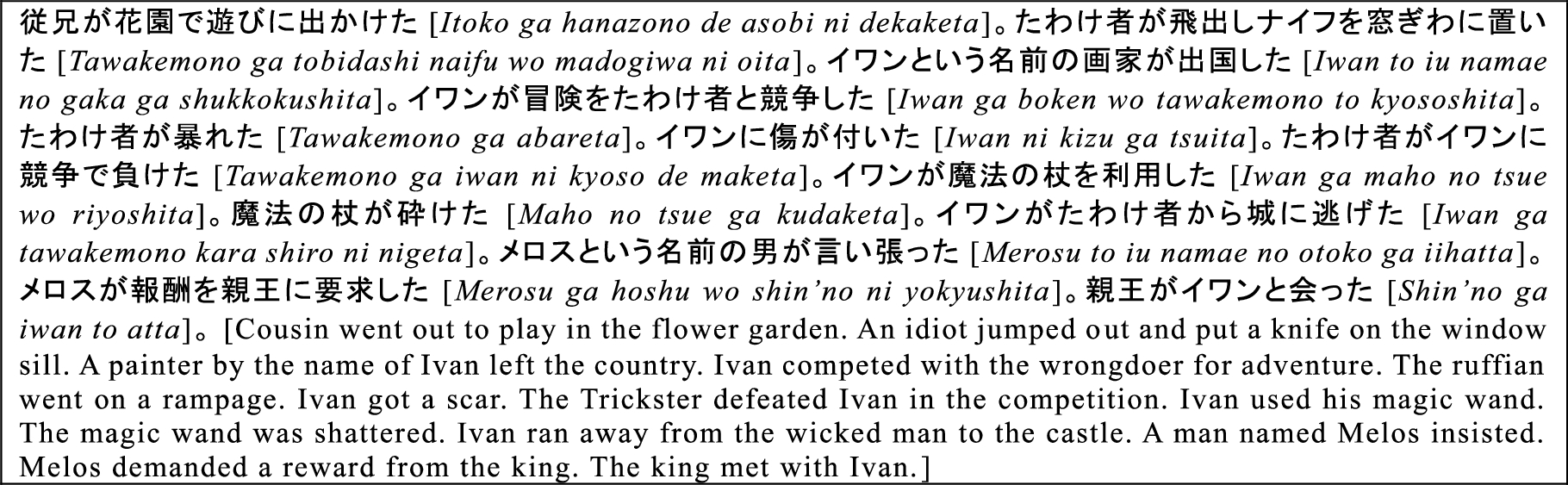
Original story.
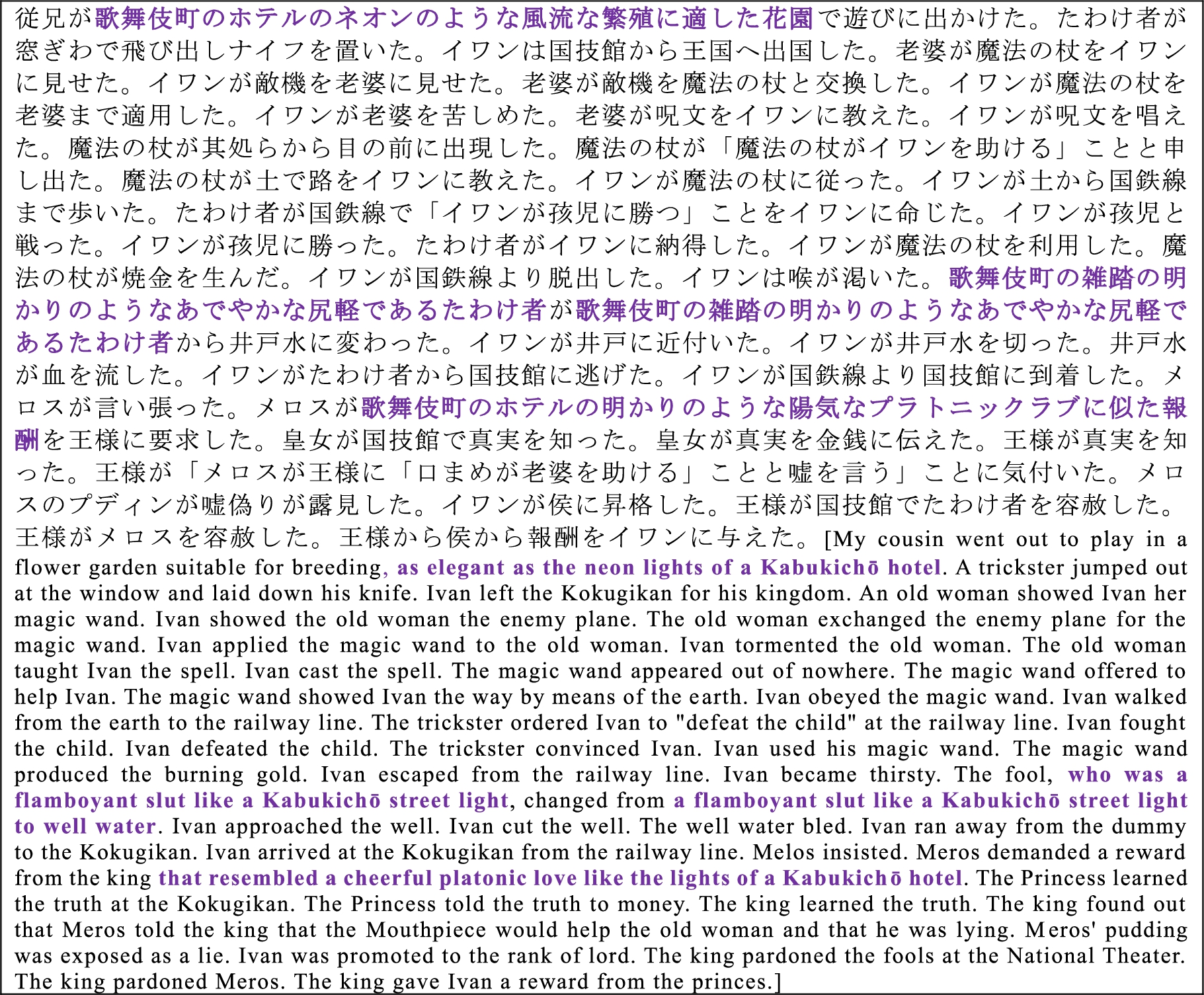
Example of the coloring method using colors in a picture.
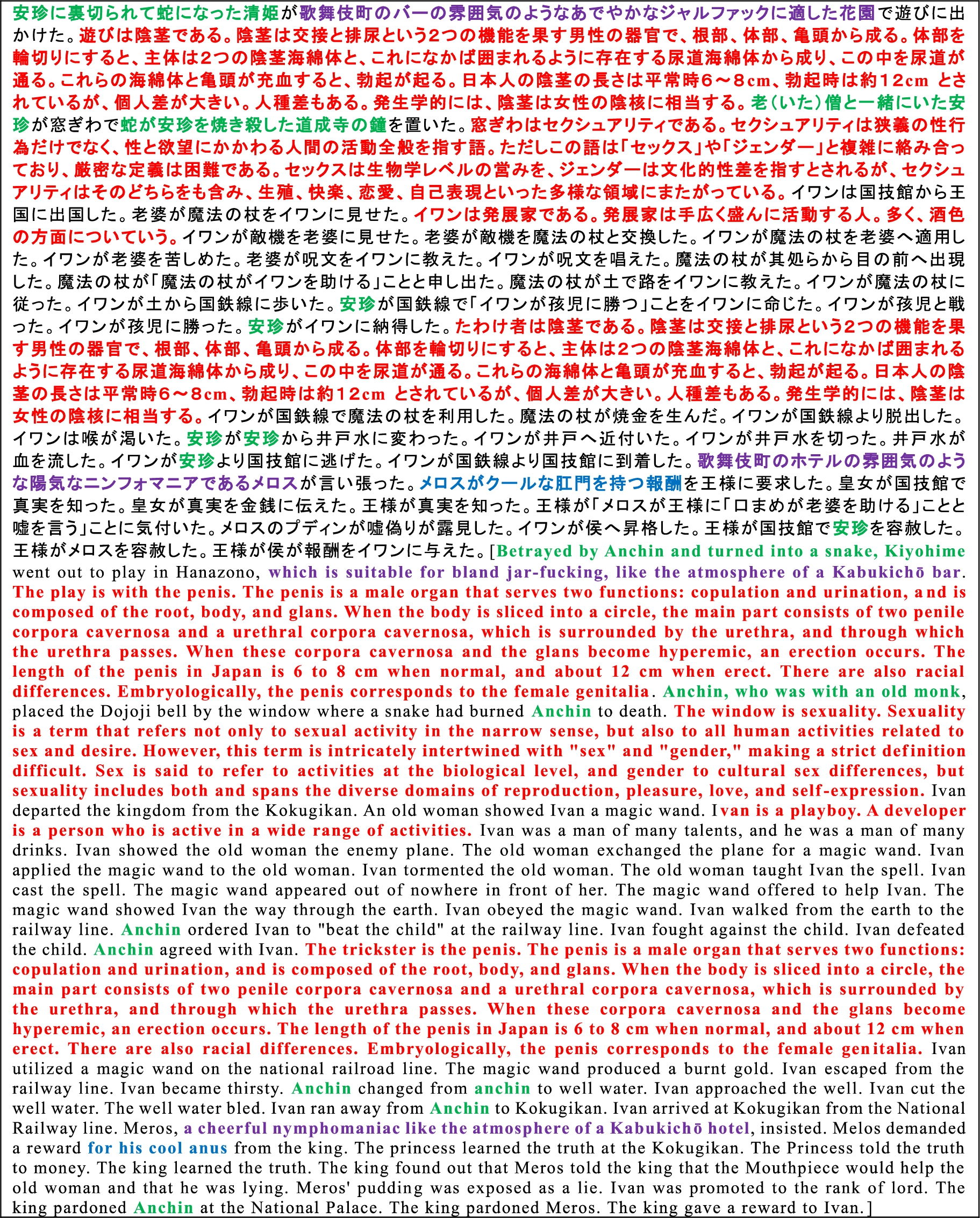
Example of story generation using coloring by multiple characters.
This section introduces the proposed coloring technique. Section 6.1 shows the consideration of the story generation in Section 5. In Section 6.2, we discuss limitations and challenges of the coloring technique. In Section 6.3, we consider the extension to robotics.
Consideration of example of story generation using the coloring technique
In Section 5, the results shown in Fig. 24 were generated by repeating four cycles of event insertion by the author and coloring by the character, to a story prepared in advance. In the framework of story generation based on mechanisms by author and character, we proposed coloring techniques that intersperse words and other information to provide an atmosphere related to love and sex in a story, and implemented several experimental systems dependent upon these methods. In this system, the character Ivan functioned as a person who was able to drive the coloring technique that adds many sexual words to create a sexy atmosphere for the story. However, the lengthy explanations accompanying the inserted sexual words gave the impression of cutting off the story flow; therefore, we will examine how to edit the inserted explanations. As shown in Fig. 24, in the case of story generation using a single character, the story flow appears to be cut off by the long explanations accompanying the inserted concepts of sexuality. Although the system in this study uses a format in which all stored knowledge is inserted purely for coloring, it is necessary to consider how to edit the inserted explanations in the future. For example, the results of this study can be treated as a way to increase the influence of characters on story generation, while the use of shortened explanations can be considered as a way to decrease the influence of characters on story generation.
Figure 24 shows examples dealing with “story generation by multiple characters.” In this figure, the author repeated the cycle of inserting events one by one 8 times, and four “characters,” each with a different story technique, performed story generation based on their own thresholds and impulse (“sexual coloring,” “coloring by modifying concepts,” “coloring by element substitution,” or “coloring method using colors in a picture”). The story was generated on the basis of the respective thresholds and stimuli. In this example, as in the case of the story generation with a single character, the long descriptions emphasized coloration related to sexuality, and other colorations were consequently less noticeable. Therefore, in the future, it is necessary to revise the story generation method by characters using story techniques in varying ways, such as by adjusting the threshold and amount of data.
The number of characters doing the coloring also affects the diversity and range of creativity of the generated stories. For example, Fig. 23 in Section 4.4 is an example of a generated story where a single character does the coloring. The amount of change is small because only a small number of characters meet the requirements for their coloring. On the other hand, the amount of change in Fig. 24 is large because of the large number of characters to be colored. In other words, the system can adjust the diversity and range of creativity of the generated stories by reducing the number of characters to be colored if it dares to reduce the changes in the story and, conversely, increasing the number of characters to be colored if it dares to change the story more.
Discussion of the limitations and challenges of the coloring technique
Three issues are discussed here. The first is the concept dictionary, the second is the function of daemons in the attribute frame, and the third is the treatment of cultural background in coloring.
A. Concept Dictionary: The coloring technique refers to the concept dictionary developed by Ogata (2015). By referring to this concept dictionary, the authors narrow down the references to a specific range of references in order to achieve coloring with a sexual element. This range of references was determined experimentally by the authors, who did not look through the concept dictionary and investigate exactly where the sexual elements are distributed in the concept dictionary. Therefore, a more precise definition of a sexual element and its distribution should be investigated. For example, if the focus is on stimuli that cause sexual arousal, it is conceivable that some people are sexually aroused by cars, or that there are other examples in Japan that are not roughly majority owned. For this reason, we will look at examples based on the majority in Japan.
B. Daemon functionality in attribute frames: As described in Section 2.4, the proposed coloring technique is stored in the attribute frames of the characters and is controlled like a daemon, depending on the state of the story. As a result, the coloring technique is controlled at a different time from the control of the main story generation mechanism, which we called “author” in Section 3. This generative mechanism represents the game mechanism introduced in Section 2.2. In this paper, the characters only used the coloring technique, but the types of stories generated can be expanded by combining story generation techniques other than the coloring technique developed by Ogata (2020). Attempts to combine different story generation techniques will be a future challenge.
C. Treatment of cultural background in coloring: The coloring techniques proposed by the authors are based solely on the use of color impressions in Japanese culture. In addition, the coloring technique proposed in Section 4.4 is based on a neon scene in a Japanese city center. It needs to be investigated whether this Japanese perception of color is specific to the Japanese cultural sphere or whether it is a universal perception worldwide. On the other hand, the authors have attempted an approach based on the Japanese cultural context (Kawai, Ono & Ogata, 2021) and consider it interesting to approach the sensation in a specific cultural sphere rather than a universal sensation.
Expansion towards robot technology
In the future, we aim to combine our story generation mechanisms with robotic technologies. Here, we preliminarily consider combining the story generation technique by coloring with a method using a robot. The role of the interactive robot is to act as a character in the behavior of the system described in Section 3. The robot colors the story provided by the user, and tells the user the result. The relationship between the user, robot, and story generation system is illustrated in Fig. 25. Through this process, the user inputs a story into the robot. In response to the user’s input, the robot proposes a story that has been modified by coloring while showing a narrative that behaves like a character in the story.
In this section, we describe the system using the RoBoHoN Wi-Fi model (model number: SR-04M-Y). In the following section, we present a preliminary experiment. For the sake of simplicity, this attempt simply uses a robot as an interface medium for the coloring narrative generation described earlier, and does not use the threshold in the above description. Based on the common input story described in Section 3, the user designates a coloring method from a list of candidates using the noun concepts of sexuality, other stories, adjectives, and adjectival verbs, and narrates a colored story in the following order: (1) The robot narrates the original input story. (2) The user selects the coloring method. (3) The robot generates a colored story based on the original story and narrates it. Through the system implementation using the robot, we could execute the robot’s narration using the three types of coloring methods. In addition, attempts are made to change the impression by physical changes through the robot. For example, the robot provides lighting that changes in conjunction with the color selected by the coloring, and for text added to the story by the coloring, the robot reads it out slowly for emphasis.
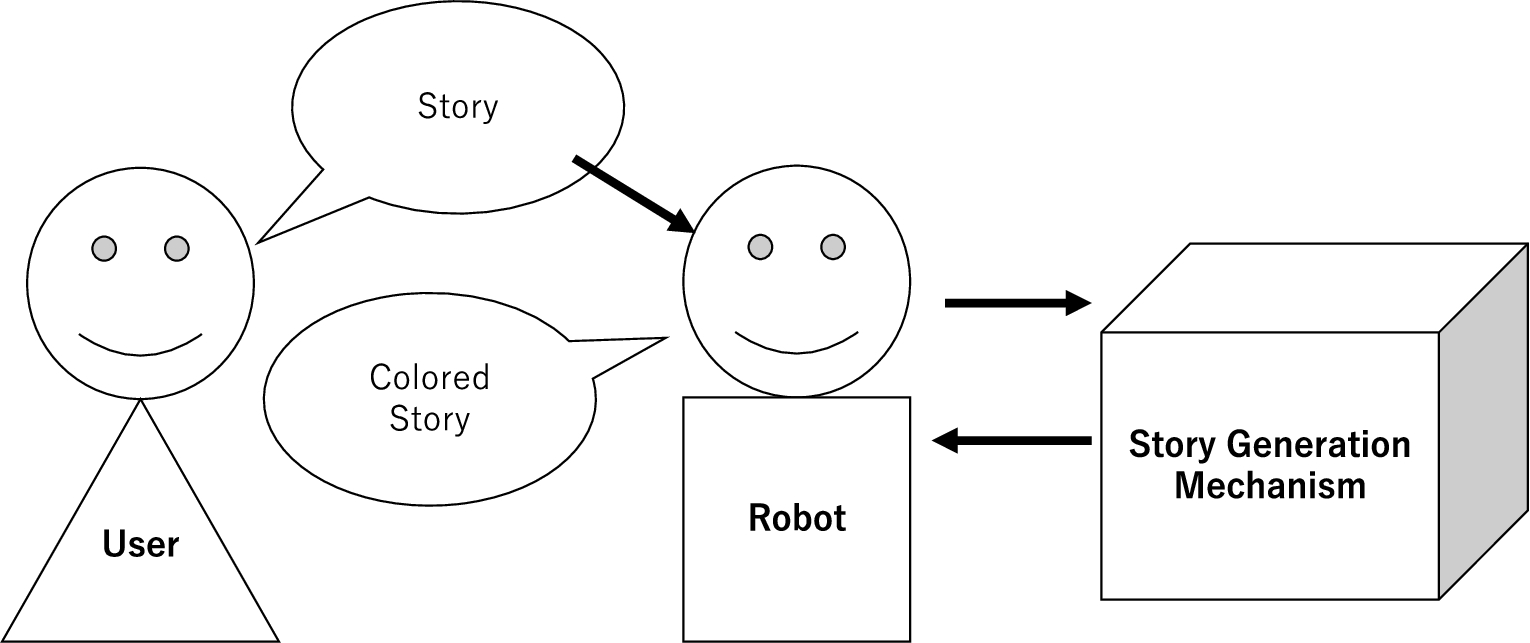
Relationships between a user, robot, and story generation mechanism.
This study designed a story generation system framework based on techniques used in story-generating games with automatic narrative generation, Lisp s-expressions, and Minsky’s frame theory. As the theoretical background, we presented methods of story generation based on the idea of coloring. Because coloring is a general technique that intersperses or inserts words and other information into a story to create a certain atmosphere, it is effective for creating imagery relating to love and sex. We proposed a coloring technique based on four different methods (“sexual coloring,” “coloring by modifying concepts,” “coloring by element substitution,” or “coloring method using colors in a picture”). In story generation, this study presented a situation where one or more characters employ coloring methods related to love and sex to mix such an atmosphere into the story, and demonstrated several kinds of experimental or prototype systems using coloring theory. The result shown that the number of characters doing the coloring also affects the diversity and range of creativity of the generated stories. However, as this attempt has various problems including the quality of coloring, future work will continue. In addition, this study aims to apply the developed techniques to robotic technologies. Although we presented a system image where a robot corresponded to a story generation character, story and narrative generation using the technique proposed in this paper will have multiple other possibilities that may contribute to robotic technology.
For example, the robot controls the lighting, which changes in conjunction with the colors chosen by the coloring, and the text added to the story by the coloring is read slowly by the robot for emphasis. Attempts to generate stories through interaction with the robot can also be used for entertainment and mental health care.
Footnotes

The color image scale is a map used in the field of design that illustrates the correspondence between adjectives and colors from three different scales: the color image scale, the color scheme image scale, and the language image scale.
Kabukichō is an entertainment district in Shinjuku, Tokyo. Kabukichō has many restaurants, host clubs, cabarets, love hotels and nightclubs. However, Kabukichō was not just an “entertainment district,” but a centre of new culture in Japan, where many cultured persons, artists and persons of theatre gathered. In and around Kabukichō there have also been many artistic attempts to combine traditional and modern culture. For example, the young kabuki actor Nakamura Kantaro and others still hold kabuki performances in Kabukichō (
Acknowledgements
This research was supported by the Japan Society for the Promotion of Science (JSPS KAKENHI) under Grant No. 21K17870.