




Abstract
Despite its abundance, life continues to be a mind-boggling mystery. Physical entities are made of matter-energy, and thus they are ontologically objective. The properties that emerge on a physical entity and characterize it are ontologically subjective and thus nonphysical. Emergent properties routinely appear on physical entities during assembly out of nowhere and disappear during disassembly. We can engineer the manifestation of desired properties by manipulating matter, but we seem to have no control over agencies. Agencies are characterized by causal power and thus the capacity to cause changes. Ontologically, agencies have primacy and supremacy. Unlike properties, agencies go beyond passively qualifying matter: they actively control matter. Many agencies can be identified in nature, such as the familiar agency of physics, comprised of the laws and forces of physics and controls the physical entities, and the quantum field agency which converts quanta of energy concisely into particles with a distinctive set of properties. In this paper it is discussed, based on careful observations, plausibility, logical consistency, and reasoned arguments, that enigmatic life is best characterized as a purposive agency that actively subjugates and controls matter rather than an emergent property that passively qualifies matter.
Introduction
Something that involves mass or energy in its composition is a physical entity. A physical entity is also referred to as an ontologically objective, material, visible, real, or tangible being. Everything else is a nonphysical existence, also known as an ontologically subjective, immaterial, invisible, virtual, abstract, or intangible being.
All physical existence, including elemental particles such as photons and electrons, possesses qualities that are emergent and thus nonphysical. Therefore, any physical entity is comprised of physical and nonphysical existence. This gives rise to the phrase “the whole is not only more than but very different from the sum of its parts” (Anderson, 1972). Properties that qualify physical things are abstractions that are epistemically objective but ontologically subjective. A physical being is a fabric woven out of the threads of physical and nonphysical existence, interlaced harmoniously. Phenomena such as life, quantum fields, and the laws of physics are nonphysical since they cannot be reduced to matter-energy, just like semantics in languages cannot be reduced to syntax.
Emergence is the phenomenon of a property or quality that appears out of nowhere on a physical thing during its construction and disappears when the thing is deconstructed. It is concerned with new properties produced as a system grows in complexity (Goldstein, 1999; Corning, 2002; O’Connor, 2021). Emergent properties do not originate from the constituents of the physical thing and cannot be reduced to their building blocks. Most properties of water, for example, cannot be related to the properties of its constituents hydrogen and oxygen (Çengel, 2021).
Emergent properties are intimately associated with physical existence. This gives rise to the notion that emergent qualities stem from the physical entity. But intimacy should not be confused with causality. A system’s constituents manifest the emergent properties, but emergent properties do not belong to the individual constituents. The reductionist stance that emergent qualities stem from physical entities remains a supposition unless and until a causal mechanism is identified and replicated. The emission of light by a light bulb is intimately connected with turning the light switch on. But the manifestation of light cannot be reduced to the state of a light switch.
The view on the nature of causation advocated here deviates from the physical causal closure view, which maintains that all physical effects have only physical causes and rejects causal effects outside the physical domain. The notion of physical causal closure is a characteristic feature of reductionist physicalism, which limits existence to physical entities. In this philosophical view, all occurrences or effects, including the subjective mental qualities, can be reduced to physical causes. But many philosophers reject the notion of physical causal closure (Gillett, 2002).
Emergents depend on their physical bases since there is a correlation between them. There is a rich literature on emergence (O’Connor and Churchill, 2010; Barnes, 2012; O’Connor, 1994; Wilson, 2015; Mead, 2002). Here, we will not be concerned with the reality and precise nature of emergence and different ontological accounts, such as strong emergence and weak emergence. Weak emergence entails that emergent features depend on their base features but are distinct from them. Unlike strong emergentists who view entities with novel causal powers that do not exist at the physical bases as emergents, most weak emergentists consider the notion of the creation of such entities as violations of the physical causal closure and reject them.
The emergence phenomenon covers a broad spectrum of contested ideas, from reductionism to some form of dualism. As O’Connor (2021) states, “The general notion of emergence is meant to conjoin these twin characteristics of dependence and autonomy. It mediates between extreme forms of dualism, which reject the micro-dependence of some entities, and reductionism, which rejects macro-autonomy.”
Bedau (1997) expresses this dilemma: “Although strong emergence is logically possible, it is uncomfortably like magic. How does an irreducible but supervenient downward causal power arise, since by definition it cannot be due to the aggregation of the micro-level potentialities? Such causal powers would be quite unlike anything within our scientific ken. This not only indicates how they will discomfort reasonable forms of materialism. Their mysteriousness will only heighten the traditional worry that emergence entails illegitimately getting something from nothing.”
Agencies are often treated as emergent quantities and thus properties of assemblies of matter. Here we take causal power to be a primitive feature of fundamental reality and categorize causal agencies as non-emergent quantities (Barnes, 2012; Wilson, 2015). This closes the door for agencies to ontological reductionism. That is, we distinctively label quantities with causal power as agencies rather than strong emergents since agencies control physical entities and they do not have a direct causal link to the physical entities they control. They are not amenable to description and explanation in a bottom-up approach. That is, agencies such as life are autonomous, and their appearance is not causally triggered by the composition and behavior of physical entities – a notion that is at odds with the physicalist view.
We also take the stance that limits emergent phenomena to properties that passively qualify the physical assembly on which properties emerge and cannot be predicted from the properties of the constituents of the physical base. That is, emergent properties are merely supervenient qualities or qualifiers. They are not agencies with causal power since they don’t exert an influence on physical beings. For example, a single proton acquires the properties of hydrogen while two protons fused in a nucleus acquire the properties of helium in a deterministic manner. Properties such as total mass and charge of an assembly are not emergent properties – they are simply determined from the corresponding properties of the constituents.
We do not subscribe to the widely accepted view that the laws of physics are emergent quantities since the laws remain the same, although the assembly of the universe changes constantly, and matter is continually turning into energy in the stars. There is no justification to doubt the existence of the entire set of laws of physics to be in place at the Big Bang. We view the set of the laws of physics together with the forces of physics as a non-purposive autonomous agency that controls the physical existence made of matter-energy. After all, the laws and forces of physics govern the physical realm as an active agent and keep all material existence in tight order rather than just qualifying the physical entities. Consequently, the laws and forces of physics differ in character from the emergent quantities described here. They are more appropriately categorized as an agency, referred to as the agency of physics.
Another entity that qualifies as an agency is the enigmatic life that governs the physical bodies of living beings. The laws of life supplement the laws of physics without supplanting them. The mind qualifies as an agency as well. But life and mind are intertwined, and it is more appropriate to consider the mind as part of the more comprehensive agency of life. When life disappears, the mind does too. The mystery of life has been the topic of numerous articles and books (Schrödinger, 1944; Trifonov, 2011; Rosen, 1991; Nurse, 2021).
Life cannot be made to emerge on an assembly of matter regardless of how we assemble a physical body. It has never happened, and we don’t have the faintest idea of how it can ever happen. Yet, most scientists and philosophers continue to characterize life as an emergent quality. For example, Samul Alexander conjectures that life emerges from chemical processes and brings with it special laws of behavior (Bedau and Humphreys, 2008). He adds that life admits no explanation, which is not surprising. But all observations refute claims that life is chemistry since no chemical activity has ever produced life.
Noting that living organisms have goals, but atoms and molecules blindly obey physical laws, physicist and astrobiologist Paul Davies (2019) also describes life as acting as an agent: “Life’s ability to construct an internal representation of the world and itself – to act as an agent, manipulate its environment and harness energy – reflects its foundation in the rules of logic. It is also the logic of life that permits biology to explore a boundless universe of novelty.”
The thought of a pile of inept physical matter producing a unified non-physical higher-level entity with knowledge and power and then this knowledgeable and powerful ghost-like enigmatic entity coming back and controlling the matter that produced it is hard to grasp. This explanation seems like a desperate attempt to remain within the bounds of the physicalist worldview and avoid dualist territory. Yet, the physical substance monists that defend those ideas end up indirectly supporting a form of dualism by conjecturing that matter creates an ontologically subjective higher-level entity that rules matter.
As O’Connor (2021) states, “one can argue that strong emergentism, at least with respect to some or all mental states, in fact requires a form of substance dualism. … One might also argue for an emergentist form of substance dualism as necessary to account for (what many strong emergentists regarding consciousness accept) there being unified subjects of conscious experience.” Zimmerman (2010) and Hasker (2016) also discuss this contested topic in depth. But in the end, a reality does not change by merely changing its name, or it does not disappear by ignoring it.
A recent handbook (Ferrero, 2022), which comprises 42 chapters contributed by a team of international experts, gives a comprehensive treatment of agency. It addresses the key issues, problems, and debates on the subject matter. It covers a broad range of topics such as the relation of agency to causation, teleology, animal agency, intentionality, planning, skills, self-knowledge, autonomy, emotions, reasons, and aesthetics. The book underscores the basic distinction drawn between those entities with the capacity of agency and those without, with an emphasis on the high-capacity agency associated with humans.
Quantum fields also qualify as autonomous agencies with causal power (and not emergent quantities) since they act like virtual mechanisms that transform quanta of energy into fundamental particles with specific properties. The laws and forces of physics as well as life are not a form of substance. Rather, they appear to be invisible virtual mechanisms that control and manipulate matter in a certain way, which is consistent with observed reality. This is no different than the astrophysicists postulating the existence of enigmatic dark matter and dark energy to explain observed physical phenomena of excess gravitational pull and the accelerated expansion of the universe.
If a circular metal coin inserted into a slot at the wall comes out of another slot below as an elliptical coin with a new figure embossed on it, we know that there is a hidden embossing machine behind the wall, as shown in Fig. 1, although we might have no idea about how it operates. The alternative view that the drop of the coin between the two slots triggering the emergence of a causal engraving mechanism with the power to subjugate and manipulate the coin in a certain way is absurd. Such a proposition equates to avoiding the issue and simply reflects the belief or presupposition that there cannot be a mechanism behind the wall.
As another analogy, despite the one-to-one correspondence between the acts of an airplane and patterns of signals in its cockpit, the attempt to reduce the airplane’s behavior to the patterns of signals is not tenable. Even in the absence of a pilot in the cockpit, the most plausible explanation for the commonsensical behavior of an airplane is the presence of a purposive, knowledgeable, and capable agency such as a remote controller, even if we have no idea about the nature and the whereabouts of that agency. The inability of the airplane to fly when the cockpit malfunctions is not credible proof that the cockpit is the active agent with the ability to control and fly the aircraft in a rational way. This is because the intense signal activity in the microelectronics of the cockpit is inherently incapable of generating a purposive agency with intent, consciousness, knowledge, skill, and the power to control and manipulate the signals. That is, the enigmatic remote controller of an airplane is irreducible to the electric signal activity in the cockpit. A similar argument can be given against the reductionist view that the maze of brain signals generates sentient and intelligent agencies (the mind) with intent, consciousness, free will, and power.
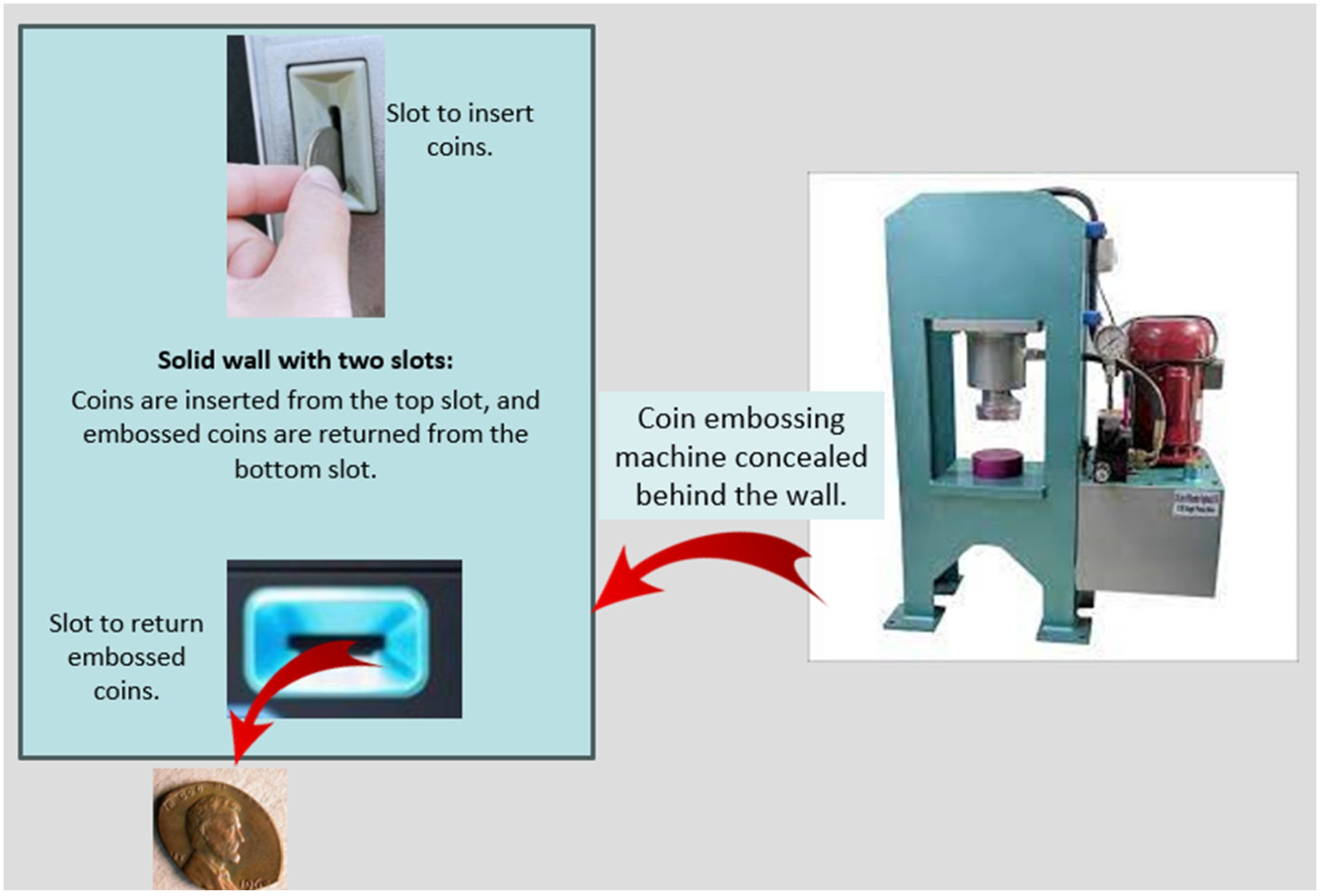
If a solid wall with two slots accepts coins from one slot and returns embossed coins from the other, we infer that there must be a coin embossing machine behind the wall.
The line of reasoning presented above lends support to non-emergent dualist theses while countering the notion of strong emergence or emergent dualism. For example, it deviates from the view expressed by Hasker (2014) as “the human soul is naturally emergent from and dependent on the structure and function of a living human brain and nervous system.” Rickabaugh (2018) refutes this view and argues that emergent dualism with the reductive physicalist twist creates several new problems evaded by the non-emergent versions of substance dualism. He also assesses that “talk of emergence is merely a label for the problem to be solved and not itself a solution.” Despite the mystery associated with agencies, the passive physical existence made of matter-energy and the nonphysical active agencies with causal power appear to work harmoniously. Other mechanisms or a hierarchy of mechanisms are proposed to explain purposive natural phenomena in living beings (Haug, 2010; Craver, 2007).
The terms active agent (or just agent) and agency are commonly used in various fields in relation to causation. Agencies are characterized by causal power and thus their capacity to cause change (Davidson, 1963; Schlosser, 2019). Agencies are recognized as invisible causal mechanisms with the ability to manipulate matter. Agencies are subjective entities that exert a noticeable influence on physical existence and actively control them.
From an atom to a cell to planets and stars, the entire universe is dynamic. Dynamism is accompanied by purposive or non-purposive causal power, and thus agencies. An agency is characterized as purposive if its influence is geared towards an objective. Life certainly falls into this category since all living beings are goal-oriented. The set of the laws and forces of physics, on the other hand, is a non-purposive agency since it exerts the same push-and-pull effect in the entire universe, such as the pulling effect of gravity, with no apparent objective.
Agencies resemble virtual machines that operate on matter. As such, they reign supreme over matter. The term agency characterizes the virtual mechanism that consistently performs specific tasks. Quantum fields, as stated before, convert bundles of energy into fundamental particles such as electrons and photons with a distinct set of properties in a repeatable and predictable manner (Zee, 2010). All the electrons in the universe, for example, are identical and cannot be differentiated from one another. All have precisely the same amounts of mass and charge. Therefore, quantum fields, which are mentally inferred subjective entities, qualify as active agents. The agency of physics rules the physical realm and subjugates it while life does the same in the animate realm. The laws of physics firmly control physical existence via the forces of physics; thus, they constitute a higher hierarchy on the ladder of existence.
An observed influence is indicative of the existence of an influencer. We recognize the existence of the laws and forces of physics because of the well-known effects of attraction and repulsion observed on physical entities. Dark matter and dark energy owe their existence to the inference based on the observed new influences. A confirmed observable effect is credible evidence for the existence of a phenomenon, and the regularity of the effect is indicative of the existence of the underpinning laws or principles.
Agencies exist on their own and are discovered by inference via inductive thinking and reasoning based on observed influences on physical beings. Their existence cannot be confirmed by direct observations since they are not physical. The validity of a propositioned agency can be tested by subjecting it to the tests of plausibility, reasonableness, logical consistency, and compliance with observations. A tenable proposed agency must fill an apparent gap in explaining a natural phenomenon.
Despite being subjective entities, agencies, including the quantum fields that serve as particle-generating virtual mechanisms, do have an existence. They may be unbounded like the quantum fields and the laws of physics or bounded in a confined domain as in the case of life. Also, agencies are natural entities, as in the case of the laws and forces of physics, quantum fields, and life, and are immune from human intervention.
Agencies are often categorized as emergent qualities, as stated above, which are properties intimately connected with assemblies of matter. Assemblies of matter acquire specific properties that qualify them. When the assembly is dismantled, the emergent qualities that appear during assembly simply disappear. Agencies do not fit this description in that agencies more than passively qualify matter; they actively govern matter. When water is formed, for example, its properties emerge automatically and characterize water. But when an artificial bacterium is built as an exact replica of its natural live counterpart, life does not occur. Therefore, the notion that the phenomenon of life is an emergent property of chemistry is not supported by observations. We can modify a life form but cannot make life out of nonlife.
The laws of physics are simply relations between the causative influences and the manifested effects. As an agency with causal power, the laws and forces of physics govern the behavior of all physical existence. Alfred Montapert has expressed this eloquently: “Nature’s laws are the invisible government of the earth.” Einstein said, “Everyone who is seriously involved in the pursuit of science becomes convinced that a spirit is manifest in the laws of the universe.” (Frankenberry, 2008).
The laws of nature are better characterized as the constitution of the universe since they represent the rules by which natural phenomena interplay. In other words, they constitute the rulebook of the universe. But the laws alone, like the rules in a game, are not causative, and they alone do not constitute an agency. As Corning (2002) points out, “Rules, or laws, have no causal efficacy; they do not in fact ‘generate’ anything. They serve merely to describe regularities and consistent relationships in nature. These patterns may be very illuminating and important, but the underlying causal agencies must be separately specified (though often they are not).” He illustrates this by pointing out that the rules of the chess game, which he describes as an organized, purposeful activity, cannot move the pieces on a chess board. An unfolding chess game involves players.
The laws of physics are beyond time and space, and questions like ‘where do they reside?’ and ‘since when do they exist?’ are irrelevant. Simply put, the laws of physics exist at all times everywhere in the universe without being anywhere.
To establish the ontology of life as a purposive, knowledgeable, and capable active agent which reigns supreme over matter, consider the operation of a restaurant. A burger house, for example, takes in supplies such as onions, potatoes, bread, oil, beef, and drinks, and gives out hamburgers, fries, and beverages. This cannot be the making of the laws and forces of physics. Considering that the supplies are consistently turned into the same products, we can infer that there is a set of procedures followed, which constitute the code of operation, and influences exerted on the supplies. The code seems to be fully controlling and governing all the supplies from the moment they are dropped off.
If we get a printout of the code of operation and leave a copy next to the supplies, hoping that the operation will proceed, we know that nothing will happen since the inscribed codes or procedures and the information they represent lack agency. For the restaurant to function, there must be a purposive active agent with the knowledge of how to turn the supplies into products and the power and skill to actually do it.
By carefully examining an apple tree and comparing it to the restaurant, we can infer that the apple tree takes in supplies from the soil, atmosphere, and the sun’s rays, and gives out apples. Clearly, this cannot be the making of the laws and forces of physics. Considering that the supplies taken in by the apple trees are turned into the same apple fruits worldwide, we can infer that there is a set of procedures followed, which constitutes the code of operation of the apple tree, and influences exerted within the bodies of all apple trees. The code seems to fully govern the raw materials from the moment of entering the tree’s body.
If we take the code of operation of the apple tree inscribed on the DNA, print it out on a seed-like medium with the genetic alphabet, and bury the artificial seed into the soil, the lifeless artificial seed will simply rot in the soil. The inscribed information in the seed will not grow roots that will take the suitable raw materials since the inscribed codes, as well as the information, lack agency. For the information in the seed to be actualized, there must be a purposive active agent with the knowledge to turn raw materials into specified products as well as the power and skill to actually do it.
When a natural seed is sown, it germinates, grows roots, takes in the right materials, builds a trunk and branches, weaves leaves, and constructs fruits, as shown in Fig. 2. An artificial seed of exact physical composition cannot do any of this. Therefore, all these qualities need to be ascribed to life, even if we cannot locate it in the seed (Çengel, 2022).
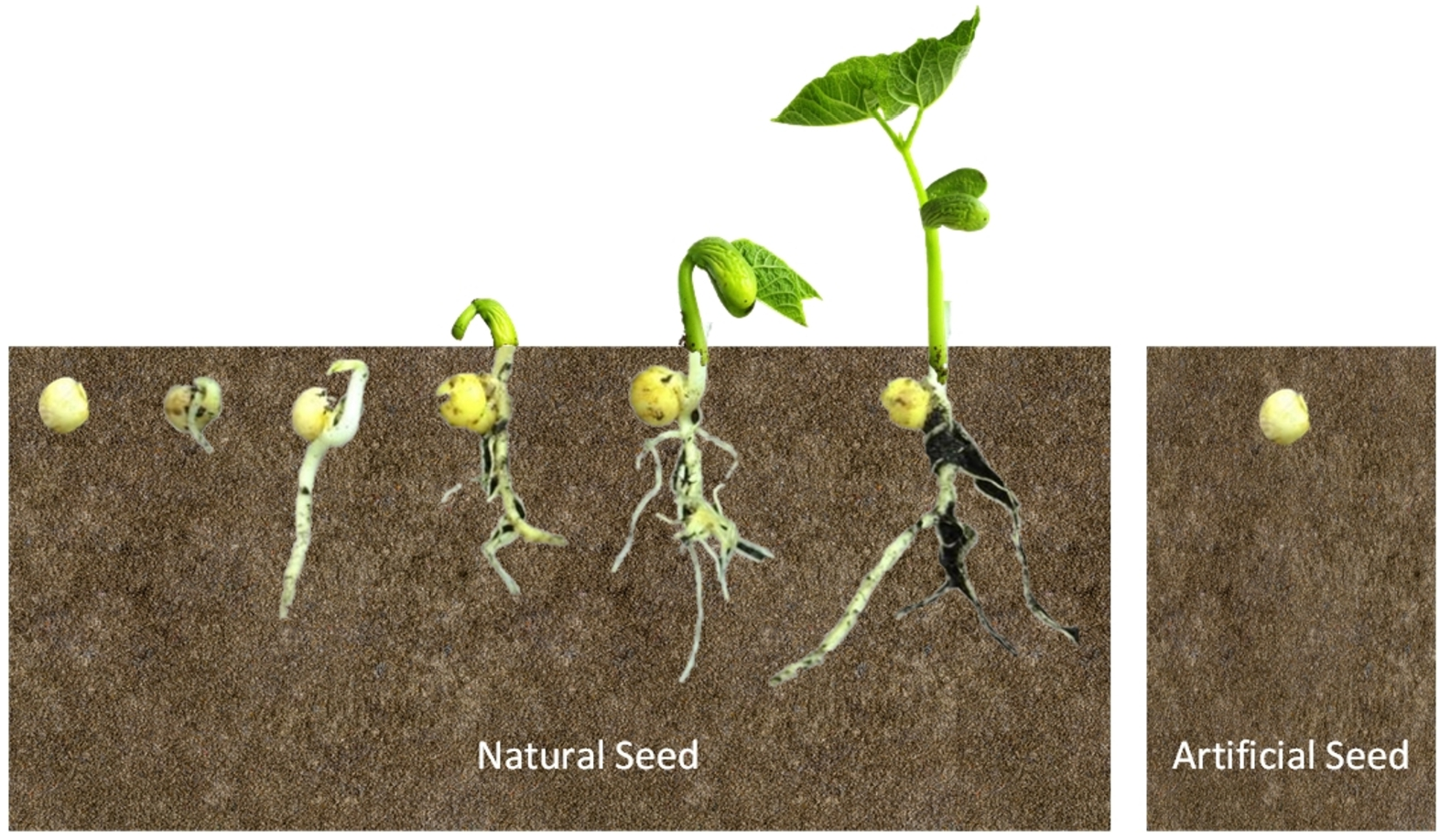
A natural plant seed buried in moist soil germinates and sprouts, while the artificial replica of it does not.
It is untenable to think that the laws and forces of physics, together with printed instructions, can turn supplies into hamburger meals and deny the presence of an agency in the restaurant with purpose, knowledge, and ability to do it. Likewise, it is also untenable to think that the laws and forces of physics, together with written instructions on DNA, can turn supplies into apples. An apple tree must possess a mechanism with purpose, knowledge, skill, and power to do what it is doing (Fig. 3). Since there is no such apparent physical mechanism, like a production line, there must be an invisible nonphysical agency with the same attributes and abilities. When the agency of life is gone and the tree is dead, the entire sophisticated operation comes to an end.
DNA is merely a chemical molecule and it does not qualify as an active agent. The DNA cannot even know what those inept symbols of information in its structure are, let alone read, understand and execute the indicated instructions. If the potatoes in a house are turned into fries, then there must be an active agent (a cook in this case) in the house with purpose, knowledge, skill, and power.
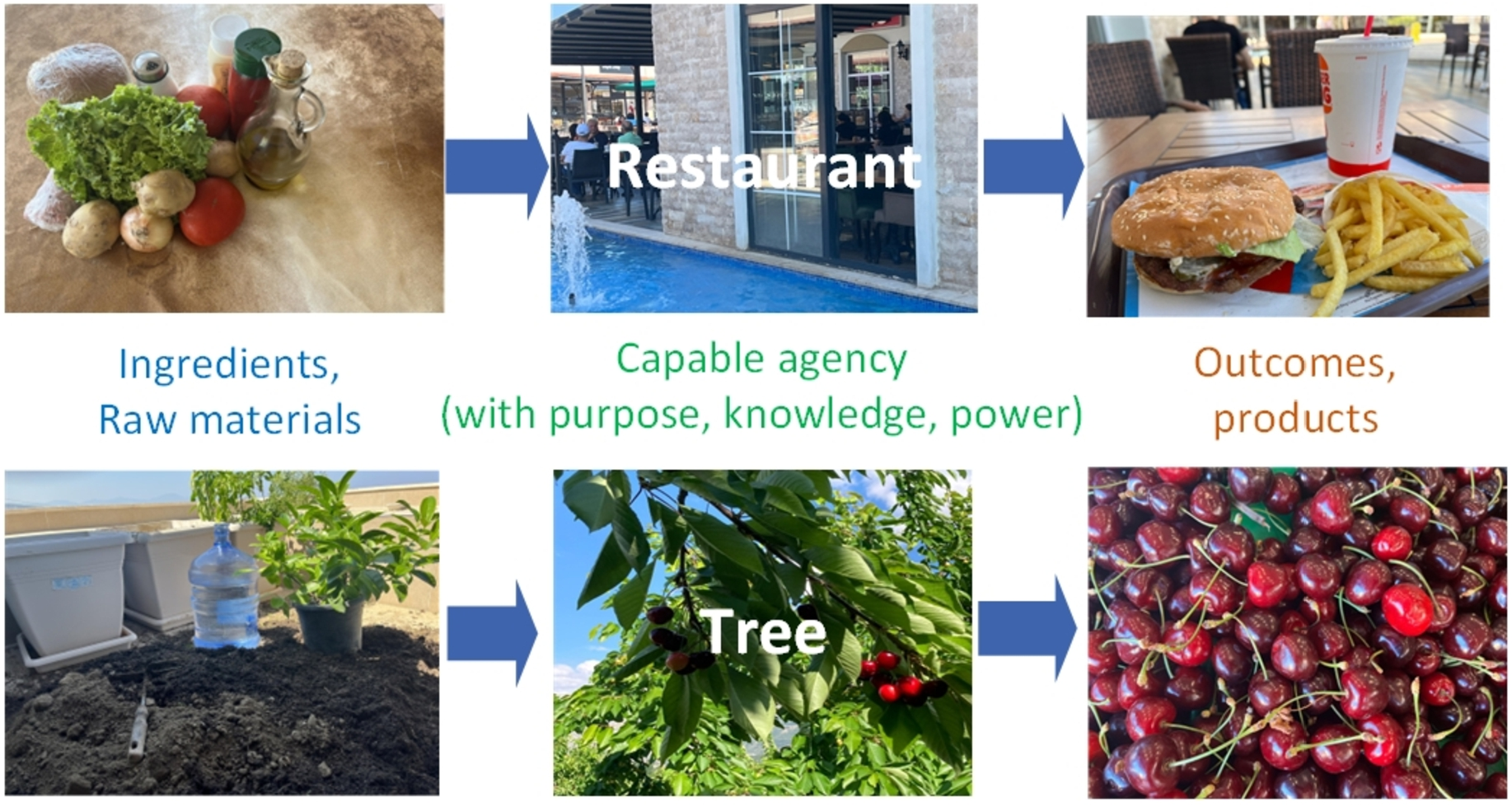
The restaurant – fruit tree analogy: both the restaurant and the fruit tree involve an agency with purpose, knowledge, skill, and power; tangible in the former but intangible in the latter.
A distinctive feature of living beings relative to nonliving ones is the apparent higher level of regularity, representing a set of higher levels of governing laws associated with life. A complementary set of laws and influences of life, superimposed on the laws and forces of physics, appears to fully control and govern the living being. The complementary set of laws and influences associated with life and the traits accompanying life can be viewed as an agency with causal power.
Labeling the rules, principles, laws, and influences associated with life as the laws and influences of life, life can be defined as “a supplemental set of laws and influences that act over a confined space which constitutes the domain of life, superimposed on the universal laws and forces of physics (Çengel, 2022). Likewise, a living being can be defined as “A natural entity whose internal changes and external behavior cannot be predicted by the universal laws and forces of physics alone at all times.” The definition underlines that life is a natural phenomenon, just like the laws and forces of physics, and that all human-made technological gadgets such as computers, smart devices, and robots that mimic living beings are lifeless.
The motion and the trajectory of a ball dropped into a river are determined by the laws and forces of physics alone. But this is not the case for a dog that fell into a river. The dog is alive, and it may decide to swim upstream. Apparently, the dog’s behavior is governed by another set of laws and influences that accompanies life superimposed on the laws and forces of physics. This qualifies life as an active agent. A similar argument can be given by contrasting a live fish with a dead one.
Life continues to be a mind-boggling mystery. This is especially the case for the human life that comes equipped with a sentient, conscious mind. One reason for this persistent mystery is the physicalist worldview that limits existence to the physical realm and reduces life to chemistry. But life does not fit this narrow description since it is not made of matter-energy.
The phenomenon of life not only exists, but it also has primacy and supremacy over physical existence comprised of matter-energy. It appears that elusive life transcends matter, subjugates matter, and manipulates matter, but is not matter. Life clearly resembles an active agent or agency with purpose, knowledge, and power. In the inquiry of life, a reasonable approach is to infer the essential features of life by contrasting animate beings against inanimate ones from different perspectives. Also, judging from its dominant influence on living beings, life resembles a domineering governing entity in a region bound by the body of a living being while maintaining unity.
In a chemistry lab, making amino acids that float around aimlessly in the water is relatively easy. But it is impossible to get all these chemicals to work in a coordinated manner towards a goal, as in a chemical factory. After all, a warehouse of chemicals is not a well-running chemical factory, the difference being the presence of active management with purpose, knowledge, and power. There is more to life since it makes the living body run like a chemical factory.
All living beings are sites of intense chemical reactions, leading to the belief that life is a series of chemical reactions. But no chemical reaction has ever produced life, as stated above, indicating that chemical reactions are not the source of life. As Haken (2006) points out, knowing chemistry is not sufficient to understand life. Chemical reactions in animate beings differ from inanimate ones in that they are purposive and tailored towards specific outcomes. A living being resembles a well-running chemical factory. The orderly and goal-oriented acts within the factory point towards the presence of active governance with purpose, knowledge, and power.
The laws and forces of physics are grossly inadequate to predict the occurrences in a chemical facility. In the words of cell biologist Paul Nurse (2021), “Some of the cell’s enzymes that control these reactions work at an astonishingly fast rate, rattling through thousands, even millions, of chemical reactions every second. These enzymes are not only extremely rapid, but can also be extremely precise. They can manipulate individual atoms with a level of accuracy and reliability that chemical engineers can only dream of.” The enigmatic agency of life acts like a competent manager in a complex chemical facility, whether in a cell or an organism. The entire operation is in the open in a chemical factory, from the equipment to the management. There is no doubt about the existence of a structure that makes the desired products from the incoming supplies. However, this is not the case for a living being.
If we mix chicken feed with water and wait, for example, some chemical changes will occur over time, and the mixture will disintegrate into simpler components and eventually give out an unpleasant odor. This is the agency of physics in action, and the same thing will happen to the mixture anywhere in the world. Now let us leave the chicken feed and water at one end of a fully automated manufacturing facility and pick up eggs and chicken manure from the other. In this case, we know this facility is a highly-technological autonomous egg factory. It must be managed by a sophisticated ‘agency of egg factory,’ onsite or remote, with well-defined objectives, knowledge, rules, and procedures.
The causal agent, in this case, cannot be the agency of physics since chicken feed is converted into eggs within the factory only, not anywhere else. Thus, there must be just the right set of procedures and effects within that factory. Also, an operation manual that contains all the information about the operation of the egg factory, including the step-by-step procedures to be followed for each process, cannot be the ‘agent of the egg factory’ since a book of conduct has no power to enforce the rules and procedures written in it. Noting that a chicken resembles an egg factory, it is only logical that the virtual ‘agency of life’ of the chicken be equipped with the set of impressive qualities of the ‘agency of egg factory.’
Cells contain millions of molecules that function in a coordinated manner to achieve specific goals, such as insulin synthesis in the pancreas. Each molecule performs its designated tasks, communicates with others, and collaborates harmoniously as a team. Individual biomolecules also exhibit an awareness of the cell’s overall function and their specific roles. The vast amount of information encoded in DNA is accurately read, understood, and implemented by specific molecules. The DNA mega molecule, which contains a vast amount of information equivalent to the information contained in a 1000-page encyclopedia, is efficiently replicated during cell division in a fraction of a second.
These remarkable actions are associated with life. Acts are indicative of the attributes and capabilities of an active agent, which is enigmatic life in this case. From observing the cellular processes, we deduce that life possesses attributes such as purpose, intent, unity, order, organization, control, knowledge, skill, power, communication, information processing, and collaboration.
At higher levels, as in organs and organisms, life involves a greater purpose, orderly functioning, harmony, interconnectedness, division of labor, and coordination among cells in a larger entity. In higher organisms, organs work together toward a higher common purpose. Life utilizes the five senses, exhibits limited levels of consciousness, intellect, instinct, and knowledge. At the human level, life encompasses emotions, desires, intelligence, reason, intuition, imagination, consciousness, and knowledge.
In essence, life is a mysterious and miraculous nonphysical, subjective, and abstract attribute of living beings. It reigns supreme over the material body and it is not reducible to matter or energy. Life belongs to the same category as consciousness, free will, beauty, knowledge, and meaning, but it also qualifies as an agency.
Natural vs. artificial life
The terms ‘natural’ and ‘artificial’ are commonly used in broad meanings, and lack precision. This looseness results in misunderstandings and misinterpretations. In the food sector, for example, almost all foodstuffs come from plants and animals, and thus one would think that practically all foodstuffs are natural. Yet, the terms ‘natural’ or ‘all-natural’ are commonly used in food labeling, and regulating the use of the label ‘natural’ in some countries implies otherwise. The phrase ‘natural food’ is usually associated with food that does not contain artificial ingredients or additives such as colors, preservatives, flavorings, vitamins, minerals, hormones, and antibiotics and does not involve genetic manipulation. However, there is no agreed-upon definition of the term ‘natural’ in the food industry, and in most cases, the label ‘natural’ does not mean anything. To provide some guidance, the Food Standards Agency of the United Kingdom defined the term as “‘Natural’ means essentially that the product is comprised of natural ingredients, e.g. ingredients produced by nature, not the work of man or interfered with by man.” (UK Food Standards Agency, 2022).
The situation is not much different when it comes to the use of the terms ‘natural’ and ‘artificial’ for life, and a clarification is in order. Currently, all life forms that we are aware of are natural, and thus, we don’t have the problem of distinguishing natural life from artificial life. But with the advent of technology, especially humanoids being indistinguishable from humans, debates are underway on whether they should be considered alive and be granted certain rights.
The challenge in the case of life is far greater than one faced in food labeling since we know foodstuff well but the enigma of life continues. We don’t even have a precise definition of life, and we cannot make much progress without a factual definition. We all have an intuitive sense of what life is, and we can tell living beings from nonliving ones. Also, doctors can tell authoritatively when a still body is dead or alive. But, as the ongoing debate on viruses being alive or not shows, we lack the necessary tools to discern living beings from nonliving ones (Forterre, 2010; Moreira and López-García, 2009). Consequently, it is a challenge to resolve the issue of natural versus artificial life.
When it comes to life, the term ‘artificial’ takes on a specific meaning. It refers to a life form that is made using any available material, natural or artificial, including molecules from living beings, but without using a living entity as the platform to build on. The smallest scale that life is observed is the cell, as in unicellular organisms like bacteria and the cells of multicellular organisms.
A bacterium built from scratch by humans using elements or molecules is an artificial bacterium. If an artificially-made bacterium somehow acquires life, that would constitute artificial life. A bacterium with a modified set of properties made by manipulating the genome of an existing live bacterium, however, is not an artificial life form by this working definition. Despite different characteristics, the life of that bacterium is still considered to be natural and not artificial. Likewise, life associated with a cluster of cells taken from living organisms and externally manipulated, such as xenobots (Kanchetty and Rao, 2023) is natural life since it starts with the platform of naturally alive entity. The same is the case with biohybrids, whose bioactive part consists of live cells, while the structural part can be of biological or non-biological origin.
All existing robots are artificial entities, and all are lifeless by this definition since robots are built out of lifeless components without ever tapping the life of a living being. If a robot ever acquires life, that will qualify as artificial life. If a humanoid acquires life so that it has subjective qualities like emotions, desires, aspirations, and initiating actions, that would also be artificial life. Otherwise, a robot will remain a lifeless machine regardless of its level of sophistication, which may exceed a human being. Using organic matter in its construction, even organic components like teeth from living beings does not change this assessment for robots.
Changing the characteristics of a living being by gene editing is not an act of making life; it is manipulating life. A life form with manipulated genes is a manipulated natural life, not an artificial life. Likewise, a man with a mechanical heart, arms, legs, lungs, kidneys, teeth, etc., continues to be an entity with natural life. He is still the same person, but now with different capabilities. The same can be said when chips are implanted into that person’s brain. This person is still a biological being with the distinctive characteristic of life. When the person dies and the natural life disappears, what remains is an inept assembly of parts, no matter how sophisticated those parts can be. But when a robot dies (metaphorically speaking), we can bring it back to life in principle by replacing the defective parts. Experiencing death appears to be a distinctive quality of living entities.
Life appears to be a transient characteristic of living beings. Matter is inanimate by its inherent nature, and there is no such thing as live matter. It is only when matter becomes part of a living organism, such as a cell, that it begins to exhibit characteristics associated with life. When water is consumed, for example, it temporarily falls under the influence of the biological processes of the human body, behaving in ways that are aligned with life. A chemical molecule is transformed into a biomolecule upon incorporation into a living system, only to revert to its inanimate state once it exits the body, such as when water is excreted as sweat. Thus, water temporarily ‘comes to life’ as it traverses through a live body. Outside of living organisms, the behavior of substances like water can be precisely predicted using the laws of physics. However, within living organisms, these substances are subject to an additional set of laws and influences associated with life, as discussed in the previous section.
Life is never made from nonlife, and it appears unlikely that it will ever be made from scratch, starting with inanimate matter or components. This is because life is an agency like the agency of physics, and the likelihood of inventing life is no greater than inventing a new law of physics with an associated force that controls matter. Living organisms act like conduits, with matter continuously entering, undergoing chemical interactions, and then exiting. Yet, this flow of matter does not in itself constitute life. All molecules of living beings, including the DNA, amino acids, and proteins, are lifeless. They are no different than ordinary chemicals, and they can be assembled in a lab.
A human being, for instance, is not merely the sum of the material content of their body, much like a chemical factory is not merely the chemicals and materials contained within its boundaries. Both living beings and factories involve materials taken in and given out, but their essence lies in the purposeful activity carried out beyond the acts of nature. Thus, the essence of both a living being and a chemical factory lies with their operational agency rather than the transient materials that pass through them.
The distinction between living and non-living entities becomes particularly pronounced when examining the behavior of complex molecules like DNA in different environments. In a laboratory setting, scientists can construct a DNA molecule by meticulously assembling the appropriate components. Yet, this artificially synthesized macromolecule remains inept, essentially a static collection of atoms, unable to perform any biological functions inscribed within its structure. This illustrates that DNA, despite its sophisticated structure, lacks the inherent ability to activate the biological processes encoded in it when isolated from a living body.
Introducing synthetic DNA into an artificial environment composed of enzymes, ribosomes, and other necessary chemicals, does not trigger any life processes. Such experiments highlight a crucial point: even a cell that is chemically identical to a living cell, if artificially constructed, remains lifeless, unable to initiate biological functions or DNA replication. Natural DNA behaves the same way when placed in such an artificial cell. However, when synthetic DNA is inserted into a living cell, replacing its natural DNA, this previously inert collection of atoms becomes active, capable of performing tasks such as self-replication–functions unachievable by any molecule in a purely chemical laboratory setting. This transformation underscores the necessity of a life environment for DNA to function, suggesting that life’s essence and the ability to replicate are not intrinsic properties of the molecule, but qualities that are externally acquired within a suitable life space.
The field of genetic engineering vividly illustrates this concept by altering specific segments of artificial DNA before inserting it into living cells, such as bacteria. Modifying the DNA sequence can change the bacterium’s life functions, demonstrating the profound impact of genetic information on living organisms. This ability to engineer biological features has led to groundbreaking applications, such as bacteria engineered to produce insulin, showcasing life as an active force capable of decoding, interpreting, and implementing genetic instructions.
J. Craig Venter Institute’s work provides a compelling example of this principle in action. By synthesizing and inserting a piece of DNA into an E. coli bacterium, the synthetic genetic material was recognized and utilized by the cell to produce a functional virus. This process, where the ‘software’ of DNA instructs the cellular ‘hardware’ to create new structures, highlights the dynamic interaction between genetic information and the cellular environment, where life appears not just as a passive collection of matter but as an active, causal agency (Venter, 2012; Hutchison et al., 2016; Lartigue et al., 2007). But this does not constitute artificial life since the same synthetic DNA would act as an inept chemical when placed in an identical physical environment without life.
Will the future robots be alive?
The prospect of future robots being alive and having human-like rights is commonly raised and hotly debated (Balasescu, 2020; Zawieska et al., 2019). If future robots with sophisticated microprocessors and AI are to acquire life, there are two conceivable ways for it to happen: Life emerges on the physical assembly of the robot as a property of the assembly, and passively qualities the robot. This is like when hydrogen and oxygen combine, the water formed acquiring the properties of water out of nowhere (the emergence phenomenon). Mysterious life with causal power somehow manifests on the robot as an agency that controls the physical body of the robot the way life controls the physical body of living beings.
When a living being dies and life disappears, all the subjective qualities associated with life also disappear and the physical body eventually decomposes. If the future robots are to be alive and act like a human, life will most likely be associated with the ‘brain’ of the robot which is its microprocessor. In the case of humans, there is a close correlation between the electrical activity of the brain and life, and a person is declared legally dead when the brain’s electrical activity ceases to exist. But as often stated, correlation is not causation. Intense electrical activity has never been observed to generate subjective qualities such as consciousness, sensations, emotions, free will, or life.
The human brain is a chunk of opaque matter and it is often likened to a microprocessor of a computer because of the considerable electrical signal activity it involves. The brain seems to be home to subjective mental faculties like imagination, intelligence, thought, and consciousness, as well as the perception of sensations and emotions. The brain is often portrayed as a physical organ with traits such as (1) being aware of everything, including itself; (2) having a mastery of all the intricate physiological processes in the entire body; and (3) giving orders to other parts of the body that are made of the same material as itself, etc.
But these marvelous acts associated with the brain are traits of an agency, not the traits of a pile of matter. Acts are indicators of the traits and capabilities of the actor. Therefore, it is common to infer the existence of a subjective entity called the mind that comes equipped with the traits of unity, organization, control, knowledge, and skill. Considering that the mind disappears at death, it can be hypothesized that the mind owes its existence to life rather than the physical brain, which often remains intact after death.
The high level of electric signal activity in the brain is comparable to that of microprocessors, and brain waves are akin to electromagnetic waves in various technologies. However, neither the intense electric signals in microprocessors nor the continuous electromagnetic waves from the sun, radio transmitters or other devices have ever produced any subjective quality.
The brain’s nearly 100 billion neurons, characterized by electrical activity across around 100 trillion synapses triggered by ion motion, has led to the idea that mental processes can be reduced to computational processes due to their similarity to microprocessors. Since the early 2000s, IBM and other tech companies have pursued neuromorphic computing to model and simulate the brain. In 2008, DARPA initiated the ‘SyNAPSe’ (Systems of Neuromorphic Adaptive Plastic Scalable Electronics) program, aiming to develop a neuromorphic computer with a cognitive computing architecture featuring 10 billion neurons and 100 trillion synapses to simulate the brain. Neuromorphic computing involves creating and utilizing neural networks to mimic the brain’s functions.
As a part of the project, in 2012, IBM declared the successful construction of a neuromorphic computer boasting 530 billion neurons and 100 trillion synapses. This achievement was realized using the world’s second-fastest supercomputer equipped with over 1.5 million processor cores. While this marked the emergence of a faster and more energy-efficient computer, it still did not exhibit any discernible subjective qualities such as consciousness, thoughts, and emotions (SciTechDaily, 2012).
The brain’s electric signal activity, being much slower than microprocessors, allows for easier tracing and comprehension of neuron activity. However, understanding how neuron activity correlates with subjective qualities like consciousness, emotions, and intent remains elusive. Some neuromorphic engineers and neurologists, including Gerard Marx of MX Biotech, express concerns about the accuracy and adequacy of current simulations in capturing real brain activity. Marx particularly highlights the absence of an active agent in the brain’s recall process in these simulations (Fulton III, 2020). In the case of humans, this active agent appears to be life.
The patterns that both a computer and a brain produce by processing signals have no causal power, and neither is equipped with an intrinsic agency. Without purposive life, the human brain with billions of neurons with sporadic intense electrical activity that resembles a maze of spark plugs or fireworks firing aimlessly would not amount to anything significant. Likewise, without an operator to assign tasks and make sense of the results, a computer is also a maze of electric signals. Unless we unravel the true nature of life, the expectation to have future robots with consciousness and emotions will remain mere speculation since having life appears to be a prerequisite to having subjective qualities such as consciousness, emotions, and taking initiatives (Tonkens, 2009).
Information is often presented as a knowledgeable agent with the ability to inflict change and organize matter. Biologist and information scientist T. Stonier (1997) expressed this notion “Information, like energy, is conceived of as a basic property of the universe; and like energy, which is traditionally defined operationally as possessing the capacity to perform work, so information is defined operationally as possessing the capacity to organize a system.”
Davies (2019) goes even further, presenting information as the agency responsible for the occurrence of life: “Patterns of information flow can literally take on a life of their own, surging through cells, swirling around brains and networking across ecosystems and societies, displaying their own systematic dynamics. It is from this rich and complex ferment of information that the concept of agency emerges, with its links to consciousness, free will and other vexing puzzles. … The thing that separates life from non-life is information. … Life = Matter + Information.”
Nurse (2021) points out that living beings behave with purpose and emphasizes the central role information plays in living beings: “One great advantage of digital codes is that they are readily translated from one coding system into another. This is what cells do when they translate the DNA code into RNA and then into protein. In doing so, they transform genetic information into physical action, in a seamless and flexible way that no human-engineered system can yet match. … A view of life that is centered on information will also help us understand higher levels of biological organization. It can shed light on how cells interact with each other to generate tissues, how tissues make organs, and how organs work together to produce a fully operational living organism, such as a human being.”
As stated above, information is often presented as a knowledgeable, purposive, and powerful agent. But information is not an active agent or an engineer, and it cannot organize a physical system. Therefore, information does not have causal power. A boxed item such as a bookcase or a bicycle that we order comes complete with detailed instructions on how to assemble it. But those instructions cannot put together the parts and assemble the bookcase or the bicycle. They just can’t. Written instructions have all the information needed to assemble the parts. But in the end, printed instructions are merely inept ink-tainted paper. Behind an assembled bookcase or bicycle, there is an agent that can read the instructions, make sense of them, and has the skill and power to move the parts into their rightful places (Fig. 4).
The information that too much salt is bad for you does not have the power to stop people from overeating salt. The information in how-to books cannot do or build anything, no matter how well the instructions are written. The information in a cookbook cannot cook any meals. This is because information is not equipped with purpose, knowledge, skill, and the power to dictate matter into certain formations and force matter into performing specific tasks.

The written instructions that come with an unassembled item in a box cannot put the parts together and assemble it. Assembly requires an agent with the ability to read the instructions, interpret them, and implement them.
A pizza recipe, for example, merely represents information and instructions on how to make a pizza. But the recipe cannot read the instructions on how to make a pizza and understand them, act on the instructions, and make a pizza out of the ingredients nearby by organizing them. Although the recipe is information (symbols of information, to be more precise), it does not know about making pizza since it does not have a conscious mind (Çengel, 2023). In other words, the recipe does not know anything. Also, the recipe does not have any power; thus, it cannot order the ingredients to move around and take positions as prescribed in the instructions. It takes only a conscious being who can read and understand the recipe and has the power and skill to command the ingredients, assemble them in the form of a pizza, and then place it into a hot oven. Cooking books have no value without a cook who is a knowledgeable and capable agent.
We owe the pleasure of enjoying pizza to an external conscious mind of an able being, like a chef, whether we see them or not. The simplistic linear thought that pizza is made only when a recipe exists and thus the recipe must have causal power, and therefore it must be the maker of pizza is simply preposterous. We cannot have pizza without an oven either, but no one with a sound mind would suggest that the oven is the maker of a pizza.
In living beings, DNA is an encoded inscription, and thus it merely represents genetic information. The DNA strand has no more knowledge and power than a pizza recipe. After all, the genetic letters in DNA are also made of the same carbon, hydrogen, oxygen, etc., atoms as the ink used in cookbooks. The only difference is that a recipe in English is written with an alphabet of 26 letters, whereas a DNA sample is written with a 4-letter alphabet of A, C, G, and T. Just like any other chemical molecule such as glucose, the marvelous DNA has no awareness and comprehension of the information it represents, and no power to dictate other molecules around in a cell. All molecules such as water, glucose, and DNA are mere clusters of inept atoms. During reproduction, what is transmitted to siblings is simply the genetic information encoded in the genetic alphabet.
A cell exhibits a lot of information, as elaborated in cell biology textbooks. But that information is not the agent that governs the millions of intricate processes occurring simultaneously in full coordination within the cell. This is why the laws and influences associated with enigmatic life are viewed as the active agent in the animate realm.
Unlike life, information does not and cannot have purpose or intentionality. Information can only manifest the intention of its provider and user. This is because information is not a conscious entity, and thus it does not and it cannot understand itself. Information is not even aware of itself. It cannot attempt to do anything with something it does know exists. Only conscious beings can have intentionality, limiting intentionality to humans and higher animals. As such, information cannot initiate actions.
A computer virus, which is a sealed package of encoded information with a set of instructions, has no intention to cause damage to computers. After all, the compiled machine language consists of a bunch of 0’s and 1’s organized in a particular fashion. The virus will still not harm any computer even when copied to the hard drive because it cannot initiate any action. It takes the intentional act of a computer hacker to trick the computer user into launching the virus and set it in motion so that the machine executes the commands in the virus and compromises itself. The evil conscious mind damages the computer, not the inept symbols of information arranged in a particular fashion in the computer virus.
We do not fully understand the nature of emergent qualities and agencies. Also, we do not have the tools to decipher how a physical thing like the brain works cohesively with nonphysical things like consciousness, imagination, emotions, and perceptions such as pain and pleasure as well as the five senses. But not understanding the nature of something does not justify rejecting the existence of that thing. The inability to understand the invisible dark energy did not keep the physicists from accepting its existence. In the end, our picture of reality must conform to the observed external world.
To put all existence into a proper perspective, the realm of existence can broadly be categorized as the physical realm and the nonphysical realm. The physical realm consists of the inanimate and animate realms, with life as the distinguishing feature between them. All other existence, including the emergent qualities and agencies, constitute the nonphysical realm.
Agencies resemble virtual mechanisms capable of manipulating physical entities. Agencies are subjective entities that influence physical beings and actively control them. Agencies are not invented by the mind; they are discovered via inference. They differ from mental constructs in that they exist out there, independent of the mind. For example, the laws and forces of physics and the quantum fields existed long before the human mind did. That is, agencies have external existence, though they are not tangible. Agencies also differ from intangible emergent properties in that they actively control matter, rather than just passively qualifying matter. Several agencies can be identified in nature, such as the agency of physics, which governs the inanimate realm, the agency of life, which governs the animate realm, and the quantum field agency, which governs the quantum realm of fundamental particles of physics.
Based on objective observations, an observer can deduce that material things are characteristically passive, submissive, affected, subjugated, controlled, and governed by external influencers. On the other hand, the active, dominant, affecting, governing, subjugating, and controlling entities are immaterial. For example, all material things are controlled by the immaterial laws and forces of physics. All entities that qualify as agencies and rule material bodies are immaterial. The postulation that the immaterial agency of life governs the material corpses of living things is based on this conjecture.
An agency is purposive or goal-oriented if, judging from the outcomes, its activity aims to realize an objective or a goal. Life qualifies as a purposive agency since, from bacteria to humans, all living beings are goal-oriented. On the other hand, the laws and forces of physics qualify as a non-purposive agency since they exert the same pull or push effect on all physical existence in the cosmos without being selective. So, it is not surprising that an arbitrarily shaped piece of stone found during archeological excavations is discarded as the product of the purposeless agency of physics. But purposefully shaped entities such as a clay pot or a needle are collected as artifacts since they are made by purposeful agents like humans with the agency of life.
On a broader scale, the acts of our physical bodies are governed predominantly by the nonphysical realm of ideas, beliefs, opinions, values, and theories that we conceive, develop or subscribe to. Whether we realize it, our physical existence and behavior are primarily guided by abstract mental existence. Subjective logic and ethics set the framework and lay the tracks for intelligent living beings to run on.
With concepts such as virtual particles, entanglement, and quantum fields that act as virtual particle-generating mechanisms, quantum theory is still largely regarded as unintuitive and even weird. But it remains one of the most successful theories ever developed because of its accurate description of observed physical phenomena and its predictive power. Once fully developed, the agency notion of life can be just as powerful.
Funding
This research did not receive any specific grant from funding agencies in the public, commercial, or not-for-profit sectors.
Conflict of interest
The authors have no conflicts of interest to declare that are relevant to the content of this article. The authors have no relevant financial or non-financial interests to disclose.