




Abstract
Turning the dirt, we have cultivated back into soil is critical to securing our planetary future. The world’s principal existential challenges – food, water and energy security, climate change abatement, biodiversity protection and human health 1 – are all underpinned by soil dysfunction. Yet, little is known about soil function, soil services and threats to soil, or how the state of our soils, determined by land use and land management, cause desertification and climate change. As greenhouse gases are transparent to incoming solar radiation, we must mitigate excess atmospheric heat by reducing the amount of organic matter mined from the soil, because when the sun’s rays fall on exposed, drained, baked dry soil, most of the solar radiation is converted from latent heat to sensible heat. Soil specific policy and legislation must be developed to regulate sources of excess sensible heat, consistent with limiting global temperature rise to 1.5°C above pre-industrial levels. Through soil security, we can deliver a better present and safeguard our planetary future.
Keywords
Introduction
The Summit for the Future is a continuation of United Nations Conferences directed to collectively combating planetary crisis. The overarching purpose of the Summit and the Path for the Future is multi-limbed. However, the most important issue of soil health continues to be under emphasised. Soil is critical to securing the future of our planet. The world’s principal existential challenges – food, water and energy security, climate change abatement, biodiversity protection and human health 2 – are all underpinned by soil security. 3 The state of our soils, determined by land use and land management, causes desertification and climate change.
The purpose of this article is to discuss soil as a driver of climate change, by highlighting why soils matter, suggesting common definitions of ‘soil’, ‘soil health’ and ‘soil security’, to champion use of common soil indicators as a necessary regulatory tool for change, to revisit international agreements and commitments incorporating soil, and lastly to provide suggestions for how through soil security, we can deliver a better present and safeguard our planetary future. This paper presents little new evidence, but rather consolidates commentary from eminent professionals from the last several decades. As such, an urgent response to soil security is imperative.
Why Soils Matter
The soil is a living system. Soil is by far the most biologically diverse material on Earth. The number of organisms in a handful of healthy soil far exceeds the population of humans on Earth. 4 Human life on Earth is dependent on soil and the vital services it provides: food, feed, fibre and fuel production, biodiversity, carbon sequestration, and climate regulation. 5 Kopittke and others wrote that historically the focus has been on the soil’s ability to provide food, fibre and biomass for energy, but recently it has been recognised that this focus and management of soil for this one function comes at the expense of others, decreasing soil’s ability to provide the other functions critical to planetary health. 6
Like human skin, soil has many functions 7 and is a complex protective layer for Earth that regulates temperature 8 and the amount of water released into the environment. Soils are an essential component of all ecosystems and contribute significantly to our global environmental, economic, and social wellbeing; principally by providing food security, healthy environments and public health outcomes. Whilst classifying and quantifying the natural capital and ecosystem services 9 of soil is a relatively new field of study, 10 in 2015 contributors to the Global Soil Security Conference modestly estimated the value of ecosystem service contributions by soil at approximately 11.4 trillion USD (today, roughly USD15T; compared to US 2023 GDP of USD $27.4T). 11
The 2019 IPCC special report on climate change and land records: ‘The total global area of degraded lands has been estimated at 10–60 Mkm2. The number of people whose livelihood depends on degraded lands has been estimated to be about 1.5 billion worldwide. The annual increase in the degraded land area has been estimated as 50,000–100,000 million km2 per year, and the loss of total ecosystem services equivalent to about 10% of the world’s GDP in the year 2010. Soil degradation is of particular concern, due to the long period necessary to restore soils’. 12
Indeed, the soil security crises is so urgent that some argue that security of soil in itself should be promoted to the status of a global existential challenge. 13 The merit of that suggestion is heightened by understanding that soil security and climate change are intimately connected. Soils are an interconnected and dynamic part of the landscape 14 and our climate. In one of the earliest known attempts to define soil health, in about 360 BC, Plato in ‘Critias’ suggested that the function of a healthy soil is to “attemper” climate. Changes in soils’ biological, chemical, hydrological and physical processes result in dynamic responses in the landscape. 15 The state of our land and, particularly the biology of our soils, changes how heat is absorbed, processed and emitted, and consequently how heat effects atmospheric processes. 16 In short, our land management practices principally through agriculture, contribute to global warming and are a dominant climate forcing agent.
Poor Soil and Landscape Health Leads to Excess Heat
We are presently attempting to solve the problem of excess heat in Earth’s atmosphere through the international climate policy goal of limiting global warming to less than two degrees Celsius compared to pre-industrialization. Heat comes from the sun, the sun being Earth’s primary source of energy, and so how we temper the burning effects of the sun (solar radiation) is critical to solving global warming.
Greenhouse gases are largely transparent to incoming sun rays or solar radiation, and so while greenhouse gas mitigation and carbon abatement remain critical, it is dysfunctional soil which continues to warm our atmosphere. The mining of organic matter from the soil by agriculture has a profound impact on the ratio of sensible heat to latent heat; thereby reducing evapotranspiration.
Essentially, greater than ninety-five per cent of incoming radiation from the sun is converted to one of two types of heat: latent heat or sensible heat. Latent heat is used in the phase change of materials from one state to another: solid to liquid and liquid to gas; for example, snow melt and water from lakes to clouds. Whereas sensible heat is the energy moving from one system to another that results in temperature change – heat we can sense or feel – from which there is no change of state.
When soil security is maximised, there is an abundance of organic matter and soil moisture to convert the radiant energy from the sun (felt as sensible heat) into latent heat. This in turn creates a vegetative layer which provides the soil with a healthy microbial biome. 17 However, if the sun’s rays fall on exposed, drained, baked dry soil, most of the solar radiation is converted into sensible heat. 18 As such, turning the dirt we have cultivated back into soil is critical to mitigating climate change.
Fifty years before Svante Arrhenius stated that increasing carbon dioxide was heating Earth, explorer and geologist Pawel Strzelecki proved (at least on a regional scale by experiment and observation) that agricultural practice affects local climate. He drew these conclusions over forty years before the first coal-powered electricity generation plant, at the bare beginning of the industrial age, ahead of any significant elevation in greenhouse gases. 19
We are not discounting the important role of greenhouse gases. However, in simple terms, global warming is a two-step process: a heat source and a blanket. In focussing on greenhouse gases, which act as the blanket, the investigation and understanding of the heat source, our soils and landscape, has largely been forgotten. Increasing the size of either the heat source or the blanket, increases the heat, and increasing the size of both accelerates the volume of entrapped heat, which compounds the heating effect.
As such, greenhouse gas mitigation and carbon abatement efforts remain of critical importance. Particularly carbon sequestration efforts and climate smart agriculture, as often they reduce or prevent the mining of soil, providing multifarious benefits: the reduction or elimination of carbon dioxide release into the atmosphere, maintaining or improving the soils’ ability to store carbon, 20 and mitigating latent to sensible heat exchange.
Understanding soil dysfunction and the critical role soil security could play in accelerating climate change mitigation efforts is imperative to securing our planetary future. Further research on this topic is necessary, 21 the role of soil, water and vegetation in regulating heat, and in this way mitigating the effects of global climate change have thus far been greatly neglected. 22
International Obligations Incorporating Soil Management
Soil health is a significant matter of international concern and affects nation’s relations with other nations. The recent ‘EU Directive on Soil Monitoring and Resilience’ emphasised this point, highlighting the scale and cross-border nature of the problem goes beyond country borders, as soil and soil contaminants can become mobile via the air, surface water and groundwater. 23 Further that soil plays a key role in the nutrient, carbon and water cycles, and that these processes are clearly not constrained by physical and political borders. 24
The principal international treaties which incorporate directly or indirectly soil health are:
As discussed above, climate change, biological diversity and desertification are all intimately connected to, if not underpinned by, soil health, and accordingly the objectives of these treaties cannot be achieved without management and conservation of soil health. 28 Soil health underpins landscape health, which in turn underpins biological diversity and climate resilience.
In addition to the above treaties, the below international instruments and programs require action from member countries in relation to soil:
2030 Development Agenda:
29
this broad intergovernmental agreement includes the UN Sustainable Development Goals (SDGs). For which many SDGs are connected to healthy soils, including Goal 2 (Zero Hunger), Goal 12 (Responsible consumption and production), Goal 13 (Climate action) and Goal 15 (Life on land); UN FAO Revised World Soil Charter, Global Soil Partnership, and the International Union of Soil Sciences.
30
It is imperative that nation states take steps to implement soil measurement and monitoring practices and include soil health indicators (discussed below) in reporting obligations. Progressing soil security can only be achieved through concerted international cooperation.
What is ‘Soil’ And ‘Soil Security’?
There is no common definition of ‘soil’ or ‘soil security’. The lack of agreement on such definitions is commonly and consistently attributed to:
the complexity and variability of global soils; the distinction between managed and natural soils, and the need to be sensitive to land use and management practices; and whether the terms speak to absolute soil health or relative soil health?
31
But, these challenges should not impede immediate action, as it is through adoption and refinement of such definitions that we will be able to create legal frameworks to support and accelerate securing our soils. While the below discussion of terms may seem unnecessarily exhaustive, we cannot properly address and govern the soil security crisis through regulatory and compliance mechanisms without a framework from which to advance thought. Hesitancy to define words is not a novel development, Roman jurists had a maximum ‘All definitions in law are dangerous, for one can rarely be found that cannot be overthrown’. 32 However, history has demonstrated that an improper system of representation can delay the advancement of thought for centuries 33 and arguably to date this hesitation to define terms relating to soil is impeding legislative reform and the development of legal frameworks to better address soil.
Definition of ‘Soil’
There is no common definition of soil, and its definition has changed over time. 34 Soil has been defined by the Council of Europe as an integral part of the Earth’s ecosystems and is situated at the interface between the Earth’s surface and bedrock. It is subdivided into successive horizontal layers with specific physical, chemical and biological characteristics. 35
More recently, for wider use and understanding of soil connectivity, soil science professors Alex McBratney and Alfred Hartemink published a short and long definition of soil. We suggest adoption of those definitions:
Short definition: The layered material at the earth’s surface, which has resulted from chemical and biological processes and physical organisation of minerals and organic matter, and which supports terrestrial ecosystems and humanity.
Long definition: The horizonated mixed solid, liquid and gaseous material at the earth’s surface, resulting from chemical and biological processes and physical organisation of minerals and organic matter which interacts with the atmosphere, lithosphere and hydrosphere, and which operates within, and supports, terrestrial ecosystems including biodiversity, plants, animals, and humanity.
Importantly the two definitions published by Professor McBratney and Professor Hartemink highlight:
Soil as a natural body is an important part of human existence, ecosystem function and critical to planetary health, rather than simply as a material; and The location, composition, and processes within the soil are contextually variable.
Definition of ‘Soil Security’
Soil security has been defined as the maintenance and improvement of the world’s soil resource to produce food, fibre and fresh water, contribute to energy and climate sustainability and maintain the biodiversity and overall protection of the ecosystem.
36
In a 2013 paper titled ‘The dimensions of soil security’ the authors, Professor McBratney, Professor Field and Andrea Koch, argued ‘soil security’ as a term should be used and understood in the same sense that it is widely used for food and water. They describe soil security as a multidimensional concept; ‘an overarching concept of soil motivated by sustainable development, concerned with the maintenance and improvement of the global soil resource’.
37
Principally, they identify five dimensions for a soil security framework (the five ‘Cs’):
Capability: ‘What functions can this soil be expected to perform, and in doing so what can it produce?’ Condition: The current, relative and absolute condition of the soil;
38
Capital: Since soil provides functions for service delivery placing a value on the soil stocks underpinning these will contribute to an account of its capital; Connectivity: Land tenure, stewardship and education; and Codification: Public policy and regulation.
The above framework is a helpful tool in creating global soil connectivity. Noting, its adoption must be underpinned by common soil quality and soil health indicators and those indicators used to inform strategic soil management practices, practises which minimize soil disturbance, and maximise soil cover, the presence of living roots and biodiversity. Having a common understanding of soil security and how we can secure our soils will accelerate soil restoration efforts.
‘Soil Health’ and ‘Soil Quality’
Commonly ‘soil quality’ and ‘soil health’ are used interchangeably. However, as soil is a living system, the distinction between ‘soil health’ and ‘soil quality’ is important. ‘Soil health’ can be thought of as akin to how we consider and conceptualise ‘human health’. It is a changing state or continuum, whereas ‘quality’ describes fixed soil characteristics relative in space and time – a slight but important difference, as will be borne out below.
In this regard it is generally not necessary to speak of ‘air health’ or ‘water health’ as neither are biological systems and as such measurement of both air and water is comparatively easy and informative, with a quality indicator satisfactorily representing the condition of the element and its ability to perform system functions. As soil is a living system, soil quality can only be used to inform but not determine soil health.
Definition of ‘Soil Quality’
It is helpful to think of soil quality as an assessment of a soils intrinsic physical, chemical and/or biological properties by which to judge its condition comparatively in space or time. Historically, soil quality measurements and concepts have underpinned rationales used in determining land capability. 39 The emphasis being on output, rather than outtake i.e. with no regard to what was mined from the soil.
In this regard, soil quality is often seen narrowly and precludes consideration of soil as part of landscape and climate systems. Whereas soil health places the wellbeing of soil function squarely within the appropriate landscape and climate system. Soil quality then both informs and is a measure by which to determine poor health but is a poor measure of absolute and relative soil health (current v optimal biophysical state). Accordingly, we suggest the following definition of soil quality:
Soil quality refers to the characteristics of a soil and the use of those characteristics as a comparative tool for monitoring the standard of the soil.
Definition of ‘Soil Health’
Broadly speaking, ‘soil health’ is best thought of as the general condition of the soil, a system measure, which is relative to its geographic location, use and management practices. The UN FAO has provided leadership in defining ‘soil health’ through its Intergovernmental Technical Panel on Soils (ITPS). The ITPS defines soil health as: ‘the ability of the soil to sustain the productivity, diversity, and environmental services of terrestrial ecosystems’. The United States Department of Agriculture’s Natural Resources Conservation Service also has a definition of soil health, and notably it clarifies that soil will sustain terrestrial ecosystems by performing five essential functions:
Regulating water and climate; Cycling nutrients; Sustaining plant and animal life; Filtering and buffering potential pollutants; and Providing physical stability and support for plants and manmade structures.
In this regard, soil in the context of other ecosystem functions has a functional role, cycling of nutrients and regulating water and climate, are ecosystem services that stem in large part from soil and its management, with the other functions a secondary service outcome.
Soil health then refers to the performance or functioning of soil systems, not its intrinsic physical, chemical, and biological properties per se. And soil health, distinguishable from soil quality, must account for input, output and outtake (both yield and organic matter mined from the soil).
As such, we suggest the following common definition of ‘soil health’ be adopted:
Soil health is a state of physical, biological and chemical well-being, and not merely the absence of dysfunction, and includes consideration of humanity’s relationship with the land, and the continuum of the condition of the soil in relation to its capability to sustain or improve biological productivity, environmental quality, and to foster a regulated climate.
Soil Health and Soil Quality Indicators
Difficulty in measuring and disagreement on what are the best common soil health and/or soil quality indicators has been a barrier to addressing soil dysfunction. While globally we have had water and air policy and legislation for many decades, few jurisdictions and fewer countries have specific soil legislation. This is in large part because the soil as a living system is complex – there is no ‘pure soil’ in the same way air and water have absolute purity – and technology for measuring the biological function of soil is still in development. However, definitions for the soilscape and terms associated with measurement and monitoring of soil are imperative to accelerating education and knowledge dissemination concerning soil and create legal frameworks to regulate soil.
Most of the problems and uncertainties we encountered in compiling this section affirm already known barriers to adoption of soil health indicators, including:
The cost and availability of soil testing, including skilled labour and lab shortages; Soils dynamism and complexity tied to interdependencies with other natural assets; Soil indicators’ sensitivity to management practices, seasonal changes (e.g. shrinking and swelling of soil as it dries or wets) and seasonal differences (e.g. wind erosion during droughts); Different countries evolving different tests to measure the same quality characteristic; Soil ‘dysfunction’ or ‘poor’ performance being a relative judgement made according to expectations, thus soil quality and soil health are judged with respect to their “fitness for use”;
40
Our evolving understanding of soil function through increased investment and technological advancement.
While we acknowledge there are many conceptual and empirical problems inherent in producing soil indicators, we think worldwide adoption is essential to:
Create a common language for soil; Provide a repeatable and comparable framework for soil analysis; Make the value of soil more apparent; Highlight those areas in need of further research; and Aid in the creation of regulatory and compliance frameworks for soil and landscape.
As such, the above challenges should not be barriers to immediate action to measure and monitor, and ultimately restore our soils biome. Accordingly, below we suggest soil quality and soil health indicators. We acknowledge that measurement of soil indicators must be practically achievable, and that currently distance, cost and resources are challenges. Accordingly, we have suggested farmer conducted in-situ testing methods (observations, and simple measurements using published field colorimetric tests) uploaded to a recording App and laboratory testing for both indicator classes. As soil indicators are widely adopted and improve, we hope the sophistication and objectivity of tools to measure and monitor soil health will too.
We must move forward with a workable framework for soil health, revisiting its merits regularly, in pursuit of an increasingly utilitarian tool.
Soil quality indicators
Common soil quality indicators favoured by research soil scientists provide a baseline of static properties but do not provide the inter-relationships necessary to create a measure of healthy soil. The emphasis of soil quality indicators is on poor performance not system measures of soil health. Presently, whether in the field or laboratory, soil quality tests are standardised and can only be performed by trained operators. This ensures that the absolute value can be understood against a database. The tests are designed to be replicable and often use aggressive extractants that bear no relationship to soil processes. Thus, farmers rarely if ever carry out soil quality testing themselves.
Currently analysis of soil quality indicators as a measure of soil health must be carefully applied. For example, a downward trend in pH over many years in a cropping system in pH variable charge soil (a characteristic of an old soil) is not a symptom of too little lime or buffering capacity, but a management system that delivers too much acid by using acid salts as fertilisers for Nitrogen and Phosphorus. The progression to more healthy soil and the return of organic matter is to change the cropping and fertiliser regime, not to keep adding lime to correct the pH drift caused by the added acid. The problem is as the acid drops, the pH alters the soil biome favouring bacteria, the organic glues dissolve and the soil disaggregates. Neutralising the soil does not restore aggregation or the soil biome. A clear example of a soil quality attribute not aligning with soil health. The soil quality of acid trending may be repaired by liming but dis-aggregation (and all it entails) can only be restored by a complete change in farm practice.
Nonetheless, in the absence of an ability to test for or understand soil health indicators, soil quality indicators can be helpful to begin the process of soil restoration. Most soil scientists would consider the following soil quality tests as essential to adequately fully characterise a soil.
In situ / on farm tests:
Soil classification logging by a trained soil pedologist; Ring infiltrometer of the A horizon (and the B horizon for a duplex soil); Soil strength measured by a penetrometer; Surface infiltration measurement by Talsma Tube (Guelph Permeameter) at 1000 cm.
Laboratory tests:
Cation Exchange Capacity; Soil pH (1 : 5 Soil/water); Emerson Aggregate Test; Percentage of organic matter; No. of Fungi/ No. of Bacteria (metagenomics); Particle size analysis; Clay mineralogy; Moisture characteristic (or at least plant available water); Extractable Na and P; X-ray fluorescence (XRF) for total element constituents.
The tests vary contextually for climate latitude, altitude and the production pressure applied to the soil.
There will be many arguments that this list is too comprehensive, not comprehensive enough or just plain wrong. We do not disagree but rather suggest common adoption, application and analysis to accelerate the development of better tests and to aid in securing our planetary future through soil security. We understand none of these tests measure system performance or what contextually an ideal system would look like. These tests may be appropriate for managing a production system in soil and assessing an adverse soil response to a perturbation but are simply the wrong strategy for measuring soil health as they are not a systems measure.
In this regard we note the ring infiltrometer and penetrometer when used together can be a measure of soil health but currently are too expensive as they require professionals to run and interpret the tests. However, this is just one example of how soon technological developments may rapidly advance our ability to test for soil health.
Soil health indicators
Currently, most laboratory soil analyses treat soils as non-living, non-integrated systems. However, it is in testing soil resistance and resilience that we can improve the soil biome, 41 which in turn increases soil organic matter, and together with vegetative cover, ensures that most solar radiation is converted to latent heat, thereby facilitating a regulated climate. 42
In situ / on farm tests:
Presently soil health tests are best done by the farmer in the field, because more appropriate technology is still being developed. An increase in organic matter, infiltration, pH, biome, degree stability and depth of aggregation can all be measured directly or relatively by the farmer. Laboratory tests can augment what the farmer is doing but effectively laboratory tests prime function to date has been to ensure maximum productivity (soil utility began around agricultural capability), not a measurement of improving soil health.
If the soil biome improves the amount of organic matter increases, aggregation improves, and both infiltration and plant available water increases. Infiltration can be measured by farmers on farm with simple devices: improvement in organic matter and plant available water with depth results in a softer soil and this can be measured by a rod, with improvement with time as the rod is pushed further. Aggregate stability, strength, odour, and colour change into the aggregate all can be measured readily by the farmer. There are test kits for farmers for soil pH and fungi/bacteria ratios. There are several digital applications around the world that will allow the farmer to do this. While these tests may seem rudimentary in nature, they serve three principal functions:
a tool to guide stewardship; Educate farmers on soil and improve farmer knowledge of their soils and how soil health is linked to management practices; and Facilitating a data repository from which to draw from and build on over time.
Laboratory tests:
Where distance and resources permit, we also advocate for laboratory testing. In terms of a laboratory derived test useful for agricultural production systems we recommended the Haney Test, developed Dr. Rick Haney, a Soil Chemist and Microbiologist formerly of the United States Department of Agriculture Research Service, 43 and the SoilBio test developed by Embrapa (the Brazilian Agricultural Research Corporation). These two tests appear amongst the best mimicry of what nature does. 44 While still in development, the soil security score proposed by Professor Evangelista et al. may soon be another methodology for measuring soil health indicators. 45 However, all three suggested tests remain relatively new, and as such must be evaluated overtime.
Soil Regulation
Soil quality indicators and soil health indicators are necessary for the development of a regulatory compliance framework for soils. We suggest governments encourage adoption of soil health cards for certain types of land use (for instance, agricultural and pastoral) to facilitate understanding of soil health and to, where appropriate, underpin a compliance management framework. A soil health card scheme is already implemented in some parts of the world 46 and is a great platform to facilitate soil education for land owners and/or occupiers, and to gather data to enable further analysis, research and informed policy decisions. In this regard, soil health card schemes should (at least initially) be subsidised, if not fully funded, and mandate registration of the soil health card every three years or so.
Implementation of basic soil regulation will also serve over time to enable regional landscape mapping, which can be used to inform strategic policy decisions concerning, the agricultural industry (or food security), environment protection and climate change. Apart from this, soil health and soil quality indicators provide a common baseline from which to develop a soil function report. Analogous to a building report, we suggest for jurisdictions in which it can be facilitated that a soil function report is obtained when certain property transacts, as an option at sale or as a mandatory condition of leasing. A soil function report would be a combination of both soil health and soil quality indicators, and rather than being self-regulated by landowners, be independently verified.
Threats to Soil Health
Soil has been and continues to be lost at rates that are orders of magnitude greater than mechanisms that replenish soil. 47 Soil loss and soil function decline continues due to the following common threats:
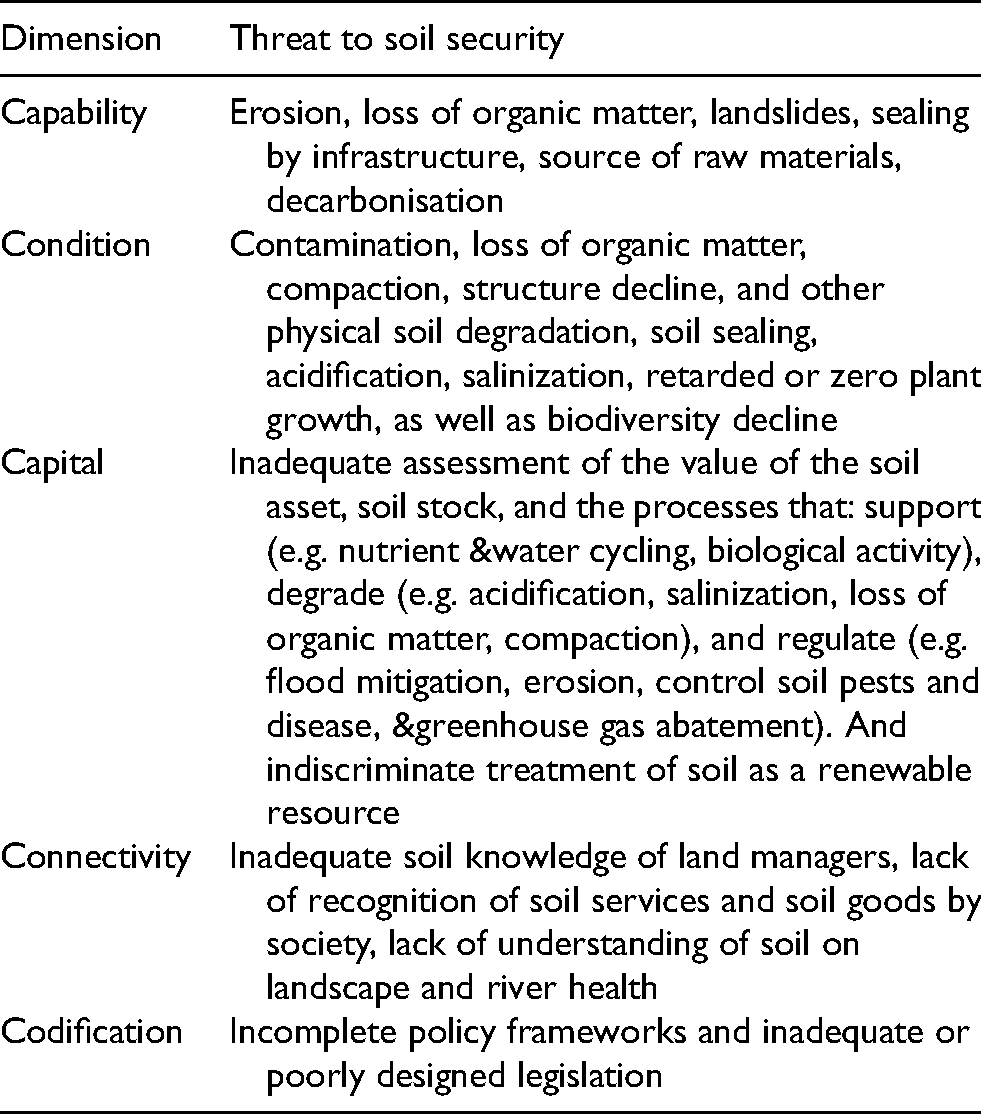
The extent to which soil is a finite or renewable resource is a topic of debate. The Food and Agriculture Organization of the United Nations (UN FAO) says soil is a finite resource because its loss and degradation is not recoverable within a human lifespan. 48 That definition accords with more traditional views that soils are very slow to form, taking 500 years or more to create 2.5 cm of new topsoil. 49 This is consistent with the weathering rate of rocks, growing soil from the bottom up.
However, a relatively new and modern understanding is evolving that soil can be grown from the top down. This is largely due to the advent of regenerative agriculture, which currently is considered more art than science, as it is largely informed by farmer observation, rather than objective data. As regenerative farming is new and has had limited uptake, further research is necessary to assess whether 2.5 cm of new topsoil can be achieved within half a decade.
On either view, the urgency of the soil security problem cannot be overstated as further research and education is required to understand and accelerate soil restoration processes, which remain relatively unknown and nuanced compared to soil degradation practices, which remain prevalent and are comparatively quick, easy and intrusive.
To improve soil security closer attention must be given to soil degradation from agricultural land use, land clearing for urban sprawl and infrastructure projects, pollution of soil from industrial works, and (easily of greatest importance) agricultural and pastoral practice and management.
What We Must Do?
Having demonstrated why soils matter and established that soil is a driver of climate change, briefly we highlight what can be done to deliver a better present and safeguard our planets future. Five action items are suggested:
We must talk about and investigate the causes of global warming, including the science of latent to sensible heat exchange. Consideration of excess sensible heat caused by soil and landscape dysfunction, shifts the lens through which we assess, weigh, and regulate carbon abatement and greenhouse gas mitigation initiatives. For example: governments’ policies
50
have driven biofuel production purportedly to reduce GHG emissions, however, biofuels produced from feedstock or food crops through monocrops
51
are unduly adding to the volume of sensible heat in the atmosphere.
We must fund and conduct more research on the relationship between land surface and the atmosphere, including sensible heat exchange and the small water cycle. Research into solar radiation and the fate of solar radiation under different agricultural practices is yet to occur. Further, consideration ought to be given to how modelling and sensitivity analysis should account for these missing parameters. Additionally, we need economic evaluation of the functions performed by soil and the relative costs to maintain those functions under different land use and management regimes. Such analysis will be supported by wide adoption of the soil indicators and soil function report suggested above.
We must understand, consider, and treat soil similar to how we treat water and air; as a critical environmental element and asset in its own right. This will best be achieved through education programs and upskilling, the creation of specific policy and legislation, as well as making the value of soil apparent. Including through mandating decision-makers consider the impact of actions on soil i.e., in the likes of environmental impact assessments, ecological civilization decision-making, and the ‘environmental rule of law’ (ecologically sustainable development, the precautionary principle, inter-generational equity and conservation of biological diversity and ecological integrity). If agroecosystems are to produce rather than consume ecosystem services,
52
decision making must integrate landscape function by emphasising the role of landscape heterogeneity. Concerning the value of soil, linkages between soil health and ecosystem services can be quantified if the properties and processes controlling soil functions are known and are measurable; making research and the broad adoption of soil indicators critical.
Farmers and land managers commonly have background knowledge in animal and plant health and diseases, pollution and watershed but have little to no knowledge of soil system function. Similarly, few professionals understand soil system function. Teaching stewards of our lands and relevant professionals how to recognize improvements in soil function is essential to achieving soil security. Additionally greater across-sector collaboration is required, with a focus on landscape structure, to address the interdisciplinary gap in environmental engineering, physical geography, and agricultural science. Soil should also be added to school curriculums and nature labs included on school campuses.
53
As with other public goods, development of and participation in such programs should be encouraged through cost sharing, subsidies, or full government funding.
Nation states must develop policy, regulation, and legislation specifically for soil. We suggest the development of a soil act per se, which includes adoption of the above definitions, requires measurement and monitoring of soil, includes a soil health card scheme, as well as provisions in aid of land degradation neutrality by promoting sustainable land management practices: practices which minimize soil disturbance, and maximize the presence of living roots, soil cover and biodiversity. This may include regional land use mapping. The UK’s Environmental Land Management program under its Agriculture (Financial Assistance) Regulations 2021, particularly the Sustainable Farming Incentive Scheme is an example of Government initiative incentivising practices which protect and enhance the natural environment through payments for producing public goods such as environmental and animal welfare improvements. Additionally, soil legislation should include environmental quality objectives, guidelines, policies and/or instruments to regulate sources of excess sensible heat, consistent with limiting global temperature rise to 1.5°C above pre-industrial levels. One such initiative may be the incorporation of soil function reports into planning, land title and tenancy laws. Adoption of the soil function report will also assist in people’s understanding of and value attribution to soil health.
Conclusion
Efforts to combat Earth’s global existential crisis must include soil, otherwise humankind’s welfare and our planetary future may drastically suffer. It was said, as early as 1845, that ‘to withhold knowledge of the injury we are inflicting upon the soil borders on a crime against humanity’. 54 In treating our soils with great abandon, we have done ourselves a disservice in causing ecosystem service decline. However, knowing this provides great hope.
We must elevate the international community’s understanding of soil and the knowledge that it provides an important portion of the total contribution to human welfare on this planet. We suggest this is done through soil health monitoring and measurement, education and the development of policies and laws to treat soil dysfunction and restore soil health. The outcome will be greater biodiversity, healthier ecosystems, and climate regulation – a more predictable and prosperous planetary future.