




Abstract
People form part of the biosphere - the biosphere being the whole intertwined network of life on Earth. While there is convergence on the need for societal change for just sustainability and a healthy biosphere, the pathways to achieve these transformations remain relatively unclear. Through legal interpretation, conceptual and thematic analysis of academic and grey literature, we seek to answer the following two questions: (a) how does the concept of Biosphere Defender enable a deeper and distinct understanding of who environmental defenders are and their role in just sustainability transformations? and (b) how does international human rights law contribute to specify the content of biosphere defenders’ rights? To address these questions, we first critically review the scope and limitations of the notion of Environmental Human Rights Defenders (EHRD) in human rights narratives in international law and policy. We examine how understandings of EHRD portray those defending their land and environment and what limitations this concept has in terms of possibilities for reflecting on transformations towards just sustainability. Second, we propose an alternative and/or complementary understanding of EHRD by using the concept of Biosphere Defenders. We also develop the Defend-Biosphere Framework to analyse the role of these actors as agents of change in pathways towards just sustainability. Third, to empirically illustrate the role of Biosphere Defenders, and the use of the Defend-Biosphere Framework we present two case studies from Latin America analyzing initiatives catalyzed by rural people who are defending their lands and territories while generating new ways to relate to socio-ecological systems and engage with the State and the economy. In both case studies, we find that relational values of solidarity, responsibility, and care (between human and other living beings) are central in understanding Biosphere Defenders’ initiatives creating pathways towards just sustainability. The findings of this article are of particular relevance to the implementation of the right to a clean, healthy and sustainable environment in the context of the Escazu Agreement on access to information, public participation and access to justice in environmental matters in Latin America and the Caribbean, the Aarhus Convention on access to information, public participation and access to justice in environmental matters and the Montreal-Kunming Global Biodiversity Framework in particular Target 22 (access to information, participation, access to justice and environmental defenders) and Target 23 (gender equality).
Keywords
Introduction
Humanity is at a crossroads for building a shared future for all life in the biosphere- the intertwined network of life on Earth. IPBES (2019) Global Biodiversity Assessment shows that the biosphere is at risk due to biodiversity loss, climate change and other human-induced changes such as land use changes, urbanization, industrial agriculture and aquaculture expansion. Approximately, one million animal and plant species are threatened with extinction. 1 Significant economic, social and cultural implications are emerging from biodiversity loss and ecosystems degradation at an unprecedented scale and magnitude. 2 IPBES (2019) warns that trends in climate change, increasing land/and sea-use change, and exploitation of living beings are negatively affecting ecosystem functions and nature’s contributions to people and these trends are projected to continue to 2050 except in scenarios of transformative change. IPBES assessments converge with significant academic literature focusing on sustainability transformations to address structural and systemic social-ecological and equity challenges. 3
Awareness is emerging by UN human rights review mechanisms specifically by certain UN Special Rapporteurs of the relevance of IPBES Assessments for conducting evidence-based analysis on human rights. For example, David Boyd, UN Special Rapporteur on Human Rights and the Environment as well as other UN Special Rapporteurs including Hilal Elver, Special Rapporteur on the Right to Food; Léo Heller, Special Rapporteur on the human rights to safe drinking water and sanitation, have warned that failing to protect biodiversity can be a human rights violation. 4 The IPBES’s global report should be setting off alarm bells about the urgency of transforming economies and societies in cleaner, and greener directions. 5 Yet, it is not well understood how the IPBES assessments can contribute to understand the role of human rights defenders in the construction of just pathways to sustainability.
In this article, we put into conversation two seemingly different bodies of literature relevant to governing the biosphere: IPBES assessments and associated scholarly work and human rights legal analysis. Human rights defenders have catalysed transformative change in turbulent times from the end of slavery and Apartheid to women’s right to vote
6
and recognition of indigenous peoples’ rights after colonial dispossession. Therefore, we see value in understanding human rights defenders through the lenses of the IPBES insights for just sustainability transformations.
In this article, we address the following two questions: (a) how does the concept of Biosphere Defender enable a deeper and distinct understanding of who environmental defenders are and their role in just sustainability transformations? and (b) how does international human rights law contribute to specify the content of biosphere defenders’ rights?
We use a legal interpretation method, a systemic interpretation approach 7 and conceptual and thematic analysis of academic and grey literature to address our research questions. We use human rights law treaties, UN Human Rights Council and UN General Assembly resolutions, as well as UN human rights Special Rapporteurs’ reports to clarify who defenders are and the rights of these defenders who defenders are and their rights. A novel approach of this article is to use the IBPES Global Assessment for conceptualizing biosphere defenders and their role in just sustainability transformations.
Based on an extensive literature review, IPBES (2019) Chapter 5 authors identify the most important elements needed for pathways to sustainability. 8 This Chapter 5 on pathways towards a sustainable future is then further elaborated in Chan et al. (2020). 9 Having in mind policy and legal interventions towards just societal transformations, the authors identified eight ‘leverage points’ or priority issues, namely: “(1) visions of a good life, (2) total consumption and waste, (3) latent values of responsibility, (4) inequalities, (5) justice and inclusion in conservation, (6) externalities from trade and other telecouplings, (7) responsible technology, innovation and investment, and (8) education and knowledge generation and sharing”. 10 The authors further identified five multi-actor governance approaches or ‘levers’ which can be applied across the key priority issues for intervention, namely: (i) incentives and capacity building, (ii) coordination across sectors and jurisdictions, (iii) pre-emptive action, (iv) adaptive decision-making and (v) environmental law and implementation. In our case studies, we investigate what levers, and leverage points are at play and what we can learn from them to think about alternative ways of sustainable ‘development’ and of building a good life on Earth where both human and non-humans are included.
In Section 2, we critically review the scope and limitations of the notion of EHRD in human rights narratives (policy and law). We also propose an alternative understanding of EHRD by using the concept of Biosphere Defender to focus on these actors as agents of change in pathways towards just sustainability. In Section 3, we present the Defend-Biosphere Framework and in Section 4 we empirically illustrate the use of this framework to show the role of biosphere defenders in different socio-ecological, political, and economic, context and the way they generate new ways to relate to nature, the economy, and the state.
Rationale Behind the Biosphere Defenders Concept
Emergence of Environmental Human Rights Defenders (EHRD)
In UN human rights fora, progressive developments on human rights defenders have emerged since the late 1970 s. In 1979, the UN Human Rights Commission urged States to support those promoting the effective observance of human rights. In 1998, the UN General Assembly -the highest level at the UN- adopted by consensus the United Nations Declaration on the Right and Responsibility of Individuals, Groups and Organs of Society to Promote and Protect Universally Recognized Human Rights and Fundamental Freedoms 11 commonly known as the Declaration on HRDs. The United Nations 12 highlights that the term “human rights defender” has been seen as a more relevant and useful term than other terms previously used before the Declaration on HRDs such as human rights “activist”, “professional”, or “worker” which before this Declaration had been more common.
Different terms have been used to enunciate those subjects that mobilize against environmental pollution, degradation, or extractive (and conservation) activities that bring displacement, and violence: ‘environmental defenders’, ‘environmental activists’, ‘defenders of the earth’, environmental and land defenders’, all of which have more recently been conceptualized as EHRD. According to Knox (2015:522) the UN Human Rights Council has emphasized state obligations in relation to defenders “to take all necessary measures to protect the legitimate exercise of everyone’s human rights when promoting environmental protection and sustainable development” as far back as 2003. 13 Knox (2017: preface) uses this term to refer to “individuals and groups who ‘strive to protect and promote human rights relating to the environment’. 14 Forst (2016) acknowledges that defenders come from many different backgrounds and work in different ways. Some are lawyers or journalists, but many are ‘ordinary people living in remote villages, forests or mountains, who may not even be aware that they are acting as environmental human rights defenders.’ 15 In many cases, they are representatives of indigenous peoples and traditional communities whose lands and ways of life are threatened by large projects such as dams, logging, mining or oil extraction. What they all have in common is that they work to protect the environment on which a vast range of human rights depend. Forst (2016) further acknowledges that he makes use of the term environmental human rights defender to include a broad range of defenders and considers that the reason why defenders advocating for the environment are often characterized as ‘land and environmental rights defenders,’ ‘environmental rights defenders,’ or just ‘environmental activists’ is because land and environmental rights are interlinked and often inseparable. In year 2019, the Human Rights Council recognized the central role of EHRD in environmental protection and sustainable development. 16
From EHRD to Biosphere Defenders
While important progress has been made with the emergence of international law and policy regarding EHRD, we argue that these narratives around EHRD are not enough to appeal for their protection and a narrow understanding limits its potential to consider them agents of change in pathways towards just sustainability. We consider that this ‘mainstream’ EHRD narrative, produced and reproduced by international NGOs such as Global Witness, and the UN policies and law such as those that emanate from the UN General Assembly and UN Human Rights Council are important and needed to call people’s (and states in particular) attention.
Yet, we observe three problematic issues in this ‘mainstream’ EHRD narrative all of them interrelated and which aim to appeal to the need to protect environmental defenders: (a) stressing their vulnerability and portraying them as victims of violence, (b) in antagonism with a particular economic activity and (c) essentializing them as individual right-holders. We analyze each of these issues and while we acknowledge that they are important, we propose specific ways to complement them and visibilize EHRD positive contributions. Building on Ituarte-Lima (2023) 17 , we continue coining the concept of “Biosphere Defenders” to mark a difference in the mainstream concept of EHRD.
From ‘Victims of Violence and in Need of Protection’ to ‘Agents of change in Need of Political Recognition’
Violence –including threats- accompanies ‘mainstream’ narratives on environmental defenders. As such, these actors are depicted as vulnerable and at risk of attacks and death. 18 The association between environmental defenders and vulnerability is almost direct, as if embedded in the concept. This is obviously the case in many regions specially in the Global South, and we acknowledge the urgency in making a global call to pay attention to this.
Despite this, we also consider that it is important to acknowledge that vulnerability can be politically constructed and paying attention to only this might invisibilise the agency of environmental defenders - for instance –to mobilize resources for their cause or to make a sustainable use of their lands, waters or territories. We argue that if vulnerability and risk are represented as the only way to appeal to action (e.g., obligation of the states to protect), this might ultimately reinforce colonial attitudes: environmental defenders are in need of protection and only non-rural, non-indigenous people can protect them. This risks to reproduce a ‘white saviour’ attitude. 19
Our proposed biosphere defenders concept decouples vulnerability from weakness and couples it with agency and solidarity. 20 Because defenders are strong and successful in challenging the status quo is that they become vulnerable -not because they are inherently weak. The reason, for instance, why many women are especially vulnerable is not because they are feeble but because of their bold proposals for more equal gender relations as well as a more respectful relation with nature. 21 See below cases studies in Section 4.
From ‘Contrarian to Development’ to ‘Inspirations for just Sustainability Policy and Law’
Often defenders are portrayed as in opposition to one economic activity in particular (e.g., mining, biofuel, infrastructure) because such activity is destroying their natural environment or denying their access to natural resources. Sometimes, the problem is depicted as environmental defenders not having a say in the implementation of those activities, or communities not participating or giving free, prior, and informed consent (FPIC) to economic projects that will modify their natural. Since these activities are promoted by nation-states in the name of ‘development’, in some countries environmental defenders are portrayed as ‘anti-development’, ‘anti-progress’, ‘anti-modernity’, or ‘enemies of the state’. 22
It is not only the impact of a particular extractive activity or the distribution of benefits and burdens, but the system or development model that supports that activity, what some biosphere defenders oppose. A narrow view of defenders in environmental matters obscures what defenders support which includes distinct relational human and nature dynamics. Defenders challenge the status-quo and power relations. A positive defender’s narrative also opens possibilities of bringing a diversity of people together. For instance, scholars working with sustainability issues in the context of agriculture or water engineering may not see their role in tackling violence but would indeed see their role in co-creating multiple-evidence based solutions for positive social-ecological outcomes.
From ‘Individual Right-Holder’ to Individual and Collective Right-holders Catalysing Just Pathways to Sustainability
Despite acknowledging the central role EHRDs play in sustainable development, we observe a tendency to frame EHRD only in relation to State’s human rights obligations to protect individual’s personal integrity and life, but little is discussed about the socio-ecological system they represent, advocate for and the collective they defend. We argue that by paying attention to the individual person under attack or killed, the mainstream narrative of environmental defender leaves aside who they represent, not only in terms of a community, but also in terms of collective’s worldviews and values. This becomes clear e.g. Front Line Defenders (2022) 23 and Global Witness 2020 24 opening their reports by listing the names of those murdered during the year under study. By abstracting the individual from her or his environment, there is a risk of dispossessing EHRD from people’s particularities e.g. if they are female, young, or member of an indigenous people, and an opportunity is missed to see what the individual person is representing.
We consider that an intersectional approach embedded in the concept of biosphere defenders contributes to overcoming the individual/collective divide. Individuals do not operate in isolation hence the need to couple agency with solidarity between humans and with biosphere -humanity understood as part of the biosphere as above-mentioned. Michel Forst, UN Special Rapporteur on Environmental Defenders under the Aarhus Convention on access to information, public participation in decision-making and access to justice in environmental matters recognizes that environmental defenders have diverse backgrounds, cultures and belief systems and may not self-identify, or be identified by others, as EHRD. 25 Forst calls for viewing the interconnectedness between individual defenders and their groups, organizations, communities. An analytical framework and empirical case studies on the rights and roles of biosphere defenders are needed to see the individual as part of the collective(s) which they form part and their role in societal change.
Framework for Understanding Biosphere Defenders’ Rights and Roles in Just Sustainability Pathways (Defend-Biosphere)
The Biosphere Defenders Framework aims to be a tool to understand defender’s role in generating positive social-ecological outcomes. This framework is needed to systematically analyse defender’s contributions to the realization of the right to a healthy environment through activating open information, public participation and access to justice. The Defend-Biosphere framework consists of two main parts: first, we present the legal framework that backs-up the work of biosphere defenders. Then, we use the IPBES’ levers and leverage points to deepen the understanding of biosphere defenders’ role in just societal transformations. Finally, in our two case studies, we use the utility of this framework in understanding who biosphere defenders are and their role in just sustainability pathways.
For the purpose of this paper, we define biosphere defenders as those
Biosphere Defenders’ Legal Basis
In this article, building on Ituarte-Lima (2023), we continue coining the concept of biosphere defenders. Even though this concept is not present in international law, we argue that the legal basis for biosphere defenders’ rights can be grounded in existing sources of international human rights law. The living instrument method of legal interpretation involves interpreting human rights treaties in the light of present-day conditions. 30 The principles and instrument upon which rights of human rights defenders are recognised are rapidly developing through various legal instruments and jurisprudence by national, regional, and international courts. Therefore, rather than proposing a new subject of international human rights law, we propose to use existing instruments clarifying the rights to defend human rights in the understanding that is not a sum outcome of human rights plus environment. Instead, a progressive interpretation demands seeing humans as part of biosphere and hence it goes beyond summing two distinct entities.
Universality and Interdependence of Biosphere Defender’s Rights
Even before the term ‘human rights defender’ was coined and incorporated in the Declaration on HRD, many people acted as biosphere defenders, reshaping gender roles, confronting colonialism, restoring ecological cycles, and advancing solidarity within a collective but also with other collectives they represent (e.g., Afro, youth, indigenous).The spirit of the Declaration on HRDs, interpreted based on its travaux preparatoire, is on human rights defenders and their rights informed by the principle of universality of human rights rather than a limited interpretation of individuals framed in the context of the principle of sovereign equality of States and non-interference in their internal affairs. 31
The Declaration on HRDs has had a trickling effect: the Organization of American States, the Council of Europe, the European Union, and the African Commission on Human’s and People’s Rights have used this Declaration as a basis for further work in their respective regions.
32
However, the first and only plurilateral treaty explicitly recognizing the rights of human rights defenders in environmental matters is the Regional Agreement on Access to Information, Public Participation and Justice in Environmental Matters in Latin America and the Caribbean commonly known as Escazu Agreement (EA).
33
While the State’s human rights obligations specifically mentioned in Article 9 (paragraph 2) concern rights sometimes framed as civil and political rights namely right to life, personal integrity, freedom of opinion and expression, peaceful assembly and association, and free movement, this first paragraph also mentions that “Each Party shall take adequate and effective measures to recognize, protect and promote
Furthermore, States shall take the most favourable interpretation to advancing biosphere defender’s rights specified in EA, Article 9. Article 4 (parr 7) of the EA establishes that “no provision in the present Agreement shall limit a more favourable interpretation of rights and guarantees set forth, at present or in the future, in the
Individual and Collective Dimensions of Full Spectrum of Biosphere Defender’s Rights
International human rights law recognizes that every person, irrespective of gender, age, ethnic, economic conditions has the right to what the IPBES conceptualises as a good quality of life.
37
In its report presented to the UN Human Rights Council, Knox (2017) clarifies obligations concerning social-ecological systems: in order to protect human rights, States have a general obligation to protect ecosystems and biodiversity because biodiversity is necessary for ecosystem services that support the full enjoyment of a wide range of human rights, including the rights to life, health, food, water and culture.
38
, para 65. Rights of biosphere defenders encompass
Like economic, social and cultural rights, defender’s
Human rights treaties provide content to
Defender’s Right to a Clean, Healthy and Sustainable Environment and Actions Towards a Healthy Biosphere
The civil, cultural, economic, political, and social rights are also interdependent on the
The recognition of the R2HE by the UN General Assembly in 2022
44
is an outcome of collective action from a diversity of groups of peoples since 1970 s. While there is not a global binding treaty recognizing the right to a healthy environment in general or of biosphere defender’s right to a healthy environment in particular, State obligations regarding this right can be derived from various sources of international public law including multilateral environmental agreements, international human rights law
45
and regional treaties such as the EA above-mentioned. Like other human rights, State’s obligations towards biosphere defenders entail obligations to respect, protect and fulfil human rights.
State’s Heightened Obligations Towards Certain Biosphere Defender’s Groups
International frameworks specifying the rights of particular groups are a source to make more precise the meaning of State’s general obligations towards individuals and collectives. Heightened State’s human rights obligations emerge towards people in vulnerable situations such as children, and people with disabilities. Below we refer to the human rights of specific groups which are relevant for our case studies in Section 5. As for rights of
As for
In the case of
Visibilising Biosphere Defenders through Leverage Points and Levers Towards just Sustainability
Complementary to the biosphere defenders’ legal basis, this second part of the Defend-Biosphere framework consists on unpacking the role of biosphere defenders in advancing key priority issues (
Leverage Points
1. Embrace diverse visions of a good life. Current natural resource overexploitation equals development with economic growth and a modern society with that of higher levels of consumption. However, other understandings of a good life exist (e.g., buen vivir) ontologically position humans in a more equal relation to nature, understanding living well in a more holistic way. Biosphere defenders show how alternative understandings of human-nature relations exist where non-material aspects of wellbeing are central such as solidarity, recognition, trust, and care.
2. Rethink and change total consumption and waste considering the inequalities between rich economies and poor ones and between middle-upper income groups and people in poverty situations. While those whose levels of consumption need to be risen, there is a need to transform how we consume and how waste is managed. Biosphere defenders showcase different socio-ecological models to relate with nature and the economy that are not based on consumism and/or to minimize waste.
3. Recognize and promote latent values of responsibility and solidarity is about changing how we interact with nature (and among us) based on values and attitudes of stewardship and care. Biosphere defenders promote relations among people and with nature (caring, safeguarding, restoring, etc.) that value nature because it mediates those social relations and not only because of its economic value.
4. Address and reduce inequalities to start up sustainable pathways at different scales. Biosphere defenders shows how unequal distribution of benefits and burdens, unfair recognition and/or exclusion of certain knowledges and socio-ecological relations are detriment to sustainable pathways while at the same time they show ways towards their transformation.
5. Promote just and inclusive conservation. Nature conservation and restoration should be just and inclusive, not to the detriment of some groups in society. Biosphere defenders, many of them members of local communities impacted by conservation policies that displace them, demand to be part of the decision-making process in such policies. At the same time, they contextualize their claims from a multi-scale approach advocating for connecting conservation in one place in a larger regional context and promote conservation with sustainability practices.
6. Consider how externalities and telecouplings impact sustainability pathways. Distant connections between two seemingly unconnected events need to be better acknowledged (e.g., increases in conservation areas in one place may trigger overexploitation in another). Biosphere defenders show how economic and political decisions sometimes made in distant places and based on particular understandings of development (e.g., extractivism based on economic growth) may impact local communities whose livelihoods depend directly on nature.
7. Reformulate the role of innovation and investment in sustainability to address how unsustainable practices are reproduced. There is a need to rethink how innovation in society and technology takes place and the externalities of innovation and investment to reverse ecosystem’s degradation. Biosphere defenders promote socio-ecological innovation uniting their traditional knowledge with new technologies. At the same time, biosphere defenders show how key international financial organizations continue to support unsustainable economic projects.
8. Generate and share education and knowledge for transformative change towards sustainability. Biosphere defenders showcase how local and traditional knowledge based on solidarity and care towards nature and human relations are central for sustainability pathways (e.g., repairing community relations through nature restoration).
Levers
A. Incentives and mobilization of capacities. Subsidies, incentive programmes, and other types of financial commitments should be aligned to just sustainability pathways. The role of biosphere defenders has been central in this regard as they have critically pointed financial mechanisms that are detrimental to sustainability (e.g. as in the case of unsustainable extractives practices supported by international banks) as well as mobilised political, economic, cultural, socio-ecological capacities at local level.
B. Coordination across sectors and jurisdictions. There is a need to recognize the importance of integration across administrative boundaries and regions. Biosphere defenders in conjunction with other stakeholders have been putting forward projects that address policy coherence and further allow integration of environmental goals into institutions at different levels of governance (local, provincial, federal, regional and international). Cooperation among diverse governance bodies is central to sustainability pathways.
C. Pre-emptive action. Addressing emerging risks proactively, even before establishing specific proof of impact, is necessary to initiate sustainable pathways. Biosphere defenders have been at the forefront of such practice when denouncing large-scale projects bringing environmental degradation. Proactive and precautionary approaches are essential due to the slow responses of nature, but also because there is often a significant time lag between scientific attention and consensus on causality. In many cases, traditional and local knowledge understands ecological dynamics better than those whose livelihoods do not depend directly on nature and therefore biosphere defenders’ voices are central.
D. Adaptive decision-making. Policies, programs, and initiatives assuming linear ecosystem dynamics may lead to surprises, while those designed to be robust, adaptive, and resilient can be more effective in the long term. Biosphere defenders are showing how relevant it is to invest in the restoration and enhancement of ecosystems and create projects and programme adapted to ecological cycles instead of the other way around.
E. Create, reform, and implement laws for R2HE outcomes. Consistent creation, reformation and implementation of laws, particularly those governing rights and responsibilities, is crucial for protecting nature and human well-being. Strengthening international and domestic environmental laws and policies, along with better implementation and enforcement, is vital. Biosphere defenders have been central to mobilize policy and law to realize their rights, but also to advocate for the reform or development of new laws and regulations when it is insufficient to apply the existing ones.
Piloting the Biosphere Defenders’ Concept and Defend-Biosphere Framework in Case Studies in Colombia and Argentina
In this section, we present two cases from South America where biosphere defenders play a central role in the construction of just sustainability using the Biosphere-Defenders Framework for the analysis.
Women as Biosphere Defenders Leading the Resistance Towards Harmful Socio-Ecological Impacts of Coal Mining in La Guajira, Colombia –The Case of Fuerza de Mujeres Wayuu
In this case study, we zoom into biosphere defenders’ collective action, specifically how they use
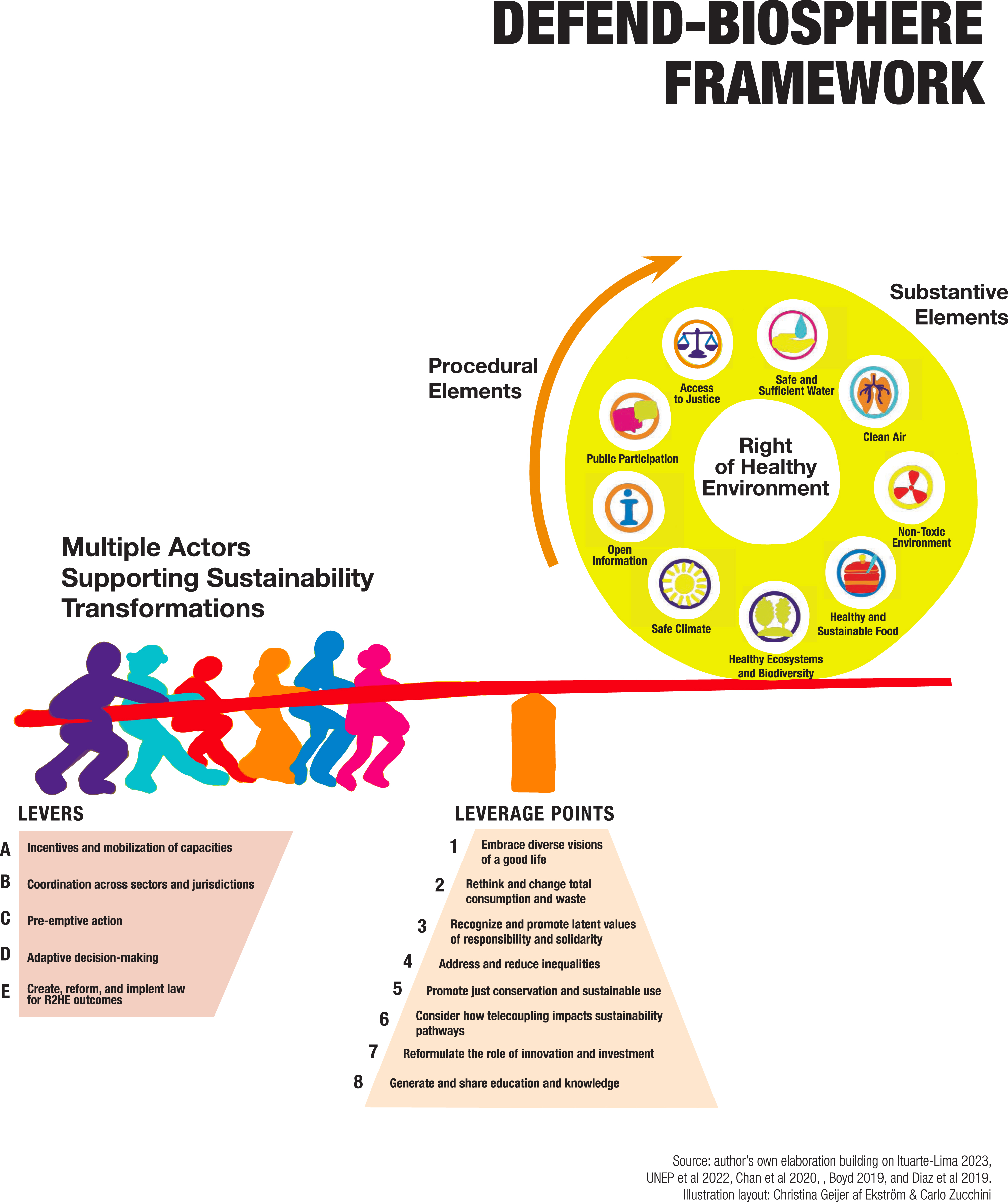
Defend-Biosphere framework.
The department of La Guajira was declared in a state of humanitarian crisis in July 2023 after years of paramilitary actions, corruption and food and water shortages that have led to human rights violations 53 , particularly of the rights of the Wayúu –an indigenous people living in this semi-desertic region of Colombia. La Guajira also hosts one of the world’s largest open pit coal mines. Glencore owns Cerrejón and this area is also seen as the epicentre for the energy transition that Colombia is facing as it seeks to gradually shift from fossil fuels to renewables. Both the mining operations but also e.g., plans for wind parks have faced local resistance due to negative socio-ecological impacts especially on the indigenous peoples, afro and peasant communities living close to the initiatives. 54 At the forefront of these struggles have often been the women led organisation Sutsüin Jieyuu Wayúu - Fuerza de Mujeres Wayúu (FMW), which translates to The Wayuu Women Force. 55
Individual and Collective Dimensions of Biosphere Defender’s Rights
FMW has operated since 2006. A big part of its work has been to shed light on the environmental, social and cultural impacts of Cerrejón and related human right violations not only on individuals but also to the Wayúu as a collective. Colombia has the highest record of assassinations of environmental defenders, with over a third of killings globally happening in Colombia in 2022. 56 The leaders, both women and men, of FMW are also constantly exposed to danger and face intimidations and death threats due to their activism. 57 The organisation actively trains women to advocate for their rights and aims to pass on to future generations and broader Wayúu community its experiences and knowledge of activism and resistance (Leverage 8). 58
Biosphere Defender’s R2HE: Zooming in on how Clean Water, Food and Non-toxic Environment Depend on Access to Justice
One of the most scrutinised cases of environmental conflict in La Guajira is related to the Bruno stream. In 2014, the national environmental licencing authority (ANLA) approved the plan of Cerrejón to divert a section of the Bruno stream to expand the coal extraction from the pit El Puente. This was in a time when the Colombian government vigorously promoted mining and foreign investment as part of their national development plan, often at the expense of proper environmental impact assessments and community consultations. 59 The diversion plan was instantly met with resistance (Lever C). Marches, press releases, social media posts and other statements mobilised by FMW and community members vocalised the importance of the river for not only the instrumental values of the river, but the cultural and spiritual values that the river and water, the Pulowi (female water spirit), hold for the Wayúu and that are affected when water becomes scarce 60 (Leverage 3). In 2017, the Constitutional Court of Colombia ruled in favour of the local communities, among them FMW leaders, stating that the diversion would violate their fundamental rights to water, health and food sovereignty. 61
The court determined that several uncertainties regarding the social and environmental impacts of the project remain and therefore the diversion should be suspended. An Interinstitutional Working Group (IWG) with governmental and non-governmental actors was created to assess how Cerrejón should realise the further studies and then recommended actions to ensure the environmental viability of the project. The Bruno case was also brought to the attention of the High Commissioner of the UN by FMW and other organisations. The Wayuu and FMW have received support and made alliances with both local and international organisations supporting the fight for their rights, including help to demonstrate that some of the environmental impact claims of Cerrejón are faulty. 62 The case thus reveals how these rural communities can harness solidarity from the local to the global to strengthen their resistance (Lever B).
The case of Bruno illustrates how FMW have highlighted several levers and priority issues in their advocacy for the realization of human rights and just transformations. Most notably, the SU-698 can be seen as a win for local communities as it ordered Cerrejón to return Bruno back to its natural cause. However, the stream remains diverted to date as different entities continue to argue about the real impacts of the diversion and Glencore has sued the Colombian state as it argues that it will suffer financial losses due to the demands presented. 63 Using legal strategies to seek just sustainability may thus be tricky if implementation of law is lacking and policy priorities are incoherent. Nonetheless, the legal struggles have given visibility to the case, leading to further support in forms of an Amicus Curiae by ABColombia. 64 The legal strategies can be seen as a coordinated action across sectors and jurisdictions as they managed to bring together the IWG and also to illustrate, although not corrected to date, some of the major flaws in the environmental governance of Colombia (Lever B, E). However, the IWG did not prove to be unproblematic and the Wayúu walked out of the working group after disappointment towards lack of implementation of actions required in SU-698.
The participation by FMW in the defence of Bruno unleashes relational values, noting that water is what maintains the relations between humans and Mother Earth. Through their ontological stance ‘Wayúu women safeguard their communities against colonial power structures such as green colonialism’. 65 Recently, the first woman Wayuu senator Marta Peralta’s bill to declare Rio Rancheria and its affluents, including Bruno, as subjects of rights for their protection, conservation, preservation and restoration was approved in the first debate in the senate 66 . The bill states the formation of a Commission of Guardians of the River composed of government and local community actors who are responsible for protecting the rights of the river (Leverage 5). The objective is to decontaminate the river and its surroundings and promote the peaceful and balanced enjoyment of the river (Lever D). The bill notes as its precedent similar cases of jurisprudence in Colombia, where rivers, moors and other ecosystems have been declared holders of rights. This Rights of Nature approach may be the next legislative strategy that combines relational values in seeking justice and socio-ecological sustainability for Bruno (Leverage 1, 3).
Lastly, it should be noted that the fight is not primarily against something, but for the future of the communities that will live in La Guajira after all else (Leverage 6). Despite threats and violence, Wayuu women continue to fiercely translate their anger into action and power and strive to overcome silencing practices for the sake of future generations 43. Therefore, highlighting the agency and solidarity instead of the victimization of FMW highlights the fierce power they possess to push for just sustainability transformations.
Constructing Agroecology in Northern Argentina: The Role of the Ferias Francas (Tax exempt Local Farmers’ Markets) in Creating Pathways Towards just Sustainability
In this case study, we delve into how biosphere defenders catalyse
Fulfilling the Right to a Healthy Environment: Sustainable Localised Food Systems
In his report to the Human Rights Council in 2010 the Special Rapporteur on the right to food, Olivier De Schutter, identified “agroecology as a mode of agricultural development which not only shows strong conceptual connections with the right to food, but has proven results for fast progress in the concretization of this human right for many vulnerable groups in various countries and environments”. 67
The negative socio-ecological impacts of industrial agriculture and husbandry has been widely shown. 68 Recently, connections have been made between human rights violations, industrial food systems, and the role of agroecology in a Just Transition: “[t]here are multiple problems with the way food is produced, processed, distributed, prepared, consumed, and disposed of in industrial food systems. Their environmental consequences amplify pre-existing inequalities and contribute to human rights violations. For the needed transformation of food systems, which is equitable, just, and sustainable, agroecology plays a crucial role”. 69
Agroecology is a type of agricultural system that is embedded in local ecologies. It is based on local knowledges produced by people whose livelihoods depend directly on their natural environment (e.g., indigenous communities, peasants, fishers, pastoralists). It is also characterized by short value chains, localized production-consumption, organic production minimizing waste and energy and being relatively independent from supply and inputs markets (usually, non-local). This translates into organic, fresh, culturally appropriate food, which does not pollute the environment.
Seeking to Fulfil the Right to Food and the Environment Amidst Structural Challenges
While Argentina is known to be one of the major industrial agriculture producers and consumers of agrochemicals, it is also the case that the country’s organic production is expanding, particularly after the Covid-19 pandemic. 70 The ferias francas (tax-exempt farmer markets) are a paradigmatic example of family farming based on agroecological principles. These ferias are direct spaces of food commercialisation (‘farm to table’) that can be found all over the country. 71 They are well-known institutions that have garnered the attention of public law and policy makers and scholars in the field of family farming for more than twenty years. 72
The first market was created in 1995 in the province of Misiones in the context of a profound crisis resulted from the implementation of structural adjustment programmes and ecological degradation. The deregulation of the provincial markets was pushing farmers out of business and with the need to reconvert their production. 73 The national and provincial governments introduced different support mechanisms, namely rural development programmes: micro-credits, technological transfer, capacity building and organisational support among other strategies (Lever A; Leverage 7, 8) with different target populations. The aim was to prevent rural-urban migration and increase the deteriorating quality of life of family farmers by assisting them to continue living and producing in their farms (e.g., introducing value-added by home-processing food, increasing independence of farmers from inputs markets, restoring ecological productivity, and/or creating new local channels of direct commercialisation). Environmental considerations were mainstreamed in this new development agenda as the native forest (local ecosystem) was incorporated as a key element in family farming planning (Leverage 1 and 3).
The first feria franca was inaugurated in the locality of Oberá as the result of the cooperation among farmers, local civil society, and the municipal government (Lever B). Since then, around 70 local markets have been created in Misiones currently involving around 3000 families. 74 The markets have consolidated new rural-urban linkages and at the same time facilitated women and young farmers’ participation in public life, among other relevant socio-economic, political, and ecological issues in different scales (from the farms to the provincial parliament).
Women’s Biosphere Defenders: Realising Women’s Rights
The ferias francas gather farmers to directly sell their food surplus production (vegetables, dairy produce, eggs, chicken, pork, bakery, jams, and other home industrialization products) between two and three times a week in many localities around the province. The participation of women in these markets has proven to be decisive. Certainly, women’s role in the agrarian economy in Misiones has always been linked to food production for domestic consumption 75 . Their work in horticulture, small animal husbandry and food preparation have long been vital to provision of food for the family.
Since food produce is produced in rural areas, women and men move to nearest towns or cities to sell their products. Historically, male farmers have enjoyed the ‘right to urban space’ as men were normally in charge of the commercialisation of industrial crops from their farms (e.g., tobacco, mate, tea, and timber). With the creation of ferias francas, women increased their opportunities to access urban spaces. This has been highly appreciated by those women participating in these spaces of commercialisation despite in many cases increasing the burden for female members since they had to work even more at the farm to increase farm production (vegetable volumes, homemade bakery, sausages, jams, and dairy products), travel to the town to sell, all while taking care of children and husbands. 76
Farmers directly selling their produce highly value their new identity as feriantes (people that commercialise in this kind of markets) because the market is a social space for meeting and socializing with other people. They also find that this kind of project reintroduces the role of women in the urban society as well as in the family, since now they are providers not only of food but also of a regular income (Leverage 4).
Fulfilling the R2HE: From Accessing Information to Creating New Legislation
Farmers’ organizations, cooperatives, rural development programmes, civil society organisations, schools, among others support the organisation of the production and commercialisation in these collective spaces. Not only have the national and provincial governments granted financial support to informal grass-roots organizations to organize the commercial aspect of agriculture, but they have also assisted through information and capacity building in food production and agroecology (e.g., facilitating access to seeds have been central in the support of ferias francas) (Lever A, D).
The local governments supported ferias francas by creating the legislative and institutional regulations which allowed a feria (market) to be tax-exempt (Lever E). This means that the markets are exempt from certain local taxes and therefore are able to sell fresh and good quality food with lower prices, allowing urban population to access better quality food (Leverage 2). In addition, since they are installed in public spaces, they need to be granted permission by the local government, who also must do the bromatological 77 control of the food (e.g., when home industrialised). In this way, the municipalities assume a role usually given to the market so as to leverage small-scale farmers to participate in the local economy (Leverage 4, 7).
The markets enhance food security in rural, peri-urban, and urban communities because farmers produce and consume their own food, selling the surplus in nearby towns. This has also increase local and regional food sovereignty since food is supplied to the provincial market decreasing this way the dependency of food produced from other provinces. During crisis times (e.g., 2008 agricultural blockage, 2020 covid) the local production and supply of food has proven to be central for accessing food.
Scaling up this, the provincial state has created a legislative framework central to sustain and promote a development model based on family farming, agroecology, and ferias francas (Lever E). More than ten laws were enacted to further support this model. In 2010, the provincial law III-10 for the Development and Promotion of Ferias Francas and Zonal Market Concentrator of the Province was passed. In 2015, the provincial law VIII-69 of promotion of family farming stablished that “the province of Misiones adopts a productive, economic, social and environmental development model based on family farming” 78 and the provincial law VIII-68 that Promotes Agroecology was enacted. In the latter, the second article clearly specifies the centrality of environmental care for the production, consumption, and commercialization of agriculture in the province.
The Future of Agroecological Localised Food Systems: Creating Spaces of Hope
Farmers’ local markets, ferias francas, are socio-economic, cultural, and political spaces that emerged as a political decision of finding ‘alternatives’ to highly polluting development based on monocultures and the internationalisation of the local industrial agriculture. Agroecology, as an alternative development model 79 has promoted relational values -urban and rural- between peoples and their natural environment which are central for sustainability.
Currently, agroecological production coexist in Misiones with industrial agriculture based on tobacco and pine plantation and an area-based nature conservation. While dismantling industrial agriculture - highly contaminant of soil and water- may seem a utopia, this case study reveals how women and men from the countryside have proven that it is possible to create new social relations based on solidarity and local production in tune with local ecologies and less dependent on agrochemicals (Leverage 3).
Conclusion
We find that uniting international human rights law with the IPBES’ Global Assessment’s levers and leverage points for sustainability pathways was useful for addressing our research questions in this paper.
If the root causes of unsustainable development are to be addressed, then State obligations concerning ESCR and the right to a healthy environment need to be equally at the center place. While a sense of urgency to
As for the
In terms of the
The insights of the case studies reveal how both
The findings of this article and the Defend-Biosphere Framework developed in this paper are of particular relevance to the implementation of the right to a clean, healthy and sustainable environment, the Escazu Agreement on access to information, public participation and access to justice in environmental matters in Latin America and the Caribbean, the Aarhus Convention on access to information, public participation and access to justice in environmental matters. It is also relevant for Montreal-Kunming Global Biodiversity Framework in particular Target 22 (access to information, participation, access to justice and environmental defenders) and Target 23 (gender equality).
Footnotes
Acknowledgments
This research was partly funded through the 2020-2021 Biodiversa and Water JPI joint call for research projects, under the BiodivRestore ERA-NET Cofund (GA N◦101003777), with the EU and the Swedish Environmental Protection Agency, and Research Council of Finland as part of the “Protecting Biodiversity through Regulating Trade and Business Relation” project (BIOTRADE). It was also funded by the Swedish Research Council for Sustainable Development (FORMAS), as part of the project Environmental Human Rights Defenders – Change Agents at the Crossroads of Climate change, Biodiversity and Cultural Conservation (project number 2022-697 01684). C. Ituarte-Lima is part of both of these projects; A. Nardi of the Formas funded project and L. Varumo of the BIOTRADE project. The authors are also grateful to the members of Fuerza Mujeres Wayuu in Colombia and members of the feria francas in Argentina for sharing their experiences. The authors would also like to acknowledge the assistance of Carlos Pardo in fieldwork in La Guajira, Colombia. The article also benefited from insights from workshops of the Prevention Project at the Center for Human Rights and Global Justice at New York University Law School; a special thanks to Pooven Moodley who coordinates the human rights and environment work stream of this Prevention Project and to Pablo de Greiff who directs it.
Diaz et al. (eds) (2019), IPBES Summary for Policymakers of the Global Assessment Report on Biodiversity and Ecosystem Services of the Intergovernmental Science, Policy Platform on Biodiversity and Ecosystem Services (IPBES). Secretariat of the Intergovernmental Science-Policy Platform on Biodiversity and Ecosystem Services, Bonn: Germany.
Ibid.
Leach M. et al. (2018), ‘Equity and Sustainability in the Anthropocene: A Social–Ecological Systems Perspective on Their Intertwined Futures’ 1:3 Global Sustainability, 1–13, Patterson, J. et al. (2017) ‘Exploring the Governance and Politics of Transformations Towards Sustainability’ 24 Environmental Innovation and Societal Transitions, pp. 1-16.
Ibid.
UNGA (2020), ‘Report of the Special Rapporteur on the Issue of Human Rights Obligations Relating to the Enjoyment of a Safe, Clean, Healthy and Sustainable Environment’ (15 July 2020) UN Doc A/75/161. In this thematic report, Boyd refers to human rights in general, rather than human rights defenders specifically.
Mclachlan, C. (2005) ‘The Principle of Systemic Integration and Article 31(3) (c) of the Vienna Convention’ 54 International and Comparative Law Quarterly, pp. 279–320.
Diaz et al. (eds) (2019), IPBES Summary For Policymakers of The Global Assessment Report on Biodiversity And Ecosystem Services of The Intergovernmental Science. Policy Platform on Biodiversity and Ecosystem Services. Secretariat of the Intergovernmental Science-Policy Platform on Biodiversity and Ecosystem Services, Bonn, Germany.
Chan, K.M.A. et al. (2020), ‘Levers and Leverage Points for Pathways to Sustainability’ 2:3 People and Nature pp. 693–717.
Ibid, p. 694
Knox, J.H. (2015), ‘Human Rights, Environmental Protection, and the Sustainable Development Goals’ 24 Washingt. Int. Law J., pp. 517–536
Ituarte-Lima, C. (2023), Biosphere Defenders Leveraging the Human Right to Healthy Environment for Transformative Change, 53:2-3 Environmental Policy and Law, pp.139-151
See more on coupling vulnerability with agency and solidarity in Ituarte-Lima (forthcoming) ‘International Lawmaking: Women Shaping Principles and Solidarity’ in Ebbesson, J. and Langlet, D. “International Environmental Law in Perspective –Stockholm+50” Cambridge, UK: Cambridge University Press.
Ibid,
Knox, J. (2020), Constructing the Human Right to a Healthy Environment, 16:1 Annual Review of Law and Social Science, pp. 79-95
Boyd, D. (2020), ‘Report of the Special Rapporteur on the Issue of Human Rights Obligations Relating to the Enjoyment of a Safe, Clean, Healthy and Sustainable Environment, UN Doc A/75/161 (15 July 2020).
Savaresi, A. et al (2019) Climate Change Litigation and Human Rights: Pushing the Boundaries, 9:3, Climate Law, pp. 244-262.
Futhazar, G., Maljean-Dubois, S., Razzaque, J. (2022) Biodiversity Litigation: Review of Trends and Challenges in Futhazar, G., Maljean-Dubois, S., Razzaque, J. (eds), Biodiversity Litigation, London, UK: Oxford University Press, pp. 359-400
Koula, A.C. (2019) ‘The UN Definition Of Human Rights Defenders: Alternative Interpretative Approaches’ 5:1 Queen Mary Human Rights Law Review, pp. 1-20.
Ibid,
International Covenant on Civil and Political Rights, 16 December 1966, into force 23 March 1976, 999 UNTS 171
International Covenant on Economic, Social and Cultural Rights, 16 December 1966, into force 3 January 1976, 993 UNTS 3
Knox J. (2017), UNHRC ‘Report by Special Rapporteur on the Issue of Human Rights Obligations Relating to the Enjoyment of a Safe, Clean, Healthy and Sustainable Environment’ highlights that international human rights law recognises that every human being has the human rights to what the Millennium Ecosystem Assessment identifies as constituents of wellbeing. A/HRC/34/49, (19 January, 2017); available at:  (accessed on 16 October, 2023)
Ibid
International Covenant on Economic, Social and Cultural Rights, 16 December 1966, into force 3 January 1976, 993 UNTS 3
International Covenant on Civil and Political Rights, 16 December 1966, into force 23 March 1976, 999 UNTS 171
Ibid,
In this section, we focus on international human rights law, for a discussion on overlapping obligations between international human rights law and the Convention on Biological Diversity, see Ituarte-Lima (2023).
The Committee on the Convention on the Elimination of All Forms of Discrimination against Women also adopted General Recommendation No. 34 that does a thorough review and interpretation of the Convention regarding the rights of rural women.
Resolution adopted by the General Assembly on 18 December 2013 [on the report of the Third Committee (A/68/456/Add.2)] 68/181. Promotion of the Declaration on the Right and Responsibility of Individuals, Groups and Organs of Society to Promote and Protect Universally Recognized Human Rights and Fundamental Freedoms: protecting women human rights defenders, available at: (accessed on 18 October, 2023)
Boshoff, E. (2020), ‘Women’s Environmental Human Rights in Africa with Reflections on Key Provisions of the Maputo Protocol’ in Addaney, M., Oluborode Jegede, A. (eds) Human Rights and the Environment under African Union Law, London, UK: Palgrave Macmillan
UNHRC (2023) The human right to a clean, healthy and sustainable environment (23 March 2023) A/HRC/52/L.7 available at:https://undocs.org/Home/Mobile?FinalSymbol=A%2FHRC%2F52%2FL.7&Language=E&DeviceType=Desktop&LangRequested=False.html (accessed on 20 October, 2023)
International Labour Organization Convention Concerning Indigenous and Tribal Peoples in Independent Countries, 27 June 1989, into force 5 September 1991, 28 ILM 1382
Ministerio de Medioambiente y Desarrollo Sostenible. Decreto Legislativo 1277/2023. Por el cual se adoptan medidas en materia ambiental y desarrollo sostenible en el marco de la declaratoria del Estado de Emergencia Económica, Social y Ecológica en el Departamento de La Guajira (July 31, 2023); available at: (accessed on 20 October, 2023)
Ulloa, A. (2021), Transformaciones radicales socioambientales frente a la destrucción renovada y verde, La Guajira, Colombia, 80 Revista de Geografía Norte Grande, pp. 13–34
Global Witness (2023), Almost 2,000 land and environmental defenders killed between 2012 and 2022 for protecting the planet (September 13, 2023); available at: https:///en/press-releases/almost-2000-land-and-environmental-defenders-killed-between-2012-and-2022-protecting-planet/.html (accessed on 20 October, 2023)
Guerrero, S. (2022), Rechazan hostigamientos a comunidad wayuu defensora del arroyo Bruno. El Heraldo (April 20, 2022); available at: (accessed on 20 October, 2023); Tapias Torrado, N. R. (2022), Overcoming Silencing Practices: Indigenous Women Defending Human Rights from Abuses Committed in Connection to Mega-Projects: A Case in Colombia, 7:1 Business and Human Rights Journal, pp. 29–44.
Corporación Geoambiental Terrae. (2023), Análisis del modelo institucional de la Autoridad Nacional de Licencias Ambientales (ANLA) en el seguimiento y control del licenciamiento ambiental en Colombia. In: Extractivismo y captura corporativa del Estado en Colombia: Aportes contra la impunidad, Fundación Heinrich Böll Colombia, pp. 31–70.
Ulloa, A. (2020), The Rights of The Wayúu People and Water in The Context of Mining in La Guajira, Colombia: Demands Of Relational Water Justice, 13:1 Human Geography, pp. 6–15
Corte Constitucional de Colombia. Sentencia SU-698/17. Derecho a la salud, al agua y a la seguridad alimentaria de comunidades indígenas: Caso en que accionantes consideran vulnerados sus derechos fundamentales con ocasión del proyecto de desvío del cauce del arroyo bruno que adelanta el Cerrejón; available at: (accessed on 20 October, 2023)
UN (2010), Report submitted by the Special Rapporteur on the right to food, Olivier De Schutter. Human Rights Council, sixteenth session, agenda item 3 Promotion and protection of all human rights, civil, political, economic, social and cultural rights, including the right to development. A/HRC/16/49 available at: (accessed on 20 October, 2023)
IAASTD (2009), Agriculture at a crossroads - Global report. International Assessment of Agricultural Knowledge, Science and Technology for Development. Washington: USA: Island Press.
Golsberg, C. & Dumrauf, S. (eds.) (2010), Agricultura familiar: ferias de la agricultura familiar en la Argentina. Buenos Aires: Ediciones INTA.
Pablo Lapegna (2005), “Transformaciones y nuevas articulaciones agroalimentarias. Las Ferias Francas de la provincia de Misiones”, in Giarraca, N. & Teubal, M. (coord.) El campo argentino en la encrucijada. Estrategias y resistencias sociales, ecos en la ciudad. Buenos Aires: Alianza; Nardi, M.A. & Pereira, S. (2007), “Dinámicas territoriales y desarrollo rural en la Argentina: el Programa Social Agropecuario y las Ferias Francas en la provincia de Misiones”, in Revista Realidad Económica 225:115-135; Nardi, M.A. & Pereira, S. (2006), “Proximidad territorial y desarrollo local: Las ferias francas de la provincia de Misiones - Noreste Argentino”, in Interaçoes (Campo Grande) 13:51-61. Pérez, D.; Roses, P. & Vuarant, S. (2021), “The processes of collective construction of commercialization spaces for family farmers and artisans in the northern region of Entre Ríos, Argentina”, in Otra Economía 14 (25): 150-168. Gabriela Schiavoni (2010), “Construir un mercado. El proceso de transformación del autoconsumo en mercancía en las ferias de agricultores de Misiones”, in Manzanal, M. & Villareal, F. (org.) El desarrollo y sus lógicas en disputa en territorios del norte argentino. Buenos Aires: Ed. CICCUS; Ferrer, G., Barrientos, M. & Saal, G. (2016), “Caracterización de las ferias francas de productores agropecuarios en la provincia de Córdoba (Argentina)”, in Fave: Sección Ciencias Agrarias 15(1). Isaac S. Leslie (2017), “Improving farmers markets and challenging neoliberalism in Argentina”, in Agric Hum Values 34:729-742; Rosa Fernández (2019), “Sistemas participativos de garantía (SPGs) agroecológicos en la Argentina”, paper presented at the XI Jornadas Interdisciplinarias de Estudios Agrarios y Agroindustriales Argentinos y Latinoamericanos. Buenos Aires: CIEA-UBA.
To reconvert means to go through a process of change to give another functionality to the assets of the farms, for instance, use the land for producing another crop.
Maria Andrea Nardi (2011), Rural Development and Territorial Dynamics in the Province of Misiones, Argentina. Doctoral Thesis, Department of Human Geography. Lund University, Lund (Sweden).
Ibid.
Quality control to make sure food can be consumed.
Maria Andrea Nardi (2013), “La agroecología como discurso y práctica ambiental, económica y política en la provincia de Misiones (Argentina)”, in M. Manzanal, & M. Ponce (Eds.) La desigualdad ¿del desarrollo?: controversias y disyuntivas del desarrollo rural en el norte argentino, Buenos Aires, Argentina: Ed. CICCUS.