




Abstract
This paper reports on an experiment of using a hybrid pedagogical approach to tackle the challenge of teaching “Information and Communication theories” to students enrolled in Master of Communication and Digital Content at the School of Communication and Journalism of Aix Marseille University in France. The hybrid pedagogical approach combines the classical textual/verbal approach with an arts informed pedagogy, augmented by creative writing and storytelling activities. The fact that the arts-informed approach was not used in isolation but in combination with the traditional textual/verbal approach and creative writing and storytelling activities offered students a wide choice of learning modalities through which they could express themselves. Our preliminary findings suggest that using a hybrid pedagogical approach rather than one single pedagogical approach improved students’ understanding of the abstract concepts implied by the communication theories discussed during the lectures. Students illustrated their understanding of these theories by recasting them in various real life or plausible situations during the creative writing activity which we call “Communication Stories” or cStories.
Keywords
Introduction
Teaching a theoretical course can be challenging on many levels. The concepts involved are often far removed from the daily lives of students and their immediate impacts are not always perceptible. The ideas and concepts involved could also have a historical dimension, or be subject to debate and to multiple interpretations which make it difficult for students to understand their implications in everyday life. This is particularly true of information and communication theories. Information and communication are fundamental concepts present across all disciplines. As such, they have received hundreds of abstract definitions that are often contradictory and have given rise to a huge body of publications [1, 2]. There is no one accepted definition of these two universal concepts that is true for all people and for all times.
The need to resort to other modalities of expression aside from the textual or verbal arose from my accumulated experience that magisterial lectures have a low student engagement rate, a high boredom factor which subsequently leads to low student attendance of classes. Engaging the students using alternative modes of expression other than textual or verbal has the capacity to engage and to improve class attendance while enabling students to better appropriate the course content. I have therefore been exploring a hybrid pedagogical approach integrating an arts-informed pedagogy (draw and write technique), a creative writing activity and an embodied pedagogy (storytelling, staging and acting) into the more classical textual/verbal approach in order to improve students’ participation, appropriation of the course content and hence their learning outcomes.
The draw-and-write technique is an instance of an arts-informed visual research method. Hartel [3] explored this approach in her teaching and research at the School of Information Science of the University of Toronto. The technique appears to have originated in the United Kingdom in the 1980s in the field of education before being tried in other fields such as healthcare, engineering, environmental science, geography, industrial design and psychology. It has been used to study a wide range of phenomena ranging from menopause, the concept of librarian, celebrities, autism, and information-seeking. Therefore, as an investigation technique, it is not limited to any one field. It offers participants an alternative mode of expression to articulate ideas and perceptions that words alone may not capture adequately. Hartel [3] developed the iSquare protocol1
The protocol was designed by Jenna Hartel and presented here:
See the cSquares website for more details
The rest of this paper is organised as follows: Section 2 gives an overview of the different stages of the pedagogical approach deployed in this course; Section 3 is devoted to my findings and Section 4 outlines future perspectives research.
The hybrid pedagogical approach adopted combined the classical textual/verbal approach with an arts informed pedagogy augmented with creative writing and storytelling activities. The course “Information and Communication Theories” in which this hybrid pedagogical approach was deployed is a compulsory course for students enrolled in different tracks of the Master of Communication and Digital Content at the School of Journalism and Communication of Aix-Marseille University in France. The course runs for eight weeks, at a rhythm of three-hour class per week. In the following sub-sections, we detail the four stages of this hybrid approach, namely Section 2.1 draw and write activity; Section 2.2 textual/verbal lectures; Section 2.3 drawings exhibition and creative writing (cStories construction); Section 2.4 staging and storytelling (from cSquares to cStories).
Draw and write activity: Making cSquares
In the first class, the whole course structure is explained to students. It is impressed upon them that while the draw and write activity may appear childish, it is a tested pedagogical and research approach used in various context including health therapy (autism, victims of trauma). The draw and write activity is an adaptation of the iSquare protocol (a 4” X 4” piece of white paper on which students are required to respond to the question “What is information?” in the form of a drawing and also to complete the phrase, “Information is …” on the backside of the same paper as well as fill in demographic information (age, gender, specialty enrolled in). We adapted it to the study students pre-conceptions of communication and have called this the “cSquare” by analogy. We simply changed the instruction to “Complete the sentence below “Communication is …” for the verbal definition. The verso of the paper is left blank for the drawing part (see Fig. 1 below). Students are also asked to provide brief demographic information such as age, gender and the master’s track they are enrolled in. Our students were aged between 21–23 years old with an average of 22 years. They were given ten minutes to perform the exercise.
The rationale in performing the draw and write activity at the very beginning of the course is to gather the preconceptions students have of the main concepts before they receive the instructor’s lectures. Once students complete their drawings, these are collected and kept by the instructor for further use. The students are informed that they will have to reuse the drawings towards the end of the course in creative writing and storytelling activities (see Sections 2.3 and 2.4 hereafter). Since I began implementing this hybrid pedagogical approach, I have collected 332 drawings, broken down as follows: 24 cSquares in 2014; 52 iSquares in 2015,3
The course in which the iSquare were gathered was given for one year only, therefore the rest of the drawings concerned communication theories, hence cSquares.
Example of blank cSquare for the draw and write activity.
The draw and write activity is immediately followed by six weeks of “traditional” lectures during which the instructor uses both verbal and textual modalities to explain the tenets of the major information and communication theories and their implications for analysing and understanding events involving human interactions. The theories presented stem from three research traditions:
Communication theories that emanated from mathematics and engineering, namely Norbert Wiener’s Cybernetics theory (1948) and Shannon’s Mathematical theory of communication (1948); Communication theories by social scientists on the effects of mass media on public opinion in the second half of the 20 Interpersonal communication theories propounded by social scientists in the context of their research on family therapy and psychotherapy, namely Gregory Bateson’s double bind theory, Paul Watlawick’s and Palo Alto school’s communication axioms.
The exhibition of the students’ drawings is done in the week following the traditional textual/verbal lecture. Students are required to form groups of three or four to view all the drawings during a two hour exhibition period. The instructions given are to choose a story which can be a real life event (past or present) or an imaginary but plausible one involving communication situations which can be explained by one or several of the theories they had learnt about during the course. They are to use some of the drawings on the cSquares to illustrate their story although they can also cull other images from the Internet. During the exhibition, students take pictures of their chosen cSquares and then work on their story during the week outside of class. The number of drawings used in each story is only limited by the students’ capacity to reuse them in their storytelling activity within the allocated time (see Section 2.4 below) and by the internal coherence they can find between the drawings and their story. Also, the number of theories they can invoke to explain the communication phenomena at work in their story is left to their discretion. Students then have one week out of class during which they work on writing their stories with their group members and on designing their visual aids, usually in the form of slides on which they feature the chosen cSquares with texts and other images eventually. The stories constructed by the students after the exhibition of cSquares are called cStories.
Storytelling and staging activity: From cSquares to cStories
In this final and fourth stage of the hybrid pedagogical approach, students present the result of their creative writing activity in front of their peers during the last week of the course. Each group is given ten minutes for their presentation and all the students in a group are expected to participate. Our pedagogical objectives in this stage are three-fold:
assess students’ understanding of the communication theories presented during the lectures; evaluate their understanding of real life or plausible situations through the lenses of communication theories; evaluate their ability to reuse the drawings done before receiving the textual/verbal lecture to illustrate real life or plausible situations. Hence, this stage calls upon other modalities for learning such as creative writing, storytelling, staging and acting and information and communication design.
Students are required to prepare slides featuring the drawings (cSquares) they chose alongside other textual and visual artefacts. Some students also staged a related short play involving role-playing. The scripts used in their presentations were collected as well as the slides, thus enabling us to build up a corpus of “cStories” which can be used for future studies (see Section 3.2). Figure 2 hereafter is an overview of our hybrid pedagogical approach.
Overview of the integrated hybrid pedagogical approach to teaching information and communication theories.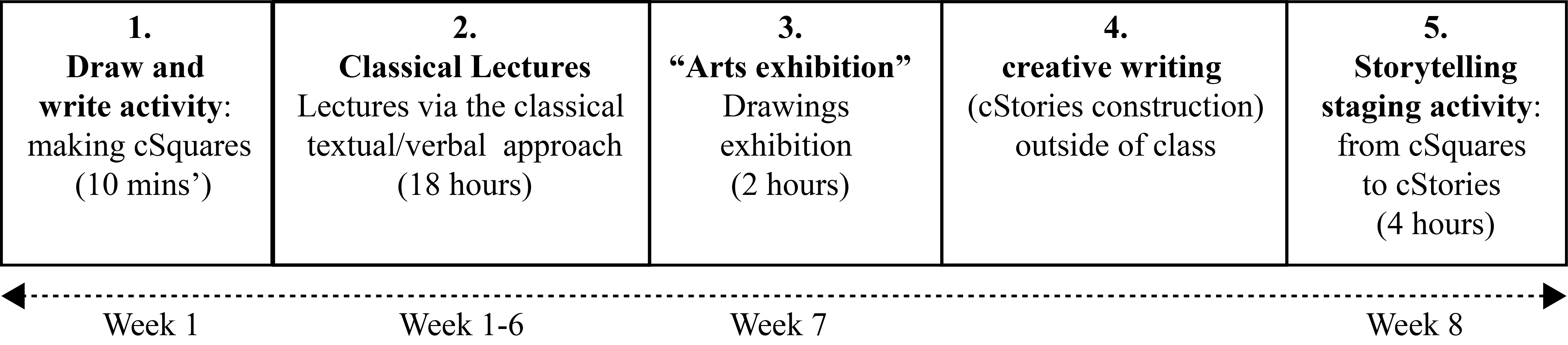
In Section 3.1, the results of the thematic analysis of a selection of drawings are presented and in Section 3.2, examples of the cStories illustrate students grasp of communication theories at work in real-life situations.
Thematic analysis of the cSquares
I performed a thematic analysis of the first batch of 74 cSquares collected during the 2015 classes in order to understand what prior conceptions students had of communication before receiving the lecture content. Thematic analysis is a qualitative analysis method involving human interpretation of knowledge artefacts. In other words, “Thematic analysis goes beyond simply counting phrases or words in a text and moves on to identifying implicit and explicit ideas within the data”.4
My first observation was that although the drawings were done before the students received the course content, their drawings and texts echoed well-known mass media and of interpersonal communication theories propounded by 20
Interpersonal communication: the drawings in this category evoked the theories propounded by Palo Alto school (Gregory Bateson, Paul Watlawick) and their research at the Mental Research Institute on the schizophrenic communication problems between psychiatric patients, their caregivers and family members in hospital settings which often resulted in a double bind. Machine mediated communication: this second group of drawings depicted the beginnings of mass media in the first half of the 20 Mass media manipulation effect: a third group of cSquares captured the popular and tenacious belief that the mass media influence people’s opinion and their perception of reality and not always in a disinterested fashion. These drawings are reminiscent of the functionalist theories of mass communication propounded by Harold Lasswell and Paul Lazarsfeld in the first half of the 20 Internet and global village: this fourth group of drawings mostly evoked Marshall McLuhan’s theories on the evolution of information and communication technologies (ICTs) and their impact on society, in particular his famous “medium is the message” aphorism as well as his prediction in “The Gutenberg Galaxy” (1962) that the next set of technological inventions will make the world a global village.6 The reader can find a more detailed analysis of these four categories of cSquares here:
Secondly, I also observed that in the students’ perception, Shannon-Weaver’s linear mathematical theory of information is not opposed to Wiener’s circular cybernetic model but that both formed a continuum.
This perceived proximity is all the more pertinent if one bears in mind the fact that the most influential theories of information and communication were propounded quasi-simultaneously by researchers who knew each other and mixed in the same circles: Claude Shannon (The Mathematical Theory of Communication 1948), Norbert Wiener (Cybernetics and control in the animal and the machine 1948) and Gregory Bateson (Steps to an ecology of Mind 1972) all attended the Macy conferences7
See
Finally, thematic analysis also showed the importance of the disciplinary background (domain bias) over linguistic, cultural and geographic biases, i.e., students’ conceptions of information and communication were more likely to be influenced by the courses they had done before enrolling in to this Masters’ course than by any other factor (geographic origins, linguistic or cultural factors). See [4] for more details.
It is quite remarkable that students were able to capture the main features of complex and abstract theoretical discourse propounded several decades ago (as early as 1927 for some) by the erudite scholars on the concept of communication using drawings on a small piece of paper, without having to resort to a lengthy verbal discourse or to elaborate graphic representations.
Around 86 cStories have been collected over four years (2015–2018). The fewer number of cStories compared to the cSquares is because it is a group activity, and I only began a systematic collection of the cStories since 2016. A presentation of a few stories from the 2015 series can be found on the cSquares website.8
More details are available here
First the texts of the 86 cStories collected between 2015 and 2018 were read to determine the theme of each story, the communications theories evoked and how they shed light on the relevance of these theories in modern times. This led me to identify seven thematic classes. As in the analysis of cSquares, the process of assigning a story to a thematic class is unavoidably subjective and the outcome depends on the pragmatic and hermeneutic goals of the analyst/interpreter. Table 1 hereafter summarises the salient features of each thematic class. As shown in this table, 32% of the stories came under the “chosen theories” category. These are real or imaginary situations interpreted through the lens of one or more chosen communication theories. Stories recounting the “history of communication came in the second position” (21%). In the third place, “communication modalities” (18.6%) referred to stories on how people communicate use different communication modalities (verbal, non-verbal and machine mediated communication such as the Internet, web, mail, radio, TV, telephone, social media). In the fourth position were stories illustrating the use of communication theories in political campaigns. Here we found stories recounting how the Obama’s, Trump’s, Clinton’s electoral campaign strategies brought into play some of the communication theories discussed in the textual/verbal lectures. In the fifth position were a few stories illustrating how specific mass media theories were deployed in advertisements and communication campaigns of global brands such as Ikea, Benetton, McDonalds, Apple, Coca-Cola, etc. Lastly, the two thematic classes “communication satire” (4.7%) and “misuse of communication” (4.7%) were ex-aequo in the sixth position.
Figure 3 hereafter summarises the distribution of the stories in the seven thematic classes.
The distribution of the 86 cStories over four years (2015–2018) in the seven thematic classes we identified
The distribution of the 86 cStories over four years (2015–2018) in the seven thematic classes we identified
Pie chart showing the distribution of the stories in the seven thematic classes.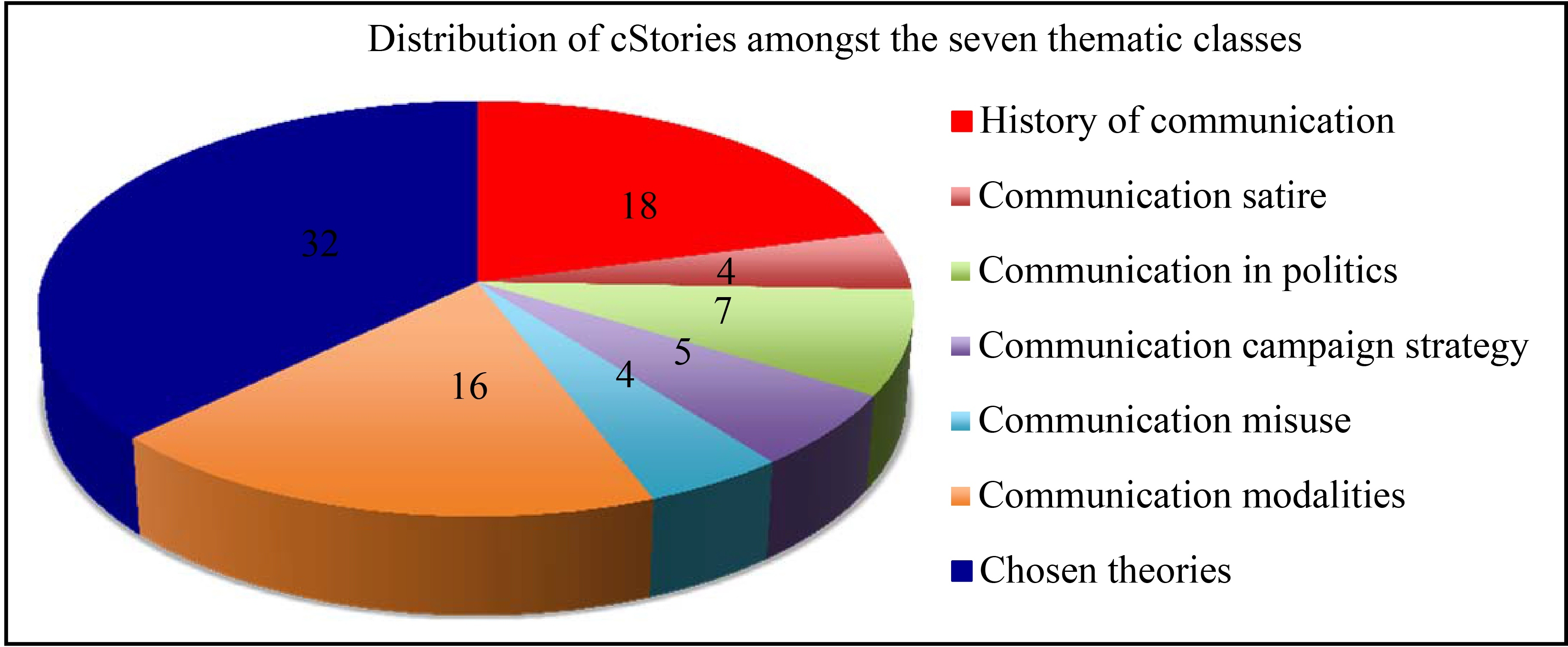
Two examples of cStories serve to illustrate the creativity of the students and their ability to interpret real life events or imaginary social phenomena through the lenses of abstract communication theories.
In general, stories classified under “communication campaign strategy” illustrate how the marketing and advertisement industries still call on mass media theories propounded in the first half of the 20
In a fourth stage, the students raised the teleological question (intention) via a drawing that portrayed the fact that the same message can be interpreted in different ways depending on the cultural context in which it is received and therefore the cultural element needs to be integrated in the design of a marketing campaign. As an example of how a message can be misunderstood by the target audience, the students cited the case of Benetton a company that specialises in provocative publicity campaigns that often ended up having a negative effect than the positive one intended by the company.
The question of feedback was tackled in the fifth stage where the students correctly analysed the strategic importance of the empowering capabilities that web 2.0 technologies have given to customers allowing them to have a powerful voice and therefore the capacity to trigger a negative buzz that can destroy the reputation of companies, brands and celebrities in a few days. The students correctly analysed that feedback can be a positive thing in that it can enable an organisation to adjust its message but it can also be negative in the case of bad buzz. The theoretical justification for the importance of feedback is of course Wiener’s cybernetics theory of communication. Wiener defined two types of feedback: positive feedback which accentuates the phenomenon and negative feedback which diminishes the effect expected. Once again, students illustrated the consequences of a negative feedback by citing the case of IKEA who had removed all feminine presence in one of its catalogues destined to Saudi Arabia in order to conform to that kingdom’s very conservative outlook on women’s role in society. This however generated a negative feedback from viewers in the western world.
cSquare 67 depicting “sheperd-flock” or opinion leader phenomenon.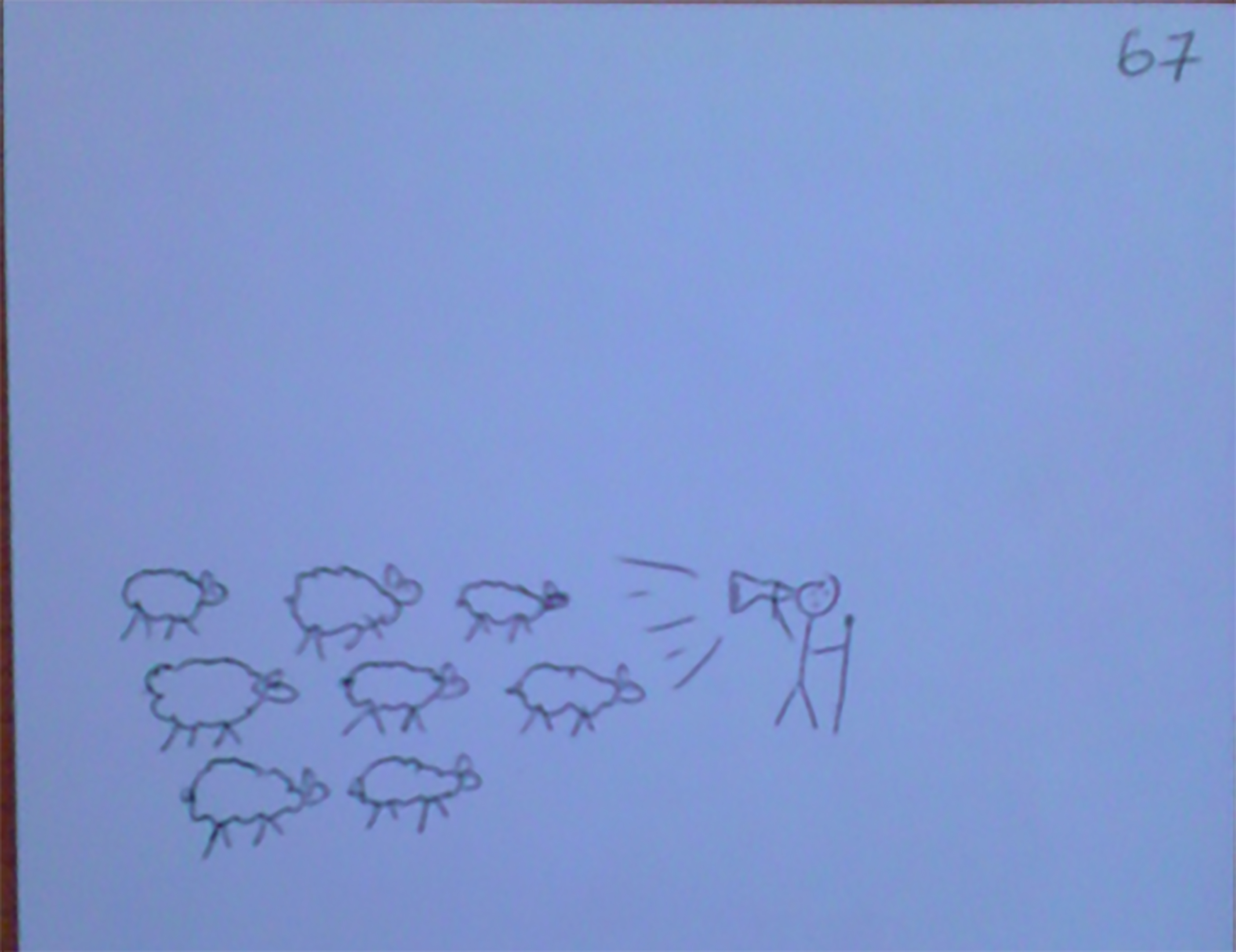
The story then concluded by recalling the three ingredients deemed fundamental for a successful communication campaign: choosing one’s target, defining one’s objectives and choosing the adequate means to get the message across as effectively as possible.
A second story from the “chosen theories” category was used to illustrate the relevance of Shannon’s linear information transmission model and particularly of noise and interference in the case of a real life event. The background was the fatal collision of two planes caused by communication problems that resulted in heavy casualties. The accident took place on 27
According to the dedicated Wikipedia page:
In part 1 entitled “The scenario”, the students set the scene by describing the events that led to the two planes being on that particular airport. In the first stage entitled “Two planes were diverted”, we learn that flight Pan Am 1736 flying from Los Angeles was informed that a bomb attack by a local separatist movement had caused the Las Palmas airport on Canary islands where it was scheduled to land to be closed. The crew asked to wait for the airport to be reopened but was ordered to fly to Los Rodeos, a neighbouring regional airport. Flight KLM 4805 also received the same order.
In the second stage entitled “Traffic jam at Tenerife”, we learn that the airport of Tenerife where the two planes had been diverted to was experiencing a traffic jam. Five big jumbo jets were already stationed on it whereas this airport was not equipped to receive such traffic. Furthermore, the runway was covered in fog. After an announcement that the Las Palmas airport had reopened, the two planes were authorised to prepare for take off. At 16:51 hours, one of the planes obtained authorisation to start its engine. At 16:52 hours, the second plane also requested and obtained permission to start its engine. The two planes began to taxi on the runway for take off.
The third stage entitled “The drama looms close”, the sequence of communication failures leading to the accident is staged. At 17:00 hours, the control tower ordered the American Boeing (PanAm 1736) to begin taxiing up the runway and to take exit 3. The crew was in doubt about the number of the exit: was it the “third” or the “first”. The plane also began to lose its way in the fog. At the same time, the KLM flight began taxiing on the runway where the lighting was out of order. In the absence of this lighting, the PanAm flight crossed exit 3 without being aware of it.
In a fourth stage 4 entitled “The collision”, the control tower gave “clearance” to the KLM flight but this does not mean that the latter had the authorisation to take off. The pilot began the manoeuvre and accelerated on the runway without seeing all the messages. At 17:06:41 hours, the two planes collided into each other.
In part two of the story entitled “Links with information-communication theories”, the students explained the communication failures through the prism of chosen theories.
First, Shannon’s linear communication model illustrated the negative effect of noise in a channel in the transmission and reception of messages between the control tower and the planes’ crews. The noise and interference during message transmission caused the PanAm crew to confuse “third” and “first” and to remain on the track without knowing which exit to take. The students’ interpretation here is quite astute because in Shannon’s mathematical theory of communication noise and uncertainty are usually seen as positive things because they increases the level of entropy which in turn creates uncertainty and surprise and subsequently imply a high information content. In this real-life scenario, we see that entropy had a very negative human consequence because noise and uncertainty in message received proved fatal and caused hundreds of death. This illustrates if need be that the purely mathematical and statistical nature of Shannon’s theory of communication is not adapted to human communication. The fact that the noise on the channel raised the degree of entropy and that the information content was high did not result in a positive social and human outcome. Indeed, a high degree of noise means that the information failed to be received correctly leading to negative real-life consequences. Thus while Shannon’s mathematical theory of communication has proved crucial for telecommunications and for data compression, it is not at all preoccupied by the social outcome of what it encodes and transmits and should therefore not be applicable to human communication. The effects of entropy in this story is indeed more wienerian than shannonian. Shannon and Wiener gave conflicting definitions of information and entropy. For the former, information is positively associated with noise, entropy, surprise and uncertainty. For Norbert Wiener in the “The Human Use of Human Beings”, entropy was the absolute evil to be combated because it caused disorder in a system, leading eventually to its disintegration. In contrast with Shannon, information was synonymous with order and regulation for Wiener.
Next, the students evoked Marshall McLuhan’s questionable distinction between “hot” and “cool” media to explain the PanAm crew’s inability to compensate for the failure of one of the five senses11
Humans are usually endowed with five basic senses: sight (vision), hearing (audition), taste (gustation), smell (olfaction), and touch (sensation)
“Cool media” on the other hand had a “low definition”, they affect many senses simultaneously and profoundly while giving only a low degree of information. They therefore require a strong participation from the receiver in order to determine its signification. McLuhan put in this category television (whose definition was very low in the 1960s), seminars, comic books, voice and the telephone. The students argued that when the functioning of a hot media is impaired, perception becomes blurred because one cannot turn to another sense. In this instance, the radio was the hot media which solicited the hearing sense (audition) of the crew but when the radio reception was impaired, the crew was thrown into doubt more so as the other sense they could have solicited (sight) was also impaired due to the presence of fog on the runway.
Finally, theories stressing the importance of context and of non verbal communication in any human interaction were evoked to explain the catastrophic failure in communication between the crews of the two planes and the control tower: Palo Alto school’s axioms on interpersonal communication, in particular, Gregory Bateson and Paul Watlawick’s focus on the context and meta-communication over the verbal content of messages; Ray Birdwhistell’s analysis of the importance of kinesics and Edward T Hall’s work on proxemics in The Silent language were all invoked in the closing paragraph of the story.
The use of an arts-informed approach in a classroom setting is a bottom-up pedagogical approach that empowers students to express their conceptions of complex and abstract phenomena and to reutilise them by showcasing real life events or plausible situations involving human interactions. What is remarkable in this experience is that the students’ pre-conceptions of communication expressed in their drawing (cSquares) prior to receiving the instructor’s lectures reflected some of the shared conceptions of information and communication debated in the scientific literature.
The fact that the arts-informed approach was not used in isolation, but in combination with the traditional textual/verbal lecture and augmented with creative writing and storytelling activities, offered students a wide choice of learning modalities which increased their engagement in the course and the learning outcomes.
The cStories showed that the students not only understood the abstract concepts implied by the communication theories discussed during the lectures, but were also able to recast them in real life situations (political campaigns, advertisements, use of social and the mass media). The cStories enhanced students’ appropriation of course content and added more depth to the thematic analysis performed on individual drawings. Since I began implementing this hybrid methodology in the teaching of this theoretically-oriented course, I have observed a higher degree of student engagement during the arts-informed pedagogical approach than during the verbal lectures. Also the arts-based activities help students to prepare for their final written examination of the course.
I have yet to fully exploit the contents of the cSquares and cStories. For instance, I would like to carry out a comprehensive analysis of the textual definitions of communication given on the recto side of the cSquares and compare them with the drawings. The cStories are still largely an untapped material. Several possibilities for analysing this material are possible. Their texts can be subjected to a text mining process in order to map the recurrent themes, the theories often associated together and the contexts in which they are evoked. A discourse analysis of the corpus of cStories can also be done in order to identify argumentative cues and rhetorical markers used by the students in constructing their stories. This will be a matter for future investigation.