




Abstract
Combining and analysing sensitive data from multiple sources offers considerable potential for knowledge discovery. However, there are a number of issues that pose problems for such analyses, including technical barriers, privacy restrictions, security concerns, and trust issues. Privacy-preserving distributed data mining techniques (PPDDM) aim to overcome these challenges by extracting knowledge from partitioned data while minimizing the release of sensitive information. This paper reports the results and findings of a systematic review of PPDDM techniques from 231 scientific articles published in the past 20 years. We summarize the state of the art, compare the problems they address, and identify the outstanding challenges in the field. This review identifies the consequence of the lack of standard criteria to evaluate new PPDDM methods and proposes comprehensive evaluation criteria with 10 key factors. We discuss the ambiguous definitions of privacy and confusion between privacy and security in the field, and provide suggestions of how to make a clear and applicable privacy description for new PPDDM techniques. The findings from our review enhance the understanding of the challenges of applying theoretical PPDDM methods to real-life use cases, and the importance of involving legal-ethical and social experts in implementing PPDDM methods. This comprehensive review will serve as a helpful guide to past research and future opportunities in the area of PPDDM.
Introduction
Mining distributed, sensitive data offers tantalising potential for new insights and a wide variety of applications, but is generally fraught with concerns of model accuracy and data privacy. Consider the case of analyzing patient data in the healthcare domain: hospitals have used patient data to improve diagnostic accuracy and efficiency [29,31] and to fuel the transition to preventive [17] and precision medicine [6,27,95]. However, learning patient data from a single hospital might cause limited model performance and incomplete knowledge discovery [59]. Patients’ health are not only affected by genetic and biological factors, but also by individual behaviour and social circumstances [19]. Combining various patient data from multiple sources offers one pathway to obtain more accurate and reliable analytical models for health outcomes [3,97]. However, combining distributed sensitive data faces a number of challenges including: data protection compliance to one or more legal jurisdictions, privacy concerns, security, and trust issues. Beyond the healthcare domain, this also applies to applications in many other fields, such as finance and law [82,114]. Conventional centralised data mining techniques are challenged in this environment and require viable alternatives.
Privacy-preserving distributed data mining (PPDDM), which focuses on the analysis of decentralised data without leaking sensitive information from any party to the other parties, offers one way forward for multiple data parties to overcome the challenges posed by centralising the data for analysis [72]. PPDDM techniques, whether data mining or machine learning, aim to make it technically or mathematically infeasible to deduce the original data from a communication message, and certainly from the final analysis result. To make use of PPDDM in practical applications, we should consider the data problems (e.g., classification, regression), the adversarial concerns the involving data parties have (e.g., malicious, honest), and the balance between data privacy and model performance. PPDDM is sometimes referred to privacy-preserving federated learning after Google first proposed the concept in 2016 [66,76]. However, privacy-preserving federated learning can be regarded as a specific category of PPDDM, in which there is a federation of autonomous organisations that express an interest to contribute to a joint analysis [92].
A number of PPDDM methods have been reported in the last 20 years. The existing survey papers have compared the theoretical backgrounds, strengths, and limitations. However, the analysis of distributed data has been poorly addressed as only one special case of privacy-preserving data mining [1,9,89,110]. The distributed data problem has been addressed to a limited extent in the survey of Hina Vaghashia [102] and Suchitra Shelke [91]. Vassilios S. et al. [110] presented five dimensions of state-of-the-art privacy-preserving data mining algorithms where the problem of analysing distributed data was merely considered to be addressed by cryptography-based techniques and only the association rule mining problem and decision tree induction were presented in this survey. Several surveys summarized the evaluation parameters to assess privacy-preserving techniques including privacy level, hiding failure, data quality, complexity, efficiency, and resistance of different data mining algorithms [9,10,36,110]. Others have a major focus on the definition and construction of Secure Multiparty Computation (SMC) and how SMC can be combined with data mining algorithms [18,72,103]. In a recent survey [77], privacy-preserving approaches were summarized for data collection, data publishing, data mining output, and distributed learning. The majority of the published surveys have typically treated PPDDM as a specialised subtopic of either distributed data mining or privacy-preserving data mining. As an emerging field, PPDDM is under-reported in the existing surveys and now requires a more comprehensive and complete analysis.
Accordingly, the main aim of this systematic review is to provide an overview of existing approaches and identify outstanding challenges in the field of PPDDM. This paper reports the results and findings of a comprehensive review of PPDDM techniques from 231 scientific articles published in the past 20 years. We present the characteristics of the 18 most cited studies and analyze their influence on other studies in the field. The results show a wide range of privacy-preserving methods and data mining algorithms have been well-studied. We highlight the findings showing a lack of standard evaluation criteria in the field, the ambiguous definition of privacy, and insufficient experimental information in some studies. These findings enhance the understanding of the challenges of applying the theoretical PPDDM methods to real-life use cases, and the importance of involving legal-ethical and social experts in implementing PPDDM methods.
The main contributions of this work to the literature in the PPDDM field are:
to propose comprehensive criteria with 10 key factors to evaluate the new PPDDM techniques. The evaluation criteria include adversarial behaviour of data parties, data partitioning, experiment datasets, privacy/security analysis, privacy-preserving methods, data mining problems, analysis algorithms, complexity and cost, performance measures, and scalability.
to present different definitions of privacy, distinguish information privacy from information security in the PPDDM field, and provide suggestions of how to make clear and applicable privacy descriptions to propose new PPDDM techniques.
to identify the most cited PPDDM articles, analyze their characteristics and how these articles influence other studies in the field, and
to provide a guideline based on the proposed evaluation criteria for researchers to conduct future research and publications in the PPDDM field.
This systematic review offers new insights into the important factors that should be considered to propose and evaluate new PPDDM techniques and how to bridge the gap between theoretical methods and practical applications in the field. We present this review paper as a helpful guide to past research and future opportunities in the area of PPDDM.
The outline of this paper is as follows. In the next section, we present existing privacy-preserving methods and define terms related to PPDDM. In Section 3, we describe the approach in conducting this systematic review. In Section 4, we provide the results of our review, including evaluation criteria. In Section 5, we compare the key influential papers. In the last section, we summarize our main findings, present a list of recommendations, and discuss future directions.
Privacy-preserving methods
Privacy-preserving methods, as the major component of PPDDM techniques, are used to minimize the release of information during data mining model training and communication among multiple parties. Various privacy-preserving methods have been proposed from different communities such as statistics, cryptography, data mining, and secure data transfer. In this section, we summarize the most commonly-used privacy-preserving methods in PPDDM.
Secure multiparty computation (SMC)
Secure multiparty computation protocols are designed for multiple parties to jointly compute some function over their own data without revealing the original data to any other parties [72]. The foundation for SMC started from cryptography. In addition to protect the participants from being attacked by external parties (who are outside of the system or protocol), SMC also protects the participants from each other. For example, some SMC protocols are implemented to prevent participants from learning private information from other parties or deliberately sending incorrect computation results to other parties. The following sub-sections describe some well-known protocols in SMC.
Building blocks (primitives) SMC of protocols
Secure protocols that are deployed as building blocks of secure computation are used to prevent data being revealed or deduced from the communication and/or computation between data parties [72]. Commonly used encryption protocols include oblivious transfer and homomorphic encryption. Oblivious transfer, first developed by Even et al. [33], considers two data parties, a requester and a sender, where the requester obtains exactly one instance without the sender knowing which element was queried, and without the requester knowing about the other instances that were not retrieved. Oblivious transfer protocols iteratively pass over the data many times during training, and as a result are computationally expensive. Another technique, homomorphic encryption, was introduced by Rivest [86]. This technique supports certain algebraic operations such as additions and multiplications on encrypted text (i.e., ciphertext). The decrypted result from the operations on ciphertext matches the result of the operations performed on the plain text. Homomorphic encryption systems are grouped into fully homomorphic encryption (FHE) or partial homomorphic encryption (PHE) [81]. As the initial scheme of a homomorphic cryptosystem, PHE can only perform a specific algebra operation such as addition or multiplication in each iteration. This limits the usability for data mining algorithms, as the algorithms consist of several complex operations. On the contrary, FHE supports any desirable operation and functionality that can run on the ciphertext. Since the ciphertext is never decrypted, the input from each data party is not revealed. The first generation of FHE system was proposed by Gentry in 2009 [42]. However, FHE systems are not sufficiently efficient due to the high computational cost of performing iterative operations over encrypted data during the training epochs.
Generic SMC protocols
Generic SMC protocols were implemented for any probabilistic polynomial-time function [72]. Unlike homomorphic encryption systems, these generic protocols are sensitive to the number of data parties. The commonly-used protocol of secure two-party computation is Yao’s garbled circuit protocol [124]. The protocol is based on evaluating the function that needs to be computed by two data parties as a combinatorial circuit with a collection of gates (e.g., AND, XOR gate). These gates connect with circuit-input wires, circuit-output wires and intermediate wires. Each gate has two input wires and one single output wire. The required communication of the protocol depends on the size of the circuit, while the computation cost depends on the number of input wires. Extensions to more than two data parties, i.e. the cases of multiparty computation, have been developed by Micali et al. [79], Beaver et al. [5], and Ben-Or et al. [7]. Following Yao’s theory, these protocols are based on designing the function as a circuit and applying a secure computation protocol to the circuit [72]. Beside computational complexity, communication cost is a considerable factor in these protocols. All protocols need a one-to-one communication channel between every pair of parties. Some require a broadcast channel for all parties.
Specialized SMC protocols
Specialized SMC protocols are commonly used as primitives to the data mining algorithms including secure sum, secure set union, secure size of intersection, and secure scalar product protocols. These protocols allow certain operations without revealing any inputs from any of the participating data parties.
Secure sum as a basic and simple example of secure multiparty computation was introduced by Clifton et al. to obtain the sum of the inputs [18]. The protocol is as follows: data party A has
Secure set union has been applied to the case where data parties want to jointly create unions of sets from rules and itemsets shared by multiple parties but not leaking the owner of each set. To guarantee a secure computation, one approach is to apply a commutative encryption system in computing the set union [18,85]. A commutative encryption system can encrypt original data multiple times using different users’ public keys. The final encrypted data can be decrypted without considering the order of the public keys in the encryption process [51]. In the secure set union protocol, one data party encrypts its own itemsets using commutative encryption and transfers them to other parties. The receiver party encrypts both its own sets and the received encrypted sets and passes it to the next party. Once the data is encrypted by all parties, decryption can start at each party in any order. The permutation of the encryption order prevents the participating parties from tracking the ownership of itemsets. However, if one item is present at multiple data parties, then the number of the item will be exposed because of duplication. Figure 1(b) presents an example of securely computing a set union among three data parties.
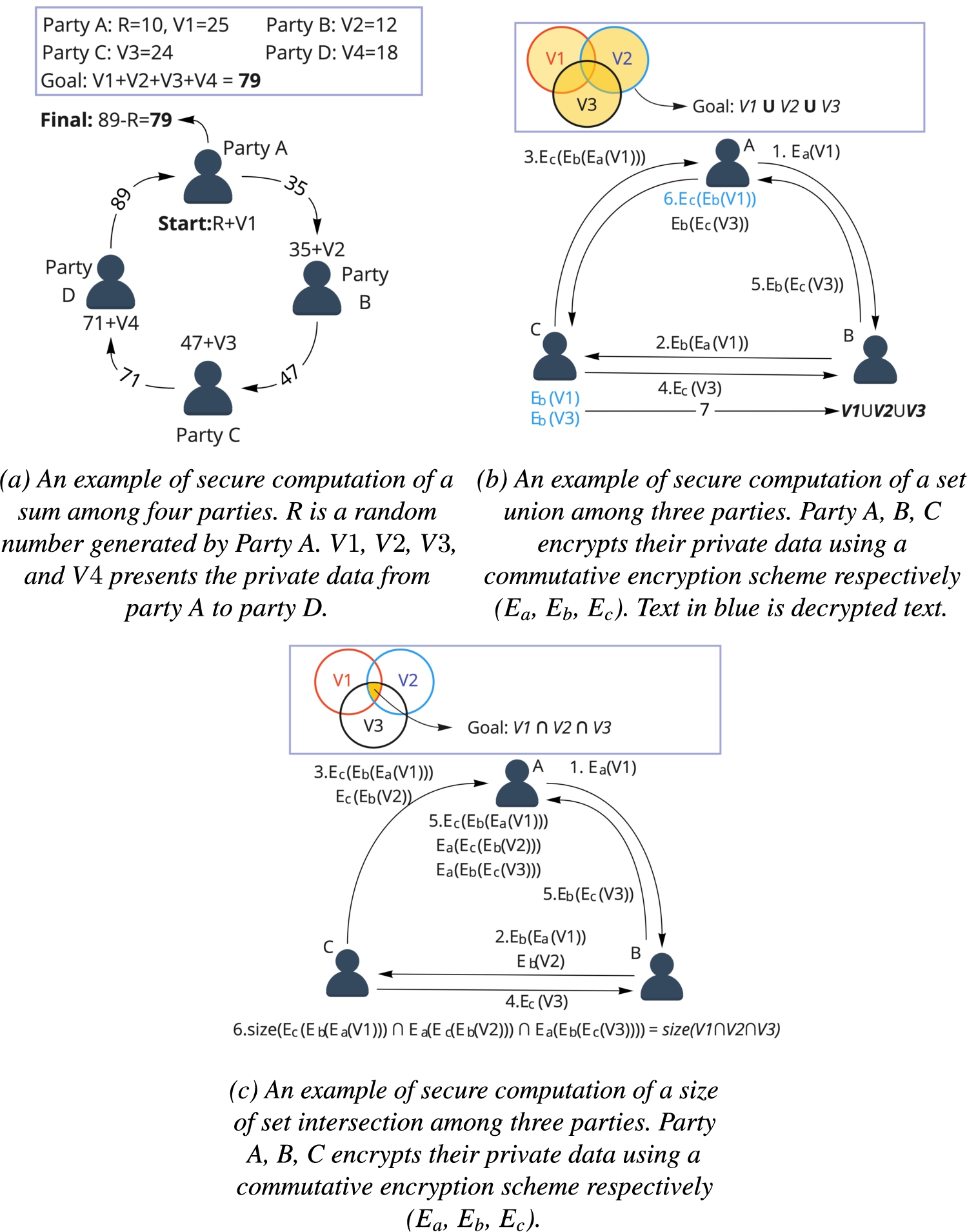
Secure size of set intersection is solving the problem that multiple data parties want to obtain the size of set intersection of their local datasets without revealing the ownership. Similar to secure set union, each data party encrypts its own item sets by using commutative encryption and sends it to another data party. The receiver encrypts these items, arbitrarily permutes the order, and sends it to the next data party. This process ends when all item sets are encrypted by all data parties. Due to the commutative encryption, if and only if the original inputs are the same, then the final outcomes from two different item sets can be equal. Therefore, the number of values that occur in all encrypted item sets is the size of the set intersection. No input will get exposed since only encryption (no decryption) is required. Figure 1(c) demonstrates the protocol of securely computing the size of set intersection.
Secure scalar product protocols are essential and powerful. It has been widely applied in many data mining algorithms which can be decomposed to the calculation of scalar products. As a notable example, Vaidya and Clifton extended a secure scalar products protocol to solve association rule mining problems between two parties [104]. The general idea is as follows:
Data party A has
The protocol starts at Party A who generates n random numbers
Party B generates
Party A calculates
Party B computes the final scalar product as
The security of this secure scalar product protocol is guaranteed by the inability of either side to deduce k equations with more than k unknowns. As with many other existing scalar product protocols [4,54], it is limited to the collaboration between only two parties because of the lack of efficiency in practice [18].
Data Perturbation preserves data privacy by adding ‘noise” to the individual records but still keeps the key summary information about the data [116]. One major approach of data perturbation is to use statistical techniques to replace the original data with synthetic values which have the same or comparable statistical information (e.g., distributions) as the original values. The synthetic data can be generated by a statistical model which learns from the original data. The other main approach is to distort the values by applying additive noise, multiplicative noise, or other randomization procedures [2]. Data swapping, another method of data perturbation, switches a set of (sensitive) attributes between different data entities to prevent the linkage of records to identities [23,35]. The major drawback of these methods is the decrease of data quality and accuracy of the learning model. Data perturbation techniques are more commonly used to protect privacy in data publishing problems [77].
Local learning and global integration
The method that integrates local models to one global model uses the foundation of ensemble learning that trains a set of models in order to enhance the performance of one single model [84,112]. Each data party can train their own local data miners independently. Then, these local data miners are sequentially or parallelly integrated to compose a center or global data miner which can generate the final results. Consequently, the original data of each party is never transferred to other data parties. A majority of data mining algorithms have been theoretically developed to this approach including Support Vector Machine [40,74,100,108], Decision Tree [34,98,106], Neural Networks [21,28,100,128] and so forth. A few of them have been successfully implemented, applied and evaluated in practical use cases such as [59] and [118].
Methodology
This paper follows the systematic review procedures described by Kitchenham [65]. In this section, we will detail the workflow. First, we discuss the inclusion and exclusion criteria of study selection, followed by the search strategies, and evaluation criteria for reviewing selected studies.
Eligibility criteria
We selected papers that are peer-reviewed publications in English between 2000 and 2020 (August) working on data mining and machine learning techniques that solve problems of classification, regression, clustering, or association rule mining. The eligible papers must take privacy preservation into account when data mining and machine learning models are executed on partitioned data. Partitioned data includes horizontally partitioned/homogeneous data, vertically partitioned/heterogeneous data, and arbitrarily partitioned data (The definitions of different partitioned data are presented in Section 3.3). Furthermore, included papers must 1) propose and/or implement a new approach and/or; 2) apply existing approaches to a practical case and/or; 3) improve the performance of existing approaches.
To narrow down the number of publications, we excluded poster and workshop abstracts, survey papers, and articles that only contain discussions on current concerns and future research directions. To set the scope of this survey, the authors screened titles, keywords, and abstracts to exclude the papers that 1) only focus on privacy-preserving data mining/machine learning on centralised data, 2) solve problems of parallel computing, cloud computing, grid computing, edge computing, and fog computing to improve computational performance rather than the complexity of the data analysis problem, 3) solve privacy issues in data collecting, data publishing, data storage, and data querying, and 4) focus on Blockchain, web attacks detection, intrusion detection, data privacy focusing on mobile devices, geographic data privacy, and differential privacy. If the papers could not be identified based on its title, keywords, and abstract, the authors reviewed the full text of the paper.
Search strategy
According to the eligibility criteria above, we used the following search engines and digital libraries: IEEE Xplore Digital Library ,1
IEEE Xplore: https://ieeexplore.ieee.org/Xplore/home.jsp/.
ACM Digital Library: https://dl.acm.org/.
ScienceDirect: https://www.sciencedirect.com/.
Web of Science – Clarivate: https://clarivate.com/products/web-of-science/.
Springer Link: https://link.springer.com/.
PubMed: https://www.ncbi.nlm.nih.gov/pubmed/.
privacy and (distributed or de-centralized or de-centralised or partitioned) and “machine learning” (
privacy and (distributed or de-centralized or de-centralised or partitioned) and “data mining” (
privacy and (vertically or heterogeneous) and “machine learning” (
privacy and (vertically or heterogeneous) and “data mining” (
privacy and (horizontally or homogeneous) and “machine learning” (
privacy and (horizontally or homogeneous) and “data mining” (
To evaluate the paper on PPDDM techniques, conventional data mining evaluation criteria are not adequate [84]. Beside conventional evaluation methods, additional factors such as communication costs, data partitioning, adversary behavior, privacy measures should be considered. To the best of our knowledge, there are no standard criteria for evaluating new PPDDM approaches. Consequently, studies selected a various set of evaluation methods which they think are necessary for their approaches. In this review, we assessed selected papers considering the following 10 factors including adversarial behavior of data party, data partitioning, experimented datasets, privacy/security analysis, privacy-preserving methods, data mining problems, analysis algorithms, complexity and cost, performance measures, and scalability. The authors initially generated and modified these evaluation criteria by reviewing 10% of the included articles. Then, the evaluation criteria have been discussed by the co-authors in several iterations of reviewing until an agreement has been made on these 10-factor evaluation criteria. Afterwards, all selected papers have been reviewed and assessed again using the criteria.
Datasets that are publicly available (e.g., UCI repository) [101]
Datasets from practical cases such as real patients data from a clinic
Synthetic datasets and datasets which were generated by authors
Experiments are presented in the paper but information about datasets is missing
No experiments are presented in the paper

Examples of three different partitioned data. Figure 2(a) shows horizontally partitioned data which contains the same attributes/features from different data instances. Figure 2(b) shows vertically partitioned data which contains the same data instances but with different attributes/features. Figure 2(c) shows arbitrarily partitioned data which is a hybrid situation of horizontally and vertically partitioned data.
In this section, we first describe the number and distribution of search results retrieved from the six search engines in the last 20 years. Detailed reviews of selected papers based on the evaluation criteria are elaborated in Section 4.2. The analysis of the relations among selected papers is described in Section 4.3.
Search results

Workflow of conducting this systematic review.
In Fig. 3, we present the workflow of this systematic review with the number of papers included in each step. Following the inclusion criteria, 4222 publications including duplicates were retrieved from six search engines. Most papers were from IEEE and Springer Link followed by ACM Digital Library. To remove the duplicates, we used Digital Object Identifiers (DOI) to keep the unique papers. The number of publications was reduced from 4222 to 2424. Furthermore, we filtered out irrelevant papers by screening the titles and abstracts of the retrieved papers. Papers that focused on parallel computing, cloud computing, edge computing, network security, intrusion detection, web attack detection, privacy in mobile data and geographic data, differential privacy, privacy in data collecting, data publishing, data storing, data querying were excluded. In the end, 231 papers were selected to be preliminarily reviewed.

Numbers and clusters of selected papers from different search terms. Papers are presented as nodes and clustered by the search terms. The number of papers in each cluster is labeled in the figure. The edges show which search terms were used to find the papers. For example, the 23 nodes in the purple cluster were found from using search terms PPDDM, PPHDM, and PPVDM.
To improve the insight of the search result, we map the selected papers into graphs by using the Gephi visualization tool [43]. In Fig. 4, the distribution of 231 selected papers using different search terms is presented. Papers are presented as nodes and clustered by the search terms. For instance, 182 selected papers were found by using the search term – PPDDM, while 38 of them were findable in PPHDM category and 50 of them were findable in PPVDM. It is obvious that data mining papers are the majority of the search outcomes. It is reasonable as data mining covers a larger scope than machine learning. Privacy issues should be considered in the entire data processing procedure instead of only the part of analysis and building machine learning models. Moreover, a large number of papers (71 papers from PPDDM, 22 papers from PPDML) did not indicated what exact data partitioning problems (vertical, horizontal, or arbitrary) their method can solve in their titles, abstracts, and keywords. This increases difficulties for other researchers and practitioners to find the correct papers based on their needs.
In Fig. 5, we summarize the review results of 231 papers using the 10 evaluation factors we discussed previously. The full review results of 231 papers are publicly available in the data repository: https://doi.org/10.6084/m9.figshare.14239937.v4. (DOI: 10.6084/m9.figshare.14239937). The following subsection elaborates on the review result of each factor.
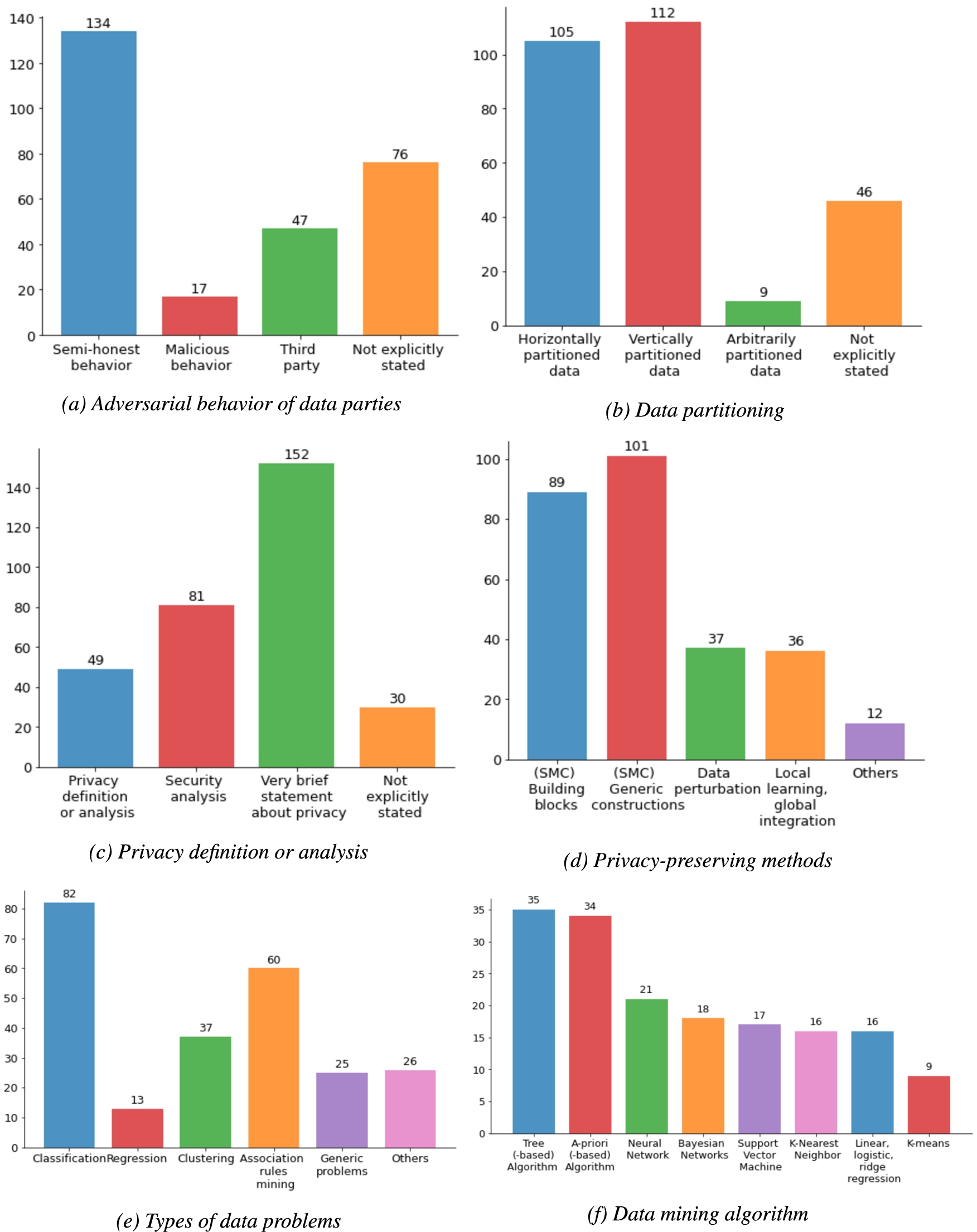
Bar charts of presenting review results using 10-factor evaluation criteria. Papers can cover one or more items in the factors except privacy definition/analysis and scalability.

(Continued.)
We investigated how selected papers influence each other based on their references and citations. We extracted text from reference sections of all selected studies and recognized titles and authors from the text. As DOIs are not available in the reference section of all papers, only titles and authors were used to recognize different studies. Figure 6 illustrates the citation network, where papers are represented as nodes, and citing relations are represented as edges. The size of nodes are proportional to the number of citations among the 231 papers. Papers [80,104,105] are most cited, with 1354, 1320, and 875 citations respectively (until 2021 Feb).
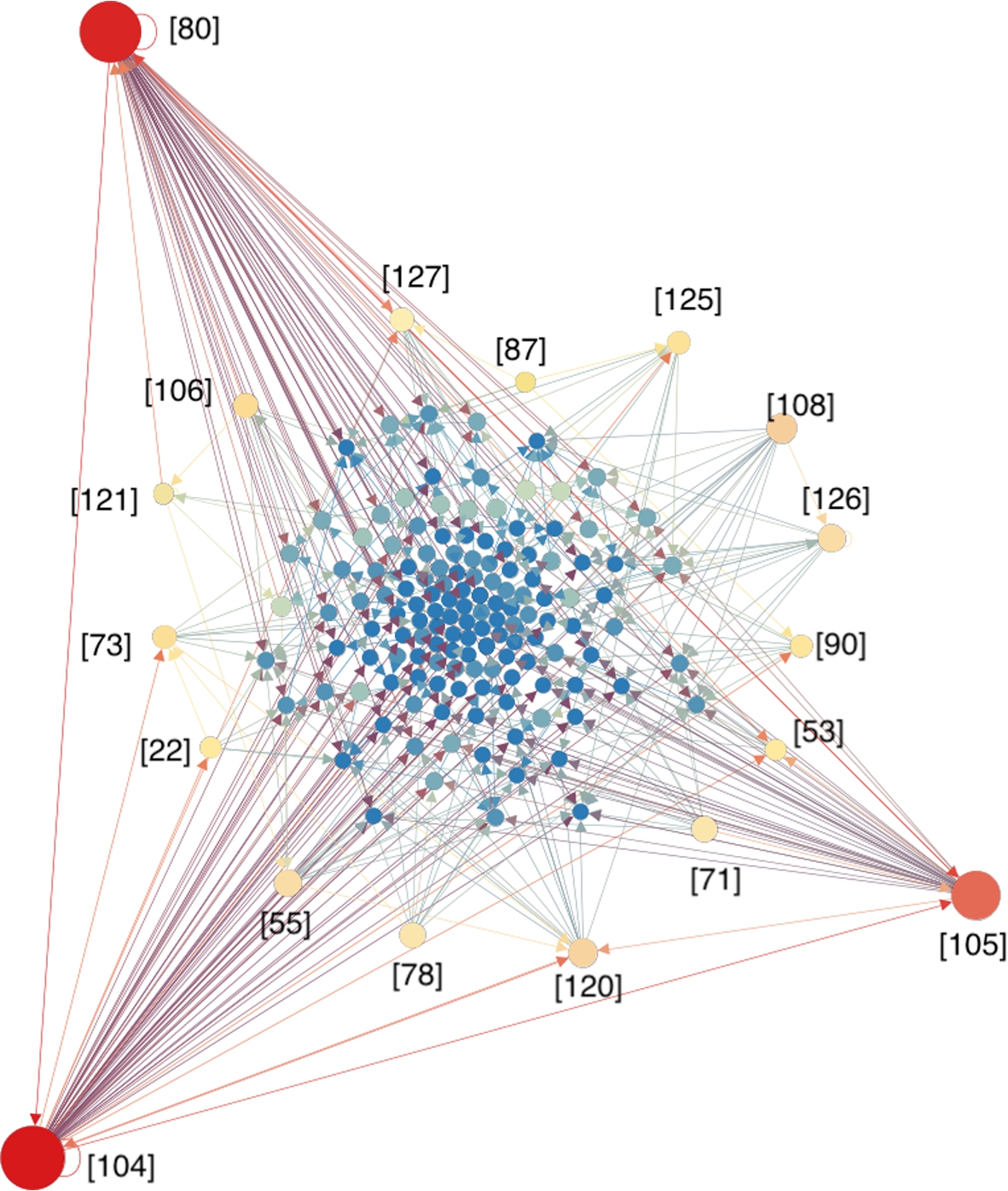
Citation network among the selected papers. Papers are presented as nodes, while the citing relations are presented as edges. The size of nodes are proportional to the number of citations among the 231 papers.
Table 1 lists the attributes of the most cited articles. Semi-honest behavior is the most common assumption, while none of these influential papers addressed malicious adversarial behavior. 3 out of 18 studies considered a third party. Two papers [55,108] took all possible data distribution situations (horizontally, vertically, and arbitrarily partitioned data) into account. Horizontally and vertically partitioned data problems have been covered with a good balance. Although the vertically partitioned data problem is more complicated than the horizontally one [107,113], our review indicates that they have been developed at the same pace.
A similar balance is apparent in the types of problems as well. Seven papers focused on solving a classification problem by using SVM, decision tree, bayesian networks, while 8 papers looked at clustering problems particularly at K-means, Expectation Maximization algorithms (EM), Local Outlier Factor (LOF) algorithm. Association rule mining problem has fewer influential papers, but the top 2 influential papers [80,104] both focused on this problem. In contrast to the balance in the types of problems, privacy-preserving solutions from the influential papers are completely dominated by SMC. 16 out of 18 influential papers covered SMC [121,127] combined SMC with homomorphic encryption, while [108,125,126] combined it with structuring local and global data miners. More than half of existing studies in our review applied SMC as the major privacy-preserving method.
Review results for the 18 most cited papers in this review. (PP method: privacy-preserving methods; local-global: local learning and global integration; ARM: association rule mining)
It is notable that 12 out of 18 studies did not conduct experiments, but they provided explicit privacy/security analyses and costs measurements instead. These privacy/security analyses have been presented in different ways, but the main objectives were similar. All influential papers described what information their approaches can protect, what information have to be disclosed, and what potential risks, problems or troubles might exist. Moreover, their computational complexity and communication costs of their approaches were clearly presented as one of the evaluation parameters. Hence, the described performance evaluation on privacy and efficiency may be the reasons why these papers are often cited.
PPDDM has been rapidly developing through active research programs across different scientific communities including data mining and machine learning, mathematics and statistics, cryptography, and data management. The total number of publications in this domain has dramatically increased in the last 20 years. Many of the studies included promising results in the efficiency and accuracy of their models in an experimental environment. These promising experimental results helped move the field forward towards practical applications. In the past five years, use cases have been developed in healthcare [25,59,63,69], finance [15], and technology companies [11,50,66] to examine different PPDDM methods. Participation of industry partners accelerates the transformation of PPDDM theoretical methods to practical applications. The existing PPDDM methods have been well-developed to solve a wide range of data problems (e.g., classification, clustering, association rule mining) using various data mining algorithms. To achieve the goal of PPDDM methods in practical studies, methods that will preserve privacy require legal, ethical, and social scholars in addition to scientific and technical experts. Successful implementation of PPDDM needs a joint effort from researchers with diverse backgrounds.
Inadequate definition and measurement of privacy
There are some challenges hindering PPDDM methods to be further developed and widely applied in practice. One of the key issues is the lack of the definition and measurement of (information) privacy. The meaning and operational definition of privacy is commonly ambiguous and subjective in the selected papers. It is not sufficiently expressed by the papers what privacy means to them, and what their proposed approaches can preserve. The three most common definitions of privacy preservation in the selected papers are 1) not revealing sensitive information; 2) not revealing private information; 3) not revealing raw data. However, it is unclear if “sensitive information” or “private information” or “raw data” is equal to personal information privacy. To understand personal information privacy from a legal and ethical perspective, it is the right of an individual or group to seclude themselves, or information about themselves, and thereby express themselves selectively [8,20,93]. Similarly, privacy is seen as the claim of individuals, groups, or institutions to determine for themselves when, how, and to what extent information about them is communicated to others [115]. In relation to controlling and protecting privacy, two definitions from legal literature state “Privacy, as a whole or in part, represents the control of transactions between person(s) and other(s), the ultimate aim of which is to enhance autonomy and/or to minimize vulnerability” [75] and “Privacy is to protect personal data and information related to a communication entity to be collected from other entities that are not authorized” [26].
According to privacy definitions above, any information about a person can be considered as privacy regardless of its sensitivity, originality, and transformation. It is the data subject that determines what data is private. For instance, a data subject might consider their state of mental health more private than their date of birth. However, existing PPDDM methods have not yet addressed different privacy requirements from each data subject. All data elements have equal treatment for all data subjects. This might cause insufficient privacy preservation for some data elements and data subjects, while over-protection for the others. To personalize the privacy preservation, Xiao and Tao [122] proposed a new generalization framework using personalized anonymity that data subjects can specify the degree of privacy protection for her/his data elements. In the study, Xiao and Tao [122] assume: 1) data subjects can easily set/change their privacy requirements with data parties, 2) data subjects are knowledgeable about the benefits and consequences of setting different degrees of privacy. This method is only applicable when the data is centralized. In the partitioned data scenario, there is no platform yet facilitating data subjects to customize privacy requirements for each data element across multiple parties. Second, privacy requirements can be satisfied when using one single data source. However, analyzing an amount of partitioned data from multiple sources increases risk of privacy violation. As indicated by the 2020 European Commission White Paper on Artificial Intelligence [32], data about persons can be re-identified through the analysis of large amounts of other non-private data.
Ambiguity between privacy and security
Another ambiguity lies in the difference between (information) privacy and (information) security. Different from privacy, security has an explicit definition and measurement from the cryptography domain, separating the problem into semantic security and technical security [44]. Semantic security is a computational-complexity analogue of Shannon’s definition of perfect privacy (which requires that the ciphertext yield no information regarding the plaintext). Technical security is the infeasibility of distinguishing between encryptions of a given pair of messages. Generally speaking, security focuses on maximally protecting information/data from malicious attacks and stealing data. Satisfying security requirements is not always sufficient for addressing privacy issues [56]. However, in the majority of the reviewed papers, the difference between security and privacy is not clearly stated. For example, some studies defined the data privacy but evaluated the methods by conducting security analysis [46,58,70]. Certain approaches guarantee that the data used for the analyses remain unknown to other parties through secure computation. However, this does not mean that the resulting output from the analyses is equally privacy-preserving [56,60,72]. The output can reveal information about the person so that the privacy is still not preserved according to the privacy definition we discussed above. For instance, the outcome of the analysis might portray a harmful profile for individuals sharing certain characteristics. Some essential problems are not taken into consideration, such as how much data or information will be revealed by the output although the output is computed securely [69], whether the models and algorithms are harmless to the data party or individuals, does the purpose of formula or function satisfy the legal and ethical concerns [96,99]. A typical example is building a decision tree on vertically partitioned data in a privacy-preserving way. The decision tree model can be securely and correctly built up. However, to some extent, the decision tree, as an output, leaks information about the input data [37]. Decision tree algorithm splits nodes based on attributes or features, while the splitting decision is dictated by the data. When the final decision tree is completed, the leaf nodes in the tree might reveal some information about the input data such as class counts. Therefore, releasing the final decision tree to all participating parties could potentially breach privacy.
Providing an applicable privacy description is significant to any PPDDM studies. What data or information should be preserved from mining can be influenced by different legal restrictions, ethical concerns, organizational regulations, personal preference, and application domains. Instead of generalizing the solution of a specific scheme to all situations, it is more reasonable to make a precise statement on the specific scenario to address. Therefore, the authors could provide a clear description to readers about what privacy means to them, and in which situation the proposed approach is privacy preserving by answering the following questions:
What is the operational definition of privacy-preservation for the work?
Which data are deemed sensitive or require protection, and why?
What computational operation is intended to preserve privacy, and where does it fail?
What is the role or responsibility of each actor (e.g., data collector, data holder, data publisher, data analyst) in the scenario?
Inadequate experiments and practical use cases
Our review result shows half of the reviewed papers did not provide any experiments to evaluate their methods, and as such there were no reports of accuracy, efficiency, and scalability in these papers. This is probably one of the gaps between the theoretical research and practical use cases in this domain. Solutions based on theory might not solve real world problems. In our review, only a few papers applied real-world use cases to evaluate their methods. It reflects a fact in this domain that many solutions have been proposed by researchers, but only a few of them were implemented in practice. Without experimenting on real data, the proposed approaches might neglect essential problems such as sparse or biased datasets [21,52], or record linkage problems in vertically partitioned data [61,94,109]. Future research in PPDDM should consider conducting experiments using real-world datasets and provide adequate information about the experiments. Meanwhile, we observed most real-life use cases to examine existing PPDDM approaches from the healthcare domain [25,69,99]. We suggest researchers apply the PPDDM methods to practical cases also in other research domains such as social science and finance. In addition to developing new theories, implementing and improving existing approaches in practice can also make a meaningful contribution to the PPDDM domain.
Nevertheless, these findings were observed in the light of limitations in our search strategy, which are elaborated in Section 5.6. This review did not specifically search for follow-up studies of reviewed papers. A possible effect is that papers which lack experiments might present their experiments in the follow-up studies, and might introduce selection bias towards the low number of practical experiments. However, we would argue that our search strategy would have found these papers if proper terminology was used.
Challenge of linking data in vertically partitioned data scenario
The accurate linking of entities across distributed datasets is of crucial importance in vertically partitioned data mining. Data parties must link their data and/or order them in an identical manner prior to data analysis. However, most papers assume this correspondence between data entities (records) exist by default. Matching data entities from multiple datasets can be error-prone particularly where the use of direct identifiers – even encrypted – are prevented by law, as is the case in the use of the national Citizen Service Number (“Burgerservicenummer”) in the Netherlands [12]. Sharing such identifiers compromises privacy as the sole information that a data subject is known to another data entity might be sensitive. Furthermore, one often assumes that records can be linked by doing exact matching on this unique identifier. However, exact matching can be very difficult due to the unstable and incorrect identifiers. Winkler and Schnell showed that 25% true matches would have been missed by exact matching in a census operation [88,117]. In another case, two data parties do not share the unique identifiers but have some features in common. As an alternative solution, two parties can match the data entities based on their common features. The matching accuracy will be affected by the correctness, completeness, and updating promptness of these common features from both data parties. In addition, privacy needs to be preserved in the matching procedure. Some efficient and privacy-compliant algorithms for the field of privacy-preserving entity matching have been developed [16,41,47,111] in the past 10 years.
A recommendation list of key parameters for PPDDM studies
It is challenging to compare similar PPDDM methods where there is a lack of key parameters presented. For instance, approaches which are designed for semi-honest parties might not be comparable with the approaches aiming to handle malicious behavior. The privacy-preserving methods for semi-honest parties will fail if involved parties show malicious behavior such as manipulating the input or output or completely aborting the protocol. Thus, the allowed adversarial behavior of participating parties is essential to be explicitly stated in the PPDDM papers. To consider all key parameters in PPDDM techniques, we provide a list of recommendations for the reporting of studies proposing new PPDDM methods or improving existing PPDDM methods as Table 2 shows. The recommendations detail the key parameters that should be described in each section of the paper of PPDDM. The factors in Table 2 refer to the 10 factors in the evaluation criteria which were discussed in the Methodology Section.
A list of recommendations for reporting PPDDM studies
A list of recommendations for reporting PPDDM studies
(Continued)
The findings of this review have to be seen in light of some potential limitations. First, the 231 reviewed studies were searched from only 6 digital bibliographic databases (IEEE Xplore Digital Library, ACM Digital Library, Science Direct, ISI Web of Science, SpringerLink, and PubMed) and must be peer-reviewed publications. Some relevant studies may be missed in this review because they were not findable in these 6 bibliographic databases during searching. Studies that have not been peer-reviewed such as relevant articles published on arXiv.org7
arXiv – a free distribution service and an open-access archive: https://arxiv.org/.
Second, we did not apply an iterative “snowballing” approach to further identify more relevant studies [45]. “Snowballing” searching includes 1) reference tracking which identifies relevant studies from the reference lists of the primarily selected papers, 2) citation tracking which identifies relevant articles that cite primarily selected papers. We decided not to apply “snowballing’ ’approach is because it may introduce a bias in favour of what authors think is relevant to their narrative [30]. Contrary, omitting the “snowballing” approach results in omitting follow-up studies of the reviewed papers. We decided to choose the latter approach, as we deemed our search criteria to be broad enough to cover follow-up studies. We have found several follow-up papers, where these papers present an extension of their existing methods to: 1) solve other data partitioning problems [125,126]; 2) apply to more advanced data analysis algorithms [62,64]; 3) to include more complicated user scenarios [67,68]; 4) to conduct more experiments by using real-life datasets [25,59,96,109].
Moreover, due to the scope of this review (providing a general overview of existing PPDDM methods and identifying outstanding challenges), more details of some privacy-preserving methods were not extensively discussed. For instance, in the category of ‘local learning and global integration’, multiple different methods can be applied to integrate the local miner (model) into a global miner (model) such as stacked generalization [119] and meta-learning [14]. In our belief this field warrants a separate in-depth review. Additionally, it has been well-recognized that there is an important trade-off between leakage of information and effectiveness or efficiency of learning in PPDDM technologies [15,66,77,123]. In practice, it is crucial to balance this trade-off depending on the specific use cases, the purposes of the data analysis, and the urgency of the problems. Although we included the privacy and efficiency factors in our review, we did not further investigate how each method weights the trade-off between them. For example, we did not measure how much and in which way information loss was tolerated to increase efficiency. We believe this specific trade-off issue between privacy (information leakage) and learning performance (effectiveness or efficiency) deserves further investigation.
Privacy-preserving distributed data mining (PPDDM) techniques consider the issue of executing data mining algorithms on private, sensitive, and/or confidential data from multiple data parties while maintaining privacy. This review presented a comprehensive overview of current PPDDM methods to help researchers better understand the development of this domain and assist practitioners to select the suitable solutions for their practical cases.
In this review, we discovered there is a lack of standard criteria for evaluating new PPDDM techniques. The previous studies applied a variety of different evaluation methods, which brings challenges to objectively comparing existing PPDDM techniques. Therefore, an comprehensive evaluation criteria was proposed in this review including 10 key factors – adversarial behavior of data parties, data partitioning, experiment datasets, privacy/security analysis, privacy-preserving methods, data mining problems, analysis algorithms, complexity and cost, performance measures, and scalability to assess 231 recent studies published between 2000 to 2020 (August). We highlighted the characteristics of the 18 most cited studies and analyzed their influence on other studies in the field. Furthermore, a variety of definitions of privacy and distinguishment between information privacy and information security in the PPDDM field were discussed in this review, followed by some suggestions of making applicable privacy descriptions for new PPDDM methods. Finally, we also provided a list of recommendations for future research such as explicitly describing the privacy aspect under consideration, and evaluating new approaches using real-life data to narrow the gap between theoretical solutions and practical applications.
Footnotes
Acknowledgements
Financial support for this study was provided by a grant from the Dutch National Research Agenda (NWA; project number: 400.17.605). We gratefully acknowledge the time and effort devoted by two reviewers Dr. Abdur Rahim and Dr. Dayana Spagnuelo for their valuable comments. We would like to thank Dr. Leto Peel for his generous feedback and suggestions to help us improve the quality of the manuscript. Special thanks are given to Dr. Amrapali Zaveri for her constructive suggestions on preparing the manuscript.