




Abstract
A successful transition into adulthood is marked by occupational identity. From the developmental perspective, it is vital to examine the occupational perceptions of college students who grew up in distinct social and psychological environments from previous generations. To bridge the research gap, this study is to examine college students’ subjective occupational perceptions and the psychosocial factors impacting their views on occupational identity. Fifty college students sorted 72 Q statements about their viewpoints on occupations. Findings revealed four viewpoints on the occupational perceptions with the highly work-engaged; money-minded; intrinsic motivation for career choice; and parent-child conflict. A person-centered counseling approach for individuals experiencing financial difficulties and/or parental conflict could enhance a sense of achievement and occupational identity. Considering delayed developmental tasks and uncertainties about their future career, along with their internal motivation and external conditions, comprehensive educational programs would be beneficial in exploring diverse career choices.
Introduction
Occupational identity is described as “the conscious awareness of oneself as a worker” (Skorikov & Vondracek, 2011, p. 693). Based on Erikson’s (1950) model of psychosocial development, a classical perspective on lifespan socialization, a sense of occupational identity can be seen as a key component of developing identity formation during adolescence (Vondracek & Porfeli, 2003). Occupational identity develops across the lifespan and reaches a critical point during adolescence when individuals explore a variety of possible occupational paths independently, projecting themselves into the future (Kroger & Marcia, 2011). The importance of occupational identity cannot be overemphasized because there is no achieved whole, unique identity and no successful transition into adulthood without an occupational identity (Ch
Accordingly, today, youth in their late teens through the mid-twenties have opportunities to explore various possibilities in their careers as they move toward making steady choices (Stangor & Walinga, 2014). To address such changes in the social and cultural environment to which youth belongs, Arnett (2007) proposed the developmental stage, “emerging adulthood,” which is between the ages of 18 and 25. Meeus (2018) suggested the alternative phrase, “searching moratorium” instead of moratorium (Kroger & Marcia, 2011) to explain a period of actively searching for one’s occupational identity, while Sznitman et al. (2019) added ruminative moratorium (e.g., ruminative exploration), reconsidering achievement (e.g., strong commitments put into question), troubled diffusion, and carefree diffusion (e.g., untroubled diffusion) into the classical viewpoint of identity status to understand how adolescents deal with identity-related issues in the context of their social and family conditions today.
In addition, in many industrialized countries, there have recently seen delays in some traditional rites of passage (e.g., settling into careers, establishing a household, and marriage which is based on economic stability). Many individuals in their late twenties and early thirties have been waiting for further education, better career options, and greater independence (Lally, 2018). These changes have accelerated diversification in the way of thinking about occupations and employments, shaping of the family, and establishment of personal lifestyles (Kim, 2014; Lee & Kang, 2021). Under such social movements, the conflict between individuals and work duty have received more attention. This has led to the study of work demands and work–family conflict (Spector et al., 2007), work-life balance (Eikhof et al., 2007), and job-related values with potential self-directions (Sassenberg & Scholl, 2013). People have shifted their attitudes regarding employment to consider their psychological prospects and consequently expect new standards from their employers or worksites (Grant et al., 2013).
Generations are defined as groups of people who were born within a similar span of time who share social experiences and historical events (McCrindle & Wolfinger, 2010). Each generation has its own characteristics regarding work values, life styles, technological influences, and general consciousness (Parry & Urwin, 2011). Previous studies of psychosocial development aspects that are associated with the occupational identity of adolescents focus on external variables such as career development interventions and career decision making capabilities (Guichard et al., 2012; Scott & Ciani, 2008). These studies mostly examine “Generation Y” or “Millennials”, the generation born between 1980 and 2000. “Generation Z”, the generation born after 2000, is characterized as “digital natives” who grew up with technology and internet as part of everyday life. They are comfortable with digital communication, social media, and technology-driven solutions; and they are not afraid of continuous changes (Bencsik et al., 2016; Francis & Hoefel 2018).
Research Purpose, Question, and Aim
The purpose of this study was to explore the internal variables such as beliefs, attitudes, and values toward work of Generation Z college students. These variables were important to understand psychosocial factors impacting their occupational identity. The reason for this exploration was that previous studies indicated that current college students may have different occupational perceptions from previous generations (Cooman & Dries, 2012). This difference may be due to the changing social, economic, and technological environments that Generation Z faces (Boyle, 2022; Ozkan, & Solmaz, 2015; Schroth, 2019). The research question was: “What are viewpoints on perceptions of long-term careers of Generation Z college students?”, and the aim was to determine how these viewpoints were shared across distinct groups of Generation Z college students.
Methods
This exploratory study was approved by the Office of HeeSoon Lee, Mary-Jon Ludy Department of Human Services, Bowling Green State University, USA (IRBNet ID # _1834837). This study used Q methodology (hereafter Q) for in-depth exploration of the subjective views of college students about occupational and work values. Rather than finding a universal pattern based on the average reaction or information of participants in a specific topic, the self-referencing points about individual response patterns were explored (Coogan & Herrington, 2011). A variable-centered approach like R methodology has the advantage of systematizing a theoretical structure for phenomena suggesting a universal explanatory model. However, a person-centered approach like Q established by William Stephenson (1953) has the advantage of understanding and explaining individual differences regarding individuals’ beliefs, attitudes, and opinions (Coogan & Herrington, 2011). In addition, by minimizing potential researchers’ bias (Ward et al., 2017) and using an integrated (the holistic or gestalt quality) perspective (Watts & Stenner, 2012), Q has been consistently used by researchers in social science fields including education, marketing, nursing, politics, psychology, social work, and sociology (McKeown & Thomas, 2013).
Q is a method of psychological measurement that presents human subjectivity through factor analysis of the correlation coefficient matrix between statements (McKeown & Thomas, 2013). After researchers establish Q-Sample (statements) that express thoughts, beliefs, behaviors, and phenomena of people related to the research topic, the study participants arrange the Q-Sample based solely on the subjective viewpoints and experiences on a normally distributed Q grid (Q-sorting) according to their degree of agreement/disagreement (relative selection between Q-Sample representing individual subjectivity). Then, the factor analysis program calculates the correlation of this arrangement. By calculating the factors and analyzing the characteristics of the groups, participants are divided into several groups based on commonalities in response patterns about the research topic (Lim et al., 2022).
Developing of the Q-Sample (Statements)
A Q-Sample refers to statements that the research participants classify by their own ideas and experiences, thus providing a comprehensive representation of their opinions on the topic (Watts et al., 2012). In the stage of composing statements, various items related to the research topics were composed in an unstructured way by exploring various data such as newspaper articles, papers, literature, internet data, and in-depth interviews (Davis & Michelle, 2011). When developing a Q-Sample, it is important to ensure that items have specific content and diversity sufficient to distinguish people’s diverse thoughts. Considering social changes and the reliability of the results, Curt (1994) suggested 40-80 statements, and Kerlinger (1972) advised that 60-90 statements were appropriate. In the present study, 72 statements (see Table 8) were used to collect the perceptions of people about work/occupation (e.g., “Every occupation deserves to be valued”; “To be successful, you have to work hard”) and address the social changes of the times (e.g., “I will work hard to buy a property that produces an income”; “I want an easy job that pays a lot, rather than having to work hard for my money”).
Study Participants
Data were collected from January to April 2022 from 50 undergraduate students from Bowling Green State University, USA. Participants were asked to sign the consent if they agreed to participate, followed by completing a questionnaire about their demographic information such as age, gender, ethnicity, and class rank, along with life satisfaction, work/job, and self-reliance questions. After reading 72 Q statements, participants were asked to place the items using the Q sorting grid (see Figure 1) in the order that they most agreed/disagreed and best represented their attitudes, beliefs, and values about their long-term career aspirations. Q sorting tutorial was provided with participants via YouTube (https://youtu.be/f0NDuBeW0dU?si=33EXKOSaGGPKoGZz). In terms of sample size, previous studies suggest the appropriate number of participants for research efficiency would be around 20 to 60 (Brown, 1980; Lim et al., 2022; Stainton-Rogers, 1995; Watts & Stenne, 2005). Thus, this study limited participation to 50 college students.
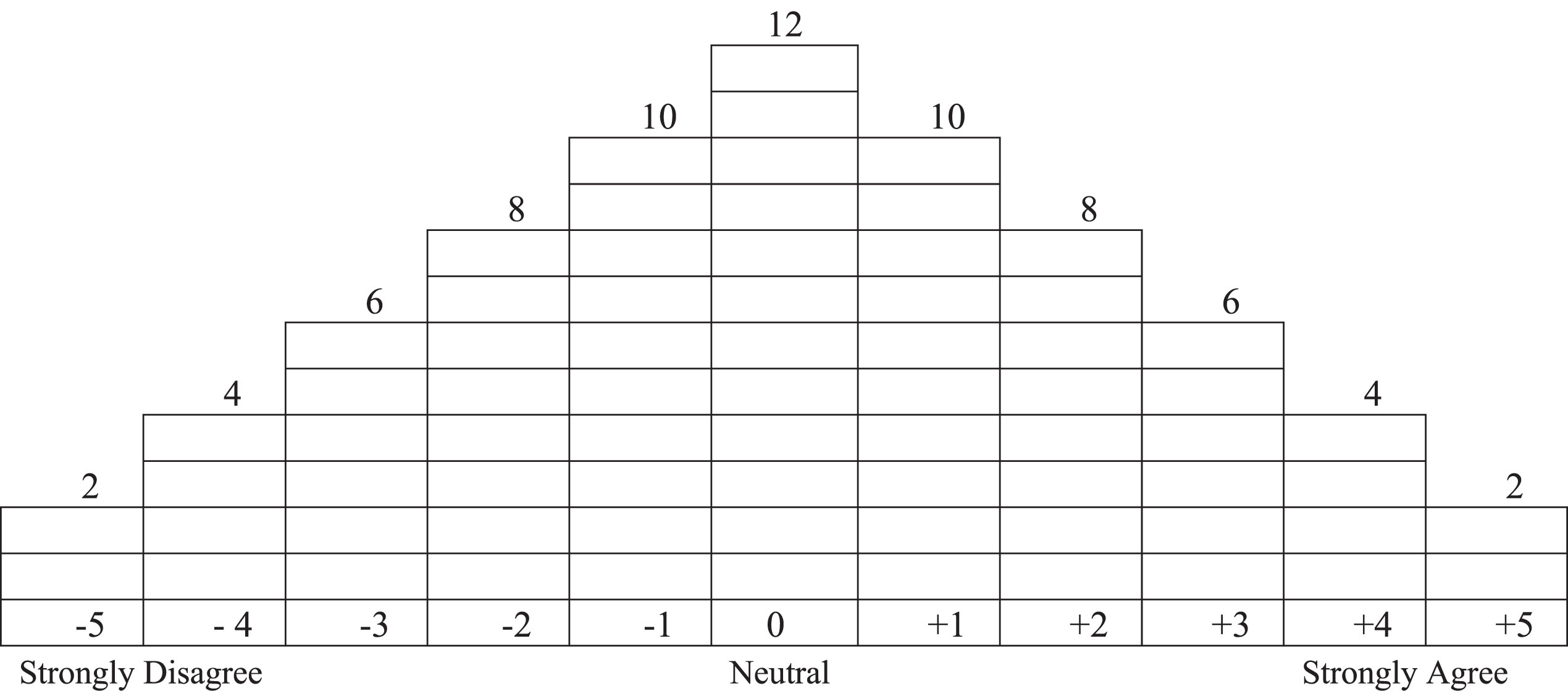
Q-Sort Grid: The Normal Distribution Curve was Used by Participants to Rank Statements According to their Level of Agreement
Demographic Information
The survey questionnaire was used to get general information about the participants. It includes demographic questions (e.g., age, class rank, and race/ethnicity), life satisfaction (in personal life, school life, and the relationship with family), and self-reliance questions (e.g., perception about their future). Additionally, questions are given asking what factors are the most important when they choose their future career/work/job; current life conditions and level of financial independence; lastly age when they started their first job. Most of the participants in this study were white (80%) and female (84%) with an average age of 20.84 (SD: 3.49). More than half (70%) were juniors and seniors. About 56% lived in the home of their parent/caregiver(s), while only 6% lived alone. Most participants (82%) said they pay for their own expenses (e.g., rent or meal costs, or both) (see Table 1).
Demographic Information (N = 50)
Analyses
The data were analyzed using Ken-Q Analysis Version 1.0.6 (Banasick, 2019), an internet-based factor analysis software. The four-factor structure which was extracted through a centroid factor analysis was judged to be suitable considering the explanatory power and conciseness of the model and all of four factors met the criteria of eigenvalues greater than 1 (Lim et al., 2022). The level of significance was determined at f > .28: above with 95% confidence interval (1.96 X 1/√50; Brown, 1980).
Results
Life Satisfaction
Their average of life satisfaction was around 7 out of 10, ranking the life satisfaction in career as the lowest. Regarding the most important considerations about future careers/work/jobs, participants ranked their interest followed by income, promising occupation, talented ability/capability, good for society and nation, accountability as a human being, and family and others’ opinions.
Finances
Regarding their finances, more than half of participants indicated low satisfaction (54%) and about 46% of participants said they pay for full tuition themselves. About 84% participants have a car. When they have a car, 64% said their parents/caregivers pay for the auto insurance, and the student pays for gas; 14% said their parents/caregivers pay for all car-related expenses; 21% pay for all expenses themselves. About 74% of participants are currently either part-time or full-time employed. The age of their first employment was 15 years old and above (74%), however, surprisingly, one participant began working when they were seven. Overall, the age range of first/initial employment was 7 to 20 years old.
Occupational Perceptions
Based on the Ken-Q analysis, four factors explained participants’ subjective perceptions of jobs and work 1 . Factor interpretation was based on agreeing statements (+3, +4, +5) and disagreeing statements (–3, –4, –5). In Tables 2 through 5 the scores received by each statement for each factor are listed.
Distinguishing Statements of Agreement and Disagreement in Factor 1: Highly Work-Engaged Group (N = 17)
Note: Agreement was categorized as Q-sort ranks between +3 and +5, while disagreement –3 and –5. Distinguishing statements were expressed by participants who loaded on the same factor with an eigenvalue of greater than 1. **p < .01.
Distinguishing Statements of Agreement and Disagreement in Factor 2: Money-Minded Group (N = 10)
Note. Agreement was categorized as Q-sort ranks between +3 and +5, while disagreement –3 and –5. Distinguishing statements were expressed by participants who loaded on the same factor with an eigenvalue of greater than 1. ** p < .01.
Distinguishing Statements of Agreement and Disagreement in Factor 3: Intrinsic Motivation for Career Choice Group (N = 18)
Note. Agreement was categorized as Q-sort ranks between +3 and +5, while disagreement –3 and –5. Distinguishing statements were expressed by participants who loaded on the same factor with an eigenvalue of greater than 1. ** p < .01.
Distinguishing Statements of Agreement and Disagreement in Factor 4: Parent-Child Conflict (N = 4)
Note. Agreement was categorized as Q-sort ranks between +3 and +5, while disagreement –3 and –5. Distinguishing statements were expressed by participants who loaded on the same factor with an eigenvalue of greater than 1. **p < .01.
Distinguishing Statements of Agreement for the Four Groups Sharing Viewpoints on Perceptions of Long-Term Careers
Distinguishing Statements of Disagreement for the Four Groups Sharing Viewpoints on Perceptions of Long-Term Careers
Statements (Q-Sample)
Factor 1: Highly Work-Engaged Group (34%)
Seventeen participants were represented by Factor 1. The upper-ranked (agreeing) statements that characterized Factor 1 included common underlying themes of high work-engagement, early retirement, and parental financial support. This group shared high work-engagement such as “To be successful, you have to work hard” (+5**). They wanted early retirement, agreeing to “I want to earn lots of money now so that I can retire early and enjoy life” (+3**). They perceived the ability to get financial assistance from their parents such as “I ask for support from my parents when I am financially suffering” (+3). On the other hand, this group shared strong disagreement for statements such as “I’ve never really thought about what kind of job I should have in the long-term” (–4**) and “If you were from rich family, you don’t have to work to earn the money” (–3**).
Factor 2: Money-Minded Group (20%)
Ten participants were represented by Factor 2. The top-ranked statements that characterize Factor 2 included common themes of the importance of money for success, lack of personal confidence in job readiness, respect for all jobs, dislike of traditional work ethics, and positive thinking about their future career. This group shared the importance of money for success such as “In this day and age, it is difficult to succeed in anything without sufficient money” (+5**), but they did not have confidence in their career such as “I’m still not certain what I want to do and what I can do well” (+4**). This group emphasized that every job needs to be respected such as “Every occupation deserves to be valued” (+4**) and shared positive thinking about their future career such as “There are lots of things I want to do in the future” (+3**). However, they did not like strict work ethics such as “I do not prefer a job pushing a traditional work ethic including strict team rules and attire” (+3**).
On the other hand, this group shared strong disagreement for statements such as “For the experience and for my future, I would be willing to work without pay now” (–5**), “To make money, you need to invest in stocks or real estate” (–5**), “Suffering when you are young is worthy” (–4**), “I am confident that I will be successful in the career field I have chosen” (–3**), and “I will work hard to buy property that produces an income” (–3**).
Factor 3: Intrinsic Motivation for Career Choice Group (36%)
Eighteen participants were represented by Factor 3. The upper-ranked (agreeing) statements that characterize Factor 3 included a common sense of positive thinking about their future career and choice of selecting a career based on intrinsic motivations. This group shared positive thinking of their future career, such as “There are lots of things I want to do in the future” (+4**). In addition, this group shared theme of choice in their career based on intrinsic motivations such as “Even if I make less money, I prefer working in a career that fits my talents” (+3**). On the other hand, this group shared strong disagreement for statements such as “I’ve never really thought about what kind of job I should have in the long-term” (–5**) and “I’m still not certain what I want to do and what I can do well” (–4**).
Factor 4: Parent-Child Conflict Group (8%)
Four participants were represented by Factor 4. The top-ranked (agreeing) statements that characterize Factor 4 included common underlying themes of conflict with their parents. This group shared conflict with their parents such as “I think most of the problems I have are due to my parents” (+4**) and “I can live well without my parents’ help” (+3**). On the other hand, this group shared strong disagreement for statements such as “I consult with my parents to choose a job or work” (–5**), “I ask for support from my parents when I am financially suffering” (–3**), “I feel a certain sense of duty to my parents or family” (–3**), and “To make money, you need to invest in stocks or real estate” (–3**).
Consensus Statements
Consensus statements are useful for describing common views of all participants on an issue. However, in this study there were no statistically significant consensus statements reflecting common agreement or disagreement across all four factors.
Discussion
Using Q methodology, this study examined subjective occupational perceptions of college students. The study findings revealed four shared viewpoints on perceptions of their long-term careers. Individuals in the “Highly Work-Engaged Group” (Factor 1) shared a common core theme that they were pursuing the typical value of success through their occupation such as “To be successful, you have to work hard.” They wanted early retirement as rewards of success such as “I want to earn lots of money now so that I can retire early and enjoy life.” This group showed highly work-engaged minds and wanted their rightful reward for their works. These findings are in line with those of previous research that this generation recognized working has a critical role in making true their dreams and wanted to guarantee their future (Ozkan & Solmaz, 2015). In addition, the extent of work engagement may be different depending on types of occupations (e.g., higher level of work in human service occupations than employment in other industries (Hakanen et al., 2019). Even in disagreeing statements, this group showed work-engaged minds, strongly disagreeing with “I’ve never really thought about what kind of job I should have in the long-term” and “If you were from rich family, you don’t have to work to earn the money.” This group expressed their willingness to get financial assistance from their parents such as “I ask for support from my parents when I am financially suffering.” Fomby and Kravitz-Wirtz (2019) indicated that the probability of parents’ financial support for their children varies by family systems and parents’ relationships with children.
Individuals in the “Money-Minded Group” (Factor 2) emphasized the importance of money for success such as “In these day and age, it is difficult to succeed in anything without sufficient money.” Even most of strongly disagreeing statements were related with money such as “For the experience and for my future, I would be willing to work without pay now” and “Suffering when you are young is worthy.” However, they lacked confidence in choice and success of their future career such as “I’m still not certain what I want to do and what I can do well,” disagreeing with “I am confident that I will be successful in the career field I have chosen.” Hartung et al. (2005) explained that students with low socioeconomic status may experience higher expectations and better opportunities for career-related exploration since students of low SES have to work hard to pay for their education and do not have enough time for career exploration.
On the other hand, college students who receive less financial assistance may be transitioning to early adulthood more rapidly to get early independence (Padilla-Walker, 2012). Additionally, this group did not like strict work ethics such as “I do not prefer a job pushing a traditional work ethic including strict team rules and attire,” which is consistent with findings of previous research that Generation Z do not like authority and accept traditional expression (Ozkan, & Solmaz, 2015).
Individuals in the “Intrinsic Motivation for Career Choice Group” (Factor 3) emphasized that they would choose their career based on intrinsic motivations such as “Even if I make less money, I prefer working in a career that fits my talents” and open up various career opportunities with positive thinking of their future career such as “There are lots of things I want to do in the future.” This group showed confidence of their future career choice, strongly disagreeing with “I’ve never really thought about what kind of job I should have in the long-term” and “I’m still not certain what I want to do and what I can do well.” Previous studies indicated that Generation Z and Y (millennial) students tend to choose medical and arts/humanities degrees driven by intrinsic interest and altruism to help others (Cui et al., 2021; Holzer et al., 2022; Skatova & Ferguson, 2014).
Individuals in the “Parent-Child Conflict Group” revealed conflicting relationships with their parents such as “I think most of the problems I have are due to my parents” and “I can live well without my parents’ help.” Even in disagreeing statements, this group strongly denied that “I consult with my parents to choose a job or work.” “I ask for support from my parents when I am financially suffering,” and “I feel a certain sense of duty to my parents or family.” Hargrove et al. (2005) noted that the formation of stable occupational identity among college students is directly influenced by the family interaction pattern such as perceptions of family relationships and family-supported goal orientations. Berríos-Allison (2005) emphasized the importance of family connectedness and separateness in fostering occupational identity among college students.
Developing a stable occupational identity during adolescence is critical to a successful transition into adulthood because no whole, unique identity can be achieved without an occupational identity (Arnett, 2007; Kroger & Marcia, 2011; Vautero & Silva, 2022). Previous studies of the occupational identity of adolescents focused mainly on external variables as key factors in the job-world such as career development interventions and career decision making capabilities (Chávez, 2016). However, this study explored the internal, subjective occupational perceptions of college students using Q-methodology. Study results revealed psychosocial factors impacting their occupational identity such as views regarding work, rewards, career choice, and relationships with parents. This study indicates that participants who felt more uncertain for their financial situation and showed conflicting relationships with their parents are more likely to fail to resolve the challenges of occupational identity than those of participants who appear confident in their future career choices.
Implications and Conclusion
In summary, study findings indicated four distinct views of occupational perceptions among Generation Z college students. Many participants (36%) emphasized work-engagement and career choice based on either intrinsic or extrinsic motivations. They were open to various career opportunities and expressing positive thinking about their future career choices. Another group of participants (34%) had occupational characteristics that adhered to traditional values, such as working diligently to achieve goals. However, their ultimate goal was early retirement rather than occupational success. Other participants (20%) expressed the importance of money for success. A minority (8%) reported conflicting relationships with their parents as influencing their occupational perspectives.
However, the study results cannot usually be generalized to all members of the Generation Z population (e.g., those who are working and not in college, other racial/ethnic or gender groups, etc.) due to the participants’ characteristics of being predominantly white female undergraduate students as well as the qualitative nature of the Q methodology to be designed to identify viewpoints in a population.
Although there were study limitations due to participant characteristics, an unfamiliar methodology, and lack of post-sort comments, the opinions of Generation Z college participants were insightful. This research expanded the findings of previous studies that mainly focused on external variables such as career development interventions and career decision making capabilities. Current study findings suggest that ‘a person-centered counseling’ approach, particularly for individuals experiencing financial difficulties and/or parental conflict, could enhance a sense of achievement and support their occupational identity development. As Generation Z has easy access to internet technology, online counseling may appeal to them due to feelings of comfort and protection due to its anonymity. Furthermore, as Generation Z students are more likely to report mental health concerns compared to previous generations, trauma-informed education or practices may be implemented through classroom activities using empowerment perspectives to assist students in developing the self-awareness (Bosse et al., 2021). Lastly, considering delayed developmental tasks and participants’ uncertainty about their future career in view of internal motivation and external conditions, providing them opportunities to explore diverse career choices through educational programs would be beneficial.
Footnotes
Bio Sketches
Dr. HeeSoon Lee is a Professor of Social Work at Bowling Green State University. Her research interests include stress and coping strategy, resilience, quality of life, emotional eating and eating behaviors, and health issues among cross-cultural older adults.
Dr. Mary-Jon Ludy is a Professor of Food & Nutrition and Associate Dean of the Graduate College at Bowling Green State University. Her research interests include energy balance, body composition, and innovative teaching.
Dr. Sooyeon Lim is a researcher in Psychology at Yonsei University in South Korea. Her research interest includes adolescents’ self-images and images of their parents using Q methodology.
Dr. Eunyoung Koh is an Associate Professor in Counselling Psychology at Woosuk University in South Korea. Her research interest includes adolescents’ self-efficacy, career-related activities, and career indecision.
One participant was not related to any of four factors.