




Abstract
Background
Despite Non-small cell lung cancer (NSCLC) ranks among the most deadly cancers worldwide, and currently, apart from a low percentage, targetable molecules have not been identified in its etiopathogenesis. The relationship between the proteoglycans decorin and biglycan, which are present in the extracellular matrix of cells, and transforming growth factor Beta-1 (TGF-B1), has been shown in many cancers. We investigated the significance of these molecules in NSCLC.
Methods
Fasting serum levels of decorin, biglycan, and TGF-B1 were obtained from 48 newly diagnosed NSCLC patients and compared with those of 48 adult control subjects matched for age and demographics. Demographic data, baseline laboratory values, and ELISA results were compared between the groups.
Results
The median age was 65(39–83) similar in both groups. There was no relation between demographic and clinical parameters and the levels of decorin, biglycan, and TGF-B1 in the NSCLC group. However, in comparison to the control group, NSCLC patients had significantly higher levels of biglycan (42.55
Conclusion
The decreased serum decorin level is an independent marker for NSCLC. Further studies are needed to investigate the prognostic significance of decorin on survival and its potential as a target in treatment.
Introduction
In the normal cellular physiology, it is well-known that transforming growth factor beta-1 (TGF-B1), one of the key molecules involved in the inflammatory pathway, plays a role in the development or clinical progression of inflammation and is overexpressed in serum and genetically in cancer. During the proliferative process, receptor tyrosine kinases in the receptors that initiate cell proliferation promote signal transduction to the nucleus, and these signals, in turn, induce proliferation in the cell nucleus by triggering other downstream signaling pathways. TGF-B1 is a molecule that stimulates the expression of proto-oncogenes and is secreted in excessive amounts in cancer patients. Increased expression and levels of biglycan are one of the stimulatory factors involved in the excessive activation and secretion of TGF-B1. Elevated levels of biglycan serve as receptors for tyrosine kinases within the cell, which transmit signals promoting cell proliferation. Decorin is one of the molecules that functions as a suppressor, helping to regulate these receptor tyrosine kinases, and low levels or expression of decorin may lead to reduced tumor suppression activity. The receptor tyrosine kinases to which decorin binds cannot transmit oncogenic signals to the cell nucleus. Thus decorin is known as a potent tumor suppressor molecule [1,2]. Proteoglycans are among the most important molecules in the formation and maintenance of cell integrity. Both decorin and biglycan bind to collagen [3] and TGF-B1 in the cell matrix, with decorin also binding to proto-oncogenic and oncogenic receptor tyrosine kinases [4]. Therefore, absence or deficiency of decorin may reduce the inhibition of oncogenic receptor tyrosine kinases, potentially facilitating development or progression of cancer. Biglycan, on the other hand, is a proteoglycan structurally similar to decorin and is located in the extracellular matrix, binding to receptors that affect cellular inflammation, with pro-inflammatory effects [5,6]. Increased inflammation within tumors and their microenvironments has been associated with elevated serum levels of biglycan or increased expression of the biglycan gene in various cancers including pancreatic, gastric, and breast cancers [7–10]. Although it is known that TGF-B1 is overexpressed in the serum of patients with non-small cell lung cancer (NSCLC) compared to healthy adults, the role of decorin and biglycan that interact with TGF-B1, has only been minimally studied in NSCLC, primarily in cell lines and tumor tissues [11,12]. Therefore, we planned this study with the hypothesis that TGF-B1 and bigylcan may be higher in NSCLC patients than in the control group in serum samples at the time of diagnosis, while decorin may be lower and this may be an independent predictor for the diagnosis of NSCLC.
Materials and methods
This study with a prospective case-control design was conducted between February 2018 and December 2020 at our Departments of Chest Diseases and Medical Oncology. The study included 48 newly diagnosed patients with non-small cell lung cancer (NSCLC) at various stages. Additionally, we included an age- and gender-matched control group of 48 healthy adults. The subjects in the control group underwent assessments, which confirmed absence of any clinical, radiological, or physical evidence of cancer. All participants gave informed consent after being provided detailed information about the study. Ethical approval for the research was obtained from the local ethics committee with the decision number 2/20 dated 07.02.2018.
Fasting serum samples were collected from all participants to analyze the levels of decorin, TGF-B1, and biglycan. Demographic data, smoking habits, and comorbidities of both the patients and control group were recorded prior to the study. During follow-up, we obtained and documented the clinical and histopathological characteristics of the patients, including histopathological subtype, grade, stage, lymph node involvement, and metastasis. We also extracted data from the electronic medical records to gather information on complete blood counts, routine biochemical tests, and hormone analyses for all participants. The patients’ performance status was assessed and recorded using the Eastern Cooperative Oncology Group (ECOG) criteria.
Serum samples were stored at
Statistical analysis was conducted using IBM SPSS Statistics for Windows, Version 25.0. The results were presented as frequencies, percentages, means, and standard deviations (SD). The normal distribution of numerical variables was assessed using the Shapiro-Wilk test. To compare means, we used independent samples
Results
Baseline characteristics of NSCLC patients.
Baseline characteristics of NSCLC patients.
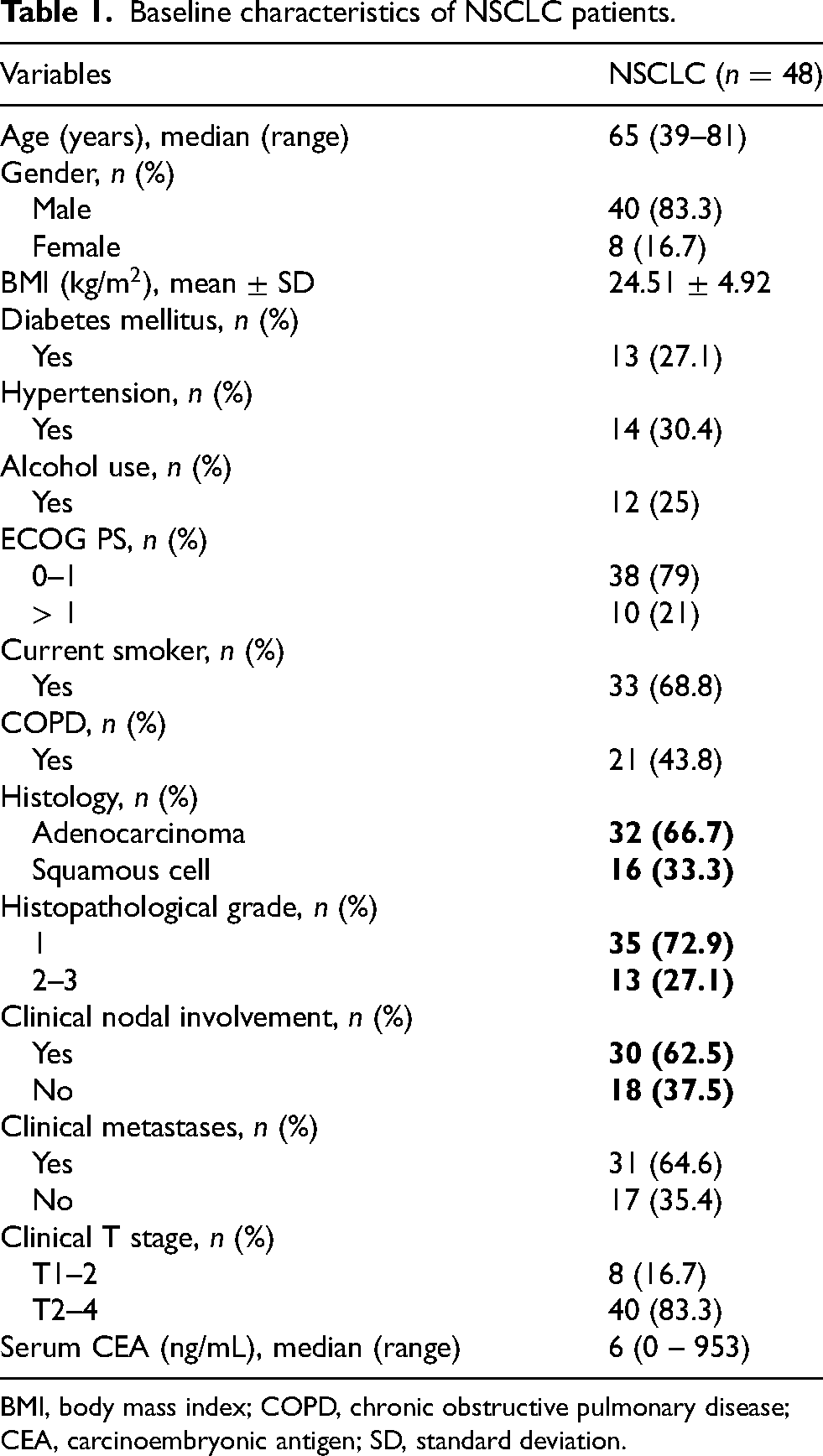
BMI, body mass index; COPD, chronic obstructive pulmonary disease; CEA, carcinoembryonic antigen; SD, standard deviation.
Comparison of baseline characteristics between the study and control groups.
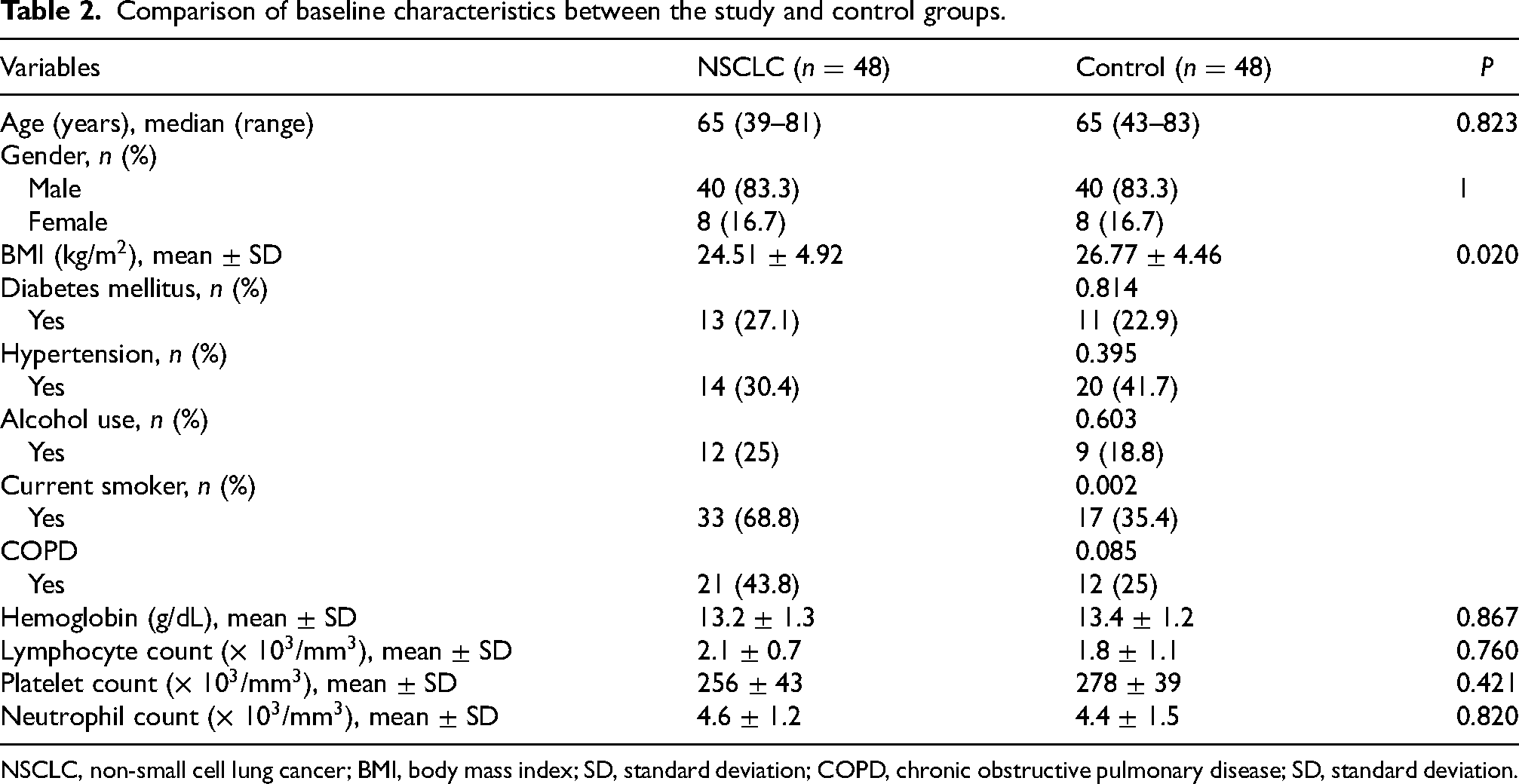
NSCLC, non-small cell lung cancer; BMI, body mass index; SD, standard deviation; COPD, chronic obstructive pulmonary disease; SD, standard deviation.
Serum levels of decorin, TGF-B1 and biglycan by groups.

NSCLC, non-small cell lung cancer; TGF-B1, transforming growth factor beta-1; SD, standard deviation.
The ROC analysis yielded the following cut-off values: decorin: 8.13 ng/mL (81% sensitivity, 80% specificity, Area: 0.836, SE: 0.042,
Multivariate logistic regression analysis for the diagnosis of NSCLC.
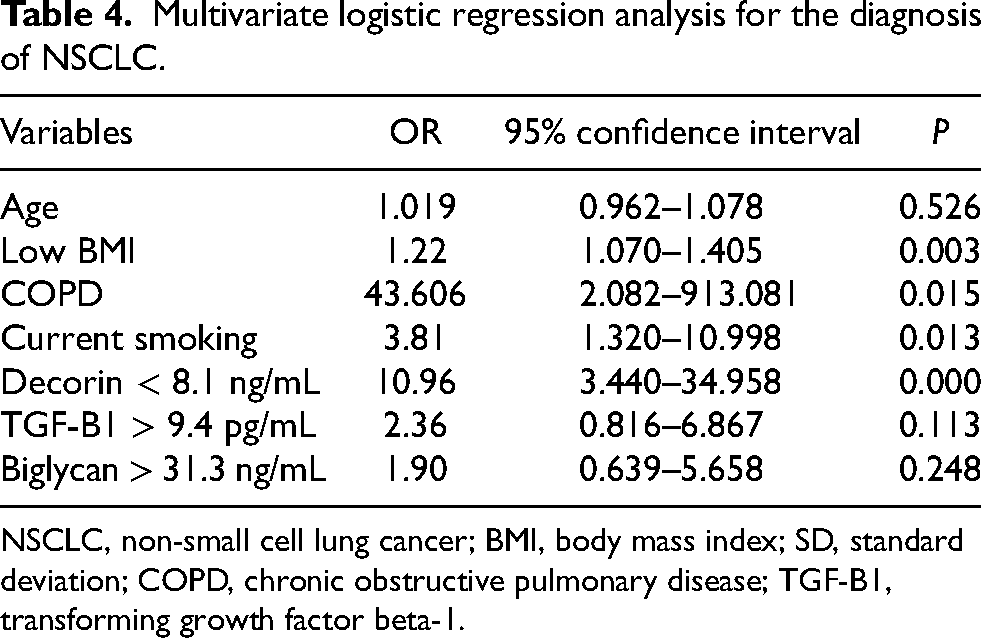
NSCLC, non-small cell lung cancer; BMI, body mass index; SD, standard deviation; COPD, chronic obstructive pulmonary disease; TGF-B1, transforming growth factor beta-1.
Proteoglycans play a crucial role in regulating the integrity of the extracellular matrix and its interactions with cells, making them one of the most important molecules in this process. Among these proteoglycans, decorin and biglycan are known to have additional effects on cell signaling apart from their established functions [13–16]. Cell signaling pathways are of significant importance in various cancers, and targeting these pathways has proven to be a more rational and effective approach to cancer treatment, and their relation to proteoglycans [17]. Despite their divergent functions, both decorin and biglycan ultimately impact cell proliferation by modulating TGF-B1 levels [14].
In our study, we investigated the levels of decorin, biglycan, and TGF-B1 in NSCLC patients compared to a control group. We observed a significant decrease in decorin levels in NSCLC patients, whereas biglycan and TGF-B1 levels were significantly elevated. Furthermore, through multivariate analysis, we identified low serum decorin levels (
The anti-proliferative activity of decorin is well known, and a study has demonstrated its role in preventing metastasis in breast cancer [22]. Decorin is also an inhibitory factor in tumor formation, and several studies demonstrated lower levels of decorin in the tumor microenvironment [23–26]. In line with the literature, our study also identified other independent predictive markers for NSCLC, including current smoking [27], low body mass index [28], and the presence of chronic obstructive pulmonary disease [29].
Despite the significance of our findings, it is important to acknowledge certain limitations within our study. Although we had sufficient number of patients, our ability to conduct a more detailed subgroup analysis was limited, which could have provided insights into the impact of concomitant medications on the studied molecules. Additionally, the unknown post-study treatments received by the patients prevented us from assessing the relationship between the treatment and the changes in decorin, biglycan, and TGF-B1 levels.
In conclusion, our study presents novel evidence to the existing body of knowledge by demonstrating that low serum decorin levels can serve as an independent predictor for the diagnosis of non-small cell lung cancer, regardless of the cancer stage. To gain a more comprehensive understanding of decorin’s impact on survival and treatment outcomes of NSCLC patients, prospective randomized studies are warranted. Furthermore, our study reinforces the association of other independent predictive markers for NSCLC, including smoking, low body mass index, and the presence of chronic obstructive pulmonary disease, with the development of this disease.
Footnotes
Acknowledgments
We would like to thank Assoc. Prof. Dr. Hilmi Kodaz for his support and contributions in the writing of this article.
Funding
None.
Conflict of interest
All authors declared that they have no conflict of interest.
Availability of data and materials
The datasets used and/or analyzed in the current study are available from the corresponding author upon reasonable request.
Ethics approval and consent to participate
Ethical approval for the research was obtained from the local ethics committee with the decision number 2/20 dated 07.02.2018.
Patient consent for publication
All participants gave informed consent after being provided detailed information about the study.
Author contribution
Conception: F.K; M.A.
Interpretation or analysis of data: F.K; H.G.K; F.I; O.S.D.
Preparation of the manuscript: F.K; H.G.K; O.S.D.
Revision for important intellectual content: M.A; F.I; F.K; O.S.D.
Supervision: F.K; H.G.K; M.A.