




Abstract
OBJECTIVE:
LGR4 expression in serous ovarian cancer paraffin-embedded tissues and fresh tissues were investigated, and its expression associated with clinicopathological parameters and prognosis in serous ovarian cancer was explored.
METHODS:
From Dec, 2009 to Jan, 2020, 122 paraffin-embedded serous ovarian cancer patients and 41 paired paratumor tissues who were both diagnosed and operated at the memorial hospital of Sun Yat-sen University and Integrated Hospital of Traditional Chinese Medicine, Southern Medical University were selected in this research, respectively, and all of these tissues were performed by immunohistochemistry (IHC) with a polyclonal antibody for LGR4. Meanwhile, from Aug, 2013 to Mar, 2019, 15 cases of serous ovarian cancer fresh tissues and 15 cases of paratumor fresh tissues who were operated at Integrated Hospital of Traditional Chinese Medicine, Southern Medical University were performed with Quantitative Real-time PCR to detect the mRNA expression of LGR4, respectively.
RESULTS:
LGR4 expression was much higher both in paraffin-embedded and fresh cancer tissues than that in paratumor tissues, respectively, and its expression was associated with recurrence free survival and overall survival in serous ovarian cancer patients. Moreover, in a multivariate model LGR4 was an indeed independent predictor of poor survival in serous ovarian cancer patients.
CONCLUSION:
LGR4 is upregulated in serous ovarian cancer, and LGR4 is an indeed useful independent prognostic predictor in serous ovarian cancer, and it may provide important clinical value of serous ovarian cancer.
Introduction
Ovarian cancer (OC) is the first leading cause of mortality in female reproductive malignant cancers in China [1]. Globally, there are 239,000 new cases and 152,000 deaths annually, making ovarian cancer the seventh most common cancer, and the second most common cause of gynecologic cancer death [2]. And the main pathological type is serous ovarian cancer. The prognosis of serous ovarian cancer is very poor, and the reason is that it was found to be advanced when diagnosed [3]. However, when found early, the survival rate dramatically rises to 90% [3, 4]. Thus, detecting serous ovarian cancer in the earliest stages or discovering recurrence early after operation is critical to a cure [5]. So the effective early diagnostic methods were urgent as it may help to improve the prognosis [6, 7]. Recently several tumor biomarkers have been used to diagnose and to monitor the progression and prognosis of ovarian cancer, and also to detect the disease recurrence after operation or chemotherapy. However, these biomarkers are neither extremely sensitive nor specific. Therefore, to search new biomarkers are very important.
Leucine-rich repeat domain containing G protein-coupled receptor 4 (LGR4) also called G-protein-coupled receptor-48 (GPCR48) [8, 9]. Upregulation of LGR4 has been found to enhance cell invasion and metastasis in colon carcinoma cells [10]. Recent studies have shown that LGR4 regulates mammary gland and prostate progression and is involved in tumor stem cell functions through regulation of the Wnt, Notch and Sonic Hedgehog signaling pathways [11]. In addition, LGR4 activates multiple signalling pathways[12, 13, 14, 15, 16]. Moreover, several reports showed that the RSPOs are the endogenous ligands of GPR48/LGR4, revealing the important role of LGR proteins in epithelial stem cell homeostasis [17, 18, 19, 20]. Further studies showed that RSPOs potentiate Wnt/
Therefore, in this study we aimed to investigate the exact role of LGR4 in serous ovarian cancer tissues and paratumor tissues (both paraffin-embedded and fresh tissues), and to explore its expression associated with clinicopathological parameters and prognostic value in serous ovarian cancer.
Materials and methods
Paraffin-embedded tissue sections
From Dec, 2009 to Jan, 2020, a total of 122 cases paraffin-embedded serous ovarian cancer tissues and 41 paraffin-embedded paratumor tissues who had been pathologically diagnosed at the memorial hospital of Sun Yat-sen University and Integrated Hospital of Traditional Chinese Medicine, Southern Medical University were all collected in this investigation. Survival duration was calculated from the operation date until Jan, 2020 (at last follow-up). This trial was both obtained approval from the memorial hospital of Sun Yat-sen University and Integrated Hospital of Traditional Chinese Medicine, Southern Medical University Ethics Committee. All of the patients signed the informed consent before operation.
Fresh tissue specimens
From Aug, 2013 to Mar, 2019, 15 cases of serous ovarian cancer fresh tissues and 15 cases of paired fresh paratumor tissues diagnosed postoperation who were collected from Integrated Hospital of Traditional Chinese Medicine, Southern Medical Universtiy. All of fresh samples were immediately preserved in liquid nitrogen. This trial was obtained approval from Integrated Hospital of Traditional Chinese Medicine, Southern Medical Universtiy Ethics Committee. All of the patients signed the informed consent before operation.
Immunohistochemistry (IHC)
The LGR4 expression in 122 cases of paraffin-embedded serous ovarian cancer and 41 cases of paired paratumor tissues were detected by immunohistochemical staining. The procedure is as follows, the samples were fixed in 4% formaldehyde for 12 h subsequently 4
Quantitative real time polymerase chain reaction (qRT-PCR)
Total RNA was extracted from the fresh serous ovarian cancer tissues and fresh paratumor tissues by Trizol (Takara Bio, Inc., Shiga, Japan). GAPDH gene were used as gene internal control. Each of paired paratumor fresh tissues’ expression levels were set as negative control group (all of the paratumor tissues’ expression level of LGR4 were 1.00
Statistical analysis
All data were carried out with the statistical software package SPSS 21.0 and Graphpad Prism 7. The chi-square test or Fisher’s exact test were used to analyze the relationship between LGR4 and clinicopathological parameters. mRNA expression of LGR4 was presented with
Results
LGR4 was upregulated in fresh serous ovarian cancer fresh tissues compared with paratumor tissues using qRT-PCR
LGR4 was significantly upregulated in serous ovarian cancer fresh tissues compared with paratumor tissues
LGR4 was significantly upregulated in serous ovarian cancer fresh tissues compared with paratumor tissues
LGR4 expression in association with standard clinicopathological parameters using the
LGR4 was upregulated in fresh serous ovarian cancer fresh tissues.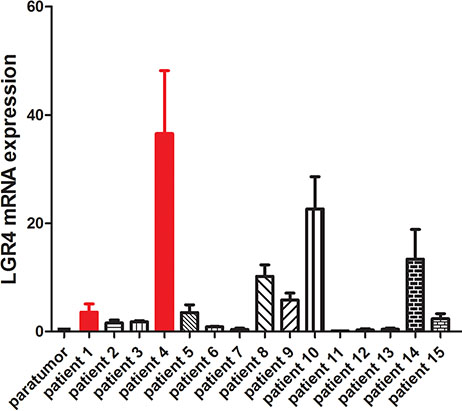
the mRNA expression of LGR4 in serous ovarian cancer and paratumor fresh tissues.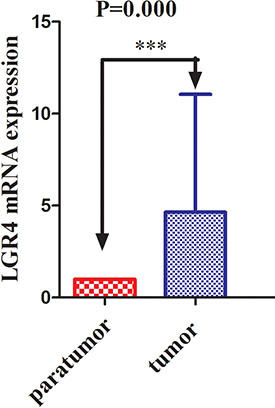
LGR4 overexpression in paraffin-embedded serous ovarian cancer tissues with IHC: (A) LGR4 expression in serous ovarian cancer tissues and paratumor tissues (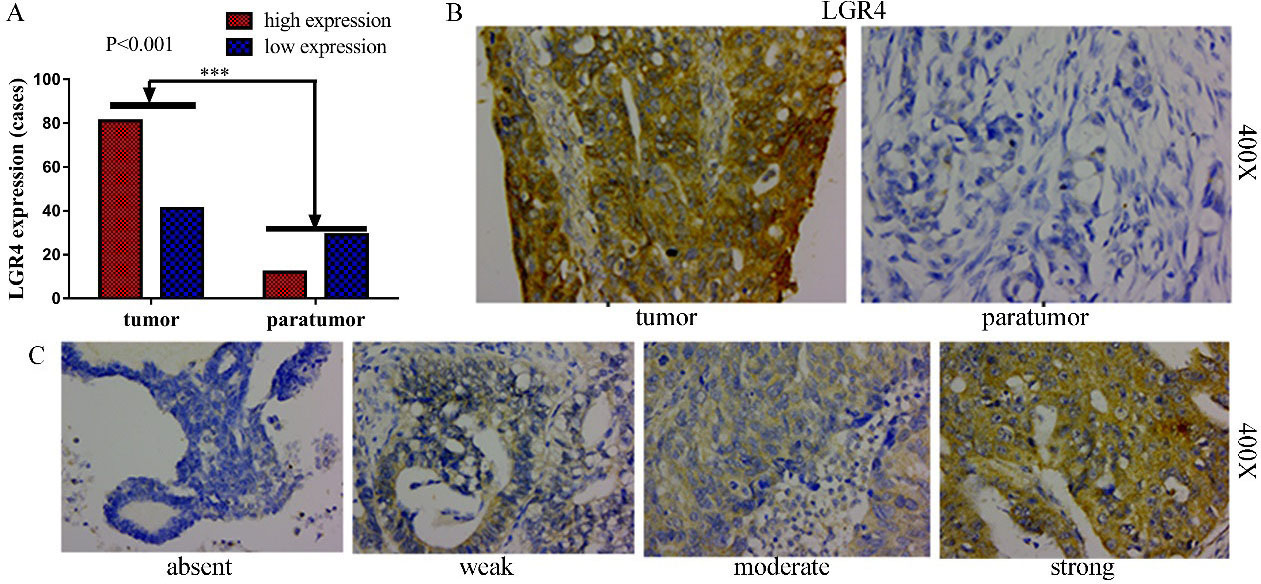
Kaplan-meier survival of overall survival (OS) and recurrence free survival (RFS) in dead serous ovarian cancer patients.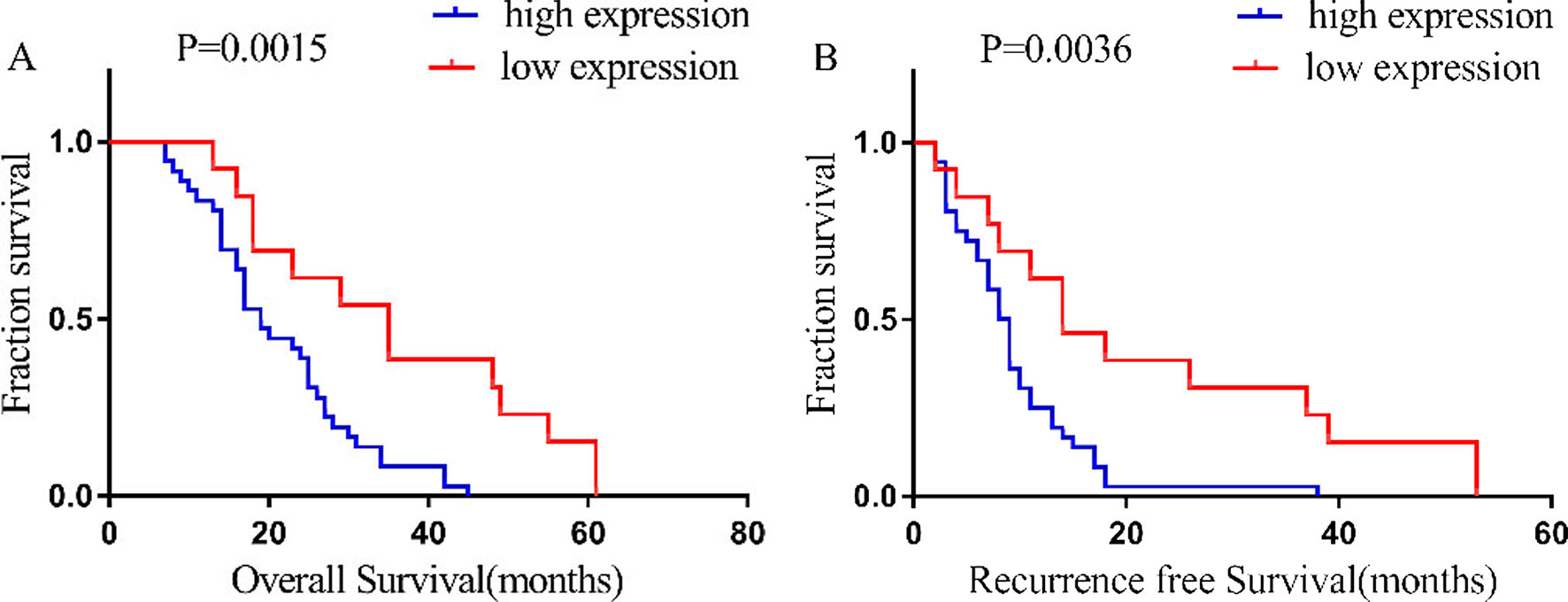
In this study, we performed qRT-PCR to detect the expression level of LGR4 in 15 cases of serous ovarian cancer fresh tissues and 15 cases of paired paratumor fresh tissues, respectively (all of paratumor tissues were 1.00
To further determine the expression of LGR4 in serous ovarian cancer paraffin-embedded tissues, we stained 122 cases of serous ovarian cancer and 41 cases of paratumor tissues. The results showed that 41/122 (33.61%) had low/none staining (also called low expression, LGR4-) and 81/122 (66.39%) had moderate/strong staining (also called high expression, LGR4+), while in 41 paratumor tissues stained with the LGR4 antibody, 29/41 (70.73%) had low/none staining and 12/41 (29.27%) had moderate/strongstaining, and there was significantly different between tumor and paratumor groups (
Cox regression univariate and multivariate analyses of prognostic factors in serous ovarian cancer
Cox regression univariate and multivariate analyses of prognostic factors in serous ovarian cancer
Subsequently, we explored the association between LGR4 expression and the clinicopathological parameters of serous ovarian cancer patients. The results showed in Table 2.
The results of using
LGR4 overexpression was associated with RFS and OS in serous ovarian cancer patients
In this study, patients with LGR4 high expression exhibited a median overall survial of only 19 months (median RFS 8.5 months), While patients with LGR4 low expression exhibited a median overall survial of 35 months (median RFS 14 months). In addition, Kaplan-Meier survival analysis demonstrated that there were statistically significant on RFS and OS between LGR4- and LGR4+ (
LGR4 overexpression was a useful indeed independent prognostic predictor of srous ovarian cancer
In addition, using univariate analyses we found that the prognostic factors in serous ovarian cancer were as follow: LGR4 high expression, Intraperitoneal metastasis, serum CA153, serum CEA, and so on. Moreover, using multivariate analyses we found that LGR4 high expression was an indeed independent prognostic predictor of serous ovarian cancer patients. However, Intraperitoneal metastasis, serum CA153 and serum CEA were no longer significant (Table 3).
Discussion
Recently several reports indicate that LGR4 participates in carcinogenesis of various cancers. LGR4 high expression is significantly correlated with regional metastasis in cancer tissue, and upregulation of LGR4 promotes cell proliferation in multiple cancers by stimulating Wnt/
In addition, LGR4 high expression more tend to have a poor OS and RFS of serous ovarian cancer patients. And this result suggested that LGR4 was associated with prognosis of serous ovarian cancer patients. And statistical analysis showed that LGR4 high expression tend to occur in older population, which indicated that earlier screening of LGR4 is more crucial.
More importantly, in a multivariate Cox regression analysis we found that only LGR4 high expression was an indeed independent prognostic factor of serous ovarian cancer, which indicated that LGR4 high expression was very important for the prognosis of serous ovarian cancer patients, and it could be recommended as a meaningful serous ovarian cancer predict biomarker.
In conclusion, all of these results suggest that LGR4 overexpression is an indeed independent prognostic factor, and LGR4 overexpression predicts poor prognosis of serous ovarian cancer. In future, we need more in vivo and in vitro research to demonstrate its role and molecular mechanism in initiation, progression, metastasis and prognosis of serous ovarian cancer.
Footnotes
Acknowledgments
This work was supported by the Nature science fund of Guangdong Province (No. 2016A030313536), the Guangdong Provincial Medical Research Fund (No. A2019096), the President Funds of Integrated Hospital of Traditional Chinese Medicine, Southern Medical University (No. 1201902001; No. 1201901002).
Conflict of interest
The authors declare no conflict of interest.