




Abstract
PTEN exerts tumor suppressor role through inhibiting PI3K/AKT signaling. DJ-1 plays an oncogenic role through negatively regulation of PTEN expression. Curcumin (Cur) is a phenolic compound extracted from a variety of plant roots, with multiple anti-tumor pharmacological effects. This study aims to investigate whether Cur plays a role in the regulation of DJ-1-PENT/PI3K/AKT signaling as well as the proliferation and apoptosis of hepatocellular carcinoma cells. Normal human hepatocyte HL-7702 and hepatocellular carcinoma cell lines SMMC-7721 and HepG2 were cultured followed by analysis of the expression of DJ-1 and PTEN. SMMC-7721 and HepG2 cells were treated with different concentrations of Cur (0, 5, 10
Introduction
Hepatocellular carcinoma (HCC) is a clinically common malignant tumor with morbidity and mortality at the forefront of global malignant tumors [1].
Phosphatase and tensin homologue deleted on chromosome ten (PTEN) regulates cell proliferation, cycle, apoptosis and invasion through inhibiting the activity of phosphatidylinositol-3 kinase (PI3K) and protein kinase B (AKT/PKB), thus exerting a tumor suppressor role in the development and progression of several tumors [2, 3, 4]. DJ-1 is an oncogene and promotes cell proliferation, cell cycle, invasion and metastasis through inhibition of PTEN expression and function and subsequent enhancement of PI3K/AKT activity and signal transduction, thus playing important roles in the pathogenesis of several tumors [5, 6]. Currently, several in vitro studies have shown that Curcumin plays a regulatory role in the proliferation, invasion and metastasis, drug resistance and other biological processes of HCC cells, suggesting a promising therapeutic strategy in the treatment of HCC [7, 8, 9]. Accumulative findings showed that it induced apoptosis of gastric cancer, breast cancer, colon cancer, through PTEN/PI3K/AKT signaling pathway [10, 11, 12]. Previous evidence suggested that curcumin prevented apoptosis and improves motor deficits in DJ-1-knockout rat model of Parkinson’s disease [13]. Of note, Curcumin inhibits the development of hepatocellular carcinoma cells by down-regulating the PTEN/PI3K/AKT signalling pathway [9, 14]. However, whether Curcumin plays a role in the regulation of DJ-1-PTEN/PI3K/AKT signaling as well as the proliferation and apoptosis of hepatocellular carcinoma cells is still elusive. This study aims to elucidate the effect of DJ-1/PTEN/PI3K/AKT signaling pathway as a potential mechanism for the anticancer effects of curcumin.
Materials and methods
Reagents
Normal human hepatocyte HL-7702 was purchased from Shanghai Huiying Biotechnology (Shanghai, China). HCC cell line SMMC-7721 and HepG2 were from Shanghai Fuxiang Biotechnology (Shanghai, China). DMEM medium and FBS were from Bioind (Cromwell, CT, China). Mycillin was bought from Procell (Wuhan, Hubei, China). Lipo 2000 and pcDNA3.1 plasmid were from Thermo Fisher Scientific (Waltham, MA, USA). PrimeScript
Cell culture
HL-7702, SMMC-7721 and HepG2 cells were cultured in DMEM medium containing 10% FBS and 1% mycillin at 37
Curcumin treatment
HL-7702, SMMC-7721 and HepG2 cells were seeded into 96-well plate and treated with different concentrations of Curcumin (Cur) dissolved in DMEM containing 0.1% DMSO (0, 5, 10
Measurement of cell proliferation
10
Construction of DJ-1 overexpression plasmid
The CDS region was amplified from the genomic DNA of HepG2 cell followed by digestion and connection into pcDNA3.1 vector, which was transfected into JM109 cells. After ampicillin resistance screening, the positive strain was obtained and confirmed by gene sequencing, which was then named as pcDNA3.1-DJ-1. pcDNA3.1-Blank was selected as a control.
Cell transfection
All cells were treated with 10
Measurement of cell proliferation
After transfection, cells were resuspended in DMEM containing 10% FBS and 10
Expression of DJ-1 and PTEN. Total RNA and protein were isolated from normal hepatocyte HL-7702 and HCC cell line SMMC-7721 and HepG2 cells for analysis of the relative mRNA expression of DJ-1 (A) and PTEN (B) by qRT-PCR, protein expression of PTEN and DJ-1 by western blot (C). Compared with HL-7702, 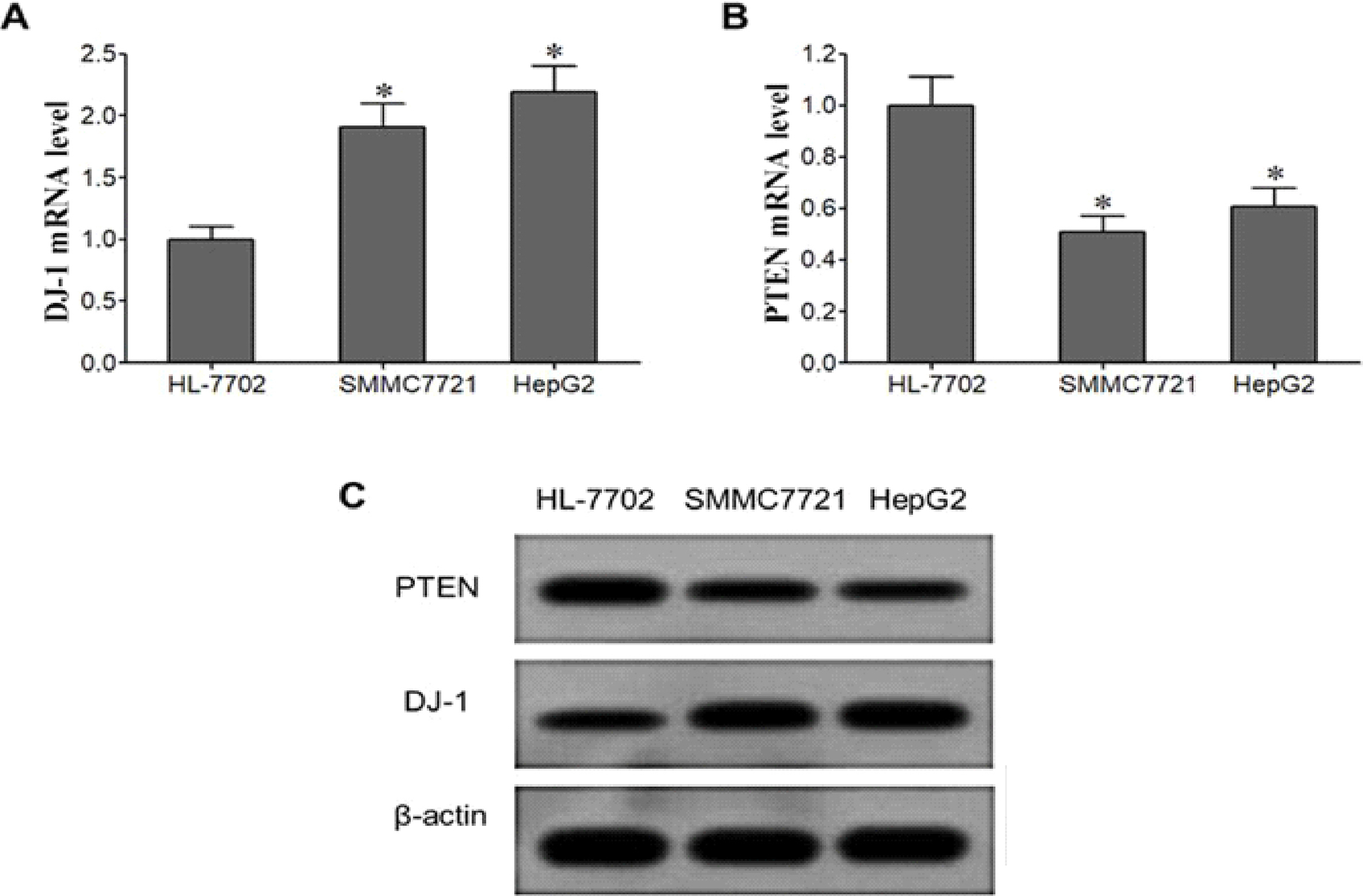
Cells were collected and washed by PBS two times followed by addition of 100
qRT-PCR analysis of gene expression
Total RNA was extracted using Trizol reagent and reversely transcripted into cDNA using PrimeScript
Western blot
Total protein was isolated using RIPA lysis buffer and separated on SDS-PAGE. After transferring into PVDF membrane and blocking, the membrane was incubated with primary antibody against DJ-1 (dilution 1:2000), PTEN (dilution 1:2000), p-AKT (dilution 1:1000) or
Statistical analysis
Data were process by SPSS18.0 software and presented as mean
Results
The level of DJ-1 was reduced while the expression of PTEN was up regulated in HCC cells
Compared with normal human hepatocyte HL-7702, significantly higher DJ-1 mRNA level (Fig. 1A) and lower PTEN mRNA level (Fig. 1B) in HCC cell line SMMC-7721 and HepG2 cells were observed (
Cur inhibited proliferation and promoted apoptosis of HCC cells
CCK-8 analysis showed that Cur treatment did not affect the proliferation of HL-7702 cells, but significantly inhibited proliferation activity of SMMC-7721 and HepG2 cells in a dose-dependent manner (
Cell proliferation and caspase-3 activity after Cur treatment. Cells were treated with different concentrations of Cur (0, 5, 10 M) followed by analysis of cell proliferation by CCK-8 assay (A) and caspase-3 activity (B). Compared with 0 M, 
DJ-1 expression after Cur treatment. Cells were treated with different concentrations of Cur (0, 5, 10 M) and the relative expression of DJ-1 mRNA (A) and protein (B) was measured by qRT-PCR and western blot respectively. Compared with 0 M, 
qRT-PCR data showed that Cur treatment (10
DJ-1 overexpression reduced the anti-tumor effect of Cur on HCC cells
Compared with pcDNA3.1-blank group, pcDNA3.1-DJ-1 group showed significantly increased DJ-1 mRNA expression (
DJ-1, PTEN, p-AKT expression, cell proliferation and apoptosis after DJ-1 over expression. Cells were transfected with pcDNA3.1-DJ-1 followed by analysis of the relative mRNA level of DJ-1 (A) and PTEN (B) by qRT-PCR, protein expression of p-AKT, PTEN and DJ-1 by western blot (C), cell proliferation (D) as well as cell apoptosis (E) by flow cytometry. Compared with Control, 
Mechanistic pathway of Cur on cell proliferation.
When the PI3K/AKT pathway is activated, P13K can catalyze the conversion of phosphatidylinositol 4,5-trisphosphate (PIP2) to phosphatidylinositol 3,4,5-trisphosphate (PIP3), which recruits AKT from the cytoplasm to the membrane, leading to phosphorylation of Ser473 and Thr308 at AKT by phosphoinositide-dependent protein kinase (PDK). Activated AKT transmits signals downstream, further activates downstream signaling molecules, thus participating in the regulation of cell growth, survival, and apoptosis [15, 16, 17, 18]. Studies have shown that excessive activation of the PI3K/AKT pathway is associated with the development, progression, metastasis and drug resistance of various tumors such as endometrial cancer [19], gastric cancer [20], and lung cancer [21]. PTEN is an inhibitor of PI3K/AKT signaling pathway, which can negatively regulate the malignant biological processes such as tumor cell proliferation, migration and invasion by blocking the activation of PI3K/AKT signaling pathway in gastric cancer [2], Breast cancer [3], and endometrial cancer [4]. A number of studies have demonstrated that DJ-1 is an important negative regulator of PTEN, which plays a role in inhibiting the expression and functional activity of PTEN, thereby indirectly regulating the activity of PI3K/AKT signaling pathway, cell proliferation, apoptosis, invasion and metastasis [5, 6]. Curcumin (Cur) is a polyphenolic substance isolated from the rhizome of plants. Several studies have reported that Cur has a tumor-regulating effect on cell proliferation, apoptosis, and cycle in gastric cancer [22], bladder cancer [23] and breast cancer [24]. Recent study on prostate cancer cells indicated that curcumin served as a promising anticancer agent by inducing a chronic ER stress mediated cell death and activation of cell cycle arrest, UPR, autophagy and oxidative stress responses [25]. At present, several studies have found that Cur plays a regulatory role in the proliferation, invasion and metastasis, drug resistance and other biological processes of HCC cells, and shows a good therapeutic effect in treating HCC [7, 8, 9]. This study investigated whether Cur plays a role in regulating the activity of DJ-1-PTEN/PI3K/AKT pathway and affecting proliferation and apoptosis of HCC cells.
In the present study, we showed that compared with normal liver HL-7702 cells, the expression of DJ-1 in HCC cell lines SMMC-7721 and HepG2 was significantly increased, while the expression of PTEN was significantly decreased, suggesting that DJ-1 might be involved in HCC. In the study of the relationship between DJ-1 and liver cancer, Guo et al. [26] showed that the expression of DJ-1 was significantly increased in hepatoma cell lines, which was associated with resistance to the chemotherapy drug sorafenib. Liu et al. [27] showed that compared with normal liver tissue, the expression of DJ-1 was significantly increased in tumor tissues of patients with HCC, and the expression of DJ-1 was related with increased alpha-fetoprotein (AFP), vascular metastasis, the degree of differentiation of tumor tissue cells, as well as the prognosis of patients. Liu et al. [28] found that compared with low metastatic HCC MHCC-97L cells, the expression of DJ-1 in high metastatic MHCC-97H cells was significantly increased, indicating that DJ-1 elevation promoted the malignant features of HCC. The results of Qiu et al. [29] showed that compared with adjacent tissues, the expression of DJ-1 in HCC patients was significantly increased, and the higher the expression of DJ-1, the worse survival and prognosis of patients. The above results indicate that elevated expression of DJ-1 is a cancer-promoting factor in the pathogenesis of HCC, which was consistent with the results in the present study.
In the study of the biological effects of Cur on HCC cells, we found that administration of different concentrations of Cur significantly inhibited the proliferation activity of HCC cells and increased the activity of caspase-3, indicating that Cur has anti-HCC effects, without significant toxicity to normal liver cells. The results of the change of DJ-1 expression showed that Cur treatment could significantly down-regulate the expression of DJ-1 in HCC cell line SMMC-7721 and HepG2 cells, suggesting that Cur may play a role in combating HCC by inhibiting the expression of DJ-1. Further, we overexpressed DJ-1 in SMMC-7721 and HepG2 cells, and observed the effect of Cur on cell proliferation and apoptosis. The results showed that the expression of DJ-1 in DJ-1 overexpression group under Cur treatment was significantly increased, the expression of PTEN was significantly decreased, the phosphorylation activity of AKT was enhanced, with increased cell proliferation activity and reduced cell apoptosis. In the study of the effect of DJ-1 on HCC cells, Guo et al. [26] showed that increasing the expression of DJ-1 can reduce the drug sensitivity of HCC cells to sorafenib, leading to decreased cell apoptosis, and DJ-1 plays a main role in the apoptosis-resistant drug resistance of HCC cells by regulating PTEN-PI3K/AKT pathway. The results of Liu et al. [28] showed that inhibition of DJ-1 expression by siRNA could up-regulate the expression of PTEN in HepG2 cells, inhibit the phosphorylation activity of AKT, and attenuate the proliferation, adhesion and invasion of HepG2 cells. In addition, it also inhibited the growth and tumorigenicity of HepG2 cells in animals. Qiu et al. [29] found that in DJ-1 knockout mice, the incidence of hepatotoxic drug diethylnitrosamine (DEN)-mediated liver cancer was significantly reduced, while overexpression of DJ-1 in liver cancer cell MHCC-97L significantly promoted cell proliferation and enhanced the malignant biological characteristics of cancer cells and DJ-1 exerted a cancer-promoting effect through MAPKs and AKT pathways. Currently, there have been several reports that Cur can exert anti-tumor effect by regulating PTEN expression. However, the role of Cur in regulating DJ-1 remains unclear [30, 31]. Our preliminary data demonstrate the involvement of DJ-1 in the regulation of HCC by curcumin. Furthermore, it is promising that the novel curcumin formulation has been found to suppress hepatocellular carcinoma efficiently in Swiss albino mice, which provides new leads for the clinical therapy [32]. Also, the pioneer studies on the anticancer efficacay of perillyl alcohol-bearing PLGA microparticles, diallyl sulfide bearing pH-sensitive liposomes, propofol-linoleic acid-loaded escheriosomal formulation provide future basis for development of appropriate formulation of curcumin [33, 34, 35]. Notably, previous study indicated that Cur treatment significantly inhibited SW480 and SW620 cell proliferation by down-regulating DJ-1 expression, but showed no significant effects on NCM460 cells, indicating the therapeutic role of curcumin in colorectal cancer [36]. Similarly, we found that Cur also played an inhibitory role in hepatocellular carcinoma by using HCC cell line SMMC-7721 and HepG2, suggesting Cur presents broad anti-cancer effect. Our further study will focus on evaluation of new curcumin formulations, such as a polymeric nanoparticle and mixed polymeric micelles, and seek more effective therapeutic regimens against hepatocellular carcinoma based on current finding of DJ-1/PTEN/PI3K/AKT signaling pathway in Curcumin-anti-HCC regime. Recent evidence revealed that cyclohexanone curcumin analogs inhibited the progression of castration-resistant prostate cancer in vivo by using a mice model [37], while liposomes encapsulated dimethyl curcumin regulates dipeptidyl peptidase I activity, gelatinase release and cell cycle of spleen lymphocytes in vivo to attenuate collagen induced arthritis in rats [38], which highlight the possible clinical impact of Cur against HCC with animal model in our further study. Pharmacokinetics, safety, and efficacy of Cur should be also evaluated in several clinical trials for the treatment of HCC.
In conclusion, Curcumin can down-regulate the expression of DJ-1, up-regulate the expression of PTEN, inhibit the activation of PI3K/AKT pathway, and exert anti-tumor effect on hepatoma cells, while increasing the expression of DJ-1 can reduce the drug sensitivity of HCC cells to Curcumin.
Footnotes
Conflict of interest
None to report.