




Abstract
BACKGROUND:
Discoidin domain receptors (DDRs), a collagen receptor tyrosine kinase, play a major role in cancer progression. DDR2 has been suggested as a prognostic marker in several cancer types; however, the correlation between DDR2 expression and clinical outcome of oral cancer patients in Taiwan population has not been investigated.
MATERIALS AND METHODS:
In the present study we sought to determine the clinical significance of Discoidin Domain Receptor Tyrosine Kinase 2 (DDR2) expression in oral squamous cell carcinoma (OSCC) patients. We examined DDR2 expression in OSCC specimens by immunohistochemistry and then we analyzed the association of DDR2 expression with clinicopathological factors in OSCC.
RESULTS:
We divided 254 OSCC cases into two groups based on DDR2 expression levels and compared with several clinicopathological factors and their overall survival. The group with high DDR2 expression had significantly higher frequencies of lymph node metastasis (
CONCLUSIONS:
Our data indicate that DDR2 is a potent biomarker that can be used as an effective therapeutic target for treating OSCC patients with lymph node metastasis.
Introduction
Oral cancer is the fourth highest incidence of malignancy in males and the seventh highest in the general population of Taiwan [1]. Oral squamous cell carcinoma (OSCC) is the main subtype of oral cancer, which accounts for
Discoidin domain receptors (DDRs) -DDR1 and DDR2 are tyrosine kinase receptors belonging to the same enzyme family as EGFR. When compared to other RTKs, DDRs are quite distinctive because it recognizes collagens as their ligand to regulate various multiple matrix metalloproteinases [6, 7]. DDR1 and DDR2 genes are located on chromosome 6P21.3 and 1q23.3, respectively [8]. Recently, many studies have shown that DDR2 might have important roles in many biological processes such as cell proliferation, differentiation, and migration [9, 10, 11, 12]. The aberrant expression of DDR2 has also been shown in various types of cancers-lung cancer [13], breast cancer [14], colorectal cancer [15], gastric cancer [16] and in oral cancer [17], suggesting its association in tumor progression. In a recent published work, Xu et al. indicated that frequency and expression intensity of DDR2 is closely associated with tumor pathologic stage and lymph node metastasis in patients head and neck primary tumors [17]. Whereas in another study, DDR2 expression was assessed on a large HNSCC cohort (554 patients) and it was found that DDR2 expression was higher in local recurrences than in primary tumors but not in lymph node metastases compared to primary tumors [18]. These contradictory results led us to investigate the role of DDR2 in our OSCC patient population. In this current study we focused our attention on investigating the expression level, clinical and pathological significance, of DDR2 in 254 OSCC tissue samples.
Materials and methods
Participants and clinical tissues
To evaluate the association of DDR2 expression with clinical/pathological factors and patient survival, a total of 268 oral cancer tissues were obtained from 253 male and 15 female patients (age ranged from 30 to 90 years old) in Changhua Christian Hospital. Research protocol and tissue collection procedures were approved by the Clinical Ethic Committee of the Changhua Christian Hospital (IRB: 170413). The tumors were classified according to the International Union against Cancer TNM classification system [19].
Tissue microarray
Formalin-fixed, paraffin-embedded block of cancer tissues were used in this experiment. The tissue cores were arranged into new paraffin blocks by using a fine steel needle to create the tissue microarrays. Cancer tissues were sliced to 4
Immunohistochemical staining
The Immunohistochemical staining methods have been described previously [20]. Tissue sections were deparaffinized and rehydrated using routine techniques. Endogenous peroxidase activity was blocked with 3% H
Two experienced pathologists (Kun-Tu Yeh and Chang Wei-Hsiang) independently assessed the results of immunohistochemical staining and a final agreement was obtained for each score at a discussion microscope. The staining intensities were scored
Statistical analysis
Categorical variables are presented as sample number and percentages. Multivariate logistic regression models were used to evaluate the association between Clinicopathologic factors and DDR2 expression. The effect of clinicopathologic factor and DDR2 expression on mortality density among OSCC patients were examined using multivariate Cox’s proportional hazards model with adjustment for age and gender. HRs and CIs were subsequently calculated. Survival outcomes were summarized by the Kaplan-Meier method.
Expression levels of DDR2 proteins in OSCC clinical specimens. Evaluation for immunohistochemical staining of DDR2 expression. Shown is a representative example of each grade.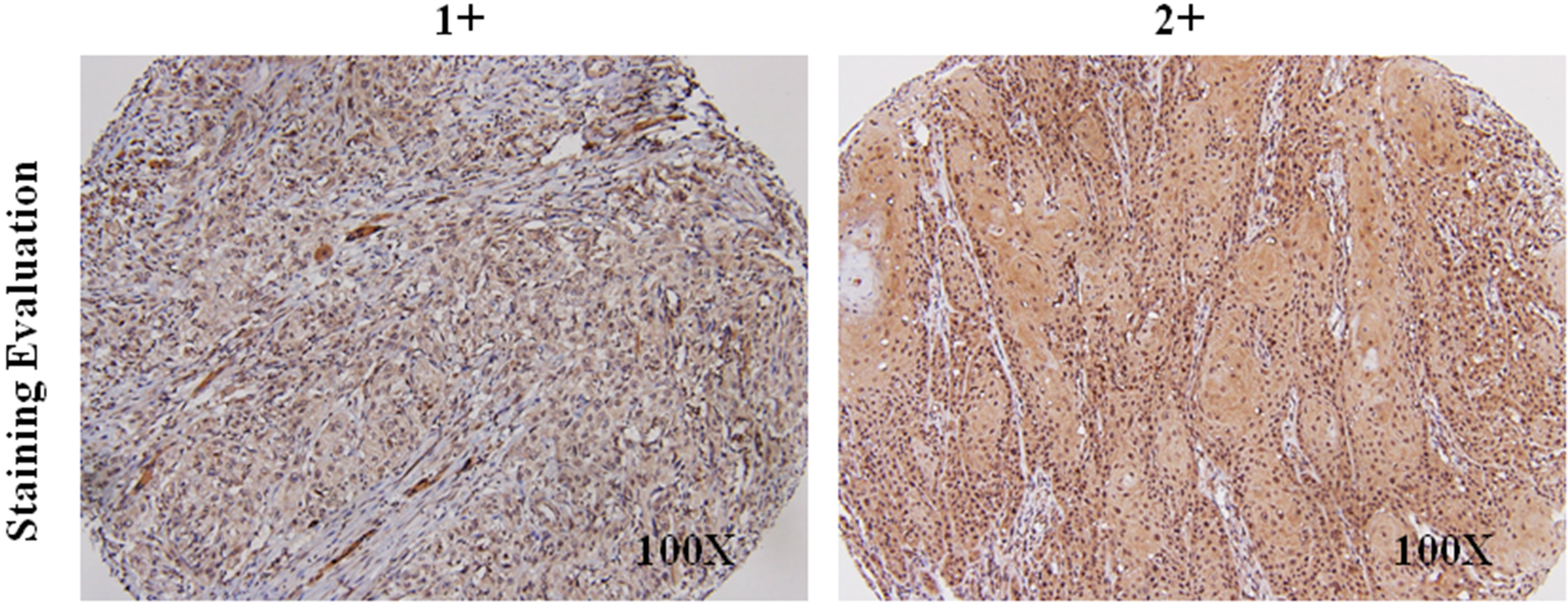
Expression patterns of DDR2 in human oral cancer tissues
At first we examined the expression of DDR2 by immunohistochemical staining of tumor tissues in situ. A total of 268 OSCC samples were evaluated, in which only 254 samples had DDR2 expression. As shown in Fig. 1, DDR2 was absolutely seen in oral cancer tissues and found primarily in the cytoplasm of tumor squamous cells.
DDR2 is positively correlated with deeper lymph node metastasis and AJCC stage
The demographic and clinicopathologic characteristics for OSCC patients were shown in Table 1. A majority of cancer patients were men (94.4%), with the tumors mainly occurred at age of
Demographic and clinicopathologic characteristics of oral squamous cell cancer patients
Demographic and clinicopathologic characteristics of oral squamous cell cancer patients
Clinicopathologic factors associated with DDR2 expression
The effect of clinicopathologic factor and DDR2 expression on mortality density and adjusted hazard ratio (aHR) among OSCC patients
The effect of clinicopathologic factor and DDR2 expression on mortality density and adjusted hazard ratio (aHR) among OSCC patients with N2
Furthermore, we divided the samples into high (above the median,
The effects of clinicopathologic factor and DDR2 expression on mortality in OSCC patient cohort were shown in Table 3. The mortality density for patients with TN stage, AJCC tumor stage and Tumor differentiation was 13.03, 28.34, 12.93 and 9.58 per 100 people-years, respectively. Independent mortality risk for patients with high DDR2 expression was not significant as compared with low expression (
Because DDR2 expression has a significant interaction with lymph node metastasis and AJCC tumor stage (Table 2), we then investigated the combined effect of DDR2 expression and the lymph node metastasis on OSCC patient’s mortality. As compared to patients with N0/N1 stage and low DDR2 expression, the mortality hazard risk was multiplicatively enhanced among patients with N2/N3 stage and high DDR2 expression (aHR
We further evaluated the combined effect of DDR2 expression and AJCC tumor stage on OSCC patient’s mortality. As compared to patients with AJCC stage (I/II) and low DDR2 expression, the mortality hazard risk was multiplicatively enhanced among patients with III/IV stage and high DDR2 expression (aHR
Discussion
Increased DDR2 expression has been detected in several human tumors, including breast, colorectal, and lung. The present study shows an association between high DDR2 expression and adverse prognosis of lymph node metastasis patients with OSCC after surgery. In addition, few other studies have found high DDR2 protein expression in oral cancer patients [18, 21]. By considering the following criteria’s (cohort sizes, ethnical differences or different evaluation method) from earlier findings, in this present study we further clarified how DDR2 expression is associated with OSCC and determined whether DDR2 could be used as a biomarker and a independent prognostic factor in oral cancer patients.
Kaplan-Meier survival curves associated with DDR2 expression among oral cancer patients in N2 
In this study we identified and quantified DDR2 protein expression in OSCC tissue and normal marginal tissues by IHC. DDR2 was localized in cytoplasm and profusely found in 92.5% of samples. Our findings showed that high DDR2 protein level was associated with a higher level of lymph node metastasis and AJCC stage, but not with TM stage and tumor differentiation among OSCC patients; suggesting that DDR2 expression might be of clinical significance in the aggressiveness of oral squamous cell carcinoma.
DDR2 is over expressed in the invasive front of primary CRC tissue and in PD tissues. It was found that high-DDR2 patient group had a significantly higher of T4, lymph node metastasis, and PD than the low-DDR2 group [15]. In breast cancer, DDR2 expression was highly correlated with advanced TNM stage and lymph node metastasis [14]. However our current study clearly demonstrated that increased DDR2 expression in all analyzed tumor tissues and we found that lymph node metastasis (N2/N3) patients with high DDR2 expression had a worst prognosis at a 10 year follow up. In contrast to our study, Xu et al. found a strong association between DDR2 and tumor pathologic stage and lymph node metastasis [17]. Von Massenhausen et al. investigated DDR2 protein levels in a large group of clinical tissue specimens containing large numbers of lymph node metastasis and recurrences next to primary tumors. DDR2 expression was higher in local recurrences than in primary tumors but not in lymph node metastases compared to primary tumors [18]. For OSCC patients, lymph nodes metastasis has been identified as one of the most important prognostic factors [22]. Previous study by Liu et al., has found that high vimentin expression was strongly associated with high lymph node metastases and poor overall survival in OSCC patients [23]. Similarly, in this present study we suggest that DDR2 expression might be a useful prognostic marker in the clinical setting, especially for lymph node metastasis patients.
In summary, aberrant activation DDR2 was more likely to be associated with a worsen survival in lymph node metastasis oral cancer patients. DDR2 could be used as indicators of poor prognosis, and may represent novel therapeutic targets in oral cancer. However, the function of DDR2 protein has not yet been clearly elucidated, and further studies are warranted.
Footnotes
Conflict of interest
The authors have declared that no competing interests exist.