




Abstract
BACKGROUND:
Oxidative stress plays an important role in promoting proliferation and metastases of cancer, which can be represented by ischemia-modified albumin (IMA). The purpose of this study was to evaluate serum IMA level in patients with operable advanced gastric cancer and analyze its prognostic significance.
MATERIALS AND METHODS:
A total of 274 patients with primary stage III gastric cancer underwent curative operation were enrolled in this study. Serum IMA level was measured within 24 hours before surgery, comparing with 112 healthy donors. The correlation between serum IMA level and survival outcome was analyzed by the Kaplan-Meier with Log-Rank test and Cox’s regression methods, respectively.
RESULTS:
Serum IMA level from gastric cancer was higher than healthy control (0.41
CONCLUSIONS:
Serum IMA level can be considered as an independent prognostic factor for operable and advanced gastric cancer.
Introduction
Gastric cancer accounted for the third most prevalent malignancy in the world, which also represents the second most frequent cancer and the third leading cause of cancer-related deaths in China [1, 2]. Although significant advances in gastric cancer treatment have been achieved through endoscopic surgery, new therapeutic approaches and multidisciplinary teamwork, prognosis of gastric cancer is far from satisfying, with a 5-year survival rate of 29.6% [3, 4, 5]. Surgery remains the only curative treatment approach for localized gastric cancer [6]. However, 50%–90% patients with advanced gastric cancer die of local recurrent or distant metastasis after a curative resection [7, 8, 9]. For localized advanced cancer, the important of preoperative risk stratification of the patients though prognostic factors which can be obtained easily and inexpensively has been increasingly recognized [7, 10, 11]. It has been revealed that oxidative stress plays an important role in promoting proliferation, tumor invasion and development of metastases [12, 13]. However, there was no sufficient data of the association between gastric cancer risk and parameters of oxidative stress.
Oxidative stress involves macromolecular oxidative damage, induces tissue protein denaturation, DNA damage, and lipid peroxidation, and interferes with the body’s normal metabolic activity, leading to the occurrence and/or development of cancer [14, 15]. Reactive oxygen species (ROS) as main active oxides mediating oxidative stress, are involved in the occurrence and development of cancer through the induction of DNA damage and genetic mutations, inhibition of apoptosis, and promotion of the proliferation, invasion, and metastasis of tumor cells [16, 17]. Overproduction of ROS results in ischemia-modified albumin (IMA) formation in vivo by oxidative modification of serum albumin [18, 19]. IMA has been confirmed as a useful biomarker for oxidative stress [20]. Otherwise, increased IMA levels were detected in in gastric cancer [21]. However, there was no study concerning the clinical value of serum IMA level in gastric cancer, especially for localized advanced diseases.
In this study, we try to furtherly evaluate the serum IMA level in patients with advanced gastric cancer and analyzed its prognostic significance.
Materials and methods
Patients
This prospective study enrolled 274 consecutive patients undergone curative resection for histologically confirmed stage III gastric cancer at the Digestive System Department in Shanxi Cancer Hospital between June 1, 2010 and June 1, 2016. According to the inclusion criteria, the study only involved histologically and clinically confirmed stage III gastric cancer cases, patients with age greater than 18 years old and life expectancy more than 6 months. Patients with preoperative severe comorbidity, such as other ischemic diseases, severe cardiac or neurological disorders, malignant disease, chronic inflammatory disease, acute and chronic infective disease, preexisting organ failure, chronic obstructive airways disease and immunosuppressive disorders, were excluded from the study. In addition, patients had extremely low or high serum albumin levels (
Clinical assessment
Clinical and histopathological data of all the patients were collected from the clinical records by one surgeon. This data, which included information such as gender, age, tumor site and size, T stage, lymph node status, TNM and pathological differentiation, was further checked by another surgeon. The histopathological and clinical staging of the tumors were evaluated though postoperative histopathological examination and clinical assessment, respectively, according to the according to the 7th American Joint Committee on Cancer (AJCC) TNM classification. Routine blood test and biochemical tests were performed on the day before the surgery to obtain serum C reactive protein level and serum albumin levels. Outcome was assessed as overall survival (OS) and recurrence-free survival (RFS). OS was accurately defined as the duration from date of surgery to death while RFS was calculated by the time of surgery to tumor recurrence.
Measurement of IMA
Five milliliter peripheral venous blood samples of all patients and control were obtained to evaluate serum IMA level on the day before the surgery. Serum IMA level was measured by using the method of Bar-Or et al. [23]. Briefly, 200
Follow-up
All Patients were followed up in regular intervals through outpatient visit including physical examination, laboratory examinations and imaging studies including blood routine test, biochemistry and tumor markers every 3 months for the first 2 years, every 6 months for the next 3 years, and once annually thereafter. Gastroscopy, and enhanced abdominal CT or MRI scans were performed generally every 12 months. Clinical follow-up lasted from the date of surgery to either the time of death or February 2017.
Statistical analysis
Analyses were performed with SPSS 20.0 (IBM, USA).
Results
Patient
The baseline demographic and clinicpathologic characteristics of 274 patients, who undergone curative resection for histologically confirmed stage III gastric cancer, are shown in Table 1. There were 191 males and 83 females, an average age of 59.7
Correlation between the serum IMA level and clinicpathologic characteristics in patients with stage III gastric cancer
Correlation between the serum IMA level and clinicpathologic characteristics in patients with stage III gastric cancer
BMI, body mass index; IMA, ischemia-modified albumin; CRP, C-reactive protein.
The mean serum IMA level from 274 patients with stage III gastric cancer was 0.41
Evaluation of serum IMA level in patients with advanced gastric cancer. Panel A showed the results of the analyzing difference of IMA level between patients with gastric cancer (
Prognostic significance of serum IMA level for stage III gastric cancer. Left panel showed the association between IMA and OS (mean OS in IMA 
Univariate and multivariate analyses of the prognostic factors of OS for stage III gastric cancer
OS, overall survival; MS, median survival; CI, confidence interval; OR, odds ratio; IMA, ischemia-modified albumin.
Univariate and multivariate analyses of the prognostic factors of RFS for stage III gastric cancer
RFS, recurrent-free survival; MS, median survival; CI, confidence interval; OR, odds ratio; IMA, ischemia-modified albumin.
Pathological differentiation stage wise survivability. Panel A and B showed that preoperative IMA was not significantly correlated with OS and RFS of patients with well or moderate differentiation gastric cancer while panel C and D showed there was significant association between IMA and OS and RFS of patients with poor differentiation gastric cancer.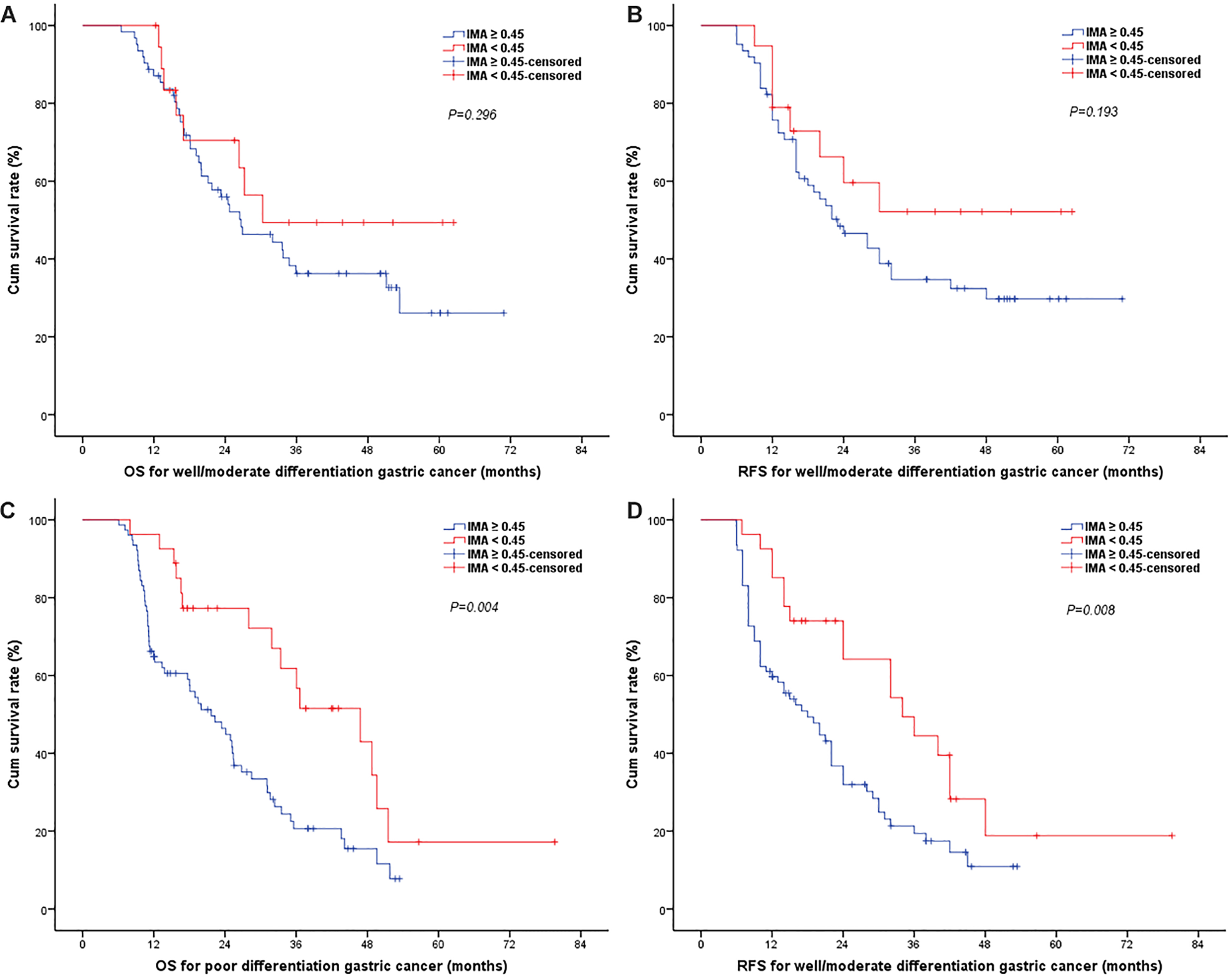
The median follow-up time was 23.2 months (6.4–79.57 months). At the endpoint, 173 (63.14%) out of all 274 patients studied had died, including 44 (51.16%) in 86 patients with a IMA
A multivariate analysis enrolled sex and gender of patients, tumor size, lymph node involvement, histological differentiation type and preoperative IMA into the COX regression model to determine independent prognostic factors for operable stage III gastric cancer. The result showed that IMA (OR, 0.774; 95% CI: 0.181–0.977;
Relationships of the preoperative IMA with pathological differentiation for the prognosis of stage III gastric cancer
Furthermore, we also evaluate the correlation of preoperative IMA with the pathological differentiation for the prognosis of gastric cancer using Kaplan-Meier survival analysis. The mean OS of patients with a IMA
Discussion
In this study, we prospectively analyzed the preoperative serum IMA level of patients with stage III gastric cancer, and found that gastric cancer patients had a significant higher IMA level than healthy subjects, and that IMA level was a useful and independent predictor of survival in patients with advanced gastric cancer from univariate and multivariate analysis. Therefore, we confirmed that the serum IMA level can be examined for optimal risk stratification of individual patients with gastric cancer, and serum IMA level can serve as a biomarker for predicting postoperative prognosis of patients with advanced gastric cancer.
Oxidative stress plays an important role in the development of cancer [24, 25, 26]. oxidative stress induces production of ROS, and then cause tissue injury or DNA damage, and as mutagen that promotes tumor initiation. In detail, ROS can oxidize guanine in DNA and RNA to form 8-hydroxyguanine (8-OHG) [27], which potentially introducing missense mutations [28]. Moreover, a large body of study has found a strong correlation between the formation of 8-OHG and carcinogenesis [29, 30]. Release of oxygen free radicals resulting from ROS overproduction induces IMA formation in vivo by oxidative modification of serum albumin [18, 31]. Otherwise, IMA, as an easily and inexpensively measurable biomarker closely relating to oxidative stress, has been proved that increased in several cancer concerning oxidative stress, such as gastric cancer, colorectal cancer and bladder cancer [19, 32]. In this study, we furtherly confirmed serum IMA level in gastric cancer patients was higher than healthy subjects.
Oxidative stress can promote several pathways that enable tumor progression and aggressiveness through regulation of proliferation, apoptosis and invasion of tumor cells [33, 34]. Furthermore, the severity of tissue inflammation and oxidative stress is directly associated with prognosis of cancer [35]. Thus, IMA level, as a factor directly reflecting oxidative stress, has been confirmed as a potential prognostic biomarker in other diseases involved with oxidative stress, such as severe sepsis and myocardial infraction [32, 36]. In current study, we first explore prognostic significance of preoperative serum IMA level in patients with stage III gastric cancer, and found that serum IMA level was significantly associated with OS and RFS of patients with gastric cancer.
Furthermore, in this study, we firstly confirmed that serum IMA level was an independent marker of prognosis in gastric cancer patients comparing with other classical predictors including lymph node involvement and pathological differentiation. At the end of study, mortality rate was higher for patients with high IMA level than with lower levels, so physicians should be aware of the risk of patient with a high IMA level and provide more proactive intervention to decrease IMA level. However, IMA level is not a direct contributor to poor outcomes, but a marker of severe oxidative stress. Targeting the original abnormal process might be a reasonable strategy to decrease IMA levels, such as correcting tissue ischemia and mitochondrial target therapy [37].
Strengths and limitations of this study
Several limitations may influence the interpretation of the results of this study. One limitation is the single center study. A large-scale, multicenter, prospective study should be conducted to confirm long-term results and obtain more definite evidence. Furthermore, we analyzed the cutoff levels of the IMA level though ROC curve in a small cohort, may imply some overestimation [38]. Thus, the results of this study may not be comparable with those of other studies. A meta-analysis including various IMA validation studies may be required to confirm more definite cutoff values for the IMA.
In conclusion, our study confirmed that patients with advanced gastric cancer have higher serum IMA level, which was correlate with serum albumin level. More important, we found that preoperative serum IMA level was an independent prognostic factor for operable and advanced gastric cancer.
Footnotes
Conflict of interest
All authors declare that there exist no conflicts of interest in this study.