




Abstract
Colorectal cancer (CRC) is one of the most common malignant tumors in digestive tract. Previous study found close correlation between insulin-like growth factor binding proteins (IGFBPs) and occurrence of multiple tumors. This study aims to analyze the effects of IGFBP6 on the apoptosis and migration of tumor cells, and to investigate underlying mechanism. HCT-116 or SW480 cell was cultured with 1.0 mg/l, 10 mg/l and 100 mg/l IGFBP-6. MTT assay was employed to test the proliferation activity of tumor cells after differential treatment. The cell cycle of tumor cells was detected by flow cytometry, while Transwell assay was used to quantify the invasion and migration of tumor cells after IGFBP-6 intervention. In experimental group with IGFPB-6 application, the proliferation rate of HCG-116 or SW480 cells was gradually decreased with higher concentrations of IGFBP-6 (
IGFBP-6 could inhibit invasion and migration of colorectal carcinoma cells possibly via inhibiting proliferation activity and arresting cell cycle of HCT-116 or SW480 cells.
Introduction
The transition of diet structure and lifestyle in recent years significantly increased both incidence and mortality of colorectal cancer (CRC). Etiology study revealed the close correlation between occurrence/development and life habit, environmental pollution, diet style and family history. Early diagnosis and treatment could significantly improve prognosis of patients. Insulin-like growth factor binding proteins (IGFBPs) belong to IGFBP super-family, which includes six important members from IGFBP-1 to IGFBP-6, all of which have high affinity with Insulin-like growth factor I (IGF-I) and IGF-II [1]. IGF-I and IGF-II could facilitate the growth and proliferation of malignant tumor cells, as their elevated expression could potentiate the occurrence of tumor metastasis. In body circulation, IGFs bind with IGFBP to regulate their activity. Previous study showed the production of specific proteinase from malignant tumor cells to degrade IGFBP, thus freeing IGF for mediating malignant tumor cells via autocrine manner [2]. In IGFs super-family, IGFBP-6 had the closet correlation with biology effect of IGF-2 [3]. Study has shown that IGFBP-6 could bind with IGF-II and regulates it biological activity for body metabolic regulation, inhibiting cell proliferation and inducing cell apoptosis, thus exerting important roles in occurrence and progression of tumors [4]. Basic study showed that IGFBP-6 could inhibit IGF-II and inhibit activity of mitosis, thus inhibiting cell growth and proliferation 2005 [5]. In this study, colorectal carcinoma cells were chosen in routine culture, and were intervened using different concentrations of IGFBP6. MTT assay, flow cytometry, and Transwell assay were sequentially applied to describe cell proliferation activity, cell cycle change, and cell invasion/migration, respectively. The effect of IGFBP6 on apoptosis and migration of colorectal carcinoma cells were then analyzed for illustrating the underlying mechanism.
Materials and methods
Cells
Human colorectal carcinoma cell HCT-116 was a generous gift from Jining First People’s Hospital, Jinan, Shandong, China. Human colorectal carcinoma cell SW480 was purchased from Nanjing COBIOER Company Limited (Nanjing, China).
Reagents and equipment
IGFBP-6 purchased from RD Systems (Minneapolis, MN, USA). DMEM medium, streptomycin/ penicillin, fetal bovine serum were purchased from Gibco BRL. Co. Ltd. (Grand Island, New York, USA). MTT reagent and PI were purchased from Sigma-Aldrich (St. Louis, Missouri, USA). Transwell chamber was purchased from Millipore (Boston, MA, USA).
Ultrapure work station (Formal 205 model, USA). Inverted microscope was purchased from Olympus (Japan). Incubator was purchased from Thermo Scientific Pierce (Rockford, IL, USA). CO
Cell culture
Human colorectal carcinoma cell HCT-116 or SW480 was cultured in RPMI1640 medium in a 37
IGFBP-6 intervention
HCT-116 or SW480 cells at log-phase were collected by trypsin digestion and were adjusted to 2.5
MTT assay
After adding different concentrations of IGFBP-6, cell activity at 12 h, 24 h, 48 h and 72 h was detected. In brief, 5 mg/ml MTT solution was added into each well (20
Flow cytometry
PI staining was used to test apoptotic rate of HCT-116 or SW480 cells after IGFBP-6 intervention. After adding 1.0 mg/l, 10 mg/l and 100 mg/l IGFBP-6 or blank control for 48 h incubation, cells were digested and collected to adjust to 10
Transwell assay for cell invasion and migration
Invasion assay
Matrigel was added into Transwell chamber for 4
Migration assay
As similar to invasion assay, cells were inoculated into the chamber without artificial basal membrane.
The effect of IGFBP-6 on cell proliferation of HCT-116 (A) or SW480 (B)
The effect of IGFBP-6 on cell proliferation of HCT-116 (A) or SW480 (B)
Compared with 0 mg/L,
SPSS17.0 was used to perform data analysis. Data were expressed as mean
Results
Proliferation activity of human colorectal carcinoma cell HCT-116 or SW480
After intervention by different concentrations of IGFBP-6, the proliferation rate of human colorectal carcinoma cell HCT-116 or SW480 was compared at 12 h, 24 h, 48 h and 72 h. Results showed decreased cell proliferation rate after applying IGFBP-6 as compared to control group (
Cell cycle alternation of HCT-116 or SW480 cells after IGFBP-6 treatment
After 72 h treatment using gradient concentrations of IGFBP-6, flow cytometry was employed to test the cycle of HCT-116 or SW480 cells. Results showed elevated G0/G1 phase cell number and decreased S phase or G2/M phase cell ratio in treatment group as compared to control group (
The effect of IGFBP-6 on cell cycle of HCT-116 (A) or SW480 (B)
The effect of IGFBP-6 on cell cycle of HCT-116 (A) or SW480 (B)
Compared with 0 mg/L,
Cell cycle change of HCT-116 or SW480 cells after IGFBP-6 intervention.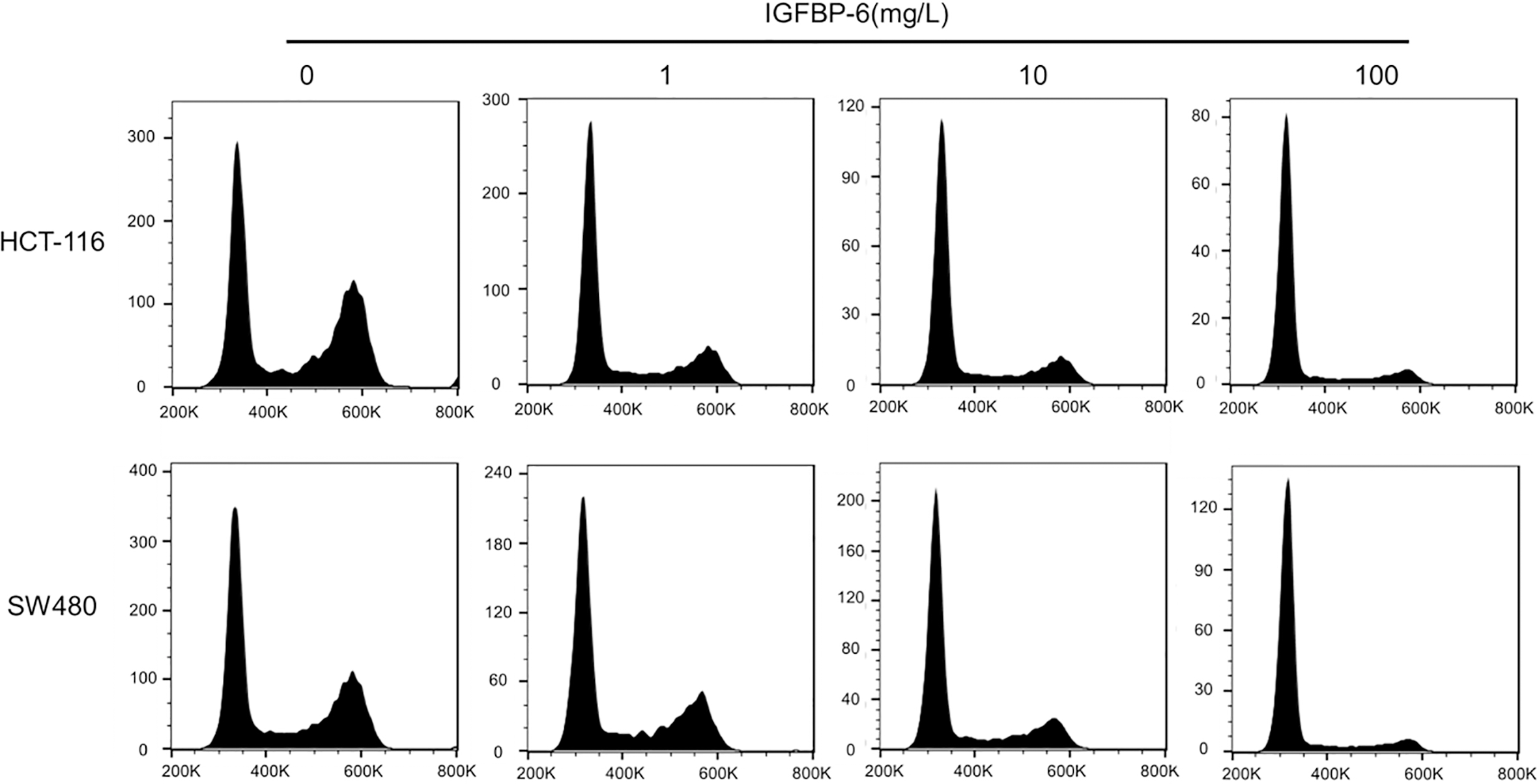
Transwell assay was employed to describe invasion and migration of HCT-116 or SW480 cells after IGFBP-6 intervention. Results showed decreased invasion and migration potency of HCT-116 or SW480 cells in treatment group as compared to control cells. With elevated concentration of IGFBP-6, both invasion and migration abilities of HCT-116 or SW480 cells were significantly decreased (
Invasion and migration of HCT-116 or SW480 cells after IGFBP-6 treatment. A: Representative image for cell invasion and migration. B: Quantified data of cell invasion and migration. Compared with 0 mg/L, 
CRC is one malignant tumor derived from mucosal epithelial cells of colon under the influence of environmental or genetic factors. It is one common cancer in digestive tract. Recently, its incidence maintains at about 2% worldwide and is increased by 4.2% annually in China [6, 7]. Primary treatment for CRC is surgical resection. However, due to the asymptotic feature at early stage, CRC is frequently diagnosed at late stage, brining high recurrence rate after surgery, plus insensitivity for chemo/radio-therapy. Colorectal endoscopy is believed as the golden standard for early diagnosis of CRC, but is difficult for wide use in high risk population. IGFBPs are important components of IGF and can be synthesized in all body tissues, especially in liver [8]. IGFBP-6 is mainly separated from cerebrospinal fluid (CSF) and is distributed in skin, heart, lung, liver, brain and skeletal muscle tissues [9, 10]. As the inhibitory factor for IGF-1, the expression level of IGFBP-6 is decreased with higher malignancy of cells [11, 12].
In this study, HCT-116 and SW480 cells were selected as the experimental model, on which different concentrations of IGFBP-6 were applied for continuous incubation for 12 h, 24 h, 48 h and 72 h. Comparing to control group, the intervention using IGFBP-6 decreased proliferation rate of HCT-116 or SW480 cells. With elongation of treatment time, proliferation rate was further down-regulated. These results suggested that IGFBP-6 could inhibit the proliferation activity of HCT-116 or SW480 cells in a positive dose-dependent manner. Previous study showed that IGF-1 could facilitate the proliferation of color cancer LIM 1215 cells while IGFBP-6 could inhibit the role of IGF-1 [13]. Basic study also showed that the inhibition of IGFBP-6 could induce the proliferation of tumor cells [14], similar to our study.
Using different concentrations of IGFBP-6 on HCT-116 or SW480 cells for 72 h, flow cytometry studied the cell cycle of tumor cells and found elevated ratio of G0/G1 phase cells and decreased cell number at S phase and G2/M phase in treatment group compared to control cells. With elevated IGFBP-6 concentration, the trend of elevated G0/G1 phase and decreased S and G2/M phase ratios was more potent. These results suggested that IGFBP-6 could arrest HCG-116 or SW480 cells at G0/G1 phase, retarding the mitosis of cells or its normal cycle. Previous study found the over-expression of IGFBP-6 in neuroblastoma cells had altered cell cycle pattern, as shown by decreased S phase ratio, tumor formation and size [15]. Cacalano et al. reported that IGFBP-6 could facilitate the apoptosis of malignant tumor cells [16]. The elevation of IGFBP-6 expression could further improve the prognosis of tumor patients.
Transwell assay was further employed to test the invasion and migration ability of HCT-116 or SW480 cells after treatment by IGFBP-6. Compared to control group, treatment cells had lower invasion and migration ability. With elevated concentration of IGFBP-6, cell invasion and migration potency was further weakened. These results suggested that IGFBP-6 could effectively inhibit invasion and migration of HCT-116 or SW480 cells. Study showed that IGFBP-6 could inhibit division, differentiation, infiltration, metastasis of tumor cells possibly via inhibiting the specific binding with IGF-2 in various tumors including osteosarcoma, neuroblastoma, and pulmonary cancer [17, 18]. Both in vivo and in vitro studies showed the inhibition of proliferation, metastasis and induction of apoptosis of sarcoma by IGFBP-6 [19]. In another study about human nasopharyngeal carcinoma, IGFBP-6 could inhibit the growth and proliferation of cell line CNE2 in a dose-dependent manner [20].
Conclusion
IGFBP-6 could arrest cells at G0/G1 phase via inhibiting proliferation activity of CRC cell HCT-116 or SW480, thus impeding normal cell cycle, and inhibiting invasion and migration of cells. IGFBP-6 thus can become one novel aspect for clinical treatment of CRC and is worth further investigation.
Footnotes
Conflict of interest
None.