




Abstract
BACKGROUND:
This study was carried out to investigate the correlation between CD133 and non-small cell lung cancer (NSCLC) clinicopathological features and its impact on survival of the patients with NSCLC.
METHODS:
In the first, we detected the level and localization of CD133 protein in NSCLC specimens and confirmed that CD133 expression was closely linked to poor prognosis of NSCLC. Secondly, TCGA genomic data for LUNG (Provisional) was retrieved and analyzed for genetic alterations of CD133 in different lung cancer subtypes. In the last, a comprehensive literature search for relevant studies published up to December 2015 was performed using Medline, EMBASE Classic
RESULTS AND CONCLUSION:
Both our experimental results and pooled results of previous studies indicated that CD133 may be used as a prognostic marker for the patients with NSCLC. However, more studies are required to evaluate CD133 potential use in predicting patients’ outcome.
Introduction
CD133 expression in NSCLC. A. The level of CD133 mRNA was higher in lung cancer tissue than matched normal tissue (
Lung cancer continues to be the most commonly diagnosed cancer as well as the leading cause of cancer death in the world [1]. A major problem in finding treatments for lung cancer is the frequent resistance to drugs. Early detection of non-small-cell lung cancer (NSCLC) and accurate prognostic risk assessment could improve patient outcome. For example, Takahashi et al., [2, 3] confirmed that DiAcSpm/cutoff ratio (DASr) could be a useful biomarker for detecting NSCLC and predicting prognosis.
Human CD133, also known as prominin-1, a 5-transmembrane domain glycoprotein, was originally identified as a cell surface antigen present on hema- topoietic stem cells [4]. Eramo et al. [5] demonstrated the existence of CD133
This study was carried out to determine the association between CD133 and the common clinical and pathologic features of NSCLC both by our experimental results and pooled results of previous studies.
Subjects
Experiments and methods of this study were conducted in accordance with ethical principles stated in the Declaration of Helsinki. The Ethics Committee of Liaoning Medical University reviewed and approved this study and a written informed consent was required from participants or caregivers. A total of 132 patients with NSCLC were obtained from the First Hospital of China Medical University (Jan. 2007 to Dec. 2010). None of the patients underwent radiotherapy or chemotherapy before the operation. Informed consent was provided by all patients according to the Helsinki Declaration. The mean age of patients at the time of surgery was 56 years (range of 38–77 years). Sex, age, tumor size, histological type, tumor differentiation, and TNM stage are also collected in this study.
RT-PCR
Total RNA was isolated from human tissues using an RNeasy Mini Kit (Biomed, Beijing, China). cDNA was reverse transcribed with 1
Relationship between CD133 and the clinicopathological parameters of patients with NSCLC
Relationship between CD133 and the clinicopathological parameters of patients with NSCLC
Abbreviations:
Specimens were lysed using lysis buffer (50 mM Tris-HCl, pH
Immunohistochemical studies (IHC)
We used immunohistochemical staining method in this study, according to the literature [11]. All the cases of lung cancer tissue samples underwent Envision two-step immunohistochemical staining. Primary antibody, CD133 (LifeSpan BioSciences Inc.), was applied at 4
Expression differences of CD133 mRNA in TCGA LUNG set (provisional) associated with clinical pathological features. The query process was performed using the cBioPortal online tools (
Characteristics of studies included in the meta-analysis
For mRNA expression data, TCGA genomic data for LUNG (Provisional) was retrieved. The returned value indicates the number of standard deviations away from the mean of expression in the reference population (
Meta-analysis
We identified relevant published research articles by a systematic search of the following electronic databases: Medline (1948 to December, 2015), EMBASE Classic
Statistical analysis
Chi-square tests were performed to verify the association between CD133 expression and the clinical and pathologic features of NSCLC. The statistical analyses and graphics were performed with GraphPad Prism 5. OR with 95% confidence intervals (CIs) was calculated by using Review Manager Version 5.3 for Windows (Cochrane Collaboration,
Flow diagram of identifying potential studies in our meta-analysis.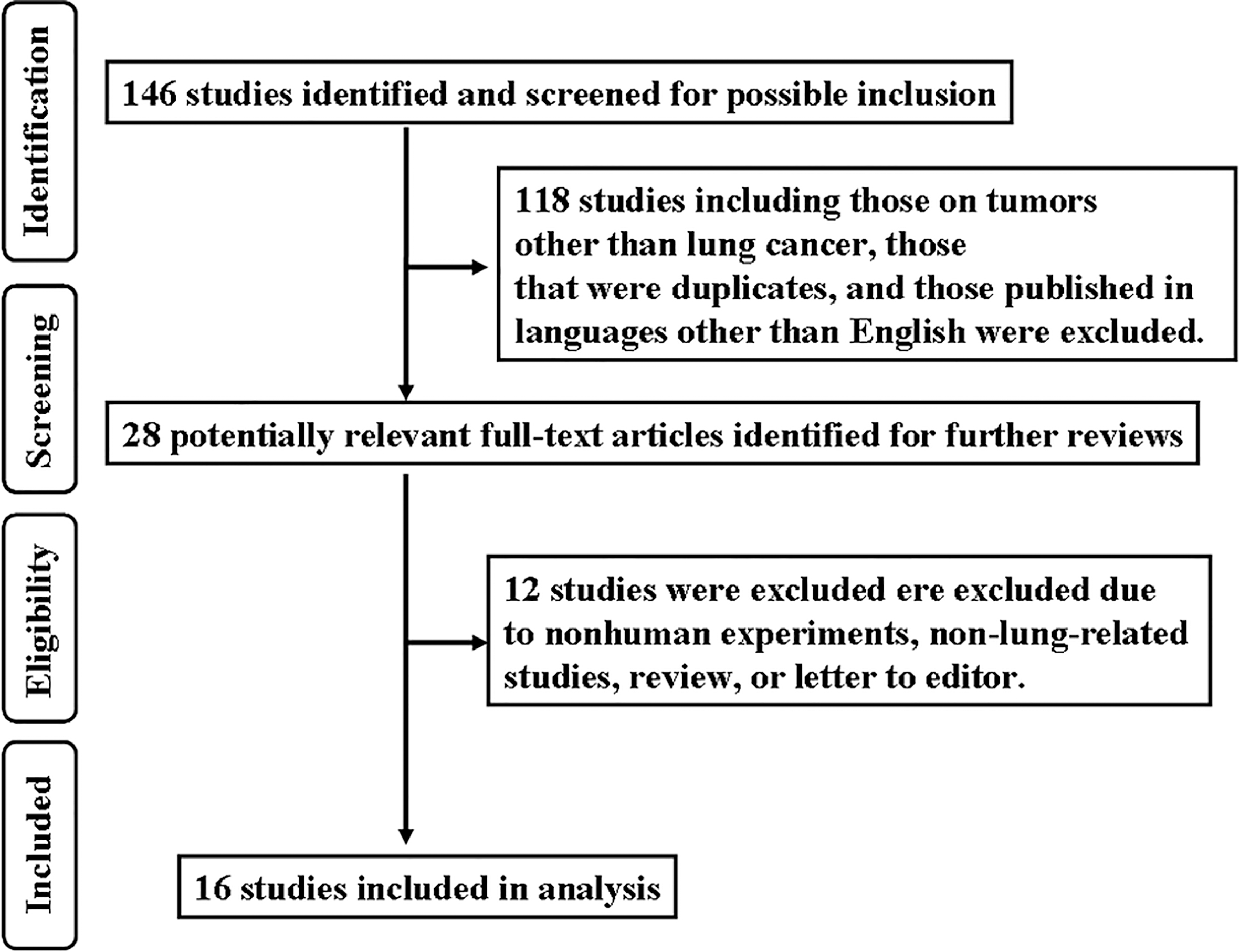
Meta-analysis of CD133 and the clinical characteristics of patients with NSCLC.
Meta-analysis of CD133 and the clinical characteristics of patients with early stage NSCLC.
Meta-analysis of correlation between CD133 and overall survival.
Funnel plot for publication bias test (CD133 and NSCLC).
RT-PCR analysis was performed in order to determine the level of CD133 mRNA in lung cancer specimens. CD133 mRNA in cancer tissue was significantly higher than that in normal tissue (
CD133 mRNA in different lung cancer subtypes
To determine whether CD133 mRNA is associated with a specific subtype of lung cancer, we compared the mRNA levels of CD133 in lung adenocarcinoma and lung squamous cell carcinoma specimens. We found that the mRNA level of CD133 were higher in T4 lung adenocarcinoma, whereas no difference in T1-T4 stages of lung squamous cell carcinoma (Fig. 2A). CD133 mRNA was highly expressed in M1 lung adenocarcinoma and less expressed in M1 lung squamous cell carcinoma compared with their matched M0 tissues (Fig. 2B). Interestingly, we found that CD133 mRNA expression could be a good indicator for lung adenocarcinoma by using both cBioPortal (Fig. 2C) and Kaplan-Meier plotter analysis (Fig. 2D). Taken together, these data indicate that CD133 may play different roles in different subtypes of lung cancer.
Meta-analysis results
Detailed search steps were described in Fig. 3. One hundred and forty-six articles were identified initially using the search strategy above. One hundred and eighteen articles included those on tumors other than lung cancer. Twelve of residual 28 papers were excluded due to nonhuman experiments, non-lung-related studies, review, or letter to editor, through reading title and abstract. After further screening, the report by Hilbe et al. [12] was excluded due to CD133 expression was detected in endothelial progenitor cells but not in tumor cells. The studies of Le et al. [7], Janikova et al. [13] and Pirozzi et al. [14] provided a hazard ratio of overall survival (OS) or disease-free survival (DSF) but insufficient information on the clinicopathological parameters of the patients. Two reports provided the information on CD133 expression and early stage NSCLC [8, 15]. Eleven studies focused on CD133 expression and NSCLC were included [9, 10, 16, 17, 18, 19, 20, 21, 22, 23, 24]. Eventually, 11 eligible studies were included in the present meta-analysis and listed in Table 2.
There was no clear correlation between CD133 expression and age (pooled OR
Discussion
To our knowledge, this is an updated meta-analysis to systematically evaluate the relationship between CD133 and NSCLC. In the studies of Mizugaki et al. [9] and Li et al. [18], they didn’t find any relationships between CD133 and differentiation of NSCLC. However, both Wu et al. [16] and Xu et al. [17] found CD133 was related to tumor cell differentiation degree. Our pooled result showed that CD133 expression was associated with differentiation of NSCLC. Included studies in this meta-analysis were not found any associations of CD133 with age and sex [9, 10, 16, 17, 18, 19, 20, 21, 22, 23, 24]. Consistent with the results of each individual study, our pooled results also confirmed that CD133 was not related to age and sex. Two papers showed that CD133 was related with histology of early stage NSCLC [8, 15]. In this meta-analysis, we compared the impact of CD133 on squamous cell carcinoma (SCC) with adenocarcinoma (ADC). Our pooled results confirmed that CD133 expression was only related with histology of early stage NSCLC. Interesting, no associations were found between CD133 and histology of all stage NSCLC. CD133 has prognostic significance for patients with colorectal cancer [25], hepatocellular carcinoma [26], and gastric cancer [27]. In our study, we evaluated the expression of CD133 and its prognostic value for the patients with NSCLC. DFS was calculated as survival without relapse or death from the date of first complete remission, censoring patients alive in continuous complete remission at the last follow-up date [28]. Our pooled results found CD133 expression had significant impact on the OS of the patients with NSCLC but not on DFS. These results indicated that CD113 may be used as a prognostic marker for NSCLC. However, according to current data, it not a prognostic marker for early stage NSCLC. In accordance with some other types of malignancies, CD133 expressed NSCLC patients had a lower OS by comparing to negative ones [25, 26, 27].
The cause of inconsistent results in each individual study was very complex. Several reasons may influence the conclusion of each included report. For example, the antibody that used to detect CD133 in each study has no universal standard. As noted in the introduction, CD133 is a transmembrane glycoprotein. Minor changes in glycan structure could have drastic functional implications both at the protein and at the cellular levels [29]. Other limitations in each individual study should be considered, such as the different cutoff value of immunohistochemical staining in each study. Although we can’t regulate these limitations in individual study, certain limitations in our meta-analysis need to be pointed out. First, the numbers of published studies were still not sufficiently large for the analysis of the CD133 expression and NSCLC. Second, language restriction could introduce bias in the results of the meta-analysis [30]. Finally, lack of the original data of the reviewed studies limited our further evaluation.
Interestingly, consistent with the pooled results from previous studies, our results in this study also confirmed that CD133 was associated with differentiation of NSCLC and the survival rate of NSCLC patients. In our study, we found CD133 is mainly localized in the membrane and cytoplasm in NSCLC cells. As noted in above, CD133 is known as a surface protein, however, anomalous localization in the nucleus has been described in various malignancies [20, 31, 32]. Nuclear localization of CD133 may be an indicator of poor prognosis in non-small cell lung cancer [20]. We didn’t find nuclear localization of CD133 in our specimens and we will collect more NSCLC tissues for further study.
In summary, this present study shows a significant correlation between CD133 expression and differentiation of NSCLC both in our results and pooled previous results. CD133 may have prognostic significance for patients with NSCLC based on currently obtained data. The value of the current meta-analysis compensates for the individual lack of precision of most studies, a problem alleviated by pooling. Further studies are required to evaluate CD133 potential use in predicting patients’ outcome.
Footnotes
Acknowledgments
This study was supported by National Natural Scientific Foundation of China (No. 81502558) and Talents Introduction Projects of Liaoning Medical University. We are grateful to Liu for providing their paper to us.
Conflict of interest
The authors declare that they have no conflicts of interest with the contents of this article.