




Abstract
Vacuum-ultraviolet circular dichroism (VUVCD) spectra of malto-, laminari-, isomalto-, and cello-oligosaccharide series and their corresponding polysaccharides (laminarin and dextran) were measured from 200 to 168 nm in aqueous solution at 25°C using a synchrotron-radiation VUVCD spectrophotometer. Disaccharides exhibited markedly different CD spectra depending on the types of glycosidic linkages, and the CD spectra of each oligosaccharide series (with the exception of the isomalto-oligosaccharide series) varied with the chain length below 190 nm while retaining the spectral shape of the constituent disaccharide. These results indicate that the basic structures of oligosaccharides were greatly affected by the configurations of their constituent disaccharides, which had unique torsion angles restricted by the intramolecular hydrogen bonds between glucose units. Based on comparisons between the experimental and theoretical data, we suggest that the chain-length dependence of CD above 180 nm reflects the backbone structure of oligosaccharides (e.g., helical structures), while those below 180 nm are influenced by other factors associated with higher-energy chromophores such as the hydroxyl groups. The reported comprehensive VUVCD spectra provide basic information for understanding the complicated structures of oligosaccharides in aqueous solution that can be used in their theoretical assignments.
Keywords
Introduction
Vacuum-ultraviolet circular dichroism (VUVCD) spectroscopy is a powerful tool for analyzing saccharide structures (especially unsubstituted saccharides) in aqueous solution [2,11,14] because they contain high-energy chromophores such as hydroxyl groups and acetal bonds whose n–σ* electronic transitions are only detectable in the vacuum-ultraviolet (VUV) region below 190 nm [1,3,17,24,25]. Some previous studies have found that the VUVCD spectra are sensitive to the equilibrium structures of monosaccharides in aqueous solution, such as the gauche (G) and trans (T) conformations of the hydroxylmethyl group at C-5, and the α- and β-anomer configurations of the hydroxyl group at C-1 [3,17,24,25]. However, since the pairwise relationships between the structures and VUVCD of monosaccharides remained unclear from these experimental results, we have recently measured the VUVCD spectra of various methyl aldopyranosides including methyl α-
Few VUVCD spectra of unsubstituted oligosaccharides including disaccharides have been reported, but interesting results have already been obtained, as well as for monosaccharides. Stipanovic et al. measured the CD spectrum of an isomalto-oligosaccharide series with an α-(
In the present study we measured the VUVCD spectra of the unsubstituted malto-, laminari-, isomalto-, and cello-oligosaccharide series down to 168 nm in aqueous solution at 25°C using a VUVCD spectrophotometer with an SR light source with the aim of clarifying the contributions of the different types of constituent disaccharides and increases in chain length to the structures and CD spectra of oligosaccharides. Table 1 and Fig. 1 respectively present the structural parameters and the chemical structures of disaccharide units of each oligosaccharide series. Although the types of glycosidic linkages differ between the series, all of them are composed of glucose units in order to simplify the comparisons among the CD spectra. To our knowledge, this is the first systematic investigation of the VUVCD of oligosaccharides in aqueous solution using an SR spectrophotometer.
Structural parameters of the oligosaccharide series examined in this study
Structural parameters of the oligosaccharide series examined in this study
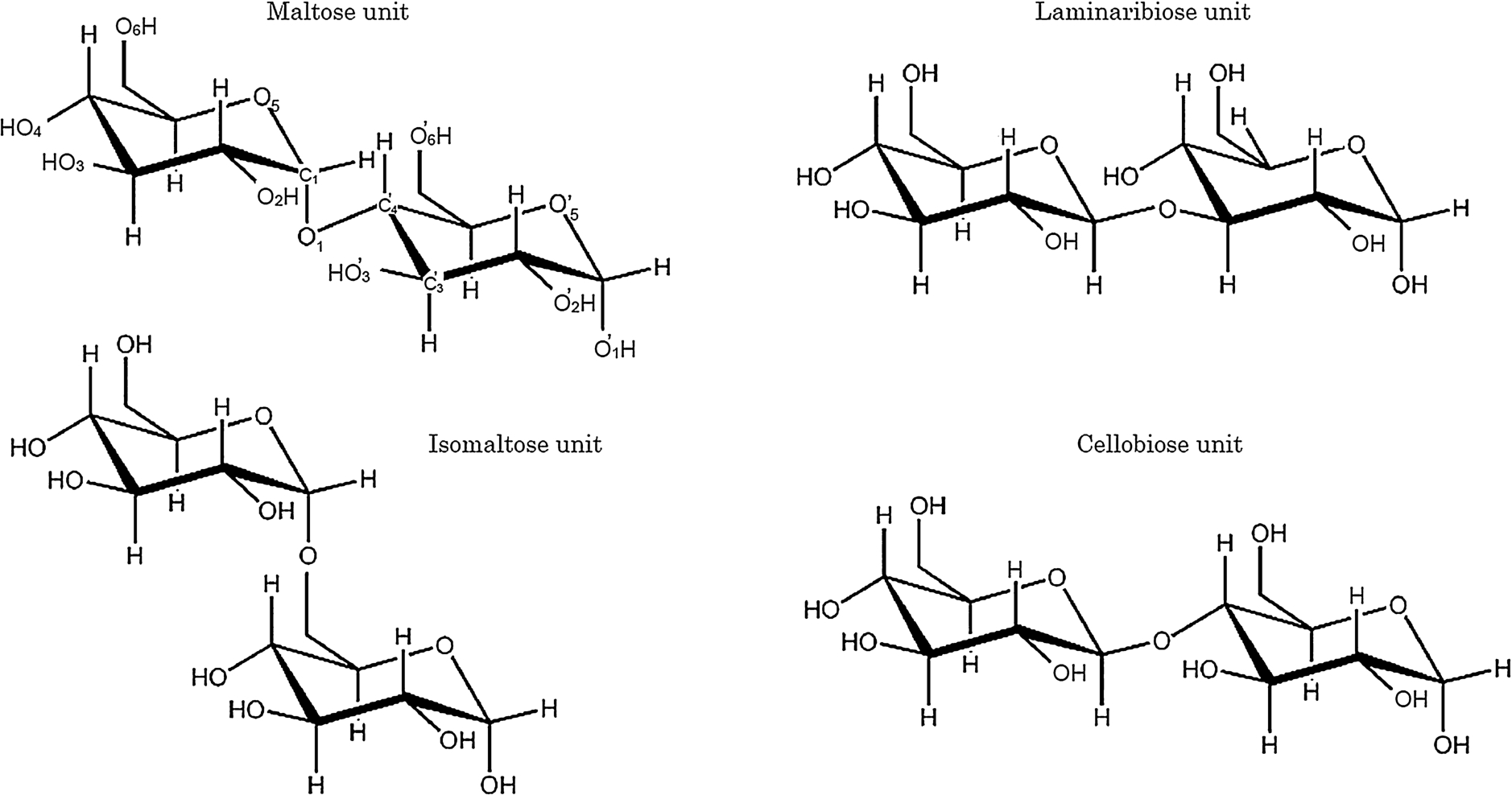
Chemical structures of disaccharide units of the malto-, laminari-, isomalto-, and cello-oligosaccharide series examined in this study.
Materials
Malto-oligosaccharides (
VUVCD measurements
The VUVCD spectra were measured from 200 to 168 nm at 25°C using the SR-VUVCD spectrophotometer. Details of the spectrophotometer and optical cell used are available elsewhere [21,28]. The path length of the CaF2 optical cell was adjusted using a Teflon spacer to 10 μm for the measurements from 200 to 172 nm, while no spacer was used for measurements below 172 nm in order to reduce the absorption of light by water. The spectra obtained without the spacer were calibrated by normalizing the ellipticities to the spectra measured using a 10 μm spacer in the overlapping wavelength region from 200 to 172 nm. The path length of the cell without spacer was estimated to be 1.4 μm by this calibration method [19,20]. All spectra were recorded with a 1.0-mm slit, 4-s time constant, 20-nm/min scan speed, 0.067-nm data interval, and 4–9 accumulations. The molar ellipticity (θ) of all saccharides was calculated using the molecular weight per monosaccharide unit, in which the total molecular weight is divided by the number of monosaccharides. The obtained spectra were reproducible within 5%, and the errors were mainly attributable to noise in the signals and inaccuracies in the length of the light path. The error was approximately twofold higher below 170 nm, mainly due to the increased noise of the signals and inaccuracies in the length of the light path.
Results
Figure 2 show the VUVCD spectra of the malto-, laminari-, isomalto-, and cello-oligosaccharides measured in this study, respectively. Two dextran polysaccharides and one laminarin polysaccharide were also measured for comparisons, and these are described in the corresponding figures. These figures clearly show CD spectra only in the VUV region below 190 nm, indicating that VUVCD spectroscopy is a powerful tool for detecting the structures of oligosaccharides in aqueous solution. None of these spectra exhibited any concentration dependence, suggesting the absence of aggregations between the solutes within the concentration range examined (1.0–8.0 w/v%) and also meaning that sufficient signal can be detected in the wavelength region below 190 nm where the absorption of water becomes heavy [22].
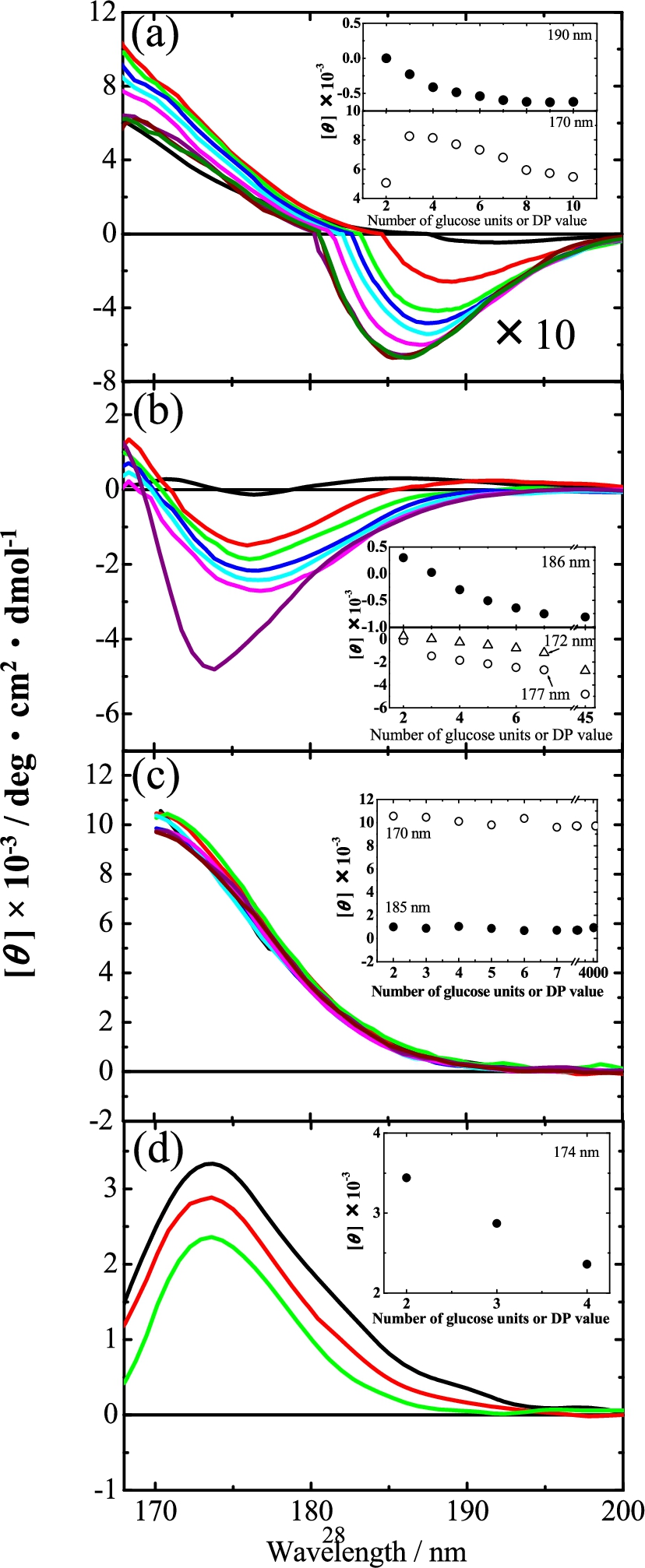
VUVCD spectra of oligosaccharides in aqueous solution at 25°C (a) malto-oligosaccharide series (maltose, black; maltotriose, red; maltotetraose, green; maltopentaose, blue; maltohexaose, sky blue; maltoheptaose, pink; maltooctaose, violet; maltononaose, brown; and maltodecaose, dark green). The intensities of CD in the negative region were shown in the 10-fold spectra. (b) laminari-oligosaccharide series (laminaribiose, black; laminaritriose, red; laminaritetraose, green; laminaripentaose, blue; laminarihexaose, sky blue; and laminariheptaose, pink) and laminarin (violet). (c) isomalto-oligosaccharide series (isomaltose, black; isomaltotriose, red; isomaltotetraose, green; isomaltopentaose, blue; isomaltohexaose, sky blue; and isomaltoheptaose, pink) and dextran (
Maltose is a disaccharide that has an α-(
To clarify how the malto-oligosaccharide spectra varied with the chain length, the CD intensity at the peaks at 190 and 170 nm (where maltose exhibited a negative CD peak and positive CD, respectively) are plotted against the DP in the inset of Fig. 2(a). It is evident that the peak intensity around 190 nm decreased exponentially as the DP increased, saturating at around
Laminari-oligosaccharide
Laminaribiose contains two
The CD intensities at 186, 177, and 172 nm where laminaribiose exhibited CD peaks are plotted against the number of glucose units in the inset of Fig. 2(b). As for the malto-oligosaccharide series (Fig. 2(a)), the CD intensity decreased gradually as the chain length increased. A particularly interesting finding was that the intensities of the CD spectra of laminariheptaose and laminarihexaose at 186 nm were similar to that of laminarin, indicating that the intensity at this wavelength decreased exponentially and saturated around
Isomalto-oligosaccharide
Isomaltose contains two
Cello-oligosaccharide
Cellobiose is a disaccharide with a β-(
Discussion
Our VUVCD measurements of oligosaccharides revealed that the VUVCD spectra exhibited characteristic peaks reflecting differences in the types and lengths of oligosaccharides, thereby demonstrating that VUVCD is sensitively affected by the structure of oligosaccharides. Further, the spectral shapes within each oligosaccharide series were highly similar and the change in the spectra with increases in chain length depended on the types of oligosaccharides or constituent disaccharides, suggesting that the structure of oligosaccharides is mainly determined by the configurations of the constituent disaccharides. Therefore, the disaccharide configurations would be useful for understanding the structures and CD spectra of oligosaccharide in aqueous solution.
Unique torsion angles of constituent disaccharides affect VUVCD spectra
The crystal structures of disaccharides investigated in this study were already determined by X-ray crystallography [30], showing that maltose, laminaribiose, and cellobiose formed the intramolecular hydrogen bonds between HO’-3…O-2, HO’-4…O-5, and HO’-3…O-5, respectively, while isomaltose did not participate in such bonding (Fig. 1). These intramolecular hydrogen bonds should directly affect the backbone torsion angles of glycosidic linkages. Actually, analyses of the torsion angles of these disaccharides using NMR and X-ray methods [6,29,32] revealed differences in the types of glycosidic linkages, such as ϕ and φ values of 96.8 and 105.2, respectively, for maltose, and
In CD calculations of methyl D-aldopyranosides using the TDDFT method at the CAM-B3LYP/6-311++G** level, the molecular orbitals and rotational strengths related to the electronic transitions of the hydroxyl group, ring oxygen, and methoxy oxygen showed that the wavelength region around 180–170 nm was mainly assigned to the n-σ* transitions from the lone-pair orbital (n-orbital) to the σ*-orbital of ring oxygen and methoxy oxygen (or acetal bond), with only small contributions from hydroxyl groups [19,20]. Further, CD calculations of maltose, laminaribiose, isomaltose, and cellobiose based on their crystal structures [30] using TDDFT method at the CAM-B3LYP/6-311++G** level showed that the wavelength region around 180 nm included the electronic transitions originating from the acetal bond in glysocidic linkages. This theoretical results are supported by the experimental ones of several disaccharides and polysaccharides in which some characteristic CD peaks depended on the types of glycosidic linkages were found around 180–170 nm [14,17]. These results suggest that the unique torsion angles of maltose, laminaribiose, isomaltose, and cellobiose molecules could contribute to their spectral differences (Fig. 2) and also become important factors influencing the backbone structure of oligosaccharide because the spectral shapes within each oligosaccharide series were highly similar.
Characteristic structures of oligosaccharides affect VUVCD spectra
To understand the spectral change of oligosaccharides with increases in chain length, it is important if the structural changes of oligosaccharides occur at the level of the torsion angle of glycosidic linkages as the chain length increases. Sugiyama et al. determined the torsion angles of malto-oligosaccharides (
Deslandes et al. reported that torsion angles ϕ and φ of β-(
Shen et al. showed differences in backbone torsion angles between cellobiose [7] and cellotetraose [12] in crystal structures [34]. Dudley et al. measured the 13C NMR spectra of cello-oligosaccharides and revealed that the transformation of the cello-oligosaccharide spectrum into that of cellulose is definitely established for cellotetraose and complete for cellopentaose and higher oligomers [10]. Cellulose is known to form sheet structures in crystal form [26,27]. These results suggest the presence of differences in torsion angles among the cello-oligosaccharides as well as the malto- and laminari-oligosaccharide series. Although we could not measure the CD spectra of cello-oligosaccharides above
Dextran is known to form random structures [23], while amylose and laminarin form helical crystal structures. Figure 2(c) shows that there was no characteristic dependence on increases in the chain length in the isomalto-oligosaccharide series and dextran, which suggests that this oligosaccharide series is similar to random structures. These flexible structures would be induced by the extended structure of isomaltose units without intermolecular hydrogen bonds between glucose units.
While the theoretical assignment of oligosaccharide CD spectra using the TDDFT method and MD simulations would be necessary for understanding the relationships between the structure and VUVCD (especially, below 180 nm) of oligosaccharides, the present comprehensive experimental data suggest that the chain length dependence observed in the VUVCD spectra of malto- and laminari-oligosaccharide series should reflect their characteristic structures such as helices, while the isomalto-oligosaccharide series does not show such CD changes due to its flexibility.
Conclusions
The VUVCD spectra of various oligosaccharide series suggested that the structure of an oligosaccharide is based on the configuration of the constituent disaccharides, with some oligosaccharides forming a helical structure as the chain length increases, affecting the CD spectra below 190 nm. Investigating the structural characteristics of oligosaccharides is not only inherently interesting but also an important step toward understanding the structure and dynamics of polysaccharides. The further accumulation of VUVCD data and their theoretical assignments is important for understanding the more detailed structures of oligosaccharides and their biological functions, which opens new fields in the structural biology of glycoconjugates.
Footnotes
Acknowledgements
This work was financially supported by Grant-in-Aids for Scientific Research from the Ministry of Education, Science, Sports, and Culture of Japan (No. 22870021 and No. 15KK0260 to K.M.) and by a grant from Kurata Memorial Hitachi Science and Technology Foundation.