




Abstract
Objectives:
The objectives of the study were to determine the effect of moderate-intensity exercise (MIE) and high-intensity interval exercise (HIIE) on serum brain-derived neurotrophic factor (BDNF) levels and working memory (WM) in young adult females.
Methodology:
This study was conducted in the Physiology Department, Khyber Girls Medical College Peshawar. Young adult females (n = 22), with a mean age of 20±2 years were recruited for two experimental sessions of MIE and HIIE, respectively. Baseline and post exercise blood samples were taken for determination of serum BDNF level and backward digit span test (BDST) for assessment of working memory in both sessions.
Results:
Serum BDNF levels pre and post MIE were 707±448 pg/ml and 829±476 pg/ml (p = 0.006) respectively while pre and post HIIE were 785±329 pg /ml and 1116±379 pg/ml (p < 0.001) respectively. BDST scores were significantly high at post intervention for both MIE (p = 0.05) and HIIE (p 0.001).
Conclusions:
Altogether our findings showed that both MIE and HIIE significantly increased serum BDNF levels and working memory in young adult females.
Keywords
INTRODUCTION
Sedentary lifestyle is associated with reduced neurotrophic factors and memory functions [1]. Most of our population is sedentary and has poor exercise compliance. Only one-fourth of the adults and teens get enough exercise to maintain good health. A World Health Organization survey shows that 23% of males and 32% of females worldwide do not engage in enough physical activity; only 5% of the adult population worldwide meets the basic recommendations of physical exercise [2]. The situation is even worse in Pakistan, 24.4% males and 43.3% females are not sufficiently active. Lack of time, use of internet, cell phones and computers are a cause for noncompliance to exercise and sedentary behavior [3, 4].
Memory can be conceptualized in terms of stages and process. As a process it can be encoding, consolidation and retrieval and in terms of stages it can be sensory, short-term, and long-term memory (LTM) [5]. Sensory memory permits a person to keep the imprints of information that is gathered through the senses [6]. Short term memory (STM) continues for about 20 seconds and has a capacity limit of holding 7±2 items. It is also called working memory, which is a strong predictor of learning [7]. Working memory holds information in mind and mentally works with it thus enabling us to bring conceptual knowledge with a sense of progression and not just passive input of information [8]. Backward digit span test which is a valid test to check working memory for research purposes [9]. All the memories we have for longer than a few seconds are encompassed in LTM [10].
There are several factors causing memory lapses like lack of sleep, certain medications, use of alcohol, stress, anxiety, depression, sedentary lifestyle, and neurological disorders[11–15]. Working memory can be enhanced by controlling attention, gating the information into and out of the buffer and reducing interference from other irrelevant sources [16]. In addition, physical exercise that is planned, structured, and repetitive not only leads to physical fitness [17], but also has a positive effect on working memory. Exercise improves memory by increasing overall arousal in brain, increase oxygen transport to brain, up regulation of N-methyl-D-aspartate (NMDA) receptors and increased brain derived neurotropic factor (BDNF) synthesis in the brain particularly in hippocampus an area involved in memory [18]. According to American College of Sports and Medicine, exercise performed at 50 –63 %, 64 –76 % and 77 –95% of maximum heart rate is termed low, moderate, and high intensity, respectively [19, 20]. High intensity exercise has been further classified as continuous, HIIE and sprint interval training [21]. HIIE is characterized by short bouts of high-intensity exercise alternating with same duration of rest or lower level of physical exercise [21]. It is less time consuming as compared to continuous moderate exercise and is preferred by most people [22–24]. It has recently emerged as an effective exercise paradigm for enhancing memory [25], however very little research has been done on the effects of HIIE on memory and BDNF [25, 26].
BDNF is a key marker for memory improvement [27]. It plays an important role in promoting dendrite formation, neurogenesis and memory [28]. During exercise reactive oxygen species are produced which alter the permeability of blood brain barrier thereby allowing more and more release of BDNF [29]. Irisin released from muscle cells causes induction of BDNF synthesis [30]. Other molecules released from skeletal muscles are lactate and cathepsin. They cross the blood brain barrier and cause the expression of BDNF in various brain regions [31–33]. Animal and human studies are strongly supportive of the impact of BDNF on cognitive functions. It has been demonstrated that BDNF antibody injection deprived the rodents from endogenous hippocampal BDNF and reduced performance of Morris water maze task [34] while exogenous BDNF injections led to improvement in Morris water maze task as compared to controls. In addition, the mice that did not have the BDNF receptors in their neurons had compromised neurogenesis [35, 36]. BDNF is found both peripherally and in the brain. Centrally, it is expressed in many brain regions such as hippocampus,motor cortex, basal ganglia, cerebellum and spinal cord [37]. It can get across the blood brain barrier and can be measured in blood [38]. There are studies reporting that both serum and plasma BDNF can be used to assess brain health, cognition and memory improvement [27, 39]. It has been reported that 70% of BDNF measured in peripheral blood comes from brain [40, 41]. Peripherally, it is expressed in the muscle fibers, adipocytes and endothelial cells and stored in the platelets, hepatocytes and spleen [42, 43].
As already mentioned, HIIE is a new exercise paradigm in the field of neurosciences. There is still a gap in the knowledge of HIIE related to BDNF and memory [25, 26]. Moreover, it has been found recently that BDNF signaling is different in males and females [44]. Globally, there is only one study relating the effects of HIIE on BDNF solely in females [45]. The primary objective of this study was to determine the effect of high intensity interval exercise on serum BDNF and memory in young adult females.
METHODS
This experimental study was carried at the Department of Physiology, Khyber Girls Medical College Peshawar from September 2020 to February 2021. After approval from ethical committee of Khyber medical university, letter No: DIR/KMU-AS&RB/EE/001166 held on 6/08/2020, volunteers were recruited through personal contacts, notices, and circulars. All the procedures were carried out in accordance with the Declaration of Helsinki, 1964.
Sample size was calculated by using WHO sample size calculator [46]. A two sided hypothesis test was adapted, level of significance was kept at % alpha = 5, Power of test (1- beta) 90, Population standard deviation was taken as 10 according to previous studies [47]. Test value of population mean was 46, from previous studies [48]. Anticipated population mean was 53, from previous studies [49]. The sample size calculated was 22.
Young adult sedentary female population 18 –25 years (n = 22) were recruited in the study. Those who had history of psychiatric illnesses, on psychiatric medication, smoking, neurological and musculoskeletal disorders were excluded from the study. The selected participants met the exercise fitness criteria as assessed through physical activity readiness questionnaire [50]. After informed consent anthropometric measurements such as weight, height, waist, and hip circumference were recorded. BMI was calculated by Quelelet’formula (weight in Kg/height in meter square [51]. Low, moderate, and high intensity of exercise were determined for everyone according to their age. Maximum heart rate (HR max) was calculated for each individual by the formula 220 –age [21]. As the levels of BDNF vary through different phases of menstrual cycle,the participants were asked to come during the follicular period of their menstrual cycle between days 2 to 6 for the two experimental sessions [52]. Additionally they came in fasted state as diet influences the levels of BDNF [53]. They were asked to refrain from tea and other caffeinated drinks 24 hours prior to experiment. The baseline and post- exercise BDNF and BDST were determined.
MEMORY TEST
Memory was assessed using backward digit span test (BDST) derived from Wechsler adult intelligence scale (WAIS-III). It is a standard scale used for research purpose in healthy adults that measures working memory [9]. Participants repeated a series of numbers in the reverse order presented to them verbally by the examiner. Digits were presented at one per second with the sequence length increasing progressively from two digits to a maximum of eight digits. The test was discontinued if a participant failed to correctly repeat two trials of the same length. BDST score was calculated by summing the number of trials answered correctly in a range of 0 to 14 [9]. Pre- and post- exercise BDST was determined for both MIE and HIIE.
EXERCISE SESSION
The participants performed 15 minutes of moderate exercise at 64 –76 % of their HRmax on a flat treadmill (American Fitness, LK700T CORE) during first experimental session. They were closely monitored to keep their heart rate within the target range. It was a homogenous exercise at moderate intensity. Other characteristics during MIE are shown in Table 1. After 72 hours the participants were called for second experimental session of HIIE for 15 minutes. High intensity interval exercise comprised of one-minute-high intensity exercise at 77 –95% % of HRmax alternating with same duration low intensity exercise at 50 –63 % of HRmax,corresponding to7 minutes of high intensity and 8 min of low intensity overall. In the 1st minute of HIIE participants performed low intensity of exercise corresponding to 50 –60 % of HRmax(mean speed 4 km/h), in the 2nd minute they performed high intensity of exercise corresponding to 77 –95% of HRmax(mean speed 7 km/h) and in the 3rd minute we again lowered the speed of treadmill to 4 km/h, in the 4th minute we again increased the speed to 7km/h and so on.
Exercise Protocol Characteristics
BIOCHEMICAL ANALYSIS
3 ml of blood was collected within a minute after completion of exercise under aseptic conditions which was then centrifuged at 3000 rpm for 15 minutes to separate serum using a centrifuge machine (AI-IE China). The serum was stored at –80°C till further analysis. Serum BDNF levels were measured by using Human BDNF ELISA Kit (Cat No: E-EL-H0010 96T) by Elabscience USA. Only five samples were duplicated because of limited financial resources. The time line for the experimental procedures is shown in Fig. 1.
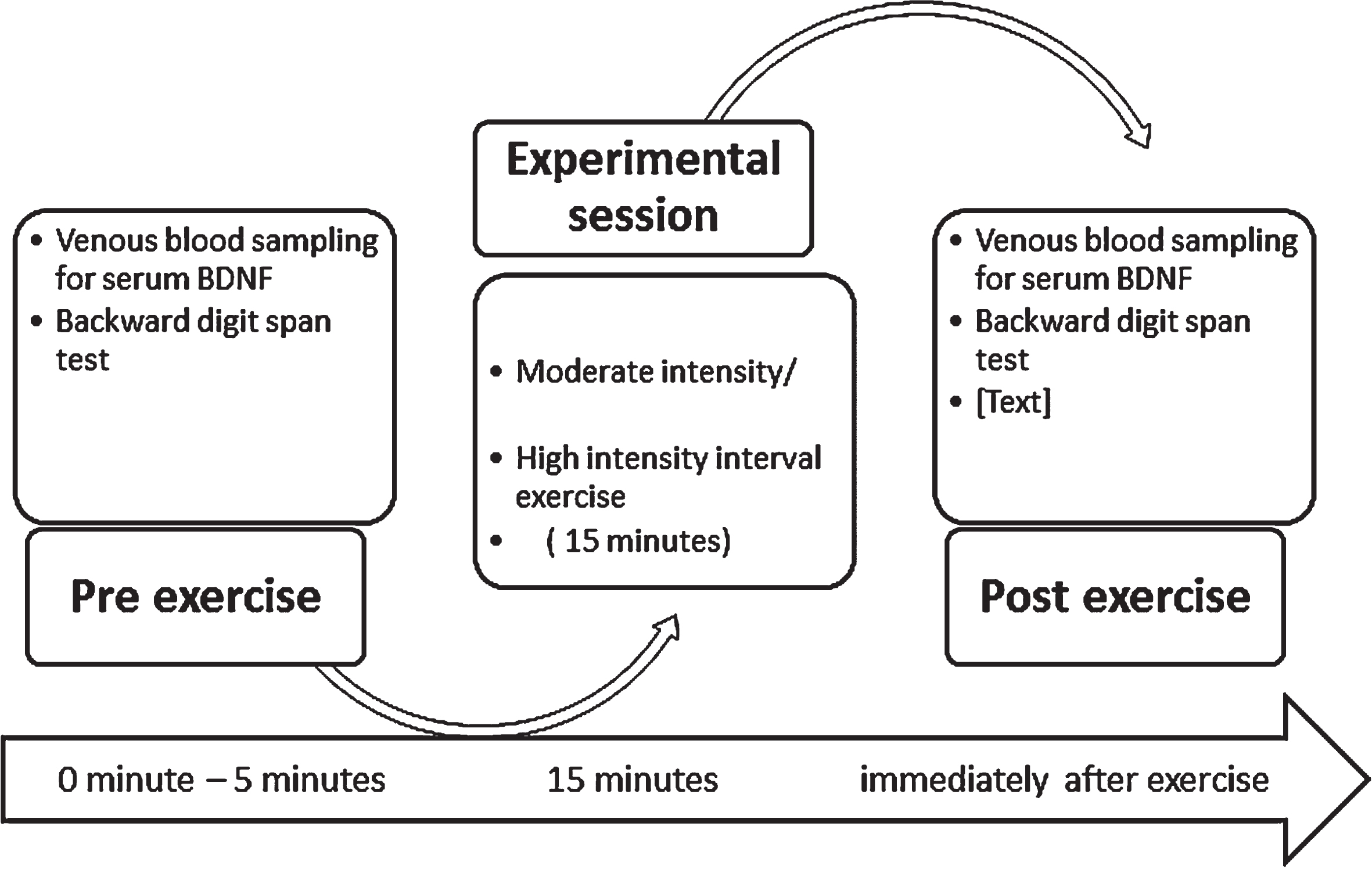
Overview of experimental sessions.
STATISTICAL ANALYSIS
Data was analysis by SPSS version 20. Normality of the data was checked by Shapiro-Wilk test. Statistical significance was considered at p < 0.05. Data for continuous variable was shown as mean±standard deviation. Wilcoxon signed rank test was run to compare pre- and post-exercise serum BDNF levels and BDST for both experimental sessions.
RESULTS
The mean age of the participants was 20±2 years, BMI was 23±4 kg/m2 and waist hip ratio was 0.81±0.05. Baseline BDNF fell in the range of 103.58 pg/ml –1349 pg/ml with a mean of 785±329 pg/ml. Wilcoxon signed rank test for serum BDNF showed a positive significant change z =–2.728, p = 0.006 with a medium effect size (r = 0.4) and z = –4.010, p = 0.000 with a large effect size (r = 0.6) for MIE and HIIE respectively. Same test for BDST scores revealed a statistically significant positive change z = –1.926, p = 0.05, with a medium effect size (r = 0.2) and z = –3.455, p = 0.001 with a large effect size (r = 0.5) for MIE and HIIE respectively. Results and mean values are summarized in Figs. 2 and 3.
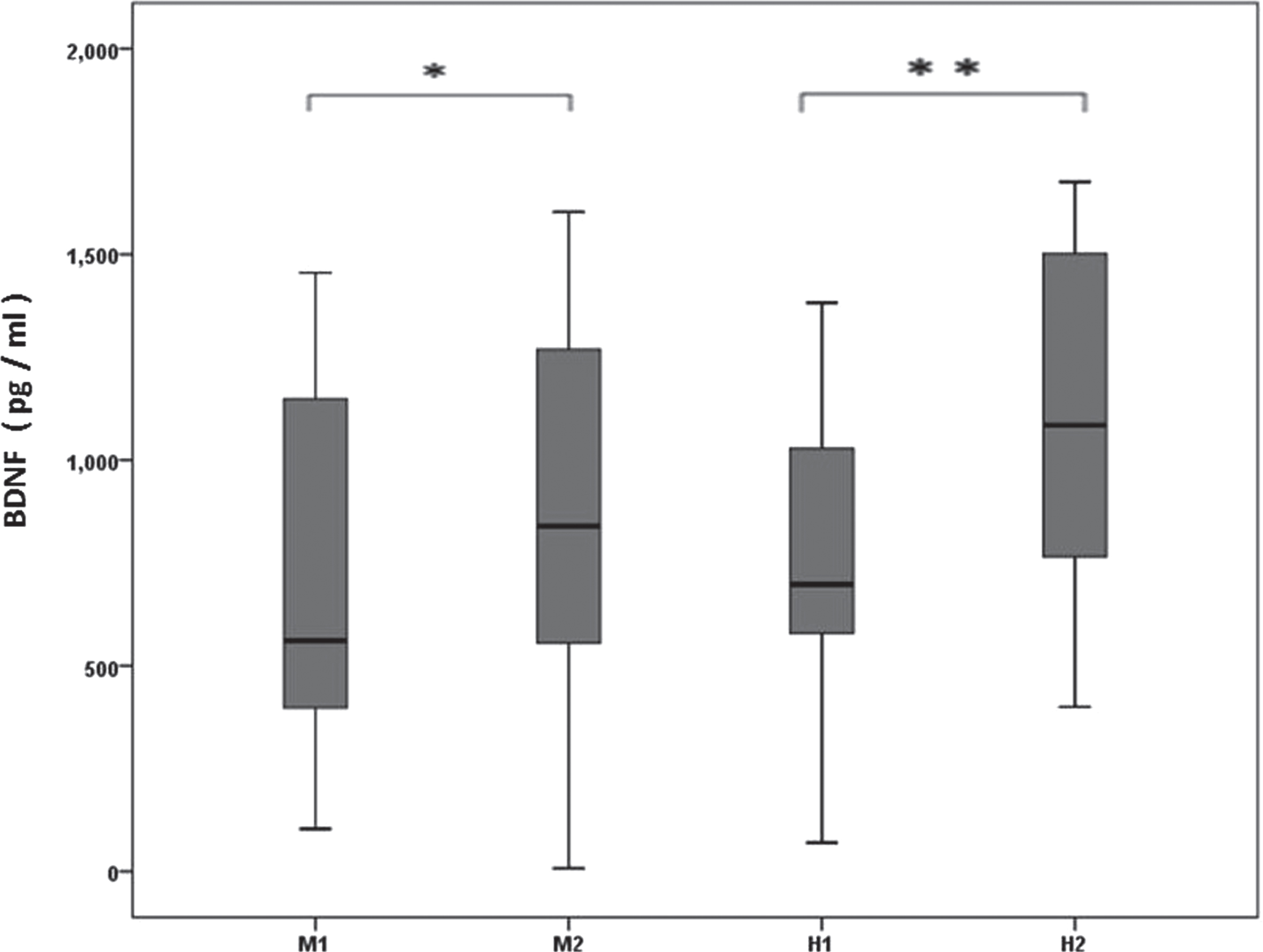
Box and Whisker plot of serum BDNF (pg/ml) levels before and after moderate and high intensity interval exercise. (M1 = before moderate exercise, M2 = after moderate exercise, H1 = before high intensity interval, H2 = after high intensity interval exercise).
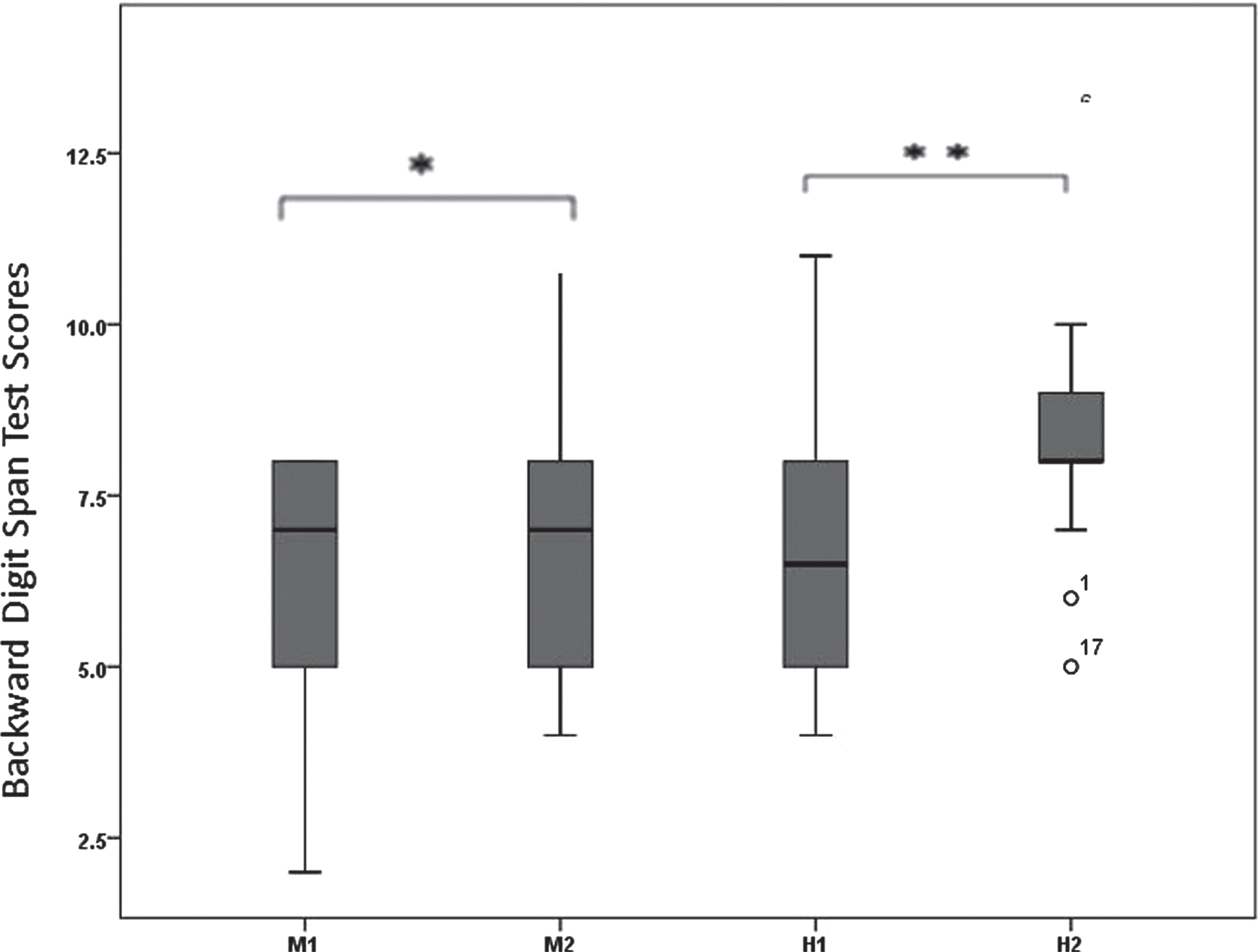
Box and Whisker plot of backward digit span test scores before and after moderate and high intensity interval exercise. Backward digit span test scores M1 = before moderate exercise, M2 = after moderate exercise, H1 = before high intensity interval, H2 = after high intensity interval exercise.
DISCUSSION
The primary objective of this study was to determine the effect of MIE and HIIE on brain derived neurotrophic factor and working memory in young adult females. The baseline BDNF levels in current study were lower (103.58 pg/ml –1349 pg/ml with a mean of 785±329 pg/ml)as compared to serum BDNF values in healthy population (18,000 pg/ml to 26,000 pg/ml) [48]. The lower values in our study may be attributed to ethnic differences or varying levels of physical activity in other researches [54, 55]. Serum BDNF level showed marked improvement in MIE (p = 0.006) and HIIE (p < 0.001) in our study. There is only one study in literature that had recruited only female population with higher BMI as compared to control group [12 HIIE sessions for four weeks and serum BDNF levels were significantly high (p = 0.05) 45]. In our study, a within subject design was adopted, females with normal BMI underwent single HIIE session. The results of current study are in line with other researches that have recruited mostly male population [24, 49, 56, 57]. Saucedo Marquez et al., 2015 compared high intensity continuous protocol and HIIE in 10 physically active men and found that HIIE caused a significant rise in serum BDNF levels (p = 0.03) [24]. Another study (13 healthy male participants, 23±1 year) reported a powerful effect of HIIE on working memory as assessed by Wisconsin Card Sorting Test and serum BDNF levels (p = 0.04) [56]. Our findings are also consistent with Nicolini et al., 2020 who demonstrated a significant increase in BDNF levels (p = 0.04) after a single HIIE session in 40 young males (23±3years) [57]. The possible mechanism for increasing BDNF level after exercise may involve cerebral hypoxia, increased production of reactive oxygen species, lactate, irisin and cathepsin. All these mediators lead to enhanced BDNF level in brain [40, 58, 59].
Both MIE (p = 0.05) and HIIE (p < 0.001) improved WM in the current study. High intensity interval exercise is beneficial for selective attention and inhibitory control that are components of WM [60]. In addition, Kao et al., 2018 reported an improvement in declarative memory [60]. More recent studies in young adult male population (21±2 years) also showed a positive effect of single bout of HIIE on working memory (p = 0.05) [61]. The potential mechanism for improved memory may be attributed to increased arousal. Previous studies reflect that high intensity continuous exercise had a negative impact on cognition contrary to our results [62]. This difference may be attributed to the continuous nature of exercise in this study that allowed the negative factors like cortisol to accumulate sufficiently and cause deterioration of memory[63]y while the intermittent nature of our exercise did not allow the cortisol to accumulate.
CONCLUSION
A single episode of both MIE and HIIE were effective at increasing BDNF levels and enhancing memory in young adult females with HIIE having large effect size.
STRENGTH AND LIMITATION
Our study is the second study of its kind, reflecting the effect of single bout of HIIE on serum BDNF level and memory exclusively in female population. However, this study was limited to sedentary female population and only working memory. Moreover we did not check for BDNF polymorphism which affects BDNF secretion in response to exercise[64].
Footnotes
ACKNOWLEDGMENTS
We acknowledge the participants for their contribution to the study. We are also thankful for the valuable help of the staff of the Physiology Department, Khyber Girls Medical College.
FUNDING
Authors have no funding to report.
CONFLICTS OF INTEREST
The authors declare that there is no conflict of interest regarding the publication of this paper.