




Abstract
BACKGROUND:
Percussion massage therapy is a popular approach in sport medicine for physical therapists, but few researchers have investigated the comparison with other intervention methods.
OBJECTIVE:
This study aimed to examine the comparison of the effects of dynamic stretching, static stretching and percussive massage therapy on balance and physical performance in individuals.
METHODS:
The participants who were 18–25 years of age, able to perform performance tests, did not have any orthopedic surgery, did not have problems during running and sudden turning, and did not have a professional sports history were included in the study. Participants were assigned randomly to three groups as dynamic stretching (DS) (
RESULTS:
When the values of the pre and post-treatment of all groups in the study were compared, significant improvements were observed in the t-test, horizontal jumping test and right/left foot balance with eyes open in DS group (
CONCLUSION:
Percussive massage therapy would be an alternative that can be used to increase the performance and balance of individuals before exercise.
Introduction
Percussive massage therapy has gained popularity in therapeutic use and sports medicine in recent years. Mechanical percussion is frequently used with electric or battery-operated devices with variously shaped points to apply a fast compression force to the myofascia. Different manufacturers (e.g. Theragun, Hypervolt) provide percussion devices for both self-massage and massage by a physiotherapist. These devices can vibrate at various frequencies up to 53 Hz. Several attachment heads can be fixed to the devices depending on the tissue so that local points can be massaged (Hypervolt, Hyperice, California, US) [1]. The application of percussive massage using specific treatment parameters may produce different mechanical and neurophysiological effects by targeting afferent receptors through myofascial tissue vibration [2]. Percussion massage therapy is used for the improvement of flexibility, performance and acceleration of recovery [3]. It is shown that the vibration applied by the device helps to relax muscle tissues, reduce soft tissue pain, increase blood circulation to the affected area and increase general physical performance [4]. However, there is a lack of scientific evidence as to how percussive massage treatment affects physical performance and muscle strength [3, 4, 5]. To date, some authors have investigated the effects of a handheld percussive massage treatment device. They did not find changes in vertical jump distance following a 5-min massage with a percussion device on several lower extremity muscle groups [5]. To the best of our knowledge, there are no studies investigating the acute effects of percussion massage therapy on balance, horizontal jumping and performance. This is a big gap in the literature, especially because percussive massage treatment has grown in popularity among strength and conditioning coaches. Long-term exercise training and achieving peak performance goals utilizing various exercise modalities are the subject of most studies on increasing sports performance. Especially, warming- up, stretching and massage are conventional methods used to enhance performance and reduce the risk of muscle injury through biomechanical, nervous and physiological mechanisms [6].
Stretching is also usually incorporated pre-exercise as it has been suggested to improve muscle flexibility, prevent muscle injury and enhance physical performance [7]. Static and dynamic stretching are most commonly used to increase physical performance. Static stretching is achieved by stretching muscles to their maximum length and keeping that position for an extended amount of time. On the other hand, dynamic stretching entails moving the limb from its neutral position to the end range, when the muscles are stretched to their maximum length and then returning the limb to its original position. This dynamic action is performed in a smooth, regulated manner and is repeated for a predetermined amount of time [8]. Many research has been done to determine the optimal warm-up and stretching protocols for performance. A general warm-up and dynamic stretching exercises are recommended before the activity to increase physical performance and range of motion [9, 10]. It is proved that dynamic stretching improves muscle power, jump height, and sprint time, and it is controversial which stretching is more beneficial for physical performance [11, 12]. Percussion massage guns are devices that provide vibration, which have been popular in recent years and are frequently used in clinics. However, studies on this subject are limited in the literature. Studies on whether it can be used instead of stretching exercises or whether it is an alternative application are insufficient. Percussion massage devices are used to relieve muscle spasms such as stretching exercises and to relax soft tissue. For this reason, we consider that it can be used before activities such as stretching exercises. As far as we know, there is no study in the literature comparing percussion massage therapy and stretching exercises. Therefore, the aim of this study to examine the comparison of the effect of dynamic, static stretching and percussive massage therapy on physical performance and balance in healthy individuals.
Design and flow of participants through the trial.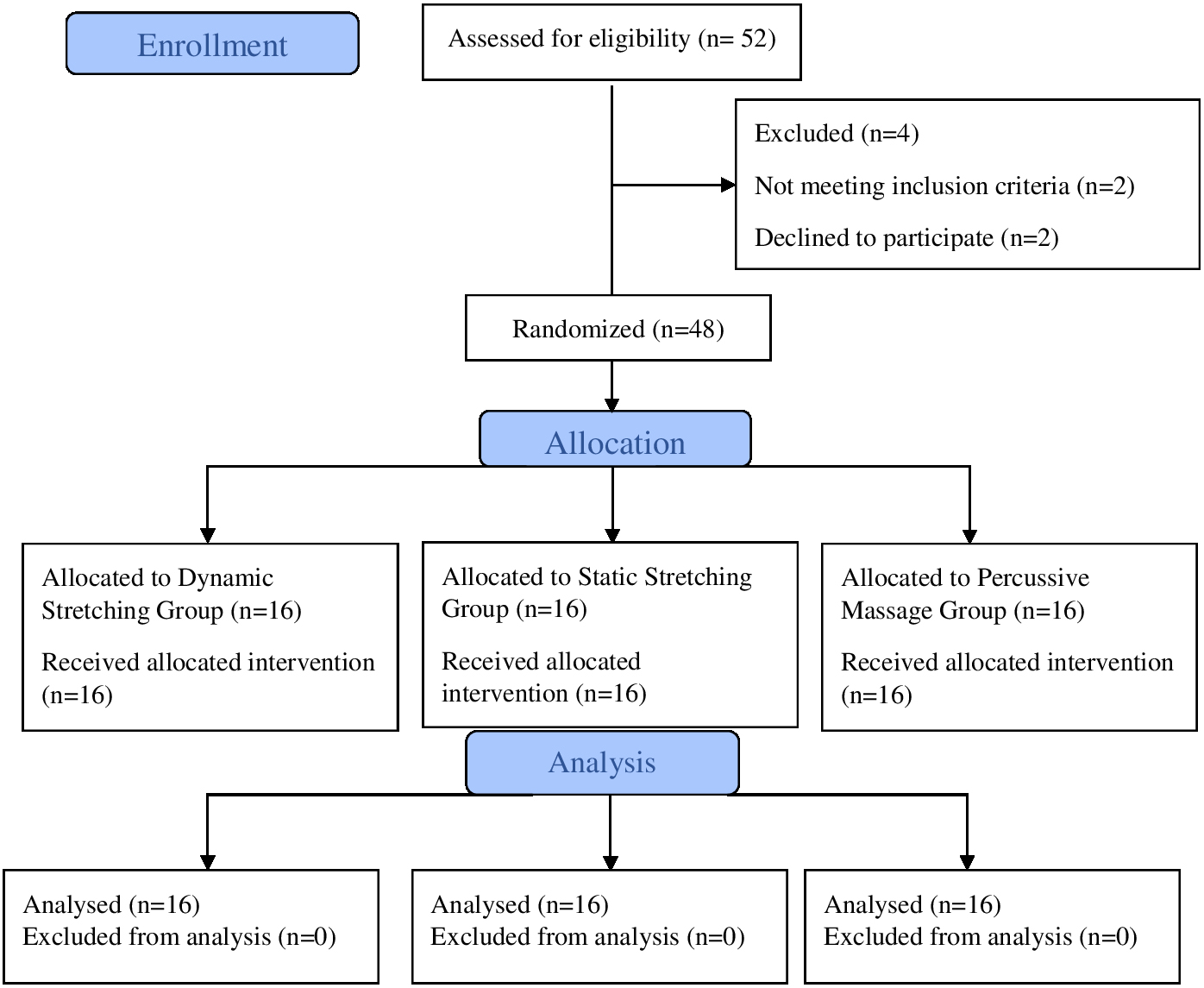
Study design
This study is a single-blind randomized trial. The design was set up as 3 separate interventions: Dynamic stretching group; static stretching group and percussive massage therapy group. Demographic information, horizontal jumping test, T drill test and balance measurements on a single leg with open and closed eyes of all participants were recorded before the study. Individuals participating in the study were given numbers according to the order in which they were included in the study. Randomizer.org site was used to generate random numbers for the individuals listed in the order of selection. After 48 numbers were randomly divided into 3 groups, the numbers given to the participants determined the groups of the participants. The evaluators were aware of the study objectives and the allocation of participants in the study groups. The participants were blind the group to which they belonged. The sequence of randomization was hidden from the evaluators and the patients. The participants rested for 30 minutes to avoid fatigue after the first evaluation and were randomly divided into three groups. After the applications, all assessments were performed again.
Participants
The study was conducted with forty-eight healthy individuals who were at Istanbul Medipol University in Istanbul. All participants were recruited between January and March 2022. This study was performed by the Declaration of Helsinki regarding the ethical principles for medical research involving human subjects. The study protocol was approved by the Non-interventional Ethics of Istanbul Medipol University (Number: E-10840098-772.02-6484). The protocol of the study was registered at ClinicalTrials.gov (NCT05192070). The participants who were 18–25 years of age, able to perform performance tests, did not have any orthopedic surgery, did not have problems during running and sudden turning, and did not have a professional sports history were included in the study. The exclusion criteria were defined as a history of trauma, anatomic deformities such as pes planus or pes cavus and skeletal system fractures, being included in a physiotherapy program in the last 6 months and having orthopedics or rheumatologic diseases.
Two of the fifty-two patients included in the study were excluded because they did not meet the inclusion criteria and two refused to participate in the study. Forty-eight individuals were divided into three groups by the randomization method. A detailed study flowchart was shown in the consolidated standards of reporting trials flow diagram (Fig. 1).
Intervention
Dynamic stretching group
Dynamic stretching exercises with 10 repetitions were applied to the hamstring, quadriceps and gastrocnemius muscles of the individuals in the DS group. Dynamic stretching exercises with a holding time of 2 seconds. During the dynamic stretching session, participants were instructed to perform 10 continuous controlled dynamic movements from the neutral stance to the end of the range of movement. A rate of one stretch cycle every 2 seconds was set and the movements were at a controlled speed throughout the range of movements. For hamstring stretching, the individual stands in the upright position, and places their hand on the wall. Then they were instructed to actively swing the leg forward with hip flexion and knee extension to allow the toes to approach the hands to the point of discomfort without pain. For the quadriceps stretch, the participants were asked to stand upright on one leg and pull the ankle of the contralateral leg up to the maximum knee flexion. For the gastrocnemius stretch, the participants climbed onto a step. They placed their metatarsals at the edge of the step and pushed downward. After holding at the end point for 2 seconds, they were returned to the neutral position.
Static stretching group
Static stretching exercises with 10 repetitions were applied to the quadriceps, hamstring and gastrocnemius muscles by the same physiotherapist. Participants held each stretch for 20 seconds at the point of discomfort. Holding static stretching for 20 seconds is recommended because most of the relaxation in passive stretches occurs in the first 20 seconds [13]. This procedure was repeated 10 times with a rest period of 10 seconds between two successive stretching. For quadriceps muscle stretching, participants stood and touched a wall for balance. The top ankle or forefoot was grasped from behind and then pulled toward the buttocks. The hip was then straightened by moving the knee backward and held in this position. For hamstrings muscles stretching, participants stood on a flexed leg. The other leg was extended with the heel on the floor. Participants bent at the hip and lowered their extended upper torso from the hips onto the extended leg. For gastrocnemius stretching, participants stood on a raised platform on the balls of one foot, then dropped the heel down toward the floor.
Percussive massage therapy.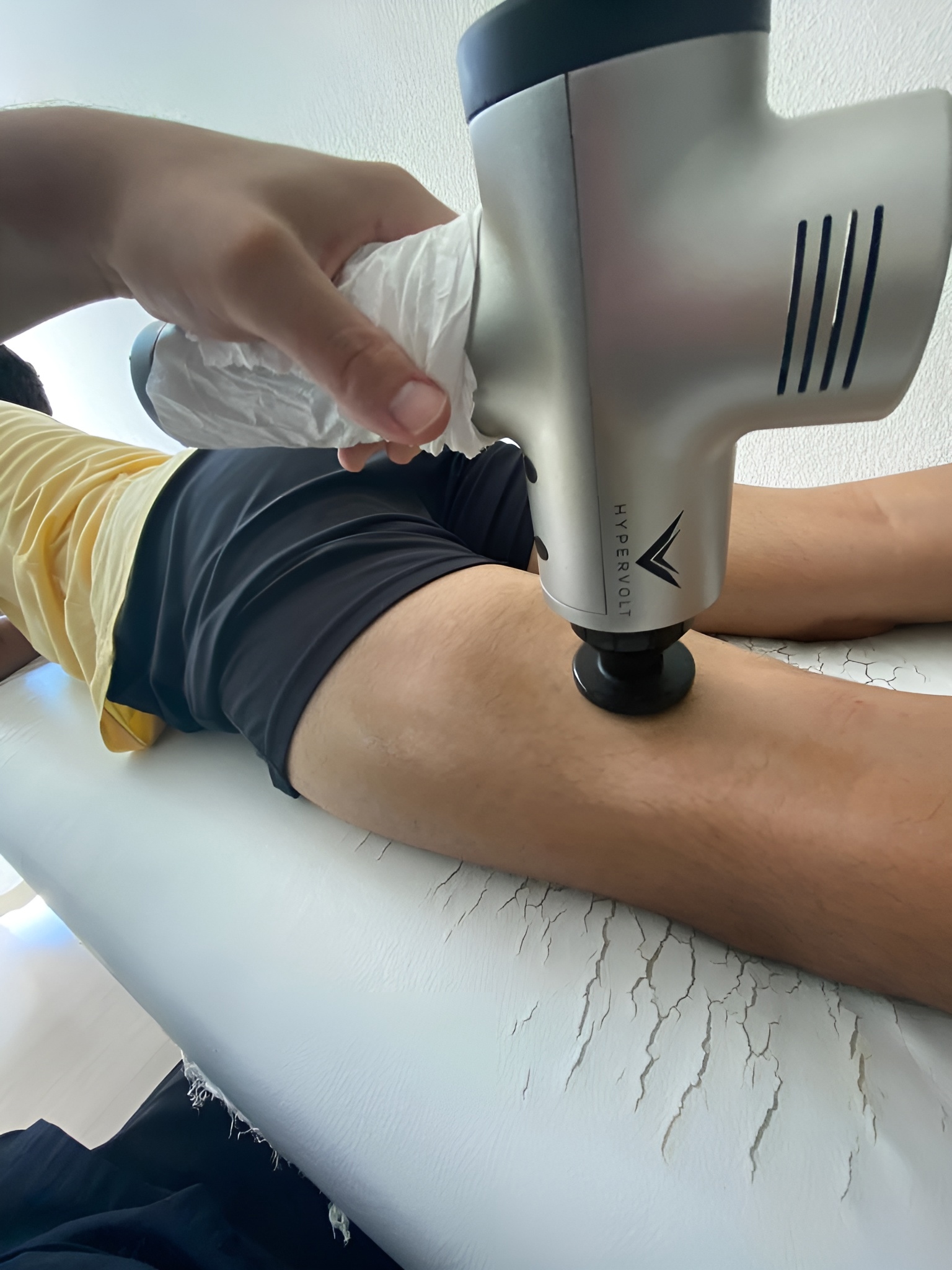
Percussion massage therapy was applied to the quadriceps, hamstring and gastrocnemius muscles of the individuals in the PMT group. The percussive massage treatment was applied by the same physiotherapist using a Hypervolt device (Hyperice, CA, USA). This device provides percussion at 40 Hz, with the flat tip head being used for the massage. The percussive massage treatment was applied to the quadriceps, hamstring and gastrocnemius muscles every 3 minutes in total. The investigator started the massage device longitudinally in a straight line from proximal to distal and back to proximal for 5 seconds along the body region (Fig. 2). After the techniques were applied to the participants, the outcome measurements were repeated and the instantaneous changes before and after the application were compared.
Outcome measurements
Horizontal jumping test
A starting line was drawn on a flat surface. A tape measure was placed on the floor from the starting line forward and the athletes were asked to take a position with both toes pointing towards the back of the previously determined line. Participants were asked to have their knees bent while their arms are parallel to the floor and their knees and to jump forward as much as possible by swinging as fast as possible. The jump distance was measured in centimeters [14].
T-drill test
It consisted of a 9.14-meter forward sprint, a 4.57-meter sidestep to the left, a 9.14-meter slide step to the right, a 4.57-meter sidestep to the left, and a 9.14-meter backward step. From the starting point (0 meters), the participants took the stance position by standing statically, one in front and the other in the back. The participants were told to take a forward bending motion for at least 3 seconds from the starting point before the run. The participants started running at maximum speed after standing in this position for at least 3 seconds. Each participant had three runs. During each run, the participants were given 3 minutes of soft rest. The results of the measurement were recorded in seconds. The best score in three trials was recorded [15].
Becure Balance System.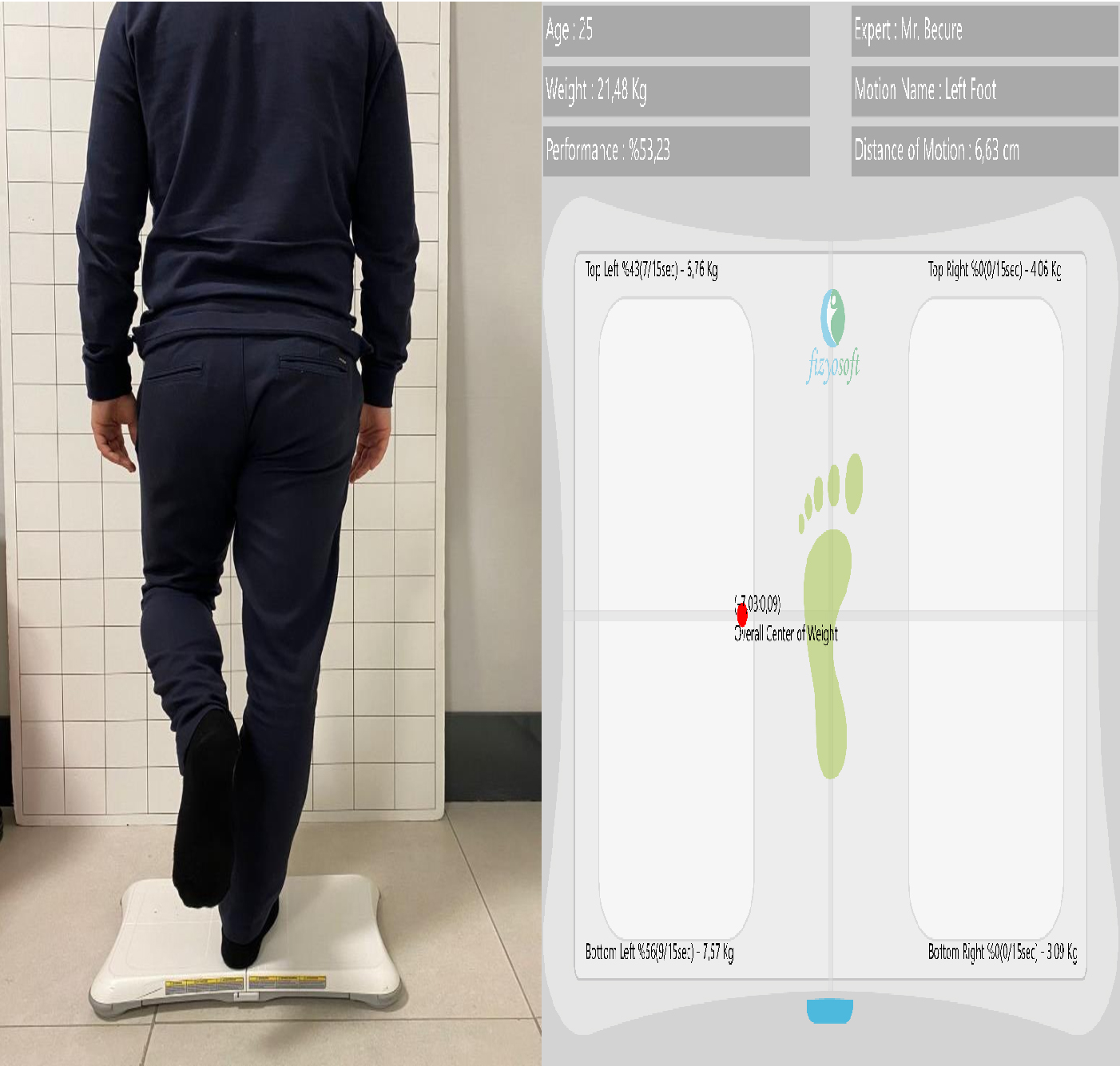
The Becure Balance System (Becure Global, Mann- heim, Germany), which was developed by engineers and physiotherapists, was used to evaluate the static balance of the participants. The Becure Balance System is based on the principle of using the Nintendo Wii Balance Board through a computer by developing software for objective balance assessment. The Balance Board is connected to the Becure Balance System via Bluetooth. The developed system evaluates the person’s static center of gravity distribution and postural sway (Fig. 3) [16, 17]. Individuals participating in the study were asked to stand in balance for 15 seconds with one foot and eyes open. Movement oscillations of individuals who were asked to stay in balance were evaluated with the Becure Balance System and reports of the individuals were collected (Fig. 4). After the evaluation with eyes open, individuals rested for 10 minutes. The same evaluation parameters were performed again with eyes closed on the device. The same evaluation methods were repeated after the application. In the Balance System, instant weight changes, the distance of motion, and overall center of weight data from 4 corner points of the device are obtained by using the Balance Board device. The values before and after the application were compared.
Statistical analyses
SPSS (Statistical Package for Social Sciences) 22 version program (SPSS, Inc, Chicago, IL) was used in the data analysis of the study. The Kolmogorov-Smirnov test was used to assess the normality. Data was revealed to be normally distributed (
Results
Characteristics of the participants
Characteristics of the participants
DS, dynamic stretching; SS, static stretching; PMT, percussive massage therapy; SD, standard deviation.
Becure balance report.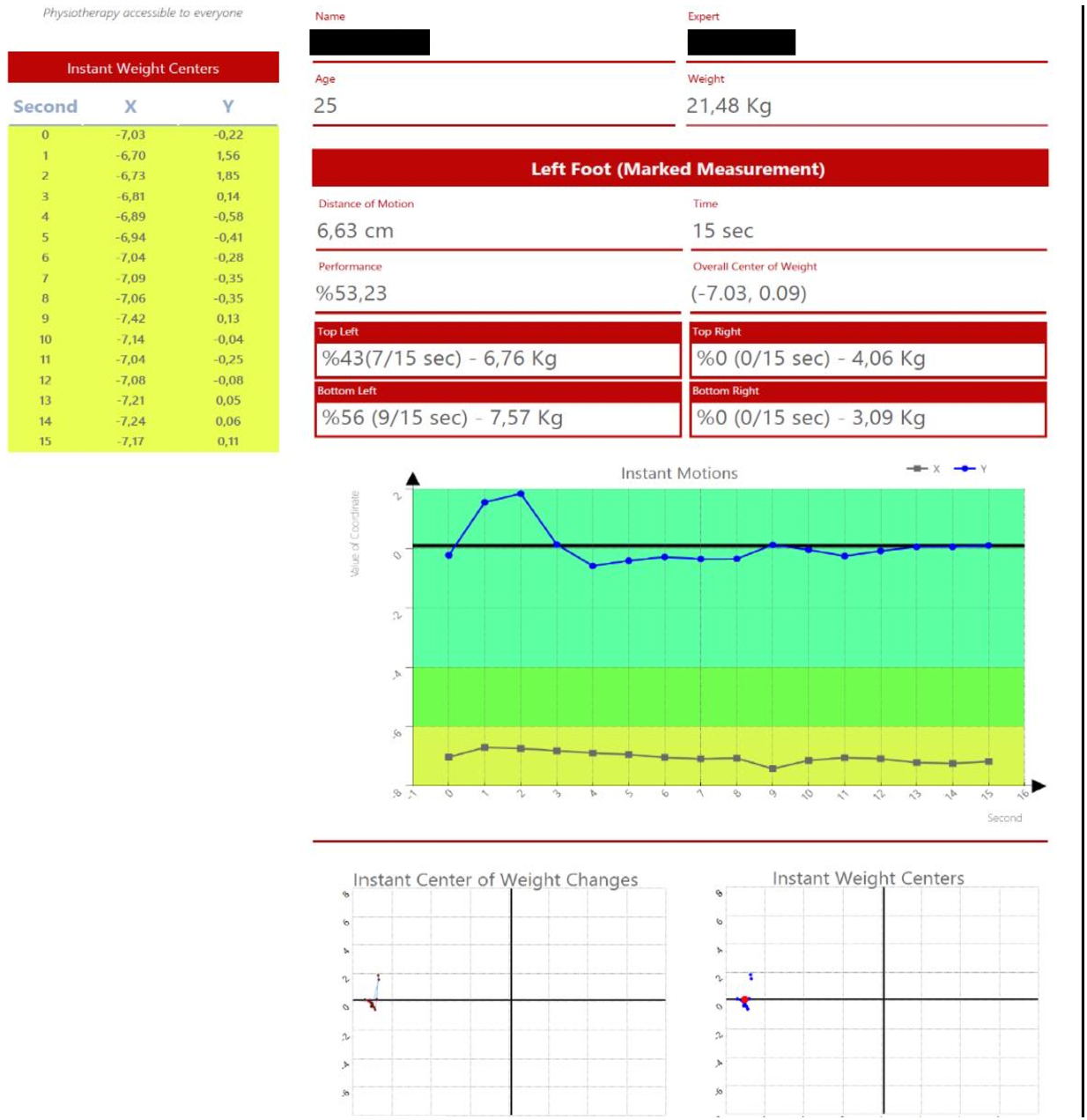
Individuals were selected among those who were in the Istanbul Medipol University. Individuals were divided into 3 groups as dynamic stretching, static stretching and percussive massage therapy. Baseline characteristics of the participants were shown in Table 1.
| Variable | Pre-DS (Mean |
Post-DS (Mean |
|
Pre-SS (Mean |
Post-SS (Mean |
|
Pre-PMT (Mean |
Post-PMT (Mean |
|
|---|---|---|---|---|---|---|---|---|---|
| T-test | 19.21 |
16.96 |
|
17.44 |
17.75 |
0.352 | 17.90 |
16.30 |
|
| Horizontal jumping test | 159.00 |
166.62 |
|
176.81 |
172.50 |
0.170 | 175.50 |
188.75 |
|
| Right single foot balance/open eyes | 14.84 |
14.36 |
|
15.26 |
16.87 |
0.079 | 15.02 |
10.56 |
|
| Left single foot balance/open eyes | 16.54 |
15.83 |
|
15.23 |
16.19 |
0.163 | 13.88 |
12.25 |
|
| Right single foot balance/closed eyes | 17.92 |
17.71 |
0.604 | 24.98 |
27.55 |
0.121 | 24.83 |
18.61 |
|
| Left single foot balance/closed eyes | 19.85 |
19.52 |
0.300 | 24.10 |
25.41 |
0.408 | 23.01 |
16.86 |
|
Intra-group differences of values pre-treatment and post-treatment and comparison of differences between groups
The comparison of pre-post treatment evaluation parameters within the group is shown in Table 3. When the values of the pre and post-treatment of all groups in the study were compared, significant improvements were observed in the t-drill test, horizontal jumping test and right/left foot balance with eyes open in the dynamic stretching group (
Discussion
A significant difference was found in the pre and post-treatment values in all parameters of the three groups included in the study. When the difference analysis between the groups was examined, more significant results were obtained in the percussion massage therapy compared to the static stretching group in all parameters. When the percussive massage therapy group and the dynamic stretching group were compared, the right single foot balance with eyes open/closed and left single foot balance with eyes closed values of the percussive massage therapy group were found to be more significant than the dynamic stretching group. The two groups were not superior to each other in other parameters. Also, significant differences were observed between static and dynamic stretching groups on the t-test and horizontal jumping test.
The effects of percussive massage therapy on physical performance and balance
There are many applications of percussion massage therapy of different duration and intensities in the literature. Many manufacturers have a variety of models with various settings that may include different speeds/frequencies (i.e., 17–53 Hz), amplitudes, and applicator tips (e.g., large and small ball, flat tip, bullet tip, fork. Device percussion settings are often within the range of frequencies and amplitudes (e.g., 5 to 300 Hz) found to produce positive myofascial outcomes. In most studies, Hypervolt devices moved 2 to 5 seconds along the body region (up and down) for pre-exercise. And 33–40 Hz is preferred for pre and post-exercise for medium speed [2]. In the present study, the Hypervolt device was applied to each muscle group for 3 minutes at an intensity of 40 Hz for medium speed.
Konrad et al. examined the effects of the Hypervolt percussive massage device on plantar flexor muscles’ range of motion and performance. No difference was found in maximal voluntary contraction performance after using the Hypervolt device compared to the control group [18]. Lin et al. indicated that the use of a vibration foam roller of 38 Hz on bilateral hamstrings in college students caused no significant improvement in the vertical jump [19]. Contrary to these studies, physical performance and single-leg balance results were improved with the application of 3 minutes of Hypervolt in each quadriceps, hamstring and gastrocnemius muscle in the present study. T-drill and horizontal jumping results were improved with percussive massage therapy.
A possible mechanism for these results might be that Hypervolt can stimulate more muscle receptors which lead to increased motor fiber recruitment [2]. We speculate that the following mechanism underlies the reduced muscle stiffness after Hypervolt: it may modulate myofascial tone through changes in thixotropic properties, blood flow, and fascial hydration, affecting tissue stiffness [9]. In addition to these effects, the transmission of additional mechanical oscillations to the target muscles affects several physiological systems, such as the Golgi tendon organ. One study showed that vibration therapy considerably improved muscle performance. They reported that there were significant increases in both knee flexion and extension range of motion and muscle strengths as well as dynamic balance after vibration therapy. Lee et al. demonstrated that vibration roller on hamstrings and quadriceps significantly increased the range of motion of knee flexion and extension, and isokinetic peak torque, muscle strength, and dynamic balance were also increased [3]. Another study reported that changes in balance behaviors within the eyes-closed condition were observed when vibratory stimulation was applied to the gastrocnemius muscle. The efficacy of vibration therapy applied to the gastrocnemius muscle at a frequency of 30 and 40 Hz was compared. It was observed that the vibration applied at 40 Hz was more effective on the center of gravity sway [20]. Similar to this, a present study showed that Hypervolt applied at a frequency of 40 Hz improved the balance of standing on one leg with eyes open and closed. Another study reported that vibration stimulation applied to the tibialis anterior and gastrocnemius improve balance when a person’s eyes are closed during double-leg standing [21]. Also, it has been established that somatosensory stimulation with vibration can decrease postural sway in normal subjects when their eyes are closed [22]. Present study results about balance are similar to them. We consider that stimulation of the afferent fiber of the muscle spindles with Hypervolt results in the maintenance of proper postural balance.
The effects of dynamic and static stretching on physical performance and balance
Several studies have shown that dynamic stretching improves power, sprinting, and jumping performance [23, 24]. For muscular performance, this stretch modality has been proven to be more effective than no-stretch and static stretching [11]. When compared to static stretching, it was found that dynamic stretching generated an equal or larger acute gain in flexibility [25]. On the other hand, others showed that static stretch was more efficient than dynamic stretch for ROM improvements. The viscoelastic stress relaxation that occurs when the muscle tissue is kept stretched in a fixed position during static stretching may be a factor in the difference in stretch-induced effects on flexibility [26]. Also, many studies reported that dynamic stretching has also been shown to be more efficient than no-stretch and static stretching in power, sprint and jump performance [23, 27]. According to our results, t-test and horizontal jumping test results were improved with dynamic stretching while no improvements were seen in physical performance and balance results with static stretching.
According to one study, the 15-second static stretching protocol significantly improved dynamic balance scores [28]. On the other hand, these findings differed from the findings of Brandenburg, who observed balance performance with a 15-second static stretching [29]. Handrakis et al. the effects of an acute static stretching protocol on balance and jump/hop performance in active middle-aged adults. They reported that 10 minutes of acute static stretching improves the dynamic balance of inactive middle-aged people while not affecting jump/hop performance [30]. This study’s findings were not consistent with our findings.
Earlier studies focused on the acute effect of dynamic stretching in facilitating physical performance such as power, sprint, agility, and jump performance through the effect of dynamic stretching on dynamic balance is limited to the best of our knowledge [31, 32]. One study reported that dynamic stretching also produced significant changes in dynamic balance performance [33]. In contrast, Azeem and Sharma found that the dynamic and static stretching exercises have the same effect on the dynamic balance performance [34]. On the other hand, Chatzopoulos et al. compared the effects of the static and dynamic stretching exercises on dynamic balance performance and found that the dynamic stretching exercises were more effective than static stretching [35]. In our study, only dynamic stretching was found to be effective in balance resulting in open eyes and closed. We consider that the reason for the improvement in the balance following dynamic stretching may be due to an increase in heart rate, increase in muscle temperature, enhancement of neural activation, and specific rehearsal of movement patterns possibly leading to increased proprioception.
Limitations
One of the limitations of the study was that it did not examine the long-term effects of the applied techniques. Also, individuals who do not participate in athletics made up the majority of those included in the study. Another limitation in our study, in which we included healthy people, was not evaluating whether people had difficulties in performance tests.
Conclusions
Percussion massage therapy was found to be more effective in all performance and balance parameters than the static stretching method. When compared with percussion massage therapy and dynamic stretching, percussion massage therapy was found to be more effective in some balance parameters, while similar improvements were observed in physical performance parameters. We suggest that percussive massage therapy is an alternative that can be used to increase the performance and balance of individuals before exercise. The results of this investigation may help practitioners decide which application to use or not. This study observed a positive effect of percussion massage therapy on balance ability. We recommend future studies to conduct comparisons of percussion massage therapy with different interventions.
Ethics approval
This study was conducted in accordance with the Declaration of Helsinki and approved by the ethics committee of Istanbul Medipol University (E-10840098-772.02-6484).
Funding
The authors report no funding.
Informed consent
Written informed consent was obtained from all participants.
Author contributions
Study conception and design: MYM, BM, Data collection: BM, Data analysis and interpretation: MYM, Drafting and critical revision of the article: BM, MYM.
Footnotes
Acknowledgments
The authors have no acknowledgments.
Conflict of interest
The authors declare that they have no conflict of interest.