




Abstract
BACKGROUND:
Currently there are not enough studies that compared frequent types of collective sports with regard to the prevalence of pain and disability of the lower limb.
OBJECTIVE:
To determine the prevalence of lower limb pain and disability in team sports players.
METHODS:
388 athletes with average age 27.26
RESULTS:
Hockey players had a prevalence of hip pain of 97.2% and a 14.3 times higher risk of developing hip pain compared with football and floorball players. Floorball players had a 81.9% prevalence of knee pain, with a 3.8 times higher the risk of knee pain compared with football and hockey. Floorball players had a 62.3% prevalence of ankle pain and a 1.8 times higher the risk of developing ankle pain compared with football and hockey players.
CONCLUSIONS:
The highest percentage of knee 81.9% and ankle 62.3% pain, as well as the greatest risk of pain, was found among floorball players. Hockey players had the highest prevalence (97.2%) and risk of developing hip pain.
Keywords
Introduction
Lower limb joint pain is a common occurrence among contact sports such as football, hockey, handball and floorball. The causes of pain in the joints of the lower limb include falls, frequent jumps and rebounds, and sudden jerky movements. Hip, knee and ankle pain pose a high risk of injury [1, 2]. The prevalence of pain in the peripheral joints of the lower limb in athletes has not been examined in detail. Currently, there are not enough studies that compared frequent types of collective sports with regard to the occurrence of pain and disability of the lower limb as a whole [1, 2, 3, 4, 5, 6, 7, 8, 9].
Pain in the hip joint occurs in runners and ice hockey players and represents a risk of injury. Hip pain may occur during sports due to muscle imbalance of the pelvic girdle muscles [2]. The prevalence of hip joint pain in athletes is estimated at 15% to 23%. The prevalence of hip joint pain in the general population aged 22 to 38 years is 8% to 16% of cases [2].
Pain in the knee joint also occurs in runners and ice hockey players and represents a risk of injury. During sports, the structures of the knee are overloaded and the biomechanics of the knee are disturbed. These factors contribute to the development of knee pain [2]. A prevalence of knee joint pain has been reported in 20.8% of football players, 13% of long-distance runners and 7.2% of hockey players. The prevalence of knee joint pain in the general population aged 22 to 38 years is 9% [2].
Pain in the ankle joint occurs mostly in runners. During sports, the muscles in the ankle area can be overloaded or stretched and this can cause ankle pain [2]. The prevalence of ankle joint pain is 11% to 25%. Ankle pain can be caused by injury to ligaments, soft tissues and tendons. The prevalence of ankle pain in the general population aged 22 to 38 years is minimal [2, 3, 4, 5].
The hardness of the training surface may contribute to the aetiology of knee and ankle pain, e.g. in floorball players. Sliding movement, sudden jerking movement and frequent falls may contribute to the aetiology of hip pain, e.g. in hockey players. Soft ground represents a lower risk of pain in the joints of the lower limb, e.g.in football players.
It is important to determine the prevalence of pain in the joints of the lower limb in professional sports and then develop exercise programmes for the primary and secondary prevention of pain and injuries of the lower limb [10, 11, 12, 13]. The objective of this study was therefore to determine the prevalence of lower limb pain and disability in team sports (football, hockey and floorball) through standardised questionnaires.
Materials and method
This cross-sectional study was carried out from June 2021 to September 2022. The study was supported by the Scientific Grant Agency of the Ministry of Education, Science, Research and Sport of the Slovak Republic and the Slovak Academy of Science under Grant No. 1/0163/21 (‘Prevalence of spine and ‘joint pain and disability in selected sports’). Before being included in the study, all enrolled participants signed written informed consent. Participants were verbally informed about the main aim of the study, the procedures, confidentiality, and the voluntary nature of their participation. The research was approved by the Institutional Ethics Committee (Approval No. PJSU-1/2020). Data collection began in March 2022 and ended in September 2022.
Enrolment flow diagram.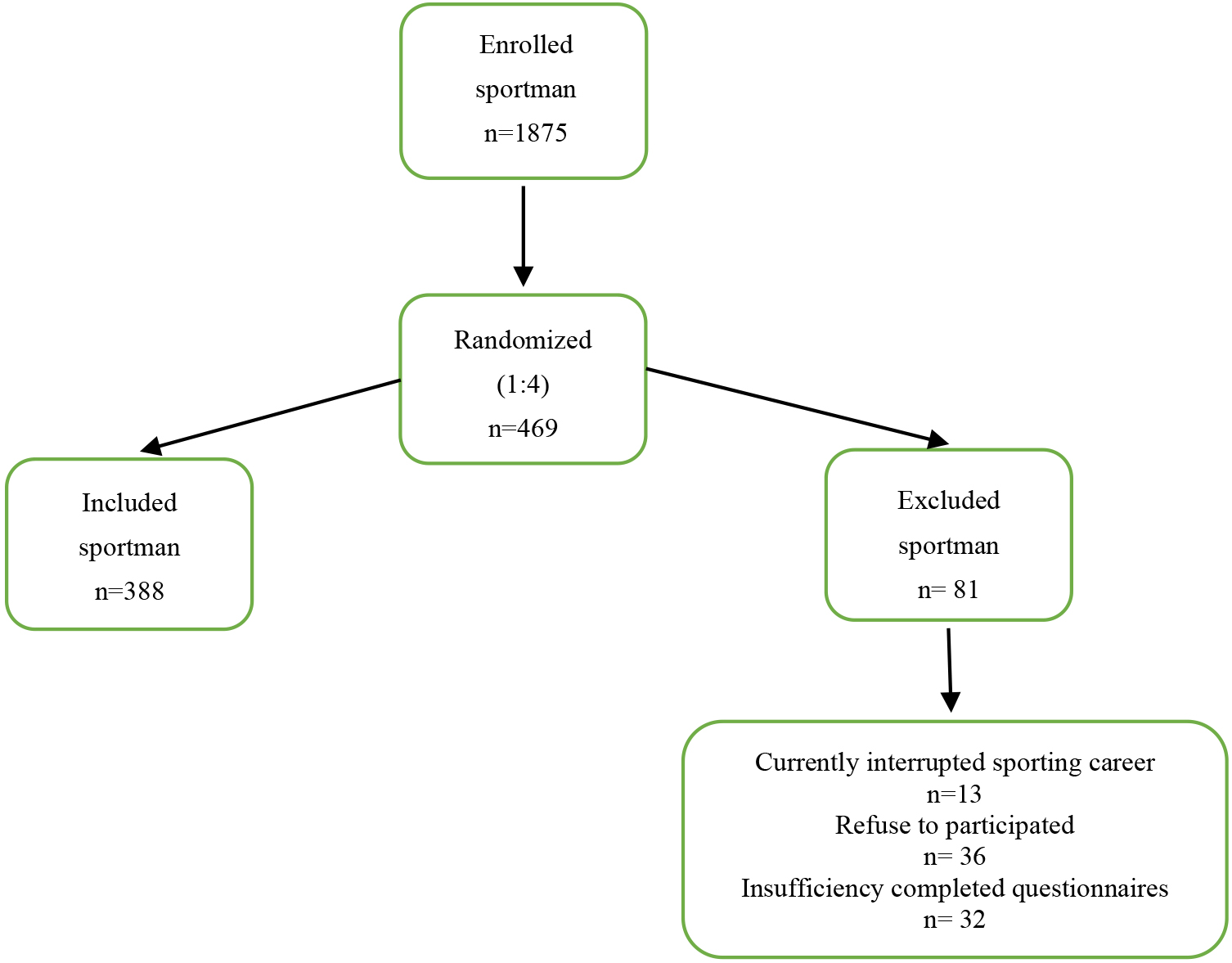
Currently, there are known data that back pain in athletes reaches a prevalence of 30% to 80%. Pain in the joints of the limbs reaches a prevalence of 15% to 50% [14]. So, the average prevalence of the mentioned problems is 50%. The sample size was determined according to the average prevalence of 50%.
We calculated the minimum sample size according to the estimate given by Daniel [15], where
From collective sports, all clubs at the national level were approached. The clubs playing in the two highest leagues – the extra league and the first league within the three most preferred and popular sports in Slovakia – football, ice hockey, and floorball. Participation in the highest national competitions and in international competitions was a condition for participation in the study. The number of registered athletes in football, ice hockey, and floorball at the required level was 1,875. From the mentioned number, every fourth athlete was randomly selected, so 469 probands were included. Randomisation was performed by an independent person using Microsoft Office Excel 2016. Three hundred eighty-eight athletes were included in the study. Eighty-one were excluded for refusing to participate in the study. Data collection was anonymous. The persons who ensured data collection did not participate in other parts of the study. All participants answered all questions in the questionnaires. Inconsistent and missing were fixed on the spot.
Hip pain and disability
The Oxford Hip Score (OHS) consists of 12 questions in two domains, pain and disability. There are six items in each section (5
Knee joint pain and disability
The International Knee Documentation Committee (IKDC) International Questionnaire for the Assessment of Knee Function has three categories: Symptoms, sports activity and knee function. Symptoms such as pain, stiffness, swelling, and knee dysfunction are assessed. The sports activity subscales assess functions such as walking up and down stairs, getting up from a chair, squats, and jumps. The score ranges from 0 to 100. The higher the score, the better the knee function. IKDC score
Pain and disability of the ankle joint
The Foot and Ankle Disability Index (FADI) is a 34-item questionnaire that is divided into two scales: Foot and Ankle. The FADI has 26 items (four items for pain assessment and 22 for activity assessment). FADI Index has eight items (activity assessment) that detect functional deficits in athletes (0
Statistical processing
Descriptive and analytical statistics were used. Data are presented as means and standard deviations. Percentages were evaluated to assess the occurrence and prevalence of pain and disability in the observed group. Logistic regression analysis was used to determine the estimate of risk (OR) with 95% confidence interval (CI). Data were normally distributed;
Demographics (
388)
Demographics (
Legend:
From 1875 male athletes, every fourth athlete was randomly selected, so 469 male athletes were initially included. Eighty-one male athletes were excluded for refusing to participate in the study. Therefore, 388 athletes were ultimately included in the study. 81 male athletes were excluded. There was a currently interrupted sporting career for 13 male athletes, 36 male athletes refused to participate, and 32 male athletes insufficiently completed questionnaires (Table 1).
The participants were young athletes with an average age of 26 to 28 years. The mentioned groups were homogeneous in terms of age, weight, height, and body mass index. There were no significant differences among the groups in the evaluation of years of practicing sports, days per week, and minutes per day.
Average values and statistical comparison of lower limb pain and disability
Average values and statistical comparison of lower limb pain and disability
Legend:
Percentage and estimate of the occurrence of the relative risk of lower limb pain and disability
Legend: OHS
Risk of developing hip pain
Football players had an OR of 0.30, which means a 0.33 times lower risk of developing hip pain compared with hockey and floorball players. The incidence of pain was 72.3%.
Hockey players had an OR of 14.34, which means a 14.34 times greater risk of developing hip pain compared with football and floorball players. The incidence of pain was 97.2 (%).
Floorball players had OR of 0.04, which means a 0.04 times lower risk of developing hip pain compared with football and hockey players. The incidence of pain was 34.4 (%).
Risk of developing knee pain
Football players had an OR of 1.10, which means that they do not have a significantly different risk of knee pain compared with hockey and floorball players. The incidence of pain was 62.8%.
Hockey players had an OR of 0.33, which means a 0.33 times lower risk of knee pain compared with football and floorball players. The incidence of pain was 47.5%.
Floorball players had an OR of 3.80, which means a 3.80 times greater risk of knee pain compared with football and hockey players. The incidence of pain was 81.9%.
Risk of developing ankle pain
Football players had an OR of 0.81, which means that they do not have a significantly different risk of ankle pain compared with hockey and floorball players. The incidence of pain was 46.6%.
Hockey players had an OR of 0.88, which means that they do not have a significantly different risk of ankle pain compared with football and floorball players. The incidence of pain was 48%.
Floorball players had an OR of 1.83, which means a 1.83 times greater risk of ankle pain compared with football and hockey players. The incidence of pain was 62.3%.
Discussion
The objective of this study was to determine the prevalence of lower limb pain and disability in team sports (football, hockey, and floorball) through standardized questionnaires. The highest percentage of knee pain (81.9%) and ankle pain (62.3%), as well as the risk of developing pain, was found in floorball players. Hockey players had the highest percentage of hip pain (97.2%) and the highest risk of developing pain. Football players had the smallest percentage of ankle pain and disability (46.6%).
It follows from our results that the hardness of the training surface contributes to knee and ankle pain in floorball players. The causes of hip pain in hockey players include sliding movements, sudden jerking movements and frequent falls. There is a lower risk of pain in the joints of the lower limbs during sports on soft ground for football players.
The above shows that athletes with a higher risk of lower extremity pain, such as floorball and hockey players, should have quality preventive rehabilitation in a larger number of hours as part of their training than in less risky sports. The mentioned authors dealt with a similar issue:
Johanson [2] examined 75 athletes, divers, weight-lifters, wrestlers, orienteers, ice hockey players and 12 non-athletes in a control group. He used a specific self-assessment questionnaire focused on pain in the cervical, thoracic and lumbar spine as well as in the joints (i.e. shoulders, elbows, wrists, hips, knees and ankles). There was no significant difference in the prevalence of back and joint pain between elite athletes in different sports or between athletes and non-athletes. Pain in the spine was also correlated with pain in the shoulders, hips and knees.
In our study, floorball players had the highest percentage of knee and ankle pain and the highest risk of developing pain. We assume that this is the result of playing sports on hard terrain, with greater overloading of the knee and ankle joints compared with football players, who play on grass, which is a softer terrain, and therefore, the joints of the lower limb are loaded less.
Patel [19] observed recurrent or chronic activity-related knee pain in young athletes. Pain can be caused by various pathologies affecting the knee. Knee pain can be referred pain from the lower back, hip or pelvis. The most common cause of knee pain in young athletes is patellofemoral pain syndrome or idiopathic anterior knee pain. Although many anatomical and biomechanical factors are thought to contribute to knee pain in young athletes, the most common underlying cause is an overuse injury.
In our research, the International Knee Documentation Committee was used for assessment of pain, which confirmed the highest percentage of knee pain in floorball players.
Steven [20] evaluated hip and groin injuries in athletes. Field sports such as basketball, football, hockey and others require multiplanar movement and high-speed changes of direction. Situations often occur when periods of physiological regeneration between bursts of physical activity are minimised, which increases existing risk factors and the risk of injury. For the reasons mentioned, targeted preventive strategies have been proposed, but their practical clinical implementation has not been thoroughly investigated in the entire sports’ spectrum.
In our research, the Oxford Hip Score was used for pain assessment. Hockey players had the highest percentage of hip pain and the highest risk of developing pain. We believe that the sliding movement on the ice surface and the violent jerking movement during falls are causative factors.
Zhang [21] evaluated ankle sprains, which is one of the most common injuries in the athletic population. Misdiagnosed and untreated ankle sprains will cause chronic ankle instability, which can significantly affect the performance of athletes. The aim of their study was to investigate the prevalence and characteristics of chronic ankle instability in elite athletes of various sports. Their cross-sectional study included 198 elite athletes. All participants answered a questionnaire concerning ankle sprains and ankle instability. The severity of their ankle instability was assessed according to the Cumberland Ankle Instability Tool. Participants further underwent clinical examinations by sports medicine physicians to determine the presence and characteristics of ankle instability. The prevalence showed differences between sports categories and was significantly higher in contact sports compared with non-contact athletes. Therefore, additional precautions must be taken when using ankle protectors for these athletes.
In our research, the FADI was used for assessment of pain. We found floorball players had a 1.83 times higher risk of ankle pain compared with football and hockey players, with a prevalence of pain of 62.3%.
The mentioned results are important for the primary and secondary prevention of pain and injuries of lower limb joints in athletes. Differential diagnosis of pain is important as part of physiotherapy for the mentioned conditions. Pain can originate from overload or degeneration of bone or muscle structures. It can be the result of a restriction in the joints. The reason for the pain can also be the instability of the joints. After establishing and confirming the diagnosis, targeted exercise is important to eliminate pain and disability. The correct directional preference is important when starting an exercise programme. After elimination of pain, we can start exercises with elements of dynamic stabilisation and balance exercises for the joints of the lower limb. Dynamic neuromuscular stabilisation and sensorimotor stimulation are suitable[22, 23].
Limitations
This study has some limitations. Only questionnaire methods were used to determine pain and disability, and test batteries were not used to assess the function of the joints of the lower limb under different types of load (e.g. during deep squats, jumps). The prevalence of lower limb pain was evaluated during the past year; we did not evaluate the prevalence for the past month or week. We did not evaluate pain intensity separately. However, the total score of the questionnaires indicated mild pain and disability. Player position, substitution or real player in the games, history of sports injury – this data was not collected.
Conclusion
The highest percentage of knee pain (81.9%) and ankle pain (62.3%) and the risk of developing pain was found in floorball players. Hockey players had the highest percentage of hip pain (97.2%) and the highest risk of developing pain. Football players had the smallest percentage of ankle pain and disability (46.6%). It would be appropriate to implement lower limb pain prevention programs into daily training routines for elite sports categories, where a high rate of occurrence of lower extremity pain has been found. Doctors, physiotherapists, and coaches should develop new effective and progressive specific preventive programs for athletes. Interventional movement programs against lower limb pain should be a part of the daily training of elite athletes.
Ethical approval
The study was approved by the Institutional Ethics Committee of the Pavol Jozef Šafárik Univesity, Košice, Slovakia (Approval No. PJSU-1/2020).
Funding
The study was supported by the Scientific Grant Agency of the Ministry of Education, Science, Research and Sports of the Slovak Republic and the Slovak Academy of Sciences (“VEGA”) – VEGA 1/0163/21: “Prevalence of pain and disability of the spine and joints in selected types of sport”.
Informed consent
Informed consent was obtained from all subjects involved in the study.
Author contributions
A.B. was responsible for the provision and selection of suitable probands; P.T. and M.H. were responsible for study design and methodology. A.B was responsible for data collection. A.B. and M.H. had access to the final trial dataset. All authors have read and agreed to the published version of the manuscript.
Footnotes
Acknowledgments
We thank the athletes for their cooperation in the study.
Conflict of interest
The authors declare no conflict of interest.