




Abstract
BACKGROUND:
Low back pain is one of the leading causes of disability globally, with a high economic and social burden. A decrease or imbalance in trunk strength has been associated with the occurrence of low back pain and its severity. Trunk strength training is helpful in the treatment of Non-specific low back pain (NSLBP) patients. However, we do not know the effects of trunk isokinetic training (IKT) on pain intensity, disability, and trunk strength.
OBJECTIVE:
This systematic review aimed to determine the effects of trunk IKT in NSLBP patients on pain intensity, disability, and trunk flexor and extensor isokinetic strength.
METHODS:
We searched PubMed, Web of Science, Scopus, CENTRAL, and PEDro, from January 2001 until March 2021 and updated to November 2022. Randomized controlled trials (RCTs) that investigated the effect of IKT in adult participants with NSLBP on pain intensity, disability, or isokinetic trunk strength were included. Mean difference (MD) and 95% confidence intervals (95% CI) were calculated for pain. Bias was assessed using the Cochrane risk of bias (RoB) tool and evidence certainty via Grading of Recommendations Assessment, Development and Evaluation (GRADE).
RESULTS:
Among 1750 retrieved articles, eight were included in this review. Meta-analysis comparing IKT (trunk isokinetic training,
CONCLUSIONS:
Trunk IKT could be a novel clinical tool for pain management in patients with NSLBP, although evidence is scarce. In addition, few RCTs exist for IKT on disability or trunk isokinetic strength in patients with NSLBP. Therefore, further research on this topic is needed.
Introduction
Low back pain (LBP) is one of the most common musculoskeletal condition [1, 2] and is an alarming health problem that has increased worldwide [3]. Globally, LBP is the leading global cause of years lived with disability [4]. The prevalence of LBP in 1990 was 377.5 million; however, this increased to 577 million in 2017 [4]. LBP includes pain, muscle tension, or stiffness located below the costal margin and above the lower gluteal folds, with or without sciatica [5]. It can be characterized in terms of temporality as acute LBP, less than six weeks, subacute LBP between 6 and 12 weeks, and chronic LBP, when the pain extends beyond 12 weeks [6]. Recurrence of LBP is expected; with more than two-thirds of individuals (69%) having a recurrence within 12 months after recovery. Of these, 40% will suffer functional disability or require medical care [7].
Regarding LBP, 90% of cases do not have a specific cause, so it is called non-specific LBP (NSLBP) [8]. Despite this, multiple factors have been associated with the occurrence of NSLBP [9, 10], including deconditioning the lumbar musculature [11, 12], reduced trunk muscle mass [13], imbalance, and decreased trunk strength [14, 15]. Thus, trunk strengthening has been proposed for manage LBP patients [16, 17, 18]. Furthermore, different trunk training methods have been investigated, such as motor control exercises [19], core stabilization [20, 21], and strengthening exercises using an isokinetic dynamometer [22].
The isokinetic dynamometer is the gold standard in strength assessment [23]. It has been previously used to assess trunk strength in healthy subjects and NSLBP patients [24, 25, 26]. Given its capacity to develop maximum strength, the precision with training can be programmed, and its high reproducibility, it could be considered a valuable tool for strength training [27]. In addition, it provides real-time visual and auditory feedback, which could benefit treatment adherence and allow objective monitoring of training results. The most distinctive characteristic of this device is the accommodation of the resistance provided by the dynamometer, which allows for maximal muscle loading throughout the entire range of motion [28].
Isokinetic training (IKT) helps train the shoulder musculature [29] and re-establishing rotator cuff strength ratios [30]. Furthermore, in lower limbs decrease reaction times [31] and increase strength and symmetry [32], explosive strength [33], muscle mass and strength post knee surgery [34, 35]. Isokinetic trunk training has been used in different populations. For example, IKT of the trunk rotator muscles may help improve the performance of world-class canoe sprinters [36]. In addition, isokinetic trunk muscle strength training effectively improves muscle function and proprioception in patients with chronic lumbar disc herniation [37]. However, in patients with a history of low back pain, isokinetic trunk extensor training has not been shown to decrease LBP recurrences [38]. To our knowledge, there is no consensus regarding whether isokinetic trunk training has benefits in NSLBP patients. Therefore, this review aimed to determine the effects of isokinetic trunk training on pain intensity, disability, and isokinetic trunk strength in NSLBP patients.
Methods
Protocol and registration
The PRISMA (Preferred Reporting Items for Systematic Review and Meta-Analyses guidelines) guidelines were used [39] (Supplementary Table S1). In addition, the protocol of this review was registered in PROSPERO (International Prospective Register of Systematic Reviews) (CRD42021247030).
Search strategy
On March 30, two authors (WR-F and DJ-M) performed the search. The databases used were PubMed, Web of Science, Scopus, CENTRAL, and PEDro. The initial search was performed from January 2011 to March 30th, 2021. The following keywords were included: “CORE strengthening”, “trunk strengthening”, “isokinetic exercise”, “muscle strength”, “dynamometer”, “isokinetic training”, “CORE”, “abdominal muscles”, “abdominal wall”, “torso”, “trunk”, “low back pain”, “low back ache”, “back pain” and “lumbago”. Due to the low number of articles retrieved and to identify the largest number of potential articles for this review, a second search was performed following the same search strategy between January 2001 and December 2010. Search strategies are presented in Supplementary Table S2. Bibliographies of previous related reviews and selected studies were manually screened for new relevant studies. An update of the search was conducted until November 17, 2022.
Eligibility criteria
Articles that met the following criteria were included in this review: (1) Population: adult participants (age
Study selection
Articles retrieved from the initial search were entered into the Rayyan QCRI application, an App that assists in the article selection process, optimizing evaluation time, and allowing collaborative work (available for free at
Risk of bias of individual studies
The risk of bias (RoB) for each individual study was assessed with The Cochrane Collaboration Risk of Bias Tool using Review Manager 5.4 [41]. This tool evaluates the RoB according to the following six domains: random sequence generation, allocation concealment, blinding, incomplete outcome data, selective outcome reporting, and “other sources of bias.” Critical assessments on the RoB are made separately for each domain, and it could be considered as “low,” “high” or “unclear” RoB (if reporting was not sufficient to assess the domain) [42]. RoB assessment were independently performed by two reviewers (WR-F and DM-G). In case of discrepancy, a third evaluator (LC-R) was consulted.
Rating the quality of evidence
The quality of the evidence was rated using the Grading of Recommendation, Assessment, Development, and Evaluation (GRADE) approach [43]. GRADE offer four levels of evidence: High, moderate, low, and very low. The GRADE pro system (
Data collection process
Data extraction was performed by three independent researchers (WR-F, A-RP, and DM-G); the information extracted was related to article identification (authors, country, and year of publication), participant characteristics (sample, gender, and age), and isokinetic and other training protocols (sessions/week). In addition to variables under study, and main results. All calculations were conducted using a Microsoft Excel (Microsoft, Redmond, WA, USA) spreadsheet containing data extracted from each publication.
Synthesis methods
Review Manager (RevMan) version 5.4 was used for all the statistical analyses. The comparison was made between the IKT trunk group and the control group (conventional exercises). A
The effect of the IKT interventions on pain intensity was calculated using the mean difference (MD). Means and standard deviations (SD) of the post-intervention values of both IKT and control groups were obtained from the included studies and added to RevMan 5.4. Random-effects inverse variance (IV) was used with the measurement of the effect of MD. A random-effects model was incorporated when the assumption is that the data demonstrated effects across studies that are randomly situated around a central value [45]. Forest plots were generated to illustrate the specific differences between the group’s effects on pain intensity and MD within the respective 95% CIs.
Results
Study selection
Flow chart for the systematic review.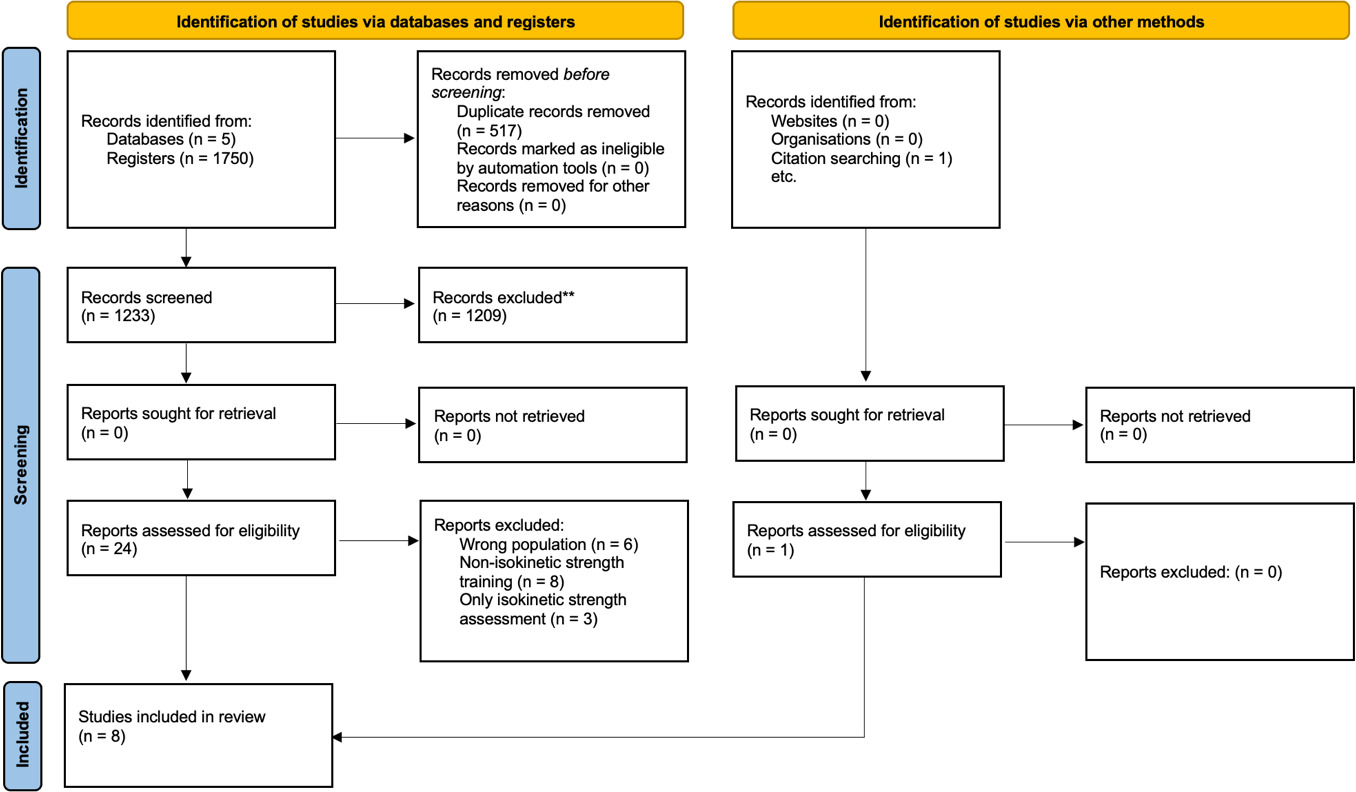
We found no systematic reviews with an objective similar to that of the present study. From the initial search, 1750 articles were retrieved (Fig. 1), of which 517 were eliminated as duplicates. After evaluating titles and abstracts, 1209 articles were excluded as not relevant to this review, leaving 24 articles for full-text reading. One additional article was identified from other sources.
From the 25 articles, six articles were excluded because they did not include patients with NSLBP, eight because they performed strength training but not isokinetic strength training, and three because they only performed isokinetic strength assessment and not isokinetic strength training. Thus, eight articles were selected, seven included in the meta-analysis. The reference list was reviewed without finding new articles. An update of the search was conducted until 17 November 2022; however, no articles met the inclusion criteria.
The retrieved studies included 361 participants with NSLBP, of whom only 19.66% (71) were women. Of the total sample, 143 received IKT. The number of participants per study ranged from 17 [22] to 60 [46, 47, 48, 49]. The minimum age of participants was 20.23
Characteristics of the included studies
Characteristics of the included studies
LBP: Low back pain; CG: control group; IKT: isokinetic training; CST: core stability training; VRT: virtual reality training; RCT: randomized controlled trial; SD: standard deviation; VAS: visual analogue scale; CSA: cross-sectional area; MRI: Magnetic resonance imaging; MOLBDQ: Modified Oswestry Low Back Disability Questionnaire; TSK-17: Tampa Scale; RMQ: Roland Morris questionnaire.
The characteristics of isokinetic strengthening training of the included studies
IKT: isokinetic training; CST: core stability training; CG: control group; VRT: virtual reality training; ROM: range of movement; reps: repetitions.
Summary of findings (SoF) and quality of evidence (GRADE) for Isokinetic trunk training in NSLBP patients
RoB: Risk of bias; IKT: Isokinetic training; CG: control group; CI: confidence interval; RCT: Randomized controlled trial; MD: mean difference. Explanations: a. Differences in the population assessed; b. The heterogeneity between studies was considerable (I
GRADE: Working Group grades of evidence.
High certainty: We are very confident that the true effect lies close to that of the estimate of the effect.
Moderate certainty: We are moderately confident in the effect estimate: The true effect is likely to be close to the estimate of the effect, but there is a possibility that it is substantially different.
Low certainty: Our confidence in the effect estimate is limited: The true effect may be substantially different from the estimate of the effect.
Very low certainty: We have very little confidence in the effect estimate: The true effect is likely to be substantially different from the estimate of effect.
Regarding training protocols, all studies considered a trunk IKT group compared to a control group (CG). The CG performed conventional exercises such as stretching and isotonic and isometric exercises of the trunk muscles. In addition, Nambi et al. [47, 48] included a core stability training group and Nambi et al. [46, 50] a virtual reality training group. For the analysis, core stability and virtual reality training groups were not included. The total intervention period ranged from two [22] to twelve weeks [51], with total training sessions between six [22] and twenty-four [51]. Concerning the dynamometers, Nambi et al. [47, 48, 50] used Biodex Corporation, NY, USA, Calmels et al. [22] and de Freitas et al. [51] a Cybex 6000
Risk of bias summary: review authors’ judgements about each risk of bias item for each included study.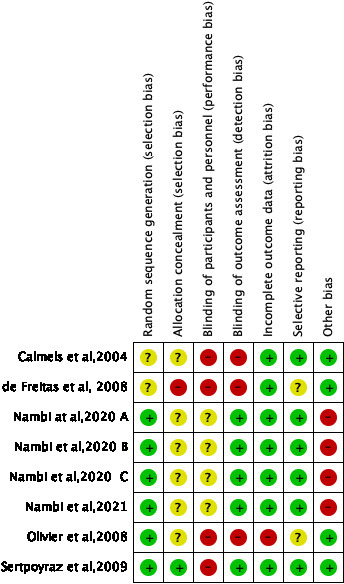
Figures 2 and 3 show the RoB assessment for all articles. For the overall RoB, only one article [52] rated 85.7% of their articles items as low RoB; four [46, 47, 48, 50] ordered 57.1% of their items as low RoB, and three [22, 49, 51] obtained less than 50% of the items classified as low RoB. Of the eight articles, 87.5% were classified as low RoB in the attrition bias [22, 46, 47, 48, 50, 51, 52], 75% were classified as low RoB in the randomization process [46, 47, 48, 49, 50, 52], and reporting bias [22, 46, 47, 48, 50, 52]. Only one article in allocation concealment [52], none in the blinding of participants and personnel, and 62.5% in the blinding of outcome assessment [46, 47, 48, 50, 52]. Four articles [46, 47, 48, 50] were classified as high RoB in “other bias” due to the specific population in which they performed the intervention.
Pain intensity
All the retrieved studies in this review evaluated pain intensity using the visual analog scale (VAS). For this reason, we performed a meta-analysis of pain intensity. One article could not be incorporated into the meta-analysis because it reported a significant decrease in pain in both groups (IKT and CG) but only indicated
At one month follow-up, the meta-analysis revealed a significant decrease in pain intensity, in favor of the IKT group of
Risk of bias graph: review authors’ judgements about each risk of bias item presented as percentages across all included studies.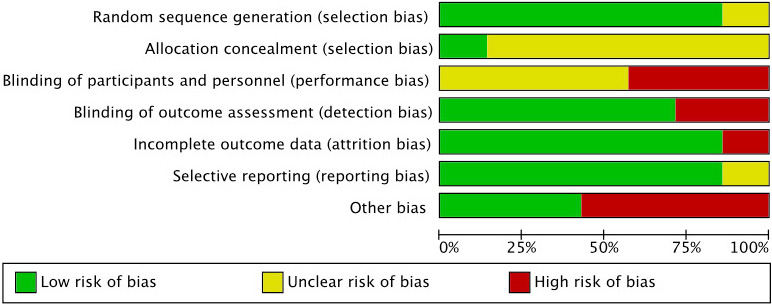
Forest plot of comparison between IKT (experimental) vs CG articles for changes in pain intensity. SD 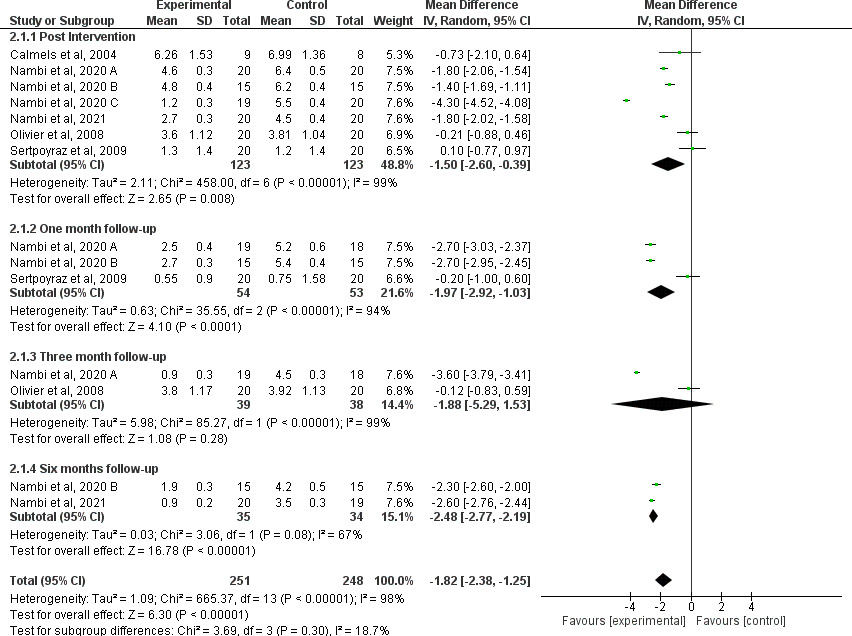
Three of the articles retrieved in this review evaluated the effects of an IKT program on disability. Calmels et al. [22] used the Quebec scale to measure functional capacity and found no significant improvements in either the CG (
Isokinetic trunk flexor and extensor strength
Only three articles of the retrieved studies evaluated the isokinetic trunk flexor and extensor strength. Olivier et al. [49] found a significant increase between pre-and post-intervention peak torque values in trunk flexor and extensor muscles. However, they only reported statistically significant differences in extensor peak torque between groups at 30
Discussion
The objective of this review and meta-analysis was to determine the effects of isokinetic trunk training on pain, disability, and isokinetic trunk strength in NSLBP patients. The main finding of this review is that the trunk IKT could be a clinical tool for pain management in patients with NSLBP, although the evidence is very uncertain. In addition, IKT reduces disability and increases trunk strength in NSLBP patients, although few RCTs exist for IKT on disability or trunk strength in patients with NSLBP.
All the studies included in this review considered patients with cLBP, that is, lasting more than three months. When comparing the clinical manifestations between patients with acute, subacute, or chronic LBP, the latter presents a higher level of pain, greater consumption of analgesics, and greater risk of requiring lumbar surgery than patients with acute and subacute LBP [53]. This review and meta-analysis show decreased pain intensity in the IKT group. The IKT group presents a more significant decrease in pain intensity post-intervention (
The difference in training volumes could explain this high heterogeneity, e.g., the studies conducted by Nambi’s group performed a protocol of 20 sessions, consisting of three sets of 15 repetitions at velocities of 60
A network meta-analysis by Owen et al. [54] attempted to determine the best exercise mode to treat LBP. The results show that Pilates, motor control, and exercise-based or aerobic training decrease pain. However, these results have high heterogeneity and low quality of evidence. Another network meta-analysis conducted by Gianola et al. [55] concluded that pain management in patients with NSLBP should be done with non-pharmacological treatment, in which exercise appears as the best alternative to reduce pain at immediate follow-up. Thus, exercise appears to be a suitable intervention for pain management in LBP.
Although the mechanism by which IKT is effective as an intervention for LBP patients is not known, we postulate that strength training with maximum load throughout the entire range of motion, as in IKT, can contribute to greater spinal stability by training the trunk muscles, which can translate into less pain for patients. However, further research is needed to understand the mechanisms underlying the decrease in pain using IKT.
We know that LBP is the leading cause of disability in the world [56]. In this review, only three studies evaluated the effects of IKT on disability. Calmels et al. report no improvement in disability, whereas de Freitas et al. [51] found a decrease in disability in both groups, with no differences. Sertpoyraz et al. [52], the only one with low RoB, reported decreased disability in the IKT and CG using the MOLBDQ. A reduction of six points in MOLBDQ is considered clinically relevant [57]. Thus, both the IKT and CG groups significantly decreased disability, 7.20 and 8.35 points, respectively, and with clinically meaningful results. Many factors can contribute to disability, such as biophysical, psychological, social, and genetic factors. Therefore, disability is not simply the result of nociceptive inputs [58]. Consequently, different types of interventions can be expected to have positive effects on disability. Thus, isokinetic trunk training could be considered a training option when the goal is to improve the disability of patients with NSLBP. It should not be ignored that these results come from only two study, so they should be interpreted with caution. Thus, further research regarding the effects of IKT on disability is needed.
Trunk muscle strength has been considered a risk factor for developing LBP [14]. In addition, we know that patients with cLBP have a decrease in lumbar extensor isokinetic strength [24]. In this review, although eight studies included a group that trained strength, only three research measured whether the IKT program affects isokinetic trunk strength. Olivier et al. [49], who added only 15 minutes daily IKT to a conventional treatment program, reported a significant increase in both groups, with differences between groups only in extensor strength at 30
Isokinetic muscle strength, a difference of pain intensity and disability, is an objective measure to determine the effects of an intervention. Furthermore, we know that neural adaptations predominate in the first weeks of strength training [60]; we can suggest that further research considering more extended training periods is necessary to observe the chronic effects of strength training in NSLBP patients. In addition, given the questioning regarding the lack of natural movements when using classical isokinetic dynamometers [61], we can further suggest using the new generations of dynamometers with a more functional approach [62, 63]. Functional dynamometers could allow a more significant transfer of these skills to the sports and daily activities of patients with cLBP. Finally, due to the limited evidence regarding disability and trunk strength in NSLBP patients, and limited evidence in non-athletes and women regarding pain intensity, further research is needed to elucidate the role of isokinetic trunk training in subjects with NSLBP.
Study limitations
This review is not exempt from limitations, such as, for example, it only encompasses articles published between 2001 to 2022, which could have excluded some of the evidence from this review. On the other hand, it includes a small number of studies and a small number of participants. In addition, most of the included studies were conducted by the same research group [46, 47, 48, 50], which evaluated only a specific type of young and athletic population, which may make it difficult to generalize the findings of this review to the rest of the patients. Despite being the same research group, the authors clarified that these were different trials with different samples. Moreover, these results should be interpreted with caution due to the high heterogeneity found, probably due to the different samples and training protocols. In addition, we did not perform the publication bias analysis since this analysis requires a minimum of 10 studies, according to the Cochrane handbook [64]. However, we can consider it a strength that there was no language restriction in the retrieved articles. Furthermore, to our knowledge, this is the first review that attempts to determine the potential role of isokinetic trunk strength training in patients with NSLBP.
Conclusion
Trunk IKT could be a novel clinical tool for pain management in patients with NSLBP, although evidence is scarce. In addition, few RCTs exist for IKT on disability or trunk strength in patients with NSLBP. Based on the current evidence, it is not possible to provide a clear recommendation on the effects of trunk IKT on pain, disability, and trunk strength. Therefore, further research on this topic is needed.
Ethical approval
Not applicable.
Funding
This study has been partially supported by FEDER/ Junta de Andalucía-Consejería de Transformación Económica, Industria, Conocimiento y Universidades /Proyecto B-CTS-184-UGR20. This work was supported by DGI-University Andres Bello, N
Informed consent
Not applicable.
Author contribution
WR-F Conception of review, database searches, data extraction, risk of bias assessment, statistical analysis, preparation, and revision of manuscript. LC-R Conception of review, reviewed conflicts between investigators, and revision of manuscript. DM-G data extraction, statistical analysis, preparation, and revision of manuscript. AR-P Conception of review, data extraction, preparation, and revision of manuscript. DJ-M Conception of review, database searches, data extraction, risk of bias assessment, preparation, and revision of manuscript. All authors approved the final version.
Supplementary data
The supplementary files are available to download from http://dx.doi.org/10.3233/BMR-220301.
Footnotes
Acknowledgments
This paper will be part of Waleska Reyes-Ferrada Doctoral Thesis performed in the Biomedicine Doctorate Program of the University of Granada, Spain. We appreciate the collaboration in this study of Nicolás Grob-Hernandez, Gonzalo Iturrieta-Correa, Camila Tapia-Brahland, and Geraldine Luengo-Monsalve. The postdoctoral researchers Daniel Jerez-Mayorga, Angela Rodriguez-Perea and Darío Martinez-Garcia has a contract through the programme “Recualificación del Profesorado Universitario. Modalidad Margarita Salas”, Universidad de Granada/Ministerio de Universidades y Fondos Next Generation de la Unión Europea.
Conflict of interest
The authors declare that they have no conflict of interest.