




Abstract
BACKGROUND:
Sedentary work may lead to low back pain. In particular, a slumped sitting position may exacerbate low back pain because of tissue damage caused by excessive lumbar flexion and posterior pelvic tilting. Subjects with low back pain may have excessive changes in the lumbopelvic posture and back muscle activity in the sitting position.
OBJECTIVE:
The purpose of this study was to compare the effects of vibration-based biofeedback using a motion sensor belt and no biofeedback on multifidus (MF) muscle activity and pelvic tilt angle during typing.
METHODS:
Thirty subjects with low back pain accompanied by hip flexion limitation (15 each in the biofeedback and non-biofeedback groups) were enrolled. Electromyography was used to investigate MF muscle activity before and after typing for 30 min. Pelvic tilt was measured after typing in a sitting position for 30 min. Independent t-tests were used to compare MF muscle activity, and pelvic and second sacrum tilt angles, between the biofeedback and non-biofeedback groups.
RESULTS:
After typing for 30 min, changes in MF muscle activity (11.45% and
CONCLUSION:
Vibration-based biofeedback minimizes the reduction in MF muscle activity and changes in pelvic and second sacrum tilt angles during typing in individuals with low back pain accompanied by hip flexion limitation.
Introduction
Most people experience low back pain at least once in their lifetime [1]. In particular, individuals who work in a sitting position are prone to low back pain [1]. A slumped sitting position can exacerbate low back pain [2]. Prolonged sitting reduces the lumbar lordotic curve and activity of trunk muscles, such as erector spinae [3, 4], leading to abnormal posture. Individuals with low back pain have difficulties in maintaining the normal lumbar lordotic curve and anterior pelvic tilt during sitting [5]. Previous studies showed that an upright sitting posture is maintained by appropriate lumbar lordosis and anterior pelvic tilt in the lumbopelvic region, which activates the multifidus (MF) muscles [1]. The upright sitting posture may change to the slumped sitting position if there is reduced activation of the active muscles, such as the spinal stabilizing muscles (including the MF muscles). The subsequent increase in involvement of passive structures, such as ligaments, leads to a backward shift of spinal load. Over the long term, this may cause low back pain [1].
Flexibility of the hip joint is required for daily life functions such as squatting, cycling, and putting on shoes [3]. The hip flexion angle required for performing functional activities is 120
To manage low back pain, appropriate anterior pelvic tilt, lumbar lordosis, and a neutral sitting position are required [7]. When postural control is insufficient during sitting, and conscious effort is required to maintain a good posture, posture may deteriorate with prolonged sitting position [8]. According to previous studies, biofeedback on the sitting position using various taping techniques improved conscious control over the lumbopelvic region and was effective for maintenance of the alignment of the vertebral joints [9, 10, 11]. Compared to the group without taping, the group with taping had improved postural muscle activity, less pain associated with posteriorly tilted lumbar vertebrae, and less lumbar flexion [9].
However, taping has limited ability to increase active muscle activity because the tape is directly attached to the skin and assists the passive structures, such as ligaments. Therefore, in the present study, vibration-based biofeedback was used, which improves the functions of active structures, such as the MF muscles. A literature review revealed that no study has investigated the effect of vibration-based biofeedback using a motion sensor belt that detects vibration from the sacrum on the pelvic tilt angle in subjects with low back pain and hip flexion limitation while typing in a sitting position. The purpose of this study was to investigate the effect of biofeedback using vibration on the activity of the MF muscles, pelvic tilt angle, and second sacrum tilt angle in subjects with low back pain during typing in a sitting position for 30 min. We hypothesized that changes in the MF muscle activity and pelvic and second sacrum tilt angles during 30 min would be significantly smaller in the group with than without biofeedback.
Subject characteristics
Subject characteristics
Participants
Thirty subjects with low back pain accompanied by hip flexion limitation were enrolled in this study (15 each in the biofeedback and non-biofeedback groups). We included subjects who had experienced non-specific chronic low back pain for at least 3 months that was exacerbated in the lumbar flexion posture, exhibited loss of lumbar lordosis in the painful region [12], and showed a limited passive hip flexion angle of 90–110
Electromyography (EMG) and data analysis
The MF muscle activity was measured using a surface EMG device. Two channels of EMG data were collected using EMG analytical hardware (Noraxon TeleMyo 2400T; Noraxon, Scottsdale, AZ, USA) and analyzed using the bundled software (MyoResearch XP Master Edition 1.06; Noraxon). The EMG data were sampled at 1,000 Hz with the bandpass set to 20–250 Hz. For the surface EMG patches, disposable electrodes of bipolar Ag/AgCl were placed on both sides of the MF muscles. Before applying the electrodes, the skin was shaved and washed with alcohol to reduce the surface resistivity [15]. The electrodes were applied to the MF muscles (2 cm lateral to the spinous process of lumbar vertebra 4) [16]. Changes in MF muscle EMG activity were quantified by subtracting the measured value before typing from that after typing for 30 min. The EMG data were measured for 5 s and data for the middle 3 s were used. For subjects with low back pain, the EMG device was used to measure isometric sub-maximal voluntary contraction (sub-MVIC) of the MF muscles during the double leg raise exercise [17]. Subjects were asked to flex both knees to 90
Measurement of pelvic tilt angle using a palpation meter (PALM)
The tilt angle between the anterior superior iliac spine (ASIS) and posterior sacroiliac spine (PSIS) was measured using a pelvic tilt meter (PALM, Performance Attainment Associates, St Paul, MN, USA). The tiltmeter includes semicircular arcs that can be moved at intervals of 1
Polhemus Liberty – device for measuring changes in sacral tilt
The Polhemus Liberty
Vibration-based biofeedback using a motion sensor belt
Vibration-based biofeedback using a motion sensor belt.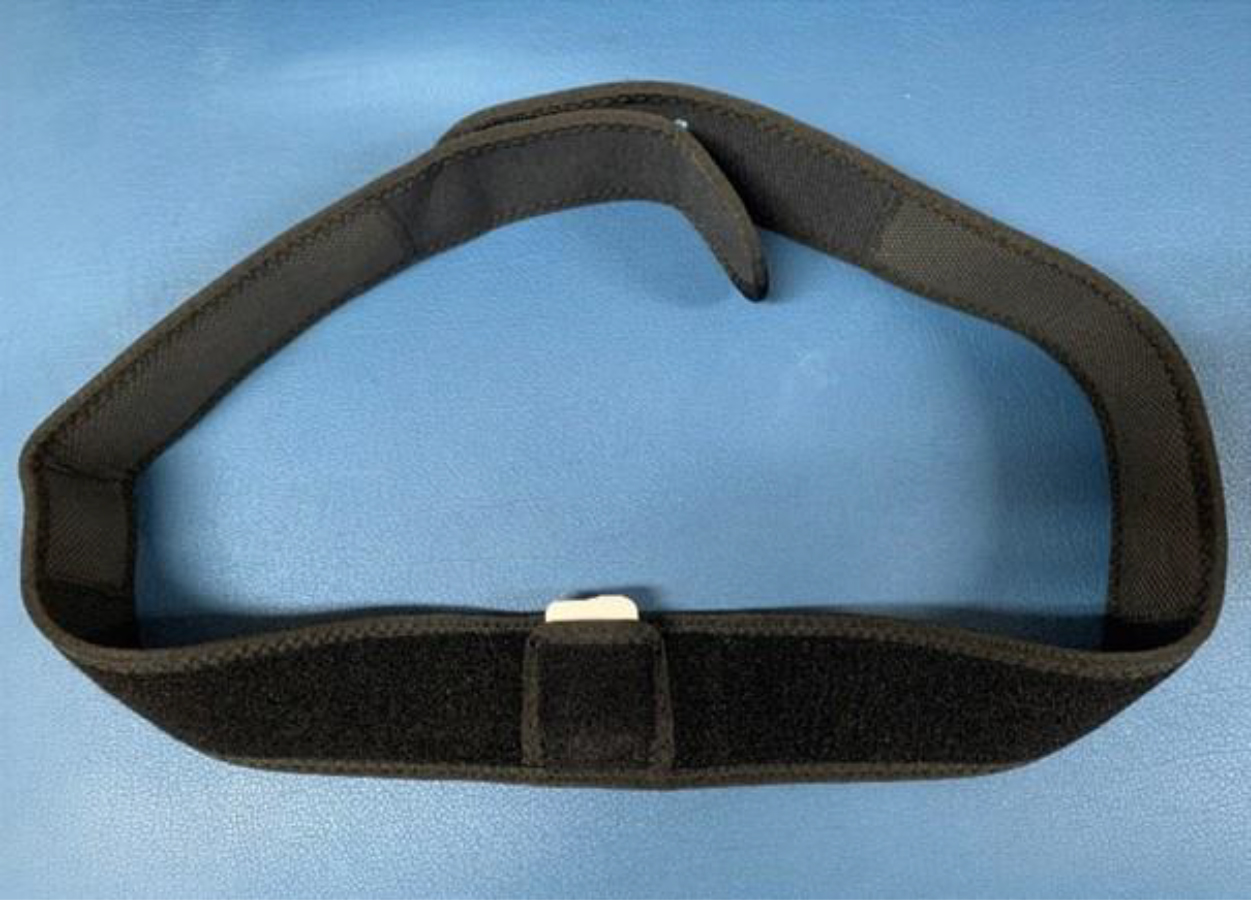
A motion sensor belt providing vibration-based biofeedback was worn by the subjects during typing in a sitting position. The motion sensor belt was worn at the level of a line connecting the ASIS and PSIS in the sitting position; the sensor was located at the second spinous process of the sacral region, which corresponds to the center of the belt, so that the reference value could be calibrated at a certain angle of the sacrum. The magnetic sensor used to measure the tilt angle of the second spinous process of the sacrum was attached to the skin under the motion sensor belt. The neutral sitting position was defined as that in which the body weight was supported by the ischial tuberosities on both sides [15], the lumbopelvic region was not inclined to any side, appropriate lumbar lordosis was maintained, and the torso was comfortably erect [1]. In addition, the ASIS and PSIS angles in the sagittal plane were adjusted to 0
The typing posture with vibration-based biofeedback using a motion sensor belt.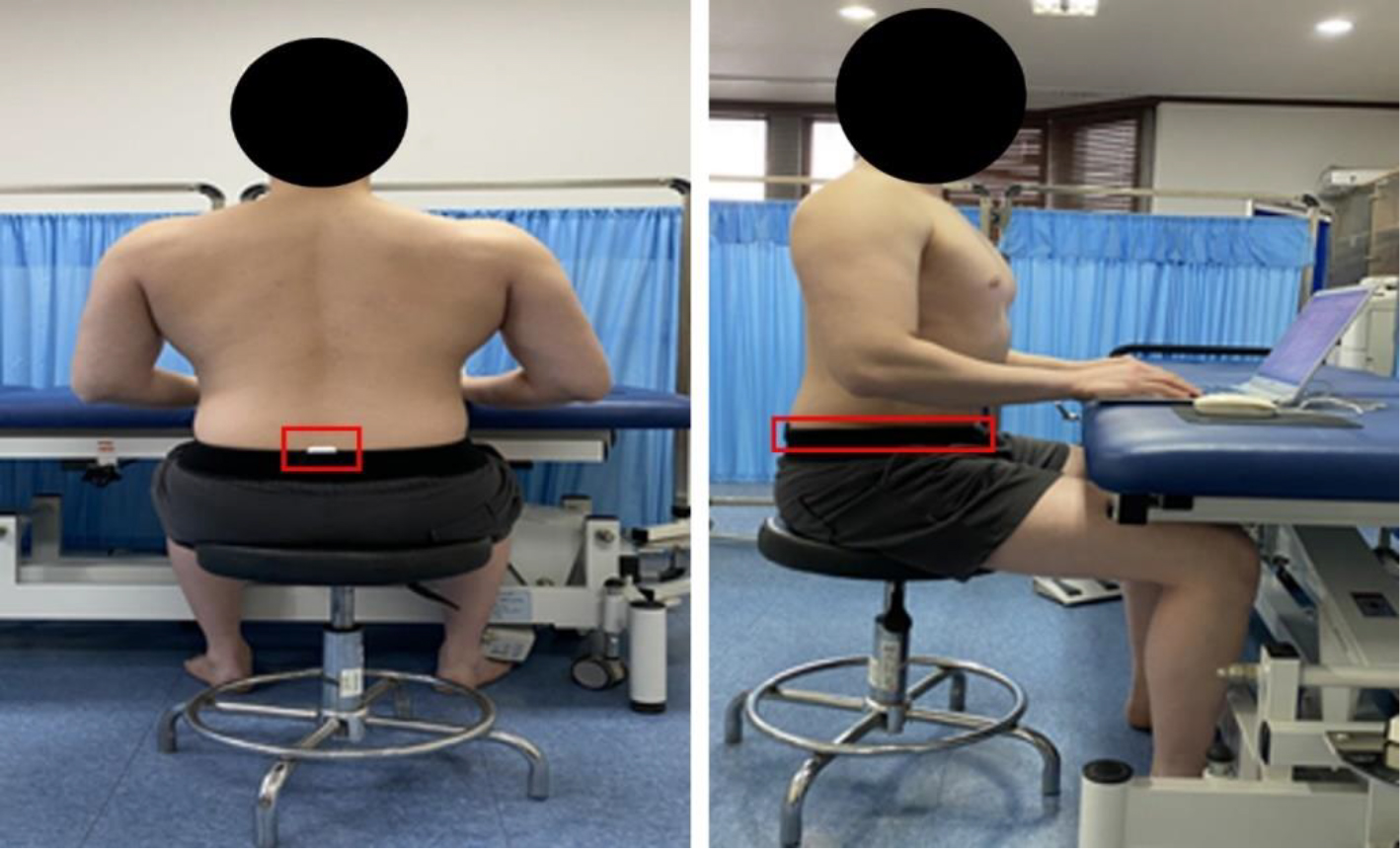
Height-adjustable desks and chairs were used. The heights of the chairs and desks were adjusted so that the elbow flexion angle was 90
Statistical analysis
SPSS software (ver. 18.0; IBM Corp., Armonk, NY, USA) was used for the statistical analysis. The Kolmogorov-Smirnov test was used to assess the normality of the data. Changes in the MF muscle activity and pelvic and second sacrum tilt angles were compared between the biofeedback and non-biofeedback groups using independent t-tests. Statistical significance was set to
Comparison of the changing value of the multifidus muscle activity in subjects with and without the biofeedback
Comparison of the changing value of the multifidus muscle activity in subjects with and without the biofeedback
Comparison of the changing value of the pelvic tilting angle in subjects with and without the biofeedback
Comparison of the changing value of the 2
During typing, changes in the MF muscle activity and pelvic and second sacrum tilt angles were significantly smaller in the biofeedback than non-biofeedback group (
Discussion
This study investigated the effects of vibration-based biofeedback using a motion sensor belt on changes in MF muscle activity and pelvic and second sacrum tilt angles in subjects with low back pain accompanied by hip flexion limitation after typing for 30 min.
The changes in MF muscle activity and pelvic and second sacrum tilt angles were significantly different between the groups. In the biofeedback group, there were smaller changes in the MF muscle activity and pelvic and second sacrum tilt angles compared to the non-biofeedback group. The reasons for the group differences in lumbopelvic movements and changes in MF muscle activity are considered below.
In subjects with low back pain accompanied by hip flexion limitation, typing for 30 min without vibration-based biofeedback may lead to compensatory changes caused by insufficient flexibility of the hip joint in a sitting position. Although a large hip flexion angle is not required during typing in the upright sitting position, accompanying insufficient flexibility of the hip joint may lead to postural changes in the lumbopelvic region and a progressively slumped sitting position over time [22]. In addition, previous studies have shown that compensatory changes in the lumbopelvic region occur frequently in subjects with hip joint limitation [3]. In particular, when hip flexion exercise is performed in the sitting position, compensatory changes such as posterior pelvic tilt and lumbar flexion increased due to increased tension in the hip joint extensors and stiffness of the posterior joint capsule [3]. Although direct comparison of the results of the present and previous studies is not appropriate because the present study investigated changes in hip flexion occurring in the sitting position during typing rather than a hip flexion exercise, previous studies suggested that lumbar flexion and increased posterior pelvic tilt represent compensatory changes in response to insufficient flexibility of the hip joint [3]. Vibration-based feedback may minimize any subconscious increase in flexion of the lumbopelvic region and lumbopelvic posterior tilt in subjects with hip flexion limitation during typing for 30 min. When typing is performed in a sitting position, biofeedback might promote awareness of posture changes in the lumbopelvic region, thus minimizing posture changes in the lumbopelvic region and improving pain and other musculoskeletal disorders.
Subjects with low back pain accompanied by hip flexion limitation tend to develop a slumped sitting position during prolonged sitting because of insufficient anterior pelvic tilt to maintain hip flexion [22]. In this study, when typing was performed in a slumped sitting position, lumbar lordosis decreased and posterior pelvic tilt occurred. Consequently, the lumbar spine was flexed so that the MF muscles were lengthened and had less activity [3, 12]. In our non-biofeedback group, there was reduced MF muscle activity and increased tension in the ligaments, which are non-contractile tissues. We attempted to minimize excessive lumbar flexion in the end range of motion. Although there is a small postural change in the lumbopelvic region in the neutral sitting posture, it may be useful to maintain activity of contractile tissues, such as the MF muscles, and to reduce the tension in non-contractile tissues such as ligaments [21]. Accordingly, in the slumped sitting position, the positions of the sacral and pelvic regions need to be shifted to the neutral position so that the MF muscles are actively contracted. Vibration-based biofeedback from the motion sensor belt improved the sitting posture by providing proprioceptive sensory information during typing. Without vibration-based biofeedback, subjects may develop posterior pelvic tilt in the sitting posture because of insufficient sensory information.
MF muscle activity was maintained in subjects who received real-time vibration biofeedback in response to a posterior second sacrum tilt of 10
There were several limitations to this study. First, the findings cannot be generalized to individuals with other diagnoses. In future studies, it will be necessary to investigate whether biofeedback is useful for patients with low back pain of different etiologies, such as disc herniation and facet joint syndrome. Second, biofeedback was only provided for 30 min during typing. In future studies, it will be necessary to investigate the effects of biofeedback during longer working times. Third, this study only enrolled young subjects with low back pain. Follow-up studies of individuals in other age groups are needed. Fourth, motion analysis of changes in the sitting position was performed only for the pelvis and sacrum, i.e., where the motion sensor belt was worn. In future studies, analysis of the entire spine should be performed.
Conclusions
Vibration-based biofeedback using a motion sensor belt minimized changes in MF muscle activity and pelvic and second sacrum tilt angles during typing in subjects with low back pain accompanied by hip flexion limitation. Vibration-based biofeedback can be recommended to minimize any reduction in MF muscle activity and changes in the pelvic and second sacrum tilt angles in subjects with low back pain accompanied by hip flexion limitation.
Ethical approval
The study protocol was approved by the Hoseo University Institutional Review Board (1041231-220105-HR-140-02).
Informed consent
All subjects provided signed informed consent for their inclusion in the research.
Author contributions
Conception and design, or acquisition, or analysis and interpretation of data: JIC. Drafting the article or revising it critically for important intellectual content: JTJ, JIC. Final approval of the version to be published: JTJ, JIC.
Footnotes
Acknowledgments
This research was supported by the Academic Research fund of Hoseo University in 2020 (No. 20200424). The authors express their gratitude to all participants for their valuable time and dedicated participation in the study.
Conflict of interest
We wish to confirm that there are no known conflicts of interest associated with this publication. We confirm that the manuscript has been read and approved by all named authors and that there are no other persons who satisfied the criteria for authorship but are not listed. We further confirm that the order of authors listed in the manuscript has been approved by all of us.