




Abstract
BACKGROUND:
Therapeutic exercise (TE) is recommended in multimodal treatment for patients with non-specific chronic back pain (cLBP).
OBJECTIVE:
The aim of this study is to identify an exercise or a spectrum of exercises, well described and reproducible by the clinician, for cLBP patients.
METHODS:
Systematic review by researching in the databases MEDLINE, EMBASE, PEDro, CINAHL, and Scopus. Evidence from Randomized Controlled Trials (RCTs) supported the TE in patients with non-specific cLBP, provided that it was well described and could be repeated by another therapist. Methodological evaluation was performed using the PEDro scale and only studies with a score of
RESULTS:
Twenty-one articles were included in this systematic review. The defective description and the poorly reporting of the intervention makes it more difficult for the clinician to include the TE into clinical practice.
CONCLUSIONS:
The findings of this study showed that the reporting of the intervention in high quality RCT on chronic low back pain is low, threatening the external validity of the results.
Keywords
Introduction
Worldwide, low back pain (LBP) is the prime cause of disability [1, 2]; more than 80% of people have at least one episode of back pain in their life time [3]. LBP is the most common reason for medical consultation [4] among musculoskeletal disorders [3]; on the basis of these reports, LBP is associated with the high costs to companies, including those related to health care and indirect care, in terms of absence from work or reduced productivity [1]. The LBP is also classified according to the duration of the symptoms: acute (
To convert evidence of effective treatment into practice and to replicate the action recommended and described in a research, clinicians need to have precise information about the details of the interventions of the exercise including dose, frequency, and intensity. This requires clear, complete, and accessible reports of all elements of the exercise, as assessed in the research studies.
Given the importance of adequate reporting of physical activity interventions in clinical trials, it is necessary to consider the Template for Intervention Description and Replication (TIDieR) in order to improve the generalizability of the results. It was developed by an international group of experts and stakeholders [9] to guide the complete reporting on physical activity interventions. The TIDieR checklist contains the minimum information about the physical activity interventions, as reported by the authors, with sufficient details that allow their replication. In addition, the TIDieR checklist has been widely adopted by scientific journals to improve the reporting of physical activity interventions [10].
Yamato et al. reported that, for most physiotherapy trials, physical activity interventions are incompletely recorded and therefore, not reproducible [11]. Poorly reported interventions can create barriers to implementation of best clinical practices that may affect treatment effectiveness, not allowing patients to receive up-to-date evidence-based interventions [12].
Aspects of completeness and quality in reporting the physical activity interventions in the treatment for cLBP have not been evaluated in Life Science Literature. The present article aims to identify an exercise or a spectrum of exercises for cLBP patients, appropriately described and reproducible by the clinician, based on assessment, needs and preferences of the patient, that can be used in response to the physical, emotional, social and economic problems caused by LBP pain [2].
Objectives
To verify if Life Science Literature contains studies describing exercise programs for patients with cLBP that are reproducible by a physiotherapist, we performed a systematic review of RCTs, that evaluate the effectiveness of exercise therapy, as compared to non-treatment or other treatments in reducing the main outcomes, such as pain, disability, functions and quality of life, using the TIDieR checklist as an essential tool to evaluate the quality of interventions reported in RCTs.
Methods
The methodology and the reporting of this systematic review were based on the Preferred Reporting Items for Systematic Reviews and Meta-Analysis Statement [13]. The protocol was a-priori registered on PROSPERO, an international prospective register of systematic reviews (registration number: CRD42018117317).
Eligibility criteria
RCTs, assessing TE in adult patients aged 18 years and over with non-specific cLBP were included as the Population of the study. Moreover about the Intervention, studies assessing every type of TE (i.e., aerobic, endurance, stretching, motor control, core stability, strengthening, flexibility) performed individually or in groups, supervised or not, alone or within a multimodal treatment that was reproducible by another operator, were considered. To satisfy the criterion of reproducibility of the exercise, the RCT had to provide clear instructions, within the article itself, without referring to other protocols of articles, for example about execution, movement, timing and repetitions of the exercise in order to make it replicable by another operator within his working setting, without the use of a particular mechanical aid or tool. The control is represented by no treatments, usual care, manual therapy, multimodal treatment and other type of exercise or physiotherapy interventios; detailed information is given in Table 1.
Studies including pregnant patients or patients with acute or subacute or specific LBP or assessing pharmacological, surgical or physical therapies (i.e., laser therapy, ultrasound, etc.) or Pilates and Yoga treatments were excluded. Only studies with PEDro score
Data sources and searches
The studies were identified through bibliographic research on the MEDLINE (through the interface PubMed), Excepta Medica dataBASE (EMBASE), the Physiotherapy Evidence Database (PEDro), the Cumulative Index to Nursing and Allied Health Literature (CINAHL) and Scopus databases from their inception
Characteristics of the studies
Characteristics of the studies
Abbreviations: ADL
tion to the 16
The research of the studies in the databases was carried out individually by two evaluators. After deleting the duplicates, the studies were evaluated first by their title, then by reading the abstract, and finally by assessing full texts; in case of disagreement between the two assessors, a third evaluator made the decision.
Methodological quality
The methodological evaluation of the included RCTs was performed with the PEDro scale [14], extracting the total score on the PEDro website [
Data extraction
Two researchers (EP and FS) collected data from the included studies, using a standardized data extraction form. They extracted from the studies information related to the characteristics of the patients (sample number, age, gender), the type of the experimental and control interventions, the outcome measures, and the follow-up.
For the extraction of data and information regarding the intervention, the TIDieR checklist [9] was used by the two evaluators (EP and FS). TIDieR is composed of 12 items: name, purpose, materials, procedure, who provided the intervention, how, where, when and how much, modifications, tailoring and adherence. In order to create a summary score for the description of the intervention, we added the scores for both TIDieR items, the intervention group and the control group. Each item was assessed on the 3-points Likert scale (0
Risk of bias in individual studies
The assessment of the risk of bias in the included studies was performed individually by two reviewers (EP and FS), using the Cochrane Collaboration tool [18], which identifies five bias domains: selection bias, performance bias, detection bias, attrition bias and reporting bias. The risk of bias was assessed as “low” if it is unlikely to seriously alter the results, “high” if it can alter them, and “unclear” if it raises any doubts about the influence on the results.
Results
Study selection
Of the 6520 articles retrieved from the electronic databases, only 21 articles qualified for inclusion in this systematic review, according to the eligibility criteria of the study especially as regards the intervention. Detailed information on each of the phases of the study selection is reported in Fig. 1.
Flow diagram.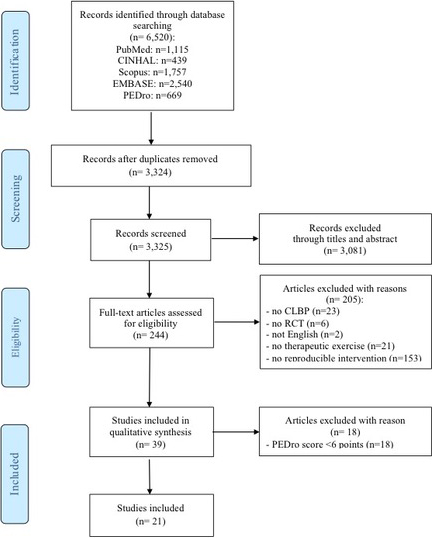
The studies included in this systematic review were RCTs published in English language, between 2011 and 2018. Detail about the included studies are reported in Table 1. A total of 702 subjects with cLBP in the intervention group and 725 in the control group were analyzed. The sample size in the intervention groups and in the comparison group varies from a minimum of 10 to a maximum of 74 with an average in the intervention group of 33.4 subjects (SD
In the intervention group 30% at least was female up to the maximum of 100% with an average age of 70.8 years (SD
In the experimental group of the included studies, the intervention involved TE in different forms: low load motor control exercises [21, 22], stretching [23], lumbar stabilization exercises [19], strengthening [24], trunk balance exercises [25], slump stretching [26], McKenzie exercise [27] that could be made alone [28] or within a multimodal program [29, 30] in combination with manual therapy [31, 32] or education on pain neurophysiology [33]. The comparison intervention in the included studies consists of other forms of TE: high load lifting exercises [21] stretching [20] motor control exercises [24, 34], aerobic activity [19], muscle strengthening [24], water exercises [35], advice on Activity of Daily Living [36], manual therapy [37], Behavioural Graded Activity [19], usual activity [23] , sham therapy [32], and in a wait list treatment [38]. These types of intervention could be associated with each other [29], as mobilization with exercise [26] or performed alone [27]. The interventions in the experimental groups were performed either in groups [39] or individually, the same thing for the comparison groups.
Evaluation risk of bias.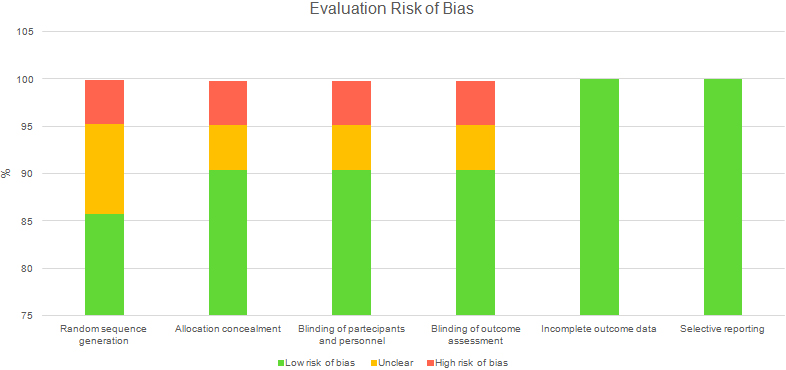
The primary outcomes mainly concerned the measurement of the pain or disability, except for some studies that considered the displacement of lumbar movements and quality of life questionnaires as the primary outcome. Secondary outcomes concerned pain or disability or quality of life, while for some studies, secondary outcomes are represented by lumbar Range of Motion, strength tests, endurance and motor control, the presence of painful positions, and kinesiophobia. In the included studies, the outcomes were assessed with final follow up ranging from a minimum of 6 weeks [25] to a maximum of 24 months [24].
The included studies, through the evaluation with the PEDro scale, were of good quality as they scored 6 to 8 points, with an average of 6.8 points (SD
Risk of bias within studies
The risk assessment of bias, performed through the Cochrane Collaboration tool, is reported in Fig. 2.
The risk of attrition bias and reporting bias was assessed as “low” in all studies included. The risk of selection bias, performance bias, detection bias, was assessed as “low” in 19 articles (90.4%), “unclear” in one article (4.8%) and “high” in one article (4.8%). The risk of selection bias (generation of the randomization sequence) was assessed as “low” in 18 articles (85.7%), “unclear” in 2 articles (9.5%) and “high” in one article (4.8%).
Description of the interventions
The findings of the description, assessed through a TIDieR score, of the experimental and control interventions for each of the studies are reported in Table 2. Regarding the description of the experimental intervention a score ranging from a minimum of 8 to a maximum of 17 points (mean
Discussion
The aim of the systematic review was to assess reproducible therapeutic exercises for cLBP patients, using the TIDieR checklist. Reporting of interventions, especially in physiotherapy, is crucial as it influences the generalizability of the results; hence, the methods of the article should contain all the information necessary for the reader to be able to reproduce the intervention in clinical practice. The main findings on this topic consider the difficulty to have a clear description of the exercises, useful to combine the exercise therapy with new findings [40]. Our results showed that the TIDieR score is low in the description of both the experimental group and the control group in RCTs in patients with LBP; furthermore, many items were scarcely (or not at all) satisfied.
The interventions reported in Garcia et al. and in Aasa et al. RCT are the better reported [21, 27]. The study by Garcia et al. compares the effectiveness of Back School and McKenzie methods in patients with cLBP. The article provides detailed information about the intervention that makes it reproducible. For example, we know patients performed sessions of one-hour once a week for 4 weeks. All participants performed the exercises under the supervision of a physiotherapist. At the end of each session, the participants were asked to perform the same exercises at home, once a day, exercises well described and illustrated by photos. The directional preference could be modified during the sessions, if needed, and the therapist could increase the level of the exercises, tailoring the treatment according to the needs of each patient. The patient should perform the exercise of truck flexion for 3 sets of 10 repetitions
TIDieR ’s score for experimental and control group
TIDieR ’s score for experimental and control group
and the patient had three possible positions. The level of increase was considered only when symptoms remained unchanged, and stopped if the symptoms worsened.
The study by Aasa et al. compared the effects of low-load motor control (LMC) exercise and those of a high-load lifting (HLL) exercise. The LMC intervention was performed individually and the HLL included groups of 5 participants. Participants were offered 12 treatment sessions over an 8-weeks period. The duration of each session was 20 to 30 minutes for the LMC group and 60 minutes for the HLL group. The physiotherapists used different forms of feedback to teach and facilitate correct performance during the exercises. Participants in the HLL group were instructed that a pain intensity under 50 mm on a Visual Analog Scale was acceptable while performing the deadlift, provided that the pain subsided after each completed set and the movement pattern/spinal neutral position did not change. In the LMC group, the exercises were individually selected with the aim to normalize the dominating movement impairment for each participant. The strategy was to start from a basic level and continue to a gradually increased level of difficulty. It was considered important to always perform the movements ideally, preferably with an optimal muscle recruitment pattern. Regarding the home exercises, the participants were encouraged to make at least 10 repetitions, 2 to 3 times a day, with the goal to incorporate the new movement pattern into daily life. In stages 2 and 3, the participants were encouraged to focus on muscle recruitment and movement pattern during the activities and to perform them as often as possible. The physiotherapist selected appropriate initial weight on the bar, taught the participants an optimal lifting technique and ensured that the participants maintained a neutral alignment of the spine when performing the exercise. During the intervention period, the load was slowly increased, gradually increasing the number of lifts and/or the weight on the bar. The participants were encouraged to use the same lifting technique during daily activities. Both interventions resulted in significant within-group improvements in reduced pain intensity, strength, and endurance. The LMC group showed significantly greater improvement on the Patient-Specific Functional Scale compared with the HLL group (
The more relevant TIDieR items allowing replication are item 3 (What materials), item 8 (When and how much) and item (How)
In this review, in the interventions of the experimental groups, the item 3 (Materials) was not reported in 18 articles (85.7%), partially reported in two articles (9.5%) and adequately reported only in one (4.8%) study.
Item 6 (How) was not reported in 11 articles (52.4%), partially reported in two articles (9.5%) and adequately reported in item 8 (When and How Much) articles (38.1%).
Item 8 (When and How Much) was partially reported in one article (4.8%) and adequately reported in 20 articles (95.2%).
This review confirms the difficulty to find studies with a regular comprehensive reporting.
TIDieR SCORE.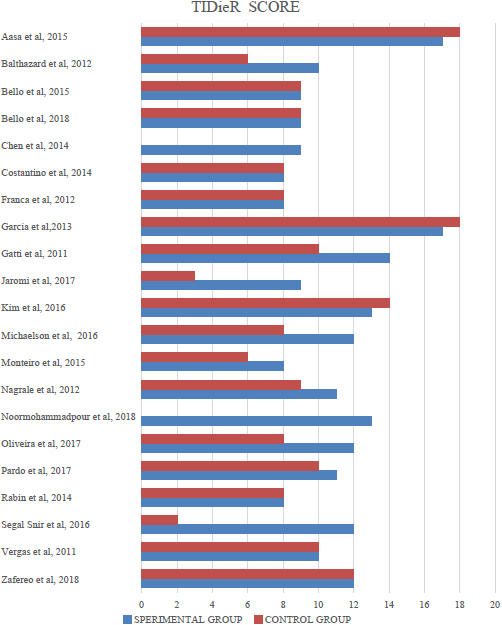
The items most poorly described in the experimental group, (Fig. 3) was item 3 (Materials), item 5 (Who provided), item 6 (How) [41], item 7 (Where), item 9 (Personalizing), item 10 (Modifications) and items 11 and 12 (Adherence). Lack of comprehensive reporting and monitoring of interventions makes it difficult for therapists to put exercises into practice and to make correct assumptions about exercise effectiveness, if it is unclear whether patients adhered to the protocol.
In control groups the interventions are less well-reported than in the experimental group, this is also documented in another study [42].
In addition, the items 11 and 12 (Adherence) in most of the cases are absent, even if it is considered as one of the important barriers for the efficacy of the exercise [43]. Hence, in clinical practice, during the planning of the exercise, the clinician implements strategies to improve the adherence of the exercise; these strategies should be reported in clinical trials to allow the clinician to be able to reproduce the exercise in all its aspects
The Good methodological quality of the studies considered does not coincide with an adequate and complete description of the interventions.
The results of the present study are in line with the study by Yamato et al. that considers the weakness of the exercise description in lots of trials. Of the intervention groups 23% report only half of the TIDieR items, and in the control group these data increase to 75% of the trials [11]. This is because most of the time exercises are described as “usual care” or “conventional treatment” without specifying the treatment modality, thus creating a barrier for the reproducibility [44]. For instance, the advice of an exercise is suggested to patients in only 19% of the cases during the usual care [44]. At the same time, the low reporting for the item Tailoring and Modification, items 9 and 10, is a serious shortcoming because during clinical practice often some modifications are needed [45].
The remarkable incompleteness of information necessary for intervention replication calls for actions [46, 47]. To address the problem of poor description of interventions within RCTs, we recommend that the TIDieR checklist be adopted by journals as a mandatory tool for guiding authors and reviewers [11, 48]. Many journals have limits on words; however, electronic resources can be used to provide more complete descriptions with interventions. For more complex interventions that are common in physiotherapy, using easily accessible videos or websites that demonstrate interventions used [49] should be considered. Such initiatives will reduce time wasted on futile and unproductive efforts and improve the applicability of the research. Finally, authors of systematic reviews and meta-analyses should consider the completeness of intervention descriptions as essential aspects for the evaluation of the usefulness of research evidence.
Wherever possible, the TIDieR checklist as well as other analytical reporting tools should guide the research of authors, reviewers and publishers in the various stages of publication. We need good quality research results that can be used and applied in a concrete and appropriate way.
This systematic review has limitations that should be discussed. Only 21 items were included out of over 6500 items found. Probably by broadening the inclusion criteria, probably more articles may have been included. Therefore this could limit the generalizability of the results to all types of low back pain. Furthermore, having included a wide range of age of patients (greater than 18 years), could be considered with a limit; on the other hand, the results of this systematic review can be applied to adult patients with LBP. Besides, it was not possible to perform a meta-analysis. For this reason, no new evidence can be seen throughout this study.
The findings of this study show defective reporting on interventions in high quality RCT on chronic low back pain (cLBP) is defective, jeopardizing the external validity of the results. More attention should be paid by researchers to the complete and accurate description of interventions reported in their studies in order to make them replicable in clinical practice. In the intervention of the exercise therapy proposed in a study the suggestion is to specify the intensity, the dose, the repetitions and the possibility to modify the program based for example in the improvement of the patient; in this way is very easy for the clinicians put into practice what the literature finds efficacy. Furthermore is important to considerate as outcome not only pain and the function but also the disability induced and perceived with cLBP.
The present authors wish to emphasize the urgent need for a call for action for researchers to use the TIDieR checklist in planning their exercise interventions to improve the replicability and the transparency of studies.
In the present study the interventions reported in Garcia et al. and in Aasa et al. RCTs, are considered as the better reported [21, 27]. In both these studies the score of the intervention description was 17 points for the experimental group and 18 points for the control group. Their articles provide detailed information about the interventions that make them reproducible by a physiotherapist.
Footnotes
Conflict of interest
None to report.
Appendix
Search strings.
Pubmed
((Back pain [Mesh]) OR (Low Back Pain [Mesh]) OR (Back Injuries [Mesh]) OR (LBP) OR (CLBP) OR (Backache) OR (Lumbago) OR (Back Injur*) OR (Lumbar pain) OR (Back disorde*) OR (Back Pain)) AND (“Exercise”[Mesh] OR “Exercise Movement Techniques”[Mesh] OR “Exercise Therapy”[Mesh] OR (Exercis*)) AND ((randomized[Title/Abstract] AND controlled[Title/Abstract] AND trial [Title/Abstract]) OR (randomised[Title/Abstract] AND controlled[Title/Abstract] AND trial[Title/Abstract]) OR ((“Randomized Controlled Trials as Topic”[Mesh]) OR “Randomized Controlled Trial” [Publication Type])) Using filter HUMANS Using filter RANDOMIZED CONTROLLED TRIAL
CINAHL
(TX
randomised
controlled
trial
OR
PT
randomised
control
trial
OR
TX
randomized
control
trial
OR
PT
randomized
control
trial)
AND
((TX
back
pain
OR
TX
low
back
pain
OR
TX
back
injury
OR
TX
lbp
OR
TX
clbp
OR
TX
backache
OR
TX
lumbago
OR
TX
back
injur*
OR
TX
lumbar
pain
OR
TX
back
disorde*
OR
TX
back
pain)
AND
((TX
exercise)
OR
(TX
exercise
movement
techniques)
OR
(TX
exercise
therapy)
OR
(TX
Exercis*))
AND
((TX
randomized)
AND
(TX
controlled)
AND
(TX
trial))
AND
((TX
randomised)
AND
(TX
controlled)
AND
(TX
trial))
AND
((TX
randomised
controlled
trial)
OR
(PT
randomised
control
trial)
OR
(TX
randomized
control
trial)
OR
(PT
randomized
control
trial)))
PEDro
Exercise AND “back pain” Using filter Method: Clinica trial
EMBASE
(‘low back pain’/exp OR ‘low back pain’ OR (low AND (‘back’/exp OR back) AND (‘pain’/exp OR pain)) OR lbp OR clbp OR ‘backache’/exp OR backache OR ‘lumbago’/exp OR lumbago OR ‘lumbar pain’/exp OR ‘lumbar pain’ OR (lumbar AND (‘pain’/exp OR pain)) OR ((‘back’/exp OR back) AND disorde*) OR ‘back pain’/exp OR ‘back pain’ OR ((‘back’/exp OR back) AND (‘pain’/exp OR pain))) AND (‘exercise’/exp OR exercis*) AND ((randomized AND controlled AND trial) OR ‘randomized controlled trial’:it OR (randomised AND controlled AND trial))
Scopus
(((TITLE-ABS-KEY (randomized AND controll ed AND trials) OR SRCTITLE (randomized A ND controlled AND trial)) AND DOCTYPE (ar OR re)) OR ((TITLE-ABS-KEY (randomised) AND TITLE-ABS-KEY (controlled) AND TITLE-ABS-KEY (trial)) AND DOCTYPE (ar OR re)) OR ((TITLE-ABS-KEY (randomized) AND TITLE-ABS-KEY (controlled) AND TIT LE-ABS-KEY (trial)) AND DOCTYPE (ar OR re))) AND ((TITLE-ABS-KEY (back AND pain) OR TITLE-ABS-KEY (low AND back AND pain) OR TITLE-ABS-KEY (back AND injures) OR TITLE-ABS-KEY (lbp) OR TITLE-ABS-K EY (clbp) OR TITLE-ABS-KEY (backache) OR TITLE-ABS-KEY (lumbago) OR TITLE-ABSKEY (back AND injur*) OR TITLE-ABS-KEY (lumbar AND pain) OR TITLE-ABS-KEY (back AND disorde*) OR TITLE-ABS-KEY (back AND pain)) AND DOCTYPE (ar OR re)) AN D ((TITLE-ABS-KEY (exercise) OR TITLE-AB S-KEY (exercise AND movement AND techniq ues) OR TITLE-ABS-KEY (exercis*) OR TITL E-ABS-KEY (exercise AND therapy))) AND (LI M IT-TO (DOCTYPE , ‘ar’))