




Abstract
BACKGROUND:
Lateral epicondylitis is a tendinopathy with a prevalence of between 1–3% of the population aged 35–54 years. It is a pathology with a favorable evolution, but with frequent recurrences (which imply an economic extra cost).
OBJECTIVE:
The objective of this review was to determine the efficacy of physiotherapy treatment for the treatment of epicondylitis and, if any, to identify the most appropriate techniques.
METHODS:
A systematic search was carried out in October 2020 in the databases of PubMed, Cinahl, Scopus, Medline and Web of Science using the search terms: Physical therapy modalities, Physical and rehabilitation medicine, Rehabilitation, Tennis elbow and Elbow tendinopathy.
RESULTS:
Nineteen articles were found, of which seven applied shock waves, three applied orthoses, three applied different manual therapy techniques, two applied some kind of bandage, one applied therapeutic exercise, one applied diacutaneous fibrolysis, one applied high intensity laser, and one applied vibration.
CONCLUSIONS:
Manual therapy and eccentric strength training are the two physiotherapeutic treatment methods that have the greatest beneficial effects, and, furthermore, their cost-benefit ratio is very favorable. Its complementation with other techniques, such as shock waves, bandages or Kinesio
Introduction
Lateral epicondylitis (LE) is a tendinopathy of the forearm extensor muscles, often caused by overuse or repetitive use (mostly of the extensor carpi radialis brevis), forced extension or direct trauma in the epicondyle [1]. Histologically, it presents signs of tendon degeneration, such as the presence of fibroblasts, vascular hyperalgesia and disorganised collagen [2]. The pain is usually localised in the epicondyle, although in more severe cases it can expand to the shoulder and wrist, and it is usually triggered by exerting pressure on the epicondyle, resisting wrist and/or third finger extension and stretching of the epicondylar muscles [3]. LE has an approximate rate of 40% and a prevalence of 1–3% of the general population, being most common in the age range of 35–54 years [4, 5]. Regarding duration, its natural evolution is considered to be favourable at two years, since it usually relapses after asymptomatic periods. Due to the latter phenomenon, this disorder implies a great economic investment [4].
Search strategy according to the focused question (PICO)
Search strategy according to the focused question (PICO)
Different treatment approaches have been proposed, such as the recommendation of rest, drugs, surgery, etc. [6]. The first therapeutic step usually involves rest and the administration of drugs that provide short-term pain relief, but also bad results for the resolution of the problem and for the prevention of relapses [7]. With the surgical approach, immediate pain relief is achieved in 80–97% of cases, although 1.5% of intervened patients underwent a second surgical procedure in the following 18–24 months [8]. Lastly, the physiotherapeutic treatment has been shown to be effective [2] and, in general, it must include manual therapy to relieve the pain and improve the joint’s range of motion (ROM) [6], taking into account that it must be performed under the pain threshold [9]. It is worth highlighting that, in this pathology, as in the rest of tendinopathies, good results are obtained from strengthening the affected area [10]; for example, eccentric training has been reported to decrease pain and improve functionality, since, during exercise: (a) the blood flow in the neovessels of the tendon is temporarily interrupted; (b) a constant mechanical stimulus is generated, which would lead to the remodeling of the tendon, and (c) collagen synthesis increases in damaged tendons [11, 12].
The aim of this review was to determine the efficacy of the new physical therapy (PT) techniques for the treatment of LE that have been studied in the last years and identify the most adequate techniques.
Search strategy and information sources
This study was registered on PROSPERO (ID: CRD42021230014) and followed the Preferred Reporting Items for Systematic Reviews and Meta-analyses (PRISMA) reporting guidelines and the recommendations from the Cochrane Collaboration [13, 14]. The PICO question was then chosen as follows: P – population: men and women diagnosed with LE; I – intervention: physical therapy techniques; C – control: different physiotherapy and/or pharmacological treatment interventions (platelet-rich plasma, corticosteroids and naproxen); O – outcome: intensity and frequency of pain, range of movement and degrees of functionality and perceived disability, mainly; S – study designs: experimental studies.
A systematic search of publications was conducted in Ocotber 2020 in the following databases: PubMed, SpringerLink, SportsDiscus, Medline, Scopus, and Web of Science. The search strategy included different combinations with the following Medical Subject Headings (MeSH) terms: Physical therapy modalities, Physical and rehabilitation medicine, Rehabilitation, Tennis elbow and Elbow tendinopathy. The search strategy according to the focused PICOS question is presented in Table 1.
PRISMA flow diagram.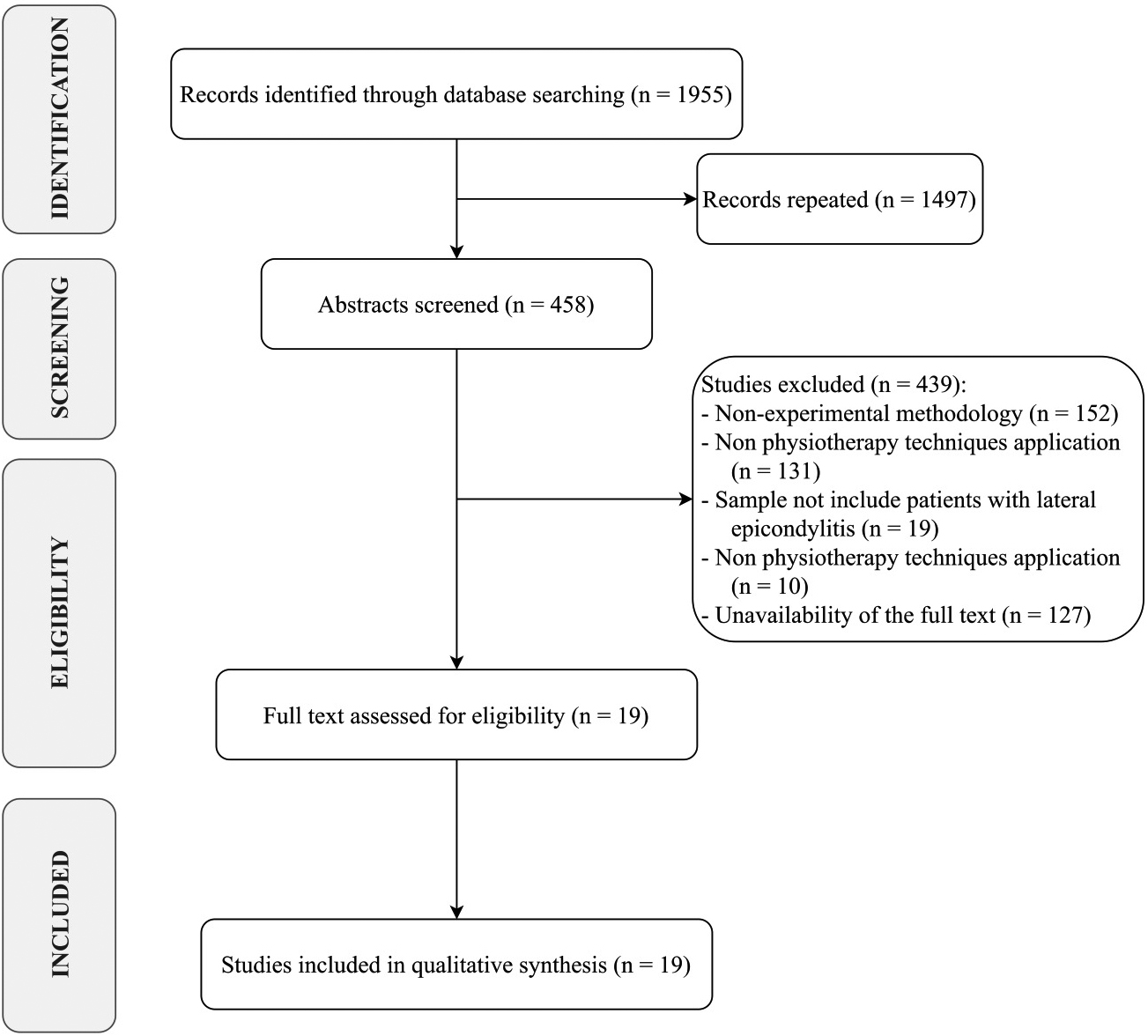
After removing duplicates, two reviewers (L.L.-P. and R.L.-R.) independently screened articles for eligibility. In case of disagreement, both reviewers debated until an agreement was reached. For the selection of results, the inclusion criteria established that the articles must have been published in the last five years (from 2015 to the present), that the sample of studies consisted exclusively of patients with LE (regardless of its duration) and that the authors applied a treatment intervention that included at least one physical therapy technique. On the other hand, studies were excluded from this review if they had a non-experimental methodology and their full text was not available.
Study selection, data collection process, data items and summary measures
After screening the data, extracting, obtaining and screening the titles and abstracts for inclusión criteria, the selected abstracts were obtained in full texts. Titles and abstracts lacking suficient information regarding inclusion criteria were also obtained as full texts. Full text articles were selected in case of compliance with inclusion criteria by the two reviewers using a data extraction form. The two reviewers mentioned independently extracted data from included studies using a customized data extraction table in Microsoft Excel. In case of disagreement, both reviewers debated until an agreement was reached.
The following data from the included articles for further analysis: demographic information (title, authors, journal and year), characteristics of the sample (age, inclusion and exclusion criteria, and number of participants), study-specific parameter (study type, duration of intervention, number of sessions, techniques of physical therapy included in the intervention, follow-up and drop-out) and results obtained. Tables were used to describe both the studies’ characteristics and the extracted data. When possible, the results were gathered based on type of intervention applied. The Oxford 2011 Levels of Evidence and the Jadad scale were used to assess the quality of studies.
Results
Study selection
Out of 1955 search results, 458 studies were considered eligible for inclusion after removing duplicates. Among the 458 papers screened, 439 were excluded after abstract and title screening. Kappa score of reviewer 1 and 2 was 0.187, indicating slight agreement. Of the 19 full-text articles assessed for eligibility, all were finally included in the synthesis, as depicted by the PRISMA flowchart in Fig. 1.
Study characteristics and risk of bias
All the studies have been published in the last 5 years (from 2015 to 2020). Of the 19 articles, seven applied extracorporeal shock waves (SW) [15, 16, 17, 18, 19, 20, 21], five applied ultrasounds (US) [15, 16, 19, 22, 23], five applied conventional physiotherapy techniques (thermotherapy [19], electrotherapy [19, 21, 23], cryotherapy [21], education [24, 25]), six manual therapy [22, 23, 24, 26, 27, 28], seven applied orthoses or taping techniques [21, 22, 25, 28, 29, 30, 31], nine applied therapeutic exercises [17, 21, 22, 24, 25, 28, 30, 31, 32], and one applied a laser [33]. The methodological characteristics of the analysed studies are shown in Table 2 and the characteristics of the interventions applied in them are presented in Table 3.
Regarding the experimental designs, 14 studies were randomized and controlled trials [15, 16, 17, 21, 22, 23, 24, 25, 26, 28, 30, 31, 32, 33] and the remaining five studies were quasi-experimental [18, 19, 20, 27, 29].
The methodological quality of the studies was three points or more on the JADAD scale in 52.6% of the studies [17, 21, 22, 23, 25, 30, 31, 33] but was zero in 26.3% of the results [18, 19, 20, 27, 29]. At the same time, as can be seen in Table 2, the level of evidence provided was between I (73.7%) [15, 16, 17, 21, 22, 23, 24, 25, 26, 28, 30, 31, 32, 33] and II (26.3%) [18, 19, 20, 27, 29].
Results of individual studies
One of the revised studies evaluated the effect of SW [17] in combination and comparison with a programme of strength and mobility exercises. The application of SW was conducted in two stages: in the first stage, the energy density was 0.348 mJ/cm
Two studies were aimed at comparing the effects of US and SW [15, 16]. One of them applied the SW sessions divided into two phases: a first phase of 2000 pulses, at 8 Hz and 1.5–2.5 bar in the epicondylar region, and a second phase of 2000 pulses, at 8 Hz and 2.5–3.5 bar in the extensor carpi radialis brevis [16]. The other study applied a total of 2000 pulses at a frequency of 10–15 Hz and 1.5–2.5 bar, using ultrasound gel as the means of transmission [15]. The parameters of US application were also different. In one of the studies, the authors applied a first phase with a head of 5 cm
Alessio-Mazzola el al. [20] compared the efficacy of the platelet-rich plasma (PRP) treatment with that of SW. Their intervention with echo-guided SW had a frequency of 4 Hz, an intensity compatible with pain tolerance (initially 0.03–0.07 mJ/mm
Methodological characteristics of the studies analyzed
Methodological characteristics of the studies analyzed
GD: Gestational diabetes; LE: Level of evidence; LOS: Longitudinal observational study; QES: Quasi-Experimental study; RCT: Randimized controlled trial.
Characteristics of the interventions of the studies analyzed
CP: conventional physiotherapy techniques.
session. The obtained results showed significant improvements in functionality and pain intensity in both groups (with no differences between them). However, the reincorporation of the participants to their usual activities was significantly faster with PRP. Lastly, Eraslan et al. [21] compared the effects of Kinesio
In addition to the above study, Nishizuka et al. [30] analysed the effects of Tennis Elbow Support (ALCARE), applied for over six hours per day in combination and comparison with the execution of stretching exercises for the wrist extensor muscles. After the treatment, pain intensity and the number of positive Thomsen tests decreased significantly in both cases (with no differences between them). They also evaluated the efficacy of a dynamic extension orthosis called CARP-X (Sporlastic) in combination and comparison with the execution of eccentric strength exercises [31]. In this case, the maximum grip strength, pain intensity and functionality improved in both groups progressively after the treatment and nine months after the end of the intervention, although strength did not improve significantly in any case. Lastly, Kachanathu et al. [22] evaluated the efficacy of the Futuro
Regarding the evaluation of bandages, Dones III et al. [29] analysed the effectiveness of different applications of Biomechanical Taping (BMT): one group received, firstly, the biomechanical bandage technique with muscular energy (Standard Biomechanical Taping, SBMT) and, subsequently, two vector correction dysfunction techniques (VCDT1 and VCDT2); the other group received the same techniques, with a different application sequence (first VCDT1, then SBMT and, lastly, VCDT2). The authors identified that pain intensity, maximum grip strength and functionality showed significant improvements in all patients. However, both immediately and one week after the intervention, the group that received SBMT as the first technique obtained better scores in pain intensity.
Finally, Giray et al. [25] evaluated the efficacy of KT [35, 36] in comparison with the application of a placebo bandage and a programme of conventional PT. All participants received the conventional PT intervention with instructions on activity modification and a home exercise programme of stretching and eccentric strengthening. The obtained results showed that functionality and pain intensity improved in all groups, although the KT group obtained significantly better results. On the other hand, grip strength also improved in the three groups, although with no statistical differences between them.
Two studies determined the efficacy of deep friction massage in comparison with a corticosteriod injection [26, 28]. In one of the cases, all participants received a wrist splint and a daily protocol of conventional PT, which included stretching and elbow and wrist mobility exercises [28]. The results showed that pain intensity, grip strength and functionality improved significantly and similarly both with the massage and with the injection, but not with the splint and the conventional PT protocol. However, at 6 months after the treatment, all groups showed improvements in all variables, although such improvements were only significant in the massage group. The other study applied corticosteroids invasively in combination and comparison with a PT intervention that included deep transverse friction massage at the origin of the tendon, Mill’s manipulation and wrist stretching exercises [26]. The results showed that, in the PT group, there was a progressive improvement in all variables, which was significant at 3, 6 and 12 months after the treatment. In the group the received corticosteroids, the improvement percentage was better at week 6 than in the subsequent evaluations. Between groups, the perception of improvement in the corticosteriod group showed better results in the first evaluation and worse results in the subsequent evaluations. Lastly, there were no statistical differences between groups one year after the evaluation.
On their part, the study of Seo et al. [27] was aimed at determining the most effective stretching position for the common extensor carpi radialis. They concluded that the shear modulus was always significantly higher when the wrist was flexed, especially with the elbow extended and the forearm in the prone position.
Regarding methods of assisted manual therapy with other instruments, studies have been conducted on diacutaneous fibrolysis (DF) [23] and vibration [24]. López-de-Celis et al. [23] evaluated the efficacy of DF in combination and comparison with US, TENS and stretching exercises with respect to a placebo group. Their results showed that, immediately after the treatment, the group that received DF presented significant improvements in all variables (pain intensity, maximum strength and functionality), whereas the conventional PT and placebo groups only presented significant changes in pain intensity, although with significantly lower changes compared to the DF group. However, at three months after the treatment, all variables improved in the three groups, with grip strength showing a significantly greater improvement in the DF group. Vibration assisted through a Tenease®device was evaluated in combination and comparison with a conventional treatment (information leaflet and education about LE, activities to be avoided and exercises to be performed) [24]. After the intervention, functionality improved in all participants, although such improvement was only significant with the conventional treatment. However, six months after the treatment, neither the quality of life nor pain intensity improved in any of the groups.
One study was aimed at comparing the efficacy of different modes of strength training for the wrist extensor muscles: eccentric, eccentric-concentric and eccentric-concentric combined with isometric training [32]. All participants showed significant improvements in pain intensity, functionality and maximum grip strength. In the intergroup comparison, the group that performed the eccentric-concentric training combined with isometric training obtained significantly better results with respect to the other two groups, both immediately after and one month after the intervention.
Lastly, Dundar et al. [33] explored the effects of high-intensity laser therapy (HILT) with pulse emissions (1064 nm), very high peak power (3 kW), high fluidity level (360–1780 mJ/cm
The aim of this review was to determine the efficacy of PT for the treatment of LE and identify the most adequate techniques. After presenting the analysed studies, we can assert that, in general, PT techniques have a positive effect on the symptoms and resolution of the clinical characteristics of LE.
Pain intensity improved with all the applied treatments [15, 16, 17, 18, 19, 20, 21, 22, 23, 24, 30, 31, 32, 33], although the interventions that included SW [15, 16, 17, 18, 19, 20], PRP [20], US, friction and stretching exercises [22] and bandages [29] achieved positive results in less time (between 3 and 9 sessions). This finding is in line with previous investigations about the SW treatment of other tendinopathies [37, 38]. For long-term pain relief, among the three studies that conducted more than one post-treatment evaluation [18, 26, 31], one of them applied SW and the other two carried out manual therapy [26], eccentric strengthening [26, 31] and corticosteroid infiltration [26]. The latter [26] carried out the latest evaluation, obtaining positive results one year after the intervention.
Regarding pain, other studies evaluated the pressure pain threshold (PPT) [15, 23, 33], which is a specially relevant variable in tendinopathies [39] and in the evaluation of chronic pain [40, 41]. This variable showed improvements with the interventions based on SW [15], orthosis [33], HILT [33], DF [23] and US, TENS and stretching exercises [23], since they can all affect hypercellularity, the collagen matrix, the proteoglycan content and neovascularisation, which is generated by the accumulation of microinjuries, due to the repetitive overload that exceeds the healing capacity of the tendon [42]. However, it is important to highlight that: (a) the combined application of US, TENS and stretching exercises obtained better results than DF [23]; and (b) the SW showed positive changes after only three sessions [15]. This could be due to the fact that the application of SW implies the administration of a series of short energy fluctuations that are rapidly transmitted, which is a method that has been revealed to be effective in the treatment of musculoskeletal disorders due to its angiogenic, analgesic and anti-inflammatory effects when applied on the painful area [43, 44].
Functionality improved in all the studies in which it was evaluated [15, 16, 19, 20, 21, 23, 24, 25, 28, 31, 32], although SW obtained better effects than US [16], probably due to the fact that the latter showed lower reliability in the application of the selected frequency and presented an unpredictable behavior of their acoustic diffraction [45]. On the other hand, SW are more reliable [39] and their efficacy increases when combined with strength exercises [46], as was also reported by Aydin et al. [17]. However, the use of orthoses did not show positive effects on functionality [28, 31], which could be explained by the fact that, by restricting movement, they may lead to muscle disuse; therefore, if orthoses are combined with strength exercises, they may show better results [32, 47]. The interventions based on conventional techniques (ortheses [28], stretching and mobility exercises [28] and education [24]) showed good results on functionality. Stretching exercises are commonly used in PT programmes, and it has been reported that the recovery time of a tendinopathy depends, to a great extent, on the frequency of their execution [48, 49]. Moreover, the article by Yi et al. [28] also obtained good results in the friction massage group, probably due to the capacity of this technique to soften the extracellular matrix and cause a slight inflammation that activates the restoration of the conjunctive tissue; in fact, it has been demonstrated to reduce pain and improve functionality in muscle and ligamentous pathologies [50]. DF was also capable of improving functionality after six sessions [23]. This could be explained by the fact that its mechanism of action consists in ripping the conjunctive tissue fibres that form adhesions, in order to recover the normal glide between the different tissue layers [51]; thus, it can improve the ROM and reduce myotendinous reflexes [52]. Lastly, with all the interventions, the improvement of this variable was achieved in the short term, especially with the application of SW [15, 16, 20, 21] and PRP [20] compared to US [15, 16]. The positive effects obtained with SW in several of the analysed variables can be due to the fact that their optimal effect is attained at a maximum depth of 3.5 cm, where epicondylar tendons can be fully treated regardless of the size of the patient [53]. Similarly, with a high concentration of growth factors, PRP favours the resolution of tendinopathies and muscle and cartilage injuries [54].
Another aspect closely related to functionality and objectively quantifiable is grip strength, which was also analysed [15, 17, 19, 22, 23, 25, 26, 28, 29, 30, 31, 32]. Regarding the improvement of this variable, the interventions based on therapeutic exercise [17, 31] and manual therapy [26] obtained good results in the long-term, and even significantly higher results compared to those based on ortheses [31], SW [15, 17, 19] and corticosteroids [26]. This could be due to the fact that corticosteroids regulate the immune function of inflammatory cells and chemical mediators, thus decreasing pain; however, injections increase protein catabolism and reduce type I collagen and the synthesis of glycosaminoglycans, thereby delaying the healing process in the long term [55]. DF improved grip strength after one session [18], thanks to its capacity to improve the mechanical and inflammatory pain of the musculoskeletal system by removing the tissue adhesions and allowing the optimal glide of the myofibrils [52]. In the short term, SW also obtained good results in this variable [15, 20, 30], although they proved to be less effective when compared to KT [21]. KT reduces pain and edema and facilitates motor activity by activating the circulatory and nervous systems with movement, improves the ROM by relieving abnormal muscle tension and stimulates the mechanoreceptors by applying pressure on the skin, which are effects that have a direct impact on the generation of strength [56]. On the other hand, the improvements obtained with KT reach a limit in time after the intervention [22, 25, 29], unless this technique is combined with conventional PT methods, such as ergonomic measures, stretching exercises and strength training [25].
The ROM was only evaluated in the studies that used orthoses [22, 31]; this variable was improved in both cases. However, also in both cases, the orthosis was applied in combination with strength exercises [31] or with US, friction and stretching exercises [22], which are techniques known for their improvement effect on joint mobility [11, 48, 50, 57]. In fact, the improvement was greater with the intervention that only included eccentric exercises [31], since this training modality is currently among the most effective techniques in the treatment of tendinopathies [58, 59, 60]. This type of training leads to the production of collagen, reduces the prevalence of inflammation and neovascularisation and decreases pain by increasing tendinous resistance and desensitising the central nervous pathways of pain transmission [11, 61].
Therefore, the treatment of LE should include eccentric strengthening, due to its benefits on pain reduction and the increase of tendinous resistance [11, 58], with techniques such as friction massage and DF (depending on the patient’s preferences), which are non-invasive and follow the same neurophysiological principles to reduce pain and inflammation, with the difference that DF can reach deeper layers [23, 50, 52], or KT, which stimulates circulation by displacing the skin, fascia and subcutaneous tissues, achieving the correction of the fascia, reducing pain and attaining neuromuscular reeducation with the stimulation of mechanoreceptors [56, 55]. If the patient presents a lot of pain, orthoses are a non-invasive method with short-term efficacy for the immediate relief of pain and the improvement of hand functionality [3], although, in these cases, complying with the guideline of exercises becomes more important for the prevention of their harmful effects. Lastly, it must be considered that, for the treatment of acute LE (processes of less than three months of evolution) [16, 17, 19, 25, 26, 28, 30, 33, 58], US and PRP are less effective. On the other hand, for the treatment of chronic LE [15, 18, 20, 21, 22, 23], no particularities were found in terms of suitability for any techniques.
With respect to the methodological limitations of this study, it must be pointed out that the inclusion of non-controlled and non-randomised experimental studies reduces the validity of the conclusions drawn in this review. Moreover, the small sample size of some of the analysed articles limits the generalisation of their results. Regarding the operationalisation of the study variables, many of them were evaluated through methods that depend on the patient’s subjectivity. Finally, in the results selection process, a considerable number of studies were eliminated because their full text was not available. On the other hand, this review has some strengths that must be highlighted, such as the comparison of different treatment techniques (including conventional low-cost techniques and other more recent methods that require greater economic investment and/or multidisciplinary intervention) and the fact that it is an update on the different PT techniques for the treatment of LE.
Future studies should conduct further RCT with larger sample sizes and compare the different combinations of the most effective techniques: manual therapy, strength training, SW and bandages. Furthermore, future research must compare and adequately define the particularities of the different approaches in acute and chronic LE.
Conclusions
Taken together, findings from papers included in the present systematic review suggested that manual therapy (e.g., stretching exercises and friction massages) and eccentric strength training are the two physiotherapy treatments with the most beneficial effects on LE, and their cost-benefit ratio is very favourable. Other techniques have positive effects, although they require greater economic investment, such as SW and the administration of PRP.
In any case, before deciding to perform surgical intervention, it is crucial to deplete all the conservative therapeutic options (drugs and PT), regardless of their economic cost. In addition, there are many PT tools that can complement the mentioned techniques, such as cryotherapy, electrotherapy, ultrasound therapy, and the application of tapes or orthoses.
Data availability
The data that support the findings of this study are available upon reasonable request from the corresponding author.
Funding
No financial support was received from any commercial company.
Footnotes
Conflict of interest
The authors report no conflict of interest.