




Abstract
BACKGROUND:
Male breast cancer is a considerably rare condition and only accounts for 1% of all breast cancer cases. Due to limited public awareness, the condition is likely to present late, leading to late diagnosis and treatment worsening morbidity and mortality. This article aims to identify the focus and most influential research on male breast cancer. Objective Identify the most influential papers in male breast cancer.
METHODS:
Search on Web of Science using the search terms ‘Male’, ‘Breast Cancer’ and “Male breast cancer” to identify all full manuscripts in English language and were ranked by the total number of citations. The top 100 articles were then further analysed according to subject, author, journal, year and country of publications.
RESULTS:
The mean number of citations per paper was 96. Most cited paper was by Thorlacius, S et al. evaluating the relationship between BRCA2 and female breast cancer, prostate cancer, pancreatic cancer and ovarian cancer. Cancer is the journal with the most published papers and received most citations in the male breast cancer research field. The USA contributed 49 of the manuscripts in the top 100. The most studied topic was risk factors for male breast cancer, with 20 articles.
CONCLUSIONS:
The most cited papers identified in this study described the advance in the knowledge of genetics and epidemiology in male breast cancer and has led to improvements in the 4 management of the disease. Most of the highly cited articles in this field were published in high impact journals and had accumulated at least 100 citations to date, reflecting their quality and impact. By collating the most influential publications in this field, this analysis can serve to identify knowledge gaps in male breast cancer research as well as to help identify what makes a paper impactful and citable.
Keywords
Introduction
Male breast cancer (MBC) is a rare condition and only accounts for 1% of all breast cancers [1]. The most common subtype of MBC is invasive ductal carcinoma [2]. The aetiology of MBC is multifactorial like other cancers, it is influenced by both environments and genetics, advancing age, hormonal imbalance and radiation exposure. Genetic risk factors of MBC include mutations in BRCA2 gene, family history of breast cancer and Klinefelter syndrome (47XXY karyotype). While BRCA2 and family history can both cause cancer, men with Klinefelter syndrome develop breast cancer through their lower physiological levels of testosterone and higher estrogen level.
Ranking of the top 100 papers
Ranking of the top 100 papers
The condition is likely to present late because of the low public awareness, leading to late diagnosis and treatment. These in turn affect mortality and morbidity, including postoperative scarring which can affect self-esteem and embarrassment [3]. Male breast cancers also present with different clinicopathologic features compared to the female counterpart. Rudan et al. studied 100 male and 500 females with confirmed breast cancer in Croatia and demonstrated that male breast cancer presents later and the primary tumour has a higher proportion of positive tumour hormone receptors, highlighting that female breast cancer research does not necessarily translate to male breast cancer. Therefore, as female breast cancer trials should not always be extrapolated for male breast cancers, it is essential to continue our research efforts for this patient cohort [4].
To evaluate the research progress and most critical findings within the field, bibliometric analyses may offer important insights. Citations are created whenever articles reference another peer-reviewed publication. Therefore, a citation rank and analysis will provide an indirect, but quantitative, measure of the importance and impact of articles. A bibliometric analysis ranks the papers accordingly to provide an overview of the top 100 published articles related to male breast cancer. This article aims to identify the current trend of MBC papers and encourage more research in this field. To our knowledge, this is the first study to identify the most influential works of male breast cancer. Through an exhaustive search of published literature, this study aims to identify and demonstrate the knowledge, advances as well as how they have changed our management over time. Additionally, this will serve as a guide to the most cited and impactful manuscripts on male breast cancer.
A literature search was conducted on the Thomson Reuters Web of Science database. All fields were searched to include the following terms ‘Male’, ‘Breast Cancer’ and ‘Male Breast Cancer’. Only articles that focus primarily on breast cancer in men are included. Similar to the methodology developed by Paladugu et al. [5] and others, filters were used to only include manuscripts in English language and published between 1948 and 2020 [6,7]. The database indexes all manuscripts within the Web of Science Core Collection, SciELO Citation Index, Chinese Science Citation database and Russian Science Citation database. The returned results are sorted by the number of citations and the full text of each article was assessed through PubMed to ensure their relevance to male breast cancer. The top 100 remaining entries are eligible for analysis.
Articles and their authorship details, citation count, publication journal, publication date, type of study, institution and country of origin are stored and analysed using Microsoft Excel®. Further, the impact factor of each journal of publication is also recorded. Articles with the same citation count are further ranked by calculating its citation rate, a number derived from dividing the number of citations by the number of years since publication.
Results
The Web of Science search returned 1056 full-length, English language manuscripts. Table 1 lists the 100 most cited papers and their respective citation count. Total number of citations ranged from 51 to 413 and the mean number of citations per paper were 96.06. Manuscript with the most citations is by Thorlacius et al., published in 1996 with 413 citations and investigates BRCA2 mutations in male and female breast cancers from Iceland families [8].
The top 100 manuscripts spanned from 1948 to 2014, with one-third of the top 100 manuscripts published in the 1990s, closely followed by 2000s and 2010s (Fig. 1). The oldest article in the top 100, by Abramson et al., was published in 1948 and reported a rare case of breast cancer in the male, secondary to oestrogenic administration [9]. The latest, and least cited paper, was an anthropometric study published in 2014 by Brinton et al. on hormonal risk factors for male breast cancer and was cited 51 times [10].
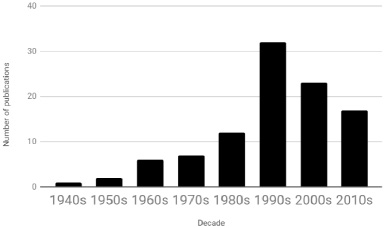
Number of publications per decade.
The manuscripts originated from 17 different countries, with the USA contributing the greatest number of both manuscripts and citations, with 49 and 5067 respectively (Fig. 2). 11 of the top 15 manuscripts also originated from the USA. The second most represented country was the United Kingdom, with 15 papers and a total of 1056 citations. The articles most frequently investigated the risk factors for male breast cancer, followed by management and comparisons against female breast cancer (Fig. 3).
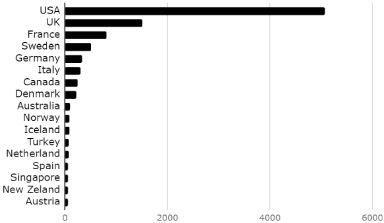
Countries with the highest number of citations.
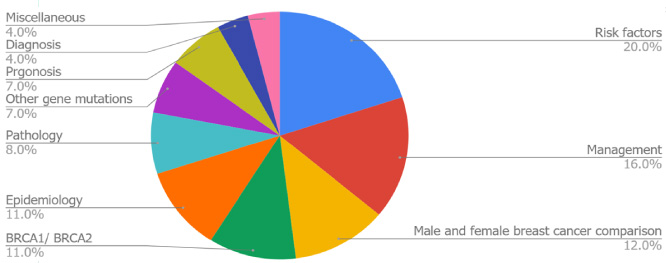
Topics covered by the top 100 papers.
Number of articles, citations, and impact factor of top 10 journal
The manuscripts were published across 47 different journals, ranging from 1 to 11 manuscripts per journal, with Cancer with the most publications and a total of 882 citations (Table 2). Despite only holding four of the top manuscripts, Nature Genetics accumulated 870 citations and ranked second in total citation count. Nature Genetics was also in the top 5 journals with the highest impact factor and 5-year impact factor. The journal with highest impact factor and 5-year impact factor was Lancet, with 59.10 and 54.66 respectively. However, despite having the highest impact factor of 59.1, Lancet only contributed 4 papers.
This analysis offers insight into developments in male breast cancer over the past decades and identifies authors and themes that produced the highest impact within the speciality. The top-cited paper in our analysis was by Thorlacius et al. which evaluated cancer phenotypes in single BRCA2 mutations in male and female breast cancer families from Iceland. 21 separate Icelandic families were studied, of which 9 had male breast cancer [8]. Wooster et al. performed genetic linkage research with 15 high-risk families and demonstrated that mutations of BRCA2, a tumour suppressor gene located on chromosome 13 [11], was also associated with female breast cancer, prostate cancer, pancreas cancer and ovarian cancer. At the time of discovery, in 1996, the importance of associating BRCA2 with other types of cancer was unparalleled. Four cases of MBC were observed in the same two families showing a correlation to BRCA2.
Following the discovery of Thorlacius et al., there was a spike of publications on male breast cancer, increasing from a mere 12 publications per decade in 1980s to a peak of 32 in the 1990s. The trend continued, albeit to a lesser effect, until the 2010s where research interests still exceed those of the 1980s and before. Similarly, coinciding with that period was a shift in research interests from risk factors, epidemiology and management of male breast cancer towards BRCA mutation research and comparisons male and female breast cancer from 1990s onwards.
The article with the second most citation was ‘Male breast cancer’ by Professor Fentiman, published in the Lancet in 2006 and provides a comprehensive overview of male breast cancer [12]. Majority of the sources used in the review were also published in or after the 1990s, further supporting the paradigm shift and increased attention in male breast cancers since the work by Thorlacius et al. As it covered topics including risk factors, presentation, diagnosis, histopathology, management and psycho-social aspects of disease, it serves as a landmark compendium on the subject for both specialists and amateurs alike.
Similarly, the third most cited study was about BRCA2 germline mutations in male breast cancer cases and breast cancer families by Couch et al. published in the Nature Genetics in 1996 [13]. It used conformation sensitive gel electrophoresis analysis of PCR amplified DNA in 50 males with breast cancer and 26 females with site-specific breast and breastovarian cancer families checking for BRCA2 mutations variants. The analysis detected nine disease-associated mutations and BRCA2 mutation was responsible for 14% of the male breast cancer case. The article suggested the majority of MBC are caused by non-coding mutations in BRCA2 [13].
There is a rising trend of MBC worldwide. Contractor et al. studied the incidence trend of male breast cancer from 1960-2000 using the Cancer Mondial database [14]. The Age Standardised Incidence per 100,000 population has increased from 0.5 to 1.1 in USA New York State. The rising incidence globally means there is a definite need to conduct more multi-centred studies, collaborating data about every case including age, demographic and risk factors such as hormone and genetics.
Our analysis found that over one-fifth of the top 100 papers examined risk factors for breast cancer in men (Fig. 3). This is crucial for accurately identifying high-risk groups that may be benefited from undergoing screening programmes. In addition, raising awareness of self-assessment in this particular male population can potentially lead to early diagnosis. Even though the late diagnosis is recognised as the main reason for poor prognosis for male breast cancer, only 4% of the top 100 papers studied the diagnostic aspect of male breast cancer. The late diagnosis has an impact on the mortality rate of breast cancer after diagnosis is higher in males than in females and warrants further research attention [15]. Breast cancer screening programmes have proved that early detection of breast malignancy is key for better prognosis. However, with the combined relative rarity of male breast cancer and general lack of awareness, men tend to present late, resulting in often late, life-threatening, diagnoses.
Limitations
Like other bibliometric analyses, the amount of citation an article receives might not directly reflect the scientific significance of a paper. As the scientific community had longer exposure to older manuscripts, they may amass a disproportionately high number of citations irrespective of their relative significance. Journals with high impact factor like Nature tend to attract more citation, but it may not correlate to the scientific importance of the article. Alternatively, recently published manuscripts on this list may have added significance due to the article amassing citations in a relatively short time frame. There are also other biases that were not accounted for, including self-citation, institutional and language bias, and may also affect the citation count, citation rate and the position of a manuscript within our list. As previously identified, the high citation number of articles originating from the USA may be attributable to preferential citation of local research and self-citations. Finally, the Web of Science database is not fully inclusive of all available literature or indexes globally and, hence, might not provide truly representative citation counts.
Conclusion
The most cited papers mentioned in this study described genetics and epidemiology for male breast cancer, improving the management of male breast cancer. Most articles published in high impact journals have at least 100 citations, reflecting their quality and impact to the field. The most cited paper by Thorlacius et al., who studied the relationship between BRCA2 and various cancers, and was followed by advancements in the field since the 1990s. This bibliometric analysis allows researchers to identify the most important advances, as well as gaps in knowledge such as MBC diagnostics, in the field of male breast cancer research. The ongoing research in male breast cancer will likely influence this list in the coming years. Readers should also consider how these papers influence our clinical practice. In order to draw more interest towards MBC, perhaps more effort should be put into publishing studies in journals with higher impact factors and more targeted audience base.
Footnotes
Acknowledgements
There was no patient or public involvement in the conception, design or data collection of the study or in the production of the manuscript.
Conflicts of interest
No funding or conflict of interest to be disclosed.