




Abstract
We analyze an approximate interior transmission eigenvalue problem in
Keywords
Introduction
Transmission eigenvalue problems have become an important area of research in inverse scattering theory. We refer the reader to [4] for a recent survey article, or to [5,12] and the references therein. The relation of transmission eigenvalues to cloaking, or to so-called non-scattering wave numbers is noteworthy [2,9,10,17,41]. At such wave numbers there exists an incident field which does not scatter, i.e. the obstacle becomes invisible, when probed by that incident field. In [7] we considered an approximate, transformation optics-based cloaking scheme for the Helmholtz equation that incorporated a Drude–Lorentz model [21,30] to account for the dispersive properties of the cloak. Specifically, the goal is to make
Here k denotes the wave number,
Interestingly, transmission eigenvalues exhibit non-discreteness: supported with numerical evidence, we conjectured that sequences of complex transmission eigenvalues accumulate at two finite points in the complex plane, namely the poles of the Drude–Lorentz term
With the motivation to have a better insight into the structure of this nonlinear transmission eigenvalue problem, in this paper we study a related Born transmission eigenvalue (BTE) problem. To be more precise, we note that for any fixed k one can expand
Broadly speaking, in the weak scattering regime, or when the contrast of an obstacle is small, i.e.
The fact that there are no real BTEs is a well-known consequence of positivity of m [6,15]. The existence of countably many BTEs is obtained by making use of the radial geometry and following [6]: separating the variables, BTEs are described as zeros of a family of analytic functions. Another important, but harder question is about the location of the transmission eigenvalues in the complex plane. Specifically, it is useful to obtain information about eigenvalue free regions. The so-called linear sampling method [3,8,11] provides a technique to obtain qualitative information about the location and the shape of the scattering obstacle, from the scattered far field data. For justification of the linear sampling method in the time domain, the questions of discreteness and location of eigenvalues (relative to the real axis) are essential. With this in mind, we show that BTEs stay away from the real axis, i.e. there exists a strip in the complex plane, parallel to and containing the real axis, which does not contain any Born transmission eigenvalues. This will allow one to use the Fourier–Laplace transform and consider the time-domain linear sampling method [8]. Moreover, we also conjecture that any strip parallel to the real axis contains at most finitely many BTEs. For simplicity of presentation we carry out the proof for the function m given by (1.3). However, our methods apply to general positive and radial functions m for which
Questions regarding the distribution of transmission eigenvalues in the complex plane, such as eigenvalue free regions were studied in [13,14,28,36,39,40]. However, there are not many works in this direction for BTEs. For example, in [6] among other things, the authors study the distribution of those BTEs that correspond to radially symmetric eigenfunctions. One of the consequences of [36] is that (for the ball with constant refractive index) all transmission eigenvalues lie in a horizontal strip containing the real axis. Our work exhibits qualitative difference between the distributions of transmission eigenvalues (TEs) and those in the Born regime (BTEs), it shows somewhat contrary, or dual behavior of BTEs, namely that all of them lie outside of some horizontal strip around the real axis. Or, invoking the conjectured stronger statement, all (but possibly finitely many) BTEs lie outside of any horizontal strip. Our proof uses Olver’s uniform asymptotic expansion of Bessel functions of large order in the complex plane in terms of Airy functions [32–34]. We also use contour deformations and Mellin transform techniques [42].
The main result
The transmission eigenvalue (TE) problem corresponding to the cloaking scheme described in the introduction is anisotropic, however changing the variables in the transmitted field inside the cloak using the map
Some remarks are now in order:
∙ Note that when we formally take limits in (2.1), the equation for
∙ Due to the singularity of m there are no eigenvalues of (2.2) in the radially symmetric case. Indeed, say
∙ It would be interesting to consider transmission eigenvalue problems like (2.2) in general domains with general singular weights m and analyze their solutions in the weighted Sobolev spaces mentioned above. This will be a task for the future.
The goal of this paper is to analyze the Born transmission eigenvalue problem (2.2). We point out that our core contribution is establishing part (iv) of the next theorem.
Let
There are no real, or purely imaginary BTEs.
There are infinitely many BTEs in
BTEs form a discrete set in
There exists
For any
Our methods of analysis for part (iv) apply to any positive and radially symmetric function
The starting point in proving the above theorem is to use the radial symmetry and separation of variables, as in [6] to characterize BTEs as zeros of a countable family of entire functions
Here we prove items
For
The set of zeros
In the radially symmetric case
Next we collect some basic properties of the functions
Let
Let
To prove the existence of infinitely many zeros of
Note that the above two lemmas directly imply items (i) and (ii) of Theorem 2.3. Now we turn to proving item (iii) of Theorem 2.3.
Let
We give the proof for We will use the large order asymptotic expansion of the Bessel function (cf. 9.3.1 of [1]): as Therefore, for j large enough
The goal of this section is to establish item (iv) of Theorem 2.3. Let us introduce
We remark that α is analytic in
Let
Let now
The above lemma directly follows from the uniform asymptotic formulas of Bessel functions due to Olver. Specifically we first use the formulas 9.3.35–9.3.42 of [1] to expand
With these preliminaries, let us start the proof of part (iv) of Theorem 2.3. For the sake of contradiction, assume that there exists a sequence
Unless stated otherwise, for the remainder of this section (including all the subsections) the limit and asymptotic relations are understood as
For each
Thus, we may assume
As described in Section 2, to achieve the desired contradiction our goal will be to establish a lower bound on
In each of these regimes the behavior of
Turning to the main ideas, we will present all the proofs when
The idea is to use the asymptotic relations in Lemma 4.1 to replace
Case I is treated in Section 4.1, Case II in Section 4.2 and Case III in Section 4.3.
In (4.8) for j large enough
It is straightforward to show that as
Applying this inequality, we conclude that for j large enough
The right hand side of the above asymptotic relation is real-valued and positive. This provides the desired contradiction.
Thus, to finish the proof it remains to establish (4.11). Let
Case II: The regime
Due to the relation (3.1) between the Bessel functions
We proceed by letting
As already discussed in the paragraph below (4.8), we first split the integral defining
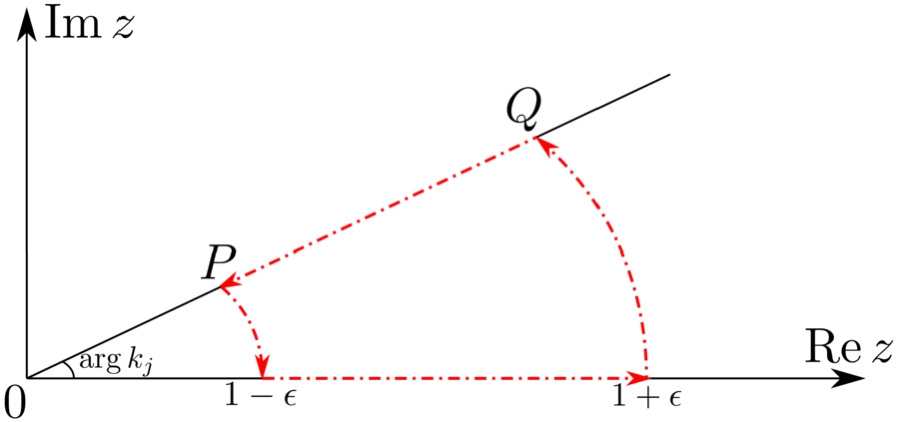
The contour of integration.
We are going to analyze the integral (4.15) via Mellin transform, however this technique does not work when z is complex (cf. Remark 4.7). Therefore, we first need to deform the integral of the analytic function
Note that
When
As the left hand side of the last expression does not depend on ϵ, we can take limits as
Let
We start by analyzing
For any t in the integration interval
This is a consequence of the explicit form of the function α and the proof can be found in part (ii) of Lemma A.1 in the Appendix (in fact, here we need the weaker version of the lower bound (A.18), where we drop the logarithm term. The stronger lower bound as formulated in (A.18) is needed in the case
Let us now turn to
As
Analyzing
via uniform asymptotics of the Bessel function
Let
The desired result will follow after showing
When
∙ We start from the term
Note that for any t in the integration interval
We now show that the dominant term comes from
Indeed, as the argument of f in
Let us show that the dominant term is
Indeed, e.g.
Finally, we show that
Next we need the following bound on the imaginary part of β (see part (i) of Lemma A.1 in the Appendix):
∙ Let us now turn to the analysis of
Note that, for some
The last term in the above inequality tends to zero as
As above, the cosine term is bounded uniformly in j and z. Hence, the integrand in (4.25) can be bounded by a constant, and as
We start by stating the main result of this section, which proves the third relation of (4.18).
Let
In particular, upon applying the dominated convergence theorem
Let
The above definition of
So the question is reduced to considering the function
If
Direct calculation shows
Originally, we started with an integral (cf. (4.15)) where in
That is,
With these preliminaries we are ready to prove Lemma 4.5, in the case In (4.31) let Our goal is to show that we can take limits as Since The remaining part of the proof is dedicated to establishing this bound. From now on let us always assume Further, in view of (4.34), as Using this relation, there exists a constant Using the basic estimates
Combining the bounds (4.37), (4.39) and (4.41) we deduce the bound
Let us show that Putting all these bounds together we obtain (4.36). □
The case
Recall that
Since
Analogously to Section 4.1, using that
The case
Let us fix a small
In the z integrals above we take the contour of integration to be the line segment connecting the two endpoints. Finally,
Similarly to Lemma 4.5, using Mellin transforms, it is straightforward to obtain the analogue of the equation (4.28) for the above integral
The term
Finally,
Combining the above results we obtain
This contradicts the fact that In the case
This case is delicate, as the behavior of
Using that f appearing in
We remark that the Mellin transform approach does not yield the leading asymptotic behavior of
The behavior of
This provides the desired contradiction.
When
The conclusion (4.46) will follow after establishing
We start from the second assertion. In view of (4.44), it is enough to prove that
Note that
Note that the first factor in (4.48) stays bounded, and so does the term
Let us consider now the integral
Indeed, once we open up the square in (4.48), multiply the result by
Therefore, we can concentrate on the remaining factors, for example the term
The well-known asymptotic relations ([1] 10.4.61 and 10.4.62) for the derivative of the Airy function imply that for some
Applying this bound we conclude that (4.49) converges to zero uniformly in z, as
So it remains to analyze
First, note that in view of the asymptotics of
It remains to show that the dominated convergence can be applied, which follows as the Airy function decays exponentially near infinity, f is bounded, and the product of the second and third factors of the integrand in (4.50) is also bounded. Indeed, the latter statement follows as the function
Indeed, note that if there is no subsequence for which
(i) In this case the decay of
In fact, the above quantity goes to infinity as
For
(ii) In this case the decay of
Let us suppress the t-dependence from the notation of
The rest of the argument of obtaining a lower bound on
Footnotes
Appendix
Acknowledgements
The author would like to thank F. Cakoni for suggesting the problem under consideration and to M. Vogelius and F. Cakoni for many fruitful conversations.