For several different boundary conditions (Dirichlet, Neumann, Robin), we prove norm-resolvent convergence for the operator in the perforated domain , , to the limit operator on , where is a constant depending on the choice of boundary conditions.
This is an improvement of previous results [Progress in Nonlinear Differential Equations and Their Applications31 (1997), 45–93; in: Proc. Japan Acad., 1985], which show strong resolvent convergence. In particular, our result implies Hausdorff convergence of the spectrum of the resolvent for the perforated domain problem.
In this article we study the following homogenisation problems labelled by (“D” for Dirichlet, “N” for Neumann, and “α” for Robin). Let , be open (bounded or unbounded) with boundary. For unbounded domains Ω we assume translation invariance, i.e., for any . Let and denote where , is the ball of radius
centered at the point , and
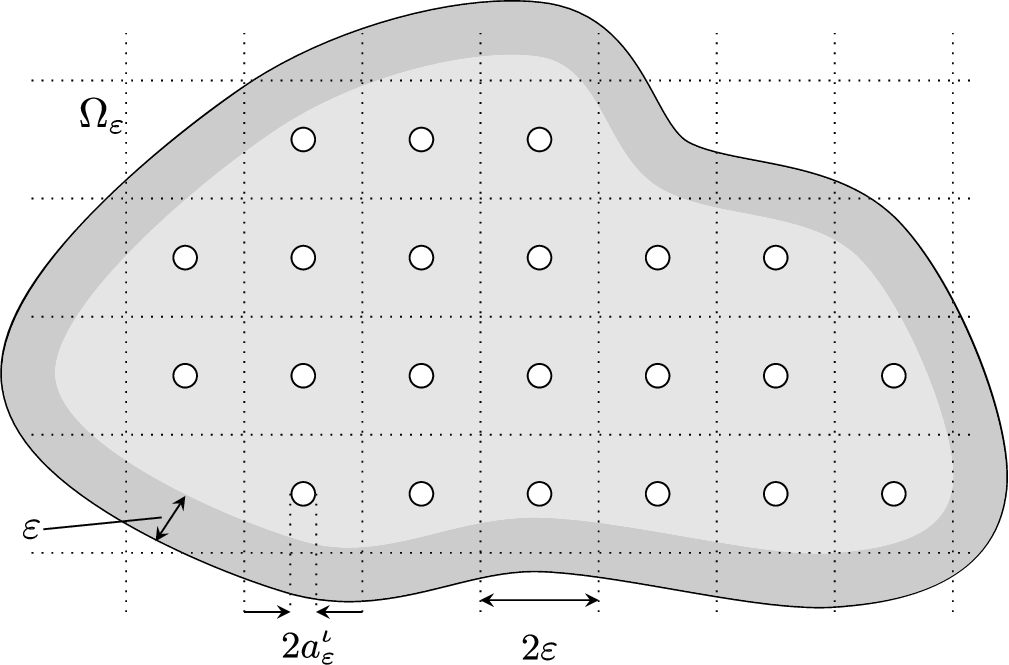
Consider the boundary value problems (cf. Figure 1)
i.e. the resolvent problem for the Laplacian, subject to the Dirichlet, Neumann and Robin boundary conditions, respectively. It is easy to see, using the Lax–Milgram theorem, that for all each of these problems has a unique weak solution . It is a classical question, which we refer to as the homogenisation problem, whether the family of solutions to (
Dir
), (
Neu
), (
Rob
), obtained by varying the parameter ε, converges in the sense of the -norm to a function as and whether the limit function u solves, in a reasonable sense, some PDE whose form is independent of the right-hand side datum f.
Sketch of the perforated domain.
Homogenisation problems of this type have been studied extensively for a long time [2,5,7,11]. For example, results by Cioranescu & Murat and Kaizu give a positive answer to the previous question for all three choices of boundary conditions at least in the case of bounded domains. In fact, they showed that the solutions of (
Dir
), (
Rob
), (
Neu
) converge strongly in to the solution of , where
where denotes the surface area of the unit ball in .
In this article we attempt to improve this result in two directions. First, we show the above convergence not only in the strong sense, but in the norm-resolvent sense (that is, the right-hand side f is allowed to depend on ε). Second, our result is then extended to the case of unbounded domains. As a corollary, we obtain a statement about the convergence of the spectra of the perforated domain problems (
Dir
), (
Neu
), (
Rob
) as .
The paper is organised as follows. In Section 2 we will briefly give a more precise formulation of the problem and include previous results. In Section 3 we will state our main result and its implications. Sections 4, 5 and 6 contain the proof of the main theorem and in Section 7 we consider implications of our main theorem for the semigroup generated by the Robin Laplacian. Section 8 contains a brief conclusion and discusses open problems.
Geometric setting and previous results
As above, assume , and let
where , as in (1.1), (1.2). Denote . We also denote and for . Constants independent of ε will be denoted C and may change from line to line. Note that our assumptions on Ω ensure that the set is dense in (cf. [1, Cor. 9.8]) in the cases .
Moreover, since we are dealing with varying spaces , it is convenient to define the identification operators
where v is the harmonic extension of u into the holes, i.e.
Foras above, one hasMoreover,are uniformly bounded in ε.
The only nontrivial statement is (2.6). To prove this, let . Then . To show that this quantity converges to 0 uniformly in f, denote for a cube shifted by k, so that . Then we have
for with , by Hölder’s inequality. Since , we can use the Gagliardo–Sobolev–Nierenberg inequality to conclude (for suitable q) that
with some suitable . Since as (cf. the definition of , (1.1)), the desired convergence follows. □
In the casesthe harmonic extension operatorsatisfies
In the above geometric setting, we will study the linear operators , in , defined by the differential expression , with (dense) domains
respectively, and the linear operators in defined by the expression , with domains
respectively, where , , are defined in (1.3).
In the case when one has the characterisation
Note that the factor arises from the fact that the unit cell is of size .
Using the notation above, we recall the following classical results.
Letbe open (bounded or unbounded), and suppose thatis smooth. Suppose also that, and letandbe the solutions toThen one has
The results are obtained by following the proofs of [2, Thm 2.2], [5, Thm 2]. Note that the weak convergence in is immediately obtained also for unbounded domains (and complex α). □
An important ingredient in the proofs are auxiliary functions defined, for each , as the solution to the problems
used as a test function in the weak formulation of the problems (
Dir
), (
Neu
), (
Rob
).
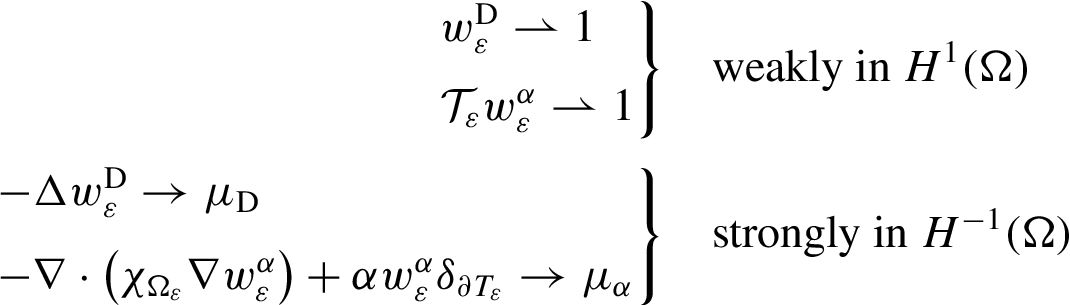
These functions were used in [2,5] as test functions to prove strong convergence of solutions. They are “optimal” in the sense that they minimise the energy in annular regions around the holes. In the Dirichlet case, the function is nothing but the potential for the capacity . It can be shown that one has the convergences
as , where denotes the Dirac measure on the boundary of the holes (for a proof of the above facts, see [2, Lemma 2.3] and [5, Section 3]).
Main results
In what follows we prove the following claim.
Letbe defined as in the previous section. Then forone hasthat is, the operator sequenceconverges toin the norm-resolvent sense.
Ifare as in Theorem
3.1
, thenwhereis as in (
2.2
).
For notational convenience, denote and . A quick calculation shows that
since . Hence
as , by (3.1) and uniform boundedness of . □
We note an important consequence of the above theorem.
For the definition of Hausdorff convergence, see e.g. [12].
First, note that the spectra of converge to that of , in the sense that for each compact there exists such that for all . The proof of this is obtained by combining the proofs of Lemma 3.11, Theorem 3.12 and Corollary 3.14 in [8]. On the other hand, an analogous proof using (3.2) and (2.6) shows that if for almost all , then . Together these two facts imply Hausdorff convergence. □
In particular, this corollary shows that (if ) a spectral gap opens for between 0 and .
We note that our assumption on the spherical shape of the holes was made for the sake of definiteness, however, our results easily generalise to more general geometries as detailed in [2, Th. 2.7]. Moreover, our results are also valid for more general elliptic operators with continuous coefficients A (cf. [2]).
Uniformity with respect to the right-hand side
In this section we prove that the result of Theorems 2.4, 2.5 hold in a strengthened form, namely, uniformly with respect to the right-hand side f. More precisely, the following holds.
Suppose that,,, with, and letandbe the solutions to the problems ()Then for every bounded, openone hasfor.
We have the following a priori estimates (note Lemma 2.2):
Thus, there exists a subsequence (still indexed by n) and such that
Note that that for every bounded the convergence statements (4.3) are strong in . In particular, employing Lemma 2.2(i), (iii) and the Rellich Theorem we immediately obtain
for all . Next, choose a further subsequence (still indexed by n) such that also weakly in , where the limit f may depend on the choice of subsequence. Now, consider the weak formulations of the problem (4.2), i.e.
where for and for . Letting and using the convergencies (4.4), (4.5) (with ) we obtain
Next consider the weak formulation of (4.1),where we choose the test function :
where again for and for . It follows from the results of [2,5] that the left and right-hand side of this equation converge to
respectively. Thus, we obtain
and hence and are weak solutions to the same equation. Uniqueness of solutions (for all ) implies , which shows the assertion for the chosen subsequence.
Finally, applying the above reasoning to every subsequence of yields the result for the whole sequence. □
If the domain Ω is bounded, one hasfor, i.e., Theorem
3.1
holds in that case of bounded Ω.
Since Ω is bounded, the embedding of in is compact, thus the sequence from the previous proof has a subsequence converging to 0 strongly in . Since this can be done for every subsequence of , the whole sequence converges to 0.
Now, choose a sequence , such that
By the above, the right-hand side of this inequality converges to zero, which implies the claim. □
Treating unbounded domains requires further effort. Since we lack compact embeddings in this case, we will have to take advantage of the sufficiently rapid decay of solutions to and a decomposition of the right hand side with a bound on the interactions.
Exponential decay of solutions
We begin with a general result which we assume is classical, but include for the sake of completeness. Let open satisfying the strong local Lipschitz condition, and consider the problems (cf. (
Dir
), (
Neu
), (
Rob
))
Let , and define the function . Then the following statement holds.
Let,compact. Then each of the problems (
5.1
)–(
5.3
) has a unique weak solutionsatisfyingwhere.
We postpone the proof, in order to introduce some notation and prove auxiliary results. First, let us denote and introduce the weighted Sobolev spaces , with scalar product
Moreover, let and define the sesquilinear forms
Forand, the formis continuous and coercive on(onin the case).
We will only treat the Robin case here, the other cases being analogous. Denote by I the second term in (5.6) and note that ω was chosen so that . By Hölder’s inequality with respect to μ one has
and thus
which shows coercivity in . Continuity follows by estimating the boundary term. By the trace theorem [3, Prop. IX.18.1] we have, for each ,
The first term can be estimated using the special choice of ω:
The desired continuity now follows immediately by combining (5.9) and (5.10). □
Let,, and suppose thatis compact. Then the problemhas a solution in.
By Hölder inequality, one has
so . The assertion now follows from Lemma 5.2 and the Lax–Milgram theorem for complex, non-symmetric sesquilinear forms [13, Thm. VI.1.4]. □
Again we focus on the Robin case, the other cases being analogous. Denote by u the solution obtained from Lemma 5.3. Then , since . Moreover, let be arbitrary and decompose it as . Then and one has
Thus, the function u solves the problem
Uniqueness of solutions and density of in implies that u is the weak solution in to the Robin problem (5.1).
The estimates (5.4), (5.5) follow from the coercivity of . □
Decomposition of the right-hand side
In this section we consider the case of unbounded Ω. We conclude the proof of Theorem 3.1 by decomposing the domain into cubes , writing and then applying the above results to each term . The following lemma shows uniform convergence with respect to the position of the cubes.
Letand,, be such thatand, wherewith. Letbe the solutions to the problemsThenfor all.
The idea of the proof is to use translation invariance, in order to shift back near zero for every n, and then use the Fréchet–Kolmogorov compactness criterion to obtain a convergent subsequence of ; Theorem 4.1 will identify its limit as zero. Since the following analysis is independent of the choice of boundary conditions, we henceforth omit ι to simplify notation.
We now carry out the outlined strategy. We set, for all ,
These functions still solve the problems (6.1) with replaced by and Ω replaced by . The new sequence has the nice property that for all n. In the following we consider as elements of that are zero outside . We will now show that converges to zero in . To this end, consider the bounded set
Claim: is precompact in .
We postpone the proof of this claim to Lemma 6.2. We immediately obtain that has a convergent subsequence in . Furthermore, Theorem 4.1 shows that for every bounded which identifies the limit of the subsequence as zero.
Arguing as above for all subsequences of , we conclude that in . Since the shift is an isometry in , this implies that in . □
We will use the notation and conventions from the previous proof and distinguish between the Dirichlet case and the Robin/Neumann cases.
Dirichlet case. Step 1: We have
where denotes the operator of translation by h. Indeed, the standard regularity theory implies
Step 2: Notice that
due to the following estimate in which we set .
which completes Step 2. Applying the Fréchet–Kolmogorov theorem yields the precompactness of .
Neumann and Robin case. Here the strategy is the same, but matters are complicated by the fact that is not in . To show that is precompact, we decompose elements in as
define , and show that and are precompact in . We will begin by showing that is precompact. To this end, denote by an extension operator satisfying and for all (cf. Prop. VII.19.1 and Remark VII.19.2 in [3]). Note that by translation invariance one has and . We start by proving that
This readily follows from the estimate
Next we prove that
Indeed, notice first that
To treat the two terms on the right-hand side we apply Lemma 2.2(ii) and Proposition 5.1 with as follows. For the second term in (6.3), we obtain
where we use the fact that is bounded by 2 on . With an analogous calculation for the first term in (6.3), we finally find
with C independent of n. Applying the Fréchet–Kolmogorov theorem yields the precompactness of the set . Finally, noting that and that multiplication by is a bounded operator on we obtain precompactness of .
To prove precompactness of , first note that by Lemma 2.2(iii) for any there exists a such that
Let us fix arbitrary and as above. It remains to estimate the terms
but these are only finitely many, which clearly converge to zero individually, and hence
Altogether we have shown that
Since was arbitrary we finally get
This completes the first Fréchet–Kolmogorov-condition. The proof of the second condition
is analogous to the case of . Applying the Fréchet–Kolmogorov theorem yields precompactness of and completes the proof. □
There existswithsuch thatfor alland.
We argue by contradiction. Suppose that there is no such function . Then there exist sequences with such that does not converge to zero, which is a contradiction to Lemma 6.1. □
In order to finalise the decomposition, we require he following two lemmas.
Suppose that, and denoteThen one hasfor allwith, wheredenotes the standard inner product in.
For convenience we write , . Denote and note that by Proposition 5.1 we have . The statement of the lemma is a consequence of the following estimate:
where we use the fact that and . □
Suppose thatand define,. Then for everyone has the inequalitywhere N is the number of cubes such that, anddo not depend on N.
We now study the last term of (6.7). It follows from Lemma 6.4 that
Using this fact and fixing k for the moment, we obtain
Summing this inequality from to infinity concludes the proof. □
Combining the above lemmas, we have the following quantitative statement.
Suppose that. Then for every,for some, wherewas defined in Corollary
6.3
.
We denote , , and estimate
□
Let with . Fix and choose such that and choose such that . Now compute
hence
and therefore
Since is arbitrary, the result follows. □
Behaviour of the semigroup
In this section we want to give an application of Theorem 3.1. In particular, we focus on the non-selfadjoint operator and study the large-time behaviour of its semigroup. In order to do this, we shall first study the numerical range of the Robin Laplacians more closely. In the remainder of this section, unless otherwise stated, the symbols and will denote the (operator-) norm and scalar product, respectively, and the symbol denotes a sector of half-angle θ in the complex plane.
Decay of
Let and assume . We want to study the decay properties of the heat semigroup . To this end, let us denote by the Robin Laplacian on Ω. It is our goal to derive estimates on the numerical range of . Let and assume that . Notice that
and therefore
Now, let and compute
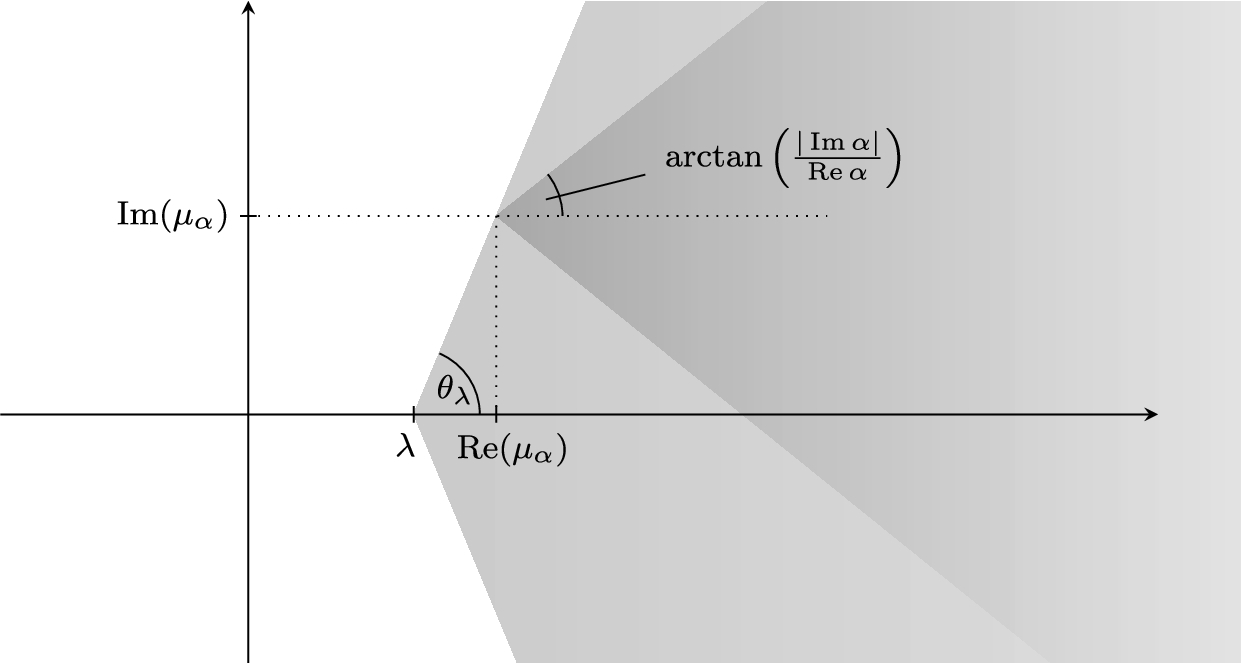
Recall from Section 1 that and hence . Combining this with (7.1), we obtain (cf. Figure 2)
The sector of decay and angle for .
Using standard generation theorems about analytic semigroups, the next statement follows.
The operatorgenerates a bounded analytic semigroup in the sector, whereEquivalently,generates an analytic semigroup with
In this section we denote . By calculations analogous to the above, we have
that is, is sectorial with sector , where , and hence generates a bounded analytic semigroup in the sector . In this subsection we improve this a priori result using spectral convergence. To this end, let and define the compact set
Note that then . By [4, Th. III.2.3] one has for every . Applying Corollary 3.3 we see that for every there exists a such that for all .
In particular we have shown that the resolvent norm is bounded on . By a trivial calculation analogous to the previous subsection this leads to the following statement.
For everyone has
Furthermore, we obtain the following lemma.
For everyone hasand there exists asuch that
This is obtained by combining Lemma 7.2 with the following two facts:
□
By the theory of analytic semigroups (cf. [6, Ch. IX.1.6]), we immediately obtain the following corollary.
For all, the operatorgenerates a bounded analytic semigroup in the sector.
This yields the main result of this section, as follows.
For everythere existssuch that for everythere existssuch that
It is straightforward to repeat the above proof for the case of Dirichlet boundary conditions to obtain an analogous result for . Here, the selfadjointness of allows us to choose the half-angle θ arbitrarily close to .
Conclusion
We have shown norm-resolvent convergence in the classical perforated domain problem with Dirichlet boundary conditions which has the interesting implication of spectral convergence (Cor. 3.3). Some questions remain open and will be addressed in the future. While the norm converges to 0, it is not clear from our method of proof how fast this happens. It would be desirable to obtain a precise convergence rate. In the case of Dirichlet boundary conditions a explicit convergence rate has been found by [10]. Another interesting question is whether in the case there exist gaps in the spectrum of and how these depend on ε. The existence of spectral gaps has been confirmed in two dimensions [9], but to the authors’ knowledge the higher-dimensional case is still open.
Footnotes
Acknowledgements
KC is grateful for the financial support of the Engineering and Physical Sciences Research Council (UK): Grant EP/L018802/2 “Mathematical foundations of metamaterials: homogenisation, dissipation and operator theory”.
D.Cioranescu and F.Murat, A strange term coming from nowhere, Progress in Nonlinear Differential Equations and Their Applications31 (1997), 45–93.
3.
E.DiBenedetto, Real Analysis, Birkhäuser Advanced Texts, Birkhäuser, Boston, 2002.
4.
D.E.Edmunds and W.D.Evans, Spectral Theory and Differential Operators, Oxford Mathematical Monographs, Oxford University Press, 1987.
5.
S.Kaizu, The Robin problems on domains with many tiny holes, in: Proc. Japan Acad., Ser. A, Vol. 61, 1985.
6.
T.Kato, Perturbation Theory for Linear Operators, Classics in Mathematics, Springer, 1995, reprint of the corr. 2nd edition.
7.
V.A.Marchenko and E.Y.Khruslov, Boundary-value problems with fine-grained boundary [in Russian], Mat. Sb. (N. S.)65(107) (1964), 458–472.
8.
D.Mugnolo, R.Nittka and O.Post, Norm convergence of sectorial operators on varying Hilbert spaces, Operators and Matrices7(4) (2013), 955–995. doi:10.7153/oam-07-54.
9.
S.A.Nazarov, K.Ruotsalainen and J.Taskinen, Spectral gaps in the Dirichlet and Neumann problem on the plane perforated by a double-periodic family of circular holes, Journal of Mathematical Sciences181(2) (2012). doi:10.1007/s10958-012-0681-y.
10.
O.Post and A.Khrabustovskyi, Operator estimates for the crushed ice problem, ArXiv e-prints, arXiv:1710.03080.
11.
J.Rauch and M.Taylor, Potential and scattering theory on wildly perturbed domains, J. Funct. Anal.18 (1975), 27–59. doi:10.1016/0022-1236(75)90028-2.
12.
R.T.Rockafellar and R.J.-B.Wets, Variational Analysis, Grundlehren der Mathematischen Wissenschaften [Fundamental Principles of Mathematical Sciences], Vol. 317, Springer-Verlag, Berlin, 1998.
13.
A.E.Taylor and D.C.Lay, Introduction to Functional Analysis, Wiley, 1980.