




Abstract
This contribution reflects on the current role of ontologies in terminology research and practice and their future role, especially with a view to the creation of fully digital terminographic resources. The very notion of (domain) ontology, its concept and term, is discussed, highlighting metaterminological differences and substantial ambiguities arising from the interdisciplinary contact between Ontology Engineering and Terminology. Major challenges in ontology building, e.g. subjectivity, are mentioned, also with respect to the distinction between realist and non-realist ontologies and their relevance in Terminology. In addition, this contribution presents some examples of terminology resources with a distinct ontological component, showing a diversity of approaches depending on the purpose of the resource and its scope. In this context, more specific topics are addressed, such as the acquisition of ontological data and suitable formats and models for representing domain knowledge. The contribution ends with a vision of the integration of complex concept systems such as ontologies in future terminology work: here, the development of models based on terminology-specific requirements and typical users will be fundamental.
Keywords
Introduction
In the past decades, Terminology studies have experienced a paradigm shift concerning the notion of a concept system and its relation to the lexical system in a given specialized field. As already emphasized by Temmerman and Kerremans (2003: 1) twenty years ago, three shifts have simultaneously affected the discipline of Terminology: “the shift towards computational terminology management, the linguistic shift in the theory of terminology and more recently the ontology shift”. In the present contribution, Terminology is understood by two of its typical meanings, namely “the study of and the field of activity concerned with the collection, description, processing and presentation of terms, i.e. lexical items belonging to specialized areas of usage of one or more languages” (Sager, 1990: 2). As pointed out by Sager, the discipline is very close to lexicology and lexicography, but differs from them in the nature of the data under analysis, of the people involved in communication, and, partly, in the methods employed (ibid.: 3). In this contribution, we will refer to Language for Special Purposes (LSP), which is common in the field of specialized lexicography, to indicate the whole language (structures) of a specialized field including terminology (here in its third meaning), namely the specialized vocabulary of the field.
In both traditional Wüsterian terminology (Wüster, 1991) and later approaches to Terminology, such as Sociocognitive terminology (Temmerman, 2001), Termontography (Temmerman & Kerremans, 2003), and Frame-Based Terminology (Faber, 2015), the idea of a connection between terms and concepts of a domain, is a fundamental assumption which affects terminology work and terminographic practice. This conceptual orientation in terminology can thus be seen as a guiding principle which governs the way in which studies in Terminology are designed and carried out independently of their specific theoretical and practical approach, as well as independently of the extent to which the two focal terminological dimensions (terms and concepts) are specifically analysed. In making this statement, we intentionally leave out those important strands of terminological studies that have focused on communicative and discourse-oriented aspects (cf., among others, Cabré, 2008). Instead, we want to explicitly focus on concepts as an essential point to be discussed when dealing with ontologies in terminology.
A concept system in Terminology is a (frequently non-formal) representation of the concepts relevant in a domain, mostly a taxonomy (cf. Arntz, Picht & Schmitz, 2016). When it comes to ontologies as a type of concept system, the lines between Terminology and Ontology Engineering (OE) suddenly get blurred, and a grey zone comes to light in which the two disciplines merge at different degrees. Ontology Engineering deals with the process of ontology development, providing standard components for building knowledge models (Gal, 2009). Although similar definitions do not usually mention formalization as one of the goals of knowledge modelling as developed by OE, this is crucial implicit information which needs to be taken into account when talking about ontologies in the two disciplines.
In this contribution, reflections will be made on the current role of ontologies in Terminology research and practice and their future role, especially with a view to the creation of fully digital terminographic resources. This paper is concerned with the general notion of ontology in Terminology as well as with some crucial metaterminological issues which arise from interdisciplinary contact between Terminology and OE. All phenomena and problems described in the paper have been primarily observed in the context of case studies on domains related to natural objects and technical artefacts. However, given their general nature, they are likely to have great cross-domain validity. Innovative ontological resources presented at the end of the paper are punctual examples pertaining to a limited number of domains but the underlying models could potentially be applied to several other specialized fields.
Interactions between terminology and ontology engineering
The subject under discussion: Metaterminological issues and discipline-oriented definitions
Interdisciplinarity and intertextuality are common phenomena described in Terminology and Specialised Communication studies (cf. Möhn & Pelka, 1984 Schubert, 2007, Heidrich, 2017). If we completely disregard the natural interplay with other linguistic domains, it can be argued that Terminology has always interacted with several other non-linguistic disciplines, thus gaining (and certainly delivering) important theoretical and methodological cues. In this sense, it is not surprising that, especially in a time in history in which the digitalization of linguistic resources has become crucial, Terminology has made connections with computer science and related disciplines. However, as is often the case, interdisciplinary interactions lead to metaterminological issues concerning the meaning and use of shared terms, especially when these are subject to resemantization.
What is (an) ontology?
Some interesting metaterminological issues can indeed be detected when comparing the meaning of some key designations (I will intentionally not use the word term) used in Terminology and OE. Unfortunately, state-of-the-art literature in Terminology does not address these issues accurately enough, which frequently results in inconsistencies, ambiguities, or otherwise lack of clarity. For instance, no ontology-related definitions appear in the main reference documentation on metaterminology, for instance in the ISO standards: here, the topic of ontologies is dealt with only in the field of Information Technology and a few other fields (e.g. Health informatics, Geographic information).
A fundamental starting point for all disciplines dealing in some way with Ontology is a linguistic differentiation. As pointed out by Guarino, Oberle & Staab (2009), ontology is both an uncountable and a countable noun. In the former case, ontology is a branch of philosophy initiated by Aristotle as the study of attributes belonging to the nature of things. From this point of view, ontology “deals with the nature and structure of reality”. By focusing on things per se, it also differs from experimental sciences, which “aim at discovering and modelling reality under a certain perspective” (ibid.: 1). As a countable noun, ontology, mostly used in Computer Science, stands for a “special kind of information object or computational artifact, [
The notion of ontology in OE and in terminology. The definition of ontology in the computational sense in OE has itself an interesting history, which took place primarily in the 1990s and is largely made of small and yet fundamental adjustments to an original core definition. In 1993, Gruber defined an ontology as the “explicit specification of a conceptualization”, in which the term conceptualization is intended as an extensional relational structure between the set “universe of discourse” and a set of relations on the former (cf. Genesereth & Nilsson, 1987 as mentioned in Guarino et al., 2009: 3). Gruber’s definition was later modified by Borst (1997), who defined an ontology as a “formal specification of a shared conceptualization”. Here, the word ‘shared’ stresses a significant requirement of ontologies (and concept systems in general): their content needs to rely on a common (or at least widely shared) view of the represented things.1
This relates to the typical issue of subjectivity of ontologies (cf. Section 2.2).
One last aspect needs to be taken into account when considering the notion of ontology in OE and in Terminology. In OE, ontology sometimes does not designate a type of content but a type of data format. As pointed out by Gruber (2009), “In the context of database systems, ontology can be viewed as a level of abstraction of data models, analogous to hierarchical and relational models, but intended for modelling knowledge about individuals, their attributes, and their relationships to other individuals”. Relevant literature thus includes a number of studies which compare ontologies and databases, e.g. relational databases (cf., among others, Ramis Ferrer et al., 2021, Sir M. et al., 2015, Martinez-Cruz et al., 2012, Weigand, 1997; cf. also Mizoguchi & Ikeda, 1996 on the depth of ontology use, structured in eight levels).
In Terminology, ontologies are usually not regarded as technologies for knowledge representation but rather as repositories for conceptual data which are systematically linked to lexical data (terms). The terminological, intrinsically linguistic notion of ontology is often in contrast to the one established in the field of OE and provided by current ISO standards.
With few exceptions (e.g. in the context of Termontography), we observe a general lack of definitions, which suggests that the notion of ontology is borrowed for all intents and purposes from other disciplines and does not yet have its own identity in the field of terminology.
Different concept systems with different distributions. Ontologies are one of the many different concept systems described in knowledge engineering. Davies (2010) highlights the expressivity continuum identified by some typical formal systems, which range from term lists to glossaries, taxonomies, thesauri, and finally ontologies.2
We consider the model described by Davies (2010) as a clear example of categorization of concept systems on an axis, which indicates the different degrees of complexity of the system in terms of degree of information, complexity, and degree of formalization. Another model is the one proposed by Lassila & McGuinness (2001) in which ontology is used as a generic term (the ontology spectrum) that includes several individual types (in this sense, for example, thesauri would be a type of lightweight ontology).
When comparing Terminology and OE, however, it is evident that a smaller number of conceptual models are described in the former. The overall impression is that taxonomies, i.e. the basic model, turn into ontologies when they start to include non-hierarchical relations. It should also be emphasized again that in Terminology the focus is not on the formalization of conceptual data but on the relationship between the linguistic level and the conceptual level. In a way this explains the different amount and distribution of concept systems in relevant literature across the two disciplines. This equally relates to the distinction found in OE between lightweight and heavyweight ontologies, where the latter term denotes complex systems, e.g. the Suggested Upper Merged Ontology (SUMO,
Wordnets as a further conceptual model. One possible addition to relevant conceptual models in Terminology, which, to the best of our knowledge, has not been considered in the related textbooks so far, are wordnets. These can be developed according to the typical structure of the forerunner, the Princeton WordNet, and are obviously to be considered a hybrid form of lexical and conceptual resource which offers a flexible way of defining different types of relationships between synsets (i.e., between the nodes forming the network). Unfortunately, wordnets have only been sporadically applied to LSP and these applications are generally lacking in scientific studies, so it is difficult to assess the practical utility of this type of concept system in Terminology (cf. Giacomini, 2023). Some examples are the Italian wordnets Jur-WordNet for the legal domain (Sagri et al., 2004) and ArchiWordNet for the domain of architecture (Bentivogli et al., 2003), as well as the German TermNet for the technical domain (Beißwenger, 2008). TermNet data are represented in the OWL language and are linked with a section of GermaNet (Kunze & Lemnitzer, 2007: 139–148), the most popular wordnet for the German language. It is also worth mentioning WordNet Domains (
These observations lead us to a final consideration concerning the nature of concept systems in Terminology. Several terminological resources, typically termbases, display basic conceptualization structures in the form of semantic relations of terms. These relations are usually embedded in term entries and presented as semantic labels of term senses: they provide conceptual links between terms but are not meant to build an autonomous concept repository. Still, this type of data could easily be reused to become (or to be the foundations of) an explicit taxonomy or even an ontology.
The representational primitives mentioned by Gruber (2009), which are the building blocks of a formal ontology, have been designated in different ways across literature. Metaterminology in this case is not homogeneous. Rather than being an issue of terminological consistency, this appears to be due to the coexistence of various formal approaches (e.g. Object-Oriented Programming, Description Logics, but also ontology-related languages such as RDF and OWL) and their corresponding terms. While some authors mention classes, attributes, and relations among classes as key ontological components, others write about entities/objects and relations (cf. Keet, 2018). This type of terminological variation only partially affects Terminology, in which the elements of a concept system, and specifically of an ontology, are usually denoted as concepts in order to maintain the crucial distinction between concepts and terms.3
Cf. Faber & L’Homme (2022) for a collection of recent papers in Terminology which clarify the notion of concept in this discipline. For an overview of concept-related cognitive studies relevant to linguistics (and terminology work) see also Margolis & Laurence (1999).
In turn, the use of concept in OE appears to not always be entirely clear, while sometimes it is rightly described as a controversial notion. For instance, Arp et al. (2015: 7) states: “We do not deny that mental representations have a role to play in the world of ontologies. [
A substantial ambiguity can be stated in any case when analysing the use of term: in OE it typically designates an object contained in an ontology, in Terminology it indicates a term in the linguistic sense (i.e. a specialized lexeme in LSP, or, quoting ISO 1087:2019 on the vocabulary of terminology work and terminology science, a “designation that represents a general concept by linguistic means”). It is obvious that this designation is borrowed by OE from linguistics. However, an ontology is not a terminology even if some definitions can suggest the opposite: “an [explicit] ontology may take a variety of forms, but necessarily it will include a vocabulary of terms and some specification of their meaning (i.e. definitions)” (Ushold & Gruninger, 1996). “Ontology doesn’t take into account the linguistic dimension of terminology” (Roche, 2012: 2627).
As pointed out by Arp et al. (2015: 7) for what concerns realist ontologies, “the ontologist [] is interested in terms or labels or codes – all of which are seen as linguistic entities – only insofar as they represent entities in reality”. If we summarize the results of the previous observations, it can be stated that some of the terminological examples mentioned so far are cases of resemantization (e.g. term has been resemantized in OE; the same is probably true of domain – cf. Section 2.1.3),4
Further examples of this kind, which have not been treated in this paper, are vocabulary and dictionary.
When dealing with ontological representations in Terminology, we usually focus on domain ontologies. In contrast with top ontologies, which cover the limited set of the most general concepts (categories), and mid-level ontologies, which build the interface between the upper categories and the most specific concepts, a domain ontology is a language-independent structure that collects, orders and relates the concepts linked to the extralinguistic entities constituting a field of knowledge. Conceptual knowledge provides an answer to questions of the kind “What type of entity is a softboard in the context of thermal insulation?”.
However, it is also crucial to outline and delimit the notion of domain itself, so that the relationship between domain concepts and superordinate conceptual categories (of top ontologies) can be defined. ISO 1087:2019 defines a domain (or subject field) as a “field of special knowledge”.5
“Si la métaphore du domaine est séduisante et essentielle à la description, elle n’en est pas moins un pur artefact et n’est valide que tant qu’on l’adapte à la réalité des faits. Le « domaine » ne saurait être un concept au sens épistémologique du terme et la notion reste approximative. Néanmoins, celle-ci garde indéniablement une valeur opératoire dès lors qu’elle est nuancée.” [If the metaphor of the domain is seductive and essential to the description, it is nevertheless a pure artefact and is only valid as long as it is adapted to the reality of the facts. The “domain” cannot be a concept in the epistemological sense of the term and the notion remains approximate. Nevertheless, it undeniably retains operational value when it is nuanced] (Delavigne, 2002: 10).
Up to this point we have focused on central notions in the field of ontologies in Terminology and OE, especially from the perspective of their designations. This will now be followed by some additional reflections on the challenges posed by the development of ontologies, as well as on different types of content an ontology can have, in particular in Terminology.
As hinted at several times throughout this contribution, there is a set of challenges that accompanies the creation of an ontology, both from the perspective of OE and, even more so, from the perspective of Terminology, in which the linguistic analysis underlies the activities of representing concepts. Major challenges concerning the content of an ontology can be summarized as follows:
Subjectivity
Systematicity and coherence
Semantic ambiguities
Linguistic/cultural differences (cf. further down the issue of universality).
As already pointed out in Section 2.1, although we frequently speak of concepts contained in an ontology, it is important to distinguish between realist and non-realist ontologies. Among the Basic Ontological Commitments described by Oberle et al. (2007) is the division between descriptive and revisionary/realist ontology: the former accounts for ontological assumptions behind language and cognition, seen as the product of human perception, while the latter aims at capturing the intrinsic nature of the world. Realist ontologies are apt to represent knowledge areas in which concrete entities are predominant (e.g. natural kinds, technologies, artefacts). They focus on the representation of existing reality, i.e. of measurable, observable entities.
While this distinction between realist and non-realist ontologies has already been highlighted in OE (cf. also Arp et al., 2015), and it is evident that OE has a primarily realist orientation when it comes to the development of ontologies, it is equally natural that Terminology may have or indeed has different priorities. The conceptual orientation of Terminology as a whole, mirrors a clearly linguistic approach, which is obviously at the core of most terminology work. The development of ontologies in Terminology thus typically reveals a tension between the pursuit of realism, or the possibly objective representation of extralinguistic entities, and the compliance with semantic-conceptual structures in language. Termontography (cf. Temmerman & Kerremans, 2003), which is the result of a pioneering cooperation between terminologists and ontology engineers, is a good example of this kind of tension. An ontology here is neutrally (formally) described as “a knowledge repository in which categories (terms) are defined as well as relationships between these categories [and in which] implicit knowledge (for humans) needs to be made explicit for computers” (ibid.: 3). However, concessions are made to the linguistic dimension, by which alone some categorization issues can be explained and resolved. This is evident when trying to deal with the problem of universals in realist ontologies: “By discussing the category, paraphrased in English as, ‘transaction for which no VAT is required’, we will show the difficulties that arise when trying to align and represent multilingual and/or culture-specific knowledge [
At this point we also need to mention Ontoterminology, a further approach in which terminology is combined with a concept system as a formal ontology (Roche, 2012). In the framework of Ontoterminology, concepts and terms are seen as existing for themselves and are respectively expressed by means of formal language and of natural language definitions. However, it is also emphasized that “a conceptualisation is more than a computational or formal representation of concepts. It must be guided by epistemological and terminological principles – and logic and computational languages are neither epistemological nor linguistic” (ibid.: 2627).
Even in OE it has been frequently stressed that the universality of concepts used to express reality is an ideal construct, and that the problem of subjectivity arises for all kinds of ontologies, from upper ontologies to more specific domain ontologies. This problem (if we consider it a problem at all) is not solvable as long as we (human agents) use linguistic elements and structures to represent extralinguistic reality. While this linguistic and conceptual substrate cannot be ruled out from the development of realist ontologies, at the other pole of possible contents of an ontology is that defined in the approach known as Natural Language Ontology (NLO): “It has long been recognized that natural language appears to involve its own ontology. That is, there are ontological categories, notions, and structures that appear to be reflected in the semantics of various relevant sorts of natural language expressions and constructions. [
The spectrum of possibilities concerning the contents of an ontology does not seem to envisage discrete units, but a continuum of options dictated by the varying relationship between our shared way of conceptualizing the world and the world itself, with the exception of two probably ideal poles (e.g. realist vs. non-realist ontologies). Awareness about these distinctions helps to more functionally and consciously define the purpose of a domain ontology in terminology, and its relationship to terms.
Ontologies in terminology resources: Examples of new approaches
This section will present some examples of digital terminology resources with a distinct ontological component, showing a diversity of innovative approaches depending on the purpose of the resource and its scope. The integration of the ontology creation process in terminology work will be first illustrated by the example of a project on term variation in the technical domain. This project, named “Ontology-Frame-Terminology: A method for extracting and modelling variants of technical terms” (Giacomini, 2019a), revolved around terminology in the domain of thermal insulation in residential buildings,7
The method was validated by application in further fields of knowledge (e.g. electrotechnical domain, medical engineering).
Frames are understood as “systems of interrelated concepts which map events and processes taking place in the domain and which correspond to specific vocabulary denoting those events and processes” (Giacomini 2019a: 7, based on Fillmore 1985).
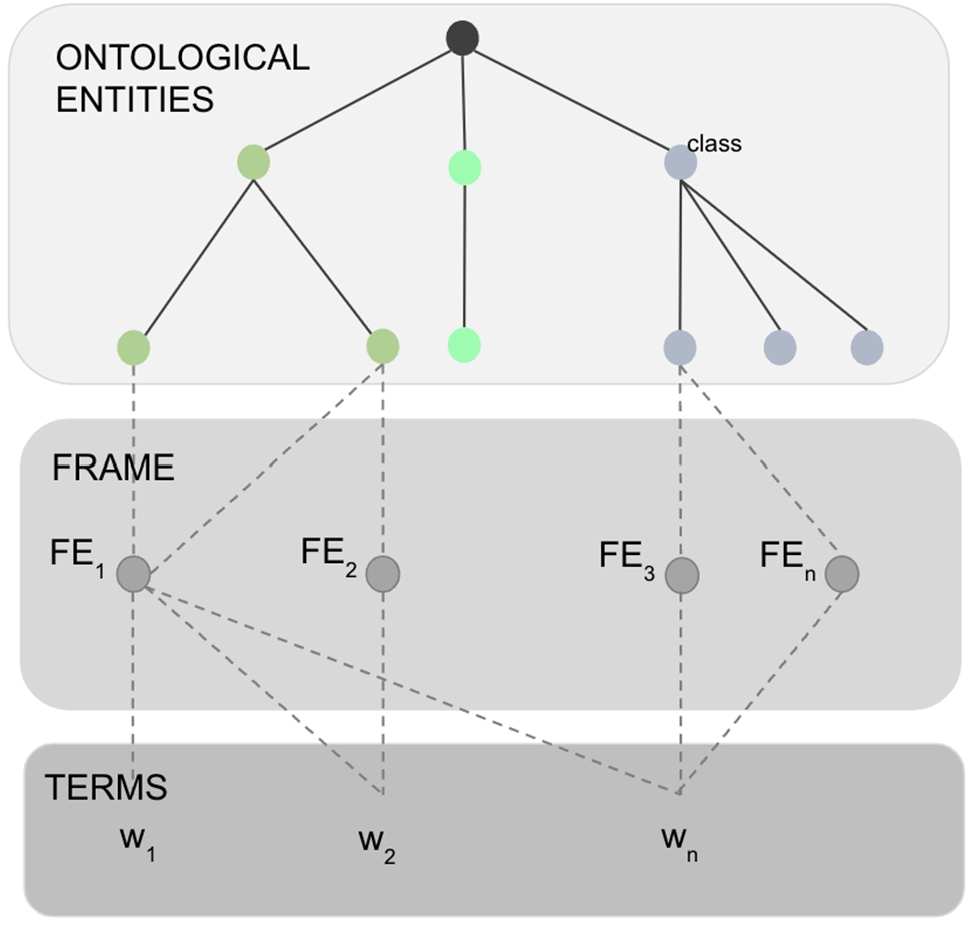
The multilayer structure in “Ontology-frame-terminology: a method for extracting and modelling variants of technical terms” (FE: frame element; w: word).
We will now concentrate on the ontological features of the model. This is a realist ontology linked to a more descriptive layer: in fact, each entity may map onto the frame elements of a specific frame, i.e. the semantic values of the terms which play a role in that frame. A straightforward example of binary correspondences between ontological entities and frame elements is PLATE, an entity with many different instances in different technical contexts (Fig. 2).
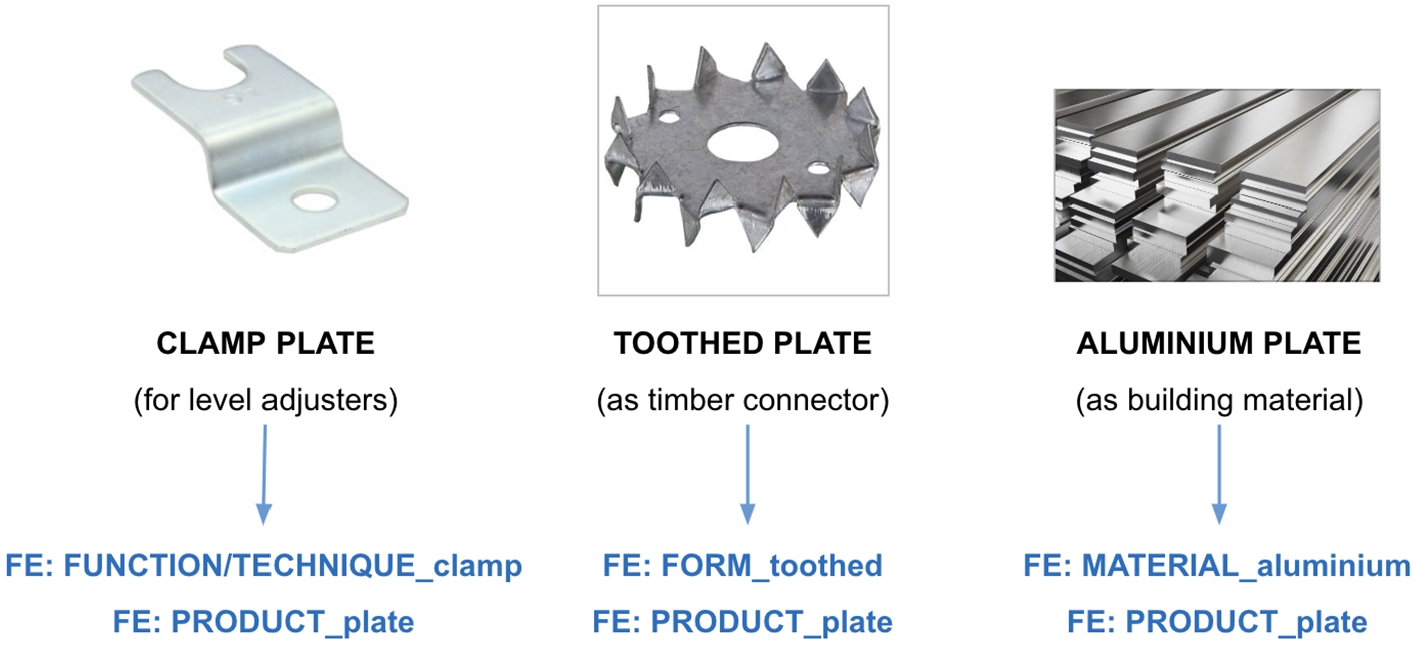
Binary correspondences between ontological entities and frame elements (FE) in the case of PLATE.
Here, verbally and non-verbally represented entities of the PLATE kind are linked to single frame elements (FE), e.g. MATERIAL, FORM, etc., by decomposing (some of)9
Of course, there can be more. Here, FE decomposition takes place on the basis of the English terms designing those entities.
Since no (formal or informal) ontology existed in this specific domain, it was manually built by using both a bottom-up (input from corpus data) and a top-down approach, i.e. subsuming all domain-related entities under the macrocategories MATERIAL, FORM, and FUNCTION (cf. Giacomini, 2019b). The ontology was meant to comprehend universally valid entities, which may or may not be related to the concepts available in specific languages and cultures.10
As shown in the case of PLATE, the prototypical image of an entity is far more informative and comprehensive than its verbal representation in a specific language. This hurdle cannot be overcome, but a multilingual approach can help fill at least part of the gaps immanent to any language. For what concerns the use of images as representational devices, it needs to be stressed that they are not systematically employed in existing ontologies. The SUMO ontology is a good and yet isolated example of their application, which does not seem to follow any principles of prototypicality. In general, the notion of prototypicality and its implications for the choice of verbal and non-verbal modes of representation of concepts in an ontology should not be underestimated. Studies in cognitive linguistics concerning prototypes (e.g. Geeraerts, 2007, Lakoff, 2007) provide in this respect a sound theoretical basis for conceptual knowledge modelling.
The ontology of thermal insulation products was implemented as an SQL database. The main reasons for this choice are as follows:
SQL databases are adequate for structured data and have been largely employed in lexicography and terminography.
They have a higher scalability compared with triple storage (e.g. OWL).
In terminology work, tables can contain different types of data, e.g. terms, ontological entities, frame elements.
Tables are perfectly capable of representing formal ontological components such as classes, instances and relations (Fig. 3).
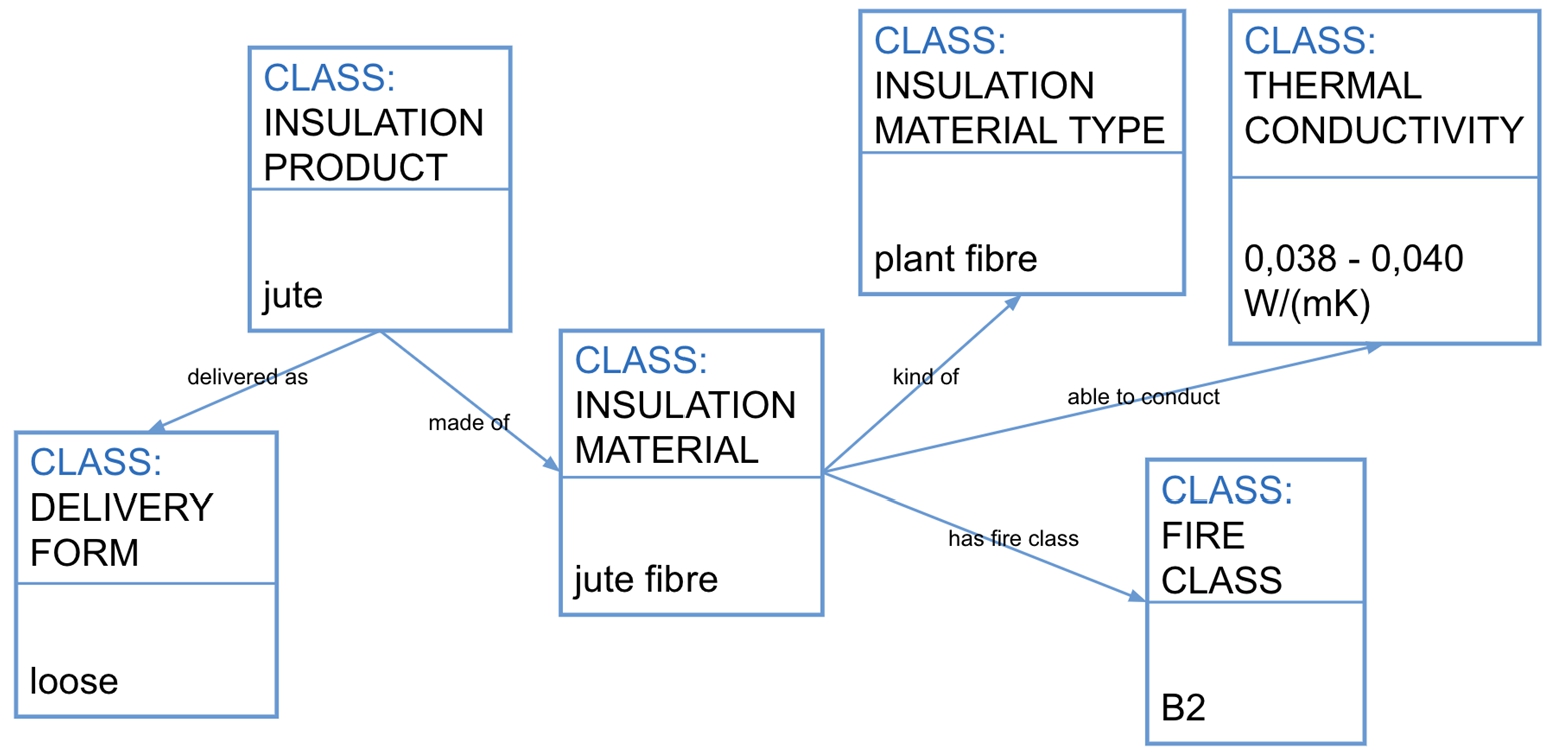
Excerpt from ontological data displaying the interplay of classes (e.g. INSULATION MATERIAL), instances of classes (e.g. jute fibre), and relations between classes (e.g. “has fire class”).
Most of all, a priority of the project was to merge all types of data in the same repository to make the future implementation of a lexicographic/terminographic resource possible. Due to the complexity of the proposed multilayer architecture, however, no existing formal model for combining linguistic and ontological information (e.g. OntoLex lemon (
A further, innovative example of how ontologies and terminologies can be integrated within a terminographic resource is EcoLexicon, a multilingual knowledge base for Environmental Science developed at the University of Granada by the team around Pamela Faber (Faber et al., 2014, San Martín et al., 2020, León Araúz & Magaña Redondo, 2010). The theoretical background is provided by Frame-Based Terminology (Faber, 2022; 2012).
As pointed out by Gil-Berrozpe et al. (2019), the influence of cognition on terminology makes it possible (and necessary) to deliver more accurate information around concepts by means of expressive formal ontologies, which “benefit both human and non-human users by facilitating knowledge acquisition and offering a higher degree of interoperability, respectively” (ibid.: 190; cf. also Elmhadhbi, Hedi Karray and Archimède, 2018 on the relevance of interoperability). For this reason, EcoLexicon has been enhanced with ontological knowledge according to a top-down approach and following the premises behind the already existing Environmental Ontology (ENVO). The categories relevant in the field of environmental knowledge were thus identified starting from the three basic ontological categories ENTITIES or OBJECTS, PROCESSES or EVENTS, and ATTRIBUTES or PROPERTIES. The result was over 150 categories, understood as semantic classes to which concepts can be linked, and several levels of categorization. It is therefore a small-scale enhancement that nevertheless covers both a domain ontology and higher ontological categories. The concept of port, for instance, can be classified according to four categories (Gil-Berrozpe et al., 2019: 183):
E-1.3: STRUCTURE
E-4.1: ARTIFICIAL GEOGRAPHIC FEATURE
E-4.2: NATURAL GEOGRAPHIC FEATURE
E-12.1.2: FACILITY
Finally, we will briefly go back to the notion of Natural Language Ontology introduced in Section 2.2 An application of the main NLO ideas to the development of a conceptual resource in language ontology has been proposed as part of the PhraseBase project in learner’s lexicography (DiMuccio-Failla & Giacomini, 2017a; 2017b). In the project, which focuses on general language and has non-native speakers as its ideal audience, an ontology is currently being modeled and implemented that is understood as a collection of concepts explicit and implicit in a natural language. The PhraseBase approach merges cognitivist and phraseological principles for the first time. This is clearly reflected by the features of the project-related ontology, named PhraseNet, which is linguistic-cognitive in nature and is (planned to be) linked to a dictionary module and a constructionist grammar module (DiMuccio-Failla & Giacomini, 2022; 2017a; 2017b). Concepts are here represented semi-formally as (predicative) phraseological patterns, e.g.
for the ontology excerpt related to the concept AGREE: “to agree with a given person about a certain entity” and “to agree to a given request”, or,
for the ontology excerpt related to the concept ARM: “a given human being’s arm” and “an arm of a given device”.
Since this type of ontology reflects concepts as they are formed and used in natural language, the idea of universality of all concepts is disregarded at the outset, and it is assumed that each language is bound to its own ontology, i.e., its own way of conceptualizing the world.
Although PhraseNet presently contains concepts related to the common language, it can be assumed that the same theoretical basis and methodology could be applied to LSP and specialised domains, such as to domains in which the ontology needs to cover complex, abstract/ possible/ implicit entities which are hard to represent by just following realist criteria (cf. legal terminology and financial terminology). If we briefly return to the above-mentioned concept AGREE in English, a possible example of a phraseological pattern with a terminological character would be, for the legal domain, “to be in a given agreement with a given person / group of persons”. In addition, as shown by the case of the concept ARM, which is also related to terminology (e.g. arm of a device, of an animal, of a river, etc.), this approach also seems to be entirely suitable for the representation of concepts belonging to technical and scientific domains.
In recent times, Terminology has paid close attention to research in the field of Ontology Engineering, gaining fundamental insights into innovative approaches to the formalisation of concept systems. Regardless of the degree to which ontologies in Terminology adhere to the criteria for ontology realization in OE, some analytical and methodological aspects developed by OE are also useful for terminology work and can help overcome at least part of the mentioned challenges (cf., among others, the Basic Ontological Commitments described by Oberle et al., 2007).
Although the main principles for ontology design and building can be borrowed from OE, it is crucial to take into consideration the different focus of Terminology, which is the linguistic perspective on terms and concepts as well as the account of language specificity.
The quality of ontological data should be prioritized over the needs for automation, since only qualitative data that are satisfactory for categorizing concepts can also ensure the consistency and systematization of terminological data in a certain domain. For this very reason, reuse of existing formal ontologies, if available, is not always feasible with little effort. In light of the metaterminological issues that have been previously emphasized, it is equally important for Terminology to make an effort to define the objects it deals with in a clear manner, while staying true to its goals. In the future, the goal of Terminology should be to coherently develop terminology-specific models for ontology development based on its own requirements and typical users.
The application examples presented in this contribution show how Terminology today can not only successfully exploit ways to formalize its concept systems, but how it also needs to move beyond the narrow view of purely realist ontologies and explore new terminology-friendly ground. Indeed, it is proving increasingly useful to create digital resources which merge different levels of conceptual and linguistic analysis. The influence of cognitive science certainly plays a fundamental role in the modernization of terminological work in this regard.