




Abstract
Weight changes, neuropsychiatric symptoms (NPS), and cognitive decline often coincide in Alzheimer’s disease (AD) and frontotemporal dementia (FTD); however, the direction of their relationship remains unclear. This study aims to clarify the connection between weight changes, NPS, and cognition in AD and FTD. We found that cognitive decline was associated with decreased body mass index (BMI) in AD, while BMI gain was associated with increased conversion to FTD. Elevated NPS were associated with decreased BMI in AD and increased BMI in FTD. Identifying early changes in NPS and BMI may facilitate the detection of cognitive decline, providing an opportunity for early intervention.
Keywords
INTRODUCTION
Detecting signals of impending cognitive decline is a challenge in dementia care, complicating efforts to forecast disease progression. Changes in body mass index (BMI), however, have emerged as a clinical indicator of accelerating decline in both Alzheimer’s disease (AD) and frontotemporal dementia (FTD) [1–3]. Despite recognizing this indicator, the relationship between BMI changes and cognition across dementia types remains incompletely understood. Clarifying the nature of weight changes associated with cognitive decline in AD and FTD and their association with neuropsychiatric symptoms (NPS) could provide opportunities for individualized prognosis and pre-emptive intervention.
AD is commonly associated with decreases in appetite and subsequent weight loss [4]. In contrast, FTD is typically associated with hyperorality and overeating, often leading to weight gain [5]. While recent work has shown that both increases and decreases in BMI may be related to cognitive decline in dementia, studies have tended not to differentiate dementia subtypes [1]. Neuropsychiatric symptoms, including depression, anxiety, apathy, disinhibition, and psychosis, are also common in AD and FTD, leading to significant patient suffering and caregiver distress [6]. In both diseases, a link between NPS and changes in eating behavior has been established [6, 7]. However, research has not yet confirmed the temporal connection between increased NPS, changes in weight, and cognitive decline. If NPS coincide with changes in eating behavior, then there may be a role for targeting NPS to forestall weight changes, thereby tempering the rate of cognitive decline.
With this background in mind, the primary aim of this study is to examine the relationship between NPS, BMI, and cognitive decline in AD and FTD. We hypothesize the following: 1) increases in NPS will be associated with weight changes in both AD and FTD, 2) increased NPS will lead to decreases in BMI in AD and increases in FTD, and 3) decreased BMI will coincide with cognitive decline in AD, while increases in BMI will coincide with cognitive decline in FTD. We hope to use insights from this study to help clarify the connection between NPS, BMI, and cognition in AD and FTD, with the goal of developing precision therapies to target difficult-to-treat symptoms in a vulnerable patient population.
METHODS
Study sample
We performed a retrospective analysis of data drawn from the National Alzheimer’s Coordinating Center (NACC), which maintains the Uniform Data Set (UDS) and includes participants from Alzheimer’s Disease Centers (ADCs) across the United States [8–10]. The UDS is the product of the National Institute on Aging’s (NIA) ADC program, which oversees an ongoing prospective, standardized, multi-site, longitudinal study of participants with dementia, mild cognitive impairment, and healthy controls. We included all participants enrolled in NACC-UDS between June 2005 and February 2021 with a final diagnosis of Alzheimer’s disease (AD, n = 3,831) or behavioral variant frontotemporal dementia (FTD, n = 417), including those entering the study with normal cognition or mild cognitive impairment (MCI) who subsequently converted to a diagnosis of AD or FTD. Written informed consent was provided by all participants and their informants and approved by local institutional review boards (IRBs).
Demographics and diagnosis
Demographic characteristics included age, sex, race, years of education, and years of follow-up. The diagnosis for each participant was based on the etiologic diagnosis at the final visit. Participants who entered the study with either normal cognition or MCI and later transitioned to a diagnosis of AD or FTD were considered ‘converters.’
Cognition
All participants underwent standardized cognitive testing at each study visit. Global cognition was captured using the Clinical Dementia Rating scale (CDR), Mini-Mental State Exam (MMSE), and Montreal Cognitive Assessment (MoCA) [11–13]. We captured memory using immediate and delayed logical memory tests and attention using the digit span backward test [14]. We used the difference in scores between the trail-making A and trail-making B tests to capture executive functioning [14, 15].
Medical comorbidity
We captured individual levels of medical comorbidity by computing each participant’s Revised Framingham Stroke Risk Profile (rFSRP) score. The rFSRP is a valuable metric to control for cognitive changes associated with cerebrovascular disease [16, 17]. The rFSRP includes age, sex, systolic blood pressure, smoking status, cardiovascular disease, diabetes, and antihypertensive medication use. We used this composite variable to control for the influence of cerebrovascular disease on cognitive decline.
Neuropsychiatric symptoms
We captured NPS using the Neuropsychiatric Inventory Questionnaire (NPI-Q), which includes items on depression, anxiety, psychosis, apathy, disinhibition, irritability, elation, and sleep disturbance/nighttime behaviors. The NPI-Q is a widely used and well-validated informant-report questionnaire used to assess psychiatric symptoms in subjects with various types of dementia, including AD and FTD [6, 18–20]. The Geriatric Depression Scale, a validated and reliable self-report metric of depressive symptoms in older adults, was also used to capture depressive states [21].
Demographic and clinical characteristics in AD and FTD
AD, Alzheimer’s disease; FTD, frontotemporal dementia; MMSE, Mini-Mental State Examination; CDR Sum, Clinical Dementia Rating – sum of boxes; FSRP, Framingham Stroke Risk Profile; BP, blood pressure; HTN, hypertension.
Body mass index
BMI was calculated based on measured weight and height (weight in kilograms divided by squared height in centimeters) at baseline and at each follow-up visit. Body mass index change was measured between each visit and from the baseline to the final visit.
Statistical analyses
Our primary outcome measure was change in BMI across study visits. The main independent variables in our analyses were cognition, psychiatric symptoms, and rFSRP. We used mixed effects time-averaged models with a random intercept testing associations of cognitive status and psychiatric symptom burden at the previous visit as predictors of subsequent BMI adjusting for rFSRP and years of education. We also used Cox proportional hazard regression models using change in BMI as a predictor of converting from normal cognition or MCI to a dementia state with adjustment for rFSRP score and level of education. Alpha was set at 0.05. We used STATA SE 17 (StataCorp LP, College Station, TX) for all analyses.
RESULTS
Demographics
Table 1 displays demographic data from our study population. Our study had 3,831 participants with a final diagnosis of AD and 417 participants with a final diagnosis of FTD. Participants with AD tended to be older and were more likely to be female than participants with FTD. Both AD and FTD participants were predominately white; however, a greater proportion of AD participants were non-white. Participants with FTD had more years of education and higher CDR sum of boxes scores, while participants with AD had higher MMSE scores. Participants with AD also had higher baseline systolic blood pressure, antihypertensive use, smoking rates, cardiac disease, and hypercholesterolemia, which elevated Framingham risk scores.
Cognition and BMI
Results from our mixed-effects regression model assessing the association of cognition on subsequent BMI in AD and FTD are displayed in Table 2. A decrease in MMSE score was associated with a lower subsequent BMI for participants with AD. Higher trail making test difference scores (worse performance) were also associated with lower subsequent BMI in AD. There was no statistically significant association between cognitive test scores and subsequent BMI in participants with FTD. However, participants with an initial diagnosis of MCI had a 1.16 increased hazard of converting to FTD when there were BMI gains between the initial visit and the first visit with a dementia diagnosis. A Kaplan-Meier curve showing the increased risk of conversion to FTD overtime in those with an increase in BMI greater than 3 kg/m2 compared to those without a BMI increase greater than 3 kg/m2 is displayed in Fig. 1.
Lagged Cognitive and Psychiatric Symptoms and BMI in AD and FTD
Cognitive model adjusted for Framingham Risk Factors and years of education. Neuropsychiatric model adjusted for Framingham Risk Factors, cognition (CDR global), and education. AD, Alzheimer’s disease; FTD, frontotemporal dementia; BMI, body mass index; MMSE, Mini-Mental State Examination; MoCA, Montreal Cognitive Assessment; NPI, Neuropsychiatric Inventory; GDS, Geriatric Depression Scale; CDR, Clinical Dementia Rating.
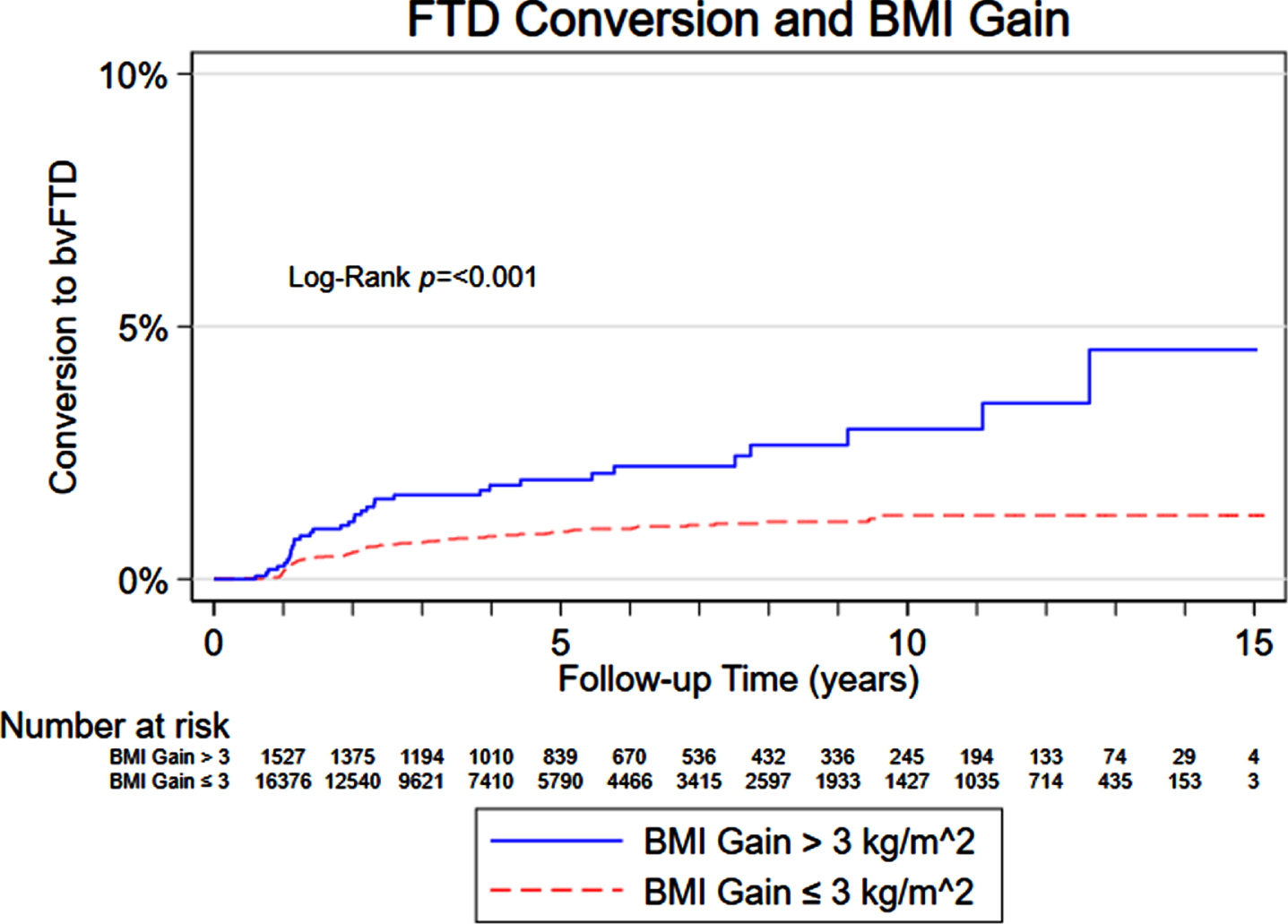
Risk of converting to FTD based on BMI gain.
Neuropsychiatric symptoms and BMI
Results from our mixed-effects regression model assessing the association of NPS on subsequent BMI in AD and FTD are also displayed in Table 2. In participants with AD, increased symptoms of depression were associated with lower subsequent BMI. There was no association between depressive symptoms and BMI in participants with FTD; however, a higher total NPI score was associated with subsequent increases in BMI in those with FTD. Changes in appetite, as rated on the NPI-Q, were associated with subsequent decreases in BMI in the AD group and subsequent increases in BMI in the FTD group. Apathy was associated with subsequent BMI increases in the FTD group. Disinhibition was also associated with subsequent BMI increases in the FTD group. There was no association between total NPI score, apathy, disinhibition, or hyperorality and subsequent BMI in participants with AD.
DISCUSSION
Overview
In this study, we present evidence of a temporal association between cognitive decline, changes in BMI, and neuropsychiatric symptoms in AD and FTD. We found that a reduction in cognition was associated with decreased BMI in AD, while increased BMI was associated with an increased risk of conversion to FTD. Increased depressive symptoms were associated with declines in BMI in AD, while apathy, appetite changes, and disinhibition were associated with increases in BMI in FTD.
Origins of weight loss in dementia
Our finding that increases in NPS are associated with changes in BMI adds to the evidence that weight changes in dementia are multifactorial, extending beyond just changes in appetite. As outlined in the European Society for Clinical Nutrition and Metabolism (ESPEN) dementia guidelines, the origins of weight loss in dementia are complex, with proposed mechanisms including atrophy of regions responsible for appetite regulation, inflammatory processes, genetic factors, and changes in olfaction among other causes [22–27]. The underlying neurodegenerative process giving rise to dementia syndromes likely leads to early psychiatric symptoms and weight changes, prior to significant cognitive changes, providing a possible window for early intervention. The existing ESPEN guidelines provide a framework for careful screening to guide nutritional interventions in patients with dementia to help maintain a healthy weight [27]. Our study supports these guidelines while reinforcing the importance of NPS screening in dementia alongside nutritional monitoring to facilitate early intervention.
Implications for disease mechanism
In addition to aiding in early detection and treatment, attention to NPS and weight changes may also provide insights into underlying disease mechanisms in AD and FTD. While our study shows that increased NPS and changes in BMI often precede cognitive declines in patients with AD and FTD, some evidence suggests that weight changes may precede cognitive impairment by several years, representing a prodromal disease state [28]. In patients eventually diagnosed with AD, weight loss preceding cognitive impairment has been linked to nutrient deficiencies and subsequent oxidative damage, increased cortisol levels, and elevated free radicals, all of which are implicated in AD pathogenesis [29–31]. Alterations in leptin levels have also been associated with AD, with low leptin levels and weight loss conferring an increased risk of AD [32, 33]. In FTD, eating abnormalities have diverse and multifactorial origins. Network degeneration and structural atrophy in the right insula, striatum, and orbitofrontal cortex have been implicated in eating behavior changes in FTD [34, 35]. Hypothalamic degeneration with subsequent disruption of orbitofrontal and cortical reward pathways has also been implicated in early abnormal eating behavior and weight gain in FTD prior to cognitive impairment [36, 37]. Similarly, neuro-endocrine changes like dysregulated levels of leptin, ghrelin, cholecystokinin, peptide tyrosine tyrosine, and agouti-related peptide have been associated with early eating abnormalities in FTD, representing initial manifestations of the underlying neurodegenerative process [5, 38]. Given these findings, changes in BMI in both AD and FTD may serve not only as signs of impending cognitive decline but also enhance understanding of disease mechanisms, providing potential targets for future therapies.
Forecasting cognitive decline
Overall, our findings provide valuable insights for understanding how BMI, cognition, and neuropsychiatric symptoms move together in AD and FTD. Predicting cognitive decline remains a core challenge in dementia care, as the goal is to help patients and families prepare to avoid complications from financial errors, falls, automobile accidents, and other consequences of cognitive change. Unfortunately, forecasting individual-level rates of disease progression is challenging even with tools like the MMSE, MoCA, neuroimaging, and biomarkers [39–42]. By necessity, care is often reactionary, responding to the consequences of cognitive decline instead of being preventative.
Implications for preventative screening
Our results suggest that careful attention to BMI and neuropsychiatric symptom status may help detect subtle changes in cognition, facilitating a more preventative approach to care. Under this approach, early treatment of psychiatric symptoms alongside nutritional interventions and safeguards against financial mistakes, falls, and other injuries could positively impact patients living with early AD and FTD and their caregivers. Increasing the frequency of neuropsychiatric symptom screens and weight checks could lead to early detection of cognitive change, facilitating a more preventative approach to care. Tools allowing for home measurement of neuropsychiatric state and BMI between visits may warrant development, to better promote monitoring of cognition and preemptive intervention at the first signals of cognitive change.
Limitations
While our study has many strengths, including the use of a large, multi-site (>40), longitudinal cohort of subjects with AD and FTD, some limitations merit consideration. Cases in this study rely on clinical diagnosis of AD and FTD rather than pathological diagnosis. However, diagnostic reliability in NACC has been validated in previous studies, suggesting that the clinical diagnoses are largely accurate [43]. We were also unable to assess the association of risk of conversion to dementia with weight changes in subjects diagnosed with AD in the same way we were able to so with FTD, as the AD data violated assumptions of the statistical model. This challenge complicates comparisons between the two disease states; however, using the lagged BMI and cognition model for AD and FTD facilitates an alternative comparison. Finally, the population consisted primarily of white participants, and findings may not generalize to other groups.
Conclusion
Dementia remains a leading cause of disability and death worldwide [44]. While advances in the field portend disease-modifying therapy, patients and families living with dementia face many obstacles, including the uncertain timing and significant consequences of cognitive decline. Our study provides preliminary insights into how increased attention to changes in neuropsychiatric symptoms and BMI may facilitate early detection of cognitive change and provide an opportunity for proactive intervention. These findings will need to be replicated and expanded upon in future studies to better clarify the connection between NPS, BMI, and cognition and to help elucidate the neurobiology underpinning their relationship. While all forms of dementia are relentlessly progressive, our study identifies opportunities to customize and improve care for patients and families facing these illnesses.
Footnotes
ACKNOWLEDGMENTS
The NACC database is funded by NIA/NIH Grant U24 AG072122. NACC data are contributed by the NIA-funded ADRCs: P30 AG062429 (PI James Brewer, MD, PhD), P30 AG066468 (PI Oscar Lopez, MD), P30 AG062421 (PI Bradley Hyman, MD, PhD), P30 AG066509 (PI Thomas Grabowski, MD), P30 AG066514 (PI Mary Sano, PhD), P30 AG066530 (PI Helena Chui, MD), P30 AG066507 (PI Marilyn Albert, PhD), P30 AG066444 (PI John Morris, MD), P30 AG066518 (PI Jeffrey Kaye, MD), P30 AG066512 (PI Thomas Wisniewski, MD), P30 AG066462 (PI Scott Small, MD), P30 AG072979 (PI David Wolk, MD), P30 AG072972 (PI Charles DeCarli, MD), P30 AG072976 (PI Andrew Saykin, PsyD), P30 AG072975 (PI David Bennett, MD), P30 AG072978 (PI Neil Kowall, MD), P30 AG072977 (PI Robert Vassar, PhD), P30 AG066519 (PI Frank LaFerla, PhD), P30 AG062677 (PI Ronald Petersen, MD, PhD), P30 AG079280 (PI Eric Reiman, MD), P30 AG062422 (PI Gil Rabinovici, MD), P30 AG066511 (PI Allan Levey, MD, PhD), P30 AG072946 (PI Linda Van Eldik, PhD), P30 AG062715 (PI Sanjay Asthana, MD, FRCP), P30 AG072973 (PI Russell Swerdlow, MD), P30 AG066506 (PI Todd Golde, MD, PhD), P30 AG066508 (PI Stephen Strittmatter, MD, PhD), P30 AG066515 (PI Victor Henderson, MD, MS), P30 AG072947 (PI Suzanne Craft, PhD), P30 AG072931 (PI Henry Paulson, MD, PhD), P30 AG066546 (PI Sudha Seshadri, MD), P20 AG068024 (PI Erik Roberson, MD, PhD), P20 AG068053 (PI Justin Miller, PhD), P20 AG068077 (PI Gary Rosenberg, MD), P20 AG068082 (PI Angela Jefferson, PhD), P30 AG072958 (PI Heather Whitson, MD), P30 AG072959 (PI James Leverenz, MD).
FUNDING
CM is funded by KL2TR003099. Dr. Kamath was supported by KL2TR001077 during the conduct of this work and is currently funded by R01AG064093 and R01NS108452.
CONFLICT OF INTEREST
The authors have no conflicts of interest to disclose.
