In this paper, we study conditional preferences in abstract argumentation by introducing a new generalization of Dung-style argumentation frameworks (AFs) called Conditional Preference-based AFs (CPAFs). Each subset of arguments in a CPAF can be associated with its own preference relation. This generalizes existing approaches for preference-handling in abstract argumentation, and allows us to reason about conditional preferences in a general way. We conduct a principle-based analysis of CPAFs and compare them to related generalizations of AFs. Specifically, we highlight similarities and differences to Modgil’s Extended AFs and show that our formalism can capture Value-based AFs. Moreover, we show that in some cases the introduction of conditional preferences leads to an increase in computational complexity.
Preferences are of great importance in computer science and artificial intelligence [16,25,39], where research areas such as recommender systems [18], computational social choice [31], and non-monotonic reasoning [15,40] are concerned with the representation and processing of preferences. Moreover, many situations require the use of conditional preferences, where a choice between two options (e.g. whether to drink tea or coffee) is dependent on other factors (e.g. the time of day). This has lead to the introduction of formalisms such as CP-nets [19], which are explicitly defined to deal with conditional preferences.
In formal argumentation theory, preferences have been studied from various points of view, be it in terms of argument strength [3,4,6,32,33], preferences between values [8,12], or weighted arguments/attacks [17]. Despite this, conditional preferences have received only limited attention in the field of argumentation. Dung et al. investigated conditional preferences in the setting of structured argumentation [27]. There, argumentation frameworks (AFs) are built from defeasible knowledge bases containing preference rules of the form , where and are defeasible rules. Similarly, there is only one recent paper we are aware of that deals with conditional preferences on the abstract level [2]. This is in contrast to unconditional preferences, which are extensively studied both in structured [36–38] and abstract [1,8,13,17,32] argumentation in the literature.
Outside of argumentation, conditional preferences appear in many situations and formalisms. One example for this are CP-nets [19], which use graphs for preference representation. Another instance is logic programming, where conditional preferences may occur in the head of rules [21,23,24] or as dedicated preference statements [20]. To demonstrate the importance of conditional preferences in common reasoning tasks, we now adapt an example given by Dung et al. [27]:
Sherlock Holmes is investigating a murder. There are two suspects, Person 1 and Person 2. After analyzing the crime scene, Sherlock is sure:
: Person 1 or Person 2 is the culprit, but not both.
Moreover, Sherlock adheres to the following rules:
: If Person i has a motive but Person j, with , does not, then this supports the case that Person i is the culprit.
: If Person i has an alibi but Person j, with , does not, then this supports the case that Person j is the culprit.
: Alibis have more importance than motives.
After interrogating the suspects, Sherlock concludes that:
: Person 1 has a motive but Person 2 does not.
: Person 1 has an alibi but Person 2 does not.
If is trusted, but is not, then this supports that Person 1 is the culprit. If is trusted then this supports that Person 2 is the culprit, regardless of our stance on .
In this paper, we aim to capture conditional preferences in argumentation on the abstract level rather than the structured level. Doing so will generalize existing formalisms for unconditional preferences in abstract argumentation and provide a more direct target formalism for structured approaches. To this end, we introduce Conditional Preference-based AFs (CPAFs), where each subset of arguments S can be associated with its own preference relation . Preferences are then resolved via so-called preference-reductions [32], which modify the attack relation based on the given preferences. As a consequence, S must be justified in view of its own preferences, i.e., S must be an extension in view of . We investigate the following topics relevant to CPAFs:
We show that CPAFs generalize Preference-based AFs (PAFs), and demonstrate that they are capable of dealing with conditional preferences in a general manner.
We conduct a principle-based analysis of CPAF-semantics and show that especially complete and stable semantics preserve properties that hold on PAFs. This analysis is helpful when aiming to understand the behavior of CPAF-semantics in a general manner, and lets us pinpoint differences to AFs/PAFs formally.
We analyze the computational complexity of CPAFs in detail, showing that for some semantics (naive, complete, grounded, preferred) the introduction of conditional preferences can cause a rise in complexity compared to AFs. This gives insights into the expressiveness of CPAFs, and differentiates them further from AFs/PAFs.
Lastly, we compare CPAFs to related formalisms. Specifically, we show that CPAFs can capture other generalizations of AFs such as Value-based AFs (VAFs) [8,12] in a straightforward way, and compare CPAFs to Extended AFs (EAFs) [10,28,34] in order to highlight similarities and differences. Moreover, we discuss a recently introduced alternative approach to conditional preferences in abstract argumentation [2] and compare it to our CPAFs.
The remainder of this paper is structured as follows: Section 2 covers the necessary preliminaries on abstract argumentation. In Section 3 we introduce CPAFs and investigate them with respect to some basic properties. Section 4 contains our principle-based analysis, and in Section 5 we analyze the computational complexity of CPAFs. We discuss related formalisms in Section 6 and conclude in Section 7.
This paper is an extended version of [
14
]. In Section
4
we now generalize and investigate all ten principles of Kaci et al. [
32
] instead of just the initial six [
33
]. The complexity analysis featured in Section
5
is entirely new. In Section
6.1
we now provide a second translation from VAFs to CPAFs. The comparison of our formalism with lifting-based CPAFs in Section
6.3
is new as well. Moreover, this version contains additional figures and explanations to improve readability.
Preliminaries
We first define (abstract) argumentation frameworks [26].
An argumentation framework (AF) is a tuple where A is a finite set of arguments and is an attack relation between arguments. Let . We say S attacks b (in F) if for some ; denotes the set of arguments attacked by S. An argument is defended (in F) by S if for each b with .
Semantics for AFs are defined as functions σ which assign to each AF a set of extensions [9]. We consider for σ the functions (conflict-free), , (admissible), (complete), (grounded), (preferred), and (stable).
Let be an AF. A set is conflict-free (in F), written as , if there are no , such that . For it holds that
iff there is no with ;
iff each is defended by S in F;
iff and each defended by S in F is contained in S;
iff and there is no with ;
iff and there is no with ;
iff each is attacked by S in F.
The computational complexity of AFs has been extensively studied in the literature [29], with the three central problems being those of credulous acceptance, skeptical acceptance, and verification.
Given an AF-semantics σ we define the following decision problems:
Credulous Acceptance (): given an AF F and an argument x, is for some ?
Skeptical Acceptance (): given an AF F and an argument x, is in all ?
Verification (): given an AF F and a set of arguments S, is ?
Table 1 shows the complexity of these problems [29]. We assume familiarity with the complexity classes of , , and . Furthermore, the class contains exactly those problems that can be solved in -time with access to an -oracle and contains the complementary problems of [7].
Preference-based AFs enrich standard AFs with preferences between arguments [3,4,6,32,33].
A preference-based AF (PAF) is a triple where is an AF and ≻ is an asymmetric binary relation over A.
If a and b are arguments and holds then we say that a is stronger than b. An established method of resolving preferences in PAFs are so-called preference reductions, of which there exist four in the literature [32]. If in a PAF there is an attack and a preference then is called a critical attack. In other words, critical attacks are from weak to strong arguments. The preference-reductions deal with these critical attacks, e.g., by removing or reverting them.
Given a PAF , a corresponding AF is constructed via Reduction i, where , as follows:
:
:
:
:
For each AF-semantics σ we define the PAF-semantics as follows: .
Intuitively, Reduction 1 removes critical attacks while Reduction 2 reverts them. Reduction 3 removes critical attacks, but only if the stronger argument also attacks the weaker one. Reduction 4 can be seen as a combination of Reduction 2 and 3: if the weaker argument attacks the stronger argument, but not vice versa, then we retain the critical attack (as in Reduction 3) but also add a reverse attack (as in Reduction 2). Note that on symmetric attacks, all four reductions function in the same way. The following example demonstrates the reductions and PAF-semantics.
Consider the PAF with and . Figure 1 depicts F as well as , . It can be checked that, for Reduction 1, and therefore . If we use Reduction 2 for example we get different extensions, namely and .
PAFs have the same complexity as AFs with respect to the decision problems of Definition 3: hardness results follows from the fact that PAFs generalize AFs, and membership results from the fact that the four preference reductions can be carried out in polynomial time.
A principle-based analysis of the four preference reductions was conducted for complete, grounded, preferred, and stable semantics [32,33]. To this end, ten PAF-properties were laid out and investigated. We now recall them in Definitions 6, 7, 9, 11 according to [32].
Let be a PAF-semantics. Let such that is asymmetric.
(conflict-freeness): If there is no such that .
(preference selects extensions 1): .
(preference selects extensions 2): .
Intuitively, states that if there is an attack between two arguments, then there is no extension containing both of them. expresses that adding more preferences to a PAF can exclude extensions, but not introduce them. states that this is also true if we add preferences to a framework without any preferences, i.e., is a special case of .
Let be a PAF-semantics. Let such that is asymmetric.
(extension refinement): for all there is such that .
(extension growth): .
(number of extensions): .
states that adding preferences means extensions will be supersets of extensions in the original PAF. says that adding preferences will preserve skeptically accepted arguments, and might cause new arguments to be skeptically accepted. expresses that the number of extensions will not grow if new preferences are added.
For the next two principles, we need to define the notion of an argument’s status.
Let be a PAF and . We write
iff x is skeptically and credulously accepted in F;
iff x is credulously but not skeptically accepted in F;
iff .
We define the order over theses statutes as follows: .
Note that in stable semantics an argument is not always credulously accepted if it is skeptically accepted, since there are AFs without stable extensions. Thus, some argument x might be skeptically accepted with respect to stable semantics, yet we still might have .
Let be a PAF-semantics.
(status conservation): .
(preference-based immunity): if and for all then .
If a semantics satisfies then the status of an argument x can not be lowered by adding a preference where x is the preferred (stronger) argument. states that if an argument x is not self-attacking and also stronger than all other arguments, then x can not be rejected.
For principles and we need the concept of paths between two arguments, by which we mean a path in the underlying undirected graph of a PAF.
Let be a PAF. Let . There is a path between and iff there is a sequence of arguments such that , , and for all .
Let be a PAF-semantics.
(path preference influence 1): if there is no path from to in then .
(path preference influence 2): if and then .
If is satisfied then adding a preference between two arguments x and y that do not occur in the same weakly connected component does not change the extensions of a PAF. is similar to , but only requires that there is no direct connection between x and y.
Satisfaction of various PAF-principles [32,33]. C stands for complete, G for grounded, P for preferred, and S for stable. × indicates that none of those four semantics satisfy this principle
(conflict-freeness)
×
(preference selects extensions)
×
×
×
(preference selects extensions 2)
×
×
×
(extension refinement)
×
×
×
(extension growth)
×
×
×
(number of extensions)
G
G
G
(status conservation)
(preference-based immunity)
×
(path preference influence 1)
(path preference influence 2)
Table 2 shows which semantics satisfy which principle, as investigated in [32,33].
As argued in the introduction, our aim is to provide a framework for reasoning with conditional preferences in abstract argumentation. This means that arguments themselves must be capable of expressing preferences, and that those argument-bound preferences are relevant only if the corresponding arguments are themselves accepted. How this is implemented must be considered carefully, as Example 1 demonstrates. There, the fact that Person 1 has a motive (let us refer to this as ) and the fact that Person 1 has an alibi () result in opposing preferences. When accepting both and it seems natural to combine these opposing preferences, i.e., to cancel them. But this does not allow us to express that alibis are more important than motives, as required in Example 1. Therefore, we need to define our formalism in a general way such that the joint acceptance of arguments must not necessarily result in the combination of their associated preferences. We solve this by mapping each subset S of arguments to a separate preference relation .
A Conditional PAF (CPAF) is a triple , where is an AF and is a function that maps each set of arguments to an irreflexive and asymmetric binary relation over A.
We set no restriction on how exactly conditional preferences are represented. This is deliberate, as we wish to stay as general as possible. In practice, succinct representations could be achieved, e.g., by expressing the -function via rules of the form where φ is a propositional formula over the arguments. Indeed, this representation will be used by us in Section 5 where we analyze the complexity of CPAFs.
Just as in PAFs, preferences in CPAFs are resolved with the help of the four preference-reductions (cf. Definition 5). A set of arguments S is an extension of some CPAF if it is an extension relative to its associated preference relation .
Let be a CPAF and let . The S-reduct of F with respect to a preference reduction is defined as . Given an AF-semantics σ we define the CPAF-semantics as follows: iff .
Using CPAFs we can easily formalize our Sherlock Holmes example.
We continue Example 1 and introduce two arguments and expressing that Person 1 (resp. Person 2) is the culprit. Moreover, we introduce and to express that Person 1 has a motive (resp. alibi) but Person 2 does not. and attack each other while and have no incoming or outgoing attacks, but rather express preferences. Formally, we model this via the CPAF with such that iff but , iff , and for all other . Figure 2 depicts F and Fig. 3 shows the S-reducts of F. Note that and are unattacked in all S-reducts of F. Therefore, both arguments must be part of any -extension for and we can conclude that .
The preference-reducts of the CPAF F from Fig. 2/Example 3.
Note that, according to Definition 13, preferred semantics do not maximize over all admissible sets of a CPAF, but rather over all admissible sets in the given S-reduct. This means that if there is a set S that is admissible in the S-reduct of F, but there is also some that is admissible in the S-reduct of F, then S is not preferred in the S-reduct of F (and therefore ). But this T does not have to be admissible in F, since it might not be admissible in the T-reduct of F. The situation is analogous for naive semantics. The following alternative semantics may be considered more natural:
Let be a CPAF and let . Then
iff and there is no T such that and ;
iff and there is no T such that and .
Intuitively, and maximize globally over all admissible sets of a CPAF, while and maximize locally over the admissible sets of the given S-reduct.
Let F be the CPAF from Example 3 and recall that . Observe that is not preferred in the -reduct of F, but it is a subset-maximal admissible set in F. Thus, .
The difference between local and global maximization is not only philosophical, but impacts fundamental properties for maximization-based semantics such as I-maximality [11]. A semantics is I-maximal if and only if implies for all CPAFs F and all .
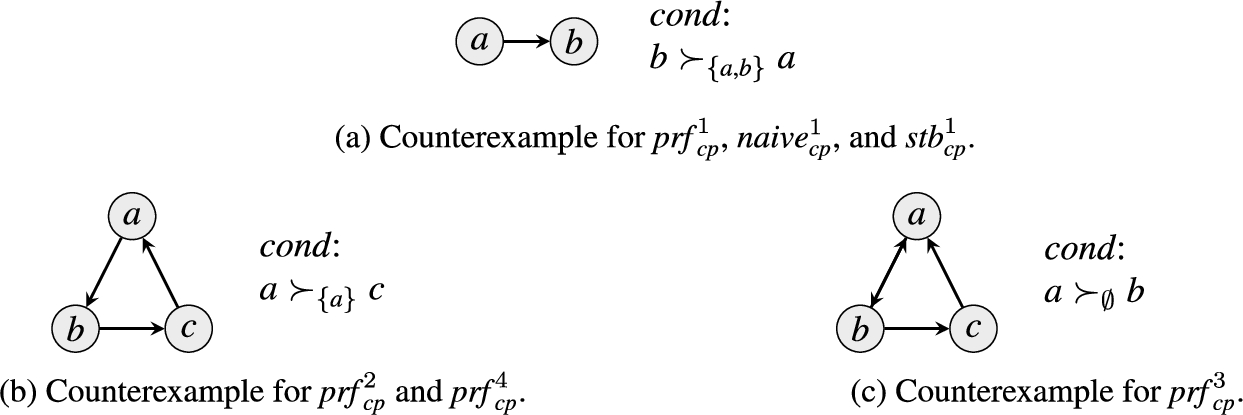
is I-maximal, butis not, where.
I-maximality of follows from Definition 14. Regarding counter examples for we consider the preference-reductions separately. Reduction 1: consider the CPAF depicted in Fig. 4a, i.e., with such that . Then and . Reductions 2 and 4: consider the CPAF depicted in Fig. 4b, i.e., with such that . Then and . Reduction 3: consider the CPAF depicted in Fig. 4c, i.e., with such that . Then and . □
Counterexamples for I-maximality (cf. Propositions 1,2,3).
One may be tempted to deduce from the above proposition that is more suitable as a default preferred semantics than . However, we will see in Section 6.1 that allows us to capture the problems of subjective/objective acceptance in VAFs in a natural way. In our subsequent analysis of CPAFs we consider both local and global subset maximization. Like preferred semantics, naive and stable semantics satisfy I-maximality on AFs. Interestingly, on CPAFs, this depends on the preference-reduction.
is I-maximal for. Moreover,is I-maximal forbut not for.
I-maximality of follows from Definition 14. I-maximality of with follows from the fact that Reductions 2, 3, and 4 do not remove conflicts between arguments, and therefore conflict-free sets are the same across all S-reducts. For we can use the same counter-example as for (cf. Proposition 1 and Fig. 4a). □
is I-maximal forbut not for.
For we can use the same counter-example as for (cf. Proposition 1 and Fig. 4a). For with we proceed by contradiction: assume there is a CPAF with such that . Then there is such that . Since there is such that . Reductions 2, 3, and 4 do not remove conflicts between arguments, and thus either or . Therefore, or . But implies , i.e., . □
A further well-known property of AFs is that if an argument set S is stable in a framework F, then S is also preferred in F [26]. The same is true for CPAFs, with the exception of preferred semantics utilizing global maximization and Reduction 1.
Ifthenfor. Moreover, ifthenfor. However,does not necessarily imply.
Let be a CPAF, and let , where . Then . Since is an AF this implies which means that .
Now let . If then every argument in is either in S or attacked by it. Towards a contradiction, assume there is such that . Then there is some . Since S attacks x in there is a conflict between some and x in the underlying AF of F. Note that . But Reductions 2, 3, 4 can not remove conflicts between arguments, i.e., . Contradiction.
For , let F be the CPAF from Fig. 4a). Then but . □
Another interesting point is that grounded extensions are not necessarily unique in CPAFs: consider with such that . Then and . We stress that each grounded extension S is still unique in the S-reduct of the given CPAF and thus unique with respect to its own preferences.
Lastly, by the following proposition we express that every CPAF-semantics considered here generalizes their corresponding PAF-semantics, i.e., that CPAFs generalize PAFs.
Letbe a CPAF such that the preference functionmaps every set of arguments to the same binary relation, i.e., there is some ≻ such thatfor all. Let. Then. Furthermore,and.
Principle-based analysis
Principles play an important role in argumentation theory, as they allow us to examine the vast amount of semantics defined for AFs in a general way [11,30,41]. In this section, we generalize the principles of Kaci et al. [32] for PAFs (cf. Definitions 6, 7, 9, 11) to account for conditional preferences. We then investigate by which semantics these principles are satisfied, and show that there are differences to PAFs.
In the case of PAFs, adding more preferences to a framework means that we now deal with the PAF . In the case of CPAFs, if we want to have at least the same preferences as , we must require that for all . However, if we only want to add a single preference to a CPAF, then we add to only a single subset S and leave the preferences associated with other subsets unchanged. Given the above considerations, generalizing the PAF-principles to CPAF-principles is quite straightforward. The notions of an argument’s status and paths between two arguments in a CPAF are defined analogously to PAFs (cf. Definitions 8, 10), e.g., iff x is contained in some but not all extensions of the CPAF F.
Let be a CPAF-semantics. In the following, given a CPAF , we denote by an arbitrary function such that for all . Moreover, is the same as except that for some we have but . Lastly, for all .
(conflict-freeness): If there is no such that .
(preference selects extensions): .
(preference selects extensions 2): .
(extension refinement): for all there is s.t. .
(extension growth): .
(number of extensions): .
(status conservation): .
(preference-based immunity): if and if is defined such that for all and all we have then .
(path preference influence 1): if there is no path from to in then .
(path preference influence 2): if and then .
The following lemma establishes some relationships between the CPAF-principles and is a generalization of known relationships between PAF-principles [32].
Ifsatisfiesthen it also satisfies,, and. Ifalways returns at least one extension, and if it satisfies, then it also satisfies.
For , , and this is easy to see. For we argue this in detail: by contrapositive, let be a semantics that always returns at least one extension, but does not satisfy . Thus, there must be A, R, , with for all , such that . Then there is such that but , i.e., there is such that and . Of course, , otherwise . But then , i.e., does not satisfy . □
Observe that, since CPAFs are a generalization of PAFs (cf. Proposition 5), a CPAF-semantics can not satisfy if the corresponding PAF-semantics does not satisfy . Moreover, it is obvious that is still satisfied under Reductions 2, 3, and 4, as conflicts are not removed by these reductions even if we consider conditional preferences. We can also show that satisfaction of carries over from PAFs to CPAFs.
Ifsatisfiesthensatisfies.
By contrapositive, assume does not satisfy . Then there is a CPAF and with for all such that . Thus, there is such that but . Then but , i.e., does not satisfy . □
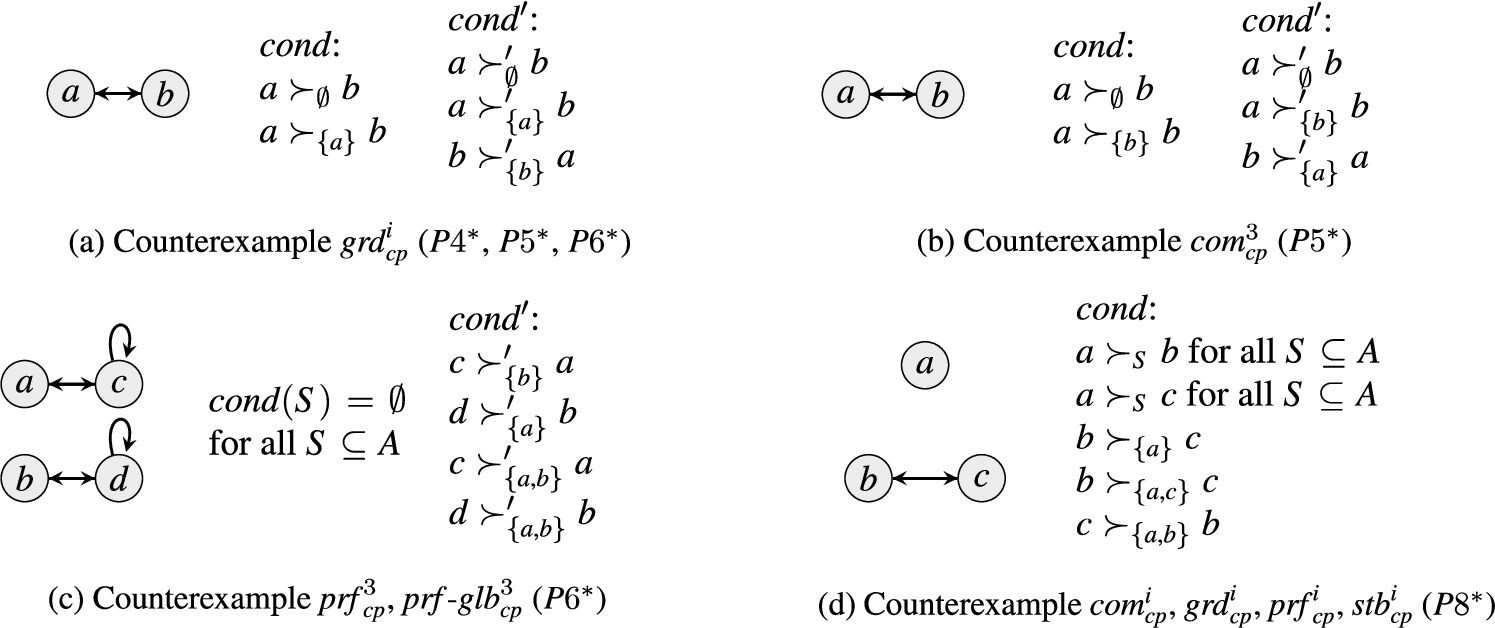
Lemma 7 implies that complete and stable semantics satisfy on CPAFs under Reduction 3. By Lemma 6 these semantics also satisfy , , and . However, we can not use Lemma 6 to show that complete semantics satisfy , since conditional preferences allow for frameworks without complete extensions. Indeed, we can find a counter-example in this case. Counterexamples for the satisfaction of various principles can also be found for grounded semantics, both variants of the preferred semantics, and even stable semantics in the case of .
For and , , , consider , , and as shown in Fig. 5a. Then while .
For and , consider , , and as shown in Fig. 5b. Then while .
For , and , consider , , and as shown in Fig. 5c. Then while .
Regarding , consider the CPAF shown in Fig. 5d. Note that and for all and all . Observe that b is unattacked in . Thus, for . Moreover, b is not defended against c in . Analogously for c in . Thus, . □
We have now fully investigated the first six principles. It remains to examine principles 7-10, of which we so far only know that is not satisfied by most semantics. It turns out that is retained when using preferred semantics with global maximization.
satisfiesfor.
Let be a CPAF containing an argument such that and for all and all we have . Specifically, this means that for all . Then, by definition of Reduction , x defends itself against all attacks in . Thus, . By this and the definition of , there is some such that . □
Now we turn our attention to , where, analogously to (cf. Lemma 7), it turns out that satisfaction carries over from PAFs to CPAFs.
Ifsatisfiesthensatisfies.
By contrapositive, assume does not satisfy . Then there is a CPAF such that . This means there is some for which but . By the definition of CPAF-semantics this means that but , i.e., does not satisfy . □
However, unlike in the case of , the above lemma does not constitute an exhaustive investigation of . The reason for this is that , in contrast to , is satisfied by preferred semantics on PAFs (cf. Table 2). Lemma 10 only allows us to conclude that satisfies , but it says nothing about the satisfaction of . We find that is satisfied also when maximizing admissible sets globally.
satisfies.
Let be an arbitrary CPAF and . Let as specified in Definition 15. There are three possible cases:
. Then trivially holds.
. Then there is some with . We distinguish two cases:
. Then clearly .
. Then is the same as except that but for some . Adding the preference via does not introduce any new attacks against S in , no matter which of the preference reductions we consider. Thus, .
In both cases we have and therefore for some . Thus, .
. By the same line of reasoning as in case (2) we have . Towards a contradiction, assume that . Then there is some such that . Since we know that . One of the following must be the case:
. Since it must be that . Then it must be that the additional preference in removes a conflict between two arguments in S. But this preference is for some . Thus, . Contradiction.
but . Since it must be that . However, the additional preference added via at most adds an attack . Since this means that S is still not defended in . Contradiction.
but there is such that . Since we know that . Since we have . By the same line of reasoning as in case (2) we can conclude that and therefore . Contradiction.
In all three cases we arrive at a contradiction. Thus, . □
Lastly, we must consider principles 9 and 10. Below, we show that they retain the satisfaction of all principles under all considered semantics.
satisfiesandfor.
Let be an arbitrary CPAF and . Let as specified in Definition 15. Note that the premise for (there is no path from to ) implies the premise of ( and ). If and then the additional preference added via does not delete or add any attacks, regardless of which preference reduction we consider. This means that for all and all and therefore for all . □
Satisfaction of CPAF-principles. C stands for complete, G for grounded, P for preferred (both and ), and S for stable. indicates that satisfies the principle but does not. If a cell is marked with × then none of the investigated semantics satisfy this principle
(conflict-freeness)
×
(preference selects extensions)
×
×
×
(preference selects extensions 2)
×
×
×
(extension refinement)
×
×
×
(extension growth)
×
×
×
×
(number of extensions)
×
×
×
(status conservation)
(preference-based immunity)
×
(path preference influence 1)
(path preference influence 2)
The above results constitute an exhaustive investigation of the ten CPAF-principles for all semantics considered in this paper. Thus, we can conclude:
The satisfaction of CPAF-principles depicted in Table
3
holds.
To summarize, complete and stable semantics preserve the satisfaction of PAF-principles in most cases. Grounded semantics no longer satisfies any of the principles 1-6 on CPAFs except (conflict-freeness) since grounded extensions are not unique on CPAFs, and since there are even CPAFs without a grounded extension (cf. Lemma 8). Unlike on PAFs, complete semantics does not satisfy (extension growth) under Reduction 3. Furthermore, neither variant of preferred semantics satisfies (number of extensions) under Reduction 3. As for principles 7-10, we note that only is no longer satisfied by all semantics.
Computational complexity
The computational complexity of Dung-style AFs and various generalizations thereof has received considerable attention in the literature [29]. Indeed, complexity results give insights into the expressiveness of specific argumentation formalisms and help to find appropriate methods for solving a given problem. As discussed in Section 2, AFs and PAFs have the same properties with regards to complexity, i.e., none of the four preference reductions result in a higher complexity when considering unconditional preferences in the setting of Dung-AFs. The situation is not as clear when dealing with conditional preferences. As we have seen in previous sections, CPAFs do not necessarily have unique grounded extensions, there are CPAFs without any complete extensions, and there is more than one way of dealing with subset maximization (recall the and semantics). In this section, we show that these differences between CPAFs and AFs/PAFs have an impact on complexity.
We define , , and analogously to , , and (cf. Definition 3), with the difference that the framework in question is now a CPAF instead of an AF and that we appeal to the semantics of Definitions 13 and 14 rather than the AF-semantics of Definition 2:
Given a CPAF-semantics we define the following decision problems:
Credulous Acceptance (): given a CPAF F and an argument x, is for some ?
Skeptical Acceptance (): given a CPAF F and an argument x, is in all ?
Verification (): given a CPAF F and a set of arguments S, is ?
In the interest of generality, we did not impose a specific method to represent conditional preferences in the previous sections. However, when analyzing the computational complexity of CPAFs, it is necessary to decide on more specific representations if tight bounds are to be found. Therefore, we will assume conditional preferences to be expressed succinctly as arbitrary propositional formulas. Note that if preferences would be stored explicitly for each possible set of arguments, the input size of our problems would always be exponentially larger than the underlying AF itself, and thus some decision problems for CPAFs would be in lower complexity classes than their counterparts for AFs.
Specifically, given the set of argument A in a framework we allow a finite number of rules where and φ is a propositional formula built from atoms in A and the usual connectives (¬, ∧, ∨). As for the meaning of these rules, we define that for some we have iff there is a rule such that and there is no rule such that .1
A set of atoms S can be seen as an interpretation, with x set to true under S iff .
Observe that, given , it is possible to compute in polynomial time with respect to the size of the given framework F since can be decided in polynomial time for each rule .2
In fact, for our membership results the explicit representation of rules using propositional formulas is not necessary. It suffices to have some representation such that, given , we can determine in polynomial time with respect to the size of . However, for hardness results, a more concrete representation such as via our rules is necessary.
Complexity of CPAFs with conditional preferences represented via finitely many rules of the form . Underlines indicate a rise in complexity compared to AFs
σ
in
trivial
in
-c/in
-c/in
in
in
-c/in
-c/in
-c
trivial
in
-c
-c
in
-c
-c
-c
-c
-c
in
-c
-c
-c
-c
-c
-c
Our complexity results are summarized in Table 4. Note that problems for semantics become harder only under Reduction 1. Intuitively, this is because Reduction 1 can remove conflicts between arguments altogether, unlike Reductions 2-4. Observe that under Reduction 1 is the only semantics for which the verification problem becomes harder (-complete) compared to AFs (in ). As a result, skeptical acceptance for is -complete, i.e., the complexity rises by two levels in the polynomial hierarchy compared to the case of AFs. For complete semantics, skeptical acceptance is now -complete regardless of which preference reduction is used. With respect to grounded semantics we see an increase in complexity for both credulous acceptance (-complete) and skeptical acceptance (-complete). Lastly, for preferred semantics with local maximization, credulous acceptance rises by one level in the polynomial hierarchy compared to AFs.
The complexity results for CPAFs depicted in Table
4
hold.
The remainder of this section is dedicated to proving Theorem 14. We first consider the verification problem, for which most semantics have the same complexity as in the case of AFs.
, where, has the same complexity properties with regards to membership and hardness asfor. Moreover,is-complete for.
Hardness follows from the fact that CPAFs are a generalization of AFs. Membership for : given a CPAF F and a set of arguments S, we can determine and therefore also in polynomial time. It then suffices to check whether . Membership for : let be an arbitrary instance of , i.e., is a CPAF and is a set of arguments. First, check in polynomial time whether . Then, in -time, check that for all T we have either or . □
For naive semantics with global maximization () we see a rise in complexity, but only when using Reduction 1. The following proof makes use of Reduction 1’s ability to delete conflicts between arguments. By Sat we denote the -complete satisfiability problem for propositional formulas, and by Unsat we denote its complementary problem which is -complete.
is infor.is-complete.
Let be an arbitrary instance of , i.e., is a CPAF and is a set of arguments. For Reductions 2, 3, and 4 it suffices to check whether since these reductions can not remove or add conflicts.
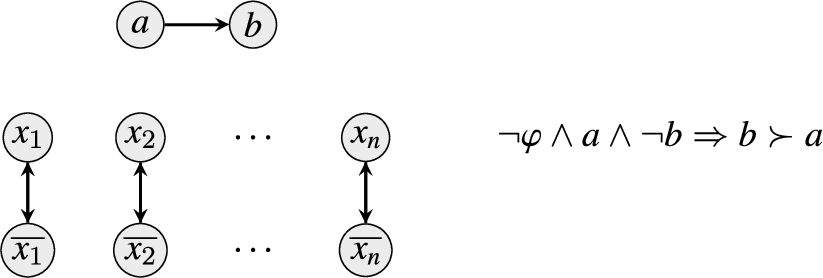
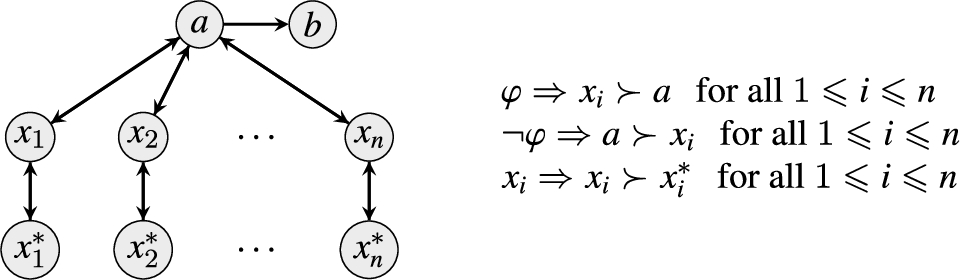
We now turn our attention to Reduction 1. -membership: first check whether . Then, in -time, check that for all T we have either or . -hardness by reduction from Unsat: let φ be an arbitrary propositional formula over variables X. Let a be a fresh variable, i.e., . We construct an instance of as follows: with , , and defined by the rules for , i.e., iff . Figure 6 depicts the above construction. We now show that φ is unsatisfiable iff (i.e., is a yes-instance of ).
Suppose φ is unsatisfiable. This means that for all and all we have , i.e., for each the attack is present in . Thus, there is no conflict-free set containing a other than which implies .
Suppose φ is satisfiable. Then there is an interpretation such that . We assume that . This is permissible since we can check in polynomial time whether ∅ satisfies φ, and if this is the case, return a trivial no-instance of . Consider . Since a does not appear in φ we have and therefore for all . Thus, and, since , . □
Construction used in the proof of Lemma 16. Given a formula φ over variables , a CPAF F is constructed such that φ is unsatisfiable iff .
We now consider credulous and skeptical acceptance, starting with semantics based solely on conflict-freeness. Let us first cover the cases in which there is no rise in complexity.
is infor,.is infor.
Let be an instance of . For it suffices to check whether x is self-attacking in the underlying AF of F, since self-attacks are not removed by any of the four reductions. For it suffices to test whether is a yes-instance of . For and Reductions 2, 3, and 4 it is enough to check whether x appears in a naive set of the underlying AF, since these reductions can not remove conflicts. □
is trivial for.is inforand.
Let be an arbitrary instance of , i.e., is a CPAF and is a an argument. Note that ∅ is always conflict-free in , i.e., is trivially a no-instance. For and Reductions 2, 3, and 4 it is enough to solve the problem on the underlying AF, since these reductions can not remove conflicts. □
For naive semantics with local maximization the complexity rises by one level in the polynomial hierarchy under Reduction 1.
is-complete andis-complete.
We will consider the complementary problem of and show that it is -complete since this allows us to prove both results simultaneously.
-Membership: given a CPAF and an argument , guess a set and, in polynomial time, check whether and (resp. and ).
-hardness by reduction from SAT: let φ be an arbitrary propositional formula over a set of variables X. Let a and b be fresh atoms, i.e., . We construct an instance of as follows: with , , and defined by the rule , i.e., iff . The above construction is visualized in Fig. 7. We show that φ is satisfiable iff is a yes-instance of iff is a no-instance of :
Assume φ is satisfiable. Then there is an interpretation such that . Then also and . Let . Note that , which means that a and b are in conflict in . Furthermore, for all , we have either or , but not both. Thus, . Note that but , i.e., is a yes-instance of but is a no-instance of .
Construction used in the proof of Lemma 19. Given a formula φ over variables , a CPAF F is constructed such that φ is satisfiable iff is a yes-instance of iff is a no-instance of .
Assume φ is unsatisfiable. Consider some . If there is some such that neither nor , then . Likewise, if there is some such that both and then and therefore . It remains to consider sets S in which for all we have either or but not both. Given such a set, we consider four cases:
and . Then since .
and . Then , i.e., . This means that the attack is present in . Note that every argument is either in S or in conflict with S in . Moreover, . We can conclude that .
and . Then , i.e., . This means that the attack is deleted in , which further implies that . Thus, .
and . Then , i.e., . This means that the attack is present in . Thus, and therefore .
In conclusion, if then and . Thus, is a no-instance of but is a yes-instance of . □
For naive semantics with global maximization, skeptical acceptance rises by even two levels in the polynomial hierarchy under Reduction 1. The reason for this is the increased complexity of the verification problem in this case (cf. Lemma 16). By we denote the -complete problem of deciding whether a quantified boolean formula of the form , where φ is a formula over , is true.
is-complete.
-membership for the complementary problem of : given a CPAF and an argument x, guess a set and check that and, in -time, that .
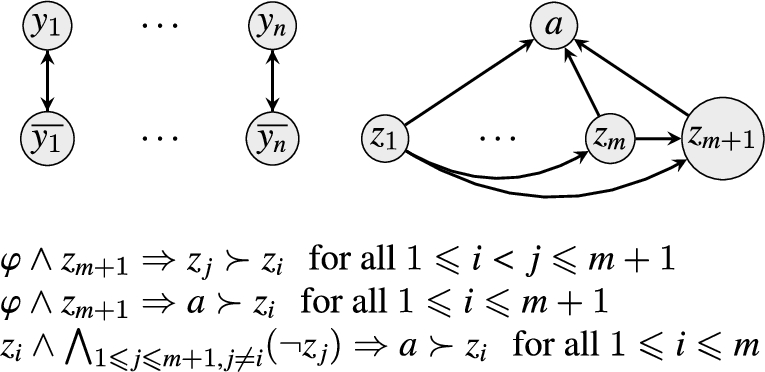
-hardness: let be an arbitrary instance of over variables and . Let . Using fresh variables a and we construct an instance of where with
,
,
and defined by the following rules:
for all ,
for all ,
for all .
Expressed in natural language, the first two rules remove all conflicts between if is satisfied, and the third rule removes the conflict between some and a if this z is the only element from Z that is part of the extension, and if is also not part of the extension.
The above construction is visualized in Fig. 8. Note that the resulting CPAF is polynomial in the size of φ as we employ rules, each linear in the size of φ. It remains to show that is true iff is a yes-instance of .
Assume that is true. We want to show that for all we have . Towards a contradiction assume this is not the case, i.e., there is some such that . There are two possibilities:
. Then for we also have since a and are fresh variables. Moreover, since and thus all conflicts between the arguments are removed. But , i.e., . Contradiction.
Construction used in the proof of Lemma 20. Given a quantified Boolean formula over variables and , a CPAF F is constructed such that is true iff is a yes-instance of .
. Then and therefore the conflicts between are not removed. This means that at most one of is in S since we require . Indeed, exactly one argument from has to be in S, since if none of them were in S then we could add any of these arguments to S and the resulting set would still be conflict free regardless of preferences. By our assumption, . Again, we distinguish two cases:
with . But then because the following rule would apply: . Thus, . Contradiction.
. Let . Since is true there is some such that . Therefore, for . Moreover, since and thus all conflicts between are removed. Since by construction we have that . Contradiction.
In all cases we arrive at a contradiction, and we can conclude that for all .
Assume that is not true. Then there is some such that for all . Let . Clearly, . Moreover, there can be no such that since we would need to add at least one argument from to S. But these arguments are all in conflict with unless , which we know to be impossible. □
We now turn our attention to admissibility-based semantics, where, in contrast to semantics based only on conflict-freeness, the choice of preference reduction makes no difference with regards to complexity. Again, let us first consider the cases in which there is no rise in complexity compared to AFs.
is-complete forand.
Hardness follows from hardness for AFs. Regarding membership of , given a CPAF F and an argument x we can simply guess a set of arguments S containing x and, by Lemma 15, check whether in polynomial time. Regarding membership of , it suffices to test whether is a yes-instance of . □
Let.is trivial for,-complete for, and-complete for.
Hardness follows from hardness for AFs. Regarding membership, let be a CPAF and . Concerning , note that ∅ is always admissible in , i.e., is trivially a no-instance. Regarding we consider the complementary problem: guess a set and check that and that with . Checking can be done in polynomial time in the case of and in -time in the case of (cf. Lemma 15). □
In the case of grounded semantics, both credulous and skeptical acceptance are located one level higher on the polynomial hierarchy compared to AFs. For complete semantics, the same is true for skeptical acceptance.
Let.is-complete.is-complete for.
We will consider the complementary problems of and show that they are -complete since this allows us to prove all results simultaneously.
-membership: given a CPAF and an argument , guess a set and, in polynomial time, check whether and (resp. and or and ).
-hardness by reduction from SAT: let φ be an arbitrary propositional formula over variables X. Let a and b be fresh variables, i.e., . We construct an instance of as follows: with , , and defined by the rules , , and for , i.e., iff , iff , and iff . Figure 9 depicts the above construction. In fact, this construction also works for the complementary problem of skeptical acceptance with respect to grounded and complete semantics, except that we will ask for the acceptance of the argument a instead of b. In this spirit, we now show that φ is satisfiable iff is a yes-instance of iff is a no-instance of .
Suppose φ is satisfiable. Then there is an interpretation such that . We assume that . This is permissible since we can check in polynomial time whether ∅ satisfies φ, and if this is the case, return a trivial yes-instance of (or a trivial no-instance of ). Consider . Then since and b does not occur in φ. We then have and for all , but for . Thus, the unattacked arguments in are exactly those in I. Since , b is defended in against a by the arguments in I. Thus, S is the minimal complete extension in and therefore also grounded in . This implies that is a yes-instance of while is a no-instance of both and .
Construction used in the proof of Lemma 23. Given a formula φ over variables , a CPAF F is constructed such that φ is satisfiable iff is a yes-instance of iff is a no-instance of .
Suppose φ is unsatisfiable. Then, for every and , we have . Thus, the argument a is unattacked in every , i.e., every complete extension (and therefore also every grounded extension) in F must contain a. Since a and b are in conflict, b is contained in no complete or grounded extension. Thus, is a no-instance of while is a yes-instance of both and . □
The last problem to consider is credulous acceptance for preferred semantics with local maximization. The following proof is the only one in this section to utilize one of the well-known standard reductions for AFs [29]. Only a very limited inclusion of conditional preferences is necessary. Indeed, only a single preference rule, consisting of a very simple propositional formula, is used in the construction.
is-complete for.
-membership: given a CPAF and an argument x, guess a set and check that and, in -time, that .
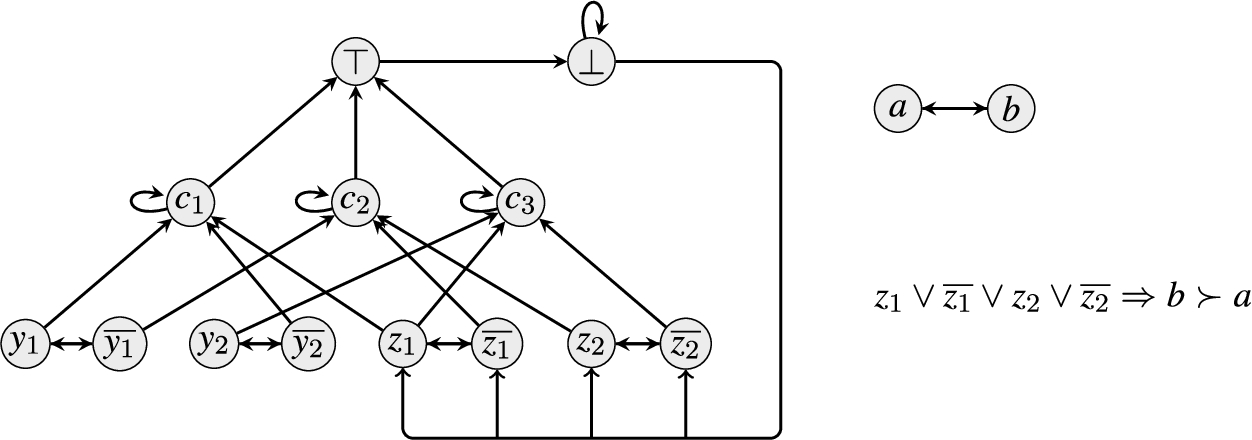
Construction used in the proof of Lemma 24. Given the quantified Boolean formula , with φ consisting of clauses , , and , a CPAF F is constructed such that is true iff is a no-instance of .
-hardness of the complementary problem: let be an arbitrary instance of in 3-CNF over variables and with clauses . Let . Using fresh variables a and b we construct an instance of where ,
,
,
and defined by the following rule: .
This construction is exemplified in Fig. 10. It remains to show that is true iff for all .
Assume that is true. Towards a contradiction, assume that there is some such that . Then it must be that , otherwise a is undefended in . Thus, for all we have and . Let . Since is true there is some such that . Let . Clearly, . Moreover, is admissible in : since all clause-arguments are attacked by arguments in , and therefore ⊤ is defended by . This further implies that all arguments z, are defended by against ⊥. We can conclude that S is not preferred in . Contradiction.
Assume that is not true. Then there is such that for all . Let . Note that and that all arguments y, defend themselves. Thus, S is admissible in . Towards a contradiction, assume there is such that is admissible in . This means one of the following must be the case:
. Then ⊤ needs to be defended by against the clause arguments . But this means that satisfies all clauses in φ, i.e., . Note that S contains exactly one of y, for every . Thus, . The fact that contradicts for all .
for some . Then z needs to be defended by against ⊥. This is only possible if , which we already have shown to not be the case. Contradiction.
for some . Analogous to the case that .
Since we arrive at a contradiction in all cases, . Moreover, note that . □
Related formalisms
We now investigate the connection between CPAFs and related formalisms. First, we show that Value-based Argumentation Frameworks (VAFs) [8,12] can be captured by CPAFs in a straightforward way. Secondly, we consider Extended Argumentation Frameworks (EAFs) [10,28,34] and highlight similarities and differences to CPAFs. Lastly, we compare our CPAFs with a recently introduced alternative approach to conditional preferences in abstract argumentation [2].
Capturing value-based argumentation
VAFs, similarly to CPAFs, are capable of dealing with multiple preference relations. But, in contrast to CPAFs, these preferences are not over individual arguments but over values associated with arguments. Which values are preferred depends on the audience. A set of arguments may then be accepted in view of one audience, but not in view of another.
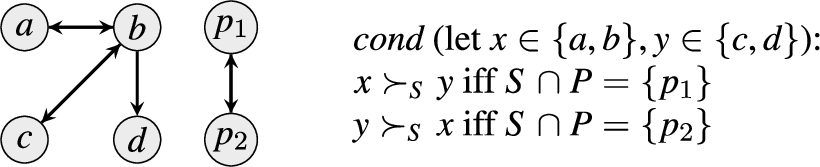
Example VAF with two audiences () and ().
More formally, a VAF is a quintuple such that is an AF, V is a set of values, is a mapping from arguments to values, and P is a finite set of audiences. Each audience is associated with a preference relation over values, and is called an audience-specific VAF (AVAF). The extensions of VAFs are determined for each audience separately. Specifically, an argument x successfully attacks y in iff and . Conflict-freeness and admissibility are then defined over these successful attacks. In essence, this boils down to using Reduction 1 on , i.e., deleting attacks that contradict the preference ordering.
Figure 11a shows a VAF with two values and . Let us say there are two audiences in this VAF, with the preference and with . The AFs associated with and , i.e., the AFs containing only the successful attacks in the AVAFs of and , are depicted in Figs 11b and 11c.
CPAF obtained by translating the VAF of Fig. 11 according to Definition 17.
The reasoning tasks typically associated with VAFs are those of subjective and objective acceptance. Let be a VAF and . Then x is subjectively accepted in F iff there is such that x is in a preferred extension of the AVAF . Similarly, x is objectively accepted in F iff for all we have that x is in all preferred extensions of the AVAF .
We now provide a translation where an arbitrary VAF is transformed into a CPAF such that the subjectively and objectively accepted arguments in F correspond to the credulously and skeptically preferred arguments in respectively.
Let be a VAF. Then is the CPAF such that
,
,
for every , iff there is with and .
Intuitively, each audience in the initial VAF is added as its own argument in our CPAF. The attacks of the VAF are preserved and symmetric attacks are added between all audience-arguments. Lastly, the preferences in our CPAF correspond to the preferences of each audience and are controlled by the newly introduced audience-arguments. Figure 12 shows the CPAF that results if the above translation is applied to the VAF of Fig. 11.
Observe that the successful attacks in some AVAF are also attacks in , where , and vice versa. Thus, the admissible sets in the initial VAF F stand in direct relationship to the admissible sets in our constructed CPAF.
Letbe a VAF,, and. Then S is admissible in the AVAFiff.
Furthermore, note that all audience-arguments in attack each other, i.e., an admissible set in contains at most one audience-argument. In fact, each audience-argument defends itself, and thus every preferred extension in must contain exactly one audience-argument if we appeal to the -semantics. Therefore, the direct correspondence between admissible sets observed in Lemma 25 carries over to preferred extensions.
Given a VAF,is subjectively (resp. objectively) accepted in F iff x is credulously (resp. skeptically) preferred inw.r.t. Reduction 1.
It must be pointed out that the translation provided in Definition 17 was designed for VAFs in which each audience is given explicitly. However, VAFs can also be defined with preferences given implicitly as the set of all possible audiences [8], where each audience corresponds to a linear ordering over all values. In this case, the translation of Definition 17 is not polynomial as the number of audience arguments would be factorial in the number of values. We now provide an alternative translation that can handle this implicit definition of audiences and where we only need additional arguments.
Let be a VAF, with P implicitly given as the set of all possible linear orderings over V. Then is the CPAF such that
,
,
is defined as follows: for every such that and every we introduce the rule .
CPAF obtained by translating the VAF of Fig. 11 according to Definition 18.
Figure 13 shows the CPAF that results if the above translation is applied to the VAF of Fig. 11. As with our first translation (cf. Definition 17), there is a direct semantic correspondence between the initial VAF and the constructed CPAF. The idea is the following: along with the arguments and attacks of the original VAF, we introduce arguments for each value . If is accepted, this means that v is considered the k-th best value. Since attacks all other value-arguments with we know that no other value is simultaneously ascribed the k-th best position. Moreover, attacks all with , i.e., v is only ascribed the k-th best position and no other. Then, we prefer an argument a to another argument b if the value of a is preferred (appears at an earlier position in the linear ordering) than b. In this way, each extension corresponds to a linear ordering over all values, i.e., each extension corresponds to an audience. This further implies that each S-reduct of the constructed CPAF has exactly the same attacks between the arguments of the initial VAFs as the AVAF corresponding to the value-ordering encoded in S. This gives us a result analogous to Proposition 26.
Given a VAFwhere P is implicitly given as the set of all possible linear orderings over V,is subjectively (resp. objectively) accepted in F iff x is credulously (resp. skeptically) preferred inw.r.t. Reduction 1.
Our translations highlight the versatility of our formalism. On the one hand, conditional preferences can be tied to dedicated arguments (in this case the audience-arguments). On the other hand, these dedicated arguments themselves may be part of the argumentation process. Note that we used CPAFs with Reduction 1 since preferences in VAFs are usually handled by deleting attacks. However, our approach also allows for the use of other preference-reductions in VAF-settings.
Moreover, note that the problem of subjective acceptance in VAFs is -complete [12], even if the set of all audiences is represented implicitly. In contrast, we have shown that credulous acceptance in CPAFs is -complete (cf. Table 4). Thus, assuming that the polynomial hierarchy does not collapse, finding a polynomial translation from CPAFs to VAFs analogous to our Proposition 26 (resp. Proposition 27) is not possible when considering credulously/subjectively accepted arguments.
Relationship to extended argumentation frameworks
EAFs allow arguments to express preferences between other arguments by permitting attacks themselves to be attacked. While EAFs are related to our CPAFs conceptually, we will see that there are crucial differences in how exactly preferences are handled.
Formally, an EAF is a triple such that is an AF, , and if then . The definition of admissibility in EAFs is quite involved and requires so-called reinstatement sets. Essentially, a set of arguments S is admissible in an EAF if all arguments are defended from other arguments , and if all attacks used for defending x are in turn defended from attacks on attacks and thus reinstated. It is possible that a chain of such reinstatements is required which is formalized with the aforementioned reinstatement sets. Formally defining these concepts is not necessary for our purposes, but the corresponding definitions can be found in [34]. Observe that the notion of attacks on attacks in EAFs is similar to Reduction 1 in the sense that attacks between arguments can be unsuccessful, but they are never reversed. Therefore, we will compare EAFs to CPAFs with Reduction 1.
Recall our Sherlock Holmes example from the introduction (Example 1) that we modeled as a CPAF (Example 3). Let us first consider a slimmed-down variation without an argument stating that Person 1 has an alibi. We can model this as an EAF with three arguments (Person 1 is the culprit), (Person 2 is the culprit), and (Person 1 has a motive) in which attacks the attack from to . The corresponding EAF is depicted in Fig. 14b. Compare this to the formalization via a CPAF in Fig. 14a. Note that is admissible in the EAF but is not since is used to defend against but not reinstated against . In the CPAF, is admissible (but not stable).
This simple example highlights a fundamental difference in how preferences are viewed in the two formalisms. In CPAFs, preferences are relevant exactly if the argument that expresses them (e.g. ) are part of the set under inspection. In EAFs, preference are relevant even if the argument that expresses them is not accepted. Modgil [34] states that admissibility for EAFs was defined in this way because it was deemed important to satisfy Dung’s Fundamental Lemma [26], which says that if S is admissible and x is acceptable w.r.t. S then is admissible. This Fundamental Lemma is not satisfied in our CPAFs. However, in our opinion, this is no drawback but rather a necessary property of formalisms that can deal with conditional preferences in a flexible way. For example, in Fig. 14a it is clear that should be admissible since, when considering only admissibility, we are not forced to include the unattacked , i.e., we do not have to accept that Person 1 has a motive. The inclusion of unattacked arguments in CPAFs is handled via more restrictive approaches such as stable or preferred semantics, as usual.
A simplified version of the Sherlock Holmes example modeled via a CPAF and an EAF.
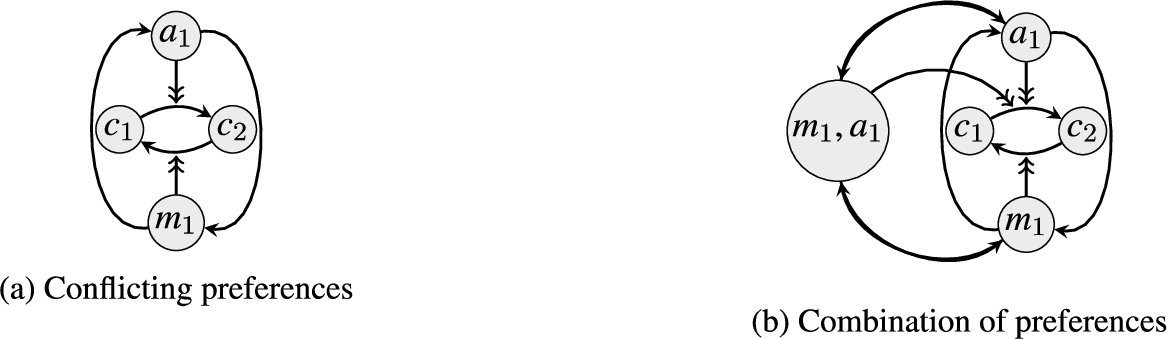
Another difference between CPAFs and EAFs becomes clear when considering the entire Sherlock Holmes example. Recall our formalization for CPAFs (cf. Fig. 2). In order to express our preference in case Person 1 has an alibi we extend our EAF from Fig. 14b by adding an attack from to the attack , as shown in Fig. 15a.3
The EAFs of Fig. 14b and Fig. 15a are also used as examples in Modgil’s original paper [34].
Note that and must attack each other in this EAF by definition since they express conflicting preferences. But this formalization is unsatisfactory since it should be possible for Person 1 to have both a motive and an alibi. The fact that the preference of one argument may change in view of another argument must be modeled indirectly in EAFs. For example, we can introduce an additional argument to express that Person 1 has both a motive and an alibi. This is depicted in Fig. 15b. Thus, we can see that CPAFs allow for more flexibility when combining preferences associated with several arguments.
The full Sherlock Holmes example modeled by two different EAFs.
There are also some differences between CPAFs and EAFs when it comes to preferred semantics. For instance, stable extensions in EAFs are not necessarily preferred extensions [28]. In CPAFs, every stable extension is also preferred, except if we use global maximization and Reduction 1 (cf. Proposition 4). Moreover, credulous acceptance under preferred semantics is in for EAFs [28], but -complete for CPAFs when using local maximization (cf. Table 4).
To summarize, CPAFs are designed to express conditional preferences in abstract argumentation, whereas preferences in EAFs are unconditional in the sense that they may always influence the argumentation process, even if the argument associated with the preference is not accepted. Moreover, since our CPAFs can make use of all four preference reductions, they allow for more flexibility in how preferences are handled compared to EAFs, in which unsuccessful attacks are always deleted. However, the two formalisms are similar in that arguments are capable of reasoning about the argumentation process itself, i.e., they constitute a form of metalevel argumentation [35].
Lifting preferences over arguments to sets of arguments
In our CPAFs, we deal with preferences by using preference reductions which modify the attack relation (see Definition 5). There exist other approaches to preferences in argumentation, where preference orderings over arguments are lifted to sets of arguments [1,6,22,33], and the most preferred extensions are then selected according to this new preference ordering.
Recently [2], conditional preferences in abstract argumentation have been investigated using the aforementioned preference liftings. We refer to the CPAFs introduced in that work as lifting-based CPAFs. Similarly to our reduction-based CPAFs, a lifting-based CPAF is given as where is an AF and Γ is a set of conditional preference rules of the form built from arguments . The conditional preferences over arguments given by Γ are lifted to preferences over sets of arguments according to one of three criteria (democratic, elitist, KTV), and then the ‘best’ extensions are selected according to this lifted preference ordering.
Note that lifting-based CPAFs, in contrast to our reduction-based CPAFs, satisfy principle (cf. Definition 15) by design, since the ‘best’ extensions selected in a lifting-based CPAF are always extensions of . We note that, for complete and stable semantics, Reduction 3 satisfies as well and thus selects extensions in the style of preference liftings (cf. Table 3).
The conditional preference rules Γ of a lifting-based CPAF are usually assumed to be well-formed, which ensures that arguments , occurring in the head of a rule do not occur in the body of the same rule. This is to prevent counterintuitive results, as explained in [2] via the following example: given with extensions and Γ given by and , one would expect the only ‘best’ extension to be . However, under semantics of lifting-based CPAFs, both and are ‘best’. This problem does not occur with the well-formed . In our reduction-based CPAFs we have no analogous assumption of well-formedness. Despite this, the counter-intuitive behavior observed above does not necessarily occur in our reduction-based CPAFs. For example, consider with , , and given by the rules and . Then . However, under all four preference reductions, the attack is deleted as soon as b or c is in the extension under inspection. Thus, .
Another difference between lifting-based CPAFs and our reduction-based CPAFs lies in their computational complexity, which is higher for lifting-based CPAFs in most cases. For example, verification for stable semantics is -complete in lifting-based CPAFs [2] but remains in in reduction-based CPAFs (see Table 4). As a result, credulous and skeptical acceptance for stable semantics are -complete and -complete respectively in lifting-based CPAFs, while they remain -complete and -completely respectively in reduction-based CPAFs. Some problems, such as credulous and skeptical acceptance of preferred semantics under elitist and KTV criteria, may even lie on the third level of the polynomial hierarchy for lifting-based CPAFs (tight bounds for the complexity of these problems have not been established yet). We observe that the increased complexity of lifting-based CPAFs is in many cases not due to the introduction of conditional preferences, but rather due to the preference-liftings themselves, as the complexity of lifting-based PAFs (featuring only unconditional preferences) is already considerably higher than that of regular AFs [1].
As pointed out in [2, Example 2], there are lifting-based CPAFs where not every (best) stable extension is also a (best) preferred extension. In contrast, every stable extension in a reduction-based CPAF is also a preferred extension, except when considering Reduction 1 and preferred semantics with global maximization (cf. Proposition 4).
To conclude this comparison, we want to emphasize that there is a conceptual difference between the reduction-based and lifting-based approaches to resolving preferences in argumentation: when using preference reductions, expresses that x is stronger than y; when using preference liftings, expresses that we prefer outcomes containing x rather than y. Which of the two approaches should be chosen depends on the task at hand.
Conclusion
In this paper, we introduce Conditional Preference-based AFs (CPAFs) which generalize PAFs and allow to flexibly handle conditional preferences in abstract argumentation.
We conduct a principle-based analysis for CPAFs and show that complete and stable semantics satisfy the same principles as on PAFs in most cases while grounded semantics no longer satisfies many of the principles. We further investigate the computational complexity of CPAFs and show that this complexity can be influenced by the chosen preference reduction (in case of naive semantics) or by how maximization is handled (in case of naive and preferred semantics). Our results also show that the satisfaction of I-maximality can depend on how maximization is dealt with (in case of preferred semantics) and on which preference-reduction is chosen (in case of stable semantics).
Moreover, we compare CPAFs to related formalisms. On the one hand, we show that CPAFs can be used to capture VAFs via a straightforward translation. On the other hand, we demonstrate that CPAFs exhibit significant differences to EAFs in terms of how preferences are handled. We also discuss a recently introduced alternative approach to conditional preferences in abstract argumentation, where preferences over arguments are lifted to preferences over sets of arguments.
The fact that Reduction 1 results in a higher complexity under naive semantics (cf. Table 4) is not unique to our setting. It has been shown that Reduction 1 causes a higher complexity compared to Reductions 2-4 also in the setting of claim-acceptance in AFs [13], although there the difference between the preference reductions extends to more than just naive semantics.
For future work, the relationship between CPAFs and existing approaches in structured argumentation [27] shall be investigated. Related to this point, it may also be interesting to see whether conditional preferences can be adapted to other formalisms such as bipolar argumentation frameworks [5], in which both attack and support relations are present. As for preference representation, it could be investigated how existing formalisms designed to handle conditional preferences such as CP-nets [19] or various forms of logic programming [20,21,23,24] relate to CPAFs.
Footnotes
Acknowledgements
We thank the anonymous reviewers, including the reviewers of the previous version of this paper, for their valuable feedback. This work was funded by the Austrian Science Fund (FWF) under grant P32830 and by the Vienna Science and Technology Fund (WWTF) under grant ICT19-065.
References
1.
G.Alfano, S.Greco, F.Parisi and I.Trubitsyna, On preferences and priority rules in abstract argumentation, in: Proc. IJCAI’22, IJCAI Organization, 2022, pp. 2517–2524.
2.
G.Alfano, S.Greco, F.Parisi, I.Trubitsynaet al., Abstract argumentation framework with conditional preferences, in: Proc. AAAI’23, AAAI Press, 2023, pp. 6218–6227.
3.
L.Amgoud and C.Cayrol, On the acceptability of arguments in preference-based argumentation, in: Proc. UAI’98, Morgan Kaufmann, 1998, pp. 1–7.
4.
L.Amgoud and C.Cayrol, A reasoning model based on the production of acceptable arguments, Ann. Math. Artif. Intell.34(1–3) (2002), 197–215. doi:10.1023/A:1014490210693.
5.
L.Amgoud, C.Cayrol, M.Lagasquie-Schiex and P.Livet, On bipolarity in argumentation frameworks, Int. J. Intell. Syst.23(10) (2008), 1062–1093. doi:10.1002/int.20307.
6.
L.Amgoud and S.Vesic, Rich preference-based argumentation frameworks, Int. J. Approx. Reason.55(2) (2014), 585–606. doi:10.1016/j.ijar.2013.10.010.
7.
S.Arora and B.Barak, Computational Complexity: A Modern Approach, Cambridge University Press, 2009.
8.
K.Atkinson and T.J.M.Bench-Capon, Value-based argumentation, in: Handbook of Formal Argumentation, Vol. 2, College Publications, 2021, pp. 299–354. Also appears in IfCoLog Journal of Logics and their Applications 8(6), 1543–1588.
9.
P.Baroni, M.Caminada and M.Giacomin, Abstract argumentation frameworks and their semantics, in: Handbook of Formal Argumentation, College Publications, 2018, pp. 159–236, Chapter 4.
10.
P.Baroni, F.Cerutti, M.Giacomin and G.Guida, Encompassing attacks to attacks in abstract argumentation frameworks, in: Proc. ECSQARU’09, LNCS, Vol. 5590, Springer, 2009, pp. 83–94.
11.
P.Baroni and M.Giacomin, On principle-based evaluation of extension-based argumentation semantics, Artif. Intell.171(10–15) (2007), 675–700. doi:10.1016/j.artint.2007.04.004.
12.
T.J.M.Bench-Capon, S.Doutre and P.E.Dunne, Audiences in argumentation frameworks, Artif. Intell.171(1) (2007), 42–71. doi:10.1016/j.artint.2006.10.013.
13.
M.Bernreiter, W.Dvořák, A.Rapberger and S.Woltran, The effect of preferences in abstract argumentation under a claim-centric view, in: Proc. AAAI’23, AAAI Press, 2023, pp. 6253–6261.
14.
M.Bernreiter, W.Dvořák and S.Woltran, Abstract argumentation with conditional preferences, in: Proc. COMMA’22, Frontiers in Artificial Intelligence and Applications, Vol. 353, IOS Press, 2022, pp. 92–103. doi:10.3233/FAIA220144.
15.
M.Bernreiter, J.Maly and S.Woltran, Choice logics and their computational properties, Artif. Intell.311 (2022), 103755. doi:10.1016/j.artint.2022.103755.
16.
M.Bienvenu, J.Lang and N.Wilson, From preference logics to preference languages, and back, in: Proc. KR’10, AAAI Press, 2010, pp. 414–424.
17.
S.Bistarelli and F.Santini, Weighted argumentation, in: Handbook of Formal Argumentation, Vol. 2, College Publications, 2021, pp. 355–395. Also appears in IfCoLog Journal of Logics and their Applications 8(6), 1589–1622.
18.
J.Bobadilla, F.Ortega, A.Hernando and A.Gutiérrez, Recommender systems survey, Knowl. Based Syst.46 (2013), 109–132. doi:10.1016/j.knosys.2013.03.012.
19.
C.Boutilier, R.I.Brafman, C.Domshlak, H.H.Hoos and D.Poole, CP-nets: A tool for representing and reasoning with conditional ceteris paribus preference statements, J. Artif. Intell. Res.21 (2004), 135–191. doi:10.1613/jair.1234.
20.
G.Brewka, J.P.Delgrande, J.Romero and T.Schaub, Asprin: Customizing answer set preferences without a headache, in: Proc. AAAI’15, AAAI Press, 2015, pp. 1467–1474.
21.
G.Brewka, I.Niemelä and T.Syrjänen, Logic programs with ordered disjunction, Comput. Intell.20(2) (2004), 335–357. doi:10.1111/j.0824-7935.2004.00241.x.
22.
G.Brewka, M.Truszczynski and S.Woltran, Representing preferences among sets, in: Proc. AAAI’10, AAAI Press, 2010, pp. 273–278.
23.
A.Charalambidis, P.Rondogiannis and A.Troumpoukis, A logical characterization of the preferred models of logic programs with ordered disjunction, Theory Pract. Log. Program.21(5) (2021), 629–645. doi:10.1017/S1471068421000235.
24.
J.P.Delgrande, T.Schaub and H.Tompits, A framework for compiling preferences in logic programs, Theory Pract. Log. Program.3(2) (2003), 129–187. doi:10.1017/S1471068402001539.
25.
C.Domshlak, E.Hüllermeier, S.Kaci and H.Prade, Preferences in AI: An overview, Artif. Intell.175(7–8) (2011), 1037–1052. doi:10.1016/j.artint.2011.03.004.
26.
P.M.Dung, On the acceptability of arguments and its fundamental role in nonmonotonic reasoning, logic programming and n-person games, Artif. Intell.77(2) (1995), 321–358. doi:10.1016/0004-3702(94)00041-X.
27.
P.M.Dung, P.M.Thang and T.C.Son, On structured argumentation with conditional preferences, in: Proc. AAAI’19, AAAI Press, 2019, pp. 2792–2800.
28.
P.E.Dunne, S.Modgil and T.J.M.Bench-Capon, Computation in extended argumentation frameworks, in: Proc. ECAI’10, FAIA, Vol. 215, IOS Press, 2010, pp. 119–124.
29.
W.Dvořák and P.E.Dunne, Computational problems in formal argumentation and their complexity, in: Handbook of Formal Argumentation, College Publications, 2018, pp. 631–687, Chapter 14. Also appears in IfCoLog Journal of Logics and their Applications 4(8), 2557–2622.
30.
W.Dvořák, M.König, M.Ulbricht and S.Woltran, Rediscovering argumentation principles utilizing collective attacks, in: Proc. KR’22, 2022.
31.
U.Endriss (ed.), Trends in Computational Social Choice, AI Access, 2017.
32.
S.Kaci, L.W.N.van der Torre, S.Vesic and S.Villata, Preference in abstract argumentation, in: Handbook of Formal Argumentation, Vol. 2, College Publications, 2021, pp. 211–248.
33.
S.Kaci, L.W.N.van der Torre and S.Villata, Preference in abstract argumentation, in: Proc. COMMA’18, FAIA, Vol. 305, IOS Press, 2018, pp. 405–412.
34.
S.Modgil, Reasoning about preferences in argumentation frameworks, Artif. Intell.173(9–10) (2009), 901–934. doi:10.1016/j.artint.2009.02.001.
35.
S.Modgil and T.J.M.Bench-Capon, Metalevel argumentation, J. Log. Comput.21(6) (2011), 959–1003. doi:10.1093/logcom/exq054.
36.
S.Modgil and H.Prakken, Reasoning about preferences in structured extended argumentation frameworks, in: Proc. COMMA’10, FAIA, Vol. 216, IOS Press, 2010, pp. 347–358.
37.
S.Modgil and H.Prakken, A general account of argumentation with preferences, Artif. Intell.195 (2013), 361–397. doi:10.1016/j.artint.2012.10.008.
38.
S.Modgil and H.Prakken, Abstract rule-based argumentation, in: Handbook of Formal Argumentation, College Publications, 2018, pp. 287–364, Chapter 6. Also appears in IfCoLog Journal of Logics and their Applications 4(8), 2319–2406.
39.
G.Pigozzi, A.Tsoukiàs and P.Viappiani, Preferences in artificial intelligence, Ann. Math. Artif. Intell.77(3–4) (2016), 361–401. doi:10.1007/s10472-015-9475-5.
40.
Y.Shoham, Nonmonotonic logics: Meaning and utility, in: Proc. IJCAI’87, Morgan Kaufmann, 1987, pp. 388–393.
41.
L.van der Torre and S.Vesic, The principle-based approach to abstract argumentation semantics, in: Handbook of Formal Argumentation, College Publications, 2018, pp. 797–838, Chapter 16. Also appears in IfCoLog Journal of Logics and their Applications 4(8), 2737–2780.