




Abstract
In this paper we describe an argumentation-based representation of normal form games, and demonstrate how argumentation can be used to compute pure strategy Nash equilibria. Our approach builds on Modgil’s Extended Argumentation Frameworks. We demonstrate its correctness, showprove several theoretical properties it satisfies, and outline how it can be used to explain why certain strategies are Nash equilibria to a non-expert human user.
Introduction
Game theory studies how multiple rational decision-makers should act given interactions between their strategies, and preferences over the resultant outcomes. Game theory has been applied to myriad fields [9]. Within game theory, decision-makers (referred to as players), their strategies, preferences and outcomes are represented within a game, and the solutions to a game identify some form of rational outcome. One such solution concept is that of a dominant strategy, where a player has a strategy or a set of strategies that will always result in the best outcome for them, regardless of what other players do. However, such dominant strategies often do not exist. In this work, we consider instead the notion of a Nash equilibrium, which identifies optimal strategies given that other players also pursue their own optimal strategies. Such Nash equilibria therefore represent a form of best response, and provide a well understood solution concept in game theory. However, finding Nash equilibria is computationally difficult, and it is sometimes difficult for a non-expert to understand why a given strategy is (or is not) a Nash equilibrium. We believe that by providing an argumentation-based representation of games, dialogues can be used to explain a Nash equilibrium to such non-experts. While work such as [7] has considered game theory in the context of ABA, to our knowledge, this work is the first to link abstract argumentation and Nash equilibria. We consider only so-called pure strategies for normal form games and intend to relax this restriction in future work.
The remainder of the paper is structured as follows. In Section 2, we provide a brief overview of argumentation and game-theory concepts necessary to understand our article. In Section 3, we describe how a normal form game can be encoded using argumentation. Section 4 examines some formal properties of our approach. Section 5 shows how we can build upon the proposed framework to provide explanations to a user about whether a strategy profile is a Nash equilibrium or not. Lastly, we discuss related and future work in Section 6 before concluding.
Background
We begin by providing the necessary background in game theory and argumentation required for the rest of the paper.
Game theory
In this paper, we use the usual normal form for games [16].
(Normal game).
A (normal) game is
The notation
We assume that for all players i,
The notation
Two games in normal form
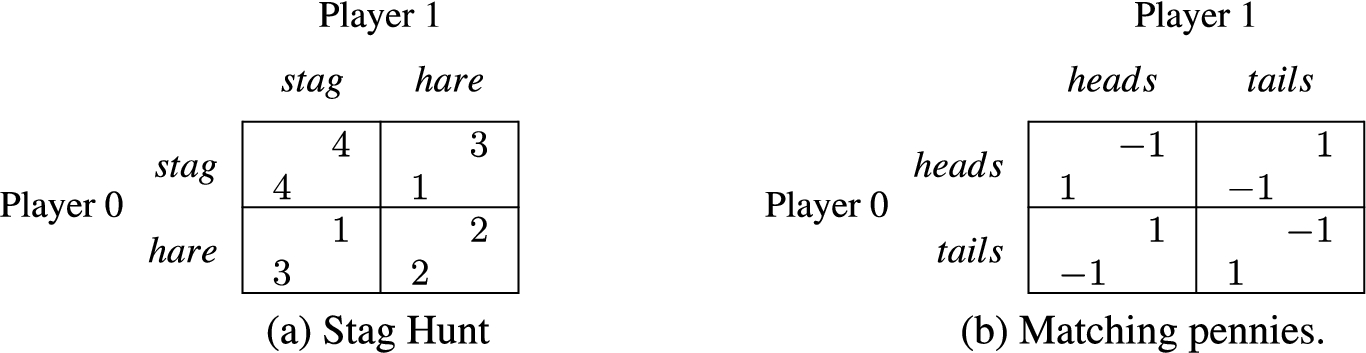
Let us consider the stag hunt game
In asking why a player should pursue some strategy, we must take into account the strategies of others.
If each player has chosen a strategy, and no player can increase their own outcome by changing their strategy while the other players keep theirs unchanged, then the current pure strategy profile constitutes a Nash equilibrium.
Let
A simple algorithm to identify all Nash equilibrium in the presence of pure strategies involves iterating through every player and identifying the best strategy profile (in terms of
Given a game in normal form, the above algorithm involves – for a two player game – scanning down each column and marking the best strategy for the row player, and then doing the same for each row marking the best strategy for the column player. Each cell marked for both players is a Nash equilibrium. In the remainder of this paper, we show an argumentation-based alternative.
There are two Nash equilibria in the stag hunt game:
Argumentation
We encode normal form games in terms of arguments and attacks by building on Modgil’s Extended Argumentation Frameworks (EAF) [11].
An Extended Argumentation Framework is a triple
Let
(Argumentation semantics).
Let E is conflict-free iff for every E is an admissible extension iff every argument in E is acceptable w.r.t. E E is a preferred extension iff E is a maximal (w.r.t. ⊆) admissible extension E is a stable extension iff for every
We will use the notation
We note in passing that it is possible to flatten an EAF, that is, transform it to a standard abstract argumentation framework such that all arguments within an extension (according to some semantics) within the EAF are equivalently found in the extension of the abstract framework [3,13,14]. Therefore, standard argumentation solvers [18] can be applied – once flattened – to identify justified arguments within an EAF.
Argumentation-based approach for games
We consider an argumentation framework with multi-level arguments. At the base level, we consider all possible strategy profiles as arguments. Since only a single strategy profile can ever occur (as players execute one set of strategies in the interaction), every argument at this level must attack every other argument. We refer to such arguments as game-based arguments, and note that they are equivalent to pure strategy profiles.
(Game-based argument).
Let
The set of all game-based arguments for a game G is denoted by
Next, we introduce preference arguments. Intuitively, these can be interpreted as statements of the form: “Given that the other players are performing a given set of strategies, the remaining player’s preferred strategy should be playing x”.
(Preference argument).
Let
The set of preference arguments for a game G is denoted by
Finally, we introduce valuation arguments, which can be interpreted as statements of the form: “Given that the other players are performing a given set of strategies, it is the case that the outcome of strategy s is better than the outcome of strategy
(Valuation argument).
Let
The set of valuation arguments for a game G is denoted by
(Cont’d).
The sets of game-based, preference and valuation arguments w.r.t. G are shown in Table 2. The argument
Arguments for the stag hunt game
Arguments for the stag hunt game
We now turn our attention to attacks. We note that preference and valuation arguments provide reasons why one argument should not attack another, and therefore introduce not only attacks between arguments, but also attacks on attacks.
For a game
The first attack captured within Definition 9 is between every two distinct game-based arguments. As each player has to choose exactly one strategy, different strategy profiles are clearly incompatible. The second bullet point represents attacks between preference arguments. In the stag hunt example for instance,
The arguments and attacks induce a very specific type of extended argumentation framework, where object-level (game-based) arguments have their attacks attacked by meta-arguments (preference arguments) at level one, and where attacks between these meta-arguments are attacked by meta-arguments at level two (valuation arguments).
The first layer is needed to encode every possible outcomes, the second layer is useful for specifying outcomes that are comparable whereas the third layer returns an agent’s preference between two outcomes.
(Argumentation framework).
Let G be a game. The argumentation framework corresponding to G is the tuple
(Example 3 Contd).
Fig. 1 represents the game-based, preference and valuation arguments of G using blue (
Argumentation graph corresponding to stag hunt game.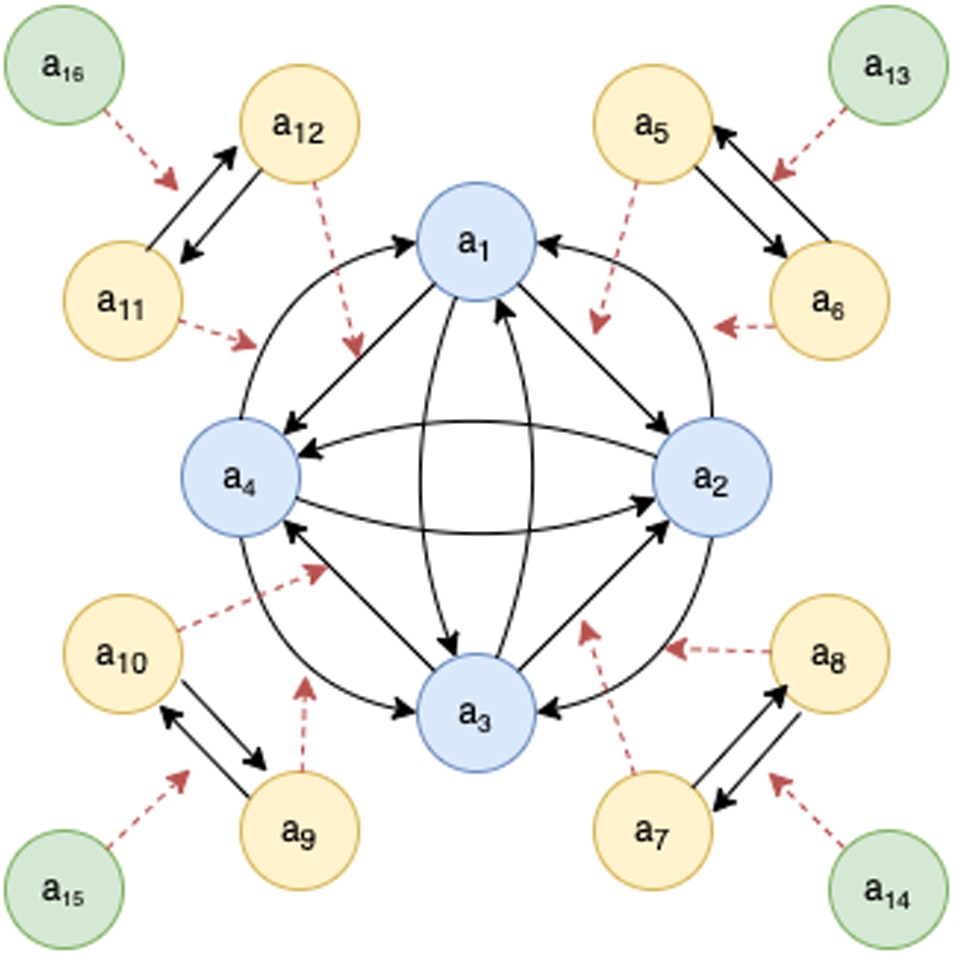
For our framework to be an EAF, it must satisfy some constraints, as described in [12], and we can easily show that this is the case.
Let G be a game and
There are only two types of attacks on attacks: (1) attacks coming from valuation arguments to attacks between preference arguments and (2) attacks coming from preference arguments to attacks between game-based arguments. In the rest of this proof, we prove that Proposition 1 is satisfied for the two types of attacks on attacks.
Considering We now study the case
Since – given Proposition 1 – our argumentation system is an EAF, we can use EAF semantics to evaluate it.
In our running example,
System properties
Having described our system, we now consider its properties. The most important result we seek to show is the correspondence between argumentation semantics and Nash equilibria, and we begin by laying the groundwork for this. We then consider how many arguments will be generated for an arbitrary normal form game.
We begin by considering which preference arguments will appear in a preferred extension. This result is used in later proofs.
Let
Assume a partial strategy profile
Next, we show that if there is a preferred extension with game-based arguments, then each such extension has exactly one game-based argument.
If any preferred extension of
Let E be a preferred extension containing game-based arguments. We prove by contradiction that it is not possible for E to have more than one game-based argument. Assume that E contains two game-based arguments
We now show that a game-based argument which is not a Nash equilibrium will not appear in any preferred extension of the associated argumentation system.
Let
Assume there is a non-Nash equilibrium game-based argument
Let
In the next proposition, we show that if a preferred extension contains a game-based argument, then it is a stable extension.
Let G be a game and
We show that if a preferred extension possesses a game-based argument, then it is also a stable extension. Assume E contains a single game-based argument. By Lemma 2, E contains exactly one game-based argument. Therefore, all game-based arguments not in the extension are defeated by the game-based argument within the extension with respect to E, meaning that the game-based argument is a member (at the game-based level) of the stable extension. □
It may seem intuitive that the preferred and stable extension should coincide. However, this is not the case, as demonstrated by the following counter-example.
Consider the matching pennies game
The set of arguments is
Arguments for the matching pennies game
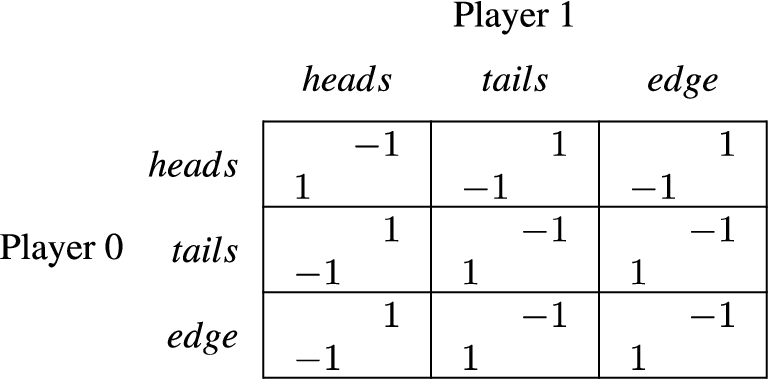
Furthermore, even when multiple preferred extensions exist, these may not coincide with the stable extensions.
Let us consider the following variant of the matching pennies game with three strategies for each player. We have
Three strategy variant of the matching pennies game
We now turn to our main result, namely the equivalence of the Nash equilibrium with the game-based arguments found in the preferred extensions.
Let
We split this proof in two parts:
We need to show that if S is a Nash equilibrium, then it is within a preferred extension of We need to show that if S is within a preferred extension, then S is a Nash equilibrium. This follows directly from the result from Corollary 1. □
Returning to the stable extensions, the following result shows that there is a one-to-one correspondence between the sets of Nash equilibria and the set of classes of stable extensions,3
We say two stable extensions are equivalent iff they have the same game-based argument.
Let
Finally, we consider how many arguments an argumentation system representing a normal form game will contain.
Let
The proof is split into three parts.
Suppose n players and m strategies per player. Each game-based argument corresponds to a pure strategy profile, i.e., there are Consider the number of the preference arguments. There are We estimate the number of valuation arguments. Each valuation argument is obtained from one partial strategy profile and one pair of different strategies. There are
We note that computing Nash equilibria is known to be computationally difficult, and the result regarding the number of arguments is therefore unsurprising.
In this section, we show how our framework can be used for determining whether a pure strategy profile is a Nash equilibrium or not. Let
We now demonstrate the sequence of utterances dialogue participants should use to ensure that the proponent will win the dialogue if and only if A is a Nash equilibrium. However, argument B advanced by the opponent may not be a Nash Equilibrium. Therefore, multiple rounds of the dialogue may be required to identify such equilibria.
The dialogue consists of agents advancing locutions which refer to arguments, valuations and players. While a dialogue without locutions can be defined, we believe that such locutions aid the explanatory process without introducing additional complexity, and that the locutions’ intuitive meaning is clear. We therefore do not provide a formal account of these locutions. There can be three possible scenarios for the dialogue:
B is strictly better than A for an agent i, i.e. The dialogue for Scenario 1
B is strictly worse than A for an agent i, i.e.
The dialogue for Scenario 2
The dialogue for Scenario 3
B is equivalent to A for an agent i, i.e.
If the resultant dialogue evolves as per Scenario 1, then the proponent’s game argument is not a Nash Equilibrium.
In this paper, we described how normal form games can be given an argumentation-based interpretation so as to allow – via argumentation semantics – for pure Nash equilibria to be computed. Intuitively, a Nash equilibrium identifies the best strategy a player can pursue given others’ strategies. However, explaining – to a non-expert – why some set of strategies forms a Nash equilibrium is often difficult, and our argument-based interpretation is the first step towards an explanatory dialogue for such explanation. Other work has shown the utility of providing such dialogue-based explanations [5,8,15].
Our approach is based on extended argumentation frameworks, and Modgil [12] has proposed a proof dialogue for such frameworks. The dialogue presented in Section 5 is tailored for our framework and more specialised than Modgil’s proof dialogue, but (we believe) provides a better explanation. In addition, while Modgil’s dialogue specifies legal moves, it does not identify what arguments should be advanced by a dialogue participant, noting only that there exists a winning strategy to demonstrate that an argument is in the credulous preferred semantics. In contrast, our (simple) dialogue amalgamates both the legal moves that a player can make and the strategy that they must follow. This is best illustrated in Table 8, which shows two possible dialogues of the stag hunt game (shown in Table 1 and Fig. 1) from Modgil’s system. The left hand dialogue is analogous to Scenario 2 of our approach (cf. Section 5), but contains only the arguments themselves without explaining why they exist or attack other arguments (unlike our approach). The dialogue on the right demonstrates a non-winning but legal strategy in Modgil’s system, which has no explanatory power.
Examining Tables 5–7, we note that the losing player will make a last
If A is a Nash Equilibrium, then there is no dialogue whose first move by P is
In the left dialogue, the proponent is demonstrating that argument
is a Nash equilibrium. In the right dialogue, both agents advance Nash equilibria
In the left dialogue, the proponent is demonstrating that argument
In the short term, we intend to empirically evaluate the explanatory capability of our dialogue with human subjects. Other extensions which we intend to investigate include providing an argumentation semantics for mixed Nash equilibria (perhaps through the use of some form of ranking semantics [1,4,10]), and investigating other solution concepts (e.g., Pareto optimality) for more complex types of games. Finally, there are clear links between game theory and group-based practical reasoning. Building on work such as [2,19], we intend to investigate how an argument-based formulation to practical reasoning underpinned by game theory can be created.
In this work, we introduced three levels of argument to compute the Nash equilibria. An obvious alternative formulation would use a single level, where joint strategy profiles are arguments (equivalent to game-based arguments), and attacks are constructed based on the algorithm for computing equilibria. While this approach would yield similar results, it provides no explanation as to why the attacks appear (and therefore why something is a Nash equilibrium).In our formulation, we have arguments about the object level (i.e., game arguments), as well as arguments about preferences over these objects, which are themselves reasoned about. Modgil [11] demonstrates that the standard way of reasoning about such structures is through the use of meta-level argumentation, instantiated as an extended argumentation framework. By making use of this multi-level approach, we have shown how our dialogues can exploit this structure to provide explanation.
Several other authors have investigated some links between game theory and argumentation. For example, in his seminal paper, Dung [6] noted that the stable extension corresponds to the stable solution of an cooperative n-person game, but did not seem to deal with non-cooperative games as we do here. Game theory was also used to describe argument strength by Matt and Toni [10], and Rahwan and Larson [17] investigated the links between argumentation and game theory from a mechanism design point of view. Perhaps most closely related to the current work is Fan and Toni’s work [7] exploring the links between dialogue and assumption-based argumentation (ABA). Here, the authors showed how admissible sets of arguments obtained from their ABA constructs are equivalent to Nash equilibria. In contrast to the current work, they only considered two player games and utilised structured argumentation, allowing them to describe a proof dialogue with associated strategies.
In this paper, we provided an argumentation-based interpretation of pure strategies in normal form games, demonstrating how argumentation semantics can be aligned with the Nash equilibrium as a solution concept, and examining some of the argumentation system’s properties. We also formalised dialogues for our framework, highlighting how it can be used for real-word explanations of Nash Equilibria to non-experts.
We believe that this work has significant application potential in the context of argument-based explanation. At the same time, we recognise that there are significant open avenues for research in this area, but believe that the current work is an important step in investigating the linkages between the two domains.