




Abstract
This work formalizes an informant-based structured argumentation approach in a multi-agent setting, where the knowledge base of an agent may include information provided by other agents, and each piece of knowledge comes attached with its informant. In that way, arguments are associated with the set of informants corresponding to the information they are built upon. Our approach proposes an informant-based notion of argument strength, where the strength of an argument is determined by the credibility of its informant agents. Moreover, we consider that the strength of an argument is not absolute, but it is relative to the resolution of the conflicts the argument is involved in. In other words, the strength of an argument may vary from one context to another, as it will be determined by comparison to its attacking arguments (respectively, the arguments it attacks). Finally, we equip agents with the means to express reasons for or against the consideration of any piece of information provided by a given informant agent. Consequently, we allow agents to argue about the arguments’ strength through the construction of arguments that challenge (respectively, defeat) or are in favour of their informant agents.
Introduction
Argumentation has proved to be a powerful paradigm for conceptualizing commonsense reasoning and a promising research area within the field of Artificial Intelligence [7,11,14,40]. One of the main issues an argumentation system has to address is the selection of the acceptable arguments, whose conclusions can be considered to be justified. For this purpose, it is necessary to account for the conflicts between the arguments in the system, and how those conflicts are to be resolved. At this point, a crucial notion comes into play: the notion of argument strength. In general, given an attack from an argument
In this paper we assume a multi-agent setting where agents share domain knowledge with one another. Hence, each deliberative agent may obtain pieces of information from other informant agents, which can have different levels of credibility. In order to reach conclusions to establish their beliefs, agents will build arguments based on the information in their knowledge bases, which include the pieces of information received from a set of their informant agents. In this context, we introduce an informant-based argumentative approach where the credibility of the information sources (i.e., the informant agents) will be used for determining the arguments’ strength. On the one hand, as it is usual in argumentation systems, arguments could be challenged due to the information they use. On the other hand, since the pieces of information used for building the arguments are associated with their informant agents, our approach is such that arguments can also be challenged on their credibility, in other words, on their strength.
The knowledge representation and reasoning capabilities of our approach will take their basis from DeLP [25]. Specifically, our proposal greatly extends and further develops the approach introduced in [21] by providing a formal account of the arguments’ strength based on the credibility of their informant sources. In particular, we extend DeLP’s representational language by including backing and detracting rules, respectively enabling to express reasons for and against the consideration of the information provided by some informant agents. Then, these new types of rules will be used for building backing and detracting arguments, allowing to argue about the arguments’ strength. As a result, in a situation where some informants are challenged whereas others are not, the existence of multiple informants for a given piece of information in an agent’s knowledge base may strengthen its position (hence, of the arguments using them).
For example, let us consider an agent
To summarize, the contribution of this paper is two-fold. On the one hand, we formalize an informant-based structured argumentation approach where the strength of an argument is determined by the strength (i.e., the credibility) of its informant agents. Furthermore, as will become clear later, the strength of an argument in our approach is not absolute, but it is relative to the resolution of the conflicts the argument is involved in. In other words, the strength of an argument will vary from one context to another, as it will be determined by comparison to its attacking arguments (respectively, the arguments it attacks). As a result, it could be the case that some informant providing information for building an argument is relevant for establishing the argument’s strength in a given context, but not in others. On the other hand, through the incorporation of backing and detracting rules (and their homonym arguments) we provide the means for reasoning about the arguments’ strength. In particular, the former will allow us to express reasons for the consideration of any piece of information provided by a given informant agent; analogously, the latter enable to express reasons against the consideration of an informant and thus, will be challenging the strength of arguments making use of information provided by that informant.
The rest of this paper is organized as follows. In Section 2 we will introduce the elements that will be used to represent the agents’ knowledge. Section 3 shows how an agent can build different kinds of arguments and identify different kinds of attacks between them. Then, in Section 4, we will introduce the ways in which the conflicts between arguments are resolved, leading to defeats. Moreover, taking those defeats into account, in Section 5 we formalize the agents’ reasoning mechanism enabling to determine their warranted beliefs. Finally, Sections 6 and 7 discuss relevant related work, draw some conclusions and comment on future lines of work.
Knowledge representation
In this section we will introduce our proposal for agents’ knowledge representation that will be defined as an informant-based DeLP program. We assume that agents may share tentative information in the form of defeasible rules, and that each agent can obtain information from other informant agents that have different degrees of credibility. Also, backing and detracting rules will be proposed in our formalization, allowing to express reasons for and against the consideration of the informant agents providing knowledge used for building the arguments.
The assumption of the existence of a total credibility order over informants is not quite realistic in many multi-agent application domains, and a similar observation applies to the existence of a global order shared by all agents. With this observation in mind, the approach to be introduced below will consider that every agent has its own partial order defined over the set of informant agents, representing the credibility it assigns to each informant. Each agent has a knowledge base where every piece of information is attached with an agent identifier representing that the corresponding agent is the source of that piece of information. In addition, agents could communicate with their peers for obtaining new information or for sharing their beliefs. Clearly, as agents may disagree with one another, the beliefs an agent has may be in conflict with another agent’s knowledge. Then, when sharing conflicting information, the credibility order among the informant agents can be used to decide which information prevails. Next, we briefly introduce the notion of credibility order, which will be used throughout the rest of the paper.
We assume a finite set
Each agent will have its own credibility order, represented by an irreflexive, asymmetric and transitive binary relation over
Consider the set of informants

Graphical representation of the credibility order
It should be noted that agents may change their assessment of one another; as a result, this change would impact their credibility orders, resulting in an update. The dynamic nature of credibility orders is outside the scope of this paper. However, for instance, the formalism proposed in [42], which provides a mechanism for handling the dynamics of a credibility order, can be a complement to our proposal.
As stated before, agents can receive information from different sources that are not equally credible. Thus, the information they provide, which may be contradictory, will be considered to be tentative. In this setting we need a mechanism for dealing with uncertain and conflicting information, able to ultimately determine the beliefs an agent should commit to. In particular, when deciding between contradictory conclusions, the reasoning mechanism will rely on the credibility order the agent has. In our approach, knowledge representation and reasoning is inspired on Defeasible Logic Programming (DeLP) [25]. Our interest in this particular computational tool is that its language provides the declarative capability of representing weak information in the form of defeasible rules and presumptions, and its defeasible argumentation inference mechanism allows warranting conclusions in the presence of contradictory information. Below we will introduce the elements that will be used for representing an agent’s knowledge, some of which are taken from DeLP’s representational language.
Let
A defeasible rule is an ordered pair, denoted “
A defeasible rule “
(Defeasible domain object).
Let
In addition to defeasible rules, we introduce backing rules and detracting rules to express reasons for and against the consideration of informants, respectively. Formally:
(Backing rule).
Let
(Detracting rule).
Let
Syntactically, the only difference between backing and detracting rules is the use of ⊕ and ⊘; however, these two types of rules are semantically opposite. A backing rule “
The entire knowledge of an agent, which will be used to make inferences and construct arguments, is composed of a set of defeasible domain objects and a set of informant rules. This knowledge base will be called informant-based DeLP program.
(Informant-based DeLP program).
An informant-based DeLP program (IBDP for short) is a pair
The following example introduces an IBDP that will serve as a running example, to illustrate the different notions proposed in this paper.
Let us consider the IBDP
As evidenced in Example 2, an IBDP can have two or more defeasible domain objects with the same defeasible rule R but different informant agents. This does not mean that the agent’s knowledge base is redundant; rather, it encodes the fact that the same piece of information was received from different sources. This feature can be considered as an advantage of our approach since, as mentioned before, the credibility order of an agent may change (even dynamically); hence, at any moment, the more credible informant of R could be considered. Furthermore, given the existence of detracting rules, a specific informant of R could be challenged, whereas others are not. Again, a situation like this is illustrated by Example 2, where there exists a detracting rule for the informant
In our approach, an agent will be specified in terms of four components: its own agent identifier, an informant-based DeLP program used to store its knowledge, a credibility order among informants, and an informant-based comparison criterion. The first three elements have been introduced above. On the other hand, the informant-based comparison criterion will make use of the credibility order to establish strict preferences among sets of informants. Briefly, sets of informant agents will be compared as part of the warranting process with the aim of deciding between conflicting arguments, to ultimately determine the accepted arguments and the justified conclusions of the agent. Consequently, since the notion of argument and the way in which they become in conflict (attack) have not been formalized yet, we will postpone the characterization of informant-based comparison criteria until Section 4; that is, we will formally introduce that notion after providing the formal context in which such criteria will be applied. An agent is defined as follows:
Let
Consider the IBDP
Given the characterization of an agent, it can be the case that two different agents
In the following section we will introduce the three kinds of arguments that can be built using the knowledge represented in an IBDP. After that, the different kinds of conflicts that may arise between those arguments (referred to as attacks) will be identified. Then, in Section 4, we will introduce the notion of valid informant-based comparison criterion, used for determining the successful attacks.
A central piece of this formalism that will allow agents to handle contradictory domain information is the notion of argument. Intuitively, an argument is a structure whose conclusion is obtained from a set of premises, informed by some agents, through the use of a reasoning mechanism. In particular, the claims of the arguments will be the tentative beliefs of the agents. When analyzing an argument for a particular belief, an agent can find other arguments, referred to as counter-arguments, that are in conflict with it. Specifically, a conflict may arise because the counter-argument contradicts some information (i.e., a premise, an intermediate conclusion or the final claim) in the argument or because it challenges one of its informants. In this situation, it is necessary to have a mechanism for comparing the conflicting arguments to decide which one prevails. This analysis leads to a dialectical process seeking to validate the arguments in conflict. The arguments that survive all possible attacks from their counter-arguments will be said to warrant their conclusions or claims, and these will be the agent’s beliefs.
Next, we will show how an agent can build different types of arguments using the defeasible domain objects and the informant rules stored in its informant-based DeLP program. As a preliminary notion, before formally defining the arguments, we introduce the concept of defeasible derivation.
(Defeasible derivation).
Let
A derivation for a literal L is called “defeasible” because, as we will show next, there may exist information in contradiction with L or any other literal appearing in the sequence, and under certain conditions this could prevent the acceptance of L as a warranted belief. It should be noted that rules from different informants can be combined to derive a literal. Also, note that the set
Let us consider the IBDP
As shown in Example 2, an IBDP may contain defeasible domain objects such that their heads correspond to complementary literals. This is reasonable because different informants may provide pieces of knowledge providing reasons for or against a given conclusion. Moreover, it could be the case that the same informant, under different conditions, gives reasons for or against a literal. Consequently, as illustrated in Example 4, defeasible derivations for complementary literals can be obtained from the same IBDP. In order to be able to identify coherent sets of elements within an IBDP, the notion of a contradictory set of defeasible domain objects of an IBDP is defined next.
Let
To illustrate this notion, let
Observe that backing and detracting rules are not used for obtaining defeasible derivations. As will be shown next, they will only be used to build arguments that, respectively, support or challenge the consideration of informant agents. Moreover, as will be formalized in Section 4, these new types of argument will allow to argue about the arguments’ strength. The usual definition of argument is then extended to consider backing and detracting rules, when required. As a result, we will distinguish among three different types of arguments: the first type regards arguments that conclude literals, whereas the other two deal with arguments for or against informant agents, respectively.
(Claim argument).
Let
(Backing argument).
Let
(Detracting argument).
Let
Briefly, as specified by the last clause in Definitions 9–11, all arguments share the characteristic of having a minimal and non-contradictory set of rules that allows to defeasibly derive a conclusion or the conditions for or against the consideration of an informant agent. In particular, this minimality requirement aligns with the definition of argument structures in [25], and has the aim of avoiding irrelevant information in the arguments (consequently, minimizing the points of attack). Also, the first clause in Definitions 10 and 11 is meant to ensure that the backing and detracting rules (as well as the corresponding defeasible domain objects) used for building the arguments actually belong to the IBDP from which the arguments are built. Another feature shared by backing and detracting arguments is that, when obtaining the required derivations, they cannot make use of defeasible domain objects provided by the informant they support or challenge, respectively. This constraint is meant to maintain a kind of coherence within the arguments that is not captured by the requirement of them being non-contradictory, as discussed below.
On the one hand, the third clause of Definition 10 has the aim of preventing the construction of backing arguments for a given informant, which are based on information provided by that same informant.1
Such arguments can be seen as an instance of the fallacy known as begging the question, which refers to its own assertion to prove the assertion.
We thank one of the reviewers for pointing out this example.
Recall that in this work we are assuming that the knowledge encoded through an IBDP belongs to the same topic. In this example all the information being modeled, in particular, the one claiming that
It is worth mentioning that backing and detracting arguments (also, their homonym rules) resemble the backing and undercutting arguments (respectively, rules) of [19]. However, their intended meanings differ: whereas backing and undercutting arguments in [19] respectively provide reasons for and against the use of specific defeasible rules (with no notion of information source), the aim of backing and detracting arguments here is to allow arguing about the arguments’ strength by providing reasons for and against the consideration of any piece of information provided by some informant agents. Also, differently from [19], in our approach there is no explicit notion of support between arguments, as it is usually done in the literature of bipolar argumentation (see [20] for an overview).
Finally note that, since informant rules are not used for obtaining defeasible derivations, claim arguments will not include informant rules. In contrast, a backing (respectively, detracting) argument will only include one backing (respectively, detracting) rule. Nevertheless, despite their common features, the three argument types are mutually exclusive. When convenient, we will abstract from an argument’s type, referring to it just as an argument. Then, given an argument built from an IBDP, we can define the notion of sub-argument as follows.
Let
It should be noted that every proper sub-argument of a backing or a detracting argument is a claim argument. In general, if
Given the agent’s specification introduced in Example 3, agent
Note that
The above example illustrates that from a given IBDP it is possible to build arguments that are in conflict with one another, such as the claim arguments
The first kind of attack, called conclusion attack (or c-attack) captures the usual conflict in an argumentation system, where the claim of one argument contradicts a conclusion (premise, intermediate or final claim) of another.
Let
The second kind of attack we consider, called strength attack (or s-attack) aims at capturing the intuition that a detracting argument for a given informant is challenging any argument that makes use of a defeasible domain object provided by that informant agent. Then, since the strength of an argument is determined in terms of the strength of its informant agents, according to the adopted informant-based comparison criterion, the detracting argument is somehow attacking the other argument’s strength.
(Strength attack).
Let
The next kind of attack we consider, referred to as strength-defense attack (or sd-attack), corresponds to the situation where a backing argument for a given informant exists, and the backing argument attacks a detracting argument for that informant. In such a situation, we consider that the backing argument is defending the strength of the argument being attacked by the detracting argument.
(Strength-defense attack).
Let
Given the existence of a backing argument for an informant
(Strength-counter-defense attack).
Let
Consequently, whenever an sd-attack exists, an scd-attack will also exist and vice-versa. This is because, as explained above, the latter is meant to provide a counter-defense to the defense provided by a backing argument. More generally, whenever a backing argument and a detracting argument for the same informant
Finally, if an argument
Given the arguments listed in Example 5, some attacks are identified next: argument
These arguments and attacks are illustrated in Fig. 2. In particular, arguments are depicted with triangles, and attacks are represented with dashed arrows between the arguments. Furthermore, the circles beside the symbol of the defeasible rule “
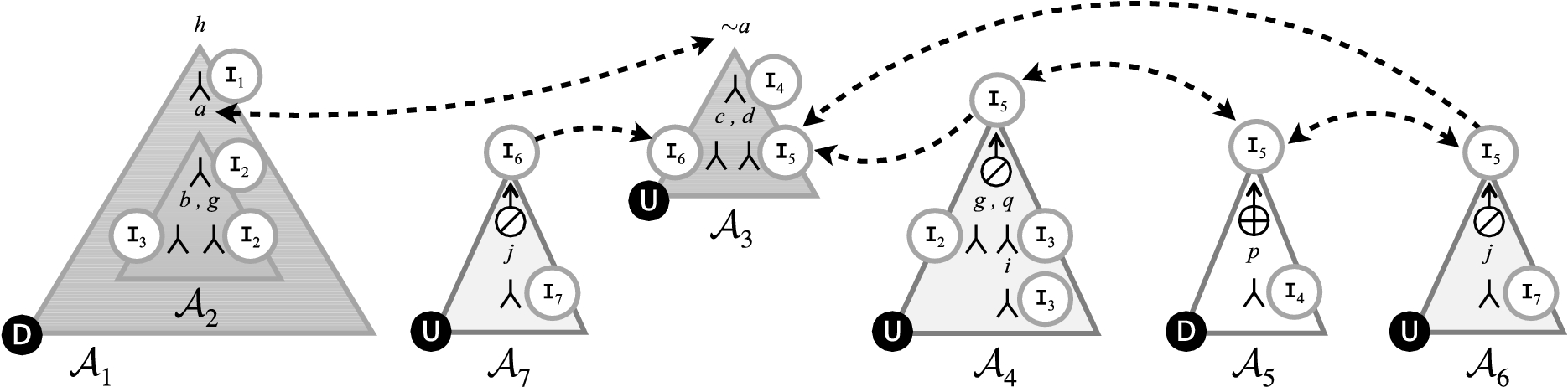
Arguments and attacks from Example 6.
As the preceding example shows, conclusion attacks are symmetric in a sense. That is, if
Given that an agent may build multiple arguments, which in turn may have several counter-arguments, in order to determine the agent’s beliefs we need to determine the undefeated arguments. To establish whether an argument
Agents build arguments from their knowledge bases with the aim of establishing their beliefs. However, as discussed in Section 3, the existence of conflicting information within an agent’s knowledge base leads to the existence of attacks between those arguments. Furthermore, since attacks could succeed or fail, it is necessary to have a comparison criterion to determine whether the attacking argument in a conflict prevails, in which case it becomes a defeater. In general, an attack will be considered to be effective when the set of informants from the attacked argument is not better than that of the attacking argument, with respect to an informant-based comparison criterion.
When comparing sets of informants corresponding to arguments built from an agent’s IBDP, the comparison criterion “≺” will be the one provided in the agent’s specification. In other words, the informant-based comparison criterion is modular. However, in order to be considered as valid, the criterion has to satisfy some constraints. The notion of a valid informant-based comparison criterion is formalized below. Following the usual convention,
(Valid informant-based comparison criterion).
Let
Following the preceding definition, a valid informant-based comparison criterion should be based on the agent’s credibility order, and it should be irreflexive and asymmetric. We do not intend these conditions to be the only ones that can be satisfied by an informant-based comparison criterion. In contrast, we aim at establishing the minimum requirements surrounding such criteria. Specifically, the first condition is meant to link an informant-based comparison criterion with the credibility order it is based on, so that it actually makes use of the information provided by that order and does not contradict it when considering the corner case of singleton sets. That is, a valid informant-based comparison criterion is such that, when comparing unitary sets of informants
As will be shown later in this section, this is a key aspect in the resolution of attacks into defeats.
Next, we will introduce a valid informant-based comparison criterion that will be used in our examples for determining the successful attacks between the arguments built from an IBDP. This criterion, called single informant credibility criterion, is an adapted version of the single rule criterion from [43], modified to account for sets of informant agents. Intuitively, it prefers a set of informants
Let
Let
We have to show that for every If If
□
It is worth remarking that, as specified by Definition 17, a valid informant-based comparison criterion is not required to be transitive. As discussed before, this does not imply that any valid criteria cannot be transitive; thus, transitive as well as non-transitive criteria can be considered as long as they meet the requirements imposed by Definition 17. Then, by not imposing such a constraint on valid criteria, we allow for a wider family of criteria to be considered. Among others, this allows us to consider the single informant credibility criterion which, as introduced in Definition 18, is not transitive. To illustrate the fact that this criterion does not satisfy transitivity, let us consider the following example.5
We thank one of the reviewers for suggesting this example.
We will now turn to establish the conditions under which the attacks introduced in Section 3 succeed and become defeats by making use of a valid informant-based comparison criterion. As mentioned before, in general, an attack will succeed if the set of informants from the attacking argument is not worse than that of the attacked argument, with respect to an informant-based comparison criterion. Hence, for each kind of attack, we will establish the sets of informants to be accounted for by the comparison criterion. For this, we need to formally characterize the set of informants associated with an argument.
Let
Having established a mechanism for identifying the set of informants associated with an argument, we now turn to formalize the different kinds of defeat that may occur between a pair of arguments built from an IBDP. In the following, whenever we want to refer to a generic argument (without caring for its conclusion or the informant it supports or challenges), for convenience we will sometimes write
(Conclusion defeat).
Let
(Strength defeat).
Let
(Strength-defense defeat).
Let
(Strength-counter-defense defeat).
Let
There exist some differences in the way in which the different types of attack are resolved. Specifically, the differences rely on the sets of informants that are compared in each case. For the resolution of c-attacks, it suffices to compare the set of informants from the attacking argument with the set of informants from the disagreement sub-argument. Note that the resolution of c-attacks in this way is analogous to the standard resolution of rebutting attacks in the literature of structured argumentation (see e.g., [25,36]). When resolving s-attacks, it is important to recall the nature of the attacking argument, which provides reasons against the consideration of a given informant used by the attacked argument. To prevent the success of an s-attack, the attacked argument should somehow give reasons for the consideration of that informant, and they should be provided by informants that are not worse than the ones associated with the attacking argument. As a result, since the attacked argument does not give reasons for the consideration of the challenged informant, the s-attack will always succeed (i.e., no comparison between sets of informants is made). Again, the resolution of s-defeats relates to the way in which undercutting attacks are resolved in the literature.
Then, sd-attacks and scd-attacks are handled analogously. In these two cases, there exists a conflict between a backing argument and a detracting argument, where they respectively provide reasons for and against the consideration of a given informant. Therefore, in the resolution of these types of attack, the entire sets of informants associated with the attacking and the attacked argument are compared. Given the resemblance between backing and detracting arguments as proposed here and the backing and undercutting arguments of [19], it can be noted that sd-defeats and scd-defeats somehow relate to the implicit defeats of [19], and are resolved analogously; notwithstanding this, there is a clear difference between them since our approach compares the sets of informant agents of the backing and detracting arguments whereas [19] makes use of a preference relation which might not take into account the information sources of arguments.
Finally note that, in all cases where sets of informants are compared to determine the success of an attack (thus turning it into a defeat), the traditional form of resolution of [3] is adopted. Namely, in our approach, an attack succeeds if the set of informants from the attacked argument is not better (w.r.t. the informant-based comparison criterion) than the set of informants from the attacking argument. In contrast, works like [6,31] consider that preferences play an additional role, serving to repair the attack relation in order to account for conflicts derived from the preferences, even in cases where those conflicts might not have been originally expressed within the attack relation. Among others, they both consider the existence of a defeat from an argument
Let us consider
The defeats are illustrated in Fig. 3. The notation for the arguments is the same as the one used in Fig. 2; on the other hand, defeats are represented with solid arrows between the arguments.
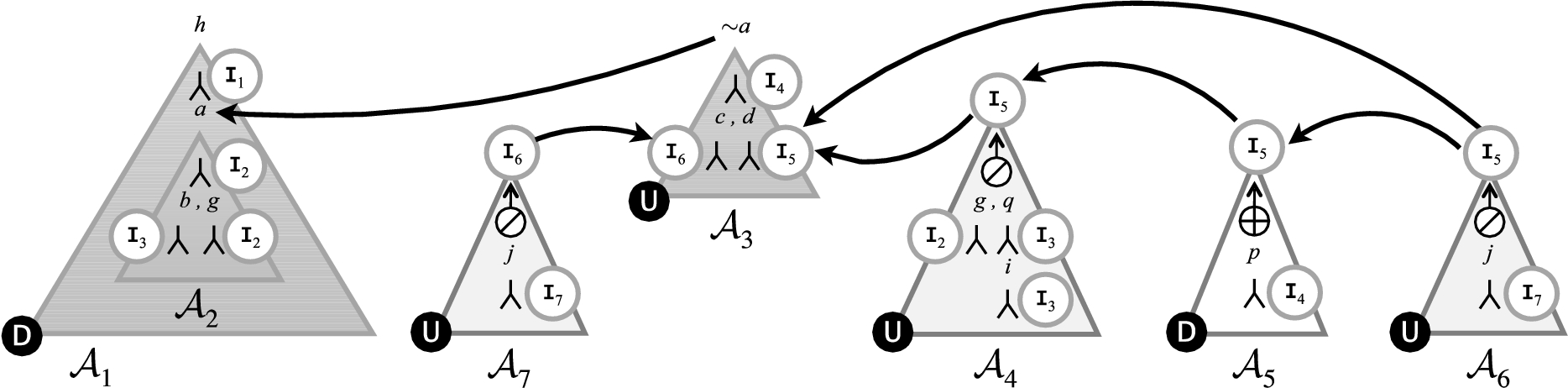
Arguments and defeats from Example 7.
To determine whether an agent
(Argumentation line).
Let
Given an argumentation line Λ for an argument
Given the specification of agent
There may exist argumentation lines that lead to fallacious chains of reasoning. In order to avoid those, we impose some restrictions on argumentation lines, to distinguish the acceptable argumentation lines. The first situation we want to avoid is to have infinite chains of reasoning; this is captured by the first and third clauses in Definition 26, by requiring an acceptable argumentation line to be a finite sequence, and to avoid the introduction of repeated arguments and disagreement sub-arguments. Another constraint imposed on acceptable argumentation lines is a kind of consistency within the sets of supporting and interfering arguments, in order to prevent an argument from being defended by another argument that is in conflict with it; this intuition is modeled in the second clause of Definition 26, requiring the sets of supporting and interfering arguments of an argumentation line to be non-contradictory.
Let us now analyze the inclusion of blocking defeaters in an argumentation line. The existence of a blocking defeat from
Note that the two sets of informants cannot be equally preferred since valid informant-based comparison criteria are required to be asymmetric, in line with the credibility order they are based.
Next, let us move to considering the inclusion of s-defeats in an argumentation line. As expressed before, s-defeats (corresponding to s-attacks, which always succeed), are aimed at challenging the strength of the defeated argument by targeting one of its informant agents. This is because, as discussed earlier, we consider that the strength of an argument is linked to the credibility of its informant agents. However, it should be noted that the existence of an s-defeat towards an argument is not, on its own, sufficient to establish that the defeat actually took place because of challenging the defeated argument’s strength. This is due to the fact that not every informant providing information used for building an argument is relevant for determining its strength. For instance, as expressed in Definition 20, the strength of a claim argument
To capture these intuitions, we next introduce the notion of strength-determining set of informants of an argument in an argumentation line, which corresponds to a set of informants of the argument that provides the necessary strength for its inclusion as a defeater of its predecessor in the line. In particular, as will be shown later in Definition 26, this notion will serve to identify s-defeaters that indeed defeat an argument by challenging its strength, because they provide reasons against one of its strength-determining informants. For instance, consider the argumentation line
Let
Function 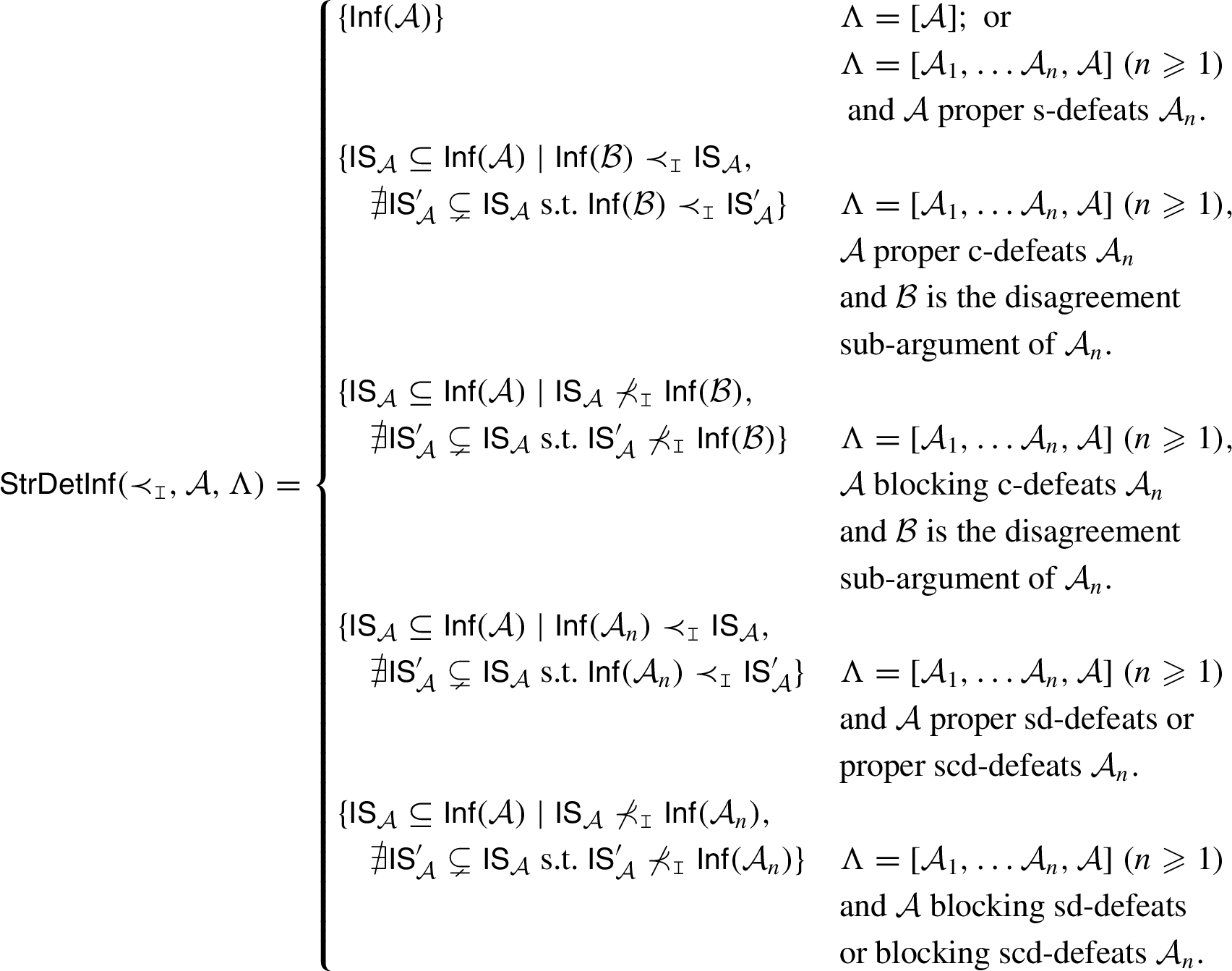
Note that, for the first argument in an argumentation line, the
Taking the notion of strength-determining set of informants into account, we will only consider the inclusion of an s-defeater in an acceptable argumentation line in cases where the detracting argument targets an informant belonging to (at least) one set of strength-determining informants of its predecessor argument in the line; this intuition is captured in the last clause of Definition 26. Finally, regarding sd-defeaters and scd-defeaters, if they appear in an argumentation line it is as a consequence of the existence of a previous s-defeater. Therefore, no additional considerations have to be taken into account for their inclusion in an acceptable argumentation line. As a result, the notion of acceptable argumentation line is formalized below:
Let Λ is a finite sequence. The set No argument For every argument For every detracting argument
Given the argumentation lines
(Dialectical tree).
Let If
Once built, the dialectical tree is marked in order to determine the acceptance status of the root argument. The marking criterion will mark the nodes in the tree as undefeated (
(Marking criterion).
Let N has a child marked for each
Consider the specification of agent
Note that, to save space, the tree is depicted horizontally.
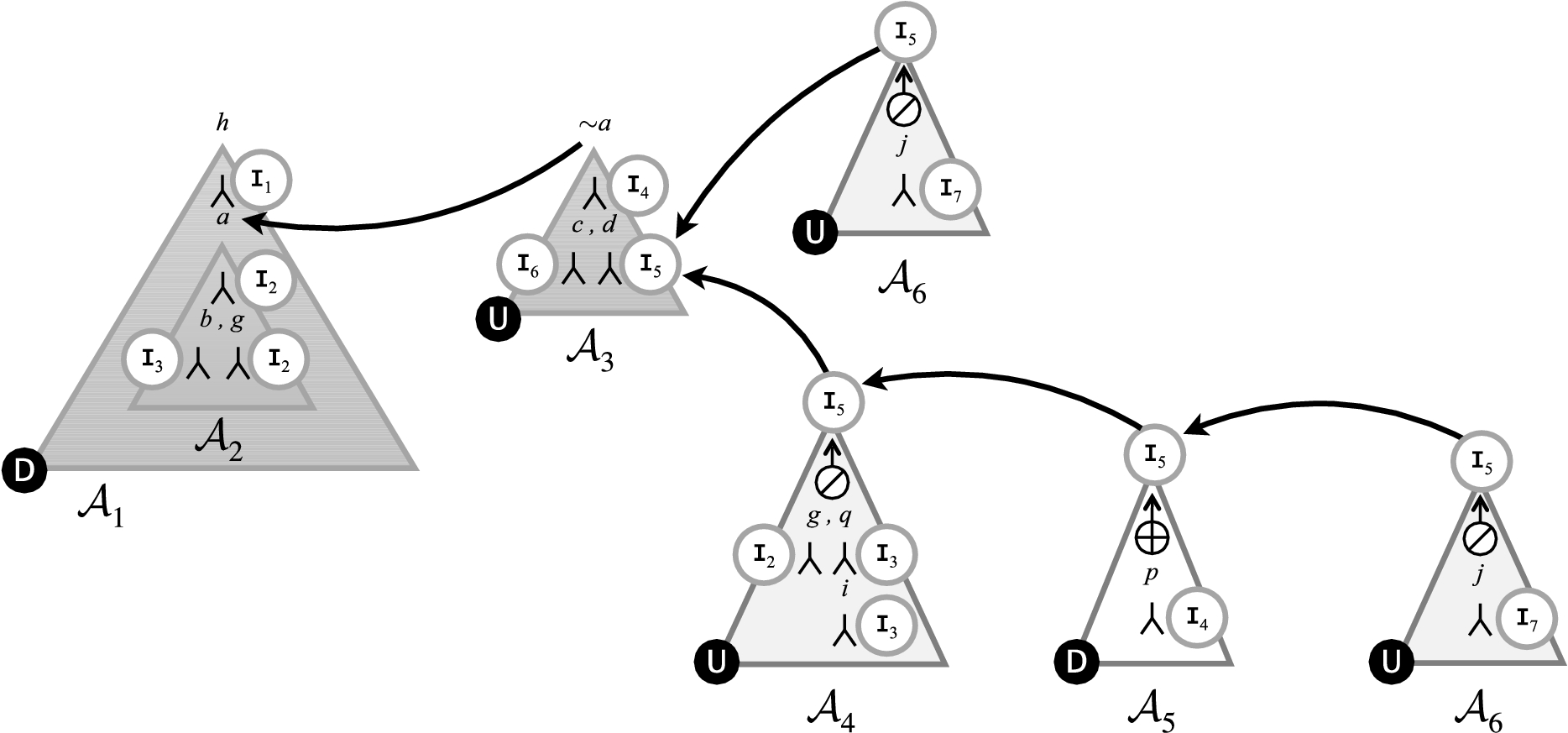
Marked dialectical tree
A marked dialectical tree embodies a dialectical analysis considering every possible argument an agent can build for and against the root argument in the tree. Hence, if the root argument is marked as
Let
Consider agent
Suppose the detracting rule
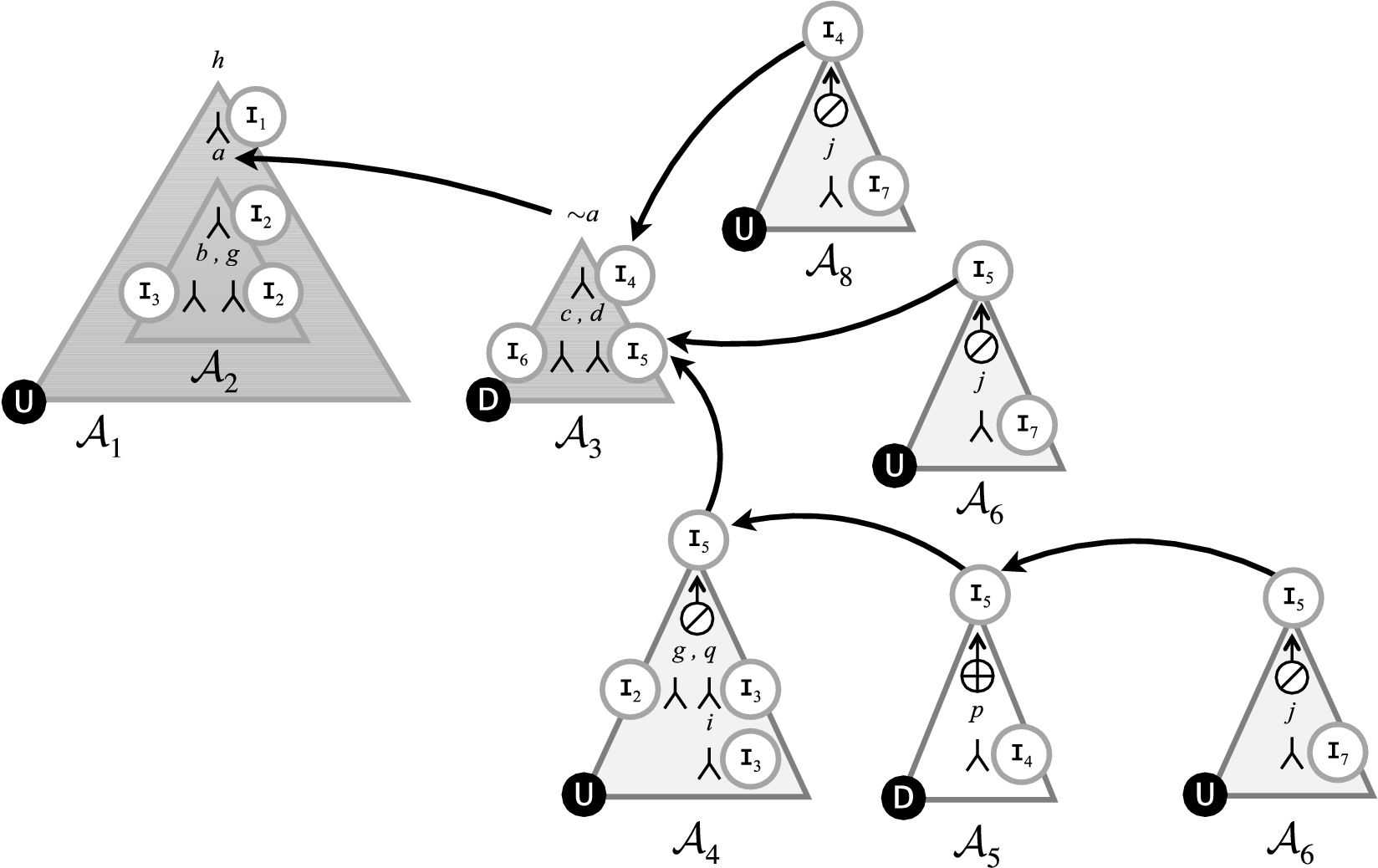
Marked dialectical tree
As introduced above, the beliefs an agent has are determined by the set of literals it warrants. Given this, it is to be expected that the set of warranted beliefs from an agent is consistent. In the remainder of this section we will formally show that an agent does not warrant complementary literals, as expressed by Theorem 1. For this purpose, we will first show some intermediate results, given by Lemmas 1 and 2.
Let
Since A part of The set of interfering arguments of
□
Let
We have to consider two cases:
□
Let
If
The literature of argumentation offers a wide and extensive variety of approaches accounting for the notion of argument strength, some of which will be discussed in this section. For instance, approaches like [3,5] resolve conflicts by identifying the stronger arguments through a general preference relation. On the other hand, works like [13,28] define the strength of an argument through a formula yielding a numerical value. This formula is based on the intuition that the strength of an argument is inversely proportional to the strength of its attackers, with the aim of codifying the likelihood of an argument to be ultimately defeated. Similarly, [35] proposed a game-theoretic measure of argument strength, where the strength of each argument is calculated in a way such that if an argument is attacked then its strength falls, but if the attack is in turn attacked, then the strength of the original argument rises. Related to these, approaches to value-based argumentation [10] consider that the strength of an argument depends on the social values it advances, and determining whether the attack of one argument on another succeeds depends on the comparative strength of the values advanced by the arguments concerned. Also, in [41] an approach combining the ASPIC argumentation system and the fuzzy set theory is proposed, where argument strength is computed by using a t-norm aggregating the importance of its involved premises and rules. Similarly to us, the latter attaches information to the basic elements of their system to compute argument strength, which in turn is used to determine acceptable arguments. However, in that work it is not possible to challenge the strength of an argument (even when undercutting defeaters could be seen as similar to our detracting defeaters, an undercut challenges the applicability of a rule instead of the strength of the argument as detracting defeaters do).
We can also identify a group of approaches that, explicitly or implicitly, make use of a notion of credibility or trust to account for the arguments’ strength. Given the close relationship between our proposal and these approaches, we devote the rest of this section to discuss the similarities and differences with some of them.
In [38] and [44] an argumentation formalism is proposed which, as part of its reasoning process, uses information about trust to measure the arguments’ strength. This formalism is described as a set of graphs and, to determine an agent’s beliefs, the authors propose a model that accounts for the trust in the information that is used for building the arguments. Like ours, their approach is presented in a multi-agent setting, where informant agents can have different levels of credibility and these credibilities are used to measure the arguments’ strength. In contrast to our proposal, where each agent has its own credibility order (completely independent from the other agents’), they use a centralized notion of trust that is codified in a shared trust network. This global network holds information about how agents trust each other and can be used to obtain an agent-centric trust network that represents the viewpoint of a particular agent. Although from these graphs it is possible to determine a credibility order for each agent, these orderings are strongly dependent on the connections in the global network.
Similarly to our formalism, each piece of information in [38,44] is linked to an agent which establishes how credible that information is, and the strength of an argument is determined by the credibility of the information it is based on. Then, [38] and [44] use an argumentation inference mechanism to deal with a potentially contradictory belief base. In that context, arguments are built to support pieces of information that can be consistently inferred from the belief base, and the strength measures are used to decide between conflicting arguments. In addition to that, our approach allows to construct arguments for and against the consideration of informant agents. Therefore, differently from theirs, an agent in our approach will be able to reason and argue about the strength of its arguments, in addition to arguing about the domain information stored in its knowledge base.
Another significant difference between [38,44] and the work reported in this paper is that they use numerical values to establish the trust relation among agents, leading to a total order over the set of agent identifiers; in contrast, we use symbolic information in the form of a strict partial order over that set. Such contrast leads to different approaches for measuring the arguments’ strength. On the one hand, they compute the strength of an argument using a formula based on numerical values assigned to the agents that provided the information used for building the argument. On the other hand, the strength of an argument in our approach is not absolute; instead, it is relative to the resolution of the conflicts the argument is involved in, and is established by the sets of strength-determining informants of the argument (according to a valid informant-based comparison criterion). Consequently, in their approach, the central component for determining the arguments’ strength is the formula to be used, whereas in ours it is the adopted informant-based comparison criterion.
The work reported in [17] relates to our proposal in that they also make use of the credibility of informant agents as a source of argument strength. Similarly to us, they associate arguments with their information sources (and multiple sources can be associated with the same argument); however, they abstract away from the origin of such credibility. That is, their credibility function associates an informant with a set of arguments, without specifically attaching the informant to a particular piece of knowledge within the argument. In contrast, we associate each defeasible rule in an argument with its informant agent to conform a defeasible domain object. Then, in [18] the authors extend their work to combine credibilities of informants of facts, assumptions and conclusions in order to determine the arguments’ strength. Like in our approach, defeats among arguments in [17,18] are defined by accounting for a notion of argument strength based on the credibility of their informants. However, a key aspect that differentiates our approach from theirs is the fact that their credibility function establishes a total order over the set of informants, whereas our credibility orders are assumed to be strict partial orders. Finally, as remarked above for other approaches, another difference between our work and [17,18] is the fact that we provide the means to reason about the arguments’ strength by allowing to build arguments for and against their different informant agents; in contrast, the approach of [17,18] does not provide such a possibility.
In this paper we introduced a particular informant-based comparison criterion (see Definition 18) to measure and compare the arguments’ strength. As discussed in Section 4, the single informant credibility criterion resembles the rules priorities criterion (see e.g., [25]) which takes preferences among rules to then define preferences among arguments (which are in turn expressed as sets of rules). That is, the rules priorities criterion lifts preferences over rules to preferences over sets of rules. Similarly, an informant-based comparison criterion makes use of a credibility order (i.e., a relationship over informant agents) to establish preferences over sets of informants; in other words, preferences over informant agents are lifted onto preferences over sets of informants. The literature offers a variety of approaches dealing with the issue of lifting preferences, such as [9,23,33,34] (see also [8] for an extensive overview on the issue of lifting an order relation on a set X to an order on the family of all non-empty subsets of X).
On the one hand, in [34] the authors propose natural extensions of the versions of five axioms introduced in [8] and also state that not every axiom is desirable in every situation. Regarding the axioms or conditions associated with a lifting principle (here, a valid informant-based comparison criterion), we can note the following difference. Whereas in our approach the credibility order (which is then lifted to define an informant-based comparison criterion) should be irreflexive, asymmetric and transitive, [34] assumes an order relation on a set X that has to be reflexive, antisymmetric, transitive and total. For instance, regarding the reflexivity vs. irreflexivity requirement, we can note that a valid informant-based comparison criterion is required to be irreflexive in order to align with the strict nature of the credibility order it is based on. An exhaustive analysis of our approach in the context of their proposed axioms is left as future work, including the study of alternative or additional conditions to be imposed either on credibility orders or on valid informant-based comparison criteria.
In [9] the authors argue that, in the context of structured argumentation, the support provided by an argument for its conclusion is determined by the degree of support of its premisses, and by the degree of support provided by the inference rules applied in its construction. Then, among other things, the authors discuss several alternatives for lifting qualitative orderings on premises and for lifting qualitative orderings on defeasible rules. It should be noted that, when accounting for orderings on different types of elements conforming the arguments, these orderings should be somehow combined when lifting preferences. Our proposal is such that domain knowledge in an IBDP is only expressed through the defeasible domain objects, which associate defeasible rules with their informant agents. In particular, our lifting criteria (the informant-based comparison criteria) only account for one dimension: the credibility order over the informant agents.
When considering the conditions imposed on valid informant-based comparison criteria and the conditions imposed by the different liftings discussed in [9], we can note the following: our conditions are meant to characterize a family of criteria whereas they describe specific kinds of liftings on qualitative orderings of elements. However, we can find a relationship between the liftings studied in [9] and the family of valid criteria characterized here, and we plan to explore this relationship as part of future work. For instance, consider the max-max criterion to lift orderings on premises to orderings on sets of premises X and Y:
Another work that relates to our proposal is [32], where the authors use an argumentation mechanism based on trust as a layer of a belief revision process carried out by agents dealing with (potentially conflicting) opinions about their pairs. In their argumentation approach, trust is used for building a preference ordering amongst arguments, thus codifying their strength. For this, they first aggregate the information about different opinions for the same proposition. Then, using these aggregated propositions, they build arguments whose trustworthiness is assessed using a conjunctive fusion operator over the opinions forming the argument. This assessment considers the number of agents and information pieces that were needed for building the argument. Even though [32] does not account for the fact that arguments can be constructed to challenge an informant agent (hence, other arguments’ strength), it could be interesting to adapt their ideas in our proposal. For that purpose, we can think of two alternatives: either provide a comparison criterion that encodes the above mentioned strategies, or extend the notion of acceptable argumentation line (Definition 26) to consider preferences codifying those strategies.
A qualitative bipolar argumentative modeling of trust is proposed in [39]. Like in our proposal, their approach is qualitative and only a finite number of levels is assumed in the trust scale. On the other hand, in contrast with our proposal, they use a bipolar argumentative approach where trust and distrust can be independently assessed. There, an agent can evaluate its trust into an object X (that can be either a source or another agent) on the basis of two types of information: the observed behavior of X, and the reputation of X according to the other agents. Reputation information is then viewed as an input the agent uses for revising or updating its own trust evaluation, based on its perception. The approach proposed in [39] is such that two kinds of arguments in favor of trusting an agent (either establishing that a good point is reached or a bad point is avoided), as well as two kinds of arguments against trusting an agent (either indicating that a bad point is satisfied or that a good point is not reached) can be constructed. These four kinds of arguments are based on an inference rule and the trust evaluation of the agent, which is represented with an interval
The authors in [29,30] adopt a symbolic approach to model credibility using two global relations: the trust relation and the distrust relation. These relations, together with the set of agents, constitute a trust system where a pair
The work reported in [4], similarly to ours, presents an agent-based argumentation approach for reasoning about beliefs and information received from other agents. There, beliefs are also used to represent how trustworthy the information sources are to a given agent. They identify six forms of trust that can appear as part of the formulas in the agent belief base. From their belief bases arguments are built, conflicts among them are identified and then resolved. In particular, besides the usual conflicts in structured argumentation, the authors identify several types of attack that arise from the semantics of the six forms of trust considered. Therefore, like us, they allow to challenge and support the credibility or trustworthiness of an informant; nevertheless, there are some differences. In their approach each form of trust is binary: the agent either trusts or does not trust an informant. In contrast, in our approach agents are ordered using a strict partial order and thus, it is possible to establish whether an informant is more credible than another. There are also differences on how trust relates to argument strength. In their approach, trust forms are used for constructing arguments and do not directly affect argument strength. On the other hand, our approach uses the level of credibility as the measure to define the arguments’ strength. They consider the notion of strength when they introduce graded beliefs, where a grade is attached to the beliefs operator. Using these grades they compute the strength of an argument as the weakest link. However, unlike our approach, they do not provide any mechanism to challenge the strength of an argument. Finally, it is worth to mention that these differences also apply to a comparison between our proposal and the work reported in [48].
Conclusion
In this paper we have presented an argumentative reasoning formalism where the credibility of informants plays a central role, as it allows to determine the arguments’ strength. Our formalism was developed in a multi-agent setting where agents share domain knowledge. There, each agent may obtain information from other informant agents and also has an assessment of how credible these informants are. Agents are equipped with the argumentative machinery, allowing them to reason with the potentially conflicting information in their knowledge bases to finally determine their warranted beliefs. In our approach, defeasible rules (which represent domain knowledge) are associated with their informant agents. Also, we introduced two new kinds of rules (backing and detracting rules) in order to be able to argue about the contexts in which the domain knowledge provided by the informant agents should be used or not. In other words, these rules are used to express reasons for and against the consideration of informants, respectively. From all this knowledge, an agent will be able to construct arguments to support its inferences. In addition, each agent has a credibility order among its informant agents and a comparison criterion used to assess the strength of the conflicting arguments built from its knowledge base.
As shown before, our informant-based approach is such that the strength of an argument is determined by the credibility of its informant agents. To that end, the comparison criterion in an agent’s specification is based on the agent’s credibility order. In particular, we have shown that the strength of an argument in our approach is not absolute, but it is relative to the resolution of the conflicts the argument is involved in. Then, it could be the case that some informant providing information for building an argument is relevant for establishing the argument’s strength in some cases, but not in others. In this context, the incorporation of backing and detracting rules allows agents to argue about the arguments’ strength. Specifically, backing rules allow to express reasons for the consideration of informant agents, whereas detracting rules enable to express reasons against the consideration of information provided by them. Using these rules we defined new types of argument which, together with the classic arguments supporting conclusions, are considered by the argumentation machinery to establish the beliefs an agent has. Finally, we have formally shown that the warranting process employed by our argumentative approach is sound, preventing an agent from warranting contradicting conclusions.
It is worth noting that the defeasible domain objects within an informant-based Defeasible Logic Program (IBDP) establish a correspondence between defeasible rules and their informant agents. The fact that, differently from standard DeLP programs, an IBDP does not include strict rules may appear as a limitation of our approach. However, recall that strict rules are provided in DeLP as a representational tool that gives the possibility of expressing the indefeasible nature of the relation between the body and head of such rules, making them indisputable. In contrast, in an IBDP, a domain object is expressed as a pair containing a rule and the informant of that rule. In this context, such rules are always defeasible since they come attached with the credibility of their informant agent. Therefore, our approach only accounts for defeasible rules (hence the name of the defeasible domain objects) since our main focus was on how the arguments’ informants affect and determine the arguments’ strength. Moreover, regarding the absence of strict rules, we would like to remark that a number of different applications of DeLP (e.g., see [1,2,16,24,26,27,47]) have been developed using defeasible logic programs without strict rules. Consequently, we consider that the current characterization of IBDPs without strict rules is not a real limitation for our approach’s expressivity and applicability. Notwithstanding this consideration, and to maintain a general approach, it is possible to extend our approach to account for standard DeLP strict rules and facts, where these elements of the program should not come with an associated informant to reflect their strict and indisputable nature accurately; we plan to do this as part of future work.
Regarding the notion of argument strength accounted for in this work, we can highlight the fact that it is solely based on the credibility of the informant agents. This may lead one to think of this notion of argument strength as too narrow, or too specific. Nevertheless, as discussed in Section 4, an informant-based comparison criterion like the single informant comparison criterion does not stray too far from other existing criteria in the literature of structured argumentation, resembling the rules priorities criterion. At any rate, as part of future work, we will explore a generalization our notion of argument strength in order to combine different comparison criteria at different levels. For instance, we could adopt an approach similar to [15], where the rules priorities criterion is used first to resolve attacks into defeats and, in case of undecidedness, the generalized specificity criterion is considered later. More generally, we will explore the possibility of using the operators defined in [45], which allow to combine multiple argument comparison criteria.
As shown in the existing literature (see [12] for an overview), DeLP is among the four major approaches to structured argumentation. Extending a DeLP program into an IBDP, with the addition of informants of defeasible rules and informant rules allowing to argue for and against the consideration of information provided by the different informant agents, we believe we are contributing to expanding DeLP’s applicability domain. Nevertheless, as part of our future work, we plan to study the possibility of further exploiting these ideas and apply them in the context of other major structured argumentation approaches such as ASPIC+ [36] or ABA [46]. In that regard, we consider that such an exploration could make for exciting advances in the area, and will most definitely bring on new challenges requiring a substantial transformation of those frameworks.
In Section 2 we argued that our approach is restricted to deal with credibility orders relating agents that are sources of information about the same topic. As future work, we intend to extend our approach to account for multi-topic credibility orders (i.e., handle multiple credibility orders, one for each topic). In order to be able to deal with these, we also plan to extend the knowledge representation and reasoning capabilities of an IBDP by, among other things, expanding defeasible domain objects to state their topic explicitly. In particular, such an extension would allow us to better model scenarios like the one described in the example of the medical domain given after Definition 11. Then, for instance, we could represent the information provided by agent
Finally, we would like to discuss other exciting prospects for future research. On the one hand, we plan to study how our approach could be extended to consider trust and distrust relations as presented in [29,30]; briefly, the idea would be to connect such relations with backing and detracting arguments. On the other hand, we will also study how an agent’s credibility order should be updated when the warranted information is taken into account. For that purpose, backing and detracting arguments can also play a central role. For instance, suppose that the credibility order initially establishes that an informant
Footnotes
Acknowledgements
We would like to thank the reviewers for their helpful and insightful comments on the previous versions of this paper. This work has been supported by EU H2020 research and innovation programme under the Marie Sklodowska-Curie grant agreement No. 690974 for the project “MIREL: MIning and REasoning with Legal texts”, by CONICET (grant PIP 112-201701-00871) and by Universidad Nacional del Sur (grants PGI 24/N046 and 24/ZN32).