




Abstract
Given a controversial issue, argument mining from texts in natural language is extremely challenging: besides linguistic aspects, domain knowledge is often required together with appropriate forms of inferences to identify arguments. Via the analysis of various corpora, this contribution explores the types of knowledge that are required to develop an efficient argument mining system. We show that the Qualia structure of the Generative Lexicon with some extensions and a specific interpretation has some expressive capabilities which are appropriate for this task.
Keywords
Aims and challenges of argument mining
One of the main goals of argument mining is, given a controversial issue, to identify in a set of texts, the arguments for or against that issue. Arguments are difficult to identify, in particular when they are not adjacent to the controversial issue, possibly not in the same text, because their linguistic, conceptual and referential links to that issue are rarely direct and explicit. Arguments are often evaluative natural language statements which become arguments because of the specific relations they have with another evaluative statement considered as a controversial issue. Arguments can be supports or attacks, with various degrees of strength. Arguments can also attack other arguments.
Let us illustrate the need of knowledge in argument mining by two examples taken from two different situations:
Issue: The situation of women has improved in India,
Statement found in another text:
early morning, we now see long lines of happy young girls with school bags walking along the roads.
(a) is a support of the issue, but it requires knowledge and inferencing to make explicit, and possibly explain, the relationships between women’s conditions and young girls carrying school bags, here education.
Let us now consider:
School buses must be provided so that schoolchildren do not reach the school totally exhausted after a long early morning walk.
(b) is an attack of (a), indeed: these young girls may not be so happy of walking early morning, but it is not an attack of the issue: the facet that is concerned in the relation between (b) and (a) does not concern women’s conditions in particular.
Let us now consider another example taken from the BBC Moral Maze debates (with non-adjacent arguments, data from the Dundee IAT group):
Speaker 1: Let’s be straight, the situation in Kenya was a bloody dirty war. Speaker 2: I think there was horror at Mau Mau.
is related to and supported by an utterance from another speaker in the debate:
To identify this support relation, knowledge about Mau Mau populations is needed, in particular that they live in Kenya and had conflicts with the British.
Except in specific contexts, and for certain types of arguments (e.g. warnings, threats, advice, requirements), most statements do not have any specific linguistic mark that allow to directly identify (1) them as supports or attacks of a controversial issue, and (2) the facet of the issue they support or attack and how. Therefore, evaluating the role of knowledge issues in argument mining is necessary. Argument mining has to deal with two major problems: (1)
This article explores this problem that has never been investigated before in the context of argument mining, to the best of our knowledge. For that purpose, an empirical analysis of the phenomena, largely manual, has been carried out. The aim of this exploratory task is to construct a relevant corpus and then to identify and categorize the forms of knowledge that are required to perform efficient argument mining. A preliminary conclusion to this exploration tends to show that a specific interpretation and use of the Qualia structure of the Generative Lexicon with some extensions has expressive capabilities which are appropriate for this task.
This paper develops preliminary results on a knowledge-driven argument mining approach and outlines the difficulties, the research questions and also the expected gains in accuracy and explicative power. It attempts to develop a working method to go beyond standard argument annotation so that the role and the importance of knowledge can be characterized. From these results, a more elaborated and principle-based analysis must be realized to characterize the relatedness aspects between an issue and an argument, or between an argument that supports or attacks another argument in an argumentation graph. This paper contributes to answering the following questions:
How to construct a valid corpus to investigate the need of knowledge in argument mining? Our approach is to define issues a priori and then to manually search for arguments found in various types of texts (Sections 3.1 and 3.2), How to annotate arguments in order to explore how they are related to a controversial issue (Section 3)? What kind of new tags should be introduced, what level of granularity should be targeted and how to gradually go into more details on knowledge issues? How to categorize the needs in terms of knowledge and reasoning (Sections 3.2 and 4)? What are the main forms of knowledge which are involved (Sections 4 and 5)? How to categorize the knowledge involved (Section 5.2)? How to account for the diversity of arguments w.r.t. an issue (Section 5.3).
Challenges of argument mining
Argument mining is an emerging research area which introduces new challenges both in natural language processing (NLP) and in Artificial Intelligence. So far, most experiments and projects focused on NLP techniques, based on corpus annotation, to mine arguments in various types of contexts. A synthesis of the techniques, annotated corpora and language resources which are used in the main current projects is given in
Argument mining research applies to written texts, e.g. [3,4], for example for opinion analysis, e.g. [5], mediation analysis [6] or transcribed dialogue analysis, e.g. [7,8]. Annotated corpora are now available, e.g. the AIFDB dialog corpora (
In opinion analysis, the benefits of argument mining are not only to identify a customer satisfaction level, but also to characterize why customers are happy or unhappy. Abstracting over arguments allows to construct summaries and to induce customer preferences or value systems (e.g. low fares are preferred to localization or quality of welcome for some categories of hotel customers). Categorizing arguments allows the construction of various forms of synthesis, organized e.g. in clusters by topic and subtopic to enhance the ease of access for readers when there are large amounts of arguments [13].
The analysis provided below shows that for about 75% of the situations some knowledge is required to accurately identify arguments w.r.t. a controversial issue. The analysis provided below is based on a simple and direct logical analysis of arguments, it does not include any pragmatic considerations which, however, play a prominent role in argumentation analysis. Pragmatic factors also involve knowledge, probably of a more generic nature, e.g. [14]. This is not developed in the remainder of this paper, but let us outline a few dimensions of these factors that will need to be taken into account at some stage of argument analysis. First the author of arguments frequently adapts his arguments to the potential readers, taking into account the Doxa (commonly admitted facts) and the main opinions shared by his audience. This Doxa may convey information that is incorrect, including potentially incorrect argumentative schemes in some contexts (e.g. quality must be preferred to quantity, what exists is preferable to what is only possible), e.g. [15]. Next, the author of arguments cares about the positive image he constructs of himself (discursive Ethos) in the organization of his arguments, to give a higher impact to his arguments, which may get a higher strength [16]. Finally, most, if not all, arguments rely on implicit structures: enthymemes, analogies, presuppositions, but also logical and pragmatic entailments. The reader therefore must participate to reconstruct the implicit data and has therefore a higher personal commitment w.r.t. the arguments. These pragmatic factors will need to be investigated in future developments of argument mining in order to elaborate accurate argumentation graphs.
Corpus construction and analysis
Corpus characteristics and construction
To explore and characterize the forms of knowledge that are required to develop argument mining in texts, we constructed and annotated four corpora based on four independent controversial issues. These corpora are relatively small, they are designed to explore the needs in terms of knowledge, knowledge organization and reasoning schemas. The goal is to elaborate the main features of a larger empirical analysis and functional model.
For this first experiment, we considered the four following issues, which involve very different types of arguments, forms of knowledge (concrete or relatively abstract) and language realizations. These issues are:
Ebola vaccination is necessary,
Women’s conditions have improved in India,
The development of nuclear plants is necessary,
Organic agriculture is the future.
Texts have been collected on the web, considering the issues as web queries. The text fragments which have been selected are extracts from various sources where these issues are discussed, in particular: newspaper articles and blogs from associations. These are documents accessible to a large public, with no professional consideration, they can therefore be understood by almost every reader. The knowledge that is involved to understand them is relatively simple and is shared by most of the readers. Language is French (glosses are given in the paper) or English. Sources are, for example:
issue 1: The Lancet (UK journal), a French journal that develops results from the Howard Hughes Medical Institute, a web site: Ebola vaccines, therapies, and diagnostics Questions and Answers
issue 2:
issue 3: Pour/Contre le nucleaire (les centrales) web site in French, etc.
A large number of texts have been collected for each issue. For each text, the next task was to manually identify arguments related to the issue at stake. The unit considered for arguments is the sentence. These sentences are then tagged
A preliminary task aimed at identifying all the arguments related to each issue. In a second stage, arguments judged by the annotator to be similar or redundant are eliminated and a single utterance, judged to be the most representative in terms of content and structure, is kept. The arguments eliminated on the redundancy criteria are kept separately for further analysis or for tests. So far, due to a lack of human resources, these tasks have been realized only by the author. It is clear that decisions made are somewhat subjective and that at least two annotators would have been necessary. In spite of these limitations, we consider that this work is a valid preliminary investigation whose main aim is (1) to gradually develop relevant annotation guidelines, as it is the case for most argument annotation projects, (2) to evaluate the impact of knowledge in argument mining processes and (3) to suggest new investigation directions. A more elaborated analysis must follow with the involvement of several trained annotators, with the progressive development of clear and stable annotation guidelines.
For each of these issues, the corpus characteristics and the different arguments found are summarized in Table 1. In this table, the number of words in column 2 represents the total size of the text portions that have been considered for this task, i.e. those paragraphs that contain at least one argument.
Corpus characteristics
Corpus characteristics
This corpus shows that the argument diversity per issue is not very large. A relatively high overlap rate has been observed: while there are original arguments, authors tend to borrow quite a lot of material from each other. For example, for issue (1) an average redundancy rate of 4.7 has been observed, i.e. the same argument is found 4.7 times on average in different texts. This overlap rate is somewhat subjective since it depends on the annotator analysis and the corpus size. In spite of this subjectivity, this rate gives an interesting rough redundancy level. It is probable that with a larger corpus, this overlap rate would increase, while the number of new arguments would gradually decrease. A more detailed analysis of those repetitions would be of much interest from a rhetorical and sociological perspective.
A last step in the corpus analysis consists in tagging the discourse structures found in those sentences identified as arguments. For that purpose, the TextCoop platform we developed [17] is used with an accuracy of about 90%, since sentences are relatively simple. Discourse structures which are identified are those usually found associated with arguments: conditions, circumstances, causes, goal and purpose expressions, contrasts and concessions. The goal is to identify the kernel of the argument (tagged

The next step is to define a set of preliminary tags appropriate for analyzing the impact and the types of knowledge involved in argument mining. In this annotation task, our approach is twofold:
the standard tags are kept, these include the text span and its associated discourse structure, the polarity and the strength of the argument, and new tags are introduced, whose goal is to clarify the need of knowledge in argument mining.
This second set of tags is preliminary and relatively global and must be revised in a later stage, when the main types of knowledge have been identified. There are therefore no guidelines yet a priori for these latter tags, since their perimeter, definition and implementation is ongoing. This is the usual methodology, essentially empirical and exploratory, that is used when dealing with a new dimension of argument mining: tags and guidelines progressively emerge from initial annotation tasks. In this paper, tags are relatively global and open so that as many details and facets as possible can be specified. Once the facets encoded in those tags are made more clear, and the value they may take are identified, more detailed tags can be defined together with their scope and constraints.
An argument and its context (the discourse structures it is associated with, such as an illustration or a condition) are tagged between XML
the
the
the
the
the
the
A argument from issue (1) is tagged as follows:
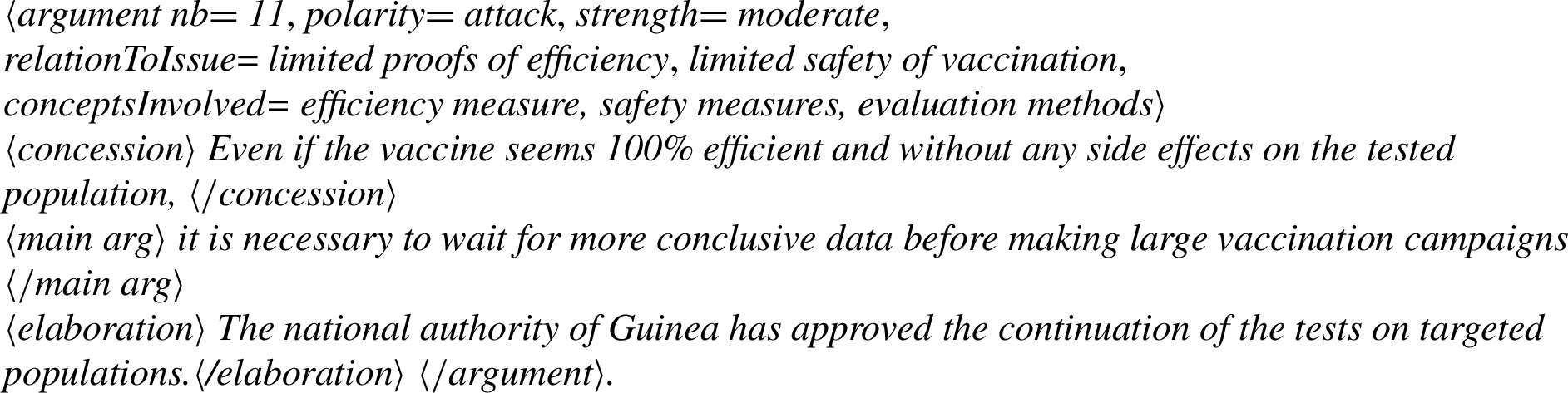
This example is a rather weak attack of issue (1) since it says that more conclusive data is necessary before making large vaccination campaigns. From that point of view, this argument may be analyzed and labeled as a concession: vaccination is necessary, however it is necessary to wait for more conclusive data.
The annotation task is realized in several steps. The specification and the language expressions used in the two attributes ‘Conceptual relation to the issue’ and ‘Concepts involved’ are proof-read and polished several times in order to have homogeneous specifications for each issue and over the four issues which are developed in this investigation. Concepts used are kept as minimal as possible, while the most accurate level of granularity is preserved from our intuitions. After this stage, a conceptual analysis of how arguments are related to an issue is carried out. This is developed in the next section.
Analysis of the types of knowledge involved in argument identification
Issues (1) to (4) involve different types of analysis which show the different facets of the knowledge needs. While issues (1) and (4) involve relatively concrete and simple concepts, issue (2) is much more abstract. It involves abstract concepts related to education, the family and human rights. Finally issue (3) involves arguments which are more fuzzy, and which are essentially comparisons with other sources of energy. This panel of issues, even if it is far from comprehensive, provides a first analysis of the types of knowledge used to identify arguments.
Dealing with knowledge remains a very vague issue in general. Knowledge can cover a large diversity of forms, from linguistic knowledge (e.g. semantic types assigned to concepts, roles played by predicate arguments), to forms involving inferences (presuppositions, implicit data), via domain and general purpose knowledge, contextual knowledge, etc. Each of these aspects of knowledge require different representation formalisms, associated inferential patterns and often involve complex acquisition procedures. This section first explores the types of knowledge involved in argument identification with respect to an issue and how it is organized. Then, a synthesis is proposed to characterize more formally the conceptual relations between the issue and the arguments. From this exploration, a relatively minimal and simple knowledge representation model emerges. The notion of concept that is used in this analysis corresponds to the notion of concept in a domain ontology, where these concepts can be either terminal (basic notions) or relational.
Main concepts in arguments related to issues (1) and (4)
In issues (1) and (4), arguments mainly attack or support salient features of the main concepts of the issue or closely related ones by means of various forms of evaluative expressions. Samples of arguments associated with issue (1) are:
vaccine protection is very good; Ebola is a dangerous disease; high contamination risks; vaccine has limited side-effects; no medical alternative to vaccine, etc.
limited number of cases and deaths compared to other diseases; limited risks of contamination, ignorance of contamination forms; competent staff and P4 lab difficult to develop; vaccine toxicity and high side-effects,
some side-effects; high production and development costs; vaccine not yet available; ethical and freedom problems.
For issue (1), the term vaccine is the central concept of the issue. The concepts used to express arguments for or against that issue can be structured as follows, from this central concept vaccine:
concepts which are
concepts associated with vaccine
concepts that describe the
For example, the concepts of side-effect and toxicity are consequences of vaccines and more generally of a medicine, which, for a large number of them may have side-effects, besides curing a given disease. The concept of contamination is related to one of the purposes of a vaccine, namely to avoid that other people get the disease via contamination, and therefore on a larger scale, the purpose of a vaccine is to prevent disease dissemination. Finally, production costs are related to the creation and development of any product, including medicines and vaccines.
Without knowing that a vaccine protects humans from getting a disease, it is not possible e.g. to say that prevents high contamination risks is a support for issue (1) and to explain why. Similarly, without knowing that the active principle of a vaccine is diluted into an adjuvant that is also injected, it is not possible to analyze the adjuvant is toxic as an attack. Without this knowledge, this statement could be e.g. purely neutral or irrelevant to the issue.
The conceptual categories used in this short analysis: purpose, functions, goals, properties, creation and development, etc. are foundational aspects of the structure of a concept. They allow an accurate identification of arguments and what facet they exactly attack or support in the issue and how. This is also useful to construct various types of argument synthesis.
Main concepts in arguments related to issue (2)
This issue is much more complex and abstract than the issues (1) and (4); it is useful to evaluate the boundaries of our approach and its feasibility. The arguments related to issue (2) mainly involve comparisons with men’s living conditions or refer to general and quite diverse principles of human welfare. Some arguments are justified by means of figures while others remain vague, possibly not up-to-date or relative to specific situations. Samples of arguments found for issue (2) are:
increased percentage of literacy among women; women are allowed to enter into new professional fields; at the upper primary level, the enrollment increased from 0.5 million girls to 22.7 million girls.
practices of female infanticide, poor health conditions and lack of education still persisting; home is women’s real domain; they are suffering the violence afflicted on them by their own family members; malnutrition is still endemic.
The concepts used in arguments related to issue (2) concentrate on facets of humans in the society and in the family and evaluates them for women. The identification of these concepts is crucial to characterize argumentative relations between issue (2) and their polarity. For example, improving literacy means higher education, better jobs and therefore more independence and social recognition, which are typical of a living condition improvement.
Roughly, the concepts used in arguments supporting or attacking issue (2) can be classified into two categories:
those related to the services provided by the society to individuals: education, safety, health, nutrition, human rights, etc. The arguments evaluate the quality of these services for women. those related to the roles or functions humans can play in the society: job and economy development, family development, cultural and social involvement, etc. Arguments evaluate if and how women play these roles and functions.
Each of these concepts needs to be structured, as above for the notion of vaccine, to allow the identification of arguments and what facet of women’s living conditions they exactly support or attack. The number of concepts involved may be very large, however, most arguments concentrate on a few prototypical ones which are the most striking. This is developed in Section 5.2.
Main concepts in arguments related to issue (3)
In the case of issue (3) (nuclear plants are necessary), supports or attacks mainly involve comparisons between various sources of energy. Samples of arguments are:
allows energy independence; creates high technology jobs; risks are over-estimated; wastes are well-managed and controlled by AIEA; preserves the other natural resources, there are alternative solutions with less pollution; alternatives create more jobs than nuclear; there are risks of military uses: more dangerous than claimed; nuclear plants have high maintenance costs, etc. nuclear plants use dangerous products, but we know how to manage them; difficult to manage nuclear plants, but we have competent persons.
In terms of concept and concept organization, nuclear plants are complex entities. A first set of concepts concern their
Most arguments lack precise comparative data, e.g. wastes are all said to be a nuisance, but the degree of nuisance is not given. These arguments rather play on the pathos. These are
Observation synthesis
From the above manual analysis, the following argument polarities are observed:
attacks: 53 occurrences, supports: 33, argumentative concessions: 21, argumentative contrasts: 19 and undetermined: 4.
The corpus shows a tendency to argue against an issue: while attacks and contrasts reach 55%, supports and concessions reach only 41%. Probably unhappy persons tend to express themselves more than if they were happy.
Evidence for Knowledge
Evidence for Knowledge
Arguments where the need of knowledge between an issue and an argument has been characterized is summarized in Table 2. For example, for issue (1), 44 arguments for a total of 50 (88%) require knowledge to be identified as arguments. For these 44 arguments, 54 different concepts are required to establish that these statements are arguments for or against issue (1).
From the annotation schemes (Section 3) and the analysis provided in the above Sections 4.1 to 4.3, it is possible to identify the main types of knowledge which are involved. From our corpus observations, it turns out that the types of knowledge involved in relating an argument to an issue are based on the existence of lexical semantics relations between the concepts of the main terms of the issue and the argument. These relations typically include:
Paradigmatic and the specific functional relations presented above cover a large majority of the relations between issues and their related arguments estimated to about 80% of the total. There are obviously other types of relations, more difficult to characterize, e.g. vaccination prevents bio-terrorism, but of much interest for argument mining.
The figures in Table 2 show that for about 77% of the statements identified as arguments, some form of knowledge is involved to establish an argumentative relation with a controversial issue. An important result is that the number of concepts involved is not very large: 124 concepts for 100 arguments over 4 domains. Even if the notion of concept remains vague, these results are nevertheless interesting to develop large argument mining systems.
Argument behavior can be summarized as follows:
Most arguments found directly attack or support the issue (about 75%),
Some authors anticipate arguments from other parties by attacking the most frequent ones (about 25%),
Groups of arguments may show forms of
About 52% of the arguments involve concepts which are directly related to the head terms of the issue (e.g. adjuvant or tests for the vaccine), while about 39% require two levels of concepts, only 9% of them involve longer conceptual chains. These figures however depend on the way concepts are structured.
The above analysis shows that the introduction of knowledge in argument mining is a crucial feature which allows to improve the identification of:
the relatedness of an evaluative statement w.r.t. a controversial issue,
which aspect(s) of the issue it attacks or supports,
the argument polarity: attack, support, concession, contrast, underspecified (when knowledge is not comprehensive enough to decide on the polarity of an argument) and fallacious.
In terms of language realizations, the following three main types of argument realizations are observed:
use of
use of
use of
Based on the notion of evaluative expression in (1) above, the following constructions are frequently observed:
if the concept is a verb with a clear polarity (e.g. protects, prevents, pollutes) or a formula, then language realizations include: (1a) the negation of the VP; (1b) the use of adverbs of frequency, completion, etc. possibly combined with a negation: never, almost never, seldom, rarely, not frequently, very frequently, fully, systematically, or (1c) the use of modals expressing doubt or uncertainty: seem, could, should, if the concept is a noun, then language realizations involve attribute structures with one or more adjectives that evaluate the concept: toxic, useless, expensive, etc., which can be modified by intensifiers such as: 100%, totally. Those adjectives must have a clear polarity in the context at stake.
These constructs allow to evaluate arguments related to purposes and goals such as: the vaccine has not been fully tested; it seems to protect people from Ebola; or related to the quality of parts of the objects in the issue: the adjuvant is toxic. Specific language patterns can be developed to identify these constructions as shown in [19].
A suitable knowledge representation model: The generative lexicon
Perspective and position
The conceptual organization described in the above analysis tends to suggest that the type of conceptual categorization offered by the Qualia structure, in particular in its last development in Generative Lexicon (GL) [20], with some extensions to the formalism, is an adequate representation framework to deal with knowledge based argument mining. The remainder of this article illustrates this proposal that needs to be evaluated in more depth when the annotation phase described above becomes more accurate and confirmed by several annotators.
The main other lexical semantics approaches such as FrameNet or VerbNet mainly concentrate on predicate argument structure for verbs and their adjuncts: they characterize the roles that these elements (NPs, PPs and S) play in the verb and proposition meaning. According to our observations, these are not central features for knowledge-based argument mining although they may be useful to develop lexical resources and argument mining templates as shown in [19].
The GL is a model that organizes concept descriptions via structures called roles. Roles describe the purposes and goals of an object or an action, its origin, and its uses. These are the main features which are supported or attacked in arguments. These, to the best of our knowledge, are specific features of the GL Qualia structure, in particular the telic and the agentive roles. However, a main limitation is however that the GL has very little resources available.
The notion of Qualia structure emerged from Aristotle categories. It has been much debated over the centuries in epistemology and philosophy. Contradictory views and definitions abound which will not be addressed in this article. Our perspective is that some features of Qualias developed in the GL seems to be appropriate to represent the type of knowledge that is crucial in knowledge-based argument mining. A number of features and uses of the Qualia (e.g. as supports of type coercion to represent logical metonymy) are not relevant for our investigations. The Qualia is therefore a convenient formalism and a set of tags that does correspond to argument mining needs.
In the remainder of this section, after a short presentation of the Qualia structure of the GL, we develop a few motivational examples, that make more concrete the proposals developed in Section 4. To conclude, some insights on the potential diversity of arguments associated to an issue are developed with an outline of a model that partly characterizes how Qualias can be used to account for the
An introduction to the Generative Lexicon
The Generative Lexicon (GL) [20] emerged from a series of research efforts inspired by Aristotle’s notion of modes of explanation. The GL is an attempt to structure lexical semantics knowledge in conjunction with domain knowledge. It allows to explain a number of language phenomena such as various types of metonymies via a decompositional view of lexical meaning. Various forms of so-called ‘generative aspects of lexical combinations’ have been characterized via the operation of type shifting, where the original type that is expected has been coerced to another type, allowing metaphors such as ‘to devour books’ or various forms of sense variations, which are frequent in language. The GL introduces some original forms of representations such as dotted types, that account for the different facets of an entity (e.g. the physical and contents facets of a book). The GL also develops a specific argument structure with semantic types, lexical paradigms, an event structure and the Qualia structure, which is the structure that is considered in our investigations.
The Qualia structure of an entity is a kind of lexical and knowledge repository composed of four fields called roles:
Roles are composed of constants or predicates a priori defined from a domain or from a general purpose ontology. A well-known example is the case of novel(X):
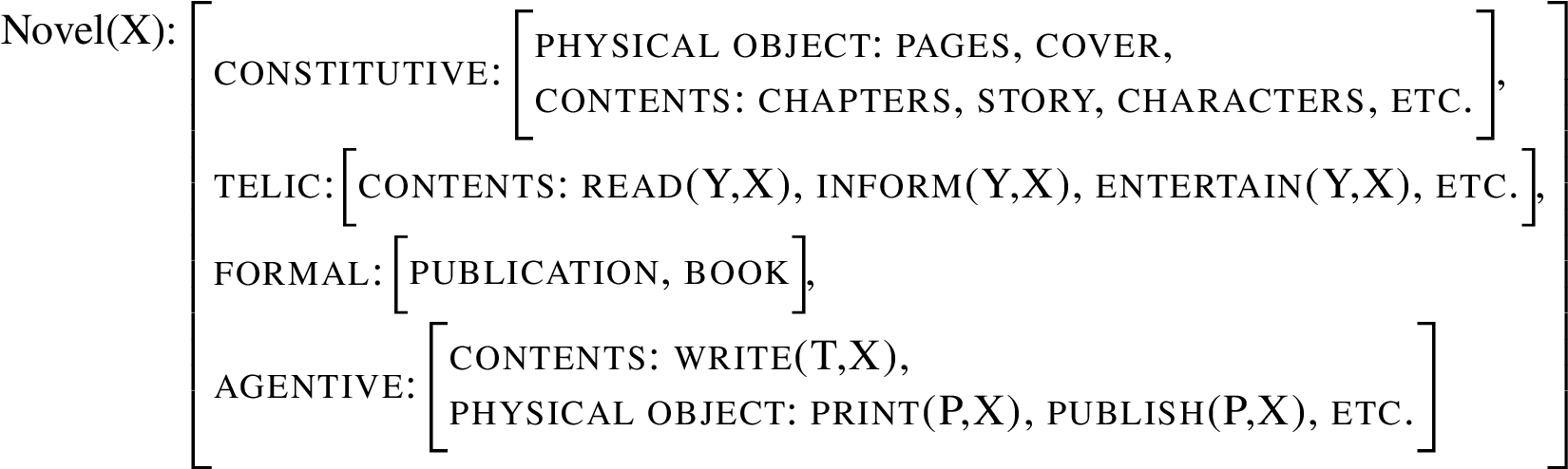
In this Qualia structure, X is the novel, Y, a reader, T, the author, and P, the publisher. Concepts are represented by means of predicates or constants. In the constitutive and agentive roles, two ‘facets’ of novel are encoded: the physical object and the contents. In the telic role, the prototypical predicate is read; the other predicates such as inform, entertain, develop additional purposes. In the agentive role, the creation of a book is characterized in particular by its writing (content facet), printing and publishing (physical object facet). Predicates such as ‘sell’ may belong to the two facets.
The formal role is close to the isa (hyponymy) relation frequently found in ontologies and in WordNet. The constitutive role has a rich informational structure since the different types of parts or constituents can be specified in dedicated sub-roles. The argument structure of the GL and its semantic typing is different from frame semantics descriptions such as FrameNet which basically develops semantic roles, not present in the GL. We show below that these two roles structure most of the knowledge that is required for a knowledge-driven approach to argument mining.
A Qualia representation of the issue head concepts
This section shows how the concepts informally presented in Sections 4.1 to 4.3 can be represented in Qualias and what extensions are required. The goal is to show how concepts can be specified in a concrete manner. This section introduces (1) the extensions to the GL that are required for argument mining and (2) the elements of a method to describe the type of data that is needed for knowledge driven argument mining. The Qualias are a relatively open representations where roles may be more or less developed and constrained: a method to describe Qualia roles is crucial to develop homogeneous and coherent sets of Qualias. Some role sub-typing have been introduced in the past in the EEC Parole-Simple project (
The Qualia structure of the head term of issue (1), vaccine, describes the structure and the main properties and functions of a vaccine: 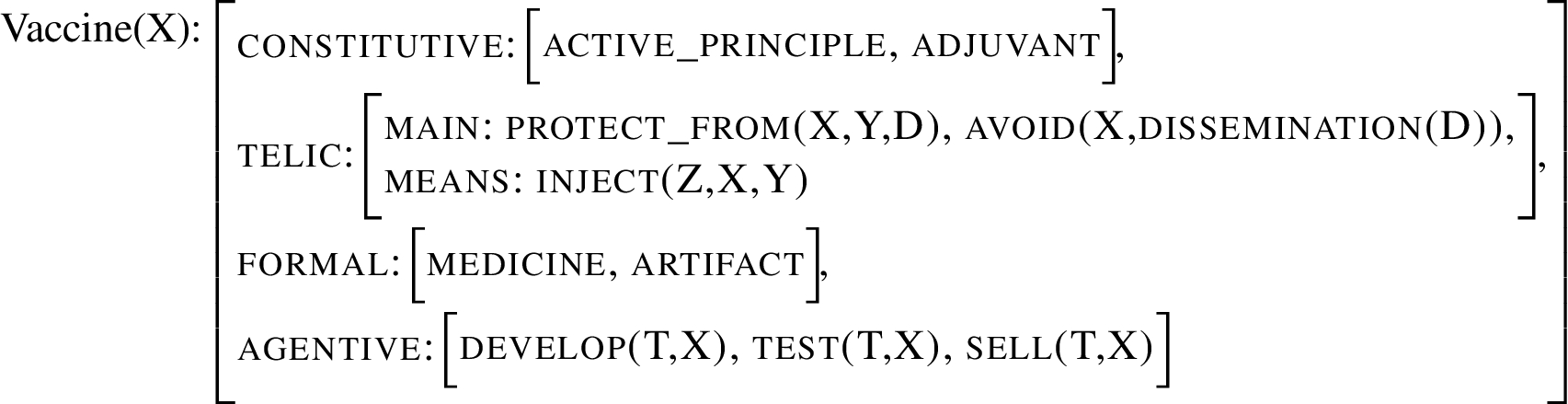 where X is the variable that represents the vaccine, Y is the person that is vaccinated, T is the biologist or company that develops the vaccine, Z is the doctor that makes the injection, and D is the disease associated with the vaccine (Ebola in our example). The agentive role develops the way the vaccine is created while the telic role develops its functions and purposes. An example of typing is introduced in this role: main functions (protect, avoid dissemination) and the means: how these functions are realized. This Qualia representation can be extended to develop causal and temporal chains:
  where E1, E2 and E3 are event-denoting variables.
This Qualia is written manually and the concepts it contains are derived from the arguments found in texts. Additional purposes or functions can be found using e.g. bootstrapping methods on the web via patterns such as ‘a vaccine allows to’. If quite a lot of data can be acquired automatically, we feel that some parts of the overall organization needs to be done manually, as in most knowledge representation systems, to guarantee coherent and well-structured representations.
Next, the Qualia structure of Ebola (and more generally, of a virus) is:  P represents the patient that gets the disease. The purpose of Ebola is to infect people (P) who get sick and may die. There is no agentive role since there is no volition in the Ebola virus. Ebola is a constant in this representation. To characterize the sequence of events, a sequence of causal chains from ‘infect’ to ‘may die’ is introduced in the telic role.
The Qualia associated with the head concept in issue (2) is more complex and has several facets. The Qualia represents the facets of humans in the society and at home. The Qualia represents the functions, roles and purposes of humans in the society and at home. Women’s conditions is evaluated w.r.t. these features. This Qualia includes the main roles of humans as found in ontologies or in texts via mining. They are organized via several informal types such as: socio-economic, society, family, etc.:
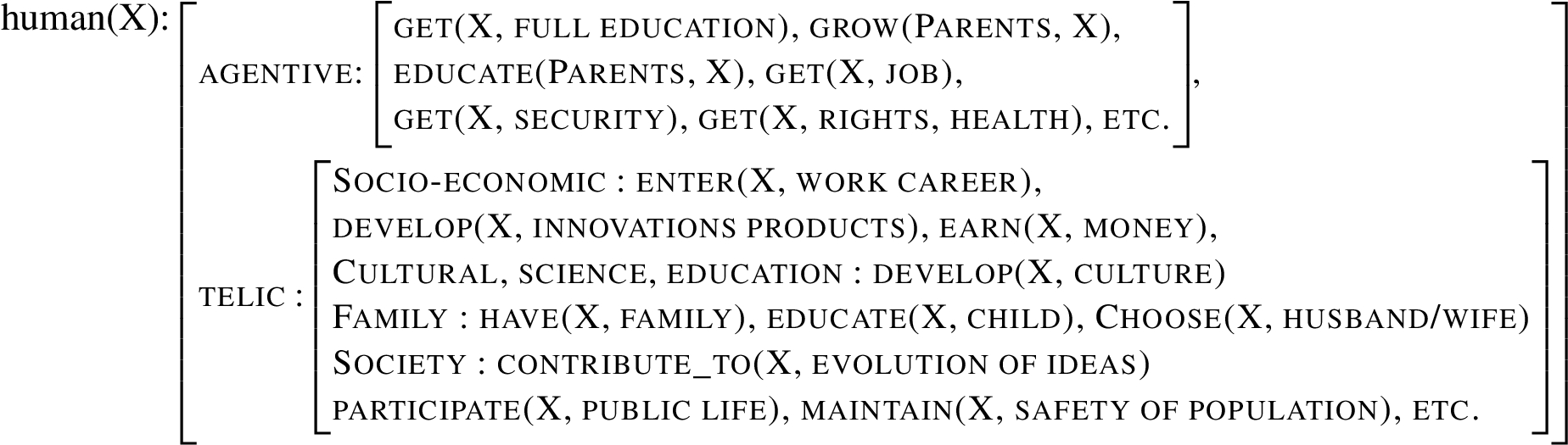
The agentive role develops the emergence of the citizen and the parent, e.g. via education. The telic describes the main roles humans play in these environments. This example, abstract and very generic, shows the limits of Qualias and also probably of most knowledge representation systems (Cyc, Sumo, etc.). However the level of granularity shown here seems to be sufficient for the purpose of argument mining.
For issue (3) the head term is the compound ‘nuclear plant’. Its Qualia can be summarized as follows:
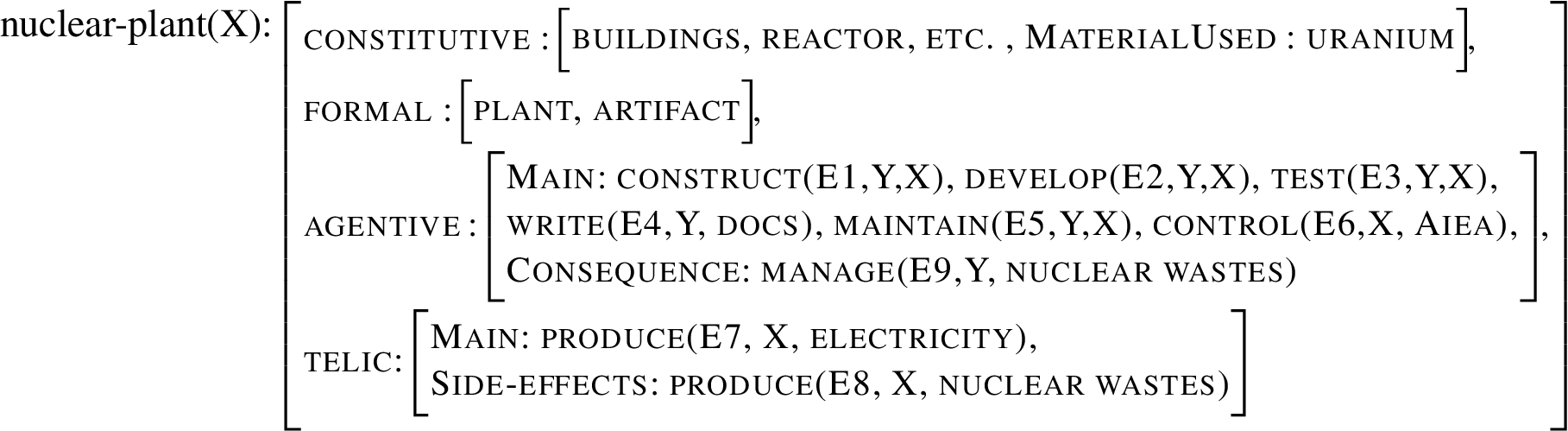
The events
Describing Qualias raises several feasibility problems since there is little data available. The problem of an automatic or semi-automatic acquisition of Qualias is addressed in e.g. [21], and to a lesser extent in [19]. While it is possible to encode Qualias manually, we feel that a bootstrapping method from corpora should enhance the process by providing a lot of data, which, however, needs to be organized by hand in a second stage. An interesting point is that, for a given issue, the knowledge that is required is not so large, as shown in Table 2. It seems that for an issue with a large scope, a maximum of 20 Qualias are needed to deal with most of the arguments. For the issues presented in this article, the number of required Qualias is given in Table 3, for the arguments that have been identified.
Estimate number of Qualia structures to identify the arguments
Estimate number of Qualia structures to identify the arguments
The number of Qualias for an issue in the corpus presented in Section 3 is on average 10. Some Qualias may be quite large while others are relatively sketchy. Some Qualias may be close to or inherit from others, e.g. vaccine and medicine. The number of Qualias may slightly change depending on how knowledge is structured, but the variation is quite limited and the number of concepts to include in the Qualias remains approximately constant. Table 3 shows that an average of 4 concepts are used per Qualia in our corpus.
Our observations show that arguments attack or support (1) specific concepts found in the Qualia of the head terms in the controversial issue (called
This network of Qualias forms the backbone of the argument mining system. This network develops the argumentative generative expansion of the controversial issue. This network is also the organization principle, expressed in terms of relatedness, that guides the generation of a synthesis where the different facets of the Qualias it contains are the structuring principles [13]. Natural language words or expressions that lexicalize each concepts can be associated with each network nodes.
Conclusion
In this contribution, we have presented a preliminary analysis of the different forms of knowledge which are frequently required to determine whether an utterance is an argument for or against a given controversial issue. The corpus analysis shows that more than 75% of the arguments that have been manually identified require some form of knowledge and inference to be accurately related to a controversial issue. A conceptual analysis shows that the Qualia structure of the GL is a useful knowledge and lexical representation approach that provides a conceptual organization which makes explicit the main topics used in arguments.
This analysis is exploratory and must be expanded in various directions before any development of a knowledge-driven argument mining system. A more detailed empirical analysis is necessary, with a larger corpus, several annotators, and annotation guidelines before concluding that the Qualia structure is the main resource that is needed and finalizing the extensions which are required. Similarly, the reasoning schemes which are proper to argumentation must be explored and modeled so that the knowledge described in the Qualias and the reasoning schemes can accurately be used to mine arguments.